Three gates, one crater lake, and a great deal of luck with the weather
Three gates, three ticketsBooked 7 days out, 18:00The lake shows 80–100 days a year1h53m from Shenyang
In short
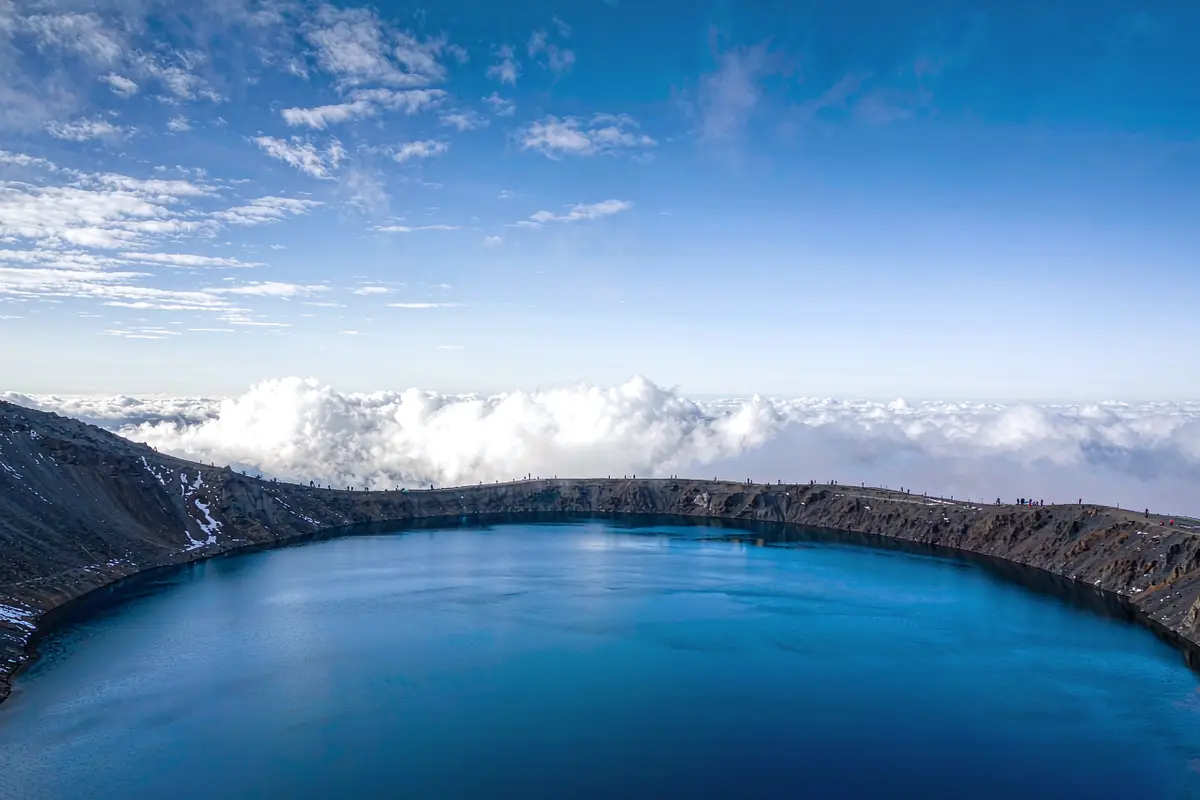
Mount Changbai (长白山, Chángbái Shān) sits in the far southeast of Jilin on the border with North Korea, and its summit holds Heaven Lake — a crater lake 2,189 m up, ringed by bare volcanic cliffs, and visible on perhaps one day in three. Its summit, Baitou Peak at 2,691 m, holds a flooded caldera called Heaven Lake (Tianchi): 2,189 m above sea level, 373 m deep, 9.82 square kilometres, the deepest lake in China. Three separate gates lead to it — the North, West and South Slopes — each with its own ticket, none connected, and you may enter only one per day. The North Slope is the easy one: ¥105 entry, ¥85 shuttle, ¥80 summit vehicle, plus ¥25 for the town-to-gate bus from Erdaobaihe, so ¥295 all in, and the vehicle drops you 200 m from the rim. The West Slope costs ¥190 and charges you 1,442 steps for the widest view of the water. The South Slope, also ¥190, opens in mid-May and admits 2,000 people a day, and puts you closest to the surface. Everything is real-name and online, released seven days ahead at 18:00; nothing is sold at the gate. Since the Shenyang–Baihe high-speed line opened in September 2025, Shenyang North to Changbaishan takes as little as 1h53m and Beijing Chaoyang 4h33m — the biggest change here in decades. The lake is clear on only 80 to 100 days a year, with the best odds from late September to early October. Three or four days is comfortable; with two you pick one slope. Budget ¥2,200–4,000 for three or four days, excluding travel to Jilin.
Comfortable on the North Slope; the West Slope means 1,442 steps
Best time to go
Late September to early October for the lake; July for the alpine garden; November to March for skiing
01One volcano, one lake, three gates
Start with the thing that confuses everybody: Mount Changbai is not a peak you walk up. It is a large stratovolcano whose summit collapsed into a basin, and the basin filled with water. The park sells that cone in three pieces — the North, West and South Slopes — each with its own gate, its own road and its own shuttle fleet. There is no trail between them and no bus either. Whichever ticket you hold decides which gate you enter, and which angle of the same lake you get.
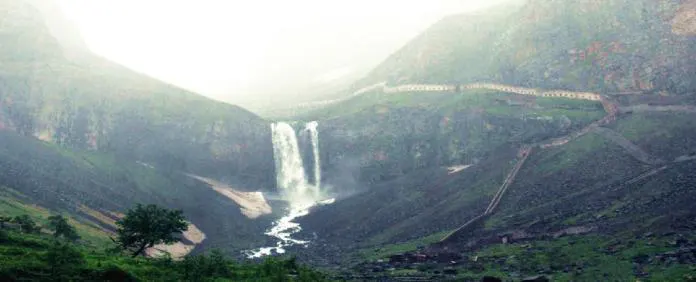
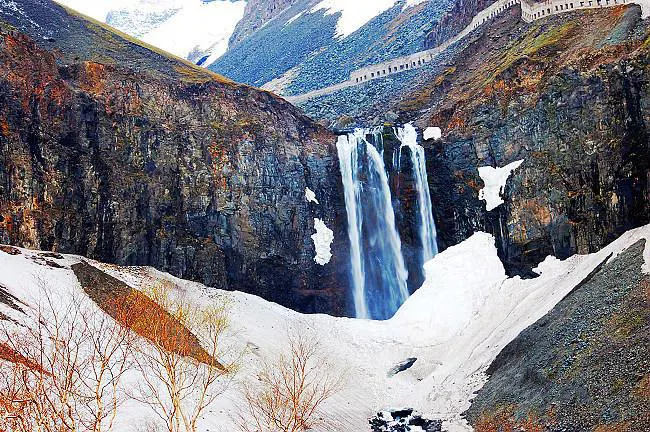
Heaven Lake is the deepest lake in China and half of it is in North Korea — the border runs across the water. The surface sits at 2,189 m, covers 9.82 square kilometres and reaches 373 m down. It has exactly one outlet: water spills through a notch on the north side, runs 1,250 m as the Shengcha River, and drops 68 m over a cliff as Changbai Waterfall. Below that it becomes the Erdaobaihe, and eventually the headwater of the Songhua River. The waterfall you see from the North Slope is the lake's only drain.
The division of labour is unusually clear. The North Slope is the lowest, the oldest and the densest: Heaven Lake, the waterfall, the hot springs, Luyuan Pool, Small Heaven Lake and the Underground Forest all sit on one road, with a bus between them — the only sane choice with children or older parents, and by far the busiest. The West Slope charges 1,442 steps and pays you back with an uninterrupted sweep of water, because there is no rock outcrop in the way; it also holds the alpine garden and the Jinjiang Grand Canyon, and in July the flowers beat the lake. The South Slope is the furthest, the most tightly capped and the shortest season, and it puts you almost directly above the surface — one for second visits and photographers.
Then there is the weather. The lake is clear on only 80 to 100 days a year; the rest of the time it is inside cloud, rain, snow or a wind strong enough to lean on. The park posts a decision each morning on whether the summit road opens, and closes it for wind, snow or ice — not out of fussiness. That 10.2 km road has a cliff on one side, and the gusts can put people on the ground. So plan for failure: give the North Slope your first clear day, keep a spare, and if the summit shuts, go and look at the waterfall, soak in a hot spring and eat an egg boiled in one. Do not stake the whole day on the water.
In the mountain of Buxian there is a pool called Tianchi, eighty li around, its water dark blue-green.
Liu Jianfeng, A Gazetteer of the Changbai Mountains, 1908
Finally, money and roads. The North Slope is ¥270 from the gate or ¥295 from the Chibei hub in Erdaobaihe, the extra ¥25 being the town bus. The West Slope is ¥190 from its gate, ¥209 from the Chixi hub. The South Slope is ¥190. Tickets and bus seats are valid for one entry on one day — no re-entry, no reuse, no crossing between slopes. And the stations are in two different towns: Changbaishan Railway Station serves Erdaobaihe and the North Slope, Changbaishan West Railway Station serves Songjianghe, the West Slope and the Wanda resort. Buy the wrong one and you have a forty-kilometre mistake.
02Six things worth rearranging the trip for
Heaven Lake from the north rimA bowl of near-black blue
The summit bus grinds up 10.2 km of switchbacks for twenty minutes and stops on a scree shoulder; two hundred metres on foot and the lake is simply below you. The first shock is scale: over four kilometres across, ringed by cliffs two and three hundred metres high, with people standing on the rim of a bowl. On a clear day the water is a blue so deep it reads black, and cloud shadows slide across it in patches of light and dark. In fog there is nothing at all but wind. The north view loses its southwest corner to a rock outcrop — the one thing the West Slope does better — but the steps you save are worth it.
Altitude:2,189 m at the water, about 2,470 m at the rim
Cost:¥105 entry + ¥85 shuttle + ¥80 summit bus
Odds:80–100 days a year; best late September to early October
Changbai Waterfall and the Julong springsThe lake's only drain
Coming down from the summit, the shuttle stops at mid-mountain and ten minutes of boardwalk brings the noise before the sight. The fall drops 68 m, split into two strands by the lip, into a pool more than twenty metres deep; when the wind turns, spray crosses the walkway and wets your jacket. Nine hundred metres downstream is Julong: a thousand square metres holding a hundred vents, the hottest at 82.3°C, with a faint sulphur smell and rock stained red-brown, emerald and ochre by the minerals. The thing to do here costs ¥10 for three hot-spring eggs, the white barely set, the yolk still running.
Drop:68 m, into a pool over 20 m deep
Time:40 minutes at the fall, an hour with the springs
Eat:Hot-spring eggs, ¥10 for three
Luyuan Pool: the photogenic oneGreen, full of fish, three metres from the path
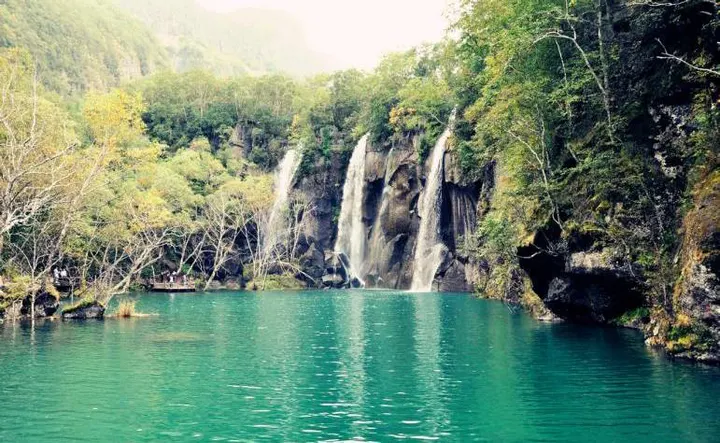
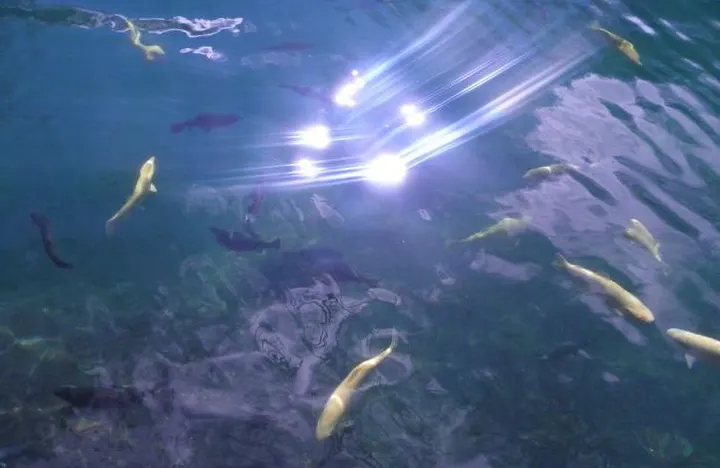
A pool smaller than half a football pitch, fed by several thin threads of water dropping off a black wall, the colour an implausible peacock green with fish visible between the stones in the shallows. It sits three metres from the boardwalk, which is why it photographs so well and why there is always somebody in front of it. Side light around 10:00 saturates the colour; at midday it goes flat and pale. It is ten minutes from the waterfall and most people treat it as a footnote — in fact, after the lake, it is the twenty minutes best spent on the North Slope.
Light:Best 09:30–11:00; flat and pale at midday
Where:Below Small Heaven Lake, right on the boardwalk
The Underground Forest: walk down and the sound changesThe lowest point in the park
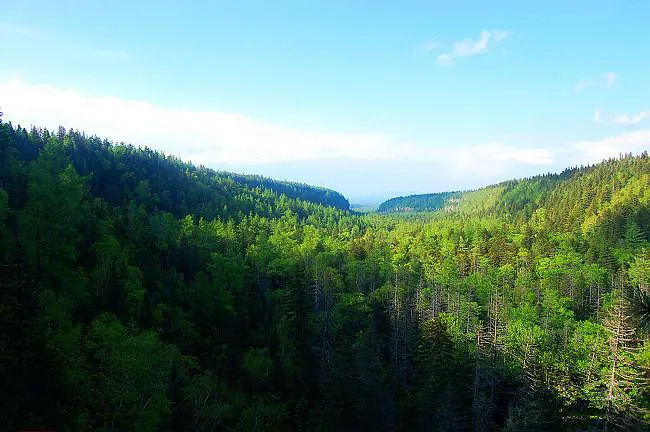
The name oversells it: this is a collapsed volcanic valley. From the rim the primary forest spreads out below you, spruce and fir crowns packed into a single layer that runs to the haze. Take the stone steps down and the light drops away, the floor is deep in moss and needles, and you can hear the Baihe running between the rocks. Forty minutes round trip; the slope is gentle but the steps are wet, and sandals are a mistake here. It is the North Slope's only attraction with no view — which makes it the right place when the summit is shut or the queues have stopped moving.
Round trip:40 minutes, steps throughout
Footwear:Grippy shoes; the floor is permanently damp
The West Slope alpine garden: one slope of flowers in JulyThree weeks of bloom
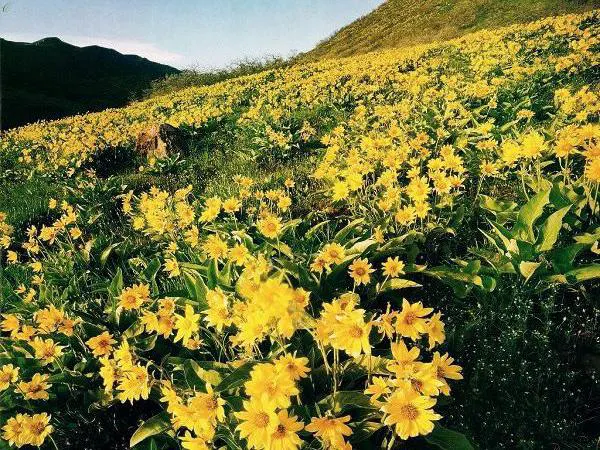
On the tundra belt at around 2,000 m, dozens of species flower at once in July: irises, veratrum, globeflowers, ligularia, in sheets of yellow, purple and white, with dwarf birch and creeping pine in between. Boardwalks keep everyone on the planks — not a restriction so much as the reason the flowers come back. Peak bloom runs roughly mid-July to early August and shifts by a week or two each year, so check the park notice. After mid-August it is over and you are looking at grass.
Bloom:Mid-July to early August
Cost:¥190 on the West Slope, plus 1,442 steps for the lake
Jinjiang Grand Canyon: volcanic ash cut openA seventy-kilometre tear
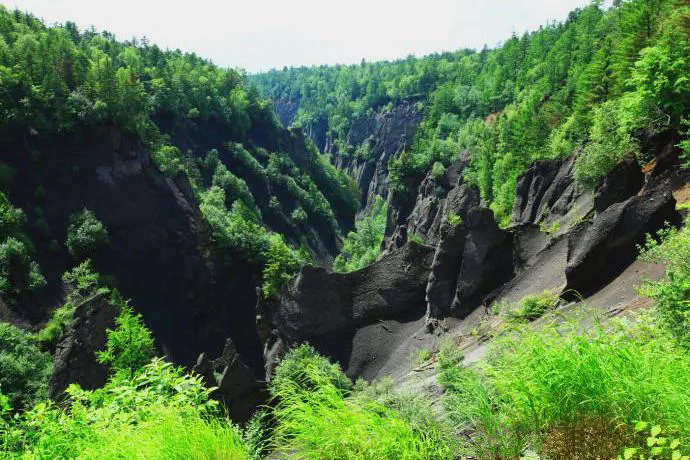
The most underrated stop on the West Slope. The canyon is a rift left by the eruptions, with the Jinjiang cutting through it; the walls are tens of metres of black volcanic rock and pale pumice, frost-shattered into columns and sheets, with intact conifer forest on top. The boardwalk follows the rim and shows you fragments — most of the floor is unreachable. After 15:00 the light rakes in and the walls separate into layers; at midday it is a black smear. It is windy, so hold on to your hat.
Scale:About 70 km long, up to 300 m wide
Light:After 15:00, when the walls gain depth
03Seven questions to settle before you book
North Slope or West Slope — which one for a first visit?
The North Slope, unless you are coming specifically to photograph. It costs ¥80 more for the summit vehicle, but that vehicle drives to the top and leaves you 200 m from the rim, which puts it within reach of children, grandparents and bad knees. It also has the waterfall, the hot springs, Luyuan Pool, Small Heaven Lake and the Underground Forest on the same road, so a closed summit does not waste the day. The West Slope saves you ¥80 and charges 1,442 steps — forty minutes of climbing at 2,400 m, no cable car, no sedan chair — and the view from the top is genuinely wider, with the southwest corner unobstructed. So: parents, small children, one visit, two days — North. Fit, photographically minded, willing to climb for a panorama — West. If you want both, stay two nights, do one slope a day, and switch stations by train in 30 to 40 minutes.
How many days do I need, and what does two days look like?
Three days is the natural shape; two works; one day covers a single slope. The standard two-day version: arrive by late morning, spend the afternoon in Erdaobaihe buying food for the next day and go to bed early; then give the whole of day two to the North Slope, at the hub before 07:00, summit first, then the waterfall, springs, Luyuan Pool, out by about 16:00. That way you gamble on the weather once. With three days, add the West Slope or the Wanda resort: North on day two, West (the steps) or a ski day on day three, leave on the morning of day four. Four days lets you add Mojie for rime in winter or the South Slope between mid-May and October. And if you have exactly one day, do not attempt both slopes: the gates are a hundred kilometres apart, each ticket is valid for one day only, and it cannot be done.
What if the lake is closed or socked in?
Separate two situations. If the summit road is closed for wind, snow or ice, the buses stop running and you get money back — the summit ticket is refundable that day and the gate ticket follows the park's notice. Do not argue at the gate; do it in the mini-program. If the road is open but you arrive inside a cloud, which is far more common, there is nothing to do but wait. Summit cloud moves fast and a lot of people get their window in twenty to forty minutes; bring a windproof layer rather than standing at the rim and shivering. If it never clears, the North Slope still has the waterfall, the springs, Luyuan Pool, Small Heaven Lake and the Underground Forest — a full day — and the Julong hot springs in the evening deal with the disappointment. If tomorrow is also grey, switch to the West Slope rather than trying the North again: the two sides do not share weather, and the West is in the lee, so it sometimes opens when the North is shut.
Can I go up in winter, and is a frozen lake worth it?
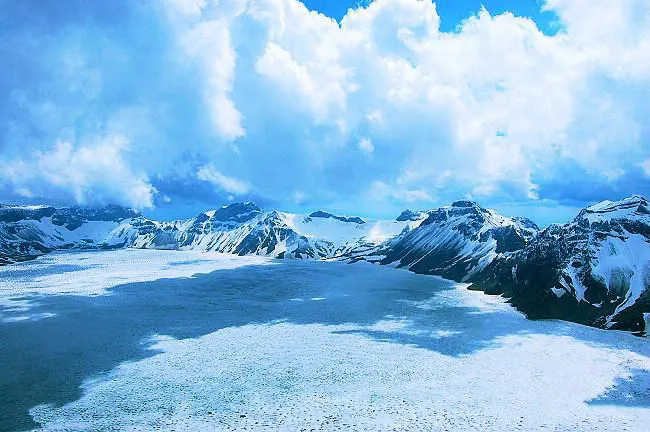
Yes — the North and West Slopes run all year, but winter is a different rulebook. The summit road closes often for snow and ice, the buses become tracked vehicles, hours shrink to roughly 08:30–15:30, and whether you get up is decided that morning. If you do, the lake is a single sheet of white-blue ice with snow along the shore and wind combing patterns across it, which is a different place from the summer lake and, by many people's judgement, a better one. The price is cold: minus twenty-five to minus thirty-five on the summit, and with wind, a phone dies in two minutes and camera batteries have to live in an inside pocket. The South Slope is shut. For skiing, the Wanda season usually opens in late November and runs to the end of March; the 2026-27 season is scheduled to start on 21 November.
Should I stay in Erdaobaihe or at the Wanda resort?
Depends what you came for. For the lake and the North Slope, stay in Erdaobaihe: the town is ten minutes from the Chibei hub, a 06:30 start catches the first buses, food is cheap and plentiful, and a double runs a little over ¥200 low season and ¥500–600 in the peak. For skiing, children and hot springs, stay at Wanda: the resort sits in Songjianghe, thirteen to eighteen kilometres from Changbaishan West station, rooms start around ¥1,300 in season but include lift tickets, the hot spring, the water park and transfers, so the total is not necessarily worse; the snow is outside the door and no child spends two hours in a bus. The third option is Songjianghe town or the Chixi area at ¥150–350, six kilometres from the West gate, for anyone on a budget doing the West Slope. The one combination to avoid is sleeping at Wanda and doing the North Slope — ninety minutes each way, three hours of the best light spent on the road.
Which station — Changbaishan or Changbaishan West?
Two stations, two directions. Changbaishan Railway Station is in Erdaobaihe: nine kilometres to the Chibei hub, then a ¥25 bus for twenty-nine kilometres to the North gate — this is the North Slope station. From Shenyang North it is as little as 1h53m, ¥241–292 in second class; Changchun a little over two hours at ¥132; Beijing Chaoyang 4h33m. Changbaishan West Railway Station is in Songjianghe, on the Shenyang–Baihe line: seven kilometres to the Chixi hub, six and a half to the West gate, thirteen to eighteen to Wanda — the West Slope and ski station, 1h39m from Shenyang North. About ten trains a day link the two in 30 to 40 minutes for around ¥10, so entering at one and leaving from the other works fine. There is also Baihe station, the old conventional-rail stop in Erdaobaihe itself: few trains, long runs, and only worth it if you specifically want the slow train.
Can older parents or young children get to the summit?
On the North Slope, yes, and it is easier than most Chinese mountains: shuttle to mid-mountain, summit bus to the car park, then 200 m of gentle gravel with no steps. You gain from 1,700 m to 2,500 m quickly, but the stay is short and most people feel nothing; anyone with heart disease or poorly controlled blood pressure should ask a doctor first. Three practical notes: the summit is ten degrees colder and windy, so bring a shell for the children; there are no toilets up there, so go before you board; and the summit vehicle is a twenty-odd-seat minibus on a road of constant hairpins, so anyone prone to motion sickness should take something beforehand. The West Slope is not suitable for older parents or small children — 1,442 steps with no landings, and carrying a child is not realistic. The South Slope is a long drive and not one for kids either.
04Three days flows; two days gambles once
One constraint shapes everything here: three slopes, three tickets, valid for the day, one per day. So the question is not how much you can see but which day has the best odds for the thing you most want. The three-day plan below is for a first visit: arrive and settle, give day two to the North Slope (best facilities, and somewhere to go if the weather turns), then the West Slope or Wanda on day three before leaving that evening or staying on.
D1
Arrive at Changbaishan station around midday and take the nine-kilometre shuttle into Erdaobaihe. Do not attempt a slope this afternoon: walk the town along the Erdaobaihe, look at the red pines, and spend an hour in the Changbai Natural History Museum (¥40) learning the volcano and the vegetation belts — better before you go up than after. Eat cold noodles or an iron-pot stew in the evening, buy bread, chocolate and hot water for tomorrow, and sleep near the Chibei hub so that 06:30 is possible.
D2
At 06:30 be at the Chibei hub, take the bus twenty-nine kilometres to the North gate, switch to the park shuttle for mid-mountain, and buy the summit vehicle first. Order matters: put the lake first, because morning is when the cloud most often lifts and because summit tickets can sell out by afternoon. Come down at 10:30 for Changbai Waterfall and the Julong springs, and eat the hot-spring eggs; lunch is whatever you brought, at the waterfall service area. In the afternoon take Luyuan Pool, Small Heaven Lake and the Underground Forest in that order, twenty to forty minutes each, and be out of the gate by 16:00. In the evening, the Julong hot springs, ¥238, open from 13:30.
D3
Pick one. For the West Slope: leave bags at the hotel, head for the Chixi hub, climb the 1,442 steps to the lake first (forty minutes), then take the shuttle to the Jinjiang Grand Canyon and Ladder River, adding the alpine garden if it is July. Five to six hours. For skiing: go straight to Wanda, rent, buy a pass, ski until 15:00, soak at the Hanal-san hot spring, and board at Changbaishan West. Both end in the late afternoon with time for an evening high-speed train to Shenyang or Changchun.
D4
With a spare day: in winter, Mojie for rime between 06:30 and 08:30, fifteen minutes by taxi from Erdaobaihe; in summer, the Jinjiang wooden-house village or Neyin ancient town, either in half a day. Or arrange nothing, sleep in, buy some mountain produce and leave. An over-scheduled Changbai itinerary is the one thing that ruins itself the moment the weather turns.
05Slope by slope
The North Slope: one road, everything on it
The North Slope runs like this: gate, shuttle for about eighteen minutes, mid-mountain interchange, then either the summit vehicle or the walk to the waterfall. Every sight branches off that spine, so there is only one correct order: summit first, then work downhill. People who do it the other way round tend to be standing in the summit queue at 14:00 watching the tickets sell out.
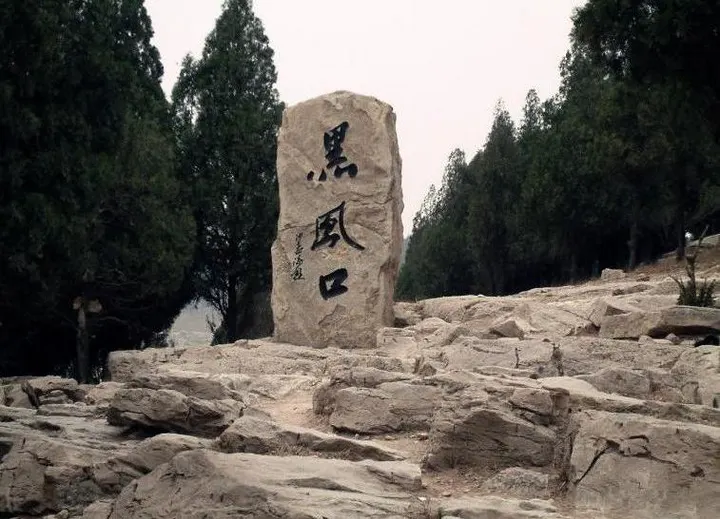
The Heifengkou stele: one rough stone, two characters, dwarf pine and scree around it
Walking down from the summit towards the waterfall you pass Heifengkou, a notch on the east shoulder of Bulao Peak that is windy most of the year; at force five people cannot stand and shuffle through crouched. It is famous because the gap gives you the whole of Changbai Waterfall and the Erdaobaihe valley in one frame. How windy is it? Every tree beside the boardwalk leans the same way. Skip it if you are short of time; if you are carrying a camera, wait for a lull.
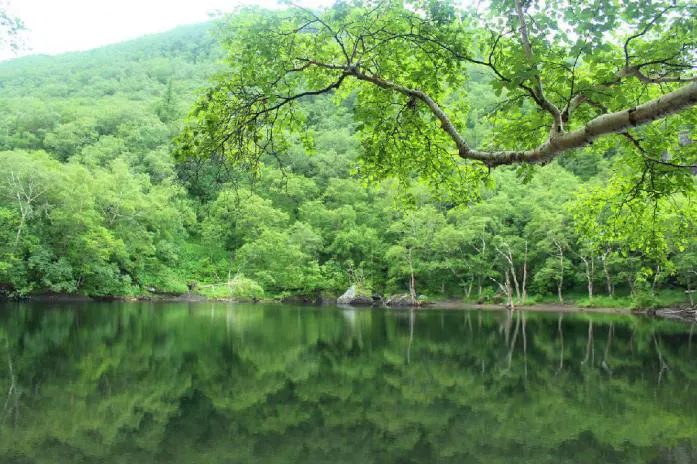
Below the waterfall are the two waters people walk past. Luyuan Pool sits in a hollow of the birch belt, several thin streams dropping side by side off a black wall into water so green it looks lit from beneath; in the shallows you can see fish moving against the light — rainbow trout stocked by the park, and the water is clear enough that they seem to hang in air. Twenty minutes on is Small Heaven Lake, a basin with no obvious inlet or outlet, ringed by broadleaf forest, and on a windless morning the reflection is so complete that the far bank appears to grow underwater.
Small Heaven Lake on a still morning — the far bank sunk whole into the water, one branch across the top of the frameThe shallows at Luyuan Pool, fish crossing a shaft of sunlight
The Underground Forest is the only North Slope sight you descend into: stone steps down from the rim to a floor of moss and needles, the Baihe running under the rocks, the canopy closing to a slit overhead. There is no viewing platform and no interpretive panel; the forest is the exhibit, and the air is thick enough with oxygen to make you slightly giddy. Forty minutes round trip, and the steps are permanently wet — trainers, not sandals.
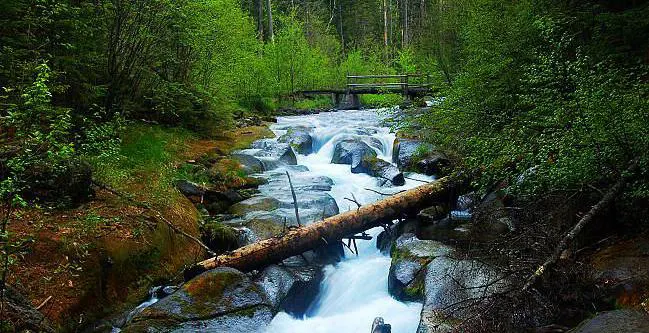
The stream on the valley floor, a fallen trunk across it and a wooden footbridge upstream
The West Slope: steps, flowers and a canyon
The West gate is on the Songjianghe side. A shuttle takes you to the foot of the stairs, and then come the 1,442. They are composite timber, wide and shallow, with a landing every two hundred; forty minutes at a normal pace, and three stops makes it comfortable. You climb from 2,200 m to 2,400 m, which is not high, but the gain is concentrated, so anyone with a heart condition should not force it. At the top the ground opens out towards the border marker and the lake lies flat in front of you with no rock in the way — which is the entire reason the West Slope exists.
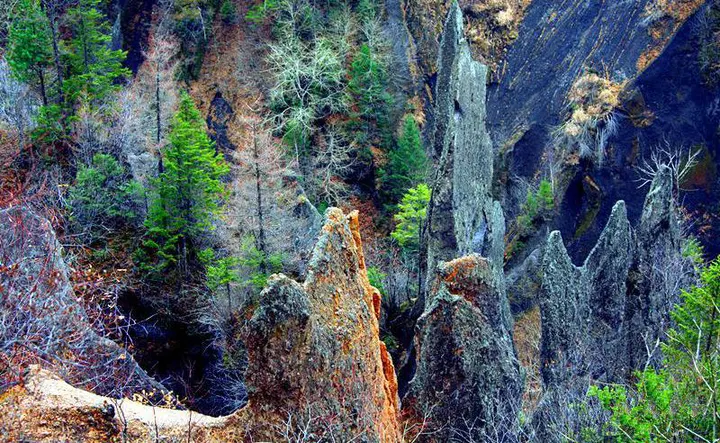
Back down, the shuttle runs towards the canyon and passes the Ladder River. It is an odd thing: a channel two metres wide and tens of metres deep, roofed over by vegetation and boulders, so from the road you hear water and see none of it — locals call it the underground river. The bus stops for five minutes; take the photograph, but do not expect a mighty river. Beyond is the Jinjiang Grand Canyon, where the boardwalk follows the rim and the walls show columns, spires and sheets of rock frost-shattered into castles, figures and animals, depending entirely on your imagination.
Volcanic spires in the canyon, standing under the conifers, some with trees still on top
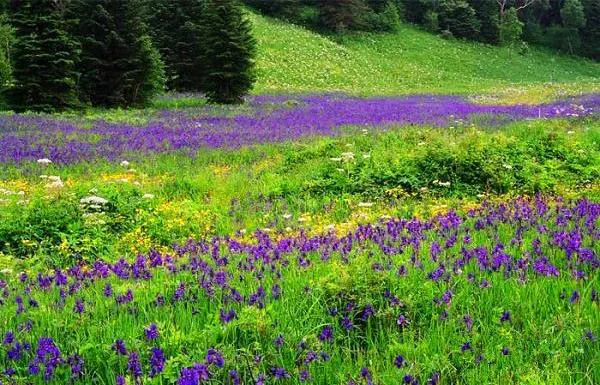
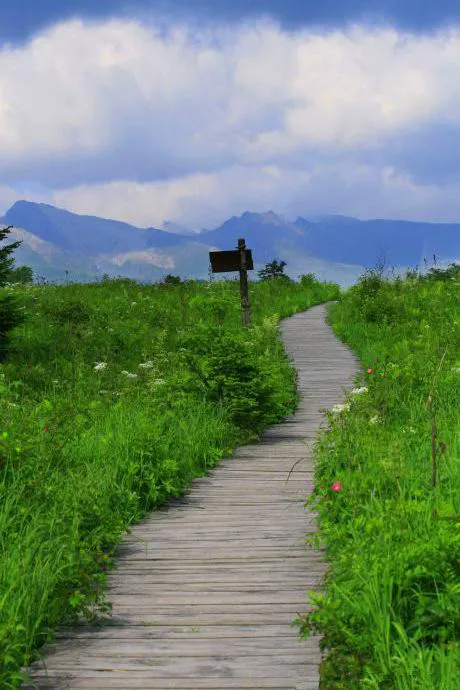
In July the West Slope adds two flower fields. The iris garden sits by the Ladder River at about 1,400 m, where Siberian iris opens in sheets of blue-violet, each flower shaped like a spread butterfly, from June into July. The alpine garden is higher, on the tundra, with more species and more ground; the boardwalk runs through the middle of it and a wooden sign stands at the far end, with the summit ridge visible above the cloud on a good day. Peak dates drift by a week or two each year; mid-July is the safest bet.
The iris garden in June — a whole slope of blue-violet with spruce behindThe boardwalk through the alpine garden, a wooden sign at the end and the summit ridge beyond
The South Slope: fewest people, closest water
The South Slope is up towards Changbai County, about three hours from Erdaobaihe and over two from Songjianghe, the furthest of the three. It opens in mid-May, earlier or later depending on the snow, and admits 2,000 people a day, so it feels close to private: the shuttle runs up the upper Yalu, with North Korea on the far bank for much of the way. Three hundred metres on foot puts you at the lake edge — the only one of the three where you look across the water rather than down at it.
The second reason to come is the Yalu Grand Canyon: ten kilometres long, two hundred wide, a hundred and seventy deep, its walls of lava and tephra eroded over centuries into towers, columns and spires that read as a row of abandoned castles. There is also Twin Birch Falls and the Gutouhe alpine wetland, a peat bog at altitude that flowers in summer and requires the boardwalk — step off and you are in water.
The birch belt: the toughest line on the mountain
Between 1,800 and 2,100 m the broadleaf trees give up and only Erman's birch remains: no height, every trunk leaning downwind and almost flat to the ground, as if pressed there. It is not disease but wind — buds on the exposed side are scoured off by ice particles in winter, only the sheltered side survives, and after decades the whole stand lies in one direction. The floor beneath is bright and damp, and the protected herb known locally as the herb of no ageing parasitises alder roots there. Look, do not dig.
06What else there is to do
Hot springs: from an 82-degree vent to a 40-degree pool
Julong inside the park is for looking at: vents, steam, mineral-stained rock, and three eggs for ¥10. For soaking you go to the Julong volcanic hot spring four hundred metres outside the old gate, where thirty-one pools are scattered through the trees at 38 to 42 degrees. Sitting outdoors at minus twenty with frost in your hair and steam coming off the surface is the best-value hour on the mountain. ¥238, ¥119 for children, open 13:30 to 23:00 with last entry at 21:30. Bring a swimsuit; buying one there costs double.
Skiing: the Wanda season
Wanda sits in Songjianghe with more than thirty runs from beginner to advanced, lifts and magic carpets kept separate so that beginners are not mown down by people off the top. The season usually runs from late November to the end of March, and 2026-27 opens on 21 November. With your own board: ¥68 for four hours on a weekday, ¥128 for a full day, ¥98 and ¥198 at weekends, ¥298 on public holidays; with rental, ¥168 and ¥228. Staying at a resort hotel gets you one ski session, one hot-spring entry and one water-park visit per night, with rooms from about ¥1,300 — for two people that usually beats buying separately. Night skiing opens in mid-to-late December, and you choose day or night, not both.
Two winter things: rime and ice
Changbai Waterfall in early winter, the water still running, snow already at the foot of the cliff
Mojie, the magic world, is a stretch of river north of Erdaobaihe that never freezes: the water holds at three or four degrees, and on a minus-twenty morning the vapour condenses as rime on every branch along both banks, then turns to rain the moment the sun clears the ridge. The window is 06:30 to 08:30, and the half hour around sunrise is the reason to come; by nine it is over. Entry is ¥98, rafting packages ¥158–258 for forty minutes on the water, cold enough to kill a phone and worth it anyway. It is a private operation, so prices and hours shift each year — check before you go.
Heaven Lake under ice — one sheet of white-blue, snow banked along the shore
The winter lake is a different sight. It freezes from December to June, the ice up to three metres thick, and on a clear day it is a single sheet of white-blue with the wind combing parallel lines across the snow. The North Slope stays open, but the summit road often closes for snow and the buses become tracked vehicles; whether you get up is a morning decision. The real problem is cold: minus thirty on top, a phone dead in two minutes, camera batteries worn against the body, and a shutter that feels like pressing wood.
Boardwalks, horses and rafts
A boardwalk through knee-high meadow, cloud shadow moving across it
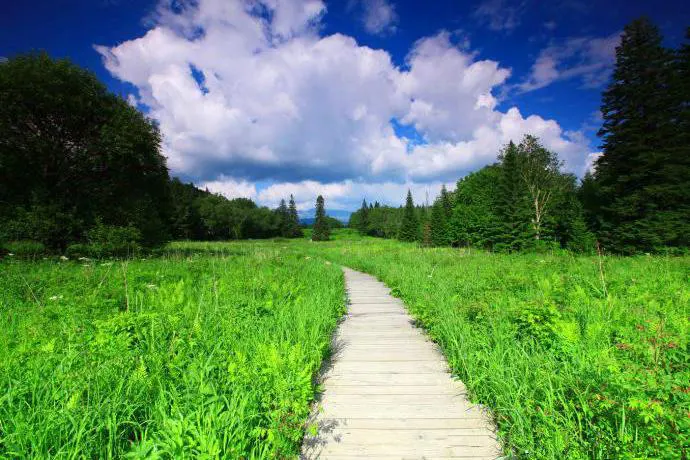
The boardwalks here are more restrained than most: low to the ground, turning with the terrain, and in the flower fields actually elevated so that you walk above the blooms rather than through them. In summer the town also sells forest rides on horseback (roughly ¥100–350 depending on distance) and rafting on the Erdaobaihe (¥80–120) — worth an hour if you have one, no loss if you do not. With children, the reindeer park at ¥30 will be remembered longer than the lake.
07Choose the slope first, then the town
Accommodation here is not a question of which hotel but of which town. Three choices: Erdaobaihe for the North Slope, Songjianghe and the Chixi area for the West, and the Wanda resort for the West plus skiing. Book the wrong town and you add one to two hours of driving to a morning that already starts at 06:30.
Erdaobaihe (Chibei): the only sensible base for the North Slope. Ten minutes to the Chibei hub, where the park buses leave. Chain hotels and guesthouses, ¥200–400 a double in low season, ¥500–900 in July, August and over National Day, more again around Spring Festival. Ask how far the hotel is from the hub rather than how many stars it has.
Songjianghe and Chixi: the West Slope base. Songjianghe is six kilometres from the West gate and seven from Changbaishan West station, with doubles at ¥150–350, plain rooms and cheap food. Chixi is the resort's outer ring, newer hotels, twenty minutes by taxi to Wanda.
Wanda International Resort: from about ¥1,300 in season, including lift ticket, hot spring, water park and transfers; roughly half that outside the snow season. The choice for skiers, families and anyone who does not want to think about transport. The drawback is ninety-five kilometres to the North Slope, ninety minutes each way.
Up on the mountain: the old athletes' village inside the North Slope gate now mainly takes teams and groups, with unreliable availability for individuals and no price advantage. Unless you specifically want to be at the waterfall before dawn, there is no reason.
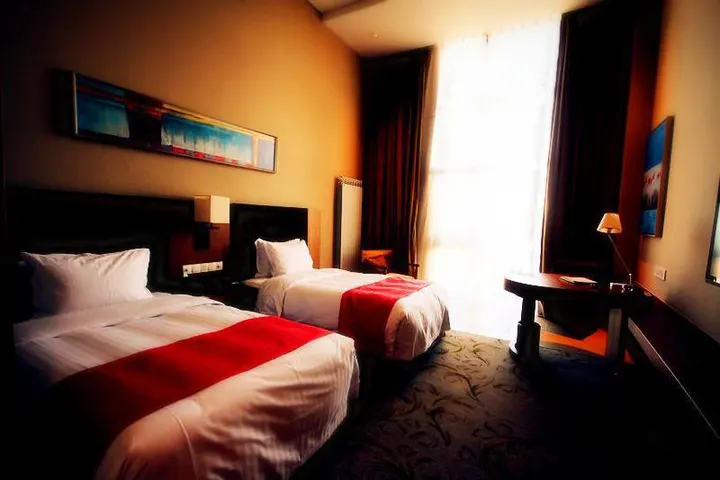
A standard town double: two beds, a small round table, warm light, not large but enough
Two notes. Heating: indoors it is 25 degrees while outside is minus 25, and walking around in a T-shirt is normal; but most hotels have no air conditioning, so July and August rooms are stuffy — ask. And transfers: guesthouses in Erdaobaihe routinely collect from Changbaishan station nine kilometres away, but many that advertise pickup mean the station and not the airport, which is 120 kilometres off. Name the station when you book.
08Eggs on the mountain, cold noodles in town
Food inside the park follows one logic: hot, fast, filling. Mid-mountain and the waterfall service area sell boxed meals, instant noodles, sausages and corn at two to three times town prices, and nobody is there for the flavour. The only two things worth money up there are the hot-spring eggs and a cup of hot water. So the standard move is to buy bread, braised eggs, chocolate and fruit in Erdaobaihe the night before and eat sitting on a sheltered step at midday; outside food is fine, litter is not.
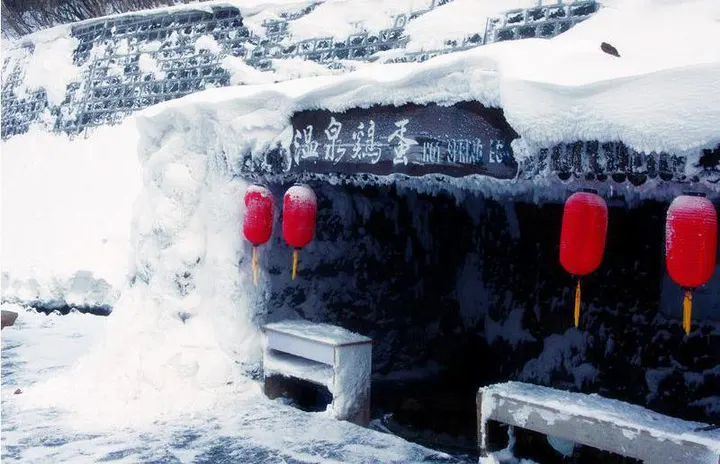
The hot-spring egg stall, snow on the eaves, four red lanterns, the sign half-frozen
The method is blunt: eggs in a wire basket, lowered into an eighty-degree vent, out after fifteen to twenty minutes. The white comes out barely set, like soft tofu, the yolk still running, with a faint sulphur note. Three for ¥10, the most famous thing to eat on the mountain and the only one that has to be eaten standing there, because it is finished once it cools.
The Korean-Chinese half
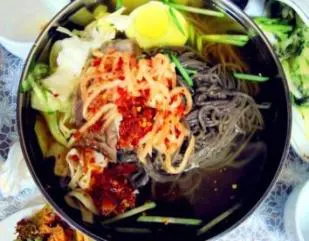
Eating here is two systems on top of each other: northeastern cooking for volume, Korean-Chinese cooking for flavour. Cold noodles are the most exacting of the second — buckwheat pressed to order, the broth served ice-cold, topped with beef, pear, cucumber, half an egg and a spoon of chilli paste, so that sour, sweet and hot arrive at once. Bibimbap should be mixed while the stone bowl is still ticking; the crust at the bottom is the point. Then there is rice cake pounded in a wooden trough and dipped in bean flour, kimchi, bean-paste soup and rice sausage.
Buckwheat cold noodles, chilli paste on top, iced broth, black bowl
The northeastern half
Iron-pot stew is the social food of the region: ribs or goose in the pot with pickled cabbage, glass noodles and potato, corn cakes stuck around the rim, the whole thing brought to the table twenty minutes later, one pot feeding four. Guobao rou is the test of any northeastern kitchen — crisp shell, sauce that clings, sweet-sour without cloying. Chicken stewed with hazel mushrooms uses local dried fungi and comes out thicker than you expect. Watch the portions: one plate here equals two in the south, and two dishes is enough for two people.
Where: Erdaobaihe's Baishan and Tianchi streets have the densest cluster, ¥40–60 a head for a good meal; Songjianghe is cheaper at ¥30–50. Wanda has more choice at double the price, with buffets around ¥150. One local note: a number of town restaurants advertise dog-meat soup, a Korean-Chinese tradition that is now controversial and rarely what visitors come for; skipping it costs you nothing.
09Buy the food, be careful with the medicine
This is the home of the old northeastern three treasures, which is why mountain-produce shops are everywhere and why the traps are everywhere with them. One rule covers it: buy what you can recognise and judge for yourself, and leave anything that needs an expert to authenticate.
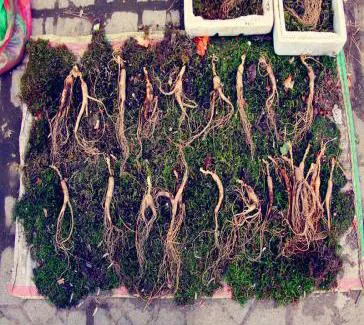
Ginseng at a market stall, roots laid on damp moss to keep them fresh, dried bracket fungus beside them
Ginseng: plantation root and wild root differ in price by a factor of fifty. Plantation ginseng runs from about ¥50 to ¥300 a root and is what most visitors should buy. Anything labelled wild or forest-grown starts in the thousands, and without experience you should not be in that conversation — nor should you agree to have it sliced or ground on the spot, because once it is powder you can never check it again.
Bracket fungus, wood ear, hazel mushrooms, pine nuts and dried blueberries: the safe purchases. Check wood ear for a white bloom on the back and a crisp snap; buy open pine nuts and taste one for rancidity; choose blueberries that are dark and matte, since the shiny ones have usually been glazed in syrup.
Korean-Chinese chilli paste, dried pollack and rice wine: available in town supermarkets and the wet market at about thirty per cent less than the souvenir shops by the gate, and in plainer packaging. Buy the paste in small jars and refrigerate it once opened.
Honey, especially linden honey: genuinely good here and genuinely faked. Buy sealed jars with an origin and a test report rather than loose honey supposedly spun in front of you at the roadside.
Four things to leave alone: any wildlife product, whether bear bile, deer penis or frog fat, which is illegal and of no reliable origin; protected plants sold as longevity herbs, which do not come back once dug; anything at the gate described as blessed; and herbs priced by the gram, because the quote is per gram and the bill arrives per fifty — the oldest trick in the market. If you actually want medicine, buy it in a proper pharmacy in Changchun or Shenyang.
10Two stations, three gates, one road you cannot walk
High-speed rail: the fastest way in since 2025
The Shenyang–Baihe high-speed line opened on 28 September 2025 and plugged Changbai into the national network: Shenyang North to Changbaishan station in as little as 1h53m for ¥241–292 in second class, or 1h39m to Changbaishan West. Changchun to Changbaishan runs a little over two hours for ¥132. Beijing Chaoyang is 4h33m direct. Sixty-four services a day ran at opening, morning through evening. The earlier Dunhua–Baihe line, open since 2021, comes in via Changchun, Dunhua and Erdaobaihe and is equally busy; when booking, check whether the destination is Changbaishan or Changbaishan West.
Changbaishan station is in Erdaobaihe: nine kilometres to the Chibei hub, where a ¥25 bus covers the twenty-nine kilometres to the old North gate in thirty-five minutes; a taxi into town is ten minutes and about ¥20. Changbaishan West station is in Songjianghe: seven kilometres to the Chixi hub, six and a half to the West gate, thirteen to eighteen to Wanda, with a free resort shuttle and taxis outside. About ten trains a day link the two in 30 to 40 minutes for around ¥10, so entering at one and leaving from the other works and costs half a chartered car; a taxi straight from Changbaishan station to Songjianghe or Wanda is ninety kilometres, ninety minutes and ¥400 or so, which is worse than changing trains.
Flying: the airport is on the west side
Changbaishan Airport (NBS) sits in Songjianghe, Fusong County: about fifteen kilometres from the West gate, eighteen from Wanda, a hundred and twenty from the North Slope. In 2026 it has direct flights from Beijing, Shanghai, Tianjin, Xi'an, Changchun, Dalian and Harbin, with more in winter. The resort runs a free shuttle timed to arrivals; there is no direct bus to Erdaobaihe, and a chartered car is ¥300–400 for ninety minutes. If you are heading for the North Slope, flying saves nothing once you add the two-hour drive.
Inside the park: three legs, none optional
The park is closed to private cars, which stop outside the gate. A North Slope day is three legs: hub to gate (¥25), gate to sights (¥85, unlimited for the day), and mid-mountain to summit (¥80). That last one runs 10.2 km of dedicated park road with constant bends and steep grades, walking is not permitted, and without a ticket you do not go up — the most commonly forgotten ticket, and people discover it is sold out when they reach mid-mountain. The West Slope is two legs, a ¥19 or ¥9 connection plus the ¥85 shuttle, with your legs doing the final climb. The South Slope is the ¥85 shuttle only.
Chartered cars and driving
A chartered car from Erdaobaihe to the North gate is ¥100–150 one way, about ¥300 for a day's round trip; the West Slope is ninety minutes each way from ¥400. There are licensed taxis and ride-hailing in town, and there are also touts at the station offering low fares that become higher halfway or detour via a shop — decline. Driving yourself: Changchun–Dunhua–Erdaobaihe is about 480 km and six hours, Shenyang–Tonghua–Baishan–Songjianghe about 500 km and seven, much easier since the expressways opened, but winter tyres are mandatory in the snow season and the mountain roads are all bends; without ice-driving experience, do not do it at night.
Check trains and fares from Shenyang to Changbaishan
Tickets: official channels only — the Changbaishan WeChat account, the Changbaishan mini-program and the Changbaishan One-Trip mini-program. Released seven days ahead at 18:00 each evening, with a waiting list once sold out; cancellations are pushed straight to that queue. There is no ticket window at the gate, and nobody selling guaranteed tickets through a third party is telling the truth.
Limits: within seven days one ID may buy one package for one of the three slopes, and one slope per date. That makes the plan of North in the morning and West in the afternoon impossible at the system level. To switch, you must first refund or first pass through a gate.
Capacity: 40,000 a day in total, split 25,000 for the North Slope, 13,000 for the West and 2,000 for the South. National Day, Spring Festival and July weekends routinely sell out on release day; these are hard caps, not marketing. If you miss, join the waiting list or move your dates — Changbai is worth shifting two days for good weather.
Discounts: under six or under 1.2 m pay no gate ticket; over 65, serving soldiers, disabled visitors and accredited journalists also pay no gate ticket but still pay the ¥85 shuttle. Ages 7–18, full-time students and 60–64 pay half, ¥52.5. Even free categories must book.
Hours: seasonal. In peak season, mid-July to mid-August, gates open at 06:30; otherwise 07:00 or 07:30, and 08:30 in the low season. Last entry falls between 13:30 and 15:00 depending on the date, so trust the day's notice and the time slots left in the mini-program. Allow six to eight hours for the North Slope in season, five to six for the West, three to four for the South, queues excluded.
Weather: check the Changbaishan weather service account and the park notice the day before and again on the morning. The summit closes at short notice for wind, blizzard, ice or thick fog; if it does, refund the summit ticket rather than standing at the gate. The top runs more than ten degrees colder than town, with two or three Beaufort more wind.
Health: the north rim is 2,470 m, far below Lhasa, and almost nobody feels altitude here, but the gain is fast — no alcohol or late nights the night before. With cardiovascular disease, pregnancy or a child under three, stay on the waterfall and hot-spring circuit and skip the summit.
Signal and money: 4G or 5G at the gates, hubs and main viewpoints; it drops to one bar or nothing on the summit and in the Underground Forest. WeChat Pay and Alipay work everywhere, and foreign cards link to Alipay's international version. Even the egg stall takes QR, but carry ¥200–300 in case the signal goes.
Hospitals: the Changbai conservation area hospital in Chibei, in Erdaobaihe, and the Fusong county hospital on the Chixi side; every service area in the park has a first-aid point for sprains, low blood sugar and mild frostbite. Police 110, ambulance 120, fire 119.
Rules: no smoking anywhere, e-cigarettes included; no drones; do not step off the boardwalk onto flowers or moss; do not feed animals; do not take stones, plants or water. Along the border, do not climb on markers and do not photograph guard posts or soldiers — if you are told to stop, stop at once. That is not park policy, it is law.
12Booking, queueing, and what to wear
Set the alarm: tickets drop at 18:00 exactly seven days out, and peak dates go in minutes. Load passport numbers into the mini-program beforehand so you can tick names rather than type them. If you miss, join the waiting list — cancellations are distributed live.
Pick the slot: on the North Slope take the first window, 07:00–09:00. Be at the hub at 06:50, on the bus at 07:00, at mid-mountain before 08:00 and on the summit by 08:30. Arrive after ten and the average queue is two hours, with summit tickets possibly gone by late morning.
Wear three layers: wicking base, fleece, windproof shell. The summit can be five degrees in summer, and a light down jacket in July is not excessive; winter needs a real down coat, hat, face covering and two pairs of gloves. Footwear has to be waterproof and grippy — the boardwalks are always wet and the Underground Forest steps are the worst of it.
Pack: sunglasses, because snow glare will burn your eyes; SPF50; lip balm; a thermos; a power bank kept in an inside pocket because the cold drains it; and something calorie-dense. Leave the trekking poles — useless on the North Slope and a nuisance on the West stairs.
Pitfalls: anyone offering to get you in without a booking is selling nothing; the oxygen cans sold at the gate are pointless at this altitude; decline any ginseng exhibition a taxi driver recommends; do not schedule the summit for the afternoon, when wind closes it; and over National Day and Spring Festival room rates triple, so book a month out.
Insurance: the park ticket carries no accident cover, and skiing, rafting and snowmobiles all count as high-risk. A day-rate outdoor policy costs ¥10 or so and saves an enormous amount of argument later.
13One volcano, three names, one legend
Geology: the eruption a thousand years ago
Mount Changbai is a dormant stratovolcano. Its base began building over twenty million years ago; the present cone is a product of the last few hundred thousand. The decisive event was the so-called Millennium Eruption around 946 CE, which punched a column into the stratosphere and carried ash as far as Hokkaido — the layer shows up in Greenland ice cores. The summit collapsed afterwards into a caldera more than four kilometres across, and rain and meltwater filled it: Heaven Lake.
The volcano is not dead. There are hot springs and heat anomalies around the lake, monitoring stations record constant microseisms, and it is classified as active but dormant. The ash and basalt also make the soil unusually rich, which is why four vegetation belts stack up the slope: Korean pine and broadleaf forest, conifer forest, Erman's birch, then alpine tundra. What would take hundreds of kilometres of latitude elsewhere happens here in two vertical kilometres.
Water: the source of three rivers
Mount Changbai is the source of three rivers — the Songhua, the Tumen and the Yalu — and the drainage of the whole northeast fans out from here. The lake has one outlet, on the north side, feeding the Shengcha River, the waterfall, the Erdaobaihe and eventually the Second Songhua. Water off the east face goes to the Tumen, off the south into the Yalu. UNESCO listed the reserve as a biosphere in 1980 and it is now also a global geopark: over 1,800 species of higher plants and fifty-odd mammals are recorded, tigers, sika deer and sable among them, though what you will actually meet beside the trail is squirrels and chipmunks.
People: two centuries closed, then rediscovered
This is the homeland of the Manchu. The early Qing treated the mountain as the dynasty's birthplace and closed it in 1677 — no logging, no farming, no ginseng digging — for two hundred years, which is the accidental reason the primary forest still exists. After the ban was lifted in 1877, Korean farmers crossed the Tumen and cut rice terraces in the valleys, Han and Hui migrants followed, and the towns at the foot of the mountain date from that wave.
In 1908 Liu Jianfeng led the first systematic survey of the massif and wrote A Gazetteer of the Changbai Mountains, recording the lake, the falls, the three river sources and the border markers — and one of the earliest written mentions of the Heaven Lake monster. The book is still useful: the route he describes runs broadly where the North Slope road runs now.
Legend: the Heaven Lake monster
Stories of a monster in the lake have circulated for over a century: a hunter in 1903 claimed to see a golden shape rolling on the surface, observers in 1962 reported two heads through binoculars, and a group of visitors in 1995 said they had photographed something long-necked and dark. All of it is eyewitness account. No photograph has survived scrutiny and no research body has confirmed anything. Ecologically the lake is close to sterile — near-freezing water, very little organic matter — and cannot support a large animal, which is the mainstream scientific view. Treat it as local folklore: it gives the water a story, but it should not be in your expectations for the trip.
Climate: why the lake keeps disappearing
A continental mountain climate: long cold winters, short cool summers, windy springs and foggy autumns, with a mean annual temperature between minus seven and plus three. The lake sits at 2,189 m inside walls two and three hundred metres high, and moisture rising into the basin gets trapped there; there is fog on more than 250 days a year and force-eight wind on more than 260. Not seeing it is normal; seeing it is luck, and the topography, not the park, is responsible. Late September, when dry cold air arrives and humidity drops, is the best window of the year.
14Half a day left at the foot of the mountain
Mojie (half a day, winter)
Thirteen kilometres north of Erdaobaihe, a stretch of river that never freezes. On a minus-twenty morning the vapour freezes onto the willows and dead trunks along both banks, mist sits on the water, and for half an hour around sunrise it looks like another planet. The window is 06:30 to 08:30; after nine the sun is up, the mist goes and the rime starts dropping. Entry ¥98, rafting packages ¥158–258 for forty minutes on the water with waterproof trousers and hand warmers provided. Walking the boardwalk loop takes forty minutes and needs no raft. A taxi is about ¥120 return, and there is a shuttle from town.
Jinjiang wooden-house village and Neyin (half a day)
Jinjiang village in Manjiang, Fusong County, is a cluster of houses built from whole logs with plank roofs and no nails — the old Changbai way of building. A few dozen remain and people still live in them; under snow it looks like an illustration, and in summer the only noise is chickens. Neyin, in the Chinan district, is a reconstructed Jurchen stockade at ¥65, fine for children and not to be taken too seriously as history. Both are on the west side and pair neatly with Wanda for half a day.
Yanji (1 day, 2 hours by train)
The capital of Yanbian and the most concentrated Korean-Chinese city in China. An hour or so by train from Changbaishan station to Yanji West, and the signage is half hangul; the cold noodles, rice sausage, barbecue, dried pollack and rice wine are all better than what you get at the mountain. The early market at Shuishang, the painted wall opposite Yanbian University and Mao'er Mountain fill a day. A lot of people run the two together: fly to Yanji, eat for two days, then take the train in.
Changchun (2–3 days, 4 hours by train)
If you fly in or out of Changchun, give it a day. The Puppet Emperor's Palace is where Puyi lived as Japan's figurehead: grey brick, green glazed tile, narrow corridors, far smaller than the Forbidden City in Beijing and far more oppressive. Then Jingyuetan, a hundred-odd square kilometres of planted forest where locals cycle in summer and ski in winter. The No.54 tram still runs red vintage cars across town for ¥2 a ride, and the full route beats any sightseeing bus.
15Korean festivals, Manchu mountain gods, and a root
Korean-Chinese: a festival is a meal
The Korean-Chinese communities at the foot of the mountain mostly descend from migrants who crossed from Hamgyong in the late nineteenth century, bringing rice, chilli paste and a full calendar. Lunar New Year matters most: vigil on the eve, rice cake or yellow rice for breakfast, and a soup called deogu later in the day. First Full Moon means five-grain rice and a drink supposed to sharpen the ears; Dano brings swinging and seesaw jumping; Chuseok brings pine cakes and ancestral rites. Two occasions outsiders rarely hear about are the sixtieth birthday and a child's first birthday, both celebrated more elaborately than weddings, with the whole village eating.
Music is the other thread. Everyone here can sing Arirang, but the local version is slower and heavier than the Korean pop arrangements; farmers' percussion bands still play at festivals, drum, gong, hourglass drum and Buddhist drum together, and once the rhythm locks in the older people in the crowd dance without being asked.
Manchu: the mountain is an ancestor
For the Manchu this mountain is the place of origin; in shamanism it houses the gods and receives the souls of ancestors. Traditional Manchu houses put the ancestral board on the west wall and reserve the west kang for the eldest, so that the ancestral seat always faces Mount Changbai to the east. The tenth day of the third lunar month is the mountain god's festival, once the day ginseng diggers burned incense and bowed before going up; some villages still keep it, reduced to an offering and a meal.
Ginseng digging: a whole code of conduct
Digging wild ginseng is calledfangshan, going up the mountain, and it comes with a code. You go in a group of at least three with a head digger in charge; you advance in a line, which is called pressing the row, and nobody talks or jokes; whoever finds a plant shouts bangchui, club, and the others answer what goods, a call and response that is both signal and ritual. The root is lifted with a bone pick, millimetre by millimetre, so that no fibre breaks; then it is wrapped in bark, the hole is backfilled and a mark left, because a plant taken is decades from being replaced. Today it survives mainly as demonstration and as a paid experience, but it explains the price of a genuine wild root.
Two legends: a mirror and a fire demon
One says the lake was a mirror belonging to the spirit of Venus; two daughters of the Queen Mother used it to settle who was prettier, the mirror chose the younger, and the elder threw it down from heaven, where it landed and became Heaven Lake. The other says a fire demon breathed flame over the mountain until a girl named Azalea carried a block of ice into its belly; the fire went out and the summit collapsed into a lake. Both answer the same question — why there is water on top of a mountain — and geology answers it differently. The legends need not be believed, but they are how people here have understood the place.