A northern sea, a Russian-drawn square, a tram that has run for a century
Squares the Russians drewThirty kilometres of coast roadTrams a century oldA rocky coast, not a soft oneLüshun, half a modern history
In short
Dalian (大连, Dàlián) sits at the tip of the Liaodong peninsula, the Bohai Sea to the west and the Yellow Sea to the east, on a plan the Russians drew in 1898 from a Paris template: rings of squares, ten boulevards off each. The sea is everyday infrastructure here — someone is swimming at dawn, someone is digging clams at low tide, someone is carrying home a bag of mussels at dusk. Three days covers the centre and Binhai Road, with another for Lüshun or Jinshitan. June and September–October are the sweet spots, and a mid-range trip runs about ¥1,600–3,000 for 3–5 days excluding long-distance transport.
Key facts
Known for
city of squares · Binhai Road · Laohutan · vintage trams · seafood
Budget
¥1,600–3,000 for 3–5 days, mid-range
Days needed
3–5 days
Comfort
Comfortable
Best time to go
June and September–October; July–August for swimming, but the busiest and priciest; November–March is windy and empty
01What kind of city Dalian is
Dalian occupies the southern tip of the Liaodong peninsula with water on three sides: the Bohai Sea to the west, the Yellow Sea to the east, Shandong a ferry ride to the south. The skeleton is Russian. After the 1898 lease, planners arrived with St Petersburg and Paris in their portfolios and laid rings of squares across the hills, ten boulevards radiating from each. It looks European and behaves unmistakably north-eastern Chinese.
Read it in three layers. Around Zhongshan Square stands the town of 1900 — banks, a church, consulates ranged in a ring around a circular plaza. South of that runs Binhai Road, thirty-odd kilometres of coast stitching Xinghai, Fujiazhuang, Laohutan and Bangchui Island into one line. East again is Donggang, land reclaimed after 2000, where the convention centre, the Venice-themed water town and the music fountain all sit.
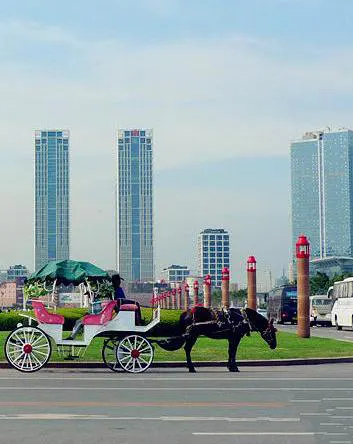
A horse-drawn carriage waiting below the glass towers
That feeling of freedom, of letting go, of sun on your back. Travel is really a change of identity — you trade in the worry, the clutter, the complicated obligations. I like it because it is the only way back to a truer version of myself.
"Dreaming of Dalian"
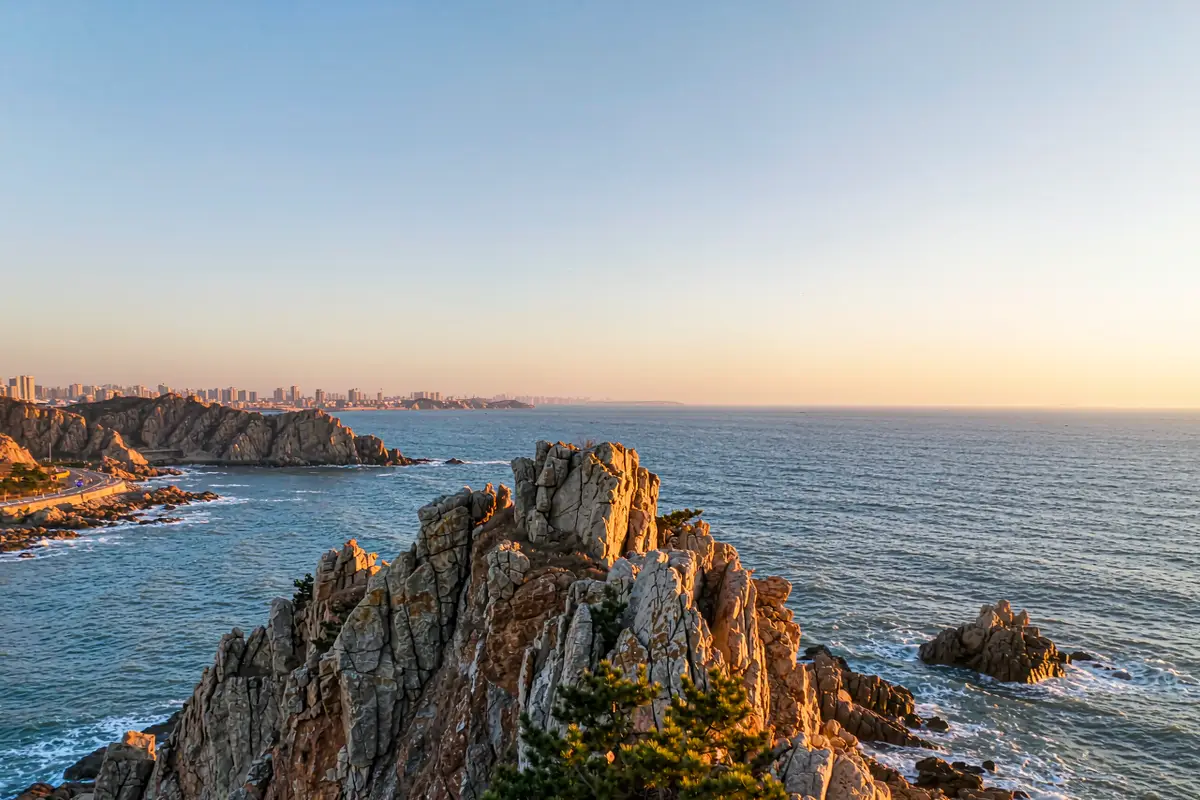
Compared with Qingdao or Sanya, the sea here is colder and harder. There is little sand and a great deal of rock, the water reaches only 23 or 24°C in August, and swimming takes a small act of will. What you get instead: a steep coast where hills drop straight into the water, a stretch of Binhai Road that runs almost along a cliff edge, and a city temperament to match — squares big enough to gallop a horse across, wind strong enough to take your hat out to sea.
Three days is the working minimum: one for the old town and Xinghai, one along Binhai Road to Laohutan, one for Jinshitan or Lüshun. Four is better, because Lüshun deserves a day of its own — it is not a sight so much as a stretch of modern history that nobody has quite tidied away.
02Six things worth your time
Bangchui Island, the island you cannot land onNamed after a laundry mallet
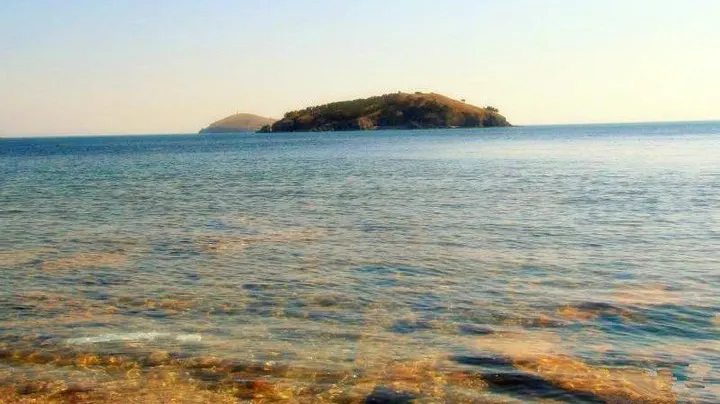
Five hundred metres offshore stands a lone rock island shaped, to a laundry-washing eye, like the wooden mallet locals call a bangchui — hence the name. Its summit is only 53 m and you cannot climb it, nor do you need to. The point is the shore: a cove of rounded pebbles, water clear enough to read the stones through, pine woods behind and a state guesthouse that does not open its gates to you.
Admission:¥20; 08:00–19:00 in season, to 17:00 off season
Getting there:Bus 703 to Shanping Street then a ¥10 taxi, or bus 90 direct
A stretch of the Binhai Road boardwalkTwenty kilometres above the water
Binhai Road began in the 1970s as a military road with soldiers at either end, opened to the public in the early 1980s, and is now the best walk in the city. Of its thirty-odd kilometres, some twenty are lined with a timber boardwalk on the seaward side, running from Xinghai Bay east to Haizhiyun. Take the Yanwoling-to-Beida Bridge stretch: enough gradient to feel it, wide open views, a bit over two hours.
Cost:Free; city loop bus ¥20 for the day
Best time:Early morning or after 16:00; no shade at midday
White whales at LaohutanFive halls, one long day
Laohutan is the biggest marine park in town, five halls strung along four kilometres of coast: polar animals in the main hall, live coral in the next, a sea-lion comedy in the theatre, feeding tanks in the mammal house, and an aviary in a valley outside the gate. The polar show runs two or three times a day; arrive forty minutes early and sit near the front but off-centre, which is where the sightlines are best.
Admission:Five-hall ticket ¥220 (¥190–210 online), students ¥110
Hours:08:30–16:30; Metro L5 Hutan Park
Brick and half-timbering on Russian Style StreetFive hundred metres of 1898
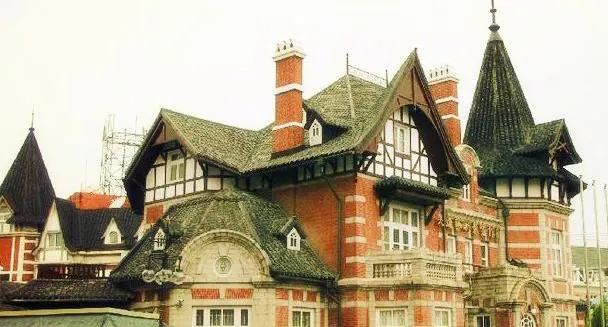
These five hundred metres of Tuanjie Street are the first buildings the Russians put up between 1898 and the early 1900s: red brick with white pointing, steep roofs, exposed timber framing, turrets that aspire to castle. The street is free and always open. One warning: the ground floors are now almost entirely matryoshka dolls and chocolate, so look up — the windows, cornices and chimneys are still the originals.
Cost:Free, open all day
Tip:Mornings are quiet and the light hits the brick
The painted houses at Fisherman's WharfBoats, coffee and a lot of paint
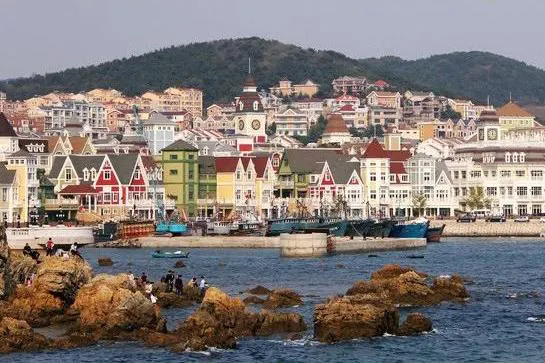
The cove east of Laohutan is half working harbour, half stage set built to look like a European fishing port: painted gables, a clock tower, a timber jetty, and below them boats that still go out. Between three and four in the afternoon they come back, unload, sort and weigh — that half hour beats any ticketed attraction in the city.
Cost:Free; 15 minutes on foot from Metro L5 Hutan Park
03Seven things to settle before you book
Dalian Station or Dalian North — which ticket should I buy?
Follow your hotel. Dalian Railway Station sits at Qingniwaqiao in the centre — the shopping district at the exit, Zhongshan Square twenty minutes on foot, Metro L2 at Qingniwaqiao right alongside, and the shortest hop to Laohutan and Binhai Road. Dalian North in Ganjingzi is the high-speed hub, about 15 km out: Metro L1 reaches Xi'an Road in 25–30 minutes, and L2 gets to the airport in nine stops. Most Harbin, Shenyang and Beijing trains use the North station, so check the station name before you pay — arriving there with a hotel in the old town is a 40-minute mistake.
When should I come, and is summer as crowded as they say?
July and August are the peak: room rates double, Binhai Road becomes a car park and the beaches are shoulder to shoulder. June and September–October are far better — the water is warm enough, the crowds halve, the light softens, and September brings the autumn fishing season. November to March is raw and windy but empty, with accommodation at half price or less, which suits old buildings, museums and hot springs.
How do I eat seafood without being fleeced?
Locals buy at the market and cook next door. Pick your own live shellfish at Changxing or Shuangxing market — scallops, mussels, clams by weight — then carry it to a cooking stall at the edge of the market and pay for the wok. Fees run by weight or by dish; steaming and blanching are cheapest, chilli-frying a step up. The one anti-rip-off rule: have the seller weigh it in front of you before it cooks, write the weight on the slip, then check the bill against the plates. Seafood terraces at the gate of any attraction charge two to three times market price.
Laohutan or Sun Asia — if I only do one, which?
With children, or if you want belugas and a dolphin show, take Laohutan: bigger site, five separate halls, a stretch of coastal path, and a ¥220 combined ticket that fills a day. If you want fish rather than mammals and only have half a day, take Sun Asia in Xinghai Park, where the 118 m transparent tunnel is the headline act: ¥199–220 for four halls, two to three hours. The two overlap enough that doing both is a waste of an afternoon.
Is Lüshun worth a day, and how do I get there?
Yes, provided you know what you are looking at. Lüshun is the ground of the 1894 war and of the 1904–05 Russo-Japanese War: Hill 203, the Dongjiguanshan forts, White Jade Hill, the former Russian-built prison the Japanese later ran, and the mass grave at Wanzhongmu are all still there, and together they amount to half of China's modern history. It is about 45 km from the centre, reachable by Metro L12 or coach; a half-day car with driver runs ¥200–300 and saves the most time. The sites cluster in town, where shared bikes work well.
How easy is Dalian without any Chinese?
The metro, airport and rail stations are signed in English, and tickets work through apps or machines. The friction is in the details: bus stops are announced in Chinese only, taxi drivers rarely speak English — showing the address in Chinese characters is the single most useful trick — and menus often have no pictures. The local accent is heavy and fast, but it is Mandarin underneath, so comprehension is not the problem it sounds like. A translation app plus a note with your hotel address will get you through any day.
What is there to do in winter?
Winter is milder than inland cities at the same latitude — January averages around -4°C — but the sea wind takes it lower fast. The payoff is emptiness: the facades around Zhongshan Square to yourself, no queues at museums, and Laohutan's indoor halls open all year. Add a hot spring (Laotieshan near Lüshun, Anbo, Minghu), the ice on the Jinshitan shore, and an afternoon in an old-town coffee shop.
04Three days as a base, five to slow down
The sights line up along one coast, thirty-odd kilometres west to east, with two escape routes bolted on: Lüshun to the west, Jinshitan to the northeast. Plan one district a day and you will never cross the city twice before lunch. Inside town, Metro L1 and L2 plus the occasional taxi cover everything; for the two outliers you want L12 and L3.
D1
Old town and squares: start at Zhongshan Square, walk the circle and count the old bank buildings, then ten minutes north to Russian Style Street and on to Shengli Bridge for the 1937 station facade. Lunch is a bowl of clam noodles around Tianjin Street or Qingniwaqiao. Metro L1 to Xinghai Square in the afternoon, walk the shore to Sun Asia, and stay for the bridge lighting up at dusk.
D2
Binhai Road: reach Yanwoling before 08:00 and walk the boardwalk to Beida Bridge, two hours down to Laohutan. Spend the middle of the day inside the park, taking the halls in the order coral, polar, theatre, mammals, and catch one beluga show. A taxi to Bangchui Island in the afternoon, sit on the pebble beach until the light goes, then dinner back at Fisherman's Wharf.
D3
Jinshitan: Metro L3 runs from Dalian Station to the end of the line in fifty minutes for ¥8. Morning in the coastal geopark, where four kilometres of shore expose rock laid down hundreds of millions of years ago and the cracked-stone platform sits at the eastern end. Seafood on the Golden Coast at midday, then either Discovery Kingdom until closing or a flat afternoon on the sand.
D4
Lüshun: Metro L12 or a hired car in the morning, starting with the timber station building and the naval harbour, then up White Jade Hill for the whole bay in one view. The afternoon belongs to Hill 203, the Dongjiguanshan forts, the old prison and finally the mass grave at Wanzhongmu. It is a heavy day; if you have children with you, decide in advance how much of it you want to explain.
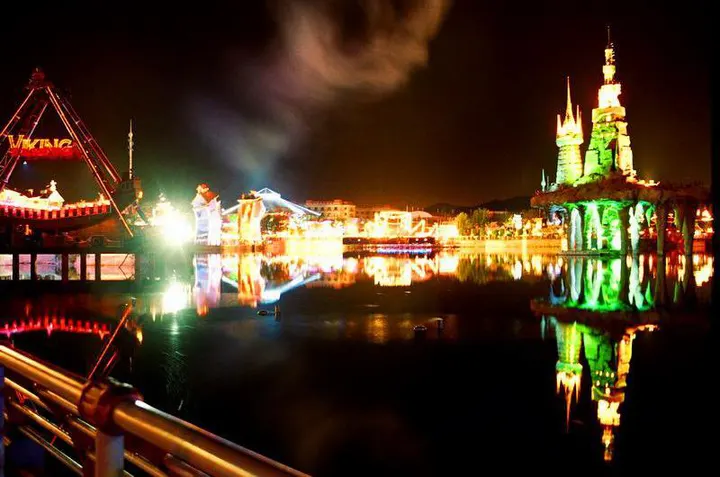
Discovery Kingdom after dark
With five days, split D3 in two: one for Jinshitan and the theme park, one for the Changhai islands or Bingyugou. Or invert it — sleep in Lüshun and walk the old villas of Taoyang Street the next morning, when the streets are still empty.
05From Xinghai to Donggang
Xinghai Square
Laid out in 1997 to mark the return of Hong Kong, 1.76 million square metres of it, billed as the largest city square in Asia — large enough that the walk from the metro exit to the water takes a quarter of an hour. The central avenue is red brick, lawns run down either side, and the far end is simply the sea. It is free and open around the clock, busiest at dusk: kite flyers, roller skaters, wedding photographers, people sitting on the steps waiting for the sun to go.
Laohutan Ocean Park
A 5A-rated park occupying a whole stretch of coast — four thousand metres of shoreline, five halls spread wide enough that a full circuit is twenty thousand steps. The polar hall is the reason to come: belugas, polar bears, penguins and walruses, with a two-thousand-seat theatre attached. The coral hall holds one of Asia's largest live collections, the theatre runs a sea-lion farce, and the aviary sits in a valley outside the gate, reachable by the cable car over the water.
Sun Asia Ocean World
Inside Xinghai Park, five hundred metres from the square. The signature is a 118 m transparent tunnel with sharks passing overhead. Four halls: fish in the ocean hall, penguins and belugas in the polar hall, coral thrown in with the combo ticket, and a domed cinema at the end. It is compact — two or three hours — which makes it the right choice when time is short or the children are small.
Bangchui Island and the eastern coast road
The scenic area costs ¥20 and contains a pebble beach and a cluster of state guesthouses in the pines; you never reach the island itself, which sits five hundred metres out and is meant to be looked at. The better approach is to drive or walk the coast road past it — road halfway up the hill, sea below, island in the middle, all three in one frame. West lie Shicao and Fisherman's Wharf, east the Haizhiyun park.
Jinshitan
Fifty-odd kilometres out, at the end of Metro L3. The resort charges no gate fee; you pay per site. The coastal geopark is ¥40–70, four kilometres of stacked rock ledges, with the famous cracked stone a single platform etched into a grid by the sea. The Golden Coast beach is free, its fine sand dredged and laid. Discovery Kingdom is separate at ¥220–320. The resort train is ¥20 and you can hop on and off all day.
Zhongshan Square
A circular square just over two hundred metres across with ten roads radiating out, the point from which the Russians planned the city in 1899. Around the rim stand the banks, post office, hotels and a church put up between 1900 and the 1930s, in styles running from neoclassical to eclectic; most are still banks. It is best after the lights come on, though the facades reward daylight.
Russian Style Street
Officially Tuanjie Street, known to everyone as Russian Street. Five hundred metres, lined with the first buildings the Russians raised after 1898: red brick, white joints, timber framing, pointed turrets. It is free and always open, and the shops are mostly souvenirs. To actually see the architecture, walk it from the far end against the flow and keep your eyes above the ground floor.
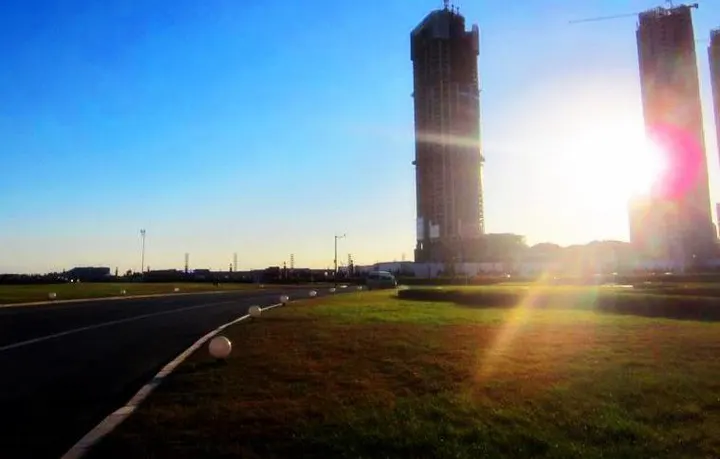
Empty lawns and new towers at dusk
Donggang
Donggang is reclaimed land, a district that did not exist before 2000. The convention centre is its marker, a folded metal box of a building; beside it the Venice water town has dug canals you can ride; further east is the fountain plaza, with one or two shows a night in season. The whole area has enormous views and an equally enormous wind.
Fisherman's Wharf
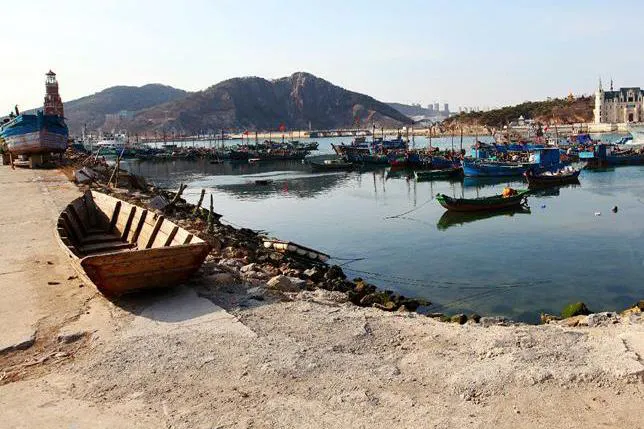
A fishing harbour below the hills, boats still in
Two kilometres east of Laohutan, a harbour that is half genuine and half scenery. The painted gables and the clock tower are the scenery; the boats in the berths are real, out before dawn and back in the afternoon. A row of cafes and seafood rooms faces the water at prices above city level — you are paying for the view of boats coming and going, and it is worth it. Free, open all day.
06Time your trip to the calendar
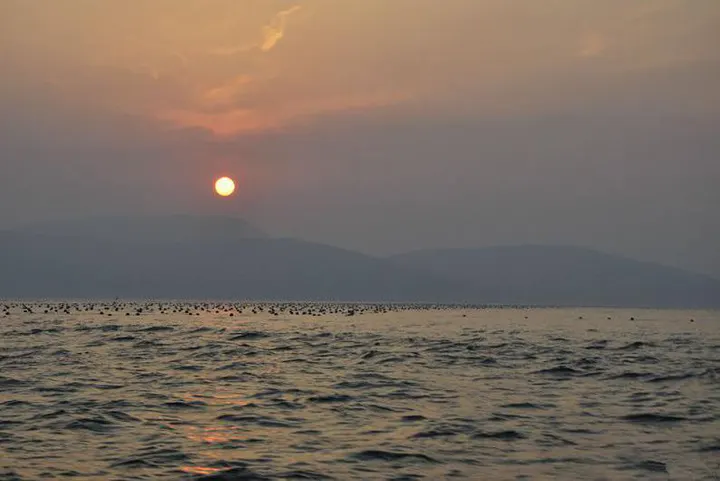
Sunset over the bay, gulls resting on the water
Swimming: the right beach, the right hour
The city's proper beaches are Fujiazhuang, Xinghai Bay, Jinshatan, Yinshatan and Bangchui Island, which charges ¥20; Jinshitan's Golden Coast is the one outside town. Water temperatures match Qingdao, peaking at 23 or 24°C in August, with July still cold enough to make people hesitate. Lifeguards work the official beaches in summer, roughly 09:00–17:00, and the season is announced each year — check before you go. There is a lot of rock, so reef shoes beat bare feet.
Ride the 201 tram
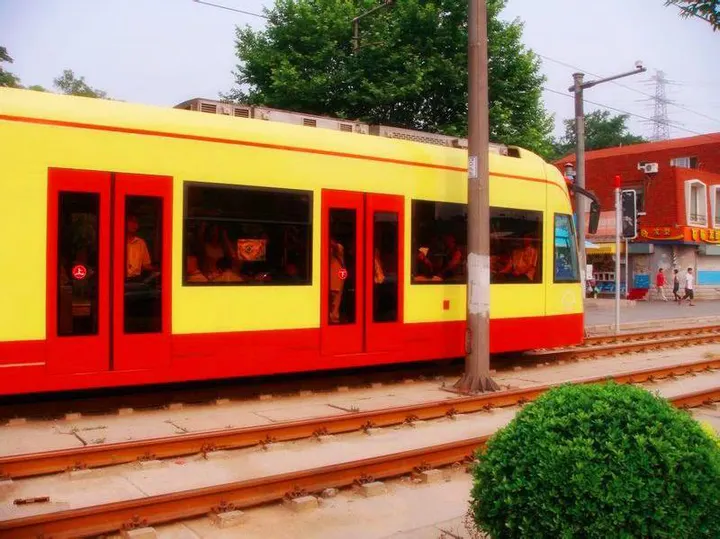
Trams have run here since 1909, and the 201 crosses the whole centre from Xinggong Street to Huale Square and Haizhiyun Park. The fleet still includes cars built in Japan between 1935 and 1938 — wooden benches, brass handrails, a rattle you can feel in your teeth — among the oldest trams still carrying passengers anywhere. Fares are ¥1–2, service runs 05:30–22:30, and the full ride takes an hour. Better value than any sightseeing bus.
Cherry blossom, late April to mid-May
Double-petalled cherry blossom in May
Blossom arrives a month later than in the Yangtze delta: opening at the end of April, peaking in early to mid-May, when the double-petalled varieties are out and the flowers carry more weight and more colour. Longwangtang in Lüshun is the established garden, a little over ¥10; Laodong Park and the botanical garden cover the city end. Go on a weekday morning — at weekends the grass is a field of picnic mats.
Two fountains after dark
The Donggang fountain is the city's fixed summer appointment: May to October, one show at 19:40 Sunday to Thursday, two on Fridays, Saturdays and holidays with a second at 20:40, all free. It stops in wind above force five or in rain, so check the official account before heading out. Xinghai Square has its own fountain on a seasonal schedule, usually later than Donggang. Metro L2 to Conference Centre, exit B, eight minutes on foot.
Catch the mounted patrol
Formed in 1994, the women's mounted unit is the city's calling card: thoroughbred horses, white uniforms in summer and navy in winter, patrolling squares six abreast. They appear most at holidays and major events. The barracks on Zhongqing Street in Zhongshan district once took visitors; whether it still does changes year to year, so ring ahead rather than turning up.
A morning in the seafood market
Changxing market is where locals shop, loudest at six in the morning: sea urchins by the piece, scallops by weight, mantis shrimp still moving. Ask if you do not recognise something — most stallholders will happily teach you how to choose. Buy, then either have it cooked at a stall inside the market or carry it back to the hotel. This hour explains the city better than any ticketed sight.
07Old town, Xinghai or Donggang
Decide which line you are travelling. Base yourself around Zhongshan Square and Qingniwaqiao and the old buildings, the station and Tianjin Street are all walkable, with Laohutan fifteen minutes by taxi. Base at Xinghai Square for sea views and Metro L1, at the cost of half an hour to the old town. Donggang is new, quiet and the best-equipped, though after the fountain stops there is nothing else at night.
Old town around Zhongshan Square and Qingniwaqiao: converted heritage buildings alongside chain hotels, doubles ¥250–500, plane trees and old bank facades at the door.
Xinghai Square: the sea-view cluster, high floors looking at the bay bridge, ¥350–600 low season and double in July–August.
Donggang: newer buildings, larger rooms, a notch cheaper than Xinghai at ¥300–550 — good for drivers and families.
Hostels and guesthouses: dorm beds ¥60–100 around Shengli Square and Xi'an Road, plus a handful of courtyard conversions in the old town from about ¥200.
The pricing follows one rule: July, August and public holidays cost two to three times the norm and must be booked ahead, with a second spike in late September and early October. The compensation is November to March, when a room that goes for ¥1,200 in summer costs ¥400–500. If you book a sea view, ask which way it faces — a north-facing 'sea view' is really a view of the port.
08Seafood, jelly and a bowl of clam noodles
Dalian cooking belongs to the Jiaodong branch of Shandong cuisine with a north-eastern layer of generosity on top: savoury, large portions, more salt and oil than you would find south of the Yellow Sea. Seafood is treated with restraint — steamed, blanched, chilli-fried, braised in bean paste, and that is the whole repertoire. Locals also insist on cooking it: raw-marinated seafood is not really a Dalian habit, and if your stomach is not battle-hardened, do not start here.
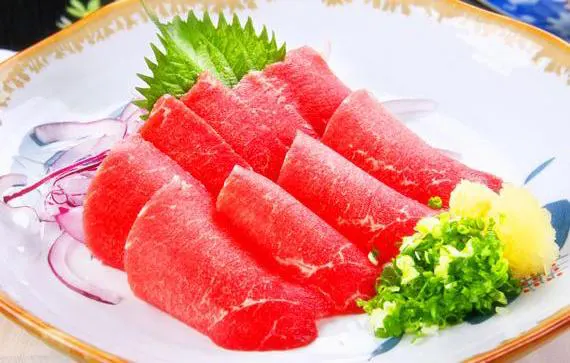
Thin-sliced raw beef, the opener of a Japanese or Korean meal
Six things to order
Menzi: sweet-potato starch set into a block, cut thick and fried until both faces crust over, then dressed with sesame paste, garlic water and shrimp oil. Crisp outside, glutinous within, ¥8–10 a portion, and the best snack in the city.
Grilled squid: whole, on a skewer, brushed and turned over charcoal, or done on a hot plate for a softer result. Any night market will have it, ¥10–15 a skewer.
Sea urchin: fattest from May to August, steamed with egg or eaten straight, ¥20–40 apiece depending on size and season.
Mackerel dumplings: spring mackerel minced with scallion, ginger and a little pork fat, thin-skinned and juicy, about ¥20 a steamer.
Seaweed buns: wakame or a local ribbon weed chopped into the filling with a little pork belly for depth — the most ordinary breakfast on this coast.
Salted fish with cornmeal cakes: mackerel cured then pan-fried, eaten with flat corn bread. The most north-eastern dish in the local repertoire, and unapologetically salty.
How to order seafood
A Dalian table has a shape: two kinds of shellfish (scallops, mussels or clams), one dish of shrimp or mantis shrimp, one fish, one seaweed or cold dish, and dumplings or noodles to finish. Order shellfish by weight and fish by the fish; portions are generous, so five dishes will feed four people. Check the weights and unit prices against the bill at the end — it is the only defence that works.
Places worth the queue
Pin Hai Lou (46 Beidou Street, inside Erqi Square): the old standby for local family celebrations — sea urchin, scallops, urchin soup in a green broth, ¥150–250 a head.
Mou Chuanren Dalian Old Kitchen: salted fish with corn cakes, quick-fried liver, sweet-and-sour pork — correct versions of the home repertoire, ¥60–90 a head.
Tiantian Fishing Port (several branches): pick from the tanks, prices displayed, expensive but frictionless, from ¥150 a head.
Dadi Spring Pancake (696 Huanghe Road, Shahekou): spring pancakes rolled around smoked pork and shredded pork in bean sauce, ¥50 a head, full of local families.
09Taking the sea home
The good souvenirs here are practical: dried seafood, shell craft, apples, amethyst. Buy dried seafood at Changxing market or Dacaishi rather than at the sights — the same dried shrimp is a third cheaper. The shopping concentrates in two districts, Qingniwaqiao and Xi'an Road, with the basement levels of Shengli Square belonging to anyone under thirty.
Dried seafood: sea cucumber, scallops, dried shrimp, squid. Sea cucumber is the wild card — sold by the piece, from a few hundred to several thousand a jin; buy from shops with proper origin labelling.
Shell craft: pictures, jewellery and wind chimes built from the natural colours of shells, ¥50–300, light and unbreakable — the easiest thing to put in a suitcase.
Dalian apples: large, crisp and sweet, best in autumn, sold by the box at markets and pre-packed at the airport.
Amethyst: a local mineral souvenir with enormous variation in quality, from ¥50 ornaments to four-figure stones. If you cannot judge it, buy the cheap one.
Tianjin Street is the century-old shopping street, now touristy and well supplied with fakes — start haggling at half the asking price. Locals gravitate to Xi'an Road and Qingniwaqiao instead. The matryoshka dolls and chocolate on Russian Street are priced for people who have not checked elsewhere; look and move on. On taking seafood home: live shellfish are not allowed on high-speed trains, vacuum-packed and dried are fine.
10Getting there and around
Arriving by train
Dalian is the southern terminus of the Harbin–Dalian high-speed line: about two hours from Shenyang, four from Harbin, four to five from Beijing via Shenyang. Departures are dense enough that you can usually turn up and go. Most north-eastern services use Dalian North; some conventional and regional trains still terminate at Dalian Station. Check the station name when you book — the two are a dozen kilometres apart and the mistake is expensive in time.
Dalian Railway Station is the 1937 building at Qingniwaqiao, straight into the centre: twenty minutes on foot to Zhongshan Square, Metro L2 at Qingniwaqiao alongside. Dalian North opened in 2012 in Ganjingzi and is an L1/L2 interchange — 25–30 minutes to Xi'an Road on L1, nine stops and about 28 minutes to the airport on L2, roughly 50 minutes to People's Square.
A 201 tram in its yellow and red livery
Flying in
Dalian Zhoushuizi International Airport (DLC) sits ten kilometres from the centre — one of the few Chinese airports still inside the city. Metro L2 stops underneath: ten stations and about half an hour to People's Square, or ¥30–45 and twenty-odd minutes by taxi to Zhongshan Square. A new airport is being built on reclaimed land at Jinzhou Bay, but until it opens DLC remains the only way in by air.
The metro: your default
L1 runs from Yaojia to Hekou, taking in Dalian North, Xinggong Street, Xi'an Road, the convention centre and Xinghai Square. L2 runs from Dalian North through the airport, People's Square, Zhongshan Square and the conference centre to Haizhiyun — essentially the visitor itinerary on rails. L3 goes from Dalian Station to Jinshitan in fifty minutes for ¥8 and is the only sensible public transport to the resort. Fares start at ¥2 and rise by distance.
Trams, buses and the sightseeing loop
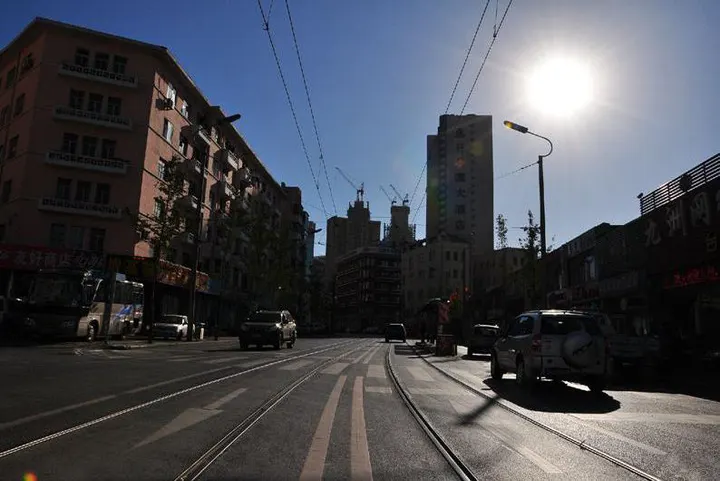
Tram rails running through a back street in the afternoon sun
The 201 and 202 are the last two tram lines; the 201 runs Xinggong Street to Haizhiyun straight through the centre for ¥1–2, 05:30–22:30. Buses cost ¥1–2, paid by QR code or coins (no change given). The sightseeing loop bus is ¥20 for the day, leaving Dalian Station on a 43 km circuit of Binhai Road from late April to early October, first departure 08:00 and last 16:30 — miss it and you are paying for a taxi home. Taxis start around ¥10 and most city trips land between ¥15 and ¥30.
By sea
Dalian port runs ro-ro ferries to Yantai and Weihai, sailing at night and arriving in the morning, six to eight hours, cars welcome on board — travellers from Shandong treat the crossing as a moving hotel. Lüshun New Port adds services to Penglai and Longkou. Fares scale with cabin class, from a cheap shared berth to roughly double for a two-berth cabin; in a windy season, take the seasickness tablet before you board.
Hospitals: the First Affiliated Hospital of Dalian Medical University (222 Zhongshan Road), Dalian Central Hospital (826 Xinan Road), and Youyi Hospital by Sanba Square. A passport is enough to register at emergency.
Money: malls, hotels, the metro and most stalls take Alipay or WeChat Pay, and the international versions link Visa and Mastercard. Morning markets, small stalls and some buses may still want cash or a local QR code, so carry a few hundred yuan.
Tides and wind: check a tide table before clamming or working the rocks — the flood moves faster than you expect. The wind off the water takes hats and scarves; on cliff edges, do not step backwards for a better frame.
Power and data: 220V with the Chinese flat two- or three-pin plug. Free Wi-Fi at the airport, stations and on the metro, usually verified by phone number.
12What to pack, what to avoid
Clothing: summer days reach 30°C and evenings fall to just over 20, with a sea breeze that wants another layer; spring and autumn swing widely enough to need both a windbreaker and a light down jacket. Winter needs a proper shell, hat and gloves.
Footwear: trainers for Binhai Road and the old-town slopes, plus reef shoes or sandals that can get wet. Most beaches here are shingle and shell, and bare feet hurt.
Sun and medicine: the UV off the water is fierce, so sunscreen, sunglasses and a hat. Add stomach medicine and seasickness tablets — a first serious seafood dinner and a first ferry crossing both have a way of testing you.
Bookings: Laohutan, Sun Asia and Discovery Kingdom all sell online and frequently sell out in season; some Lüshun sites register visitors by ID, so keep your passport with you.
Four things to avoid: the 'Lüshun day tour' touts working the station and ferry terminal, which are mostly shopping runs — take Metro L12 or hire a car yourself; unlicensed drivers on Binhai Road promising to 'do the whole road', since there is no official sightseeing vehicle; seafood terraces at attraction gates, where you ask the price before ordering; and the costumed photo props and ponies on the beach, where you agree the price before the shutter clicks.
13A city rewritten by leases and wars
Geography and climate
Dalian sits at the southern tip of the Liaodong peninsula, the Bohai Sea to the northwest and the Yellow Sea to the southeast, with more than two hundred islands in its jurisdiction. The terrain is hilly enough that flat ground is rare, which is why the roads bend, the gradients bite and the squares double as roundabouts. The climate is temperate monsoon moderated by the sea: an annual mean of 10.5°C, August averaging around 24°C and January around -4°C. The old claim that winter here is not severe and summer not oppressive is, for once, accurate.
The Russian lease, Lüshun and the Kwantung Army
In 1898 Russia, trading on its role in forcing Japan to give back the Liaodong peninsula, obtained a twenty-five-year lease on Lüshunkou and Dalian Bay. The planner Sakharov laid out Dalny — 'the far one' — as a city organised around squares, and from 1899 port, station and streets went up together. War with Japan broke out in 1904; Russia lost, and in 1905 Japan took over the lease, reorganised the territory as Kwantung, installed a governor-general, and gave the Kwantung Army its name.
Lüshun is where all of it happened. In 1894, after Japanese troops entered the town, they killed its unarmed civilians; the dead are buried together at Wanzhongmu. The 1904–05 war was fought here for more than three hundred days, at Hill 203 and the Dongjiguanshan forts among other places, with tens of thousands of casualties on both sides. The tower on White Jade Hill was put up by the Japanese garrison in 1909; the prison was begun by the Russians in 1902, expanded by the Japanese and used until 1945. All of it is open as a site, and none of it needs a narrator — the facts carry themselves.
Football, software and a fashion festival
In the 1990s Dalian was China's football city: between 1994 and 2005 its clubs — Wanda, then Shide — won eight top-flight titles, and the People's Stadium sold out weekly. In the same years the software park spread across the high-tech zone, with Japanese and Korean outsourcing turning the city into the northeast's IT gateway. The international fashion festival, running since 1988 every September, is the image the city most cares about: an industrial town that would like to be thought stylish.
14Four ways out of town
Lüshun (1 day)
Forty-five kilometres west of the centre, at the very tip of the peninsula, with the Yellow Sea on one side and the Bohai on the other and a narrow isthmus between them. Lüshunkou is a natural deep-water harbour, and therefore a place fought over repeatedly: the 1894 war, the 1904–05 war and four decades of Japanese rule all begin or end here. The sites cluster, and the main line can be done in a day.
The route: the old timber station building, the naval harbour park, White Jade Hill for the whole bay in one look (around ¥38), Hill 203, the Dongjiguanshan forts, the former prison (free, register at the gate), and Wanzhongmu last. Metro L12 reaches Lüshun with a bus change in town; a half-day car at ¥200–300 saves the most time, and the driver will usually explain what happened where.
Jinshitan (1 day)
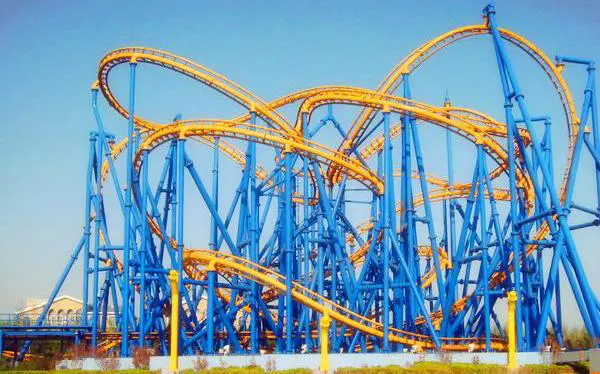
The roller coaster at Discovery Kingdom
At the end of Metro L3, fifty minutes and ¥8. The rock here runs from roughly 600 million years old down to 300 million, cut by the sea into stacked ledges, the star turn being a platform etched into a grid of cracks. The geopark takes two hours on foot, or you can see the cliffs from a speedboat. Entertainment sits alongside: Discovery Kingdom (¥220–320, open late March to early November), the free Golden Coast beach, and a handful of museums.
Bingyugou (1–2 days)
In northern Zhuanghe, about 200 km from the city, billed as 'the little Guilin of southern Liaoning': quartzite pinnacles around a green river valley, rafting in summer and icefalls in winter. Admission is around ¥120 including two boat legs. Public transport means two changes; the easy route is the direct coach from Gangqiao bus station, or a no-shopping day tour. Worth it if you have had enough of the sea and want a different kind of landscape.
The Changhai islands (2 days)
The Changshan group lies in the northern Yellow Sea, an hour or two by boat from Pikou or Dalian port. Dachangshan, Xiaochangshan, Guanglu, Zhangzi and Haiyang each have fishing villages, and in summer you can dig clams, fish and eat whatever came off the boat that morning. Accommodation is mostly family-run fishing guesthouses — plain, and quiet for it. Boats stop in typhoon season, so do not cut the return too fine.
15Watch and read before you go
Film
"Goodbye Mr Loser" (2015, dir. Yan Fei and Peng Damo): most of it was shot in Dalian, with the old walk-up apartment blocks, the shoreline and a school running track all real locations. Watch the backgrounds and you will recognise streets in Xinghai and Lüshun.
Books
"City Heritage: the aesthetics of Dalian's old houses" by Tuo Tuo: a photograph-led survey of the residential buildings left by the Russian and Japanese periods, and the best single entry into why the city looks the way it does. "Impressions of Old Dalian Places", from the Dalian Evening News weekly desk, works the other way, through old street names and the people who lived on them — Shengli Bridge, Si'ergou, and so on.
Music
"Love of Dalian" (1994, lyrics by Yang Daoli, music by Liu Huan): written as the opening number for the sixth Dalian International Fashion Festival and later adopted as the city's television identity song. The arrangement is old-fashioned and unashamedly sentimental, but the line about the blue being 'like poetry, like a dream' holds up if you play it on Binhai Road.