A desert oasis with a thousand years of painted caves
Book Mogao 30 days outSand and springEnd of the corridorA day out to the yardang
In short
Dunhuang (敦煌, Dūnhuáng) is the last of the four Han-dynasty commanderies on the Hexi Corridor: five kilometers south of town the Mingsha dunes wrap around Crescent Lake, twenty-five kilometers southeast the Mogao Caves hold hundreds of painted grottoes, and ninety kilometers west only the earthen stump of Yumenguan and a low Han wall remain. Mogao runs on timed reservations — the ¥238 A ticket with eight caves sells out the day it opens in high season — and the dunes are best at sunset, on a camel. Three days covers caves, sand and the night market; four or five adds the western desert line. Come May to October; a mid-range trip costs about ¥2,000–3,500 for 3–5 days, excluding long-distance transport.
May–October; September and October for clear skies and ripe fruit
01What kind of town Dunhuang is
The train west from Lanzhou runs seven or eight hours down the Hexi Corridor: Wuwei, Zhangye, Jiuquan and Jiayuguan fall away one by one, the green thins out, and eventually there is only black gravel on both sides of the rails and a thread of snow mountains on the horizon. Then poplars, vineyards and concrete yards covered in drying apricots appear, and you are in Dunhuang — not a sight in the desert but an entire oasis economy, kept alive by snowmelt from the Qilian Mountains and ringed by sand for two thousand years.
Everything about the place comes down to one word: junction. The Han set the fourth and furthest commandery here, and beyond Dunhuang the road split in two — north through Yumenguan, south through Yangguan — both leading into the Western Regions. Caravans, envoys, monks and garrison troops stopped here for water, fresh camels and news, and left behind both their faith and the painters who served it. That is why the town has three separate draws: the caves are what people made, the dunes and the spring are what the land made, and the two passes with their wall are what an empire made.
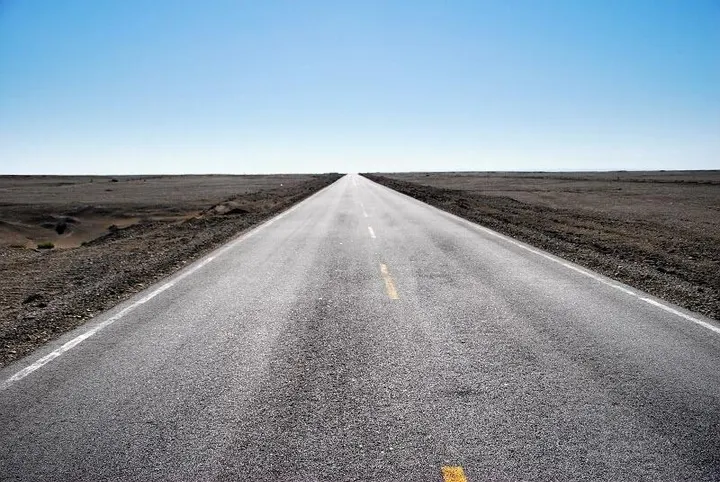
West of town, a two-lane road runs dead straight into the black gobi
Think of it: a small road running to the edge of the sky across empty gobi. The sand is all around you, but there is an oasis in your head, and the road stops being tedious.
"Along the Silk Road, All the Way to Dunhuang"
The town itself is small: one main street, taxis starting at five yuan, twenty minutes end to end. Your days get organised around two fixed points — caves in the morning, sand in the evening — and the fierce hours in between are best spent napping, walking the museum, or drinking iced apricot juice at the mouth of the night market. Dunhuang runs on the sun's schedule, not yours.
02Six things worth the train ride
Mogao: the twenty minutes inside a caveA thousand years in one room
Forty minutes of dome-screen film, then a shuttle to the cliff. The guide's torch beam sweeps the wall and the colours come up out of the dark in layers — lapis blue, malachite green, iron red — and no photograph prepares you for it. Which caves you get is decided that morning, so nobody's Dunhuang is quite the same.
Mingsha and Crescent LakeSinging sand, a spring that will not dry
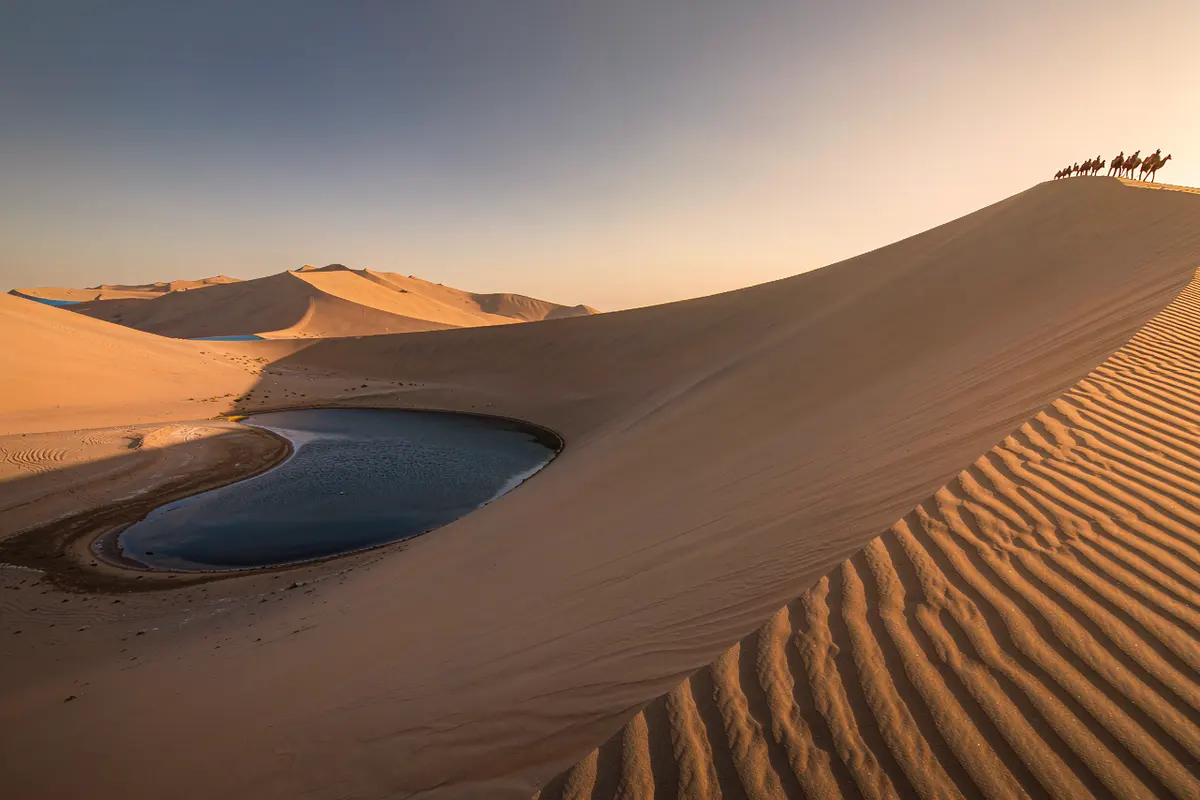
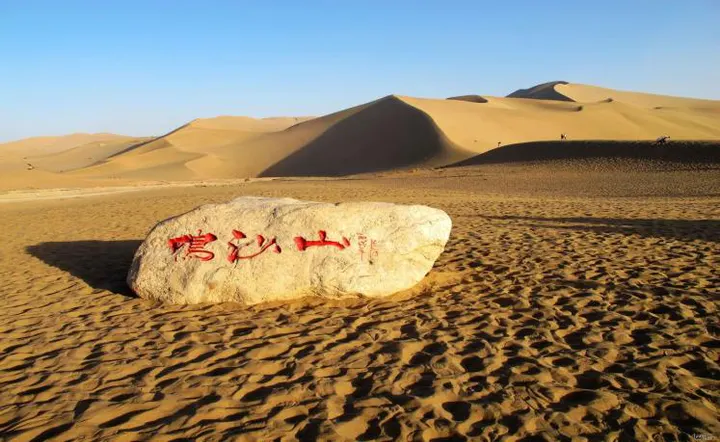
Dunes run from the edge of town to the horizon, and in the middle of them a crescent of water sits in a hollow. Climb to a ridge, sit down, and the wind combs patterns into the surface; slide a foot and you hear a low hum — the 'singing' is quartz grains grinding, not a legend. At sunset the whole field turns orange, and it is the best twenty minutes in town.
The yardang: a city carved by windDusk in Devil City
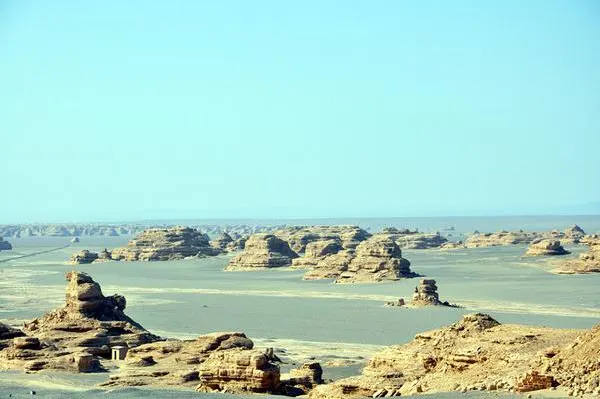
Out on the gravel plain, rows of ochre ridges stand like abandoned walls and beached ships, and the wind funnels between them with a sound like someone blowing across a bottle. Locals call it Devil City. The hour before sunset is the time: shadows stretch, the ridges go to silhouette, and the sky fades from blue to grey-violet.
Dinner at Shazhou Night MarketOne street, most of Gansu
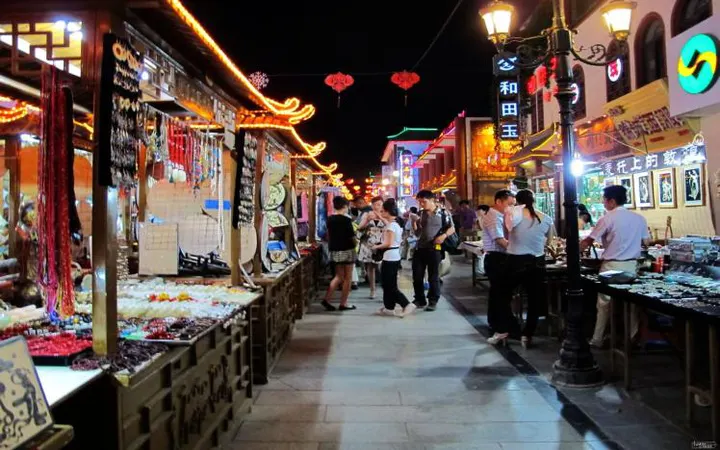
Behind the archway the street splits into snacks, grills and handicrafts. Work your way through donkey-meat noodles, braised lamb with flatbread, skewers, cold liangpi and apricot juice for ¥30–40 a head. Browse the craft stalls but do not buy at the front — the same luminous jade cup costs half as much further in.
Yumenguan and the Han wallWhere the spring wind stops
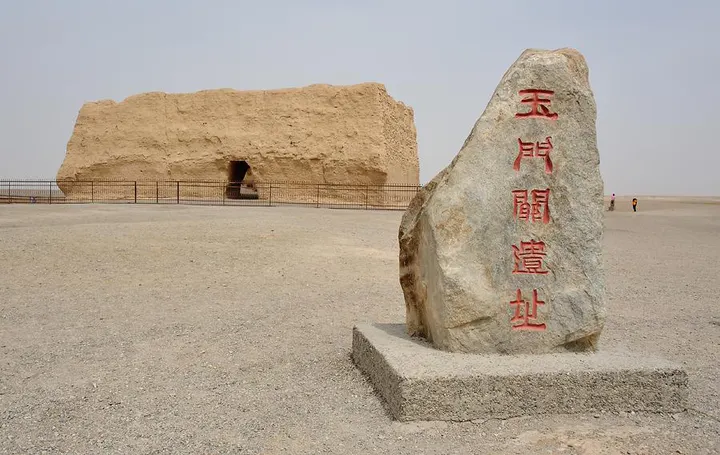
A small square fortress of rammed earth stands alone on a gravel rise, with absolutely nothing around it. Nearby, a stretch of Han wall survives as a knee-high ridge of layered reed and loess, two thousand years old and still there. Standing between them, the old farewell poems stop sounding like metaphor.
Western Thousand Buddha Caves: the cave you can argue withSmall, quiet, conversational
The Dang River has cut a gorge here, and a dozen caves from the Northern Wei to the Tang freckle the cliff; nine are open. Crowds are thin, so the guide is often one-to-one and you can interrupt at will — what mineral is that blue, why was this figure restored. Come after Mogao and the things you half-understood suddenly make sense.
03Seven questions to settle before you book
How exactly do I book Mogao, and what separates the A and B tickets?
Reservations only, real name, through the official Mogao booking mini-program; tickets release thirty days out and vanish the same morning in July, August and the October holiday. The A ticket costs ¥238 and buys two digital films, the shuttle, a guide and eight actual caves, capped at about 6,000 a day. The B 'emergency' ticket costs ¥100 for four caves and the shuttle, with no films and no guide — 12,000 a day, usually released once A sells out. That extra ¥138 buys comprehension; do not skip it on a first visit.
What if the tickets are gone? Is turning up worth it?
There are no A tickets at the gate, and the cave area sells nothing at all. Three workarounds: watch for cancellations, which the official system releases in the week before; buy the B ticket a day ahead or try the counter at the digital centre on the day; or shift your trip to December–March, when ¥140 buys ten caves and the corridors are empty. Whatever you do, do not take a taxi straight to the cliffs — there is no ticket office there.
Should I arrive at Dunhuang Station or Liuyuan South?
It depends where you start. From Lanzhou, Xi'an or Yinchuan, high-speed trains run into Dunhuang Station itself — the 11:58 from Lanzhou West arrives 19:26, second class from ¥324 — with bus 12 into town for ¥3 or a ¥30 taxi. Services from Urumqi and Hami mostly stop at Liuyuan South, still 130 km away: a minibus costs ¥50 and a shared taxi ¥60–80, and the drive takes 1.5–2 hours. Check the destination on your ticket before you pay.
When should I go to the dunes, and is the camel worth it?
Two windows: in before 05:30 to climb for sunrise, or after 17:30 to wait for sunset. In between, the surface can hit fifty or sixty degrees, so do not tough it out. The camel costs ¥100 for about forty minutes, looping from Mingyue Square over the eastern ridge down to the lake, and it is the only way to find yourself in a caravan silhouetted on a crest — worth it, unless your back objects. Sand-sledding runs ¥25–40: three minutes down, half an hour back up.
How do I handle sun, sand and wind out there?
Rainfall here is under 40 mm a year and the UV is not subtle. Hat, sunglasses, high-factor sunscreen and a light long-sleeved layer are all non-negotiable; bag your camera and phone, because sand in a lens is worse than water. Gaiters cost ¥15 inside the dunes gate and ¥5 from the stalls outside. When the wind gets up, visibility on the western road collapses — skip the desert line and go to the museum instead.
How many days do I actually need?
Three days is the floor: Mogao plus a dune sunset on day one, a full western loop of Western Caves, Yumenguan and the yardang on day two, museum and night market on day three. Four is comfortable, with a spare morning for the Yulin Caves or simply sitting on a dune. With only two days, drop the western line and do Mogao and the sand properly — better than sprinting.
Is the Yulin Caves detour worth it, and can I still see caves in winter?
Yulin sits in Guazhou, 170 km and two and a half hours each way. The ¥40 ticket covers five caves, Cave 25's Tang paradise murals are called the finest painting in the whole Dunhuang system, and special caves cost another ¥100–200. Worth it if murals have already got under your skin; skippable if you are ticking boxes. Winter works fine and costs less: from 1 December to 31 March Mogao is ¥140 with ten caves and the dunes are half price at ¥55 — you just need a real coat.
04Three days as a base, four to breathe
One constraint governs everything: your Mogao slot is whatever you managed to grab, so book that first and build around it. The rhythm that works is caves in the morning, dunes at dusk, night market after dark, with the hottest hours left empty. The western line — Western Caves, Yumenguan, yardang — is 160 km each way and eats a whole day.
D1
Mogao in the morning: reach the digital centre half an hour early, collect tickets, watch both films, take the shuttle, and follow a guide through eight caves — about three hours all in. Back to town for lunch and a nap. After 17:00, enter the dunes, take a camel over the eastern ridge, then walk down to the lake for sunset. Finish with donkey-meat noodles and apricot juice at the night market.
D2
The western day: leave at 07:30, stop first at the Western Thousand Buddha Caves for the Northern Wei material, then push on to Yumenguan for the fortress, the Han wall and the granary ruins, eating a plain lunch somewhere on the gravel. Enter the yardang after 15:00, ride the shuttle between viewpoints, and climb high before sunset. You get back near midnight, with a sky that has no light pollution in it at all.
D3
Morning at the Dunhuang Museum, which is free and closed on Mondays: Han wooden slips, Library Cave documents, brick reliefs from Wei-Jin tombs — and everything you saw the day before clicks together. Spend the afternoon at Leiyin Temple or the White Horse Pagoda, then use your three-day dune ticket again at dusk; plenty of people discover the sunrise is better than the sunset. In the evening, take in a show.
D4
Day four can go east to the Yulin Caves — 170 km, two and a half hours — for the Tang painting in Cave 25, with a bowl of noodles in Guazhou on the way back. If that feels like too much driving, give the day to Yangguan, the vineyard valley and the rebuilt old town, and spend the evening filling the gaps in your night-market list.
05From the cliff face to the gravel plain
The Mogao Caves
In 366 a monk named Yuezun walked to the foot of the Sanwei hills, saw a thousand Buddhas inside a shaft of golden light, and cut the first cave into the cliff. For the next thousand years every dynasty added to it — Northern Liang, Northern Wei, Western Wei, Northern Zhou, Sui, Tang, Five Dynasties, Song, Western Xia, Yuan — leaving 735 caves, some 45,000 square metres of mural and more than 2,000 painted clay figures. There is nowhere else like it.
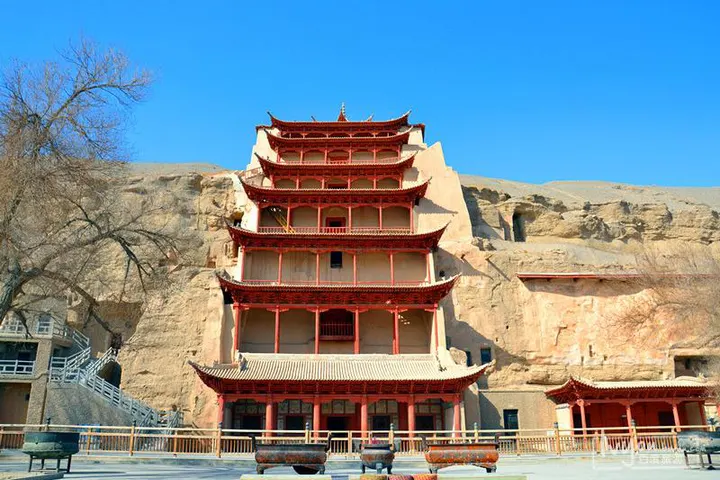
The route is fixed: two films at the digital centre — a documentary and a dome-screen piece, about forty minutes — then a twenty-minute shuttle to the cliff, then groups of twenty following a guide through eight caves at five or six minutes each. Caves rotate, so the nine-storey facade of Cave 96 and the Library Cave, Cave 17, are not guaranteed; once inside, follow the torch beam instead of a checklist. Photography is banned, and you do not need your own torch — the guide carries one.
Mingsha Mountain and Crescent Lake
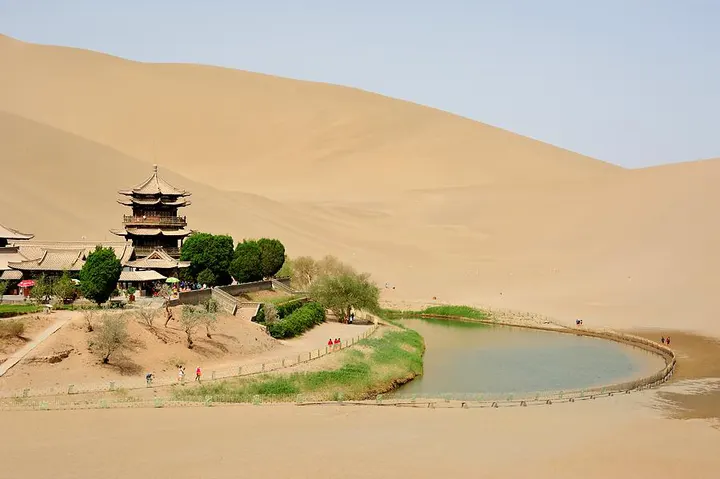
Crescent Lake and its pavilions, entirely enclosed by dunes
Mingsha Mountain — Echoing Sand Mountain in the old gazetteers — tops out a little over a hundred metres, and it is harder than it looks: your feet sink, you take a step and slide back half of it, and a normal climber needs forty minutes. Crescent Lake lies in the hollow the dunes make, under a hundred metres long and about two metres deep, and it has not been buried in two thousand years thanks to a wind funnel that lifts sand back up the slopes. Levels fell dangerously in the 1990s; today seepage and top-ups keep it alive, and the reeds around the rim are held in place by hand.
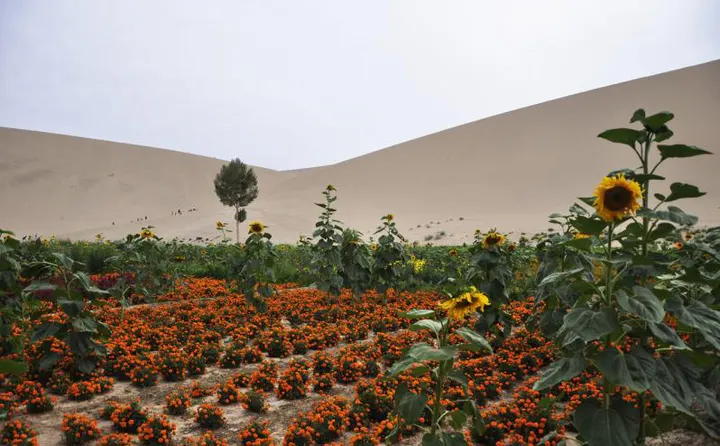
Marigolds and sunflowers in a field at the foot of the dunes
Your ticket is valid for repeat entry over three days, which most visitors never use. The efficient play: sunset on day one, sunrise the next morning, the western line in between. Gates open at 06:30, later in midsummer; entry is ¥110, a camel ¥100, sand-sledding ¥25–40 and the shuttle ¥10 one way.
Yumenguan and the Han wall
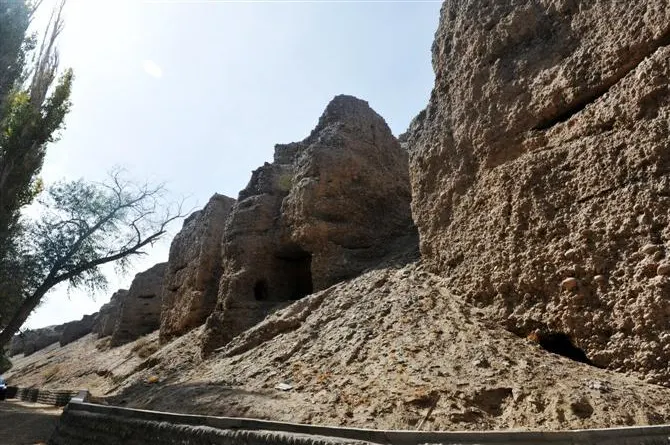
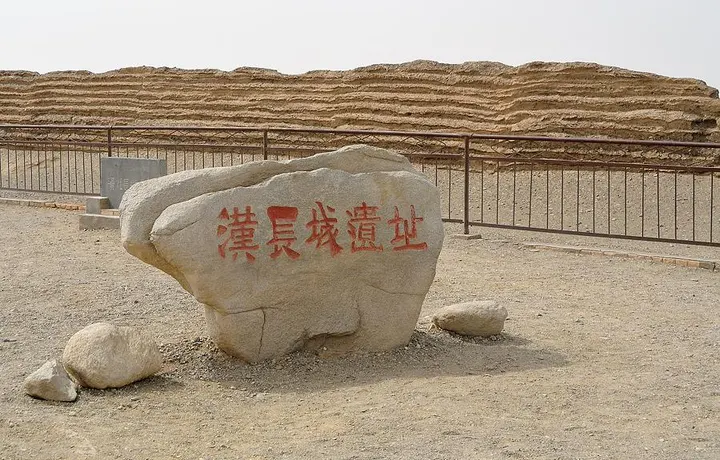
The Han wall, layers of reed and loess rammed into a low ridge
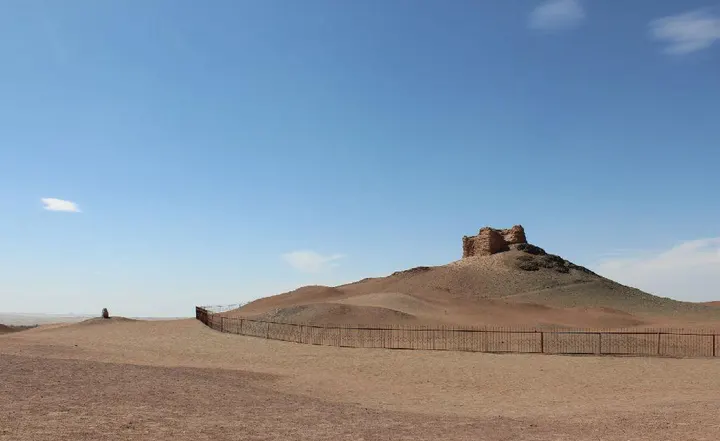
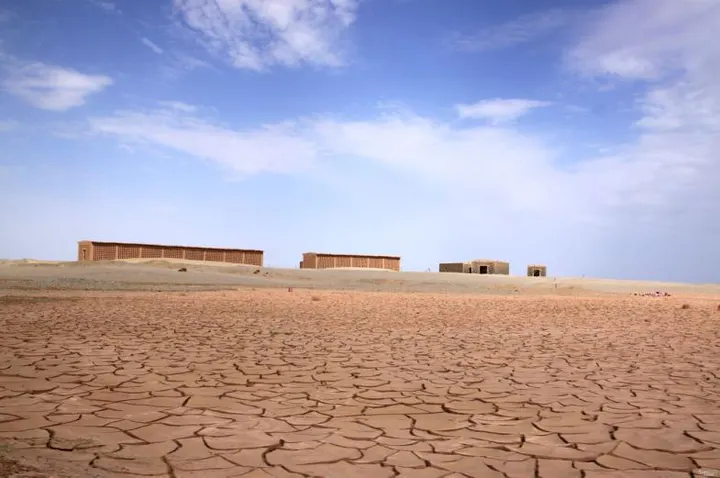
Yumenguan, known as the Small Square Fort, is down to a single block of rammed earth about twenty-five metres on each side — the last gate on the Han road into the Western Regions. Twenty kilometres east stands Hechang, the army's granary, where a few mud storerooms still hold their shape, and along the way the wall survives as banded courses of tamarisk, reed and loess, cut like a layer cake. One ¥40 ticket covers all three, with a ¥50 shuttle linking them.
Yangguan Pass
Yangguan's beacon tower, a block of rammed earth on a hilltop
Seventy kilometres southwest, Yangguan was the southern gateway of the Silk Road. The city is long gone; what remains is a Han beacon tower on a hill and a surprisingly good museum that explains both the farewell poetry and the courier system behind it. There is horse riding, archery and rubbing workshops on site. Entry is ¥50 with a ¥20 shuttle, or ¥90 combined with Yumenguan. This is also Dunhuang's grape country — in August and September the roadside is one long fruit stall.
The Dunhuang Yardang National Geopark
Yardang is wind erosion at work: lake-bed mudstone is sandblasted year after year, the soft layers leave first, and the hard cores remain as ridges, walls and what looks like a fleet. Four viewpoints are linked by shuttle, the last one — the Western Sea Fleet — being the most convincing. The hour before sunset gives the best light, and photographers time their visit for exactly that.
Tickets are ¥50 plus ¥70 for the shuttle, ¥120 in total; the gate sells from 06:30 and stops at 19:30, with seasonal shifts. It is 158 km out with no public transport, so you go by hired car or a day tour, usually combined with Yumenguan and the Han wall. To reach the core zone, off-road vehicles are rented separately from about ¥500 a car.
The Western Thousand Buddha Caves
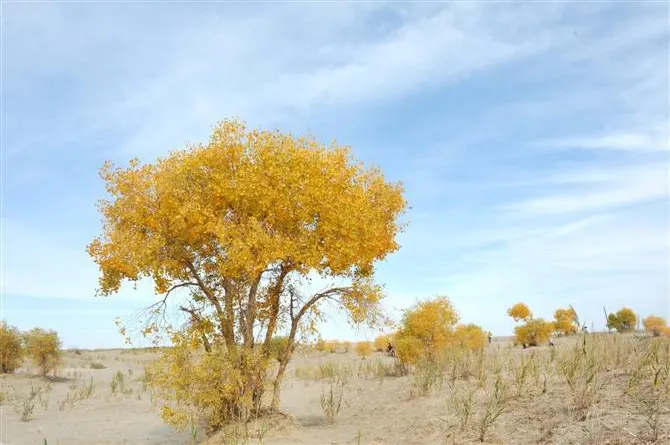
Desert poplars turned gold in autumn
Cut into the cliff of the Dang River gorge, possibly earlier than Mogao itself, these caves number sixteen with nine open, mostly Northern Wei. In Cave 5 a donor's vow survives beneath the central pillar, seventy-odd characters still legible — a rare piece of Northern Dynasty handwriting. You will often be the only group there, and the guide is happy to keep talking. ¥40, thirty-five kilometres west of town.
The Dang River oasis
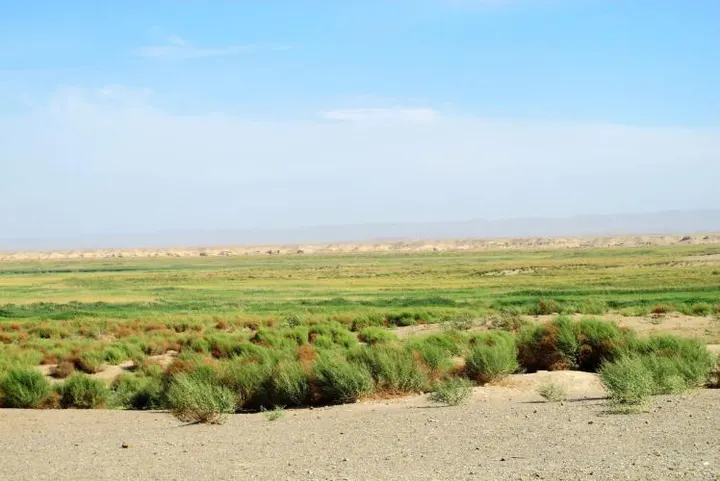
Marsh grass at the edge of the oasis, dunes beyond
Dunhuang exists because of the Dang River. Snowmelt off the Qilian Mountains feeds it, the water sinks underground after leaving the mountains and resurfaces at the oasis edge as brackish marsh. Cycle out in the evening and you get reeds and water birds on one side, dunes a few hundred metres away on the other — the plainest possible illustration of the word oasis.
06On the sand, after dark, on a stage
Camel riding
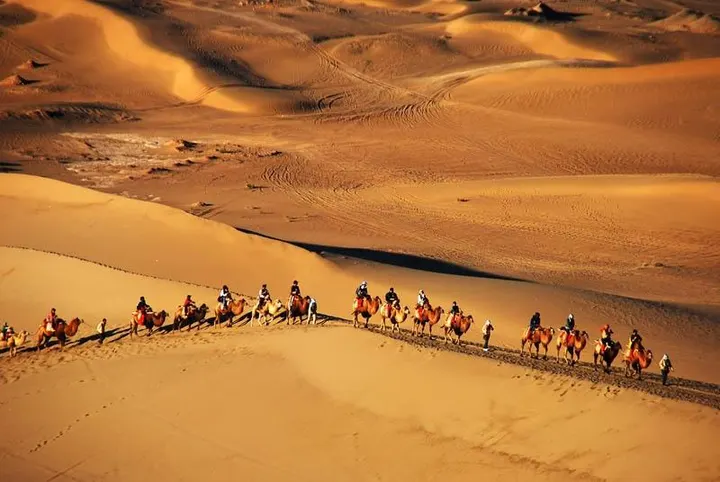
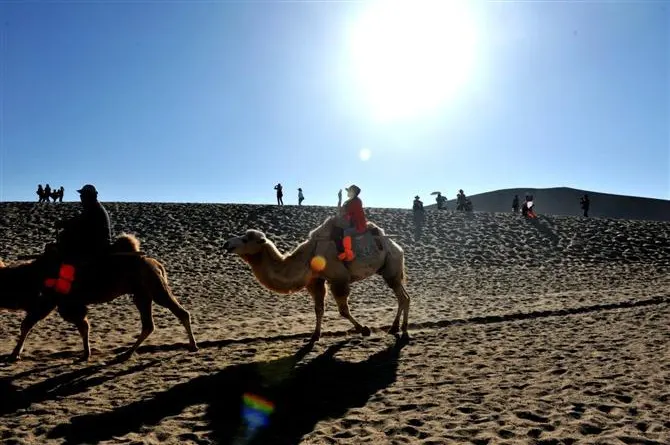
A camel train strung along a crest in the last of the light
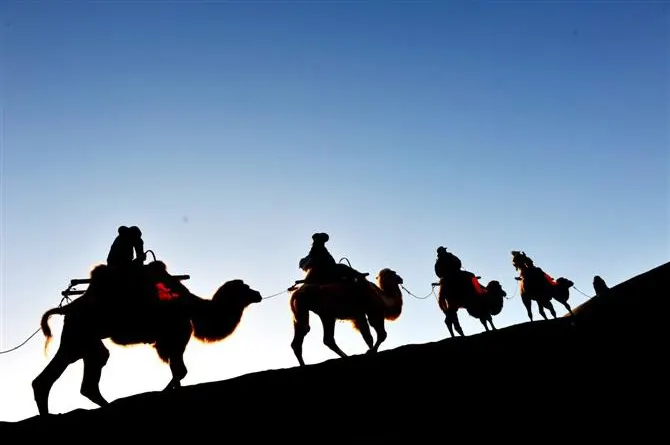
A hundred yuan for forty minutes, from Mingyue Square over the eastern ridge and down to the lake. The only frightening part is the animal folding and unfolding underneath you; hold the saddle horn and lean forward. Once walking, the rhythm is steady and hypnotic, the string of beasts ahead of you throws long shadows, and a lot of people say this is the closest the trip gets to the Silk Road.
Last light: the caravan reduced to silhouettes
Sand-sledding and desert vehicles
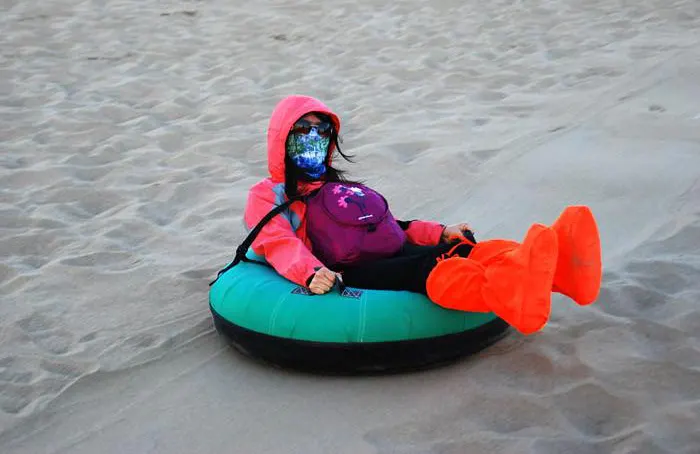
Sliding down a dune on an inflatable sled
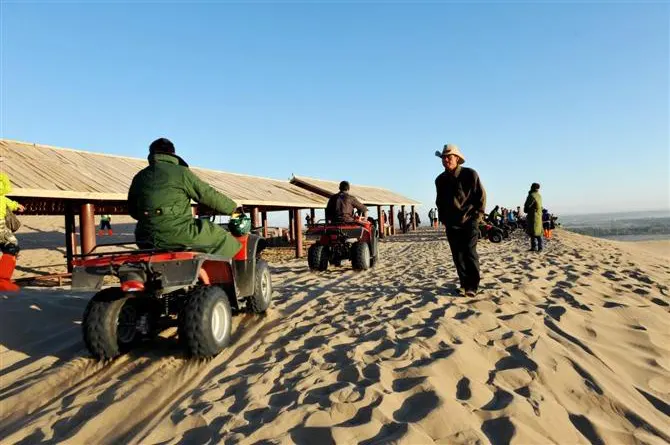
Tickets for the sled are sold at the wooden platform on the crest, ¥25–40 a run: sit in the inflatable, three minutes down, half an hour back up. As you slide, the dune answers with a low drone that gets louder with more people on it — that is the whole mystery of the singing sand. If climbing is not your idea of fun, quad bikes and buggies start at ¥120–300 and haul you up the ridge.
Quad bikes waiting under a shade roof at the dune edge
Night market and the immersive show
Shazhou Night Market runs from dusk to midnight: snacks and grills at the near end, crafts at the far end, and a few tea seats in between for three-cup tea. For shows, 'Encore Dunhuang' is a walk-through production where the audience moves between rooms, ¥298–688; 'Dunhuang Spectacle' plays outdoors below the dunes, ¥238–588; and the veteran dance drama 'Along the Silk Road' — the one that gave the world the pipa-played-behind-the-back pose — still runs locally.
Festivals: Buddha's birthday and the sliding festival
On the eighth day of the fourth lunar month, locals climb to the caves for Buddha's birthday, and Mogao is at its busiest, with queues running from the nine-storey facade down the cliff. On the sixth day of the sixth month comes the old custom of burying aching backs and legs in hot sand at noon. Early June brings a sand-sliding festival, when a hundred sleds go down at once and the drone carries five kilometres into town. Dates follow the lunar calendar — check before you go.
07In town, or at the foot of the dunes
Accommodation splits in two. In town — around Shazhou Night Market, Yangguan Road and Mingshan Road — you can walk to dinner and reach anything in fifteen minutes by taxi. At the foot of the dunes, Yueyaquan town is quiet, you can walk to the gate for sunrise, and there is almost nothing to do after dark. First-timers should stay in town and simply take a taxi out on sunrise day. Prices double in July, August and the October holiday, so book early.
Hostels: a dozen sit around Qinzhouhu and Xindun lanes in town, beds ¥60–120, most with a shared kitchen and a board for sharing cars to the western line.
Budget chains and guesthouses: doubles ¥120–250, small but clean, many offering station pickup; off-season rates sometimes dip under ¥100.
Mid-range hotels: ¥200–400, clustered on Yangguan Middle Road and Mingshan Road, breakfast and parking included — the default for anyone driving or hiring a car.
At the dunes: guesthouses and resorts in Yueyaquan town from ¥300, some with terraces facing the sand — for people who want the sunrise without a dawn drive.
One practical note: hotels here do not hand out desert kit beyond the odd humidifier, but plenty of front desks will lend gaiters, neck tubes and torches. Ask whether they pick up from Dunhuang Station when you book — it saves a thirty-yuan taxi.
08Noodles, donkey meat, apricot juice
The base note here is northwest: wheat above rice, lamb and donkey and chicken in rotation, savoury and salty, chilli oil on the table for you to add. Tourist volume means Sichuan and Guangdong kitchens exist too, but eat the local list first and worry about the rest later.
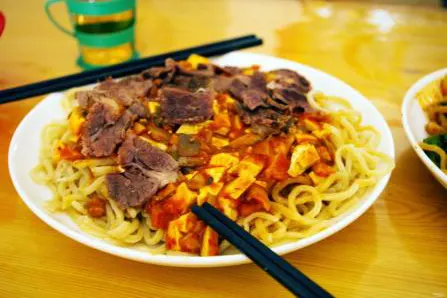
Donkey-meat yellow noodles, sliced braised meat over a plate of fine noodles
Five things to order
Donkey-meat yellow noodles: alkaline dough pulled thin, dressed with a mushroom, tofu and tomato sauce, the sliced donkey meat served alongside. Locals quote an old line about dragon meat in heaven and donkey on earth. ¥15–25 a plate.
Braised lamb with flatbread: the bread cooks in the pot under the meat, soaks up everything, and ends up better than the lamb. About ¥80–120 for two.
Saozi noodles and jiangshui noodles: the first is thick, sour and hot; the second is built on fermented vegetable liquor and wakes you up instantly in summer. ¥10–15 each.
Lamb soup with bean jelly: bone broth, thin slices of meat, cubes of cold jelly — the right breakfast when it is below freezing. Around ¥20.
Apricot juice and Li Guang apricots: dried fruit boiled into a sweet-sour drink, ¥5 a cup over ice, the best thing in the desert. In July and August fresh apricots arrive by the basket at the roadside.
Where to eat
Shunzhang Yellow Noodle: the most trusted of the old noodle houses, with the pulling done at the front and donkey meat sold by weight. ¥30–50 a head.
The snack zone in Shazhou Night Market: everything in one pass at fair prices, at the cost of noise and cramped benches. ¥30–60 a head.
Yangguan East Road: where locals actually eat, heavy on Hui restaurants — rice plates, grilled meat, claypot stews, all cheap. ¥20–40 a head.
Middle Mingshan Road: Chinese and Western menus, calmer rooms, good for a late meal after a show. ¥50–80 a head.
Watch the portions — northwest plates are big and two people ordering three dishes usually lose. In Hui restaurants do not bring outside food or ask for alcohol. At the fruit stalls prices are by weight, so ask before you pick.
09Taking a piece of Dunhuang home
Dunhuang souvenirs come in two grades. Luminous jade cups, painted clay figures, camel toys and silk rugs are real crafts; anything sold as a 'rubbing from a Mogao mural' is a print with age applied to it, and should never be bought as an antique. One rule covers the rest: if it can be mass-produced, it can be haggled.
Luminous cups: turned from Qilian jade, thin as paper, dark green against the light. A genuine one responds to a magnet; prices run from tens to hundreds of yuan depending on stone and finish.
Painted clay figures copied from Mogao sculpture — bodhisattvas, apsaras, donors. Quality varies wildly; ¥100–500 buys a good one.
Mingsha dates and dried Li Guang apricots: the dates are large and sweet, and the local method cures them in liquor; apricots come stoned or whole at ¥20–40 per 500 g.
Cloth camels and silk rugs: the stitched camels cost tens of yuan and make easy gifts; hand-knotted silk rugs run into the thousands and are for keeping.
Where to buy
The craft lanes of Shazhou Night Market are the densest place to compare prices in one walk. The pedestrian street off Mingshan Road has proper shops at higher prices but with returns honoured. Feitian and Tianma department stores are where locals buy dates and dried fruit — roughly thirty per cent cheaper than the stalls near the sights.
10Getting there and getting around
Arriving by rail
Dunhuang Station is the terminus of a branch off the Lanzhou–Xinjiang line, thirteen kilometres from town. Two high-speed services leave Lanzhou West: D2749 at 11:58 arriving 19:26, and D2737 at 13:47 arriving 21:20, second class ¥324–334, seven and a half to eight hours, with Wushaoling, the Zhangye badlands, Jiayuguan and the Guazhou gravel sliding past. The overnight Z6201 leaves Lanzhou at 18:30 and arrives 06:35, hard sleeper ¥244.5 — sleep through it and you are in time for the first caves.
Leaving is just as easy: D2739 departs 08:30 and reaches Xi'an North at 19:13 in ten and a half hours; D2758 leaves 09:56 for Lanzhou West at 18:14; D8933 runs 21:05 to Jiayuguan South in two hours twenty-three. Outside the exit, bus 12 goes into town for ¥3 to the east gate of Shazhou Market, a taxi costs about ¥30, and many hotels will collect you.
Liuyuan South, if you come from Xinjiang
Trains from Urumqi, Hami and Turpan mostly stop at Liuyuan South, still 130 km from Dunhuang. Minibuses outside the station run to the coach station for ¥50; shared taxis cost ¥60–80 and will drop you at your hotel; scheduled coaches are ¥80–100 but infrequent. The drive takes 1.5–2 hours across open gravel. Prices rise late at night, so avoid arriving after the last scheduled service.
Flying in
Dunhuang Mogao International Airport sits thirteen kilometres east: a dozen daily flights to Lanzhou, several a day to Beijing and Xi'an, plus Shanghai, Chengdu and Urumqi. The airport bus costs ¥10 into town; a taxi is about ¥30 and twenty minutes. Seats tighten in high season, so look a month ahead.
In town: buses, taxis, hired cars
Bus 3 runs straight to the dunes for ¥1–2; a taxi is about ¥15. For Mogao you first go to the digital centre: bus 12 from Silk Road Hotel via the railway station takes forty minutes for ¥5–8 and runs roughly hourly, or a taxi is ¥30–40. In town, meters start at ¥5 and almost nothing costs more than ¥15. The western line has no public transport — a car with driver runs ¥400–700 a day for four people, and every hostel front desk arranges shares.
Emergency numbers: police 110, ambulance 120, fire 119. Tourism complaints 0937-8822 234; the dunes hotline is 400-118-3388.
Hospitals: Dunhuang People's Hospital (20 Yangguan East Road, 0937-8859 088) is the largest; the TCM Hospital (6 Shazhou South Road, 0937-8825 831) is handy for heat exhaustion and stomach trouble.
Money: QR payment works in town and at the sights, and Alipay's international version links to Visa and Mastercard. A few night-market stalls still want cash, so carry a hundred or two in small notes.
Phones: 5G is fine in town, but the western line loses signal for long stretches. Screenshot your map and ticket QR codes before you leave.
Altitude: at 1,139 m Dunhuang is not high enough to cause altitude sickness, though anyone arriving straight from Qinghai should take the first day slowly.
12Packing list and pitfalls
Bookings: Mogao thirty days out on the official mini-program, the dunes a day or two ahead, show seats as soon as dates are fixed. Enter your passport number exactly — tickets are checked against ID at the gate.
Sun kit: wide hat, sunglasses, SPF50 and a light long-sleeved layer. Reapplying through the day matters far more than one application at breakfast.
Sand: zip bags for camera and phone, gaiters (¥15 inside the gate, ¥5 outside), and a scarf you can pull over your nose. Dust days are miserable in contact lenses.
Clothing: the day-night swing can exceed fifteen degrees, so bring a light jacket even in summer; November to March needs a down coat, with nights near minus twenty. Wear closed trainers — sandals on a dune are a mistake.
Extras: a thermos, lip balm, wet wipes, some cash and a small medical kit — stomach medicine, cold tablets, eye drops. Dry air here means two or three litres of water a day.
Five pitfalls. Anyone offering to get you into Mogao without a booking is selling nothing — the cliff has no ticket window. Settle the price before a camel photo or a costume shoot. Treat 'antiques' and mural rubbings at the market as souvenirs, never as relics. When hiring a car for the western line, confirm whether tickets and site shuttles are included, because Yumenguan and the yardang charge separately. And never push into the yardang in a dust storm: visibility can drop to tens of metres in ten minutes.
13The end of the corridor, two thousand years of junction
Geography and climate
Dunhuang is a basin walled by mountains and sand: the Qilian range to the south, the Sanwei hills east, the edge of the Kumtag desert west and gravel north. It sits at 1,139 m with under 40 mm of rain a year and sixty times that in evaporation. Extremes run to 43°C in summer and minus 28°C in winter, and a fifteen-degree swing between day and night is normal.
The Hexi Corridor and the four commanderies
Snowmelt from the Qilian Mountains strings a few hundred kilometres of oasis across the gravel: that is the Hexi Corridor, the only practicable road from the Chinese heartland into the Western Regions. After breaking the Xiongnu hold, Emperor Wu of Han set four commanderies along it — Wuwei, Zhangye, Jiuquan and Dunhuang — with Dunhuang at the far end, where the road split north and south. The Ming closed Jiayuguan and cut the town off for centuries; it rejoined the empire only under the Kangxi Emperor in the Qing.
In 1900 Wang Yuanlu, the Taoist caretaker clearing sand at Mogao, broke into a small chamber that had been sealed for nine hundred years. Cave 17 held more than fifty thousand manuscripts, paintings and documents — sutras, loan contracts, a child's handwriting practice, a tavern's accounts. Over the next two decades Aurel Stein, Paul Pelliot and others carried much of it out of China, and the material is now scattered across London, Paris, St Petersburg and Tokyo.
That loss created a discipline. The Dunhuang Academy's predecessor was founded in 1944, when Chang Shuhong and a handful of others moved into mud rooms by the Dangquan River and stayed for decades; today the Academy cares for Mogao, Yulin, the Western Caves and three other sites, and has been digitising the murals for more than thirty years. The twenty minutes you spend inside a cave rests on a century of people standing guard.
14Two routes east
The Yulin Caves (1 day, 170 km)
In the Yulin River gorge seventy kilometres south of Guazhou town, forty-three caves open off both walls, Tang through Yuan, and the site is known as Mogao's sister. The ¥40 ticket covers five caves (¥55 for foreign visitors, including an English-speaking guide), with groups of twenty or thirty and six or seven minutes in each. The real money goes on the special caves: Cave 25's Tang depiction of the Western Paradise is called the finest painting in the Dunhuang system and costs ¥200; Cave 3's Western Xia landscape is ¥150; Caves 2 and 4 are ¥100 each.
Jiayuguan (1–2 days, 380 km)
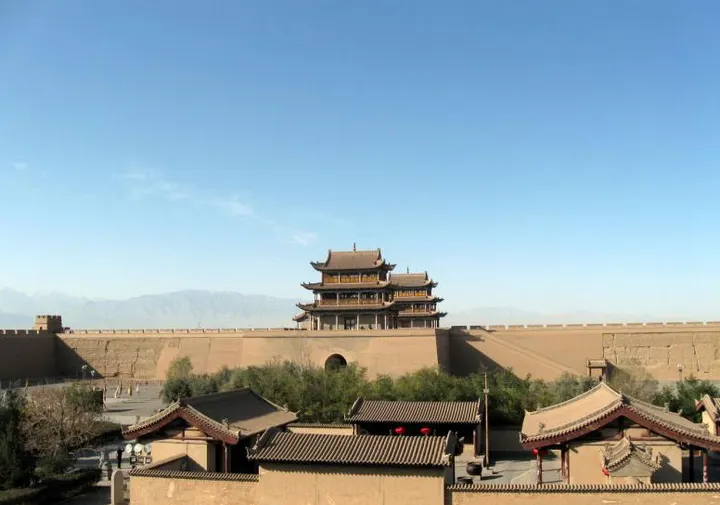
The westernmost pass of the Ming wall and the best-preserved military fortress on it: three storeys of gate tower, rammed earth faced in brick, and the Qilian snowline visible from the parapet. High-speed trains take two and a half hours from Dunhuang to Jiayuguan South, conventional ones five. The fort, the First Beacon Tower and the Overhanging Wall sell separate tickets — about ¥110–120 for the fort in high season, with combination tickets better value. On the way back, Zhangye's badlands are worth a stop.
Jiayuguan's gate tower rising above the rammed-earth wall
15Watch and read before you go
Film
'Flying Swords of Dragon Gate' (2011, dir. Tsui Hark): a Ming-era chase that ends at an inn built among the Dunhuang dunes, with real sandstorms, camel trains and sunsets rather than sets. 'Dunhuang' (1988, a Sino-Japanese production from Yasushi Inoue's novel): a failed scholar stakes his life on a sutra and ends up inside a Tangut army — watch it and the caves read differently.
Camels in hard backlight, the sun flaring above the ridge
Books
Yasushi Inoue, 'Dunhuang': a Japanese novelist's reconstruction of the western frontier from documents and imagination, which in the 1970s sent a generation of Japanese travellers down the corridor. Chen Shunchen, 'A Journey to Dunhuang': travel writing strung on history, light but dense. Chai Jianhong, 'Dunhuang Studies and Dunhuang Culture': the least painful way to understand what the discipline actually studies.
Music and stage
Kitaro's score for 'Dunhuang' is where a lot of people first heard this desert; Dao Lang's 'Great Dunhuang' put camel bells and chanting into a pop song; F.I.R.'s 'Moon Bay' is about a spring that was nearly lost. On stage, the 1979 dance drama 'Along the Silk Road' lifted the pipa-behind-the-back pose straight off a mural, and it is still running.