On the 3,000-metre grassland, the monastery is bigger than the town
No railway: bus from LanzhouLabrang ticket includes a guideOne town, two provincesA car buys you a day
In short
Gannan (甘南, Gānnán) is the Tibetan autonomous prefecture in southern Gansu, administered from Hezuo, averaging around 3,000 m. There is no railway: trains reach Lanzhou and no further, and from there it is a 3.5–4 hour drive to Xiahe or Hezuo — that single fact shapes every itinerary. Four things matter: Labrang Monastery at Xiahe, one of the six great Gelug houses, ¥40 with a guided tour and a 3.5 km circuit of prayer wheels; Langmusi, where the Bailong River splits the town between Gansu and Sichuan and each monastery charges ¥30; Gahai Lake and the Sangke grassland; and the stone-box village of Zhagana in Diebu county. Six days covers the loop, seven or eight with Zhagana. The grass is greenest in June–August, the light is cleanest in September–October, and winter brings festivals at minus fifteen. A mid-range trip runs about ¥3,000–4,500 before transport to Lanzhou.
¥3,000–4,500 for six days, mid-range, sharing a car between two, excluding travel to Lanzhou
Days needed
6–7 days
Comfort
Moderate — 2,900–3,500 m, ordinary roads, simple rooms
Best time to go
June–August for green grass; September–October for clear skies; winter for festivals and serious cold
01What Gannan actually is
South of Lanzhou the road climbs out of the Yellow River valley. Past Linxia the loess gives way to grass, the grass gives way to long green slopes, and after three and a half to four hours the houses start coming in white walls, black window frames and prayer flags on the roof. This is Xiahe, at 2,900 m — not high, exactly, but high enough that hauling a bag out of the boot leaves you briefly out of breath. That is the first lesson Gannan teaches: everything here runs half a beat slower.
The prefecture sits on the northeastern rim of the Tibetan plateau, with Ngawa in Sichuan to the south and Qinghai's Huangnan and Golog to the west. It covers 45,000 square kilometres, a little larger than the Netherlands, and holds roughly seven hundred thousand people. Hezuo, the capital, sits in the middle and functions as the bus hub every route passes through. Elevations run from 1,100 m to 4,900 m, but almost everything a visitor wants lies between 2,900 and 3,500 — the band where grass, monasteries and yaks all do well.
What people call the Gannan route is really three pieces strung into a loop. Xiahe in the west holds Labrang, the Sangke and Ganjia grasslands and the eight-cornered fort, and wants two or three days. Langmusi in the south is a town cut in half by the Bailong River, one step from Sichuan, with Gahai and the Namo gorge nearby; give it a day and a half. Zhagana sits in the southeast corner of Diebu county, a ring of stone walls around terraced fields and Tibetan hamlets — two and a half hours from Langmusi, five or six from Xiahe via Hezuo and Luqu. String all three together and six days is the floor; seven or eight is comfortable.
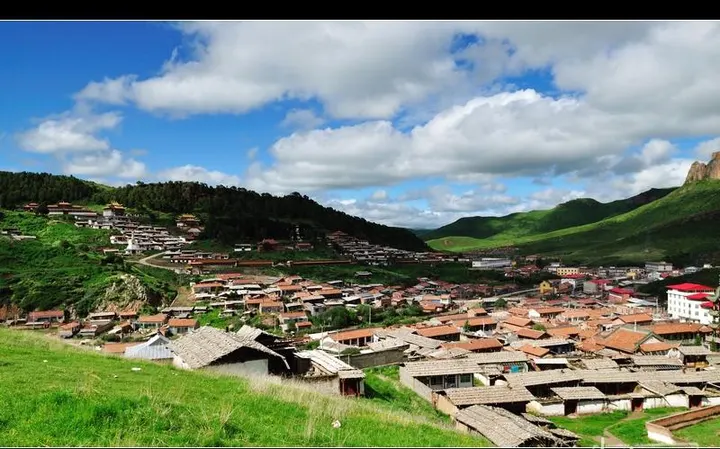
Langmusi from the hillside — whitewashed houses, monastery roofs, and the red cliff standing behind the town
One fact has to come first: Gannan has no railway. The Lanzhou–Hezuo line broke ground at the end of 2021 and is scheduled to open in 2027; until then the only ways in are road and Xiahe airport. So every itinerary begins with getting to Lanzhou and only then with the drive south. That also settles the car question. Buses reach Xiahe, Hezuo and Langmusi, but not Zhagana, not the eight-cornered fort, not the Gahai junction — and those are precisely the parts worth the trip.
Do not treat Gannan as a stand-in for Lhasa. There is no monument on the scale of the Potala and no old town shaped like the Barkhor. What is good here is scattered: three and a half kilometres of prayer wheels, a slope with no fence around it, a town at seven in the morning with nothing but cooking smoke moving. So leave the days loose — two stops at most, and the hours between them spent sitting down somewhere. The faster you go, the less you see, and that is truer here than almost anywhere.
02Six reasons to add a day
Labrang: three and a half kilometres of wheelsOne of the longest circuits anywhere
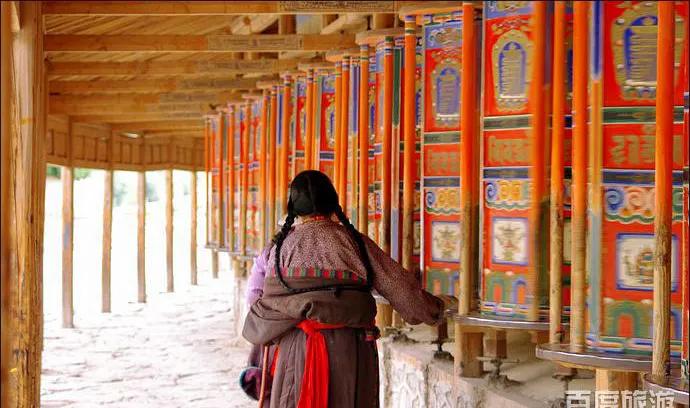
Labrang has no wall; the monastery and the town grew into each other. Around the outside runs a covered circuit of three and a half kilometres lined with more than two thousand copper wheels. Locals walk it in eighty minutes; visitors, stopping to look, take two hours. Half past six in the morning is the fullest hour, mostly older people with a hand wheel going in one hand and a mantra under their breath, unhurried and unstopping. Walk clockwise, never against the flow, and push each wheel with a flat palm so it spins on its own rather than flicking at it.
Ticket:¥40 including a guided tour, groups leaving every 15 minutes; the outer circuit is free
Time:Monastery 09:00–17:00; the circuit runs all day, best at dawn and dusk
Langmusi: one stream, two provincesTen minutes, a provincial border
The Bailong River runs through the middle of town, less than two metres wide; the north bank is Gansu's Luqu county, the south bank is Ruoergai in Sichuan. Sertri Monastery climbs the gentle slope on the Gansu side, gold roofs and white stupas, with the whole town laid out below its rear hill. Gerdi Monastery on the Sichuan side is larger, one of the most influential Gelug houses in Ngawa, and the mouth of the Namo gorge opens directly behind it. Two tickets, two circuits, two provinces ten minutes apart — that dislocation is the pleasure of the place.
Tickets:Sertri in Gansu ¥30; Gerdi in Sichuan ¥30, including the Namo gorge
Altitude:3,480 m — the highest night on the loop
Sangke: an hour on a horse, an afternoon doing nothingTen kilometres from Xiahe
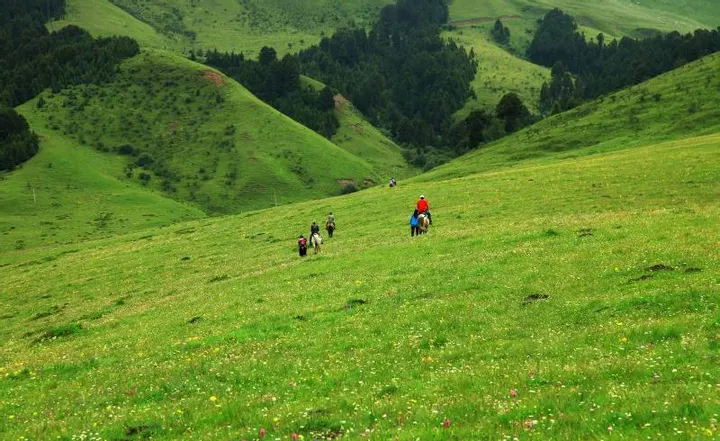
Sangke is a broad meadow southwest of Xiahe, with the Daxia River easing through the middle and rounded hills on every side. Entry is free; the charges are for activities — ¥50–80 an hour on a horse, ¥20–30 to be dressed in a Tibetan coat for photographs, ¥150–300 for a night in a yurt. July brings the densest wildflowers, sheets of purple and yellow; August brings the tallest grass, which lies down in a gust and stands back up. The evening light is the best of it, when the coach parties have gone and the only movement is herders bringing cattle in.
Entry:Free; horses ¥50–80 an hour
Getting there:¥50–80 return by taxi from Xiahe, twenty minutes
Gahai: a piece of wetland that mirrors3,400 m, more birds than people
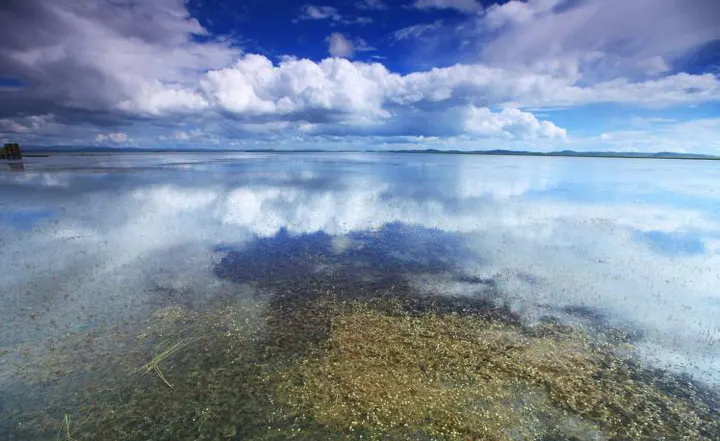
Gahai sits beside the highway 43 km northwest of Langmusi: the largest freshwater lake in Gannan and a wetland of real importance on the eastern plateau. A boardwalk threads between reeds and shallow water, forty minutes end to end, and because the cloud moves fast the surface never holds still. Late May to early June is the bird window, when greylag geese, ruddy shelducks and black-necked cranes pass through or nest. By July the reeds have risen and cut the lake into pieces, which is beautiful to stand in and useless for the postcard reflection.
Ticket:¥40–50, adjusted by year, sold at the gate
Allow:40–60 minutes; worth it on the way, not as a detour
Zhagana: a village inside a stone boxThe name means stone box
Zhagana lies in Yiwa township, Diebu county, inside a near-vertical ring of limestone. Four villages — Dongwa, Yeri, Dari and Daya — sit on the floor with barley terraces stepping up the slopes behind them. Between six and eight in the morning cloud pours up the valley mouth and the villages are alternately above it and inside it. The ticket includes the shuttle, which covers the several kilometres from the gate to the villages. The view that matters is from the Fairy Meadow above Dongwa, forty minutes up on foot: turn around there and the whole stone box is under you.
Ticket:¥80 including the shuttle; concession ¥40
Distance:120 km and 2.5 hours from Langmusi; 300 km and 5–6 hours from Xiahe
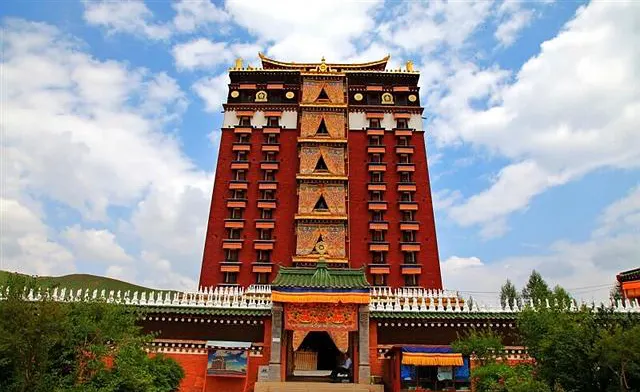
The Milarepa Tower: Hezuo's nine storeysOne building, a whole pantheon
The tall red building on the edge of Hezuo is the Milarepa Tower, known locally as the nine-storey house. It is not dedicated to one Buddha but to the teachers and historical figures of every Tibetan Buddhist school, floor after floor, murals and clay figures and thangkas packed in together like a museum stood on end. The stairs are timber, narrow and loud underfoot, and shoes come off at the door. On the top floor the light comes in sideways through the window openings and lands on the painted beams — the best minute in the building.
Ticket:¥20
Hours:08:00–18:00; no photography inside
03Seven questions worth settling early
How many days does Gannan need?
Six days is the floor, seven is comfortable, eight lets you sleep a night at Zhagana. The standard six: day one to Lanzhou, day two Lanzhou to Xiahe for Labrang, day three the Ganjia fort and Sangke, day four Xiahe to Langmusi via Gahai, day five Langmusi in the morning then Hezuo and the Milarepa Tower, day six back to Lanzhou. Zhagana costs two more: two and a half hours from Langmusi, a night in the village for the morning cloud, then out through Diebu and Hezuo. Three days is possible only by dropping Langmusi or Zhagana, and dropping either one hurts.
Do I have to charter a car, or can buses do it?
Buses cover the three towns — Lanzhou to Xiahe for ¥75, Hezuo to Langmusi for ¥50 — and they are cheap. What they do not do is Gahai's shore, the eight-cornered fort, the far side of Sangke or the villages inside Zhagana, and their departures are few and early. The workable compromise is bus between towns plus a car for the day: bus to Xiahe, charter for Ganjia and Sangke at ¥300–400 for the day, bus on to Langmusi. For two or more people on a trip of six days or less, a car throughout is better value — ¥700–900 a day all in, split two ways it lands close to the bus-plus-taxi arithmetic, and what you save is the waiting.
Is altitude sickness a problem here? Do I need oxygen?
Lower than Lhasa, but not low. Xiahe is 2,900 m, Hezuo 2,960, Langmusi 3,480, Gahai 3,400 — and coming up from Lanzhou at 1,500 m means gaining 1,500 to 2,000 m in a day, which reliably produces a headache and a bad first night. It usually passes in one or two nights. Three things actually help: no hot shower, no alcohol and no hill-climbing on the first evening; two litres of water a day; and no dawn start at Langmusi the morning after you arrive. Cans of oxygen cost ¥20–30 and are sold in pharmacies and guesthouses — a few breaths when the headache spikes, not a mask all night. Travellers with children, older parents or heart and lung conditions should slow the loop further and swap the Langmusi night for Hezuo at 2,960 m.
What are the rules inside a monastery, and can I watch the debate?
Labrang and Langmusi are working monasteries, not attractions. The hard rules: hats and sunglasses off indoors, trousers past the knee, sleeves past the elbow; no photography inside any hall, and never a flash; do not touch statues, texts, or a monk's rosary and amulets; walk clockwise around buildings, stupas and mani piles; do not point at a statue with one finger — indicate with an open hand; never stand on a threshold. Monastic debate is usually at three in the afternoon, at Labrang in the yard in front of the philosophy college. Stand at the edge, do not push into the circle, keep your voice down and keep the lens out of faces. If a hall is closed for a ritual or a retreat, take the refusal at the door and walk away.
Is Langmusi in Gansu or Sichuan?
Both. The town is cut in two by the Bailong River: the north bank belongs to Luqu county in Gannan prefecture, Gansu; the south bank to Ruoergai county in Ngawa prefecture, Sichuan. The little bridge between them is the provincial line, unmarked except for your phone signal dropping and re-registering. Each side has its own Gelug monastery. Sertri, on the Gansu side, was founded in 1748 by a former abbot of Ganden; Gerdi, on the Sichuan side, is older and oversees eighteen branch houses and some five hundred monks. Tickets are ¥30 each, and the Sichuan one includes the Namo gorge. Search for the town on a map and you will get two provincial versions — neither is wrong.
At Zhagana, should I stay in the village or outside?
If you want the morning cloud, sleep in the village — there is no second option. It rises from the valley mouth between six and eight, and Diebu county town is forty minutes away, too far to catch it. Village guesthouses run ¥150–500 and vary enormously: the newer ones have private bathrooms and electric blankets, the older ones share facilities, transmit every sound and get cold at night. Ask specifically about both before booking. At over 3,000 m the first night here is harder than Xiahe. Drivers park at the gate and take the shuttle in; with heavy bags choose Dongwa, the closest village to the drop-off. July and August need booking weeks ahead — the bed count inside the valley is small.
Is it worth coming outside June–August? What about winter?
Yes, and September–October may beat summer: the rains end, the sky goes hard and blue, the grass turns from green to ochre, visibility is at its best and the crowds thin out. May is still brown but has the most birds and the cheapest rooms. November to March is low season — minus five in the day, minus fifteen to twenty at night, some guesthouses shut, Gahai's road can close — and what you get in exchange is monasteries with almost nobody in them and the great New Year festival at Labrang, which runs from the third to the seventeenth of the first lunar month: animal release on the eighth, the great thangka on the thirteenth, masked dance on the fourteenth, butter sculptures on the fifteenth. If cold and closures frighten you, stay away; if you want to see the monasteries actually working, winter is the season.
04Six days round, plus two for Zhagana
One rule governs the whole loop: sleep low on the first night. Lanzhou is 1,500 m, Xiahe 2,900, Langmusi 3,480 — going straight up to Langmusi costs you the next day. So the order runs Lanzhou, Xiahe, Langmusi, Hezuo, Lanzhou, climbing in stages and coming back down. The reverse works too, but people who sleep at Langmusi on night one usually lose the following morning.
D1
Arrive in Lanzhou. Stay in Chengguan or near Lanzhou West; walk the Yellow River in the afternoon — Zhongshan Bridge, Baita Hill, the waterwheel park in one line — and eat at Zhenning Road night market. Save the beef noodles for tomorrow morning: in Lanzhou they are breakfast, and after noon the broth is not the same.
D2
The 07:30 bus from Lanzhou South to Xiahe, ¥75, three and a half to four hours. Arrive around noon, stay near Renmin Street, and enter Labrang at two with the guided group for ninety minutes; walk a stretch of the circuit afterwards, and be at the debate yard by three. Climb the slope opposite the monastery for the panorama before dark, and be down before the light goes.
D3
Charter a car for Ganjia: the eight-cornered fort is 35 km north of Xiahe, an earthen wall with eight corners around a village that still farms inside it, two hours there and back. Lunch in Xiahe, then Sangke in the afternoon — an hour on a horse, then find a slope and sit until the sun goes. Back to Xiahe for the night.
D4
Leave at eight for Langmusi on the G213, two and a half hours to Gahai for the boardwalk, then another hour into town. In the afternoon cross to the Sichuan side and walk the first kilometre and a half of the Namo gorge behind Gerdi; towards evening come back over the bridge to Sertri and climb the slope at the back for the view down. Sleep in Langmusi.
D5
One more circuit of Langmusi in the morning, then the 09:30 bus to Hezuo, three hours. The Milarepa Tower in the afternoon: shoes off, nine floors, forty minutes. Hezuo is the prefecture capital, so dinner and beds are a grade better than in the county towns — this is the place for hand-pulled lamb.
D6
Hezuo back to Lanzhou, a bus every half hour, three and a half hours. Take an afternoon train or flight if you must; otherwise give Lanzhou one more night and eat what you missed.
Two extra days for Zhagana: skip Hezuo on day five and run southeast from Langmusi, two and a half hours, walk up to the Fairy Meadow in the afternoon and sleep in Dongwa. Day six, up at six for the cloud, away by ten either back through Diebu and Hezuo to Lanzhou or south into Sichuan. That turns the trip into eight days, and the final driving day is long — plan for it.
05From Labrang to the stone box
Labrang Monastery
Labrang was founded in 1709 under the first Jamyang Shepa and is one of the six great Gelug monasteries, alongside Ganden, Drepung, Sera, Tashilhunpo and Kumbum. The Gelug school is the youngest of the major Tibetan Buddhist traditions, reformed by Tsongkhapa in the fifteenth century around strict discipline and a systematic monastic education — and Labrang is the largest embodiment of that system in the Amdo region. Six colleges make up the institution, covering sutra, tantra, Kalachakra, medicine and the tantric rituals of the Guhyasamaja cycle, each with its own assembly hall; at its height four thousand monks lived here.
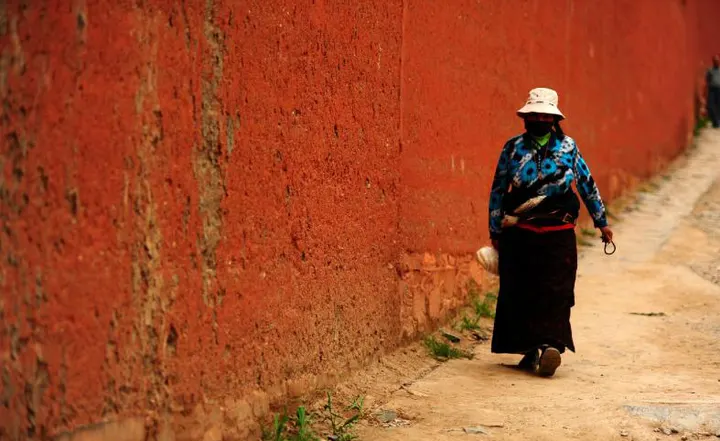
A woman in a wide-brimmed hat walking the red outer wall at Labrang, the circuit running along the other side
The simplest way in is with the guided group: the ¥40 ticket includes a monk-led tour that leaves the gate every fifteen minutes and takes in the great assembly hall, the Lion's Roar chapel and the butter-sculpture hall in about ninety minutes. Give the butter sculptures an extra ten minutes — figures and tableaux modelled in coloured yak butter with a density of detail that does not look hand-made, kept at sub-zero temperatures, so dress for it. No photography inside the halls, though the butter hall is an exception. Walking only the outer circuit costs nothing, and plenty of people do exactly that and come away satisfied.
Two places give you the whole thing. The Gongtang Pagoda at the southeast corner charges ¥20 to climb, and from its third level you get the full field of gold roofs with Longshan, the Dragon Hill, behind. Or cross the bridge south of the monastery and walk twenty minutes up the far bank of the Daxia for a wilder angle that holds monastery, town and river in one frame. Go late: the light comes in from the west, the gold reads warm and the white walls read cold.
Langmusi: the two monasteries
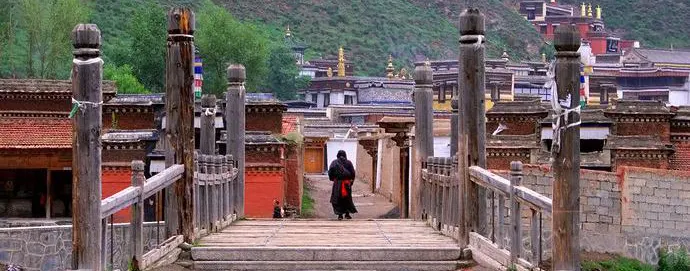
Timber posts and stone steps on the walkway into a Langmusi monastery, a figure in red heading in
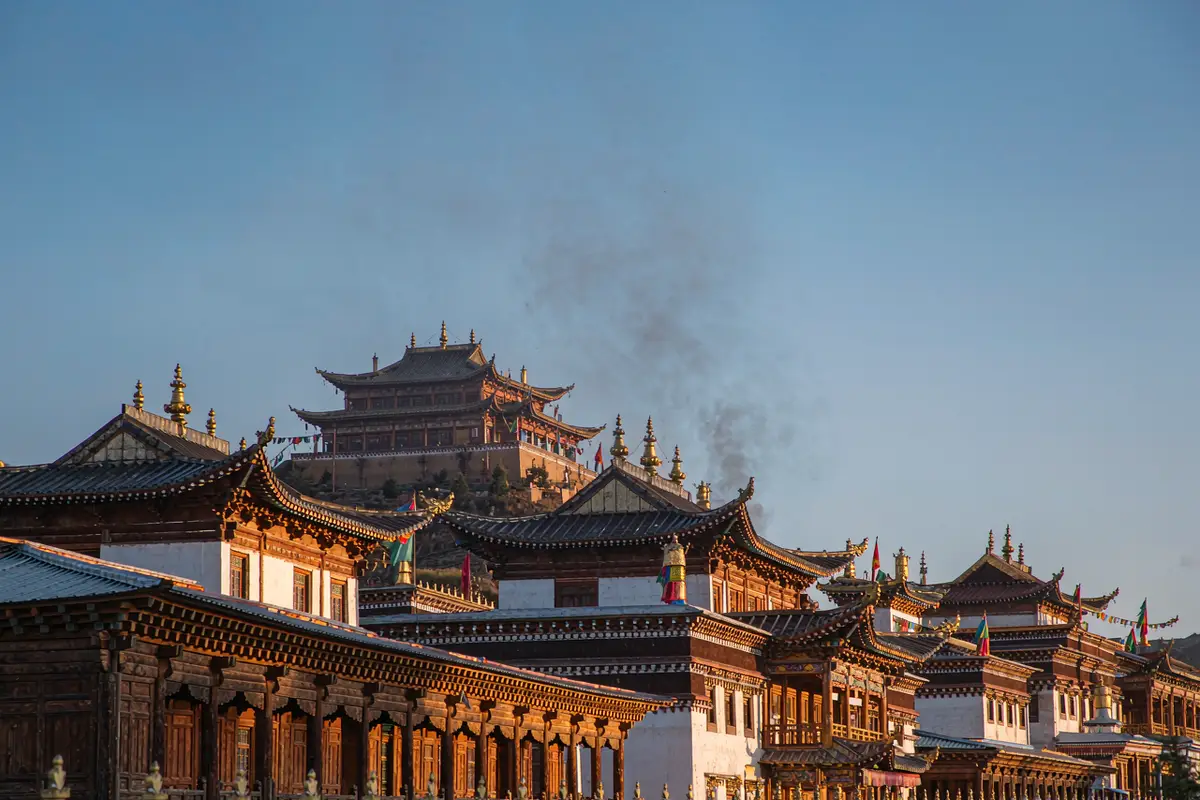
Sertri, on the Gansu side, climbs a gentle slope: a few minutes from the gate to the assembly hall, gold roofs, white stupas, red columns. It is far smaller than Labrang and much quieter. A path behind it leads up for twenty minutes to a view over the whole town and the red cliff opposite; at sunset the rock turns brick and the town turns blue-grey, which is the picture everyone comes for.
Gerdi, across the water, is the larger foundation and a Gelug stronghold for the whole Ngawa region, with eighteen branch monasteries under it. Behind it the Namo gorge makes an easy walk: a kilometre and a half upstream on level ground, an hour or so there and back, ending at the spring that is treated as the source of the Bailong River. The gorge is dark and the stones are slick, so wear grip. The monastery's best-known relic is the preserved body of the fifth Gerdi lama; whether and when you may see it is a question for the monks at the door, not for you to open.
Gahai Lake
Gahai is the largest freshwater lake in Gannan at 3,400 m, ringed by pasture, shallow and reedy. A single boardwalk covers it in forty minutes; you cannot get down to the water and drones are not welcome — this is a reserve, and the birds outrank the visitors. Late May and early June are the peak, when migrants are moving through and the surface is never still. By July the grass has come up and hides half the lake, which is a fair trade for the colour. The wind is strong; hold on to your hat.
Zhagana
Zhagana sits in Diebu county inside a ring of rock walls four hundred to a thousand metres high, with four villages stacked up the valley floor in plank houses weighted down with stones. Joseph Rock passed through in the 1920s and wrote the sentence that is now printed on every signboard in the county. The ¥80 ticket includes the shuttle from the gate to Dongwa; after that you walk. The Fairy Meadow is a forty-minute climb, and from the top the whole stone box lies behind you. Another two or three hours beyond it is the Fairy Lake, on a path that is easy to lose — ask in the village.
Of the four villages Dongwa is the biggest and has the most beds; Yeri sits halfway up and has the best angle for sunrise; Dari and Daya are smaller and quieter. The cloud between six and eight in the morning is the entire point, and outside those hours it is simply a valley. So either sleep here or skip it — a day trip shows you some villages and nothing else.
The Milarepa Tower and Ganjia's eight-cornered fort
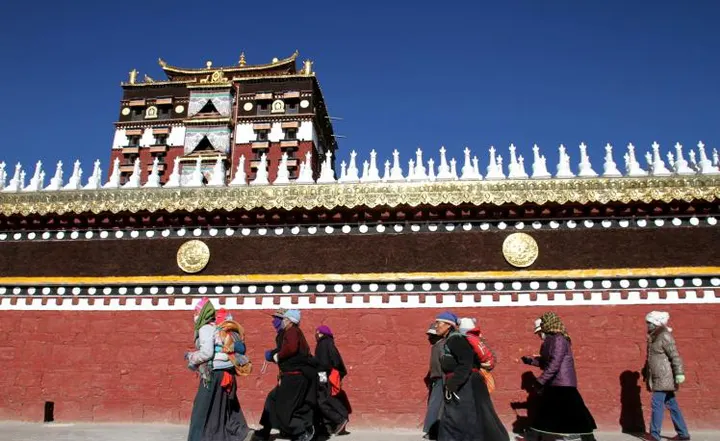
The low wall around the Milarepa Tower, white stupas along its top and pilgrims passing below
The Milarepa Tower stands on the north edge of Hezuo. First built in 1777, destroyed in the 1960s and rebuilt in 1992, it rises nine storeys and forty metres in honour of Milarepa, founder of the Kagyu school — but the floors hold the teachers of every tradition and half the historical figures of the plateau, which makes it read more like a vertical museum of Tibetan learning than a single-sect shrine. ¥20, shoes off, no photographs, and narrow stairs that queue up when a group arrives.
Ganjia's eight-cornered fort lies 35 km north of Xiahe: rammed-earth walls, eight corners, a hollow cross in plan, usually attributed to the frontier defences of the Han–Tang period though the dating is still argued over. People live inside it and still grow barley and keep sheep. You can walk the wall, but the earth is soft and trodden — stay away from the outer edge. There is no proper ticket office; someone may appear at the junction asking ¥20, and you can negotiate. A return charter from Xiahe is ¥100–130 and takes two hours.
06Walk, ride, listen
The early circuit
Out at half six, when the light is still flat, and the circuit at Labrang already has people on it. Older men and women move fast with an even spin on the hand wheel; younger ones carry flasks of butter; now and then someone goes down full length and pushes back up with boards strapped to their hands. Walk with them. You do not need the words; your feet find the rhythm by the second corner. One lap is three and a half kilometres, a little over an hour, which lands you at breakfast. When someone is prostrating, stand to the side and leave the space in front of them clear — and keep the camera away from their face.
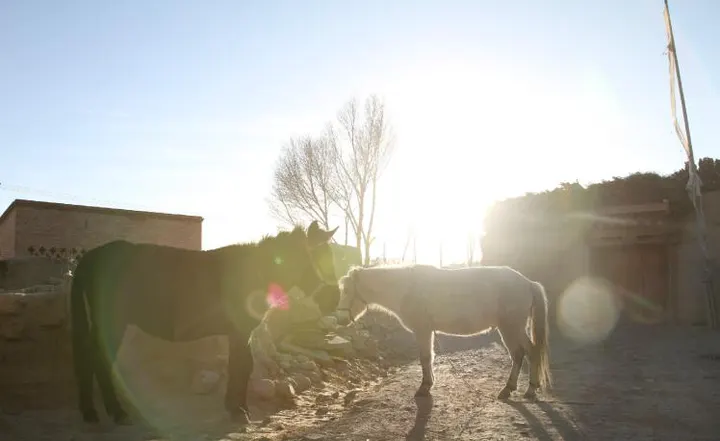
Yaks in backlight against a mud wall, tails swinging slowly
Watching the debate
Debate is part of how monks are trained, not a show. At three in the afternoon in the yard in front of Labrang's philosophy college, the seated monk answers and the standing one claps his hands to press the question; claps, stamped feet and very fast speech arrive together. Visitors may watch, on terms: stay at the edge, keep quiet, no flash, and never step into the circle. Not understanding the content does not matter — watch the rhythm. A single question can run for fifteen minutes and the one answering is not allowed to stop. Both Langmusi monasteries debate as well, at irregular hours; the guesthouse owner will know better than any guidebook.
Riding on the grassland
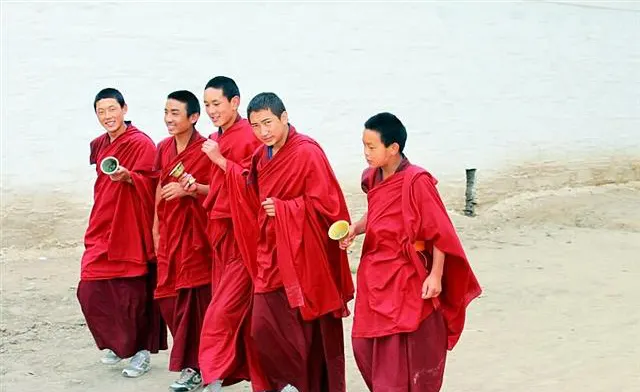
Young monks talking and laughing on open ground, red robes lifting in the wind
Both Sangke and Langmusi run horse trips. Sangke charges by the hour, ¥50–80; Langmusi charges by the route — a day to the source of the Bailong, half a day round the red cliff — from just over ¥100 to the low ¥300s. The horses belong to herders rather than a riding school, the instructions are simple, and following the guide is the whole technique. Agree the duration, the route and whether someone leads the horse before you get on. Grassland looks flat and is full of pika holes and ditches, so do not take the reins and kick. July and August are the months for it; in May the grass is short, the wind is up, and ten minutes is enough.
The New Year festival and Xianglang
Labrang holds seven great festivals a year, the largest being the New Year prayer festival, which runs from the third to the seventeenth of the first lunar month. On the eighth animals are released after being sprinkled with water and tied with coloured ribbons; on the thirteenth a thangka tens of metres long is unrolled down the hillside; on the fourteenth monks dance in masks; on the evening of the fifteenth the colleges set out butter sculptures around the great hall. Xiahe fills up that week and the temperature sits well below freezing, so two hours standing still will take the feeling out of your feet — dress for it. Summer belongs to Xianglang, when families take tents and cooking pots up onto the hills for a few days sometime in the sixth or seventh lunar month. There is no fixed date; catching it is luck.
07Four bases, four standards
Judge Gannan's rooms on three things — hot water, a private bathroom, and how cold the night gets — rather than on stars. Xiahe and Hezuo have the widest choice, Langmusi less, and the villages at Zhagana the fewest beds at the highest prices. Book ahead for July, August and the New Year festival; the rest of the year you can arrive and look.
Xiahe: densest along Renmin Street, ten minutes on foot from Labrang. Guesthouse doubles ¥150–300, many of them newly done in Tibetan style; the older hotels ¥200–400 with parking. If you want the monastery out of the window, ask whether the room actually faces the gold roofs — plenty face the back yard.
Langmusi: along the main street and around the bridge, guesthouses ¥100–250, hostel beds ¥40–60. The older buildings transmit sound and lose heat; ask about electric blankets and private bathrooms. At 3,480 m, do not take an unheated room on your first night.
Zhagana: Dongwa has the most beds, Tibetan guesthouses ¥150–500, the newer ones with underfloor heating and private bathrooms, the older ones sharing facilities. High season doubles the price and still sells out. Above 3,000 m the nights are cold; asking for a second quilt is normal.
Hezuo: the prefecture capital, business hotels ¥180–350, newer rooms and reliable hot water — the most solid night's sleep on the loop, and the sensible stop before the run back to Lanzhou.
One practical note: winter is low season, and between November and March plenty of guesthouses simply close, while those that stay open may have no heating. If you come then, ask the two questions — is there heating, is there hot water — before you look at the photographs. Summer inverts the problem: the issue is noise rather than cold, with traffic on the street until late, so take a room facing the courtyard.
08Butter, barley, yak — and one bowl of Lanzhou noodles
Everyday food in Gannan is plateau food: high in calories, light on seasoning, short on vegetables. The staples are tsampa and wheat noodles, the meat is yak and mutton, and dairy turns up at every meal. The first sitting can taste either bland or greasy; by the third it is obvious why it suits the place — at 3,000 m this is what the body asks for. Xiahe and Langmusi also have Sichuan kitchens, Hui restaurants and even a passable Western menu, so a difficult stomach always has an exit.
What to order
Butter tea: brick tea boiled, churned with butter and salt, served savoury. One bowl holds you for half a day. The first mouthful puzzles most people and the second settles it. ¥15–30 a pot.
Tsampa: roasted barley flour worked into a ball with butter tea, by hand. Doing it once teaches more than watching ten times — if it crumbles add tea, and it is ready when it stands up in your palm.
Tibetan momo: yak-filled dumplings with a thick skin and a lot of juice, about eight to a steamer for ¥15–25. The ones in Xiahe's Tibetan restaurants beat anything near a ticket gate.
Fern-root rice: rice steamed with the sweet tuber locals call fern root, plus butter and sugar. A celebration dish, sweet and extremely filling, ¥10–15 a bowl.
Yak: braised, stewed or in a hotpot. The fibre is coarser than beef and the fat much lower, so it needs long cooking. Xiahe's hand-pulled mutton is worth ordering too, sold by weight and eaten with salt and pepper.
Yogurt: set in a ceramic bowl, sour without apology, eaten with two spoons of sugar. ¥5–10 a bowl from any small shop.
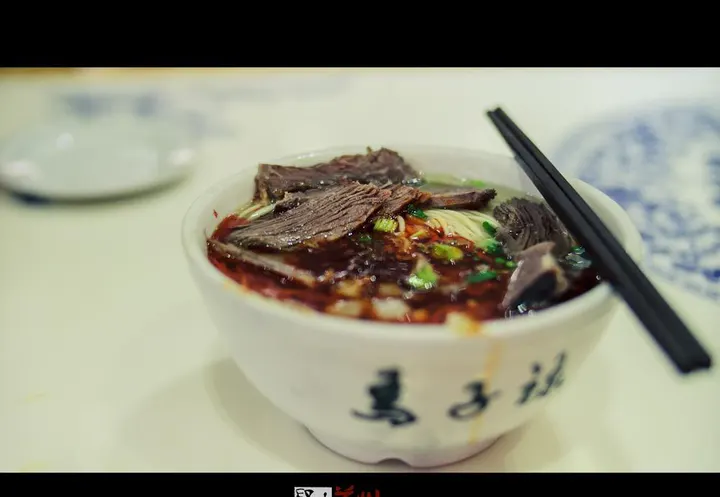
Lanzhou beef noodles: eat them on your first morning in Lanzhou. Clear broth, white radish, red chilli oil, green coriander, yellow noodles, with the noodle gauge chosen at the counter from hair-fine to wide. ¥8–15 a bowl, and the broth is not the same after noon.
A bowl of Lanzhou beef noodles — clear broth, radish, chilli oil, coriander, noodles underneath
Where to eat: Renmin Street in Xiahe covers everything in one run — Tibetan, Sichuan, noodle shops side by side. Langmusi's main street leans Sichuan and Hui, with a couple of small places doing apple pie and coffee, a habit left by two decades of foreign backpackers. Hezuo does hand-pulled lamb better than the county towns, and Lanzhou deserves a final bowl of noodles. A proper dinner for three runs ¥100–180; a noodle lunch is ¥15–30 a head.
Three notes. Digestion runs slow up here, so keep the first two days light and go easy on the oil. Do not bring your own alcohol into restaurants near monasteries or into Hui places, and do not push drinks on anyone. In Tibetan restaurants, do not leave half-eaten meat lying on the table or wave chopsticks at people. Teahouses mostly take cash — keep a few tens in small notes.
09Prayer wheels, thangkas, and what to leave alone
Gannan is not a shopping destination, but a few things here are genuinely good: copper prayer wheels, beads, hand-knotted carpets and thangkas. Xiahe's Renmin Street and the row outside Labrang have the densest concentration, Langmusi's main street rather less. Opening prices run two to three times what a seller will take, so start at half; if they will not move, walk, because ten shops on the same street carry the same object. Anything near a gate labelled old or antique is new.
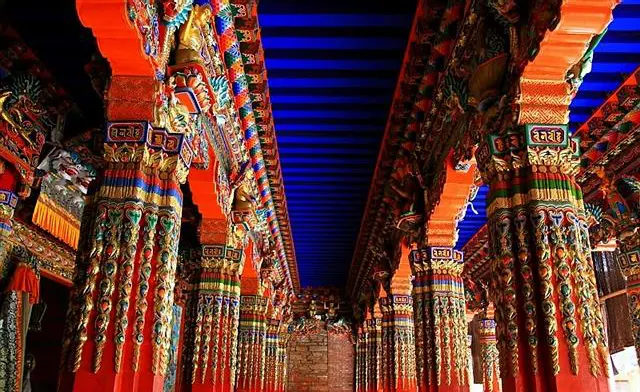
Painted pillars under a monastery porch, red and gold and blue stacked together — the palette the thangka shops work from
Prayer wheels: copper, wood or silver, from tens of yuan to several hundred for hand-beaten copper. Spin it before you buy — smooth, weighted, and no rattle.
Beads: bodhi seed, wood, yak bone, tens to hundreds of yuan. On bodhi, look at the holes and the surface — new beads are chalky, worn ones have a sheen.
Carpets and seat cushions: hand-knotted from a few hundred to ¥2,000, machine-made from about ¥100. Turn it over — handwork has irregular, strong knots; machine work is too tidy.
Thangka: a few hundred buys a print with hand-painted gold, tens of thousands buys months of a painter's work. Ask whether it is hand-painted and how long it took, and only buy where they will write a receipt.
Dried yak: choose packs listing only meat, salt and spice, ¥25–40 per 100 g. Vacuum packs travel by train and plane, but Australia, New Zealand and the United States restrict meat imports — check before you buy.
Leave alone: Tibetan knives, which cannot fly in cabin or, on most airlines, in the hold; old amber and old dzi beads, which at any stall are new; and loose saffron, which belongs in a proper pharmacy, sold by the gram with a receipt.
To compare in one walk, do Xiahe's jewellery row and Langmusi's main street; prices are close, Langmusi slightly cheaper with less choice. The genuinely old pieces are not in these shops but in herders' houses, where you cannot buy them — and should not.
10The train stops at Lanzhou; the last four hours are road
Leg one: everything runs through Lanzhou
Gannan has no railway, which leaves Lanzhou as the only practical gateway. Xi'an North to Lanzhou West is about three hours for ¥175–200 in second class, twenty-odd trains a day; Beijing, Shanghai and Guangzhou all have direct services, but at ten hours plus most people fly. Zhongchuan airport is 75 km northwest of the city, ¥30 and an hour by shuttle bus, ¥150–180 by taxi. From Lanzhou West to the South bus station, bus 129 costs ¥2 and takes forty minutes, longer in traffic — allow ninety if you are catching a departure.
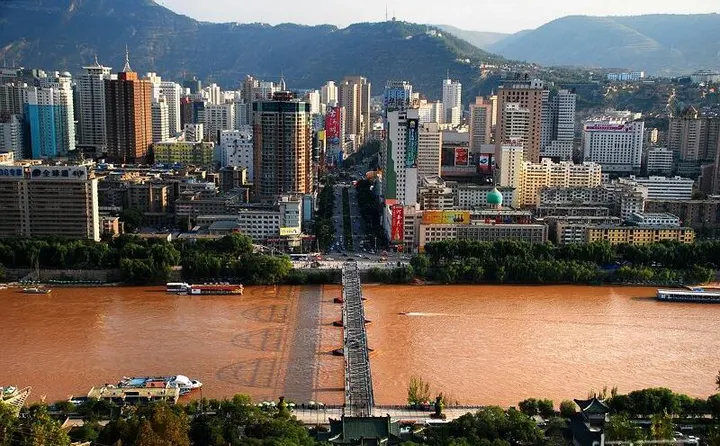
Lanzhou from above: the Yellow River through the middle, the iron bridge and the towers close on both banks — where every Gannan trip starts and ends
Leg two: the buses
Lanzhou South, at 81 Langongping Road opposite the Lanzhou University of Technology, is the one station that matters for Gannan. Xiahe gets five departures a day — 07:30, 08:30, 09:30, 14:00 and 15:00 — for about ¥75 and three and a half to four hours. Hezuo runs every twenty to thirty minutes from 07:00 to 17:00 for the same ¥75. Langmusi has two direct buses at 08:40 and 09:40 for about ¥120, routed via Diebu and taking over seven hours; you are better off going to Xiahe or Hezuo first and changing.
Inside the prefecture there are only three links worth memorising. Hezuo to Xiahe is about ¥25 and an hour, every half hour. Hezuo to Langmusi is about ¥50 and three hours, at 07:00, 10:20 and 12:00. Xiahe to Langmusi is about ¥71.5 and four hours, leaving at 06:40 and 07:40 with the return at 14:00. Timetables drift a little every year, so have your guesthouse ring the station the day before — that beats any guide, including this one.
Chartering: dearer, and worth a day
A five-seat sedan with driver runs ¥700–900 a day including fuel, tolls and the driver's own food and lodging; an SUV from ¥800; a seven-seat van around ¥1,000. Lanzhou to Xiahe one way is ¥500–700, Xiahe to the eight-cornered fort ¥100–130 return, Xiahe to Sangke ¥50–80 return. A three-day mini-loop — Xiahe, Gahai, Langmusi, Hezuo — costs ¥2,400–2,900 for the vehicle, and six days ¥4,000–5,000. Shared seats are ¥150–250 a head per day on fixed routes with no unscheduled stops.
Book through your guesthouse, hotel desk or an introduction, not from the touts in the station forecourt. Even a verbal agreement should fix the start time, the finish time, the overtime rate, whether Zhagana is included — it adds three hundred kilometres and many quotes quietly exclude it — and who pays for the driver's food and bed. Gannan's roads are bendy, the climbs are long and livestock crosses without warning; without mountain-driving experience, do not self-drive. A local driver covers two hundred kilometres a day as routine and knows which blind corner needs a horn.
Rail: not yet, and under construction
This needs stating plainly, because tickets for a Lanzhou–Xiahe high-speed train are already being advertised online and no such service exists. The Lanzhou–Hezuo railway is 147 km at a design speed of 200 km/h, broke ground in December 2021 and is scheduled to open in 2027, at which point Lanzhou to Hezuo will take an hour; the Gannan section of the Xining–Chengdu line is planned for 2029. Until then, reaching Gannan still means changing to a bus in Lanzhou. Xiahe airport (GXH) sits at 3,190 m, 43 km from Xiahe and 32 km from Hezuo, with scheduled flights in 2025 to Xi'an, Chengdu, Lhasa and Tianjin via Xi'an — seasonal, so check the day's schedule before you book.
Emergency: police 110, ambulance 120, fire 119. Ambulances are slow to reach you up here; if you can walk to a hospital, walk.
Hospitals: Xiahe County People's Hospital is at 50 Renmin East Road, five hundred metres east of the bus station; the Gannan Prefecture People's Hospital in Hezuo is the largest in the prefecture. A headache that lasts three days, an unsteady walk or breathlessness at rest means go now.
Oxygen: portable cans ¥20–30 from pharmacies and guesthouse desks, and some guesthouses rent concentrators by the hour. Do not sleep on it — dependence sets in fast.
Money: WeChat and Alipay both link foreign cards and QR payment works in the towns. Monastery tickets, old teahouses and village shops often want cash, so keep two or three hundred yuan in small notes. ATMs on Xiahe's Renmin Street include Agricultural Bank and China Construction Bank.
Phones: 4G is fine in the towns and drops out for long stretches on the highway to Langmusi; the valley at Zhagana is weak. Screenshot maps and ticket codes in advance rather than trusting the signal.
Documents: carry your passport — hotels register you on arrival and checkpoints occasionally ask. Monastery tickets do not require it.
Manners: no smoking in monasteries, no touching statues or texts, no striking drums or bells, and never sit on a seat reserved for a lama. Walk clockwise around wheels, stupas and monastery walls. Ask before photographing anyone, especially older people and anyone mid-prostration. At a festival or a private ceremony, stay at the edge and do not push in.
Toilets: one or two yuan at sights and monasteries, and bring your own paper; out on the grassland expect a long drop and nothing more. Tipping is not expected, not in restaurants and not for drivers.
Two smaller things. The ultraviolet at 3,000 m will burn you in twenty minutes, cloud or no cloud, and the wind on the grassland will take a hat without a chin strap. And carry your rubbish out — Gahai and Zhagana are protected areas, the bins along the road are often full, and a bottle left in the grass stays there.
12What to sort out, and when
Three to four weeks out: book transport to and from Lanzhou and decide between six days and eight. In July and August book Xiahe and Langmusi at the same time, and Zhagana's village rooms especially early.
One to two weeks out: fix the car, with the route, the number of days and whether Zhagana is included agreed in writing. Check the bus times once and write them down.
Three days out: watch the forecast. July and August bring hard afternoon showers that turn the grassland tracks to slurry, and two days of rain can close the Zhagana road at short notice.
Clothing: a shell, a fleece or light down, two long-sleeved layers, two pairs of trousers, shoes you can walk uphill in, a wide hat, sunglasses, SPF50 and lip balm. Monasteries want knees and shoulders covered, so leave the shorts and vests at home.
Medicine: cold tablets, painkillers, something for the stomach, glucose sachets, plasters. Rhodiola is taken for a week beforehand with thin evidence and no risk; acetazolamide works faster but ask a doctor first.
Extras: a thermos, wet wipes, a power bank, three to five hundred yuan in cash, and an offline map. Do not fill the case — you will come back with dried yak and a carpet.
A few hard lines. Do not come up with an active cold; at this altitude it can settle into the chest. Get a doctor's view first if you have heart or lung disease, badly controlled blood pressure, severe anaemia or recent surgery, and skip it altogether with an infant. Being fit does not exempt you, and there is no need to stop training beforehand — but do not show off once you are here. In Gannan the people who walk slowly are the ones still going at the end of the week.
13The edge of the plateau, a corridor, two provinces
Geography and climate
Gannan sits on the northeastern rim of the plateau, where it meets the loess country: open meadow grassland in the northwest, hilly farmland in the east, and the deep forested valleys of Minshan in the south. At Maqu the Yellow River swings through a bend more than four hundred kilometres around, the only serious meander on its upper course. Elevations run from 1,100 to 4,900 m; Hezuo, the capital, is at 2,960 m with a mean annual temperature below two degrees and no guaranteed frost-free season — even at the height of summer you want a jacket morning and evening.
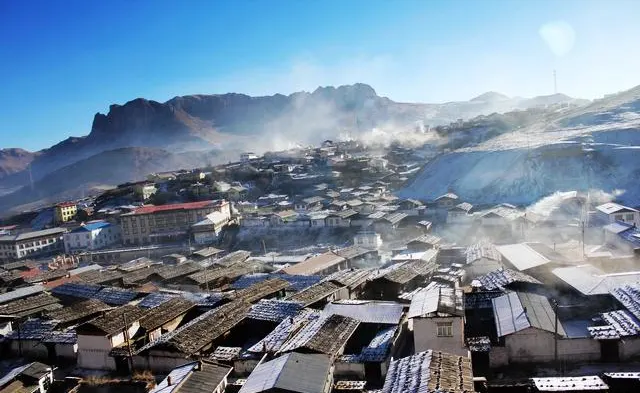
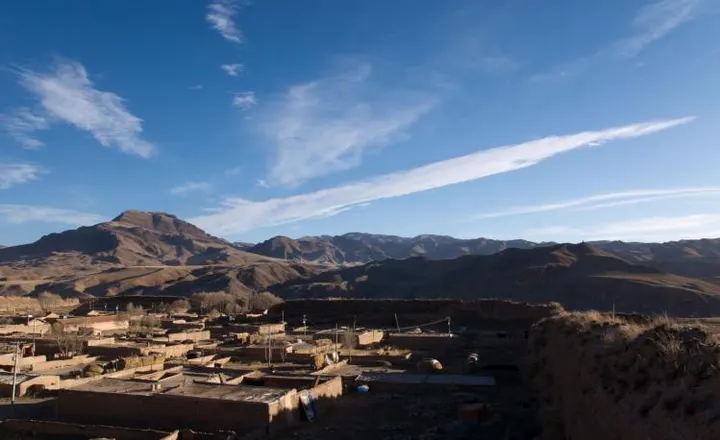
First snow on a Gannan town — flat roofs holding a crust, the ridge going white before the valley does
The Gelug school and Labrang
Tibetan Buddhism has several traditions — Nyingma, Sakya, Kagyu and Gelug among them. The Gelug is the youngest, founded by Tsongkhapa in the fifteenth century around discipline and a graded monastic education; a monk can spend fifteen years working toward a degree. It became the most influential of the schools, and its six great houses are Ganden, Drepung, Sera, Tashilhunpo, Kumbum and Labrang. Labrang was founded in 1709 by the first Jamyang Shepa and at its height held four thousand monks across six colleges, making it the centre of Buddhist learning for the whole Amdo region — Qinghai, Gansu and northwestern Sichuan. That is what the old phrase second Tibet refers to: academic standing, nothing more.
Why Langmusi is two provinces
The Bailong River here is a stream two metres wide, but it has marked an administrative boundary since the Qing. The north bank belongs to Luqu in Gansu, the south bank to Ruoergai in Sichuan, and each side has its own Gelug monastery with its own branch houses and congregation. The town's shape grew out of that: one main street along the water, Gansu shops on this side of the bridge and Sichuan courtyards on the other. For a visitor it means two tickets and two welcome texts from your mobile operator.
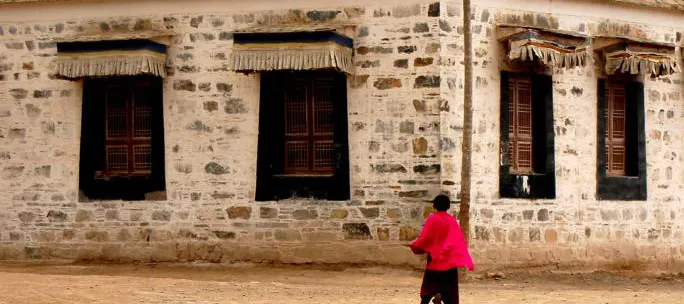
A lane in Langmusi — stone walls, black window frames, pleated valances above each window, a figure in red passing
A herder's year
The grassland is home mostly to Amdo Tibetans, with herding and farming splitting the year between them. Herders follow the grass: up to the high summer pastures in tents, back to fixed houses for the winter on hay cut in autumn. The black yak-hair tents, the rows of prayer flags, the mani piles on the ridges — all of that is the working furniture of that life, not a set built for visitors. Ask before you photograph and most people will nod, but do not chase children with a lens.
Festivals
Two dates matter. In the first lunar month Labrang's prayer festival runs from the third to the seventeenth, with the great thangka, the masked dances and the butter sculptures packed into the thirteenth to the fifteenth — the most concentrated stretch of the year. In the sixth and seventh lunar months comes Xianglang, when families take tents and stoves up onto the hills for a few days, at dates that vary village by village; Hezuo also holds its Shambhala festival in July or August, when several hundred tents appear on the grassland overnight. Both follow the lunar calendar, so look up the Gregorian dates for your year before building a trip around them.
14Four directions, half a day to two
Ganjia grassland and the eight-cornered fort (half a day, 70 km)
Gannan's grass slopes stacking one behind another, the road running the ridge, cloud shadow sliding across
Thirty-three kilometres north of Xiahe the Ganjia grassland opens out, and two kilometres beyond it stands the eight-cornered fort. Ganjia is wilder than Sangke, the hills closer around it, and in July and August it is thick with flowers. You can walk the rammed-earth wall in twenty minutes; inside, the village farms barley right up to its foot. This is a half-day charter, ¥100–130 return. A motorbike or your own car works too, though the last stretch is dirt.
Sangke grassland (half a day, 10 km)
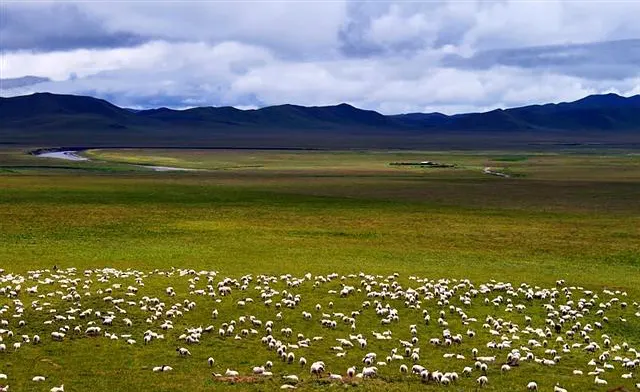
Sheep scattered across the meadow, white dots all the way to the foot of the hill under a low sky
Ten kilometres and twenty minutes from Xiahe, Sangke is the easiest half-day on the whole trip. The grassland is free; the money goes on horses, yurts and being photographed in a Tibetan coat. If you have already come through Zhagana and Gahai, an evening here is enough. If Xiahe is all you are doing, Sangke is the least effortful grass you will find. Skip the resort bonfire evenings, which are loud and staged, and find a slope to sit on instead.
The first bend at Maqu (1–2 days, 3 hours each way)
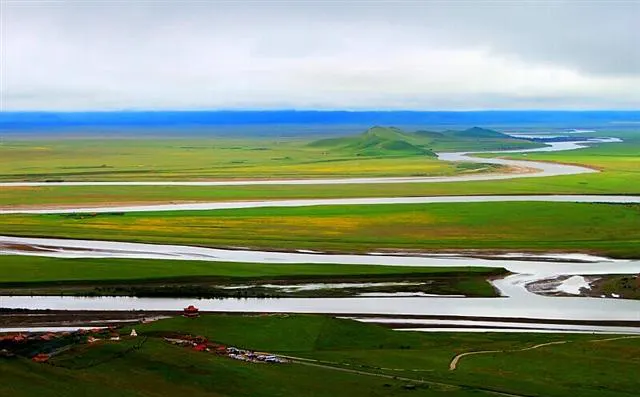
The braided upper Yellow River, split by grassland into several channels — lake-wide in places, a step across in others
Maqu occupies the southwest corner of the prefecture, where the Yellow River makes that four-hundred-kilometre bend; the name means the river itself. It is about three hours from Hezuo on a good road, grass running to the horizon the whole way. The viewing platform is a few kilometres out of town, charges a ticket and is best at sunset. At 3,400–3,500 m the wind is relentless and ten minutes standing still is enough to get cold. Most people come back to Hezuo the same day; stay in town only if you want sunrise.
Zhagana (2 days, 120 km)
South-east from Langmusi on the G213 and then the provincial road, Zhagana is two and a half hours away and the best-value extension on the trip. Walk up to the Fairy Meadow on the first afternoon, sleep in Dongwa, be up at six for the cloud and leave by ten. Coming straight from Xiahe means five or six hours via Hezuo and Luqu and a whole day in the car; better to put it after Langmusi.
Tongren in Qinghai: where thangkas come from (1–2 days)
Northwest from Langmusi through Luqu and Henan county, Tongren in Qinghai is 280 km and six and a half hours — the most common extension of the Gannan loop. Known in Tibetan as Rebgong, it is the painting country that supplies much of the thangka trade: Rongwo Monastery and the Wutun and Nianduhu villages hold the workshops, where you can watch painters at work and buy a thangka cheaper, and with a clearer provenance, than in Xiahe. Stay a night, then carry on to Xining, four hours west.
15A little homework
Film
A World Without Thieves (2004, dir. Feng Xiaogang) follows two pickpockets on a train who decide to protect the savings of a naive young man heading home to marry. The plot is ordinary; the sequence shot inside Labrang is not, and for a great many Chinese travellers this film was the first they ever heard of Gannan. Walk the circuit afterwards and you will recognise corners from the frame. Kekexili: Mountain Patrol (2004, dir. Lu Chuan) was shot elsewhere on the plateau but remains the most unsparing portrait of it, and it will give you a physical sense of what 3,500 m means.
Books
Yang Xianhui's Gannan Chronicles is twelve short stories drawn from years of listening in the pasture country: how herders run a herd, sell a yak, get a child to school, get an old man to a doctor. The prose is plain and unsentimental, and it is the most direct account of daily life here in any language. Tsangyang Gyatso's poems, in the Miao Xinyu and Ma Hui edition, are arranged into earth, water, fire and wind; the translations are disputed, but the lines are quoted everywhere on the plateau, and reading a few before you enter a monastery explains why the words on the walls get repeated.
Music
Dadawa's Sister Drum (1995), composed by He Xuntian, folds Tibetan melody and chant into synthesisers; it sold in the hundreds of thousands abroad and became the doorway to plateau sound for a lot of foreign listeners. Do not mistake it for field recording — it is a studio album borrowing the vocabulary. It is also the right thing to have on in the car, better than any generic highland playlist.