Rafting the Li RiverThe Yulong's little damsLongji rice terracesElephant Trunk Hill, freeA bowl of noodles for ¥5
In short
Guilin (桂林, Guìlín) sits in northeast Guangxi, where karst towers run from the city centre down to the riverbank and the Li River strings Guilin and Yangshuo together along 83 km of scenery. Do Elephant Trunk Hill, the Prince's City and the Two Rivers and Four Lakes in town, take a raft or a cruise boat on the river, cycle the Ten-Mile Gallery and raft the Yulong at Yangshuo, then give a day to the Longji terraces in the north. Four or five days fits it well. April to June and September to October are the kindest months, and a mid-range trip runs about ¥2,000–3,500 for 4–5 days excluding long-distance transport.
Key facts
Known for
Li River · karst peaks · Yangshuo · Longji terraces · rice noodles
Budget
¥2,000–3,500 for 4–5 days, mid-range
Days needed
4–5 days
Comfort
Comfortable
Best time to go
April–June for full water and mist; September–October for clear skies and gold rice; July–August is hot with afternoon storms; December–February is quiet but the river runs low
01What kind of place Guilin is
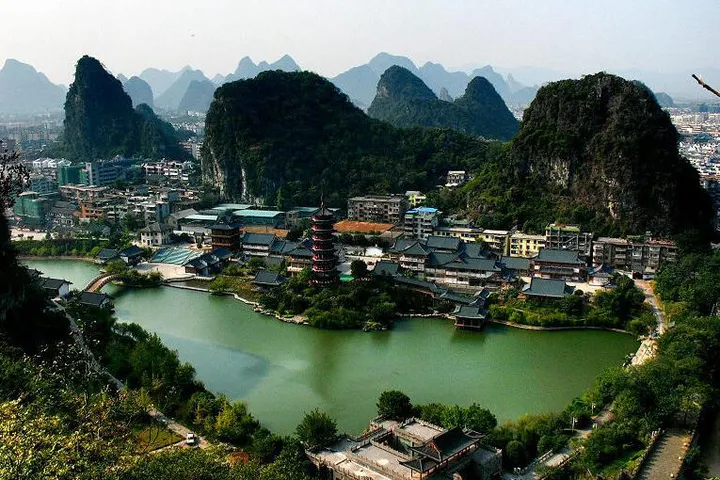
Guilin does not really look like a city. It looks like a forest of stone that grew out of flat ground. This was seabed 300-odd million years ago; limestone piled up layer by layer, then lifted, dissolved and collapsed, leaving several hundred isolated towers standing on a river plain and a set of caves where water had hollowed the rock out. The town was built between them: roads bend around the hills, and the river slips through the gaps.
The famous line about Guilin's landscape being the finest under heaven is not marketing. It comes from a poem by Wang Zhenggong in 1201, and the original carving still sits on the cliff of Solitary Beauty Peak. Eight centuries on, it is both the city's shortest introduction and its heaviest burden: tens of millions of people arrive each year because of those seven characters.
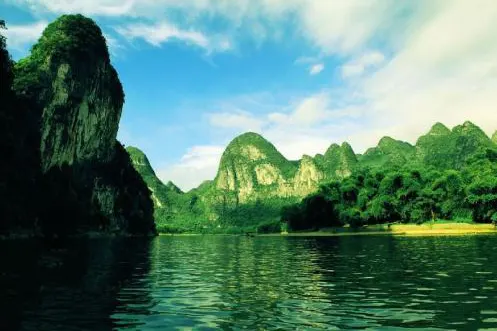
A lone tower of limestone above the Li River
The river is a green silk ribbon; the hills are jade hairpins.
Han Yu, "Seeing Off the Prefect of Guizhou", early 9th century
Read the trip in three parts. First the city: Elephant Trunk Hill, the Prince's City and Solitary Beauty Peak, the Two Rivers and Four Lakes, Reed Flute Cave — a day to a day and a half, all on foot and by bus. Second the river: four hours downstream from Guilin by cruise boat, or from Yangtai by raft to Xingping, and the high point of the whole journey. Third Yangshuo: the Yulong, the Ten-Mile Gallery, West Street, two slow nights. The Longji terraces sit 87 km north and deserve a day of their own, ideally with a night on the mountain.
One thing to understand: in Guilin the ticketed attraction and the actual view are often in different places. Elephant Trunk Hill is free now, but the best angle on it is from the far bank at Zizhou. The finest stretch of the Li is not at any ticket window but on the 20 km of water between Yangtai and Xingping. The Longji terraces belong to the villages that built them; what you buy is the road in and the viewpoints. Once that clicks, the money starts making sense.
02Six things worth your time
Take the river down to YangshuoFour hours of moving scenery
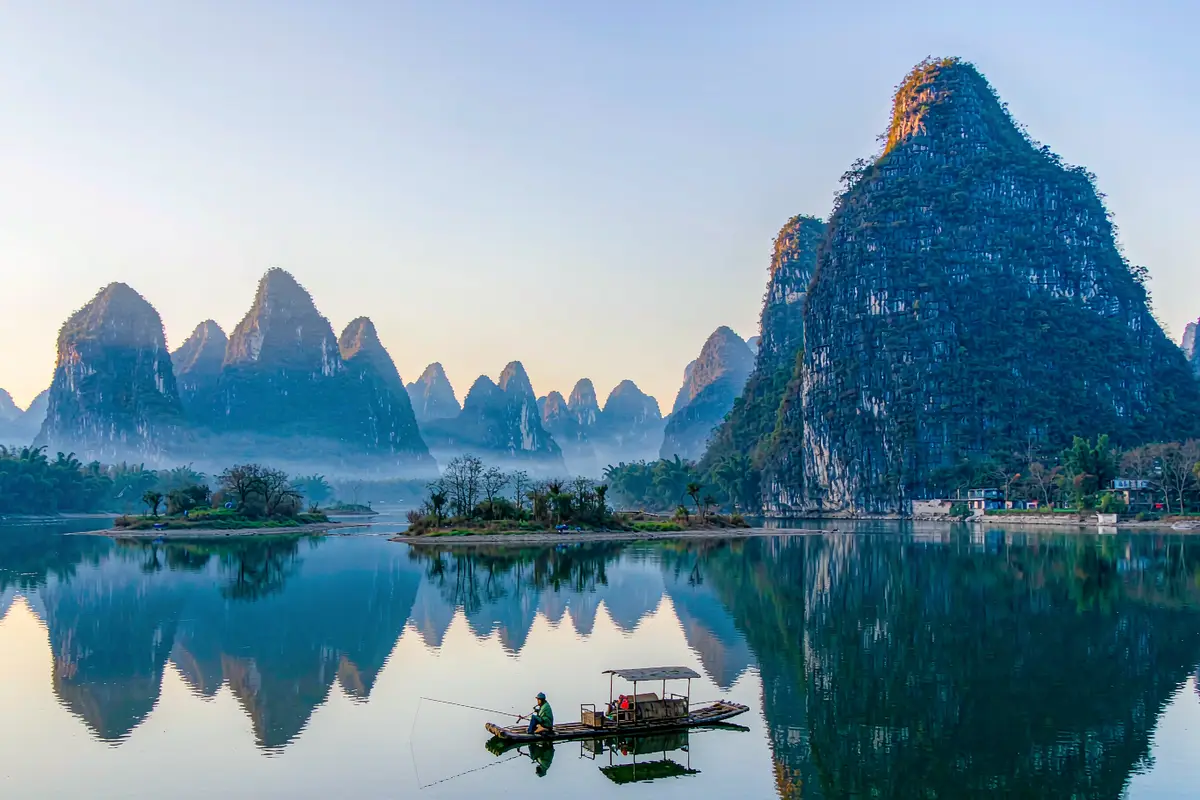
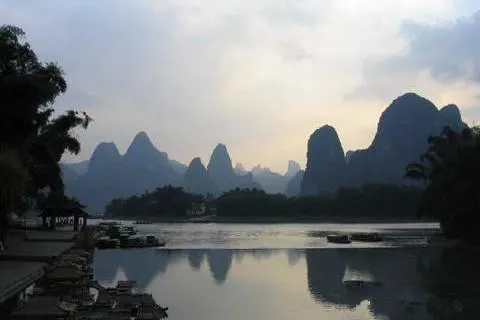
The Li runs 83 km from Guilin to Yangshuo and the boat covers all of it, but the part you came for is Yangtai to Xingping: Nine Horses Fresco Hill, the Yellow Cloth reflection, the bend printed on the back of the ¥20 note, sliding past the rail one after another. A three-star boat costs ¥215, a four-star ¥360; the difference buys a seat, a meal and deck space, not a better view.
Fare:¥215 three-star / ¥360 four-star, scenic ticket included
Duration:About 4–4.5 hours, morning departures
Ride a bamboo raft on the YulongNine small dams, nine splashes
There are no motorboats on the Yulong, only pole-punted rafts, and the water is shallow enough to see the stones on the bottom. From Jinlong Bridge to Jiuxian is just over 6 km and nine low dams; each one drops the raft with a slap of spray, rice paddies and sugarcane on both banks. People call it the little Li, but it is far quieter than the real thing.
Price:¥320 per two-person raft, Jinlong Bridge to Jiuxian
Booking:Released at 20:00 the day before, official mini-program
Look at Elephant Trunk HillFree, but you still book
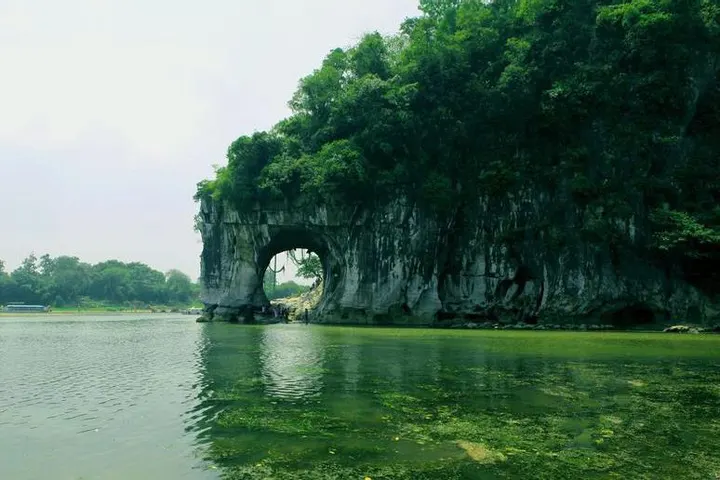
A stone elephant with its trunk in the Li, the round hole between trunk and leg called Water Moon Cave — on a full moon there is a second moon in the water. This is the city's emblem and the picture on a generation of primary-school textbooks. Admission has been free since 2022, booked online with your ID; ignore anyone at the gate selling a fast-track ticket.
Admission:Free, real-name reservation required
Hours:7:00–21:00, gate 3 until 21:30
Stand above the Longji terracesSix and a half centuries of contours
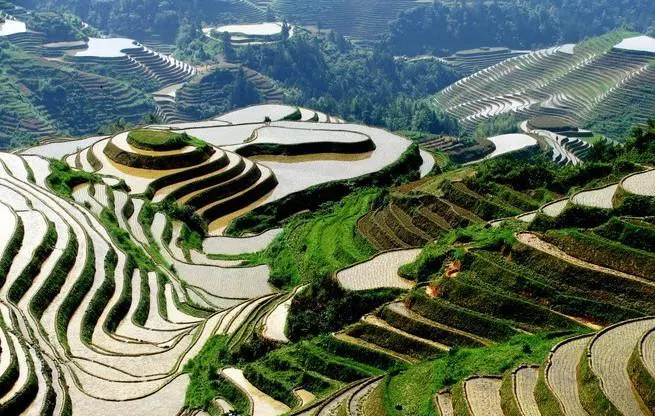
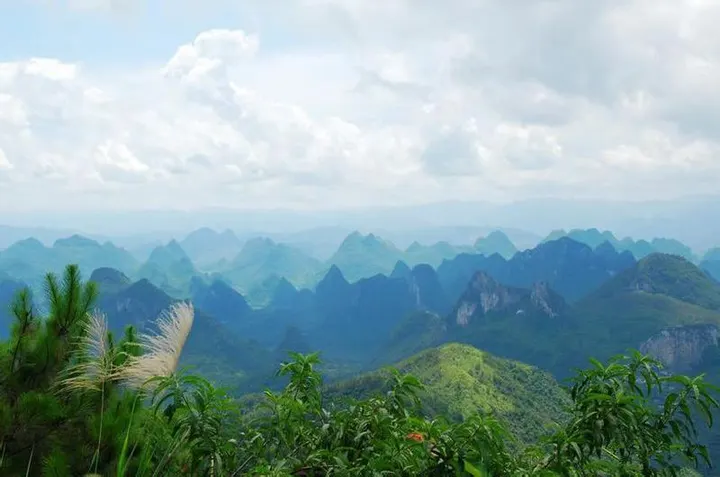
Zhuang and Yao villagers started terracing these slopes in the Yuan dynasty and never stopped; the fields now run from 300 m up to 1,100 m. Ping'an has the finer lines, Dazhai the bigger gesture. In late May, when the paddies are flooded, the whole mountain looks like broken mirror; by late September it has turned gold and reads completely differently.
Ticket:¥80, valid three days across all three villages
Cable car:Jinkeng only: ¥70 one way, ¥100 return
Walk the Two Rivers and Four Lakes at nightThe version without a boat ticket
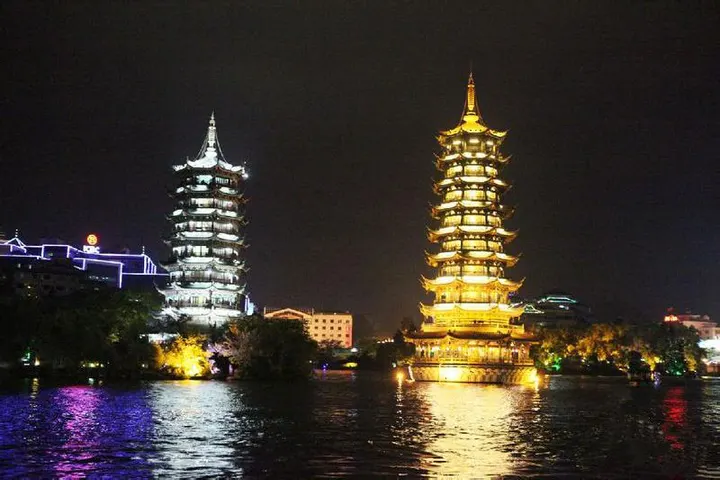
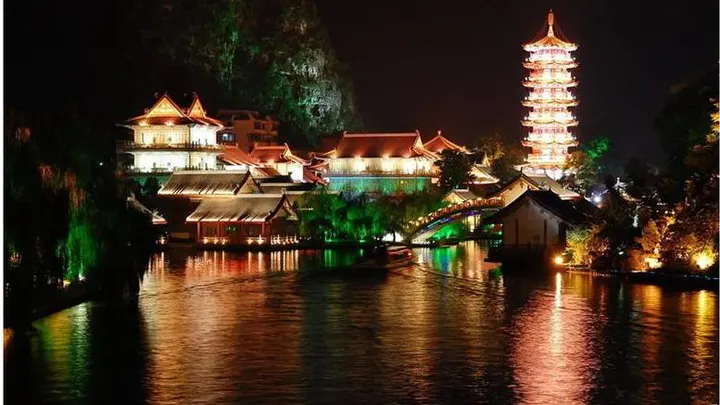
The Li and the Peach Blossom rivers were joined to four lakes — Shan, Rong, Gui and Mulong — into one ring of water around the old town, and the waterside paths are free. Start at the Sun and Moon Pagodas on Shan Lake after dark, walk west along Rong Lake to the old south gate, and watch bridges and pagodas drop into the water as the lights come on. The boat is ¥210 for 90 minutes; walking shows you just as much.
On foot:Paths free, roughly 5 km end to end
By boat:Night cruise ¥210, 90 minutes
Eat noodles at seven in the morningBreakfast for ¥5
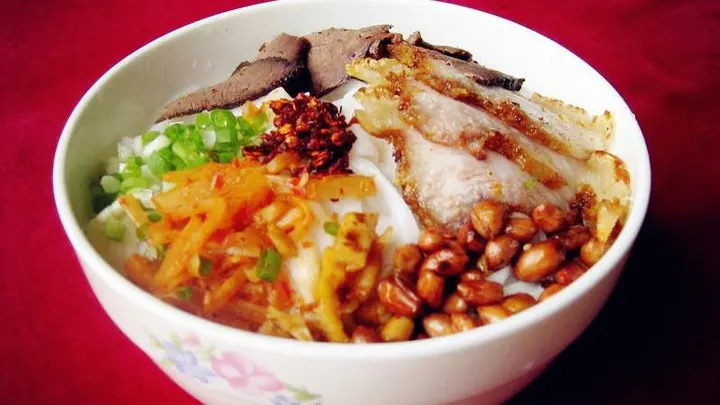
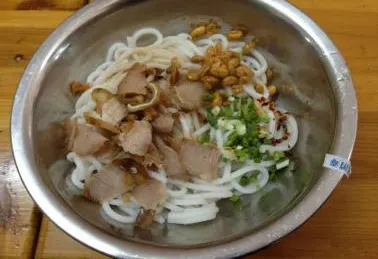
The first thing Guilin does in the morning is queue at a noodle shop. Two liang of braised-meat noodles costs ¥5–7; the master stock is beef bone and twenty-odd spices, and the guoshao on top is pork belly fried until it blisters. Eat it dry first, toss it through, then ask for bone broth halfway down the bowl — one bowl, two dishes.
Price:¥5–7 in the city, ¥15–20 at the sights
When:06:00–14:00; the crackling often sells out by mid-afternoon
03Seven things to settle before you book
Guilin, Guilin North, Guilin West or Yangshuo — which ticket?
Follow your first night's bed. Staying downtown — Elephant Trunk Hill, the lakes, Zhengyang pedestrian street — buy Guilin Station; the river is a fifteen-minute walk from the exit. Guilin North, 8 km out, has the most departures and a ¥20, twenty-minute taxi into town, and most cross-province trains stop there. Guilin West is 12–20 km away with poor buses; skip it unless you are arriving from Guiyang and heading straight to Yangshuo. For Yangshuo only, buy Yangshuo Station — but note it is not in the county town, it is at Xingping, 30 km from West Street.
Cruise boat or bamboo raft on the Li, and can I get the pier wrong?
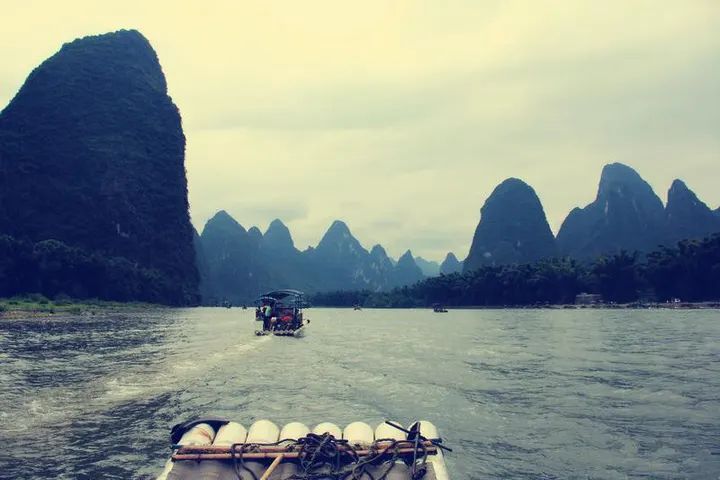
The cruise boat runs the full Guilin-to-Yangshuo route in four hours: three-star boats load at Mopanshan pier, four-star at Zhujiang, and the two piers are 6.5 km apart, so the wrong one means a missed boat. The raft covers only the best stretch, Yangtai to Xingping, in two hours, ¥255 per person or ¥560 for a private four-person raft — closer to the water, more freedom, more sun. With children or older relatives, take the boat; to watch reflections slide under you, take the raft. Doing both will not fit in one day.
Is Elephant Trunk Hill really free, and do I still need to book?
Genuinely free — no admission since 2022 — but you must reserve by name through the official WeChat account, up to three tickets per phone number; over-60s skip the booking and swipe their ID. It stays open to 21:00, gate 3 until 21:30. For the classic photograph, enter at gate 3 and walk straight to Lover's Island; gate 2 is exit-only. Anyone at the gate selling a fast-entry ticket is selling nothing.
When should I come, and will it rain the whole time?
April to June has the water and the mist — Guilin as an ink painting — at the cost of rain and the occasional river closure. September and October are the surest bet: high skies, low humidity, and the Longji terraces turning from green to gold. July and August are hottest, with afternoon storms that arrive and leave fast; the river is high and photogenic. December to February is empty, but the water is low and rafts may stop running — Reed Flute Cave, at a steady 18°C, does not care.
How do I book a Yulong raft, and who is not allowed on?
Book through the official mini-program, which releases next-day tickets at 20:00 the evening before; the Jinlong Bridge run sells out in minutes in season, so be on time. There is no entrance fee, only the raft: ¥320 for two on the Jinlong Bridge to Jiuxian route, ¥200 for the half-hour Shuiedi to Zonghe run. Hard rules: no children under 1 m and nobody over 70 on a two-person raft, a combined weight over 160 kg means splitting up, and pregnant women or anyone with heart or blood-pressure conditions is refused outright.
Can I do Longji as a day trip, and do I need the cable car?
It is two to two and a half hours each way, so a day trip buys you one village and five hours in a bus. Better to sleep up there: reach Dazhai in the afternoon, take the 25-minute cable car to Jinfoding for sunset, then walk forty minutes to Xishan Shaoyue at dawn for sunrise over cloud. The cable car exists only at Jinkeng — ¥70 one way, ¥100 return. Ping'an has none; you use the shuttle and your legs, on gentler paths, which suits older travellers. The ¥80 ticket covers all three villages for three days.
Base in Guilin or Yangshuo, and what will it cost?
Split it: two nights in the city for the hills and lakes, two in Yangshuo for the Yulong and the Ten-Mile Gallery. Staying only in Yangshuo and shuttling back to see Elephant Trunk Hill wastes three hours a day. A mid-range four or five days runs ¥2,000–3,500: ¥400–700 a night for a room, ¥215–360 for the river, about ¥250 for a Longji day, ¥100–150 a day on food. Guilin is cheap by Chinese tourist-city standards; only the things sold inside the gates are expensive.
04Four days as a base, five to slow down
Guilin arranges itself along the water, so plan downstream and never double back: the city upstream, Yangtai and Xingping in the middle, Yangshuo at the end, with Longji off in another direction entirely. City, river, Yangshuo — and slot Longji at either end. Doing it the other way round costs you half a day in a bus.
D1
The city on foot: Elephant Trunk Hill before 07:00, in at gate 3 for the view from Lover's Island, then along the riverside road to Fubo Hill and Folded Brocade Hill, with noodles on Zhengyang street at noon. The afternoon is the Prince's City and the 306 steps up Solitary Beauty Peak for the roofscape, then Dongxi Alley. At dusk walk Rong and Shan lakes as the Sun and Moon Pagodas light up, and eat beer fish for dinner.
D2
The river: board at Mopanshan or Zhujiang in the morning and drift four hours to Longtoushan pier in Yangshuo, past Nine Horses Fresco Hill and the Yellow Cloth reflection — bring a ¥20 note. Check in around West Street in the afternoon, climb Bilian Peak or watch the sun go down from the bank, and walk West Street after dinner. On a budget, take the Yangtai–Xingping raft instead, two hours, then a local bus into town.
D3
Yulong and the gallery: at Jinlong Bridge pier before 08:00, raft down to Jiuxian through nine dams — you will get wet, so wear sandals and bring a dry bag. Lunch in Jiuxian, then rent an e-bike or bicycle for the Ten-Mile Gallery, riding south to Moon Hill with a stop at the Big Banyan Tree. Back to West Street for dinner, or to Impression Sanjie Liu.
D4
Longji: leave Guilin early, two and a half hours to Dazhai, cable car up to Jinfoding for the full sweep of terraces, bamboo-tube rice for lunch, walk the Thousand-Layer ladders in the afternoon, and drive back at dusk. For sunrise, invert it and sleep up there: arrive in the afternoon, sunset at Jinfoding, dawn at Xishan Shaoyue, back in the city by noon.
D5
Day five is for whatever you missed: Reed Flute Cave, a steady 18°C for an hour, the stone inscriptions in Seven Star Park, or the Lingqu Canal at Xing'an — a working canal cut in the Qin dynasty, 2,200 years ago, and far quieter than the city. Buy souvenirs in the afternoon and close the trip with one more loop of the lakes after dark.
05From the city emblem to midstream
Elephant Trunk Hill and Water Moon Cave
Elephant Trunk Hill stands where the Li meets the Peach Blossom, less than 60 m high and shaped so exactly like an elephant drinking that it has served as the city's sign since the Song dynasty. The arch between trunk and leg is Water Moon Cave, round as a full moon with the river running through it; a Song poet carved a line on the rock about the moon beneath the water and the moon afloat above it. On the summit sits a Ming-dynasty pagoda shaped like a sword hilt, which locals call the Vase Pagoda.
Solitary Beauty Peak and the Jingjiang Prince's City
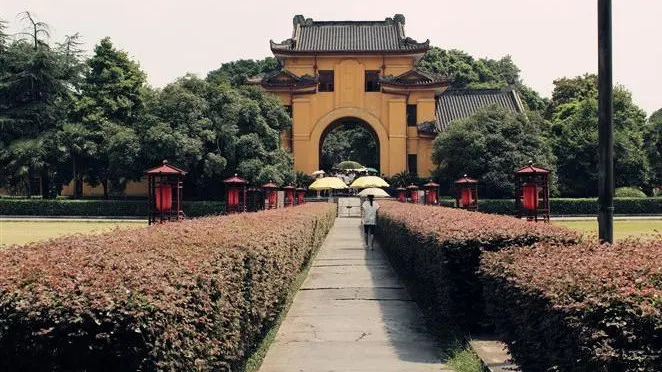
The gate of the Jingjiang Prince's City
In 1370 Zhu Shouqian, a grand-nephew of the founding Ming emperor, was made Prince of Jingjiang and walled off a compound in the middle of Guilin; the circuit of wall has survived seven centuries. Inside it, Solitary Beauty Peak is only 66 m high but marks the centre of the city, and 306 steps put the whole town under your feet. The original carving of the line about Guilin's landscape being the finest under heaven is on the cliff at its base, still legible.
The ¥100 ticket covers a guided walk through the palace compound and the climb. The tour runs about an hour in a group, after which you go up on your own. Expect a pitch for rubbings and a mock imperial-exam experience inside; some rubbings are priced in the tens of thousands. Look, decline, move on.
The Two Rivers and Four Lakes
The ring of water and its pagodas after dark
This is a piece of engineering finished in 2002: the Li and Peach Blossom rivers were connected to four lakes so that a boat could circle the old town. By day it reads as ordinary urban water; after dark the Song-style quarter at Mulong Lake, the Sun and Moon Pagodas on Shan Lake and the old south gate on Rong Lake all light up at once and the design makes sense. Cruises run ¥90 to ¥210 for 60 to 90 minutes; the lakeside paths are free and show you nearly as much.
The Li River: Yangtai to Xingping
A riverside village near Xingping
The Li runs more than 400 km; the 83 km between Guilin and Yangshuo is billed as a hundred-li gallery, and the densest 20 km of it lies between Yangtai and Xingping. Nine Horses Fresco Hill is a cliff scoured by water whose streaks are read as nine horses — locals say seeing seven makes you a second-class scholar, nine a first. Below it the river widens into the Yellow Cloth reflection, where the peaks lie whole in the water; this is the view printed on the back of the ¥20 note.
Three ways to do it: the four-hour cruise, the two-hour raft from Yangtai to Xingping at ¥255 a person, or walking the bank — two ferry crossings, four to six hours on field paths and village lanes, and brutally exposed in summer. Xingping old town needs an hour: the street is short, and the viewing platform for the ¥20 view is beside the jetty.
Reed Flute Cave and Seven Star Park
Reed Flute Cave sits 6 km northwest of the centre, a 200-odd-metre passage that takes forty minutes at a steady 18°C. The stalactites are lit to look like a palace, and the guide will name each formation; believe as much as you like. It has hosted visiting heads of state and supplied sets for the 1980s television version of Journey to the West. Tickets ¥82–90.
Seven Star Park on the east bank is the biggest green space in the city, holding Camel Hill, the Flower Bridge and the Guihai stelae forest. The inscriptions are the real reason to come: two hundred-odd carvings from the Tang to the Republic crowd the cliff at Longyin Cave, so densely that locals say no stone there is unmarked. Park admission ¥55, ¥100 with the Seven Star Cave.
Yangshuo: the Ten-Mile Gallery and West Street
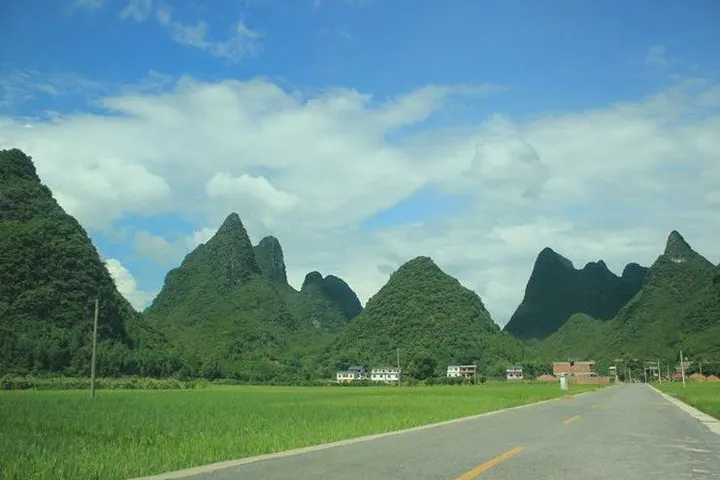
The Ten-Mile Gallery, a road running through the peaks
An 8 km road runs south from Yangshuo town to Moon Hill, peaks and paddies on both sides and rapeseed in flower along the verge in March; the scenery is so continuous that people call it the Ten-Mile Gallery. Cycling is the way: 16 km there and back, two or three hours, ¥20–30 a day for a bicycle and ¥30–50 for an e-bike. The Big Banyan Tree, Butterfly Spring and Moon Hill each charge ¥15–78 to enter, and skipping all of them costs you nothing.
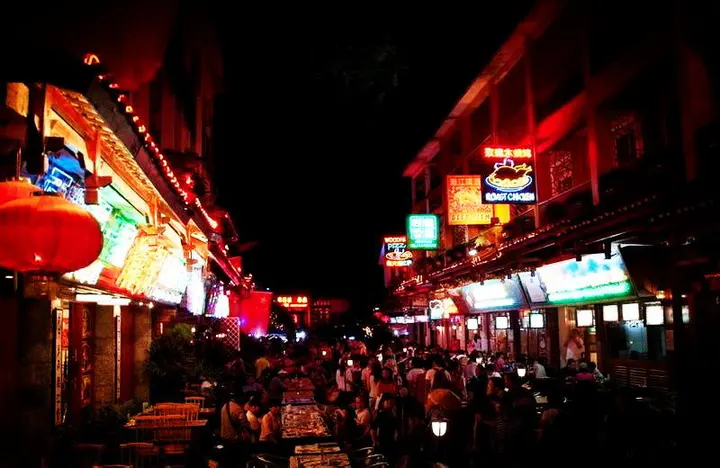
West Street is 1,400 years old and 1,180 m long, its flagstones laid over the original roadbed. By day it sells ginger candy and scarves; by night the bars put their tables in the street and the noise carries to the river. For quiet, turn into the side lanes — Fuqian and Xianqian still have old houses and noodle shops that serve locals.
06Put yourself inside the landscape
Rafting: three different rivers
Three rafting rivers ring Yangshuo and they feel nothing alike. The Yulong is the gentlest — pole-punted rafts over nine low dams, fine for children and grandparents, ¥320 for the Jinlong Bridge to Jiuxian run. Longjing River is the wildest: inflatable rafts down real drops, about ninety minutes, roughly ¥150, with fewer departures when the water is low, so confirm the day's schedule before you go. Nine Horses canyon sits between them at ¥180 — less drop than Longjing, more than the Yulong.
Climbing: limestone ground zero
Yangshuo's limestone has been the centre of Chinese rock climbing since the 1990s, with routes from grade 5 to grade 9 and old crags at Moon Hill, Baishan and Leipi. Beginners can take a half-day taster near Butterfly Spring in the Ten-Mile Gallery for about ¥120 an hour including gear and a guide; anyone with mileage should hire a local guide for ¥200–400 a day. In the wet season the rock is slick — do not force it.
Cycling and walking
Yangshuo is made for bicycles: town to Jiuxian, to Gongnong Bridge, to Moon Hill are all flat runs of about 10 km, with a dedicated path along the Yulong. Rental is ¥20–30 a day, a little more for an e-bike and worth it in the heat. For walking, the classic is Yangtai to Xingping on the Li, two ferry crossings and four to six hours with no shops en route — carry your own water.
Impression Sanjie Liu
Zhang Yimou, Wang Chaoge and Fan Yue built this in 2004 with twelve limestone peaks and a stretch of the Li as the stage; most of the 600-odd performers are fishermen and villagers from nearby. It starts at 19:30 and runs seventy minutes, with seats at ¥238, ¥628 and ¥828. Extra shows run in peak season, and the whole of Tianyuan Road jams afterwards — book your ride before the finale.
Sunrise and sunset at Longji
The two best hours at Longji are both up the mountain. Sunset belongs to Jinfoding at Jinkeng, twenty-five minutes by cable car, when the light turns the terraces copper. Sunrise means walking to Xishan Shaoyue — out of the door at 05:30, forty to fifty minutes up, and if you are lucky the cloud is pouring up out of the valley. Late May, when the paddies are flooded, and late September, when they turn gold, are the two peaks, and the two busiest.
07City centre, riverbank, or above West Street
Three zones. Downtown Guilin is the most practical — Elephant Trunk Hill to the lakes on foot, hostels to five-star hotels. West Street in Yangshuo is loud and convenient, food at the door and noise through the wall. The Yulong valley and Jiuxian are the guesthouse belt, rice fields and peaks out of the window, at the price of needing transport.
Riverside hotels downtown: Binjiang Road faces the Li, ten minutes' walk to Elephant Trunk Hill, ¥400–700 in low season and double on holidays.
Chain hotels and hostels: thickest around Guilin Station and Zhengyang street, doubles ¥150–300, dorm beds ¥40–70 — the right choice if you have an early boat.
West Street, Yangshuo: bars and restaurants at the door, guesthouse doubles ¥200–400. Ask which way the room faces; street-side ones have conversation outside until 02:00.
Yulong valley guesthouses: converted farmyards at Jiuxian, Jima and Xiatang with paddies and peaks in view, ¥300–600, most of them lend bicycles.
Up at Longji: stilted wooden houses at Ping'an and Tiantou, ¥150–400, plainly furnished but with terraces out of the window; have the guesthouse meet your bag at the village gate.
The pattern: May Day, National Day, Spring Festival and July–August weekends are the expensive ones, book two or three weeks out; April and November give the best value, with river-view rooms around forty per cent cheaper. Longji guesthouses have no central heating in winter — confirm there is a heat pump before you book.
08One bowl of noodles, one fish, one table of stuffed vegetables
Guilin cooking starts sour and hot and finishes savoury, pulled from Hunan on one side and Guangxi on the other. Breakfast is noodles, the main meal is beer fish, steamed pork belly and stuffed vegetables, and late night is snails and skewers. Prices are low for a tourist city: ¥5 for a bowl of noodles, ¥50–60 a head for a proper dinner.
A bowl of rice noodles under braised meat and crackling
How to order rice noodles
Say 'er liang lu cai' at the counter and pay ¥5–7. Braised-meat noodles come dry: a spoon of master stock in the bottom, crackling pork belly and braised beef on top, and help-yourself pickles, sour bamboo, fried soybeans and chilli. When a third is left, add a ladle of bone broth and it becomes a second dish. For soup noodles ask for 'er liang tang cai' — minced pork broth, gentler. Shops near the sights advertising 'authentic Guilin rice noodles' at ¥15–20 are worse than the corner shop.
Five things to order
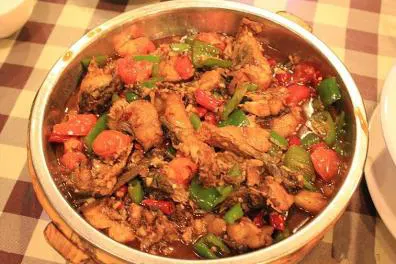
Yangshuo beer fish: fried scales-on until the skin blisters, then braised with beer, tomato and peppers; the gravy over rice is the point. Snakehead is boneless and dearer, carp is cheaper and full of bones. ¥50–80 a head.
Stuffed river snails: the meat minced with pork, mint and water chestnut, packed back into the shells and braised. Suck it out and the snail and mint arrive together. About ¥40 a portion.
Taro and pork belly: slices of belly and Lipu taro layered alternately and steamed until the meat collapses and the taro goes floury. The taro drinks the fat, which is why it does not taste heavy. ¥40–60.
The three treasures: chilli sauce, fermented tofu and Sanhua liquor. The liquor is a rice-aroma spirit, distilled three times and shaken until it flowers, soft going down and stronger than it looks.
Gongcheng oil tea: tea leaves pounded with ginger and garlic, boiled, bitter with a chilli edge, drunk with puffed rice, peanuts and fried dough. Locals have it for breakfast; ¥5 a bowl.
Stir-fried river snails, the night-market staple
Where to eat
Noodles: Lao Dongjiang on Shijiayuan Road, Tianyuan and Chongshan — locals queue at all three, ¥5–7 for two liang, and the crackling may be gone by mid-afternoon.
Beer fish: Xie Dajie and Dashifu on West Street are the long-standing chains at ¥60–70 a head; go one lane back and the same fish costs ¥20 less.
Local cooking: Xiaonanguo on Wenming Road does Guilin home-style, reliably the chicken in a wooden bucket and the river shrimp; Chunji Roast Goose is worth the trip for the goose and the candied taro.
Late night: Guilin Porridge City never closes — congee and a couple of stir-fries, and the reason to be glad it does not.
Steamed pork belly, sliced and layered
09Taking the three treasures home
Guilin's souvenirs are few and practical: the three treasures — Sanhua liquor, chilli sauce, fermented tofu — plus monk fruit, dried osmanthus, persimmon cakes and pine-flower candy, and handwork such as round fans and combs. Supermarkets and local markets are cheapest; the tourist streets charge half again as much.
Painted folding fans laid out on a stall
Sanhua liquor: rice-aroma spirit, from about ¥15 for a small bottle to several hundred. Glass is awkward in a suitcase; the airport will pack it properly.
Chilli sauce and fermented tofu: local brands such as Huaqiao and Sifangjing, around ¥10. The tofu must be checked in, not carried on.
Monk fruit and osmanthus: ¥2–3 a fruit, steeped as tea; dried osmanthus for sweet rice and rice wine, a small bag for ¥15 or so.
Yangshuo pine-flower candy and persimmon cakes: the candy is like a crisper marshmallow sachima, made in front of you at old workshops in Xingping; the persimmons are best in autumn.
Round fans and painted fans: Guilin's round fan is a regional intangible heritage craft. Hand-painted silk starts at ¥100–200, printed ones are tens of yuan, and the bamboo ribs and brushwork tell you which is which.
Three places to browse: Zhengyang pedestrian street is the most touristed and the best stocked, Dongxi Alley is the restored old quarter and better after dark, and Weixiaotang at Cross Street is where locals actually shop. Xicheng Road night market is the liveliest, crafts and snacks mixed together — start bargaining at sixty per cent.
10Getting there and getting around
Arriving by high-speed rail
Guangzhou South to Guilin is 1 h 58 min at best, ¥176–235 in second class; since the Guiyang–Guangzhou line went to 300 km/h in October 2026 there are dozens of departures a day and you can turn up and go. D-trains take 2.5–3 hours for ¥149–192 and stop more often at Guilin West and Guilin North. Nanning East is about 2 h 40 min, Guiyang just over an hour, Changsha around three.
The four stations do different jobs. Guilin Station is downtown — fifteen minutes on foot to Elephant Trunk Hill and the lakes — mostly regional trains, fewer departures, best position. Guilin North, 8 km out, takes most cross-province services, with a ¥20 taxi into town in twenty minutes. Guilin West is 12–20 km away with poor buses, handling through trains on the Guiyang–Guangzhou line. Yangshuo Railway Station is at Xingping, not in the county town, still 30 km from West Street.
A stone jetty on the Li River
Getting in from Yangshuo Station
Turn right out of the exit and the shuttle stands are there. For Xingping old town and the ¥20 viewpoint, take shuttle 2: 7 km, ¥5, ten to fifteen minutes. For West Street, take high-speed shuttle 1 to Fengming transport hub and change to 801 or 805 — ¥15–20, fifty to sixty minutes, ninety in traffic. A taxi to West Street is ¥80–100 a car, which split four ways matches the bus. With luggage, check the bag through to Fengming for ¥10 and go to Xingping empty-handed.
Flying in
Liangjiang International Airport sits 28 km west of town with sixty-odd domestic and international routes. The airport bus runs every twenty minutes to the CAAC building downtown for ¥20 in fifty minutes; the Yangshuo coach is about ¥60, and a business shuttle straight to West Street ¥70. A taxi into the city is ¥80–100.
Getting around: buses, taxis, bikes
The centre is small and buses start at ¥1, ¥2 for air-conditioned ones and the sightseeing loop, with direct services to Elephant Trunk Hill, Fubo Hill, Folded Brocade Hill and Seven Star Park. Taxis run ¥15–30 across town, about ¥10 from Guilin Station to Elephant Trunk Hill. Yangshuo runs on two wheels: ¥20–30 a day for a bicycle, ¥30–50 for an e-bike, and flat roads to Jiuxian, Gongnong Bridge and Moon Hill.
For Longji, board at Qintan bus station or the direct-bus stop opposite Guilin Station: ¥50–65 and two and a half hours to the Dazhai car park. The mountain road has a lot of bends; if you are a new driver, do not.
Hospitals: the Affiliated Hospital of Guilin Medical University (15 Lequn Road, 0773-282 3244) and Guilin People's Hospital (12 Wenming Road, 0773-281 0816).
Money: hotels, chain restaurants and ticket offices take Alipay and WeChat Pay, and the international versions link Visa and Mastercard. Noodle shops and stalls sometimes take only a local QR code, so keep ¥100–200 in cash.
Rain: April to June is the plum-rain season, and mountain storms arrive fast in the afternoon. The Li closes when the water is too high and the Yulong stops rafts after heavy rain, so keep a spare day in the plan.
Bugs and sun: mosquitoes along the river and up at the terraces, so bring repellent; the UV in the hills is stronger than in town and a hat beats an umbrella.
Power and data: 220V with the Chinese flat two-pin plug. Hotels and sights offer free Wi-Fi, usually verified by phone number.
Peaks before rain, cloud sitting low
12What to pack, what to avoid
Footwear: trainers with grip for Longji and the peaks, sandals that can get wet for the rafts. The stone paths at the terraces are treacherous after rain; flip-flops up there are an accident waiting to happen.
Clothing: a light rain shell from April to June, easier than an umbrella; the hills swing ten degrees between morning and evening, so add a fleece for a night at Longji. Summer is short sleeves plus a sun layer.
Waterproofing: rafts ship water at every dam, so bag the phone and camera; the deck of a cruise boat is windy and a hat needs a cord.
Bookings: Elephant Trunk Hill by name, with over-60s exempt; the Li cruise at least a day ahead; the Yulong rafts at 20:00 the night before; and a bed up at Longji well in advance in season.
ID: every ticket gate and raft checks identity. Foreign visitors should carry the passport they booked with; online tickets are still verified on site.
Five things to avoid: the 'day tours' touted at stations and gates usually include a shopping stop — take the public bus instead; 'photographers' who approach you on the riverbank quote their price afterwards, so agree first; if a raft pole asks for a tip, refuse and report it to the scenic area on 0773-888 3299; do not believe anyone at the foot of Longji saying the village is full, your guesthouse will come and get you; and read the drinks list on West Street before ordering.
13Stone, water and two thousand years
Geography and climate
Karst towers and their reflection
Guilin sits at 25° north, 150 m above sea level, at the southwest end of the Nanling range. Three hundred million years ago this was shallow sea laying down thick limestone; then the crust lifted and carbon-dioxide-laden water worked along the joints, cutting the sheet rock into isolated towers and leaving the hollows behind as caves. Geologists call it tower karst, it is rare worldwide, and Guilin has one of the most complete examples — inscribed in 2014 as part of the South China Karst World Heritage site.
The climate is subtropical monsoon: long summers, short winters, rain and heat arriving together. July and August reach 35°C and beyond; January and February hover near freezing but snow is rare. Rainfall is around 1,900 mm a year and April to June takes most of it, which is why the river is wide and the hills are misty then — and why boats are most likely to be cancelled.
The Lingqu Canal and the Ming prince
In 214 BC, Qin Shi Huang had a canal cut at Xing'an to link the Xiang and the Li, so that boats from the Yangtze basin could reach the Pearl River. The 37 km Lingqu has worked for 2,200 years and remains one of the most complete ancient water projects in China, ranked with Dujiangyan and the Zhengguo Canal. The name Guilin first appears that same year, as a commandery.
In 1370 the founding Ming emperor's grand-nephew Zhu Shouqian was enfeoffed as Prince of Jingjiang and built his palace below Solitary Beauty Peak; the line lasted 280 years and eleven generations. Under the Qing the compound became the provincial examination hall, in the Republican era the Guangxi government, and during the war years Guilin briefly became a cultural capital that drew Mao Dun, Ba Jin, Tian Han and Xu Beihong. The 1944 battle for the city levelled much of it; most of the old streets you walk today are reconstructions.
Dialect and peoples
The Guilin dialect is a branch of Southwestern Mandarin, close enough that a northern Chinese visitor catches most of it; in the imperial examination era it served as the south's court speech. More than thirty ethnic groups live across the prefecture, and around Longji the villages are Zhuang and Red Yao — the call-and-response singing on the third day of the third lunar month and the Red Yao women's long hair are still ordinary life, not a show.
14Four ways out of town
The Longji terraces (1–2 days)
Longji lies in Longsheng county, 87 km and two and a half hours from Guilin. Three villages share the terraces: Ping'an is Zhuang, with gentle paths and viewpoints an hour's walk apart at Seven Stars with the Moon and Nine Dragons and Five Tigers; Dazhai is Red Yao, bigger and more spread out, served by cable car and electric shuttle; the old Zhuang village is the emptiest. The ¥80 ticket covers all three for three days, shuttle ¥40 return. Late May, when the paddies flood, and late September, when they ripen, are the peaks — the 2026 harvest starts on 1 November.
The Lingqu Canal at Xing'an (1 day)
The Lingqu runs along the edge of Xing'an town, 57 km from Guilin and twenty-odd minutes by train. The clever parts of its 37 km are the flash locks, early pound locks that raised the water with timber boards so boats could be walked over a watershed, and the ploughshare dam that splits the Xiang into two channels — seven parts continuing north, three feeding the Li. The water street is lined with old houses and stone bridges, with a fraction of Guilin's crowds.
Bajiaozhai at Ziyuan (1–2 days)
Guilin is not all limestone. North at Ziyuan, Bajiaozhai is Danxia country: red conglomerate cut into peaks with eight upturned corners, the main summit at 818 m and a ridge walk narrow enough for one person at a time, cliffs of several hundred metres on either side. Three hours by road from Guilin, usually paired with a raft down the Zijiang over two days. The steps are slippery in rain; do not go up in a thunderstorm.
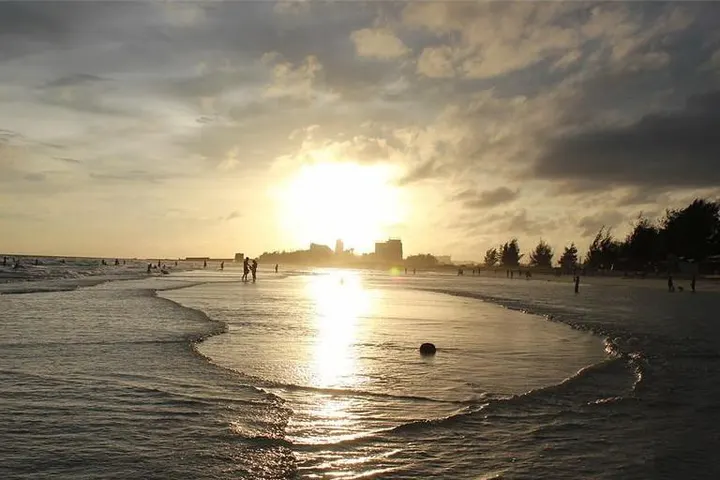
Sunset at Beihai Silver Beach
Beihai and Weizhou Island (2–3 days)
Four-odd hours by train from Guilin, Beihai is the other end of Guangxi. Silver Beach runs 24 km with fine sand and a slope so gentle that low tide exposes hundreds of metres of it; Weizhou Island is an hour and a bit by ferry, the youngest volcanic island in China, small enough to circle by e-bike in a day. The qilou arcades of the old street survive from the consular architecture of the 1890s. Seafood is cheaper than in Guilin, but still ask the price and watch the scale.
15Read and watch before you go
Film
"The Painted Veil" (2006, dir. John Curran): from Maugham's novel, with Edward Norton and Naomi Watts as a British couple in 1920s China, cholera and a marriage and a kind of atonement all played out on a Guangxi river. The Li, the rafts and the peaks in mist are real locations, and they lend the film its chill.
Books
"Tasting Guilin" by Shadi Heimi and Shen Dongzi: two long-term residents write about the city's history, landscape and people, local nostalgia set beside an outsider's eye — a rare local book that does not oversell. "Waiting for Me on West Street" is a picture-led notebook about Yangshuo's old street, mostly photographs, good for the train down.
Music and stage
"I Want to Go to Guilin" (Han Xiao, 1994) was the soundtrack to the 1990s migration south, sung by a man with neither the money nor the leave to get there; Phoenix Legend's "Guilin Beautiful" turned the landscape into a pop tune, and you will hear both on the bus to Yangshuo. The sound that actually belongs here is cai diao opera and Sanjie Liu's mountain songs — arranged for the stage at Impression Sanjie Liu at night, and sung unarranged by old people in the parks by day.
West Street after dark, lanterns all the way to the river