A mountain kept alight by incense for a thousand years, and a stairway polished by feet
1,300.2 m at Zhurong PeakScenic-area ticket valid 48 hoursCable car closed; new line due late 2026Grand Temple ¥40 from November
In short
Mount Heng (衡山, Héng Shān) is the southern peak of China's Five Great Mountains, standing 1,300.2 m at Zhurong Peak in Hunan's Nanyue district, south of Hengyang — not the Mount Heng of Shanxi province in the north, which shares the same English name and nothing else. What makes this mountain unusual is that the pilgrimage starts before the climb: a nine-courtyard Grand Temple sits at the foot, and temples continue all the way to the summit, so half the people here are walking and half are offering incense. Tickets come in two parts. The scenic area is ¥110, valid 48 hours for two entries; the Nanyue Grand Temple is separate at ¥58, dropping to ¥40 from November to April. The shuttle is ¥44 one way or ¥78 return, forty minutes from the visitor centre to South Heaven Gate. The old cable car has been out of service since the end of 2020 and its replacement is not expected before late 2026, so the last 2 km to the top are on stone steps, forty to sixty minutes. For sunrise, either sleep at Shangfeng Temple or South Heaven Gate, or start from Shengli Fang around 02:00 and walk 11–12 km and more than 10,000 steps in four to six hours. Budget ¥900–1,400 for two days and one night, excluding travel to Hunan.
Key facts
Known for
Nanyue · Zhurong Peak · the Grand Temple · incense · sunrise over cloud
Budget
¥900–1,400 for two days and one night, mid-range
Days needed
Two days is right; one day gets you up and down but not sunrise
Comfort
Moderate — a shuttle reaches South Heaven Gate, but the last 2 km and every temple stair are on foot
Best time to go
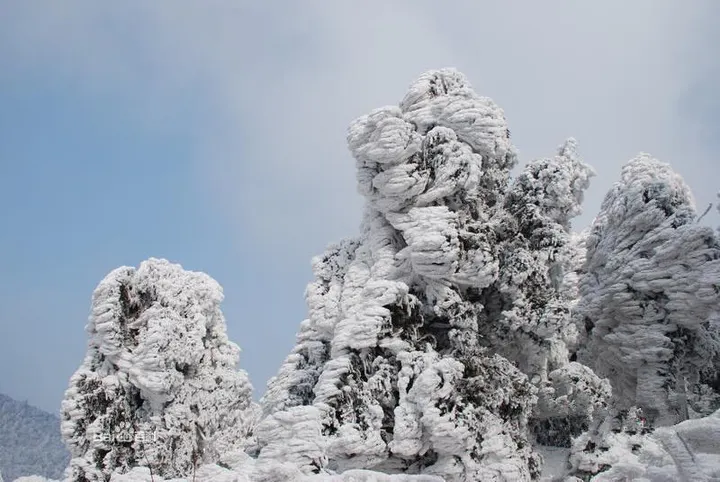
September to November for cloud and clarity; December to February for rime; avoid the first day of the eighth lunar month and the first three days of National Day
01The southern peak, in Hunan — not the northern one
Start with the name, because it causes real mistakes. This is Mount Heng in Hunan, the southern peak of the Five Great Mountains, its highest point Zhurong Peak at 1,300.2 m, forty kilometres north of Hengyang. There is another Mount Heng in Shanxi province, the northern peak, with the same English spelling and nothing else in common: different history, different architecture, different weather, twelve hundred kilometres apart. When you book, search trains or ask directions, use Nanyue — the southern peak — and you will land in the right place.
The range itself is a ridge of granite running north to south, seventy-two summits strung across some four hundred kilometres, from Huiyan Peak inside Hengyang city to Yuelu Mountain in Changsha. The part that sells tickets is one section of it. Nanyue town sits at about 200 m, with the Grand Temple on its northern edge. A shuttle climbs forty minutes of switchbacks from the visitor centre to South Heaven Gate, about 1,100 m. From there, two kilometres of stone steps lead to Zhurong Peak. That shape dictates the visit: you do not walk up from the bottom, you see the temple, take the bus, and walk the last stretch.
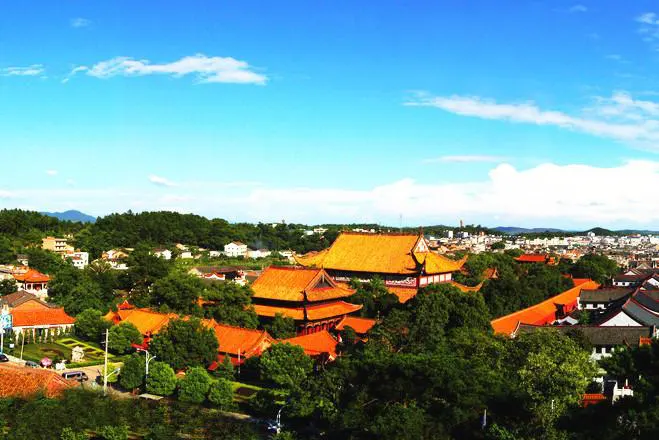
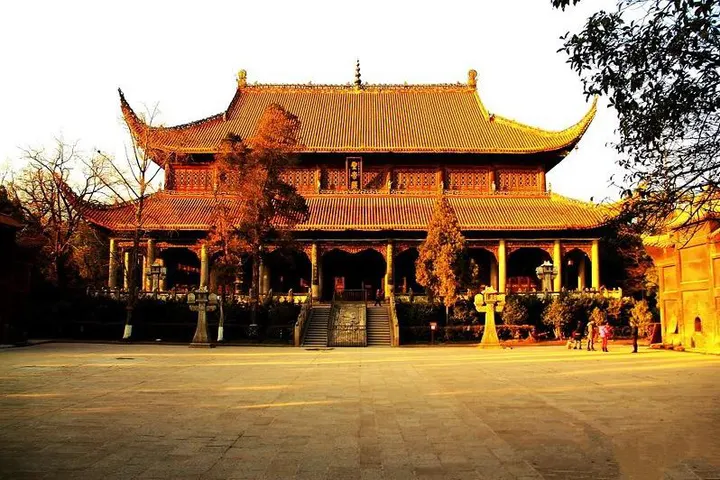
The Nanyue Grand Temple from above — a field of yellow glazed roofs over red walls and old trees, ridges stepping back towards the white rooftops of Nanyue town
Money comes in two separate bills. The scenic-area ticket is ¥110 and admits you twice within 48 hours. The Nanyue Grand Temple has its own gate and its own ticket: ¥58 from May to October, ¥40 from 1 November to 30 April. The shuttle is extra, ¥44 one way or ¥78 return. And the cable car is gone: the old line stopped on 31 December 2020 for safety reasons, its South Heaven Gate station was demolished on 15 December 2025, and the replacement — a 3S system, 1,607 m long, rated at 5,000 people an hour — is expected around the end of 2026. Fares of ¥45 and ¥80 still appear on price lists because they are the reopening fares. Do not build an itinerary on them.
Two kinds of people share the mountain. Pilgrims arrive early with yellow cloth bags, bow, offer incense and move through the halls with the ease of long practice. Visitors arrive a little later in shell jackets, looking for angles in the same courtyards. They do not collide, because the courtyards are large. The only skill required is knowing when to be quiet: when someone is praying, watch from the side rather than stepping in front with a phone; inside a hall, do not photograph the statues or anyone mid-chant. These are not arbitrary rules. The place is in use.
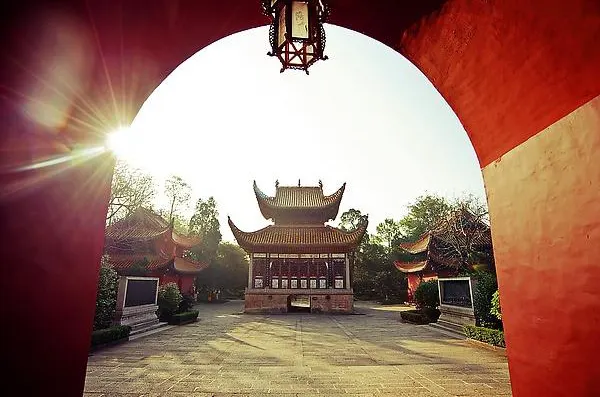
A view through a round opening in a red temple wall — a paved courtyard, a double-eaved hall at its centre, a smaller hall on either side, sun flaring at the upper left
One honest caveat. Mount Heng does not win on wildness. The steps are well built, supply points are frequent, trees block a good deal of the view, and the summit is only 1,300 m. What it does well is elsewhere. First, cloud: on a clear morning after autumn rain, it rises out of the valleys and turns the seventy-two peaks into a line of islands. Second, the order of the buildings, temple to shrine to pavilion to monastery to hall, each in its place from the foot to the top; walk it and you have read the mountain's story in sequence. Come to conquer a peak and you may shrug. Come to see how one mountain has been used for a thousand years and two days is not enough.
The northern Heng moves, Mount Tai sits, Mount Hua stands, Mount Song lies down — only Nanyue flies.
Wei Yuan, Ode to Mount Heng, Qing dynasty
02Six things worth rearranging the day for
Zhurong Peak and Sun-Watching Terrace: waiting for light at 1,300 mWhere the mountain ends
From South Heaven Gate the summit is 2 km of stone steps and about 300 m of ascent, forty to sixty minutes at an ordinary pace, the last stretch pinned to the ridge and exposed to wind. On top sits a small stone hall dedicated to Zhurong, the fire god, wedged onto the highest rock. Sunrise is not watched from inside it but from Sun-Watching Terrace beside it: a platform facing east with nothing in front and cloud moving below. In summer the sun clears the ridge between 05:20 and 05:50; in winter, between 06:40 and 07:10; in late October, around 06:30. Arrive thirty minutes early or you will be in the third row.
Altitude:1,300.2 m
Last leg:2 km of steps from South Heaven Gate, 40–60 minutes
Sunrise:05:20–05:50 in summer, 06:40–07:10 in winter; be there 30 minutes early
The Nanyue Grand Temple: nine courtyards, three religionsThe first stop, and the centre of the incense
The Grand Temple occupies the northern end of Nanyue town, 98,500 m² in nine courtyards running from the Lingxing Gate to the rear north gate. Its main hall, the Hall of the Holy Emperor, stands 31.11 m under a double-eaved yellow glazed roof, with seventy-two stone columns inside and out answering the mountain's seventy-two peaks. The plan is the interesting part: eight Taoist temples along the east side, eight Buddhist temples along the west, and Confucian ceremonial buildings down the middle, three traditions sharing one walled compound. Do not rush it as a photo stop; give it ninety minutes and walk the axis slowly.
Ticket:¥58 May–October, ¥40 November–April; separate from the mountain ticket
Hours:08:00–17:30, last entry 17:00; opens at 07:00 on peak pilgrimage days
Time:One and a half to two hours
The Martyrs' Shrine: 276 steps of quietThe one place to lower your voice
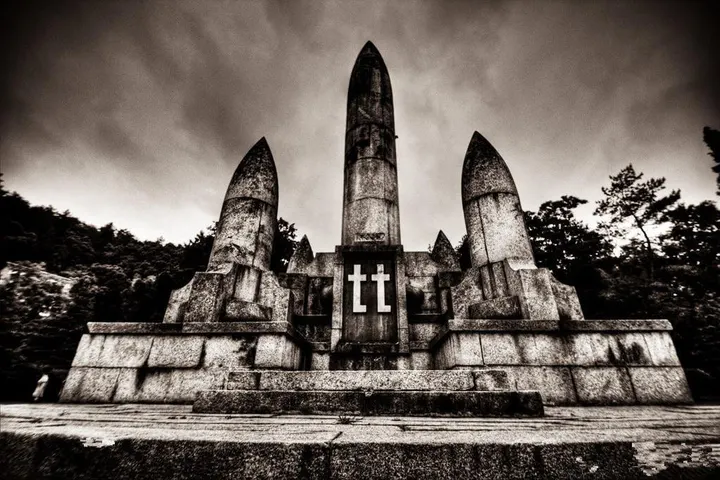
Below Xianglu Peak, four kilometres from Nanyue town, the shrine was begun in 1940 and completed in 1943 to commemorate Chinese soldiers killed in the war against Japan. Everything sits on one axis: memorial arch, the 7 July 1937 memorial tower, the memorial hall, a tribute stele and the offering hall, linked by 276 stone steps over a length of 242 m, with thirteen graves set into the slopes on either side. The tower is shaped as five stone shells pointing at the sky. Entry is free, but the shrine stands inside the scenic area, so the mountain ticket still applies. Once through the gate, keep your voice down and your flash off.
Ticket:Free, with a valid scenic-area ticket
Hours:08:00–17:30, to 17:00 in winter
Steps:276 on the central axis
South Heaven Gate and Immortal Bridge: two thresholds in stoneAs high as the bus goes; feet from here
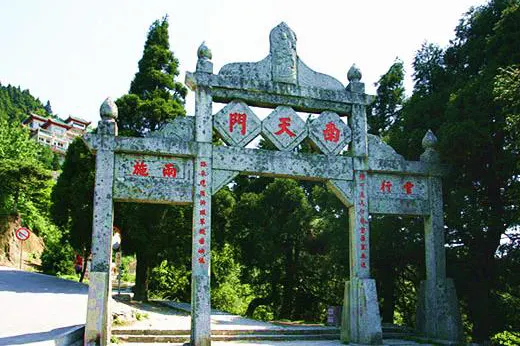
South Heaven Gate is where the shuttle stops and where the front and back of the mountain divide: a three-bay stone archway beside the road, its centre carved with the gate's name and its side bays with the words for moving cloud and bringing rain. The summit is 2 km further on gentle steps, though the exposed stretches are cold in wind. A few minutes beyond, a slab of rock pushes out from the ridge — Immortal Bridge — with a walkway wide enough for one or two people and nothing on either side; in fog you cannot see the bottom. If heights bother you, look from the railing. Do not climb past it.
Where:The shuttle terminus, about 1,100 m
To the summit:2 km of steps, 40–60 minutes
Watch:Cold in wind, slick in fog; stay inside the rail
Sutra Library Hall and Mirror-Polishing Terrace: forest and old argumentsThe emptiest stretch, and the best trees
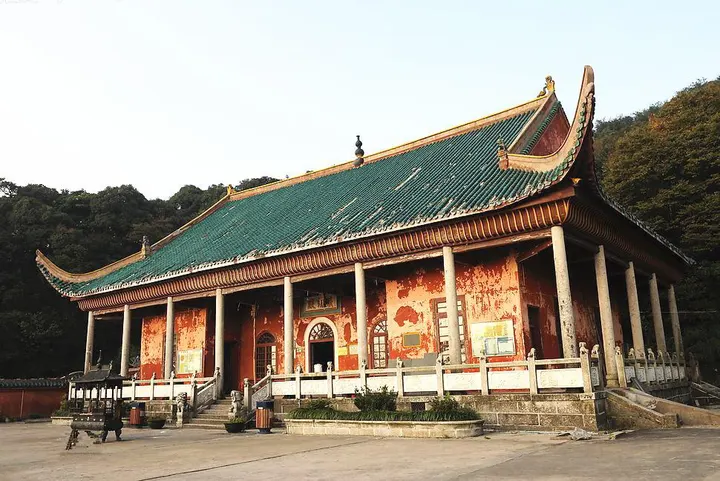
Sutra Library Hall sits below Xiangguang Peak, founded by the monk Huisi in the Southern Dynasties, renamed after Zhu Yuanzhang sent a set of scriptures here in the Ming, and rebuilt in 1936. It is a small hall under green glaze with red walls, surrounded by a patch of subtropical evergreen forest, with three celebrated trees on the slope in front. Further down is Mirror-Polishing Terrace, where one of Chan Buddhism's best-known arguments took place: the master Huairang polished a brick to make a mirror, and in doing so woke up the future patriarch Mazu. A path behind the terrace climbs 206 steps, with a stele naming it Huairang Road. Few people come this way. Slow down.
Where:Below Xiangguang Peak, west of Mid-Slope Pavilion
Look for:The Ming hall, old-growth forest, the 206 steps of Huairang Road
Time:One to one and a half hours
Water Curtain Cave: a sixty-metre fall and a wall of inscriptionsA separate ticket, few crowds, best in summer
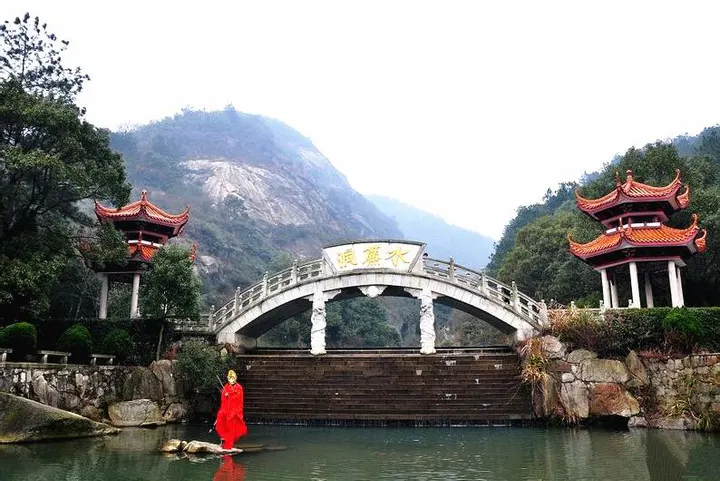
Four kilometres east of Nanyue town, below Zigai Peak, this is one of the mountain's four traditional marvels. Water comes off the peak, runs through a cave and drops more than sixty metres down a rock face; on a sunny morning there is a rainbow in the spray. A stone arch bridge forms the entrance, two small red-columned pavilions frame the fall, and beyond them the cliff carries layer after layer of inscriptions from the Tang, Song and later. The ticket is ¥30, not included in the scenic-area pass, and it is ten minutes by taxi from the old town. In dry spells the flow is thin; two or three days after rain is the time to come.
Ticket:¥30, sold separately
Distance:About 4 km east of Nanyue town
Best:Two or three days after rain, in the morning
03Seven decisions to make before you book
How do I arrange a night climb for sunrise?
There are two routes, and they are not equal. The easy one: take the afternoon shuttle to South Heaven Gate the day before, sleep at Shangfeng Temple or the South Heaven Gate guesthouses, get up at 04:30 and walk the 2 km of steps to Sun-Watching Terrace, in place by 05:00. A bed at Shangfeng is ¥80–150, a double about ¥300, and the terrace is minutes away — that proximity is the entire argument for sleeping up here. The hard one: walk the whole thing from Shengli Fang at the foot, via Huanyan Lake, the Martyrs' Shrine, Mid-Slope Pavilion and South Heaven Gate, 11–12 km, more than 10,000 steps and about 1,080 m of ascent, four to six hours for a normal walker. For a 06:30 sunrise, leave by 01:30; in summer, when the sun is earlier, by 00:30. Take a head torch, a jacket and 1.5 litres of water, walk with someone, and stay on the main stair. One warning: when the scenic area reopened on 6 September 2026, the notice gave hours of 08:00–18:00 with no night entry and six trails under repair. Whether night climbing is allowed changes with that notice. Check the Nanyue Yimayou mini-program the day before; do not bet on an old blog.
When did the cable car stop, and can I ride it now?
No. The old line opened in 1995 between Mid-Slope Pavilion and South Heaven Gate and was taken out of service on 31 December 2020 because its equipment was worn out; the South Heaven Gate station was demolished on 15 December 2025. Construction of the replacement began on 17 September 2024: 1,607 m of 3S cableway, 5,000 people an hour, about five minutes in transit, with an official target of opening around the end of 2026. So in October 2026 the only mechanical way up is the shuttle to South Heaven Gate, then 2 km on foot. The ¥45 and ¥80 on price lists are the fares for when it reopens, not now. High wind, thunderstorms and ice also stop the shuttle at short notice, and winter weather cuts it back — in January 2026 it ran only as far as Mid-Slope Pavilion. Check the live notice on the Nanyue Yimayou mini-program before you set out.
Is one day enough?
Enough to get up and down, not enough for sunrise. The standard day: into the Grand Temple at 08:00 for ninety minutes; at the visitor centre by 10:00 for the forty-minute shuttle to South Heaven Gate; on the 2 km summit walk by 11:00, with time at Sun-Watching Terrace and the summit hall; back at the gate for lunch at 12:30; down to Mid-Slope Pavilion at 13:30 for an hour at Mirror-Polishing Terrace or the Martyrs' Shrine; out by 15:30. That is six to seven hours and you catch the 17:30 bus. The costs: no sunrise, no cloud sea — both are early-morning events — only one of the shrine or Sutra Library Hall, and no slack for a queue or a downpour. Two days is the sweet spot: temple and mid-mountain on day one, sleep at Shangfeng, sunrise and the summit on day two, then Sutra Library Hall and down by noon.
Are the Grand Temple and the mountain two separate things?
Yes, and this is the mistake most first-timers make. The Grand Temple stands at the north end of Nanyue town at about 200 m, costs ¥58 (¥40 from November to April) and takes ninety minutes. The scenic area entrance is at the other end of town, costs ¥110, and the shuttle leaves from the visitor centre. The two gates are roughly 2 km apart, the tickets are not interchangeable, and bookings are separate. Locals do the temple first and the mountain second, and it is good advice: temple in the morning, lunch in the old town, mountain in the afternoon. And do not navigate to the Grand Temple expecting the trailhead — the visitor centre is in a different direction, and the detour costs half an hour.
How do I buy incense without being ripped off?
The reliable answer is: do not buy any. The Grand Temple and the religious sites on the mountain give away three sticks of incense free, and since the 2026 pilgrimage season the three-stick rule has been enforced: visitors bringing their own may carry one box of three sticks per adult. The bundles pressed on you at the gate, in the car park and at the station — several hundred yuan, sometimes four figures — are unnecessary and are not allowed into the halls. If you genuinely want a nicer box, go to a proper shop in the old town with prices on the shelf, ask what one box costs, and pay ¥30–40, which is plenty. The etiquette is short: step over the threshold, never on it; fan a flame out with your hand rather than blowing; bow to the four directions before placing incense in the burner; and inside a hall, photograph neither statues nor anyone praying. Sincerity has no price here, and that is practical advice rather than a platitude.
Which month is best?
Late September to early November is the window I would pick: little rain, long views, the best odds all year of a cloud sea at dawn, trees starting to turn, and comfortable temperatures — low twenties in town, six to ten degrees cooler on top. December to February is rime season, when ice coats every tree between Mid-Slope Pavilion and South Heaven Gate, a spectacle rare this far south; the price is ice on the steps, a shuttle that may stop short, and sunrise not until about 07:00. March to May brings azaleas and a lot of mist — good for temples, poor for views. June to August is the escape-the-heat season, cool on top but with afternoon thunderstorms and sunrise decided by luck. The dates to avoid are specific: the first day of the eighth lunar month, 11 September in 2026, which is the Holy Emperor's birthday, with three days of road controls and a very full temple; the first three days of May Day and National Day; and 08:00–11:00 on any weekend.
Can I go up if it rains?
Light rain, yes; heavy rain and thunderstorms, no. The mountain spends most of the year under cloud, drizzle is normal, wet steps are slippery, but the shuttle runs and the temples stay open, and the halls actually read better in mist. What you change is the order: buildings first — the Grand Temple, the Martyrs' Shrine, Sutra Library Hall — and the summit when it clears. Three conditions should stop you: thunderstorms, because there is no shelter on the summit ridge or around South Heaven Gate and you should not stand in the open; torrential rain, which brings rockfall and temporary trail closures; and ice, when the steps glaze and the shuttle may terminate at Mid-Slope Pavilion. When the park reopened in September 2026, six trails were under repair, including Fanyin Ancient Trail, the Mirror-Polishing Terrace to Tianzhu Peak path and the South Heaven Gate to Lion Rock path, and those close first in bad weather. Read the park's own notice the night before — it beats any weather app — and carry a rain shell, because an umbrella will not survive the wind.
04Two days: one for the temple, one for the summit
One hard constraint shapes every plan: the shuttle stops at 17:30, there is no transport above South Heaven Gate, and sunrise only happens early. So the sensible shape is not to cram everything into one day but to split the foot from the summit: go up on the first afternoon, sleep high, watch the sun rise, then walk down slowly. The reverse — summit first, temple second — also works, but you will be queueing when you are most tired.
D1
In Nanyue town by 10:00 and straight to the Grand Temple: Lingxing Gate to the Hall of the Holy Emperor, with a look at the Taoist and Buddhist ranges on either side, takes ninety minutes. Eat at noon in the old town — a bowl of rice noodles or a temple-style vegetarian meal. At 13:30 be at the visitor centre; take the shuttle to Mid-Slope Pavilion (25 minutes) for Mirror-Polishing Terrace and Fuyan Temple, or stay on to South Heaven Gate (40 minutes). Check in at Shangfeng Temple by 15:30, drop the bag, walk ten minutes to Sun-Watching Terrace to learn the way, then go up to Zhurong Peak for sunset. Back at the temple for the 17:20 vegetarian supper, and out on the terrace at 20:30 for stars — at 1,300 m the Milky Way is obvious on a clear night.
D2
Up at 05:00, on Sun-Watching Terrace by 05:20. After sunrise, back to the temple for a bowl of vegetarian noodles, then up to Zhurong Peak at 07:30, when the carved name-stone in front of the hall looks best in low light. Start down at 08:30, branching at South Heaven Gate for Sutra Library Hall — about ninety minutes there and back — and the 206 steps of Huairang Road. Back at the gate by 11:00, shuttle down to Mid-Slope Pavilion, and give the Martyrs' Shrine forty minutes. Out of the park by 13:00, lunch in the old town, and away from Hengshan West in the afternoon. With only one day, cut Sutra Library Hall and the shrine: temple at 08:00, mountain at 10:00, down by 15:30, and it still holds together.
With a third day, do not force another summit visit. Give it to the foot of the mountain and Water Curtain Cave: the Great Ding of Longevity and Zhusheng Temple in the morning, a taxi to the waterfall in the afternoon (¥30, two hours), and Nanyueli in the old town at dusk. Or take the back road to Fangguang Temple, founded in 503 below Lotus Peak, where almost nobody goes and the maples are best in late autumn. Neither is on a must-see list, and both belong to the quiet half of this mountain.
05From 200 m to 1,300 m, in five stages
The foot: the Grand Temple, Zhusheng Temple, the Great Ding
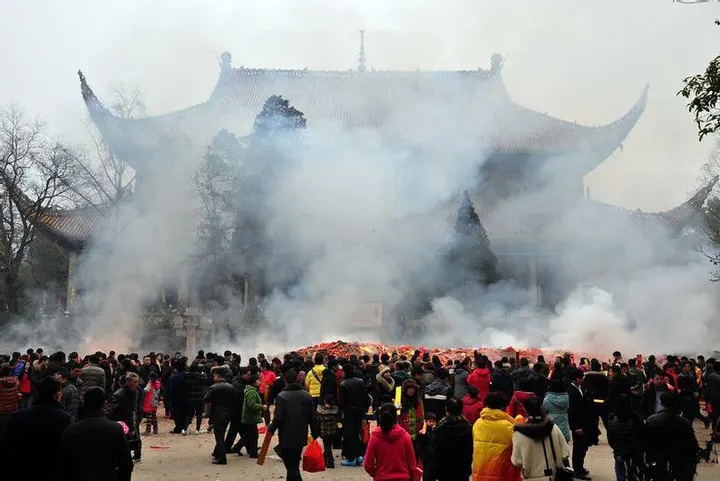
The Grand Temple was founded in the Tang, and its present plan dates from 1882: nine courtyards in four depths, 98,500 m², the largest palace-style complex in southern China. Look at three things. First, the way the axis gains height from the Lingxing Gate to the Hall of the Holy Emperor. Second, the seventy-two stone columns of that hall and the carved marble dragon slab down the centre of its steps. Third, the plan itself — eight Taoist temples east, eight Buddhist temples west, Confucian ceremonial space in the middle — an arrangement you will not find many other places. Incense here is heavy, and on holidays tens of thousands pass through; go at 08:00 when the doors open and you get a few quiet courtyards.
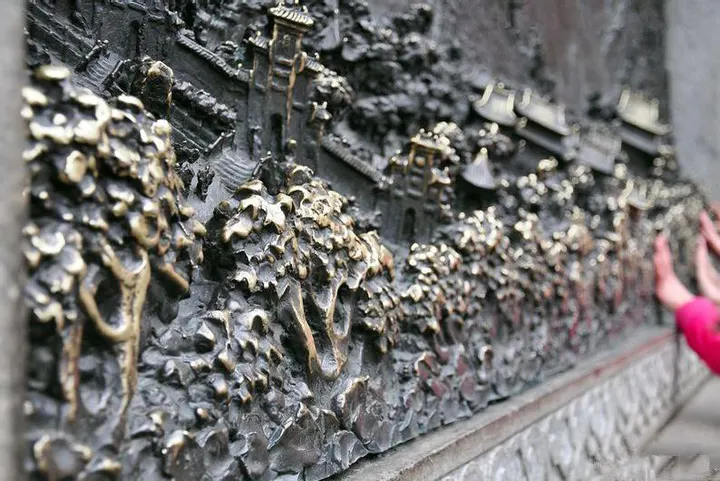
The Grand Temple forecourt on a pilgrimage day — a crowd around a long burner, flame and smoke rising together, the hall roof half lost in itA bronze relief panel in the Grand Temple — hills, trees, halls and pagodas modelled in low relief, the high points polished by hands, one hand resting on the surface at the lower right
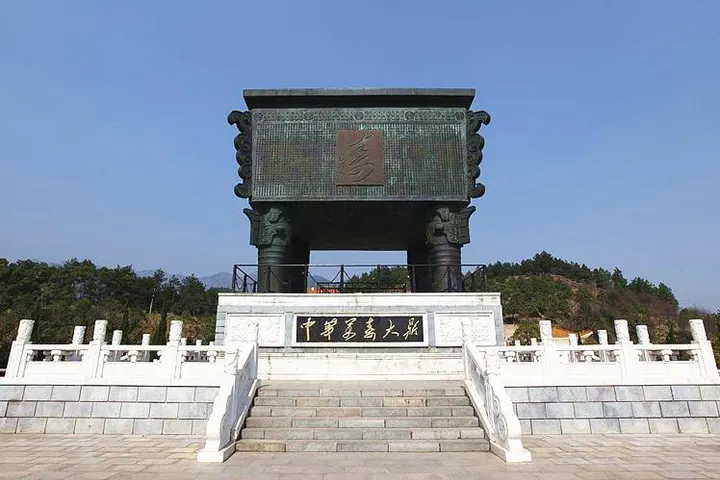
Half a li east of the Grand Temple stands Zhusheng Temple, one of the mountain's six great Buddhist monasteries and listed nationally in 1983. It runs five courtyards deep, and its fame rests on the 500 bluestone arhats in the arhat hall, carved with unusual freedom. It is far quieter than the Grand Temple and feels more lived-in; you will pass monks in the courtyards. South of town, the Great Ding of Longevity stands on Wanshou Square: 9.9 m high, 56 tonnes, cast with ten thousand versions of the character for longevity in different scripts. The ticket is ¥29.5 and twenty minutes covers it. Together these three fill two hours at the foot.
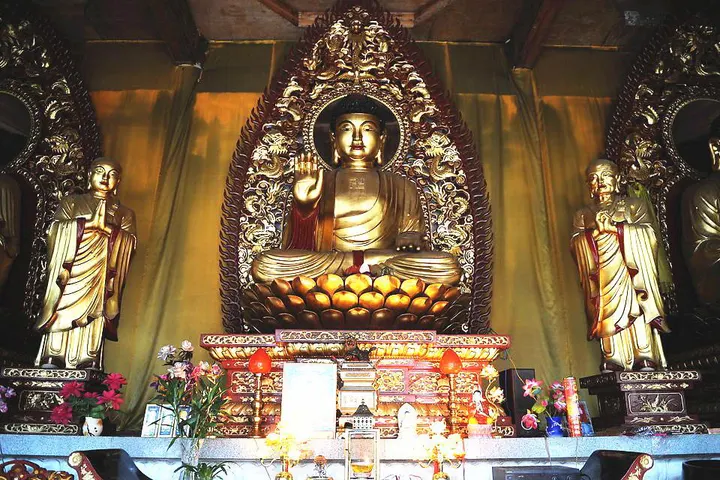
The Great Ding on Wanshou Square — a rectangular bronze vessel on four heavy legs, a single raised longevity character on its face, the white stone plinth below carved with its name, blue sky and low hills behindA Buddhist hall on the mountain — three gilded figures, the central Buddha seated on a lotus against a densely carved mandorla, candles and flowers on the altar below
Mid-mountain: the shrine, Mid-Slope Pavilion, Mirror-Polishing Terrace, Fuyan and Nantai
The first shuttle stop is the Martyrs' Shrine. Begun in 1940 and finished in 1943, it commemorates Chinese soldiers killed in the war against Japan: 276 steps link arch, memorial tower, hall, tribute stele and offering hall along 242 m, with thirteen graves on the slopes. The tower takes the form of five shells pointing skyward. Keep quiet here and turn the flash off. Continue by bus to Mid-Slope Pavilion, named for sitting exactly halfway between the town and the summit, ten li each way. It is a square pavilion with painted eaves, surrounded by old pines whose branches all lean south — the place to rest and refill water.
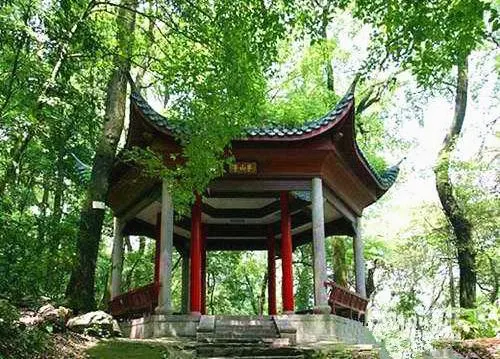
Mid-Slope Pavilion — red columns, dark tiles, open on all four sides, with steps up the front and dense trees behind
West of Mid-Slope Pavilion is Mirror-Polishing Terrace. In the Tang, the master Huairang sat here polishing a brick, and when Mazu asked why, told him that a brick cannot become a mirror and sitting cannot make a Buddha — an exchange from which two of Chan Buddhism's major lineages grew. The terrace still has the Ancestral Source inscription, Huairang's tomb and the Seven Patriarchs Pagoda; behind it, a path of 206 steps is named on a stele as Huairang Road. In the 1930s and 40s the same terrace hosted a guerrilla training school and several military conferences, so the layers of history sit on top of one another. Two kilometres downhill stands Fuyan Temple, its gate inscribed with the words Court of the Dharma Under Heaven and its couplets claiming a monastery from the Six Dynasties and a seat of the seventh patriarch. It climbs the slope in five brick-and-timber courtyards.
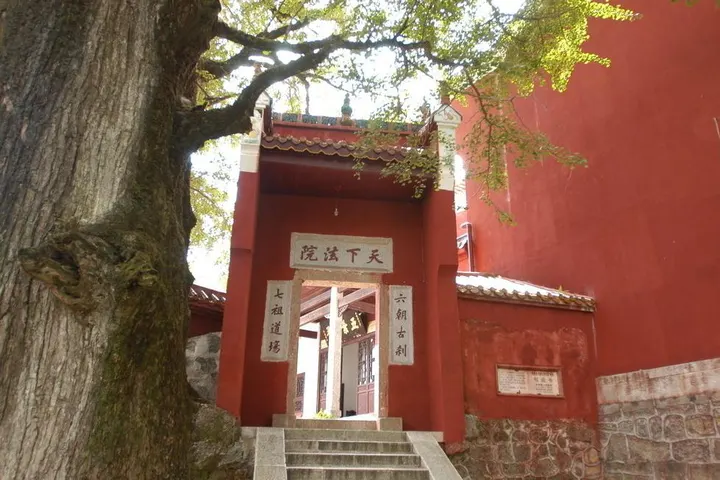
The gate of Fuyan Temple — a doorway cut through a red wall, a stone plaque reading Court of the Dharma Under Heaven, couplets either side, and an old tree trunk filling the left of the frame
Two kilometres below Fuyan is Nantai Temple, known as the Source of the Dharma Under Heaven and regarded by the Japanese Soto school as an ancestral seat. Behind it stands the Vajra Relic Pagoda: eight sides, nine storeys, 48 m tall on a 24 m granite base, the largest mountain reliquary pagoda in southern China. Inside, 256 steps spiral up the wall, and visitors may climb to the eighth floor for a view over the whole valley and the rooftops of Nanyue town. The two relics kept on the top floor are for veneration, not display; respect that and do not photograph through the glass.
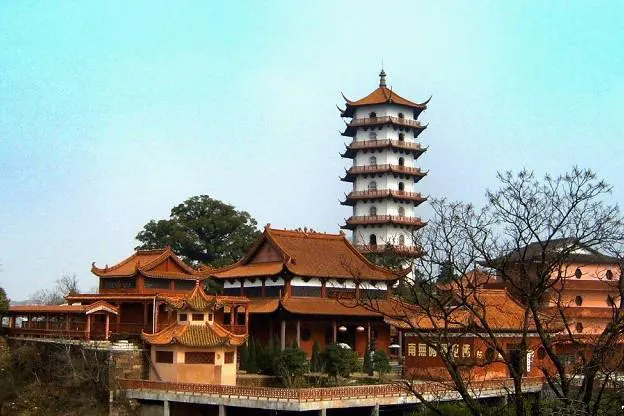
Nantai Temple and the Vajra Relic Pagoda — orange roofs spreading in front, the nine-storey octagonal tower behind, sky a pale blue-green
The summit: South Heaven Gate, Shangfeng, Sun-Watching Terrace, Zhurong Hall, Immortal Bridge
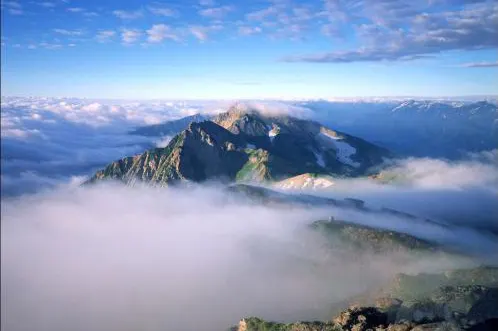
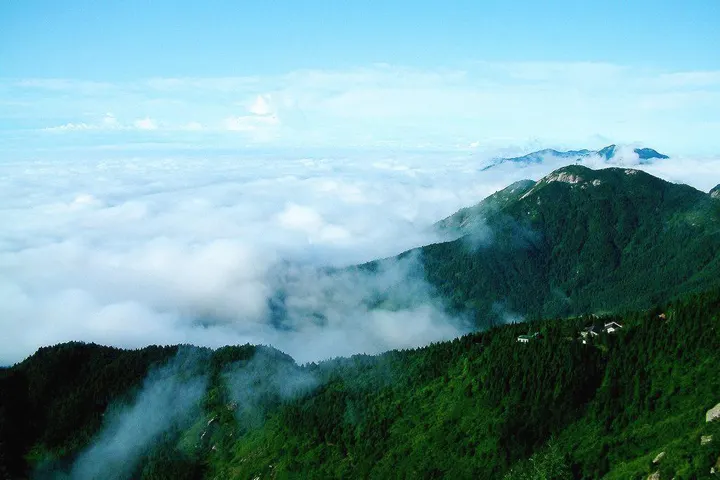
From the ridge, cloud filling the valleys to a flat white floor, wooded ridges standing out of it, a clean high blue overhead and a thin haze on the far ridge to the right
South Heaven Gate sits at about 1,100 m and is where the bus stops. The stone archway has three bays: the centre inscribed with the gate's name, the side lintels with Moving Cloud and Bringing Rain. From here the steps follow the ridge, and this last stretch is gentler than people expect, though it is exposed to wind and iced in winter. The steepest climb on the mountain is actually the five kilometres between Mid-Slope Pavilion and this gate, where the stone stair goes up with very little relief. Forty to sixty minutes brings you to Shangfeng Temple, the largest monastery on the summit and the most convenient bed for sunrise: ¥80–150 for a dormitory bed, ¥20–30 for a vegetarian meal, supper at 17:20 and no later.
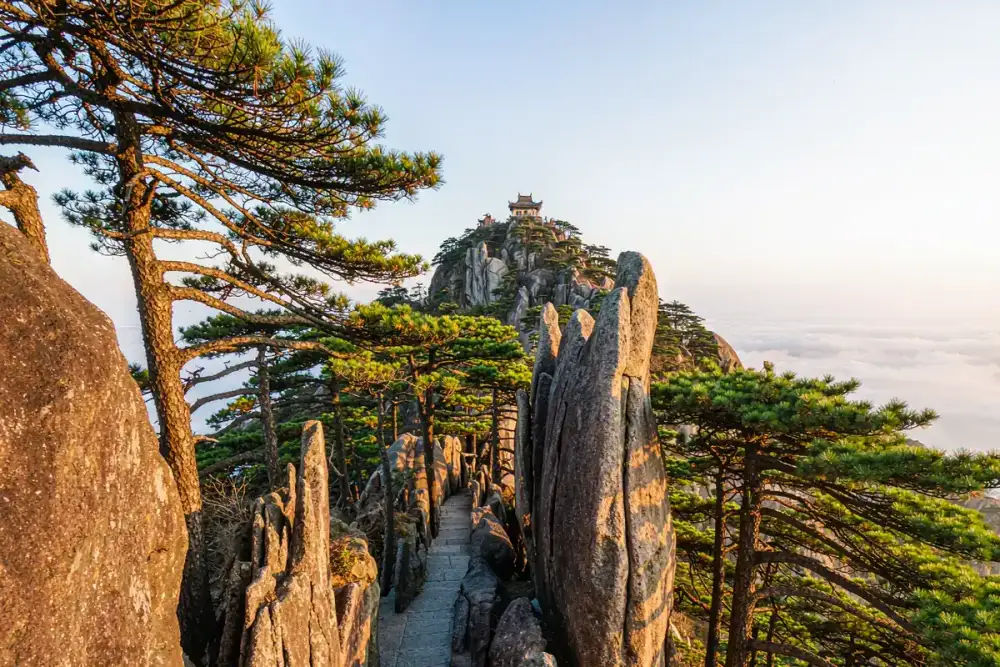
Sun-Watching Terrace lies five minutes east of Shangfeng, a natural rock platform facing east over the whole valley. Sunrise moves with the season: around 05:20 at the end of June, 06:30 in late October, 07:15 at the start of January. Cloud seas form most often on the morning after rain clears; with or without them there is something to see, and on a clear day the Xiang River bends in the distance. Zhurong Hall stands on the very top, built of stone, its door facing south, with the fire god inside. Immortal Bridge is off to one side: a slab pushed out from the ridge, narrow on top, empty on both sides, and genuinely unnerving in fog.
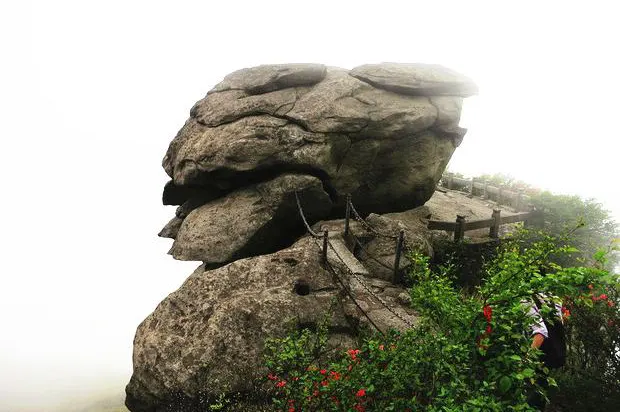
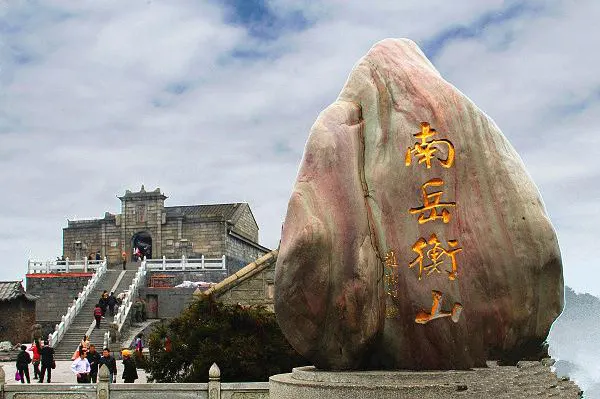
Immortal Bridge — a huge rounded boulder overhanging the ridge, a narrow stair cut through it, chains for a handhold, red flowers on the right and fog erasing the backgroundThe summit name-stone — a pink-brown boulder on a plinth carved with four gilt characters, steps and a gate behind, visitors moving up and down
Sutra Library Hall and Fangguang Temple: the quiet half
Sutra Library Hall sits below Xiangguang Peak, about forty minutes on foot from South Heaven Gate. The present hall dates from 1936: green glaze, red walls, and three famous trees on the slope in front. Around it is a remarkably intact patch of subtropical evergreen forest — tall trees, thick moss, low light, three or four degrees cooler than outside in summer. Fangguang Temple is further out, below Lotus Peak, about five kilometres by road from Nanyue town. Founded in 503, it sits at the centre of eight peaks that arrange themselves like the petals of a lotus. Late autumn, when the maples turn, is the time; most days you will have it alone.
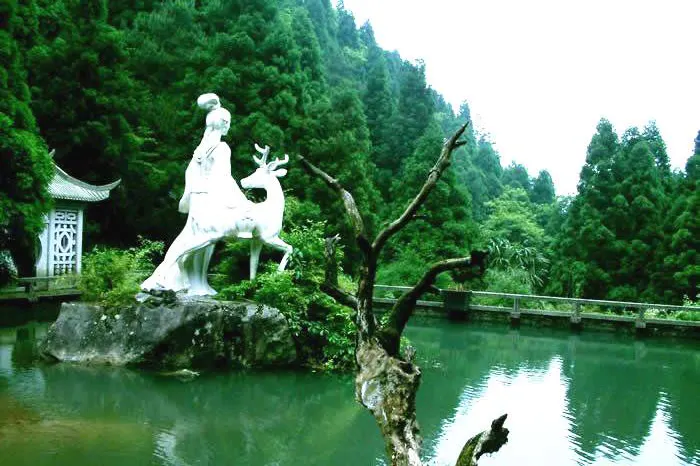
Magu Fairyland — a white figure on a rock in a dark green pool, a deer beside her, forest all around
Water Curtain Cave: the other line at the foot
Water Curtain Cave lies four kilometres east of Nanyue town, below Zigai Peak, the only one of the mountain's four traditional marvels off the main route. Water comes over the top and falls more than sixty metres down a rock face, with a deep cave behind it. The stone arch at the entrance carries the cave's name, with a small red-columned pavilion on either side. Beyond, the cliff is covered in inscriptions from the Song to the Qing, including the names by which Taoists ranked this as a grotto-heaven and the line calling it the finest spring under heaven. The ticket is ¥30, the taxi from the old town takes fifteen minutes, an hour is enough, and it is the best summer stop for children.
06Beyond the climb
Offer incense: how, and what not to do
The pilgrims here have a full procedure, but you do not need all of it; a few points will keep you from giving offence. Incense burns in the burners outside, not inside the halls. Light it, then put the flame out with your hand rather than your breath. Raise the sticks above your head, bow once in each of the four directions, then set them in the burner — three sticks, roughly evenly spaced. The Grand Temple and the sites on the mountain give away three sticks free, and since 2026 this has been enforced; if you bring your own, one box of three per adult is the limit. Inside a hall: no incense, no photographs, no loud talk. Step over the threshold, never on it. And if someone is bowing, walk around behind them rather than across their line of sight.
Catch a sunrise, and a sunset too
Everyone crowds the sunrise, but the sunset is easier and often better. After 16:00 the coach groups have gone, the platform west of Zhurong Hall empties, and the sun drops behind ridge after ridge; the cloud goes from orange to grey-blue in twenty minutes. From there it is a ten-minute walk back to Shangfeng Temple, with no descent in the dark. Sunrise requires the early start, and in summer the sky is already pale at 04:30. Do both and you sleep up top — which is the one thing a summit bed is genuinely worth.
Walk a stretch of the Fanyin Ancient Trail
Enter at Shengli Fang and take the flagstone path on the left that follows the stream: this is the Fanyin Ancient Trail, named for the Tang monk Mingzan, whose chanting carried down this valley. It is the easiest walking on the mountain — flat stones, deep shade, water always beside you, several degrees cooler than the road in summer. The Martyrs' Shrine is about two hours in, Mid-Slope Pavilion another hour beyond. In the September 2026 notice the trail was on the repair list and may be only partly open, so ask before you enter. If it is shut, ride to Mid-Slope Pavilion and walk the spur to Mirror-Polishing Terrace; the feel is close enough.
Eat a temple meal
Shangfeng and Zhusheng temples both open their refectories to visitors: ¥20–30 a head, four or five vegetable dishes, a tureen of soup, rice as needed. Shangfeng keeps monastic hours, with supper around 17:20 and nothing afterwards, so guests need to say they are eating. The rules are simple: take what you will finish, wash your own bowl, stack it back on the rack. The food is light on oil, and after a day on steps a bowl of hot soup is worth more than a menu. The vegetarian restaurants in the old town cost more (¥40–60 a head) and offer more choice, which suits the evening after you come down.
Rime season and pilgrimage season
From late December to early February, on the first clear day after a cold front, everything above Mid-Slope Pavilion wears rime: twigs, railings and wires all furred with white, and when the sun comes up the colour temperature turns the whole slope into somewhere else. Bring crampons (¥15 in town, ¥50 on the mountain), start before 08:00, and be off the exposed sections by 10:00 when the ice begins to drop. Pilgrimage season runs through the seventh to ninth lunar months and peaks on the first day of the eighth, the Holy Emperor's birthday — 11 September in 2026 — with three days of traffic controls, the Grand Temple opening at 07:00, and crowds thick enough to stop you moving. Come then to see the pilgrimage at full strength, and stay away if you want the mountain to yourself.
Rime on the ridge — pine branches sealed inside a shell of ice like white coral, a pale blue sky behind
07Four bases, and what time you get up
There are only four places to sleep: Nanyue old town at the foot, Mid-Slope Pavilion and Yanshou village halfway up, the South Heaven Gate cluster near the top, and Shangfeng Temple just below the summit. Prices run from ¥80 to ¥800, and the difference is not the room but where you wake up. For sunrise, only the last two make sense. Without sunrise, the first two are cheaper, more comfortable and much better for food.
Nanyue old town, at the foot: guesthouses and chain hotels ¥80–260, five to ten minutes on foot from the Grand Temple, with food, water and cash machines on the doorstep. The drawback is an early start for the first shuttle and, in practice, no sunrise. Best for day trips, families with older people or small children, and anyone catching a train the next day.
Mid-Slope Pavilion and Yanshou village, halfway: ¥120–400 at 600–700 m, cool in summer and close to Mirror-Polishing Terrace and Fuyan Temple. The next morning you can walk to South Heaven Gate in two to two and a half hours or take the bus. Good for people who want some walking without a bare-bones room.
Around South Heaven Gate, near the top: guesthouses and small hotels ¥300–800. Rooms are small and damp and hot water may be time-limited, but Sun-Watching Terrace is ten-odd minutes away. Book three to seven days ahead in high season and pilgrimage periods; walk-ins are usually turned away.
Shangfeng Temple, just below the summit: ¥80–150 a bed, about ¥300 for a double, shared bathrooms, monastic hours, supper at 17:20 and a very early service. This is not a hotel but a working temple, and guests are expected to keep it quiet and sober. Sun-Watching Terrace is five minutes away, which is the whole point.
Three practical notes. Do not look for a summit room on the day, especially September to November or the fortnight around the eighth lunar month. Before booking, ask whether the bathroom is private, until what hour hot water runs, and how far the shuttle stop is. And because the mountain is damp, ask about electric blankets in winter; in summer you will not need one, since nights sit just above twenty. With children, stay in the old town or at Mid-Slope Pavilion — the summit is cold and windy at night, and small children feel it.
08Temple food, rice noodles, tofu claypot
This is Hengyang, in Hunan, so the cooking is xiang cuisine: hot, oily and built for rice. Everything on the mountain arrives by truck and costs roughly double — ¥5–8 for a bottle of water, ¥15–20 for instant noodles, ¥58 for a set meal at South Heaven Gate. The sensible split is temple food and noodles up top, and the proper meal down in the old town, where ¥30–40 a head buys something good.
Nanyue vegetarian food: vegetables dressed as meat
Nanyue's vegetarian tradition is recorded as far back as the Eastern Jin, and its trick is imitation: tofu, wheat gluten, mushrooms and konjac shaped and named as ham, pork knuckle or roast goose, with none of them in the bowl. Temple refectories are the simplest version at ¥20–30 a head — a few seasonal dishes, tofu, soup. The vegetarian restaurants in the old town are more elaborate at ¥40–60, with bamboo-shoot claypot and arhat soup the usual orders. Eating vegetarian before the climb is a local habit, and a way of keeping your stomach light.
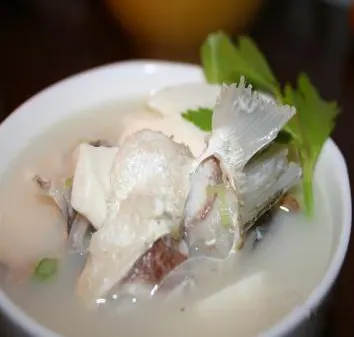
A bowl of fish-head and tofu soup — milky broth, chunks of fish head and tofu, a few coriander leaves on top
What to eat down in town
Hengshan rice noodles: the breakfast default, whether fish, braised or pork, ¥8–15 a bowl on a pork-bone broth with chilli added at the table. The shops along the old-town streets are much of a muchness; pick the one with local number plates outside.
Nanyue tofu claypot: local tofu set with spring water, tender, braised with cured pork and mushrooms. A small portion is ¥30–40 and feeds two. Every Hunan restaurant in town serves it; the variable is the quality of the cured pork.
Hengdong country cooking: stir-fried crisp tripe, steamed taro with chopped chilli, chicken steamed with camellia oil, ¥40–50 a head. The heat is real. If you cannot take it, say so when ordering — otherwise the default is generous.
Pailou tangyuan: a Hengyang snack, savoury rice-flour balls the size of a fingertip in a clear broth with spring onion and white pepper, about ¥10 a bowl. Nothing like the sweet tangyuan of the east coast; treat it as a hot soup.
Nanyue cloud-mist tea: green tea from the mountain's cloud belt, ¥20–30 a pot in a town teahouse with refills. To buy, ¥100–600 per 500 g is the honest range; below ¥80 it is unlikely to be from this slope.
Where: the lanes off Jinsha Road and Zhurong Road in the old town have the densest cluster of small restaurants, and the night stalls by Wanshou Square run past midnight. Inside the park, Yanshou village at Mid-Slope Pavilion is the best value, all family-run and open to a little bargaining. One warning: do not order wild mushrooms or rock frog at the summit. The prices are inflated and the provenance is unclear; eat mushrooms in a proper restaurant down in town.
09Tea, longevity cakes, dried mountain goods — and no fancy incense
There is not a great deal worth carrying home, but a few things are genuine. The test is the same as anywhere: will it be eaten, worn out or given away? Anything that only works if you believe in it stays in the shop.
Nanyue cloud-mist tea: green leaf from the cloud belt, finely rolled and good for several infusions. Taste before buying — the shops in town will brew for you — and expect the same leaf to cost double at a sight entrance. Spring tea around Qingming is best; summer and autumn leaf is cheaper.
Nanyue longevity cakes: traditionally traced to a pea-and-bean cake eaten on the legendary Emperor Shun's southern tour, later renamed for longevity. Sweet but not cloying, heavy on sesame. The ones baked in the old town beat the boxed versions, ¥20–40 a box, with a short shelf life — do not stock up.
Dried mountain goods: bamboo shoot, shiitake, wood ear and the local goose mushroom, sold by weight for a few tens of yuan. Check three things — insect holes, a musty smell, and whether it yields when squeezed, which means damp. The goose mushroom is the best local fungus, expensive and often faked; smell for a resinous, pine-like note before you pay.
Longevity liquor and fermented tofu: a local rice spirit steeped with herbs, ¥30–120 a bottle and a reasonable gift for an older relative; and small jars of Nanyue fermented tofu at about ¥10, good with rice. Both are heavy, so think about your bag.
Three things to leave alone. First, the big incense bundles at the gate: several hundred yuan, when the temple gives three sticks free and allows three of your own — you cannot take them in anyway. Second, anything sold as blessed: the temples do have small shops where a charm costs ¥20–30 and is a souvenir; the stalls outside quoting hundreds for something that will change your luck are a business. Third, wildlife products and wild herbs: buying and selling are both illegal, and the claim that something was picked on the mountain is not a reason to believe it.
10High-speed rail to Hengshan West, then a ¥6 bus
Three stations, one right answer
Hengshan West is the high-speed station and the only one worth remembering. It sits on the edge of Hengshan county town, seven kilometres from Nanyue town along Hengyue Avenue. The official shuttle costs ¥6 and reaches the visitor centre in fifteen to twenty-five minutes from the stand on the right as you exit; a taxi is ¥20–35. Do not take the county buses that run via Hengshan town — that route loops 23 km and takes over an hour. Hengshan Station is the old conventional-rail stop in Hengdong county, 28 km out, with a minibus at ¥8 taking forty minutes. Hengyang East is a major high-speed station but 50 km away and requires a second change; unless Hengshan West is sold out, skip it.
Inside the gate there is one mode: the shuttle
Private cars stop at the visitor centre (¥20 a day) and everyone transfers to the shuttle. Tickets are ¥44 one way or ¥78 return on the route visitor centre–Mid-Slope Pavilion–South Heaven Gate, forty minutes of switchbacks; take motion-sickness tablets half an hour before. Since 25 April 2026 the bus ticket also requires a timed slot on the Nanyue Yimayou mini-program, with quotas per slot, and at holiday time the desk often has nothing left. Buses run 07:00–17:30, extended to 18:00 on peak weekends; miss the last one and you walk down or sleep up there. While the cable car is closed this road is the only mechanical way up, so queues are long in high season — aim for the 07:00 departure.
Getting here from Changsha, Guangzhou or Wuhan
Changsha South to Hengshan West is as little as 26 minutes, ¥64–71 in second class, with about fourteen departures a day — 07:00, 08:00 and 09:00 all have trains, so a same-day return is realistic. Guangzhou South is a little over two hours at around ¥300; Shenzhen North two and a half to three; Wuhan one and a half to two. Trains back to Changsha run into the evening, so a sunset is not out of the question. Flying into Hengyang Nanyue Airport leaves you 60 km out with few flights; flying to Changsha and taking the train is better. Driving, take the G4 or the Nanyue expressway, leave at the Nanyue exit, and navigate to the Nanyue Mount Heng Visitor Centre rather than the Grand Temple.
Check trains and fares from Changsha to Hengshan West
Hours: the scenic area runs 07:00–17:30, with the shuttle on the same clock; the September 2026 reopening notice gave 08:00–18:00 with no night entry. The Grand Temple is 08:00–17:30, last entry 17:00, opening at 07:00 on pilgrimage days. Water Curtain Cave and the Great Ding are 08:00–17:30. Three different clocks — plan to the earliest.
Bookings: everything is real-name and online through the Nanyue Yimayou mini-program on WeChat, with an identical Alipay version, covering date, time slot, gate ticket and shuttle. Book three days ahead at holidays, one day ahead otherwise. Staffed windows exist, but popular slots sell out; cancel by 23:59 on the day if you cannot go, or the ticket is written off.
ID: Chinese visitors tap their ID card at the gate. Foreign visitors book with a passport number and use the staffed lane, with the booking QR code and passport both in hand. Guesthouses and temples on the mountain will also register your passport.
Incense rules: the Grand Temple and the religious sites provide three free sticks; visitors bringing their own may carry one box of three per adult; oversized or poor-quality incense and anything meant for burning are banned, and naked flame is prohibited across the park. Enforcement has been strict since the 2026 pilgrimage season, and the big bundles sold at the gate generally do not get in.
Closures: when the park reopened in September 2026, six trails were under repair — Fanyin Ancient Trail, Yubanqiao to Lingzhi Spring, Magu Fairyland to the Folk Culture City, Mirror-Polishing Terrace to Tianzhu Peak, Xiangnan Temple to Zushi Hall, and South Heaven Gate to Lion Rock — and the Longfeng, Liantang and Huixianqiao checkpoints were shut. Rain, snow and ice bring further temporary closures and short-turn buses. Check the mini-program before setting out.
Medical and signal: first-aid points at South Heaven Gate and Mid-Slope Pavilion handle sprains and mild altitude symptoms; the nearest full hospital is in Nanyue town, about thirty minutes by ambulance. Signal is 4G/5G in town and at the main sights, dropping out on the middle of the trails and behind the summit. Carry two or three hundred yuan in cash.
Temple etiquette: step over the threshold, never on it; inside a hall, photograph neither statues nor anyone chanting; do not point at images while talking; use the three free sticks rather than a bundle; and when a service or a pilgrimage group passes, stand to one side and let them through. You do not need to understand it. Watching quietly and moving on is the respect required.
12What to pack, and how to dodge the crowds
Footwear: grippy and treaded. A thousand years of pilgrims have polished these steps, and rain turns them greasy; the exposed stretch between South Heaven Gate and the summit grows moss. No new shoes, no flat leather soles, no canvas.
Clothing: the summit runs six to ten degrees cooler and is windy. Even in summer, bring a light layer and a windproof shell; at dawn in August it sits around 15 °C. In winter, a down jacket, hat and gloves, plus crampons.
Water and food: ¥5–8 for a bottle and ¥15–20 for noodles up top, with fewer kiosks on the trails than you expect. Carry 1.5 litres, something salty and something sweet, and refill before Mid-Slope Pavilion.
Night climb or sunrise: a head torch, because a phone light is not enough and the steps are unlit; a knee brace; a disposable rain poncho. Add hand warmers in winter. Military coats can be rented on top for about ¥30, but the sizes run out.
Medicine: motion-sickness tablets for the forty-minute switchback road, plasters, something for the stomach. If your knees have history, take the bus down instead of walking; descents do more damage than climbs.
Screenshots: signal drops. Save the QR codes for the gate ticket and the shuttle slot to your photo library, plus a copy of the park map, since signage is incomplete when trails are closed.
The coach timetable deserves memorising. The standard pattern: Grand Temple at 09:30, visitor centre at 11:00, South Heaven Gate at noon, summit at 13:00, down by 15:00. So either go two hours earlier — in at 07:00, at the gate by 08:30, sharing the top only with sunrise people — or two hours later, going up after 15:00 when the groups have left. The bad window is 10:00 to 14:00: queue for the bus, queue at the gate, queue for the photograph. At weekends and holidays, move “early” half an hour earlier still.
Three smaller things. The Grand Temple and the scenic area have separate entrances, so check the map — the wrong one costs half an hour. There is no ATM and no pharmacy on the mountain, so buy what you need in the old town. And the shuttle ticket is timed: a 09:00 slot will not let you on at 08:00, and if you miss your slot the staff may or may not fit you onto a later bus, especially in high season. Get these three right and the day runs.
13A fire god, a mountain of longevity, and one temple for three faiths
How the mountain was made
The mountain is made of Yanshan granite, intruded about 180 million years ago and later lifted, faulted and weathered into seventy-two summits. Its high point is modest, but the humidity is not: cloud covers it for most of the year, which is why the forest is denser and the moss thicker than at the same latitude elsewhere. Half the reason emperors cared about this peak is position. It stands at the northern edge of the Hunan basin, with Dongting Lake and the Yangtze beyond it and the upper Xiang River to the south, on the old north–south road.
The mountain of longevity: one word, a thousand years
Mount Heng is also called the Mountain of Longevity. The idea comes from astronomy: in the old correspondence between the twenty-eight lunar mansions and the provinces, Nanyue was tied to the Zhen mansion, which governed human lifespan, and the mountain inherited the job. Emperor Huizong of the Song had the two characters for longevity carved on a boulder that still stands on Huangdi Rock; the stele Kangxi wrote for the temple's restoration opens by calling Nanyue the great bulwark of the south, answering the stars of the Northern Dipper, and therefore the Mountain of Longevity. That is why the character is everywhere here — on cliffs, plaques, burners and cake wrappers. When Chinese speakers wish someone a life as long as the southern mountain, this is the mountain they mean.
Zhurong: the fire god and the peak
The summit takes its name from Zhurong, the god of fire in Chinese myth and one of the ancestral figures worshipped in the Chu culture of the middle Yangtze. There are two layers to him here. The myth says he taught people to use fire on this mountain and was buried on the peak. The history is that as Chu influence moved south, the cult of the fire god moved with it, and Nanyue became its centre. The small stone hall on top is his, and the pilgrims inside are mostly asking for the safety of their households and for work. You do not have to believe any of it; you also do not have to treat the hall as a prop. It is in use.
One temple, three traditions
What is unusual about the Grand Temple is not its size but its plan: a Confucian ceremonial axis down the middle, eight Taoist temples on the east side, eight Buddhist temples on the west. Taoism ranked Nanyue as one of its lesser grotto-heavens; Buddhism built here from the Southern and Northern Dynasties, and figures central to Chan history — Huisi, Huairang, Shitou Xiqian — are all connected to the mountain. Two systems occupying opposite sides of one walled compound, sharing a gate, is rare among Chinese mountains. You do not need to rank them. Look at how the buildings are arranged and how people move through them, and you can see that the arrangement has been working for a long time.
1938–1943: the Martyrs' Shrine
The Martyrs' Shrine is the most recent layer of history on this mountain. Planned in 1938, begun in 1940 and completed in 1943, it buries Chinese soldiers killed in the war against Japan and holds a collective tablet to the war dead of the Chinese nation. The design is a memorial axis climbing the slope: 276 steps linking five structures, with the memorial tower shaped as five artillery shells. It became a national protected site in 1996 and has been free since 2009. It is not on the blessing circuit, but everyone who comes to Mount Heng should stop here for twenty minutes.
Today: a 5A rating, a longevity certificate, and a new cableway
Nanyue was among the first national scenic areas in 1982, was rated 5A in 2007, and in September 2024 the district was certified as a World Longevity Region by the International Institute on Ageing. The biggest recent project is transport: the old cable car closed at the end of 2020, and the new one began in September 2024 — ¥827 million, a 3S system, 1,607 m, 5,000 people an hour, five minutes in transit, due around the end of 2026. The other change is incense: the three-stick rule, piloted at the Grand Temple to cut smoke and open flame, came through its first full pilgrimage peak in 2026. Both will change the mountain you see.
14The old town, Hengyang city, and a back-road trail
Nanyueli and the old town (half a day)
Nanyueli sits south-east of the Grand Temple, a recent street built around the temple-fair theme, free to enter: design shops and snacks by day, lanterns at night. It is not historic, so adjust expectations, but it solves the old town's evening problem. The old town itself is worth more time: Jinsha Road, Zhurong Road, Beizhi Street, noodle stalls at seven in the morning, incense shops in the afternoon, residents trimming vegetables in their doorways at dusk. This is the everyday side of the mountain.
Hengyang city (one day)
Hengyang is an hour away by bus. Three stops. Shigu Academy stands on a rock where the Zheng and Xiang rivers meet, one of the four great academies of the Song; book through its mini-program, open Tuesday to Sunday 08:30–17:00, closed Mondays. Huiyan Peak, the first of the mountain's seventy-two summits, is right in the city centre — twenty minutes up, low but with a river view. And the Hengyang Defence Memorial in Yansfeng district covers the 1944 siege, free to enter. Together they fill a day, and they are the right choice for a rainy one or a long wait for a train.
The Zeng Guofan Trail (most of a day)
A stone pilgrim road on the back of the mountain, starting at Hongqi village in Hengyang county and running via Baoxin Ridge, Ganlu Temple and Huixianqiao to the summit: eight to nine kilometres, four to five hours, almost empty, and with little in the way of supplies. The Zeng Guofan brothers paid for its rebuilding in the Qing, and the surface is rougher and the views wider than the front route. It suits people who have been to Mount Heng before and want a different line. Not for a first visit: the trailhead is remote, public transport is awkward, and a late descent means no taxi.
15How the mountain got into a martial-arts novel, then a sitcom
The novel: Jin Yong's Hengshan sect
In Jin Yong's The Smiling, Proud Wanderer (1967), the Five Mountains Sword Sect takes in Tai, Hua, Song, Heng of Shanxi province and Heng of Hunan. Its Hengshan branch is led by Mo Da, a man with a two-stringed fiddle and a very fast sword, one of the bleakest and clearest-eyed characters in the book. Keep the distinction: the sword sect is fiction. The real five mountains are five places with five religious and architectural traditions and no alliance. But the novel shaped how several generations picture Nanyue, and for many readers it was the first time they heard the name.
The sitcom: the Hengshan sect on television
The 2006 sitcom My Own Swordsman turns the Hengshan sect's leader, Mo Xiaobao, into a running joke: the sect has collapsed and all that remains is his sister, Mo Xiaobei. The show is set in a fictional town and has nothing to do with the real mountain, but it put the words Hengshan sect into everyday speech, and you will still find themed souvenirs in the old town. Treat it as background. It shows that the mountain occupies a place in popular culture, even a comic one.
Travel writing and poetry: from Li Bai to Wei Yuan
The most quoted lines about Mount Heng are Wei Yuan's comparison of the five peaks: Heng moves, Tai sits, Hua stands, Song lies down, and only Nanyue flies. Li Bai wrote about its snow: a whirling wind scatters the five peaks' snow, and petals of it fall on Dongting Lake. Neither is reportage, and both explain how a mountain of only 1,300 m entered the canonical five. It was never height. It was position, shape, and a thousand years of writing. Read the two lines before you climb and the summit will have one more layer.