A World Heritage villageTicket valid three days1h41m from HangzhouStay a night for the morning
In short
Hongcun (宏村, Hóngcūn) sits in Yi County under the Yellow Mountains of southern Anhui, and it is a village organised around water. Founded in the Southern Song, it was given a network of stone channels that still carries mountain spring past every doorstep; the Moon Pond is the ox's stomach, the South Lake its belly, and the whole village is laid out as an ox. It has run without a break for six hundred years and joined the World Heritage list with Xidi in 2000. Entry is ¥104 at the gate, ¥94 online, valid for three days with re-entry and including a free guided walk. Since the Huangshan–Nanchang high-speed line opened at the end of 2023, Hangzhou West to Yixian East Railway Station takes as little as 1h41m for ¥121, and the station is a twenty-odd-minute drive from the village, with a local bus as backup; Huangshan North Railway Station has a direct coach. You can walk Hongcun in two hours, but you need a night to see the South Lake before the groups and the Moon Pond after the lanterns come on. Rapeseed in March and April, best colour from late October to mid-November, and the most art students in April–May and September–October. Budget ¥1,100–2,000 for two or three days, excluding travel to Anhui.
Key facts
Known for
Moon Pond · South Lake · horse-head walls · ox-shaped water system
Budget
¥1,100–2,000 for 2–3 days, mid-range
Days needed
2 days; one is possible
Comfort
Comfortable — flat throughout, though the stone lanes are slippery
Best time to go
Rapeseed in March–April; best colour late October to mid-November; quietest after snow
01A village shaped like an ox
The first thing you hear in Hongcun is water. Not a river — a stone channel barely half a metre wide, running along the foot of the wall, turning at every doorway and disappearing under the slabs. The lanes are narrow enough that two people have to turn sideways, the white walls rise above head height, and the lime wash comes away in patches to show the grey brick and an earlier coat of white beneath. A strip of sky above, moving water below, and a band of cool air in between: that is the village's opening sentence.
The system was planned when the village was founded in the Southern Song, in the Shaoxing era from 1131, and took its present form in the Ming. Its authors described the whole place as a reclining ox: Leigang Hill behind the village is the head, the two five-hundred-year-old trees at the entrance are the horns, the Moon Pond is the stomach, the South Lake the belly, the channels the intestines, and the four bridges over the stream the legs. Water is led in from the West Stream, runs past every hall and kitchen, settles in the Moon Pond, spills into the South Lake, then irrigates the fields and returns to the stream. Fire fighting, drinking, washing, irrigation and local climate, all from one channel, for six hundred years.
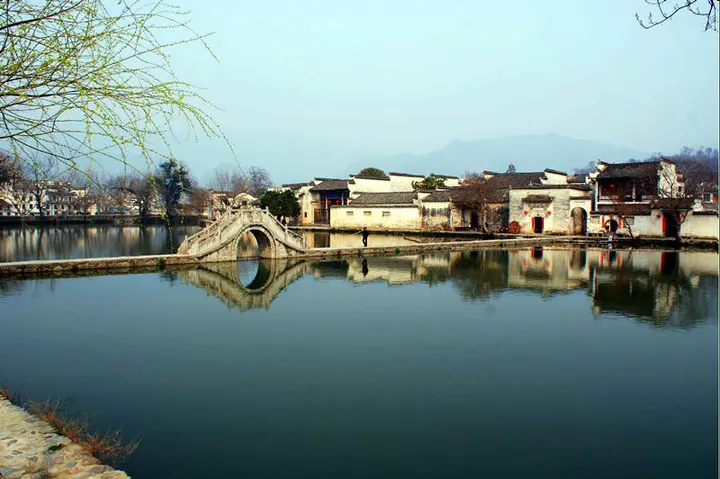
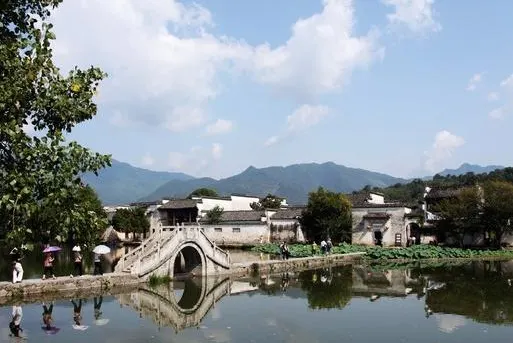
The South Lake and its painted bridge, the arch and its reflection closing into a full circle
The village is small — nineteen hectares, forty minutes around — but unusually dense. More than 140 Ming and Qing houses still stand, ancestral halls, an academy, a salt merchant's mansion and ordinary farmhouses with their skywells, all packed along a few lanes. Chengzhi Hall alone has nine skywells, sixty rooms and 136 timber columns; the South Lake Academy was rebuilt in 1814 from six earlier schools; Lexu Hall on the north side of the Moon Pond is the Wang ancestral hall, its roof frame still early Ming. You do not need to know anything about architecture to see that the white walls are not background but canvas — every carved door hood, brick panel, red lantern and string of drying chillies is hung on that white.
Hongcun and Xidi were inscribed together in 2000 as the Ancient Villages in Southern Anhui. It is not an emptied museum: more than four hundred households still live here. In the morning someone washes vegetables at the Moon Pond, at midday someone sits on a doorsill with a bowl, and in the evening a bamboo basket is dragged home along the lane. Tourism turned this into a ticketed site without quite turning it into a set, which is why it wears better than most old towns.
No one need walk far to wash or draw; every door has clear spring water at its step.
A Huizhou couplet, quoted in Wang Senqiang's Waterlines of Hongcun
02Six things worth slowing down for
The South Lake: the mirror at half past sixThe first view
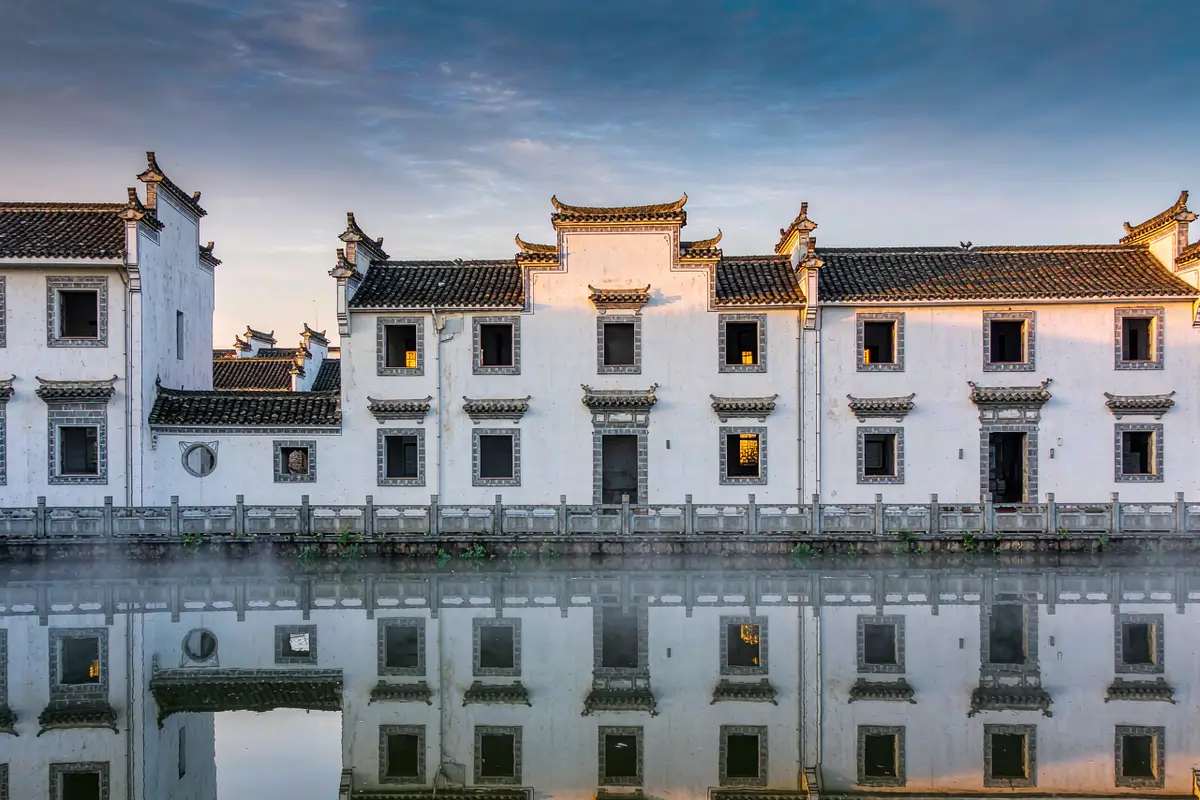
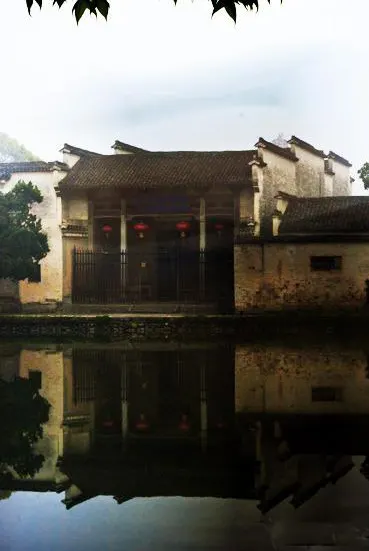
The South Lake lies south of the village, dug in 1607 on the model of Hangzhou's West Lake, with a humpbacked painted bridge cutting the water in two. On a still morning the horse-head walls opposite, the ridge behind them and the first person to cross the bridge all sink into the water intact, down to the cracks in the plaster. After seven the coaches arrive at the south gate, the first crowd steps onto the bridge, and the mirror is gone. The South Lake is not really a sight; it is an hour, between about 06:30 and 07:30.
The Moon Pond: why it is only half a moonThe centre of the village
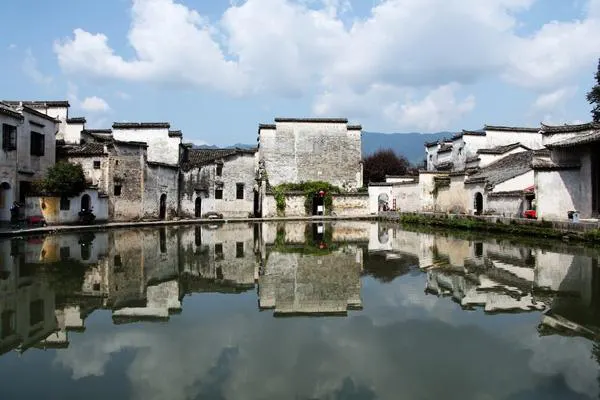
The Moon Pond sits at the exact centre, a semicircular basin dug by hand and hemmed in by halls and houses, with only a few lane mouths to enter. The founding geomancer is said to have argued that a full moon must wane, so the pond was left as a half circle — room to spare. By day it is the village's front room: someone rinses a mop on the west side, someone dries radish slices on the north bank, visitors sit on the stone kerb with a sesame cake. After dark the lanterns come on and the water turns into a dark mirror, pushing the white walls down into itself more clearly than the walls themselves.
Chengzhi Hall: how fine a salt merchant's house can beThe peak of Hui woodcarving
Wang Dinggui, a salt merchant, built this house around 1855: 2,100 square metres of site, over 3,000 of floor, nine skywells, sixty rooms and 136 columns. The timber panel above the inner door shows a hundred boys at the Lantern Festival — punting land boats, dancing a dragon, letting off firecrackers — and no two figures do the same thing. On the bracket sets either side, four scenes from Romance of the Three Kingdoms are carved; above them sit the gods of wealth. Huizhou families cut scholarship and commerce into the same beam, and standing under the skywell you are looking at their view of the world.
The channels: follow the water and you cannot get lostSix hundred years of running water
The channels are only half a metre wide, but they come in from the West Stream and thread the whole village along the foot of every lane, ducking under houses when they have to. Locals navigate by them: with the flow takes you out to the South Lake, against it takes you north towards the Moon Pond and the source. Every few dozen metres a slab is set aside for crouching and washing, and the square drawing tanks always have a wet ring around them. Reading the water is more reliable than reading a phone.
Horse-head walls and skywells: white is not decorationFire, light, water
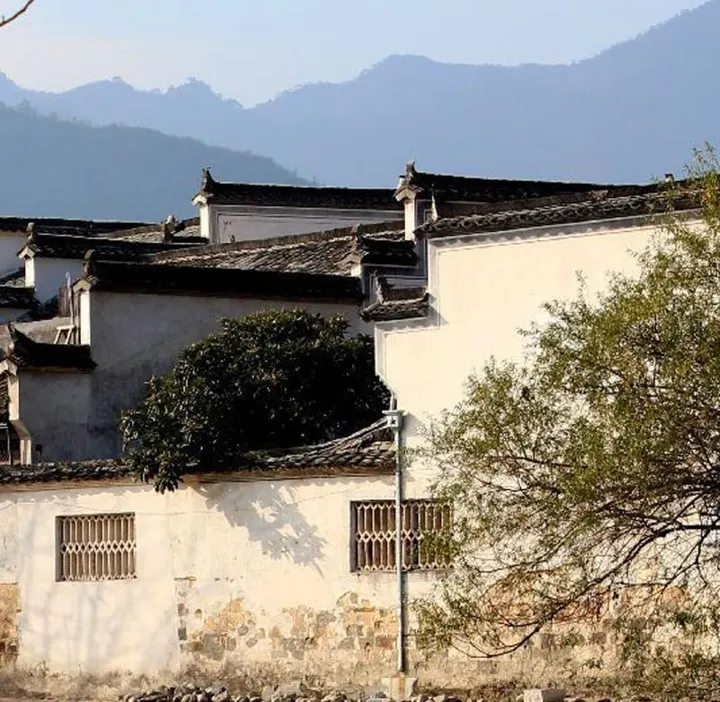
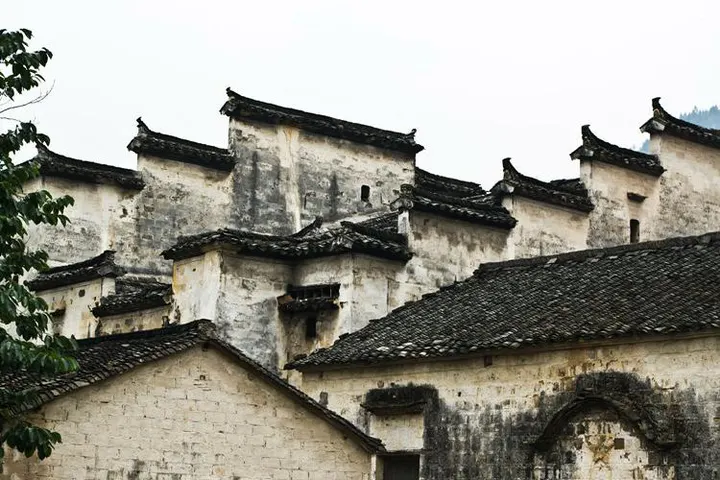
In a Hui house the gable wall rises above the roof and steps up in stages, each stage tipped with a small curved cap: the horse-head wall. Its purpose is fire — if the neighbour burns, the wall stops the flames jumping the roof line. Inside, the roof pitches inward from all four sides towards the skywell, so every drop of rain lands in the courtyard, a device called four waters returning to the hall, which merchants read as wealth staying home. White lime, black tile and grey stone supply the village's entire palette, and all of its contrast.
The working village: washing, drying, sketchingNot a performance
The most honest layer of Hongcun is that it still works. At seven someone is crouched at the Moon Pond washing clothes in a wooden basin that rocks on the water; by ten the easels are up along the South Lake and art students are reducing white walls to planes of grey; in the afternoon pickles and cured pork hang in the lanes and a cat sleeps on a step. The students are not a show: Yi County hosts more than half a million of them a year, sharing the same water and the same lanes as the people who live here. If you want to photograph them, ask first.
03Seven questions to settle before you go
Is one day enough, and should I stay a night?
For daylight, yes. The village is small: the South Lake, the Moon Pond, Chengzhi Hall and the channels take two and a half to three hours. But enough and worth it are different questions. Coaches come in after 09:30, and between ten and three you will queue for a photograph on the painted bridge and around the Moon Pond. The two best hours — mist on the South Lake from 06:30, lanterns on the Moon Pond after 18:30 — sit outside or at the edge of ticket-checking time. That is what a night buys you: empty lanes at nine in the evening, fog on the water at six in the morning, and the village rather than the crowd. Staying just outside the south gate still gets you the early show, five minutes' walk away, for about half the price.
What time in the morning is quietest?
Around seven. Ticket checks start at 07:30, or 08:00 in winter, but the lanes are open all night, so anyone sleeping inside can be out at 06:30. If you are outside the gate, be at the south entrance by 07:20, go in with the first check, and you will have the South Lake to yourself for twenty minutes. Eight to nine is still good — a few independent travellers and the sketching students. The first coaches land at 09:30, and ten to half past eleven is the worst of the day. The second peak runs from 13:30 to 15:30; it thins after four and is quiet again after five. For empty frames, remember two windows: 07:00–08:30 and 16:30–17:30.
Does the ticket include a guide, and do I need one?
It does. The ¥104 ticket includes one guided walk, meeting at the visitor centre and covering the core sights in about an hour — the water system, the carvings in Chengzhi Hall, why the Moon Pond is a half circle. This matters more than it sounds: without someone talking, Hongcun is a heap of white walls and old timber. With them you learn which panel spells out the character for merchant, which door the women of the house used, and why the skywell is not paved. The free group is large and brisk; for a slower look hire a village guide privately, around ¥100–150 a session and shareable, or read up on Hui architecture beforehand. The ticket is valid three days, but re-entry requires registering your passport or ID at the ticket window.
Should I arrive at Yixian East or Huangshan North?
Yixian East, unless your train only goes to Huangshan North. The station sits near Yecun in Xidi town, about 24 km from Hongcun: thirty-odd minutes and ¥40–60 by taxi. The No.10 tourist bus leaves from the forecourt, linking Xidi, Pingshan and Saijinhua with Hongcun for ¥8–13, roughly every half hour, forty minutes on the road, and it waits for train arrivals. Huangshan North has far more services, but it is 57 km out: the direct coach is ¥30–33 and takes ninety minutes, departing between 08:05 and 17:05. One neat trick — the train from Huangshan North to Yixian East takes eleven minutes for about ¥13, and connecting to the bus beats the coach. And keep the geography straight: Huangshan City, Huangshan North station, Huangshan scenic area and Tangkou are four different places.
How bad is it when the art students are in town?
Busy, but not ruinous. The sketching seasons are April–May and September–October, when easels line the South Lake, the west side of the Moon Pond and the main lanes from eight in the morning until four in the afternoon, in classes of several dozen with a teacher critiquing behind them. The good news is that their hours differ from yours: before seven and after five they are largely gone. The bad news is that outside those hours the best spots on the bridge and the pond involve waiting. Yi County receives over half a million sketching students a year; this is normal, not an anomaly. If crowds really bother you, come from late November to February, or stay a night and give the South Lake to the early morning. Do not walk through the middle of an easel, and do not put a lens in someone's face.
How do I fit Tachuan in, and is it worth it in autumn?
Tachuan is two kilometres northeast of Hongcun: half an hour on foot, ten minutes and ¥10–15 by taxi. Its subject is the Chinese tallow tree, not maple — one tree can hold red, orange, yellow and green at once, leaning out from behind a white wall. The window is short. The 2026 forecast puts the peak between 11 and 26 November, with mid-November the safest bet; colour starts in late October and leaves fall from about the 20th. Tachuan's soul is the mist and kitchen smoke between 06:30 and 07:30. After eight the fog lifts, the light hardens and the crowd arrives, and it is a different, lesser place. So the order is: sleep in Hongcun, go up to the Tachuan viewpoint before dawn, come back for breakfast at eight, and enter the village before nine. Doing Hongcun first and Tachuan after is close to pointless. Tickets are ¥35 online, ¥40 at the gate.
Is it worth going in the rain?
Yes, provided you accept two things: wet feet and crowded halls. Rain is when Hongcun looks most like the ink painting it is sold as — lime wash darkens to grey, tiles gloss over, puddles turn the horse-head walls upside down, and the lanes lose the hard shadows of sun, which flatters photographs. The price is that the stone is genuinely slippery, especially around the Moon Pond and along the channels, so wear real grip; the interiors at Chengzhi Hall and Lexu Hall fill with people sheltering; and the painted bridge has no cover at all. Bring a solid umbrella, a light rain shell and a dry cloth for the camera. Summer thunderstorms arrive fast, and winter rain turns to sleet. The half hour after the rain stops is the best of all: the vapour is still hanging and the crowd has already gone.
04Two days is comfortable, one works
One principle shapes any Hongcun itinerary: give the village its early mornings and late afternoons, and give the middle of the day to somewhere else. Two or three hours covers the sights, but the value is in the hours when the light is low and the crowd is thin, so do not count the day in ticked-off viewpoints. The two-day version below enters on the first afternoon for the evening, goes out to Tachuan at dawn on the second day and comes back for the halls it missed. With only one day, drop Tachuan and see the South Lake and the Moon Pond twice each — once at dawn, once with the lanterns on.
D1
Arrive in the afternoon and drop the bags. If you are staying inside, go straight in; from the south gate, enter at 15:30 and walk against the flow: South Lake Academy, Jingde Hall, the channels, the Moon Pond, Lexu Hall, Chengzhi Hall. After five the coaches drain out and the lanes empty section by section, which is the easiest hour to photograph. Before dark, climb halfway up Leigang Hill for the roof line, then come down and eat beside the Moon Pond. The lanterns come on at about 19:30; walk the pond once and turn in.
D2
Up at six, at the South Lake by 06:20. Mist on the water, one man sweeping the bridge, two people with cameras. Back for breakfast at 07:30, then out at eight to Tachuan in autumn or Mukeng Bamboo Sea otherwise, ten minutes by car. Stay on the Tachuan viewpoint until nine and come back when the fog lifts. In at ten for what yesterday missed: the carvings at Chengzhi Hall, the hexagonal plot of Shuren Hall, the fish pond at Deyi Hall. Lunch inside the village, leave at two, and take the bus or a taxi to Yixian East.
D3
Give the extra day to Xidi. It is eleven kilometres from Hongcun, twenty-odd minutes and about ¥50 by taxi; the bus is ¥8 but takes a long way round. Xidi is linear — one main street and two lanes — with the stone archway, Jing'ai Hall and Lüfu Hall in sequence, quieter than Hongcun and less commercial. Come back for your bags in the afternoon, or go straight from Xidi to Huangshan North. With half a day spare, the woodcarving hall at Lucun (¥45) is worth more than any famous viewpoint.
05Two waters, one channel, a handful of houses
The South Lake: the village's front face
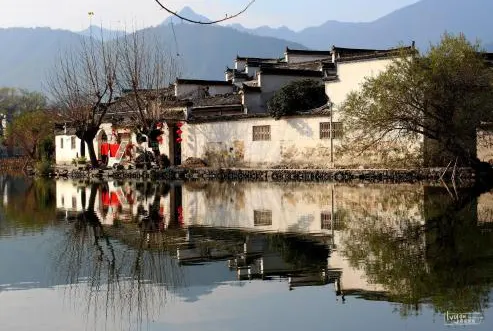
The South Lake was dug in the Wanli era and sits at the southern edge of the village like a front garden. It is shallow and goes flat in any light breeze; the row of houses opposite is uniformly white and black, and the stepped gables repeat in the water as a second skyline. The painted bridge crosses east of centre, low enough that from the top you can see the whole shore. Willows green first in spring, lotus fills the southern half in summer, the water turns blue in autumn, and after snow a strip of open water stays down the middle. Spring is the busiest season and the one most thoroughly occupied by easels.
The north shore of the South Lake: white walls, red lanterns and a full set of reflections
The Moon Pond: the most photographed water in the village
Walk north from the South Lake through the channels and a few lanes and you fall into the Moon Pond without warning. It lacks the South Lake's breadth; houses press in on all four sides, the walls cut half the light, and the water is darker, heavier and more complete as a mirror. Lexu Hall, the Wang ancestral hall, occupies the centre of the north bank, its gate house Ming, its curved beams and spandrels original. The houses east and west step up and down, and the stone at the waterline is stained dark. The photograph that made the pond famous was a landscape stamp issued in 1982; since then it has been the default image of the word Huizhou.
What is worth looking at around the Moon Pond is the wear: the kerb polished by generations of sitting, the landing steps rounded by water, the bamboo trays for drying vegetables leaning against the ancestral hall. These details explain the place better than any single house — it was not preserved for visitors. Two steps west there is a small teahouse with a few square tables, a pot for ¥10, and no one hurrying you out after an afternoon.
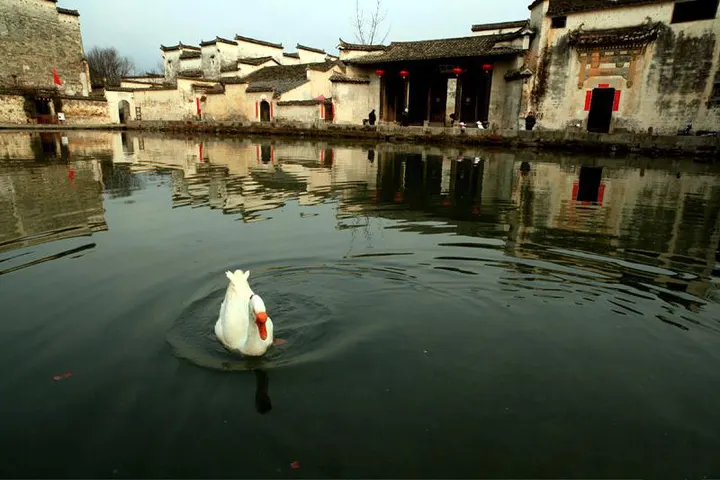
A white goose crossing the Moon Pond, the reflection creased into rings
Chengzhi Hall and the other houses
Chengzhi Hall stands on the middle reach of the upper channel and is the one interior in Hongcun that justifies a queue. The subject is wood: the hundred boys at the Lantern Festival across the front hall beam, the merchant character worked into the bracket sets, the ice-crack lattice on the side-room windows, all original. The skywell is small and gathers light from four roofs at once, warm on timber and cold on stone. When it is crowded, do not hurry out — stand in the middle of the skywell and look up for five minutes; the crowd passes and the light comes back.
Pick the rest by appetite. The South Lake Academy is one of the largest old schools in southern Anhui, a sequence of teaching hall, shrine and viewing tower from which you can see the lake. Shuren Hall sits on a hexagonal plot chosen for good fortune. Deyi Hall has a courtyard pond linked to the channels by a hidden drain and earns its name, the open-air flower hall. Jingxiu Hall keeps two century-old peonies that bloom in April. House fatigue is real: three interiors a day is plenty, and the lanes and water deserve the rest.
Leigang Hill: where you look at roofs
Five minutes north from the back street, stone steps climb Leigang Hill without steepness. Old trees of two to three hundred years stand on the slope, and a platform halfway up looks over the entire roofscape: a field of black tile, a few gables lifting out of it, a strip of white showing between trees. Go late: with the sun behind the hill the roofs darken first while the walls still hold light, and the village looks lit from below. No ticket, few people, and the most overlooked viewpoint in Hongcun.
06Beyond walking
Photography: two good hours a day
Hongcun runs north to south, with the sun rising over the eastern ridge and setting behind the western one, so direct light is limited. The two good stretches are 06:30 to 08:00, when the South Lake is still and often misty and the far bank is front-lit, and 16:30 to 18:00, when the sun drops and raking light gives the white walls around the Moon Pond their texture, gable shadows stepping down the plaster. Do not fight midday: overhead sun turns a skywell into two flat blocks and the lanes into pure contrast. Overcast is underrated — diffuse light pulls out all the greys in the lime wash, as long as you keep most of the sky out of frame.
Sit down and draw
Hongcun hosts more than half a million sketching students a year, and there are art-supply shops in the village and guesthouses that will lend a stool. You do not need to be able to draw: a pencil and a sketchbook, half an hour on the South Lake, and you start noticing what you normally walk past — the angle at which a gable lifts, the depth of the brick carving over a door, how far the water stretches a house. Keep out of the lane, do not set up against a historic wall, and note that most interiors forbid easels. April and October are the sketching seasons: the best atmosphere and the worst crowding.
A student sketching on the South Lake shore, the far bank taking shape on the board
The village at dusk and after dark
The coaches leave at five and the village lets out its breath within half an hour. Shops close first, baskets and plastic stools carried inside; then kitchen smoke, a few threads rising behind the roofs; then the lanterns, the row on the north bank of the Moon Pond first, then the guesthouses along the South Lake. This is the hour to do nothing: find a step by the pond, watch the water go from grey to black and the reflected lights multiply one by one. After eight the lanes are empty and the street lighting is dim, so bring a small torch.
Ride out of the village
The Yi County basin around Hongcun is threaded by a scenic road known as the Beautiful 218, and Tachuan, Lucun and Mukeng Bamboo Sea all lie within five kilometres. The surface is good and traffic light, which makes a bike better than a car. Rental shops at the village entrance and in town charge ¥50–80 a day. Ride to Lucun for rapeseed in spring, to Tachuan for tallow trees in autumn — two hours there and back. There are hills, so know your legs, and the road is slippery after rain.
07Inside the walls or outside the gate
The short answer: stay inside for the early mornings and the lanterns, stay outside the south or west gate for lower prices, parking and anyone in the party who cannot manage stone lanes. The two are five to ten minutes apart on foot and quite different in experience. No cars are allowed inside, so bags are carried over the slabs and guesthouses usually meet you at the entrance; outside, a car reaches the door and parking costs ¥10–20 a day.
Inside, on the South Lake or the Moon Pond: converted merchant houses with water at the window, ¥200–500 a night and double in the colour season and over National Day. The advantage is being on the shore at 06:30 and walking back from the lanterns; the drawbacks are small rooms, thin walls, damp and bags you carry yourself.
Outside the south and west gates: five to ten minutes from the ticket check, ¥100–220, plain but clean, and the owner will usually buy tickets, call a car and hold luggage. Best for drivers and families.
By Qishu Lake, three kilometres out: resorts and guesthouses at ¥300–600, quiet lake-view rooms, good for older parents or anyone who wants comfort over proximity. It is also close to the Hongcun Aju evening show, if it is running, at the cost of twenty extra minutes each way.
Yi County town, Biyang: fifteen kilometres away, ¥150–300, where locals actually live, with cheaper and better food. Fine for a single night before an early train; useless for mist photographs.
Two notes. Old-house rooms have no lifts and the timber stairs are narrow and steep, so travel light. And re-entry requires registering your ID at the ticket window; if you are sleeping inside you will cross the gate most often, so register right after your first entry and save yourself the explanations. For mid-November and National Day, book a month ahead; on ordinary weekdays three or four days is enough.
08Heavy, dark Huizhou cooking, built for cold hills
Huizhou cooking is mountain food: heavy on oil, dark in colour, long on the fire, because winters were long and fresh produce scarce, and curing, drying and braising were how you kept things. In Hongcun you meet it in two forms — the proper restaurant version, and the ¥5 sesame cake at the mouth of a lane. The first deserves a sit-down meal; the second is your lunch on the move.
A griddle at a lane mouth: small cakes with dried mustard greens, baked against the side, ¥5 each
What to order
Stinky mandarin fish: the signature. Fresh fish salted in a wooden tub for several days until the flesh tightens and smells faintly, then braised, at which point it turns savoury and separates into garlic-like flakes. Half a fish feeds two, around ¥100.
Hairy tofu: bean curd left on straw until a white mould covers it, then pan-fried until golden and eaten with chilli sauce. Crisp outside, half liquid within — the texture surprises first-timers, who usually order a second plate.
Cured pork served on a wooden board: salted belly steamed under a weighted board so the wood draws off some of the fat, then sliced thin. Salty, fragrant, not greasy, and best with rice — it is what locals put on the table at New Year.
Laba tofu: a Yi County speciality made in the twelfth lunar month, when bean curd is cut, salted, pierced with a hole, strung up under the eaves and dried. Sliced and stir-fried or stewed, it eats like a firm pressed tofu with a fermented edge.
Pork braised with bamboo shoot skin, eggs scrambled with acanthopanax leaves, and free-range chicken soup: the three most everyday dishes, with the best shoots in spring. The leaves are a hill vegetable, faintly bitter and sweet after, and locals always cook them with egg.
Dried-mustard-green cakes: the most common food in the village, baked against the wall of a charcoal oven, crisp outside and filled with savoury greens and a little lard. Eat them hot; cold, they lose half.
Braised stinky mandarin fish: deep sauce, flesh in flakes, a handful of spring onion on top
Where to eat
Deyue Lou on the Moon Pond is the best-known address: a table by the water at dusk, dependable fish, chicken soup and pork with dried bamboo, ¥80–120 a head. Sanlitang in Chahang Lane is run by a couple who do the cooking, with pickled cabbage and tofu and mushroom chicken, ¥60–80. For cheaper food go outside the south gate, where a street of farm restaurants runs ¥40–60 a head without much loss. Teahouses in the village charge ¥10–20 a pot and let you sit all afternoon.
09What travels: food and useful things
Hongcun has more shops than Xidi, and they sell roughly the same things: sesame cakes, tea, dried bamboo, mushrooms, laba tofu, bamboo baskets, brushes and inkstones. The genuinely worthwhile list is short but useful. The rule: food yes, stationery only if you know what you are looking at, antiques never.
Huangshan sesame cakes, known as crab-shell yellow: dried greens and lard inside, baked until the crust is the colour of a crab shell. ¥20–40 a bag, light, keeps well and makes the best gift. Buy freshly baked, not the ones already gone soft.
Taiping Houkui and Huangshan Maofeng: Houkui has large flat leaves and a faint orchid scent; Maofeng is finer and better for everyday drinking. Village shops will brew for you, ¥100–300 per 500 g is normal, and ignore anything described as ancient-tree tea.
Dried bamboo shoots, shiitake and wood ear: the most honest mountain produce, and genuinely useful in a braise or a soup. Buy loose, check that the colour is natural and there is no mould, and avoid anything unnaturally white or glossy.
Laba tofu: unique to Yi County, sold vacuum-packed for travel and excellent sliced into a stir-fry with cured pork at home. ¥20–30 a pack, available in the village and in town.
Bamboo work: baskets, trays and sieves woven in front of you by older villagers, from a few dozen yuan. Large pieces are awkward to carry; a small fruit dish or tea mat is enough.
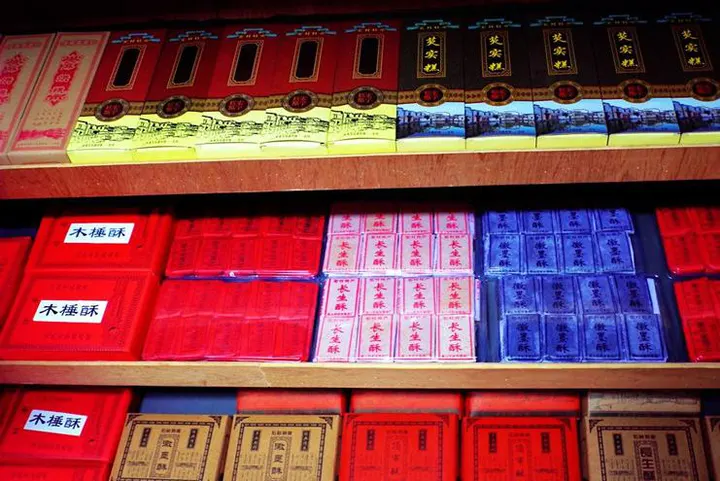
Shelves in a village shop: cakes, pastries and tea stacked in boxes to the ceiling
Two things to leave alone. Old ink and old inkstones: genuine antiques are not sold off a shelf in a scenic village, and anything labelled Qing for a few hundred yuan is new; for stationery, go to a proper shop in Tunxi or Shexian. And any offer to walk you in without a ticket — Hongcun checks carefully, and being caught means paying again plus a possible fine. Not worth saving a few dozen yuan.
10High-speed rail to Yixian East, then twenty-odd kilometres of road
High-speed rail: the default since late 2023
The Huangshan–Nanchang high-speed line opened at the end of December 2023, and Yixian East Railway Station opened with it, giving Hongcun a real railway gateway for the first time. Hangzhou West to Yixian East takes as little as 1h41m for ¥121 in second class; Shanghai is about 3h40m, Hefei South about two hours, Nanchang East about three and a half. Services are not dense — roughly a dozen to the mid-twenties a day — so check 12306 for your date rather than trusting an old timetable. The station itself is worth a look: the roofline abstracts the stepped gables, and the central arch comes from the village bridges.
The station is about 24 km from Hongcun: twenty-odd minutes to half an hour by car, ¥40–60 by taxi. The public option is the No.10 tourist bus from the forecourt, linking Yixian East, Xidi, Pingshan, Saijinhua and Hongcun over 28–33 km for ¥8–13 on a staged fare, every thirty to forty minutes, forty minutes on the road. The first bus out of Hongcun is around 08:00 and the last sometime between 17:00 and 18:50. The bus waits for train arrivals, which is better than most county towns manage.
Huangshan North: more trains, much further out
Huangshan North is the rail hub of southern Anhui, with an order of magnitude more services than Yixian East; most people arriving from Beijing, Shanghai, Hangzhou or Fuzhou land here. It is 57 km from Hongcun. The direct coach from the forecourt costs ¥30–33, takes about ninety minutes and runs frequently between 08:05 and 17:05. The tidier route is the eleven-minute train to Yixian East (about ¥13) and then the No.10 bus: roughly the same total time, but on a schedule you can plan around. From the Huangshan scenic area at Tangkou there is a direct service, about fifty minutes.
Driving, parking, and inside the village
Driving from Hangzhou, take the Hangzhou–Huizhou expressway and switch to the Huangshan–Fuyang line, exiting at Yi County: about three and a half hours. From Hefei, the Beijing–Taipei then Dezhou–Shangrao expressway, exiting at Qimen Baixi and entering the county through the Xiwuling tunnel that opened in February 2026: about four hours. The west gate is the main car park, ¥10 a day for a car and ¥20 overnight; it fills in peak season, when the Qishu Lake overflow lot and its shuttle are the fallback. No vehicles enter the village, so bags are transferred to wheels or shoulders at the car park. At weekends and in the colour season the 102 county road jams, and on the two kilometres from Hongcun to Tachuan, walking often beats driving.
Check trains and fares from Shanghai to Yixian East
Tickets: ¥104 at the gate, ¥94 online through the Huihuangyou mini-program, Ctrip or Tongcheng, all real-name. Valid three days with unlimited entry; re-entry needs your ID registered at the ticket window or the gate will not read it. One free guided walk is included, meeting at the visitor centre. Students and ages 60–64 pay ¥52; under six or under 1.2 m, over 65, serving military and disabled visitors go free.
Hours: 07:30–17:30 from 1 March to 30 November, last entry 16:30; 08:00–17:00 from 1 December to the end of February. The lanes are walkable around the clock; the historic interiors keep ticket hours.
Numbers: Hongcun scenic area 0559-5541158; Yi County Huihuang Tourism 0559-5553333; tourist complaints 0559-2267721. Police 110, ambulance 120, fire 119.
Hospitals: Yi County People's Hospital is in Biyang town, about fifteen kilometres and twenty minutes away, with a 24-hour emergency department. There is a village clinic for cuts, heat and stomach trouble.
Money: tickets, guesthouses and restaurants all take QR payment, and Alipay's international version links Visa and Mastercard. Small shops and cake stalls sometimes take only cash or WeChat, so carry ¥200–300 in small notes.
Signal: 4G holds in the village and weakens in the deeper lanes; guesthouse Wi-Fi is universal but slow. Screenshot your ticket QR code and the guesthouse address.
Rules: most interiors ban tripods and easels, and nothing carved — wood, brick or stone — should be touched. Drones are effectively prohibited in the scenic area; ask before bringing one. This is a residential village, so keep your voice down in the lanes after 22:00.
Walking: it is all stone slab, treacherous after rain, so wear flat shoes with tread. No cars inside; strollers work but must be lifted over steps. A wheelchair manages the South Lake and the Moon Pond circuit, not the lanes or Leigang Hill.
12Packing and pitfalls
Tickets: ¥94 online saves ten yuan over the gate and needs only a day's notice, though for colour-season weekends and National Day book three to five days ahead and confirm the re-entry registration rule.
Beds: stay inside or just outside the south gate for the mist, a month ahead in the colour season. Old houses are damp, so bring a light fleece to sleep in.
Shoes: flat, waterproof and grippy matters more than any other item. The slabs are polished smooth and behave like ice in the rain.
Rain kit: a solid long-handled umbrella plus a light shell. The lanes are too narrow for an umbrella to be polite, and a shell is easier with a camera.
Clothing: spring and autumn swing ten degrees between morning and afternoon, so a light down layer is right in March and November. Summer is muggy — cotton and linen. Winter cold is damp, and thermal layers beat a heavy coat.
Camera: wide for the South Lake, medium for lanes and carvings; a polariser cuts surface glare and cleans up reflections. Batteries drain fast in the cold, so carry a spare.
Cash: ¥200–300 in small notes for cake stalls, an old woman's bamboo basket and the car park barrier.
Five pitfalls. Anyone offering to get you in for thirty yuan is selling you a fine; checks run to 16:30, and although the lanes stay open the halls shut. The free guides soliciting at the entrance usually route you through shops — join the official walk at the visitor centre or agree a price up front. Qing-dynasty ink and inkstones on a scenic-area shelf are not what they claim. Do not touch or step over a student's easel; the work is wet and one nudge costs an afternoon. And do not treat Hongcun as a substitute for Mount Huang: they are thirty-odd kilometres and an hour of mountain road apart, and doing both in a day shortchanges both.
13The Wangs, the merchants and one channel
A clan that came south
Hongcun is a Wang clan village. In the last years of the Northern Song, with Jin armies moving south, families from the central plains migrated in numbers; one branch of the Wangs came this far, found flat ground and water in front of Leigang Hill, sheltered from the north wind and facing the sun, and stopped. The village was formally founded in 1131, in the Shaoxing era of the Southern Song, with a dozen households. It grew in the Ming, when Huizhou merchants began trading outside and brought money home for houses, ancestral halls and schools. By the Qing it was a thousand-strong settlement of tightly packed roofs.
Water: a Ming engineering project
The system visible today was a planned Ming project: water taken from the West Stream, carried in a channel cut along the high northern edge of the village, and moved by gravity down a north-to-south slope, with branches delivered to every doorway. The channel is about half a metre wide and less than a metre deep, passes under houses at their footings, and widens into square tanks at lane junctions for drawing and washing. It ends in the Moon Pond and the South Lake, then drains to the fields. The design answered a practical fear: Huizhou villages are timber, packed wall to wall, and one fire could take the whole place. With water in the lane, you did not have to run to the stream.
Huizhou merchants: money comes home
Horse-head walls stepping back one behind another, the black-and-white contrast that defines Huizhou
Huizhou is eight parts mountain, one part water and one part field; farming could not feed it, so boys left in their early teens to apprentice in salt, pawnbroking, tea and timber, following the Xin'an River down to Hangzhou and up to Yangzhou. Chengzhi Hall, Lexu Hall and the South Lake Academy were all built with that money. What is striking is how little of it shows outside: the street walls are uniformly white, the doors are small, and the wealth goes into skywells, beams, carvings and ancestral halls, visible only once you are through the door. That restraint outside and extravagance within is the core of Hui architecture, and the reason Hongcun looks ordinary from a lane and astonishing from a courtyard.
From village to World Heritage
Until the 1980s Hongcun was an ordinary southern Anhui village: the young left, the old houses decayed. Painters and art students began arriving in the eighties, and their photographs and paintings carried the white walls and black tiles outward. In 2000 Hongcun and Xidi were inscribed as the Ancient Villages in Southern Anhui; in 2011 it became a 5A scenic area. At the end of 2023 the high-speed line arrived and Yixian East opened, turning Hongcun from a village below Mount Huang into a weekend destination. More visitors brought more argument — houses converted to guesthouses, residents moving out, the commercial street getting longer. The village is still here, but it is being redefined, and you can feel that in the lanes.
14Xidi, Tachuan and Mukeng, all within half an hour
Xidi (11 km, half a day to a day)
Xidi entered the World Heritage list the same year as Hongcun and feels nothing like it. Hongcun grew around a sheet of water; Xidi is laid along one main street and two lanes, like a fishbone. Its subject is stone: the Hu Wenguang memorial archway at the entrance is a Ming masterpiece, three bays and four columns under five roofs, every surface perforated with characters and figures. Jing'ai Hall is the Hu ancestral hall, with its plaque and stage; Lüfu Hall and the Grand Secretary's House are still lived in, vegetables drying at the door. Xidi is quieter and less commercial, and rewards a slow walk. Tickets are ¥104 at the gate, ¥94 online, valid three days; the combined ticket with Hongcun runs ¥159–186.
Tachuan (2 km, one dawn)
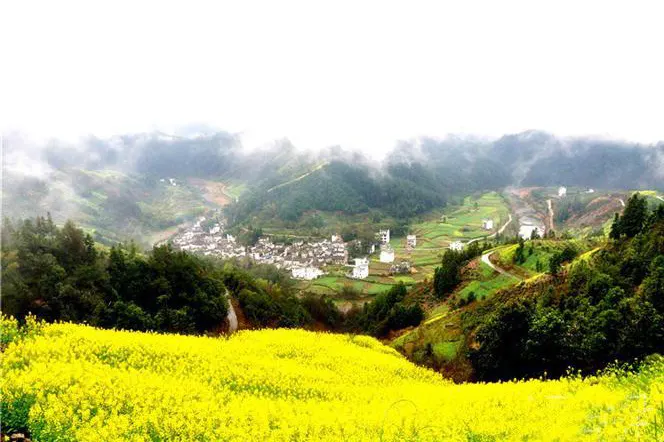
Rapeseed outside the village in spring, the white houses sitting in the middle of the valley
Tachuan's autumn is the headline act of Yi County, and the star is the Chinese tallow tree: one crown holding red, orange, yellow and green at once, leaning out from behind a gable and colliding with the black-and-white. The window lasts about three weeks. The 2026 forecast is 11–26 November, with mid-month the safest. There is only one right time to see it: 06:30 to 07:30, when fog rises out of the valley, swallows the lower half of the village and leaves the gables and a few red trees floating on top while the kitchen smoke starts. After eight the fog lifts, the light hardens and the viewpoint fills. Tickets ¥35 online, ¥40 at the gate. Half an hour on foot from Hongcun, ¥10–15 by taxi.
Mukeng Bamboo Sea (4 km, two hours)
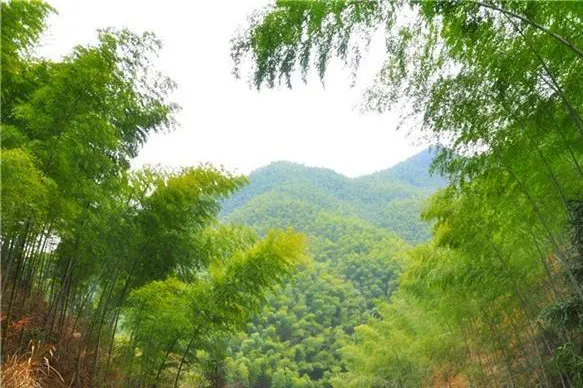
The Mukeng valley: moso bamboo climbing from floor to ridge, the whole slope moving in one gust
Mukeng lies four kilometres northeast of Hongcun, a valley filled with moso bamboo. The duel in the bamboo tops in Crouching Tiger, Hidden Dragon made it famous, but the film is only the introduction — what matters is the bamboo itself, growing from the valley floor to the ridge, the whole slope swaying in a single gust with a sound like distant rain. Tickets ¥35 online, ¥40 at the gate, 08:00–17:00. Steps climb the valley; allow one and a half to two hours. April and May are the moulting season, when the colour goes yellow-green and flat, so summer and autumn look better. Ten minutes by taxi, or the No.1 bus from the village entrance to the Mukeng stop.
Lucun and Tangyue (on the way)
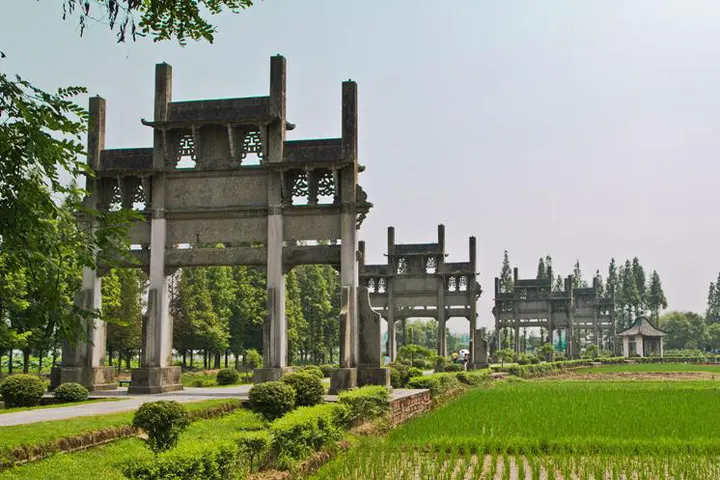
Lucun is two kilometres north of Hongcun, ¥45, and its reason to exist is the woodcarving house at Zhicheng Hall — every door and window packed with figures, opera scenes, flowers and birds at a density that makes the eye tired, which is why it is called China's first woodcarving mansion. The village is small, half an hour covers it, and the rapeseed terraces behind it are excellent in spring. Tangyue is in Shexian, about forty kilometres and an hour away, where seven memorial archways stand in a line in the fields, the Bao family's Ming and Qing morality made visible: loyalty, filial piety, chastity, righteousness, one story per arch. It is covered by combined tickets; check the day's price if buying alone.
The Tangyue archways: seven stone gates in a row along the paddy fields
15You have seen this water before
Film
Crouching Tiger, Hidden Dragon (2000, dir. Ang Lee): the fight in the bamboo tops was shot at Mukeng, while the painted bridge over the South Lake and the white walls of the Moon Pond appear in the passages where Jen arrives in the south. Lee wanted the weightlessness of water, so the camera skims the surface and the arch closes with its reflection into a circle — a composition that became Hongcun's standard portrait. Temptress Moon (1996, dir. Chen Kaige): Gong Li and Leslie Cheung play two people trapped by family and history in these old houses, and the camera lingers in dark skywells and on carved doors, catching the pressure of a Huizhou mansion exactly.
Books
Wang Senqiang, Waterlines of Hongcun: the author was born in Shuren Hall and spent a lifetime on the water system. He maps the channels, the dimensions of the Moon Pond and the position of every outlet, and it is the most solid account of the ox-shaped layout; sold in village bookshops and at the visitor centre. Wang Senqiang and Lu Tingfang, Inside the Old House: how a Huizhou house was lived in and built, how the skywell drains, what the carvings are telling you — heavy on drawings, light on text, and worth an evening before you arrive.
Music
Qingwa Baqiang Lian Huizhou — tiled roofs, white walls, love for Huizhou — is played on loop in the scenic area until everyone can hum it; the tune comes from southern Anhui folk song and the lyric is simply white wall, grey tile, rainy lane. At the other end is Tan Dun's score for Crouching Tiger: cello and erhu, with A Love Before Time setting Western strings against an Eastern line, and for many people the first sound they associate with bamboo forest. Walk the South Lake with either in your ears and you get two different villages.