One waterfall you can walk behind, and three sites that do not touch
Book before you goCave needs its own slotTicket valid ten days8–10 km in a day
In short
Huangguoshu (黄果树, Huángguǒshù) is a cluster of waterfalls on the Bai Shui River in Anshun, Guizhou, and its centrepiece is the Great Waterfall: 77.8 m high, 101 m wide, with a 134 m cave running along its waist so that you can walk behind the falling water. That single feature has no equivalent anywhere else in China. The park has three parts — Doupotang upstream, the Great Waterfall, Tianxingqiao downstream — one to six kilometres apart, linked by a 23 km shuttle loop. Entry is ¥160 in high season and ¥150 in low, covers all three, and stays valid for ten days from first scan; the shuttle is ¥50 for three days; the escalator is ¥30 one way or ¥50 return. Everything is real-name and booked ahead on the official Anlütong mini-program, one to fifteen days out, with a daily cap of 50,000; Water Curtain Cave is capped separately at 6,000 a day and needs its own timed slot. High-speed rail runs to Anshun West in thirty minutes from Guiyang North, where a ¥22 shuttle covers the last forty to fifty minutes. One long day covers all three sites, but it means eight to ten kilometres on foot and six or seven hundred steps; two days is comfortable. Water peaks from June to August, October and November are clear and quieter, and from December to February a reservoir upstream holds the flow above eight cubic metres a second — a narrower fall, and far fewer people. Budget ¥800–1,500 for two days, excluding travel to Guizhou.
Key facts
Known for
Great Waterfall · Water Curtain Cave · Doupotang · Tianxingqiao · batik
Budget
¥800–1,500 for two days, mid-range
Days needed
1–2 days
Comfort
Moderate — shuttles link everything, but a day means 8–10 km and 600–700 steps
Best time to go
June–August for volume; October–November for clarity and fewer people; December–February for quiet and the lowest ticket
01Three falls, one loop, one long day
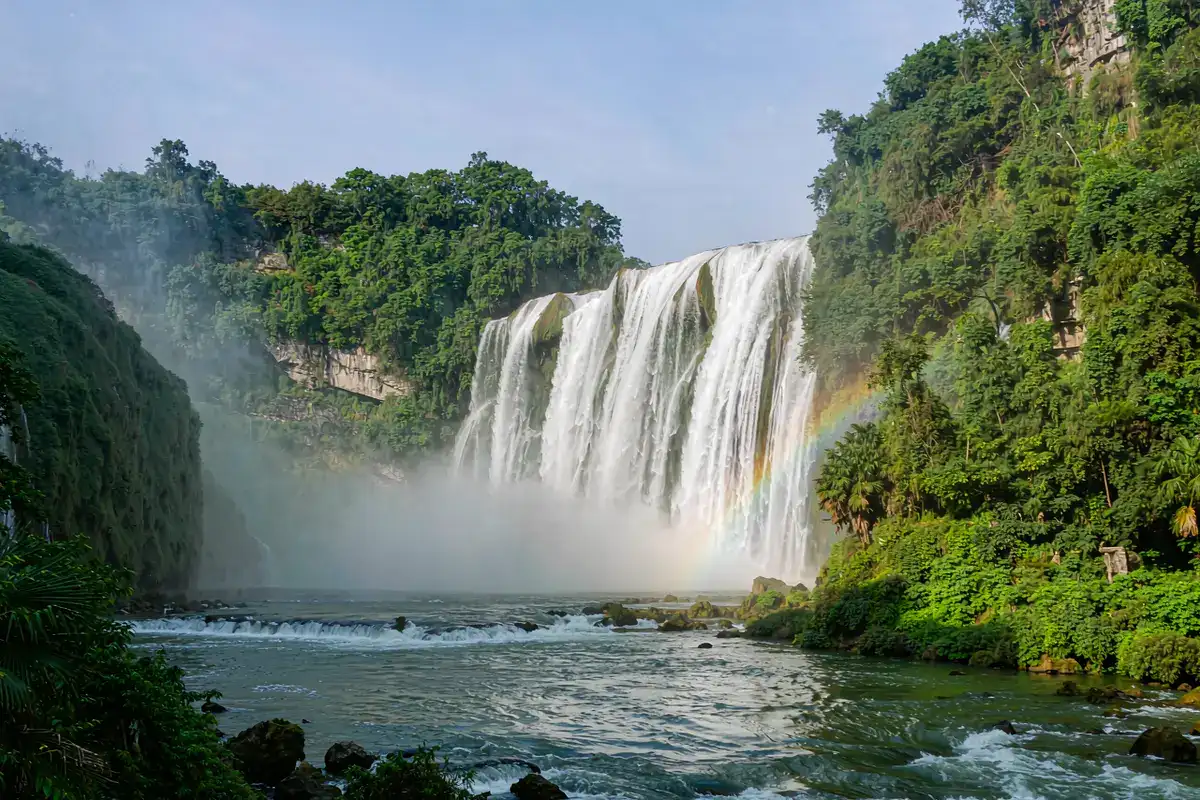
You go through the gate at 07:30 and the shuttle drops into the valley, and the sound arrives before the water does. Then the last bend turns and the whole cliff face is white: a hundred and one metres of river coming down from seventy-seven point eight, hitting Rhino Pool and exploding into mist that the wind carries thirty metres up the slope and onto everybody's glasses. This is Huangguoshu. You have seen it in a primary-school textbook, you have seen it behind the closing credits of Journey to the West, and it still stops you for two full seconds.
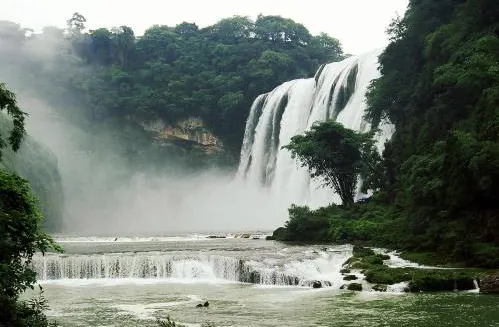
It is not one sight, though. It is three. A kilometre upstream sits Doupotang, a hundred and five metres across the crest and only twenty-one high, the widest fall in the group. In the middle is the Great Waterfall, the one in your head. Six kilometres downstream is Tianxingqiao, three and a half kilometres of karst stone forest, water lanes and caves — the prettiest section and much the hardest on the legs. There is no footpath between them; a 23 km shuttle loop does the work. So the real question at Huangguoshu is not whether to come. It is how to sequence three widely separated sites so that the middle of the day does not push you around.
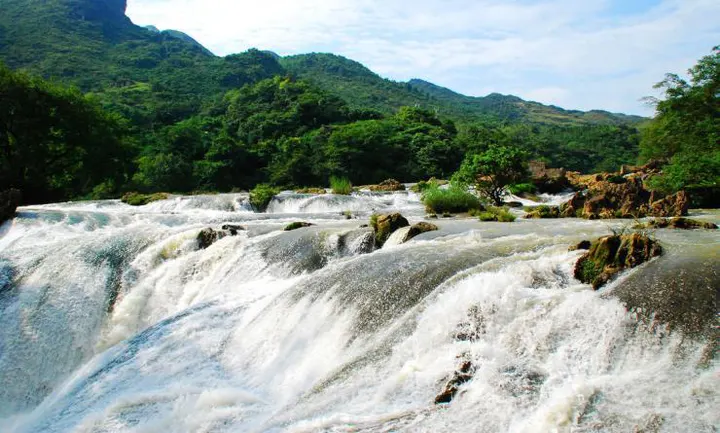
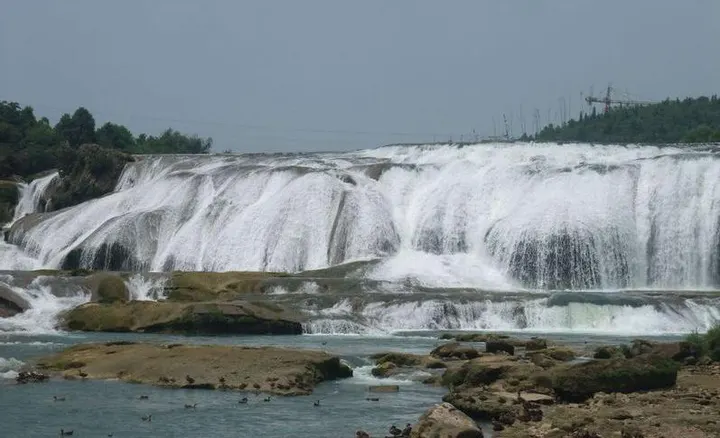
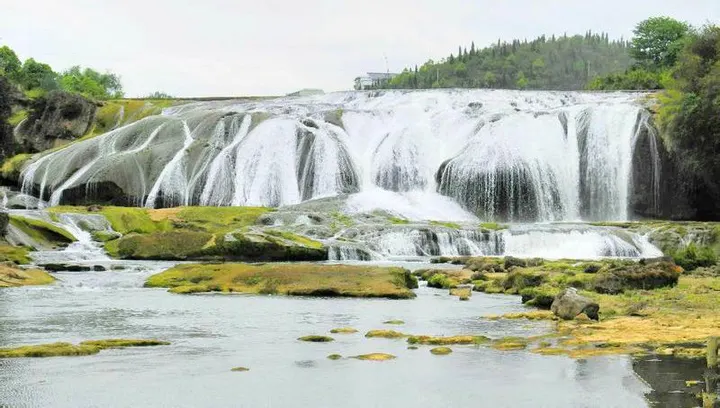
Water spreading across a tilted rock shelf, bright white against the green ridges behind
Do the arithmetic. Entry is ¥160 in high season, ¥150 in low, and covers all three sites; the shuttle is ¥50, the escalator ¥30 one way or ¥50 return, the Tianxingqiao chairlift ¥10. That sounds steep until you notice the ticket is valid for ten days and the shuttle for three — unusually generous for a Chinese 5A park, and clearly designed to stop everybody arriving on the same morning. Almost everybody still does, because holidays are short. My advice is blunt: take two days if you can, give the first to the Great Waterfall and the cave, the second to Tianxingqiao and Doupotang, and sleep in the new town between them. With one day, follow the order below and you will queue less.
Looking south through a gap in the ridge, a stream hangs and pounds on the left of the road, ten thousand white silks flying … it smashes pearls and breaks jade, the spray surges back up like smoke into the sky, and the force of it is fierce.
Xu Xiake, 1638
He wrote that in 1638, and it is the first description of the place that sounds like the place. Three hundred and eighty years later his viewpoint is roughly where the Rhino Pool platform stands; he had mud underfoot, you have slip-resistant stone. Huangguoshu was on the first national list of scenic areas in 1982 and became a 5A park in 2007. The designated area runs to 163 square kilometres and Bouyei villages sit inside it — Shitou Zhai and Huashishao are both within the boundary — which is why it does not feel like a walled theme park. People farm here, dye cloth here, and run boats here.
Let me be direct: the waterfall earns every bit of its reputation, and the park around it is an exercise in scheduling. Tour groups arrive between 09:30 and 11:00 and leave around 15:00, and in those five and a half hours the main platform and the boardwalk to the cave clog. The most useful thing you can do is not buy a fast track — there isn't one — but move your day around theirs. Either be through the gate at 07:30 and go straight to the Great Waterfall, or go the other way: Tianxingqiao first thing while it is empty, the Great Waterfall after three. Both beat standing at the gate at ten.
02Six things worth rearranging the day for
The Great Waterfall from Rhino Pool: get wet first, photograph second101 metres across
Getting down to the pool means six or seven hundred steps, fifteen to twenty minutes, or a five-minute ride on the escalator for ¥30. The pool platform is the only place where you see the full width and the impact point at once, and the noise is loud enough that you have to shout. On a clear morning between nine and eleven there is usually a rainbow in the spray, appearing whenever the wind drops and vanishing when it picks up. Do not photograph first. Stand there for two minutes and let your ears adjust; no picture carries that volume.
Size:77.8 m high, 101 m wide
Steps:600–700 down, or five minutes on the escalator
Water Curtain Cave: looking out from inside the fall6,000 people a day
The cave runs 134 m with six windows, five chambers, three springs and six passages, and you walk it one way. Inside, the water falls past your head and in front of your chest, and the green hills and the people outside swim behind the curtain. This is what separates Huangguoshu from every other big fall in the country, and it is also the longest queue in the park: sixty to ninety minutes at peak, thirty to forty inside. Book a slot on Anlütong — it is free, but when they are gone they are gone. Bring a thin rain jacket, a bag for the camera, and shoes with grip.
Length:134 m, one way
Timing:Shortest queues before 09:00 or after 15:30
Doupotang: the widest one, and the one people skipA 105 m crest
Twenty-one metres high and a hundred and five wide, the water sliding evenly off a flat rock lip like a sheet being unrolled — not violent, just large. The closing credits of the 1986 Journey to the West were filmed here, and Chinese visitors tend to go quiet for a moment when they reach the platform. Before a flood it emits a low roar, which is why locals call it the shouting fall. The loop is 1.2 km on the level, forty minutes is enough, and early morning is when it is empty.
Size:21 m high, 105 m wide
Loop:1.2 km, almost flat
Lower Tianxingqiao: Yinlian Falls is the pointPretty, and it costs you a walk
Tianxingqiao splits into two halves. The upper half is stone forest, water lanes and the birthday stones, and most coach groups turn back at Gao Laozhuang. The lower half holds Yinlian Falls, where water spreads across a cluster of rock lobes curled like lotus leaves, divides into thousands of threads and drops into a trough-shaped pool. Ten metres high, forty wide, and the loveliest single thing in the park. The walk from the entrance through to the exit is over three kilometres with near-constant steps, two to three hours. If your knees are doubtful, the ¥10 chairlift removes the last climb.
Trail:3.5 km, constant steps
Yinlian Falls:About 10 m high and 40 m wide
The birthday stones: find your own date365 of them
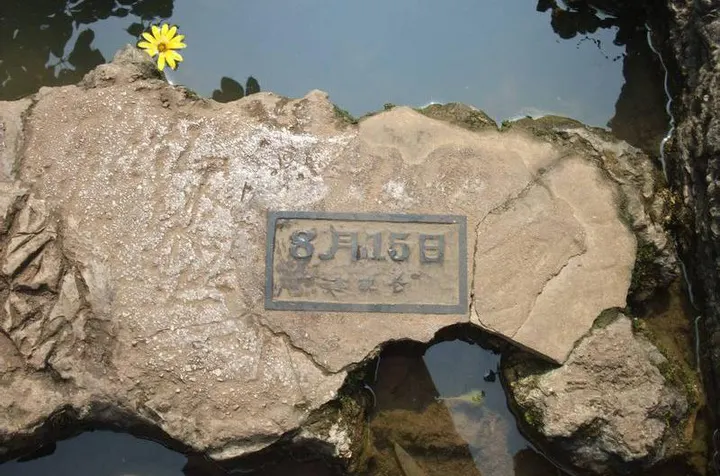
In the upper half of Tianxingqiao a line of stepping stones crosses the water, 365 of them, each carved with a date, one step for one day of the year. Chinese visitors stop and hunt for their birthday, then crouch to photograph it, which is why the queue crawls. It is not sophisticated design, but it works, especially with children, who will count their way along by month. Come before eight for a photograph without people in it; after nine you are shoulder to shoulder.
Count:365 stones, one per day
Where:Upper Tianxingqiao, before the water stone forest
Shitou Zhai: a village built of stone, still dyeing clothFree, six kilometres out
Six kilometres from the Great Waterfall, a Bouyei village six hundred years old: stone walls, stone-slab roofs, stone lanes, stone yards and stone steps, not a brick anywhere. What makes it worth the detour is that it is still lived in — maize drying by the doors, women sitting on the steps drawing on white cloth with a brass knife dipped in beeswax before the cloth goes into an indigo vat. A batik session costs ¥20–30 and you keep the result even if it is crooked. There is no ticket and no gate; ask before photographing into a courtyard.
Entry:Free; batik ¥20–30
Time:1.5–2 hours
03Seven questions to settle before you book
Is one day enough?
Yes, but it is a full one: eight to ten hours, eight to ten kilometres, six or seven hundred steps. The order that works is through the gate at 07:30 and straight to the Great Waterfall — down to the pool for the full view, then Water Curtain Cave at your booked slot, and up by escalator or on foot — then Doupotang for the 1.2 km loop at eleven, lunch at the ticket centre or by the falls exit, Tianxingqiao at one for the lower half only as far as Yinlian Falls, and out by four. If you have to cut something, cut the upper half of Tianxingqiao: the stone forest and the birthday stones are fun, but they are not in the same league as the lower half. With older parents, small children, or a camera, take two days: Great Waterfall and cave first, Tianxingqiao and Doupotang second, sleeping in the new town between.
Should I stay in Anshun or at the park?
It depends what you want from the evening. Staying in the new town by the ticket centre puts you in the first batch through the gate at 07:30 and saves an hour of driving, at the cost of nothing much to do after dark and higher peak rates (¥200–400, doubled on public holidays). Anshun city (¥150–350) has better food, an old street and a night market, but costs two hours of driving a day and makes a 07:30 start unrealistic. Guiyang is the worst of both: two hours each way, only sensible if Huangguoshu is a day trip, and then you leave at six. My default is the park for the first night and an early gate, or Anshun the night before if you only have one day, leaving at seven.
Will I get soaked in Water Curtain Cave?
Damp, not drenched. The cave is full of mist, water drips from the roof and the sides, and you come out with a wet outer layer and a dry shirt. A thin rain jacket is enough; the disposable ponchos sold at the gate for a few yuan work but tear in wind, and an umbrella is a nuisance inside. What actually needs protecting is your phone and camera — this mist is finer than rain and finds every seam. Wear shoes with grip: the floor is permanently wet, the steps are narrow, and the route is one-way, so when the person ahead stops, you stop. When the river is very high the park closes the cave at short notice; that is routine rather than an emergency, and it is posted on Anlütong.
Is it worth coming in the dry season?
Yes, with different expectations. From December to February a reservoir upstream releases water to keep the flow above eight cubic metres a second, so the fall never stops, but it narrows, splits into several strands and exposes rock that is usually under water. That is not grandeur; it is leanness, and plenty of people prefer it. The practical gains are real: ¥150 entry, no crowds, almost no queue for the cave, and blue-green water in the pool. The losses are real too. Yinlian Falls shrinks to a few threads, and Doupotang stops being a single sheet. If you are coming for the sheer volume of the largest fall in Asia, do not come now. If you want to look quietly at rock and water, December to February is the best window of the year.
In what order should I do the three falls?
The official order is Doupotang, then Tianxingqiao, then the Great Waterfall, because it follows the river downhill and keeps bus legs short. The problem is that it lands you at Tianxingqiao exactly when the coaches do, and the birthday stones jam. I would go one of two ways instead. If you have the legs: gate at 07:30, shuttle straight to the Great Waterfall, at the pool before eight, cave at nine, Doupotang at eleven, lower Tianxingqiao from one, out by four. If you would rather avoid heat and jostling: Tianxingqiao first at 07:30 when the water stone forest is empty, out by 10:30, Doupotang before lunch, and the Great Waterfall at two — the groups start leaving after three and the platform half empties. Both plans park the worst of the middle of the day indoors or on a bus.
How hard is it with children or older parents?
Harder than Jiuzhaigou, easier than Mount Fanjing. Three things bite. The descent to the pool at the Great Waterfall is six or seven hundred steps, and the escalator removes all of them for ¥30 one way or ¥50 return — with parents or small children, pay the fifty. Tianxingqiao is 3.5 km of continuous up-and-down where a stroller is useless and anyone under five will need carrying for part of it. And the shuttle between sites means waiting, boarding and unloading, which drains people in a way walking does not. The compensations: Doupotang is 1.2 km of almost flat path a child can do alone, with ruddy shelducks in the pool below that will hold their attention for half an hour. Keep the day to six or eight kilometres and cut Tianxingqiao to the lower half, and three generations will be fine. Wheelchairs and strollers are lent free at the visitor centre, but they only really work at Doupotang and on the upper level of the Great Waterfall.
Do I need a guide?
Not for navigation. Signage is clear, the shuttle routes are fixed, Anlütong carries a map, and it is more or less impossible to get lost between three sites. What a guide is for is everything else: how a Bouyei stone house is actually lived in, where the blue in batik comes from, why Tunpu villagers still dress as if it were the Ming. Without that, you are looking at a pile of rock and a piece of blue cloth. Guides can be hired at the ticket centre, usually ¥200–300 a session; the village guides at Shitou Zhai and Tianlong Tunpu are cheaper and better storytellers. As for the men at the gate selling car-plus-guide packages or a way to skip the queue: ignore them. There is no fast lane, and no private car reaches the core sites.
04One day is a sprint; two days is a trip
One hard constraint shapes every plan: there is no footpath between the three sites, the shuttle is compulsory, and its first and last runs follow park hours. So what time you enter matters more than which site you do first. The second constraint is your Water Curtain Cave slot, which fixes the hour you must be at the cave mouth and everything else arranges itself around it. Three shapes follow, by the number of days you have.
D1
At the ticket centre by 07:20, through the gate at 07:30, shuttle straight to the Great Waterfall. Down at the pool before eight for the full view and the rainbow; into Water Curtain Cave at your booked slot at nine; out and up by escalator. Doupotang at eleven for the 1.2 km loop and the ducks. Lunch at the ticket centre at 12:30. Into Tianxingqiao at one for the lower half only — birthday stones, water stone forest, Yinlian Falls — then the chairlift or the climb out at 3:30, and out of the park by four. Eight to ten kilometres, then the new town or back to Anshun.
D2
Arrive the first afternoon, stay in the new town, and spend the evening at Shitou Zhai, six kilometres away and free, watching batik being drawn and dyed; back before dark. On day two, gate at 07:30 and go to Tianxingqiao first — the water stone forest at eight is empty, and you can walk the whole 3.5 km before coming out at eleven. Lunch, then the Great Waterfall at one; after three the coaches leave and the platform loosens up, so book the cave for around four. Out at 5:30, which lands you neatly at the 19:30 night show at the falls (a separate ¥200 ticket), where the water is lit from below and the whole thing reads completely differently.
D3
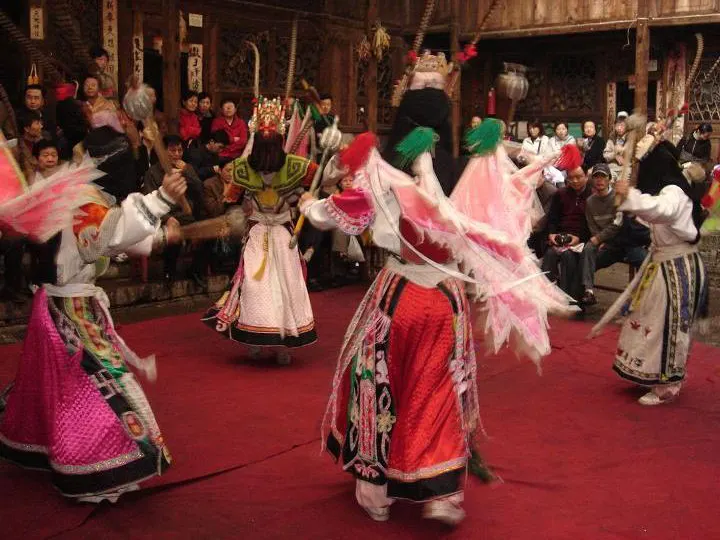
Give the third day to people rather than water. Tianlong Tunpu in the morning — twenty kilometres from Pingba South station, ¥79 with the shuttle, or ¥35 for the lanes plus one opera performance — where the dixi troupe performs at nine, ten and eleven in the drill hall, masked in carved wood and singing the duel of the three heroes at Hulao Pass. Back to Anshun in the afternoon for the Confucian temple, the old street and a bowl of duoduo fen. With a fourth day, either Longgong (¥60 entry plus ¥70 for the boat) or Zhijin Cave (¥110) earns its half day, but neither fits into a morning.
05Three sites, three ways of looking
The Great Waterfall: width first, then proximity
The shuttle drops you at the Great Waterfall entrance, and there is still a stretch of downhill path to the cliff top. Most people stop there and photograph, and what they get is the upper half of the fall. Keep going down to Rhino Pool, where the full hundred and one metres fills your field of view at once. The pool is the first of a chain of plunge basins — Three Shoals, Horse Hoof Pool and Maoshui Pool follow — as a box-shaped gorge hands the river down step by step.
Light is worth planning around. The fall faces roughly north-east, so morning light is front-lit and the water reads bright; after about two in the afternoon the sun is behind the ridge, the fall turns backlit, the spray blows out to flat white and the rock goes grey. That leaves two windows for the standard photograph — from opening until eleven, or any overcast day. Overcast is not a loss: diffuse light holds the texture of the cliff, as long as you keep the sky out of the frame.
Water Curtain Cave: a path through the back of the fall
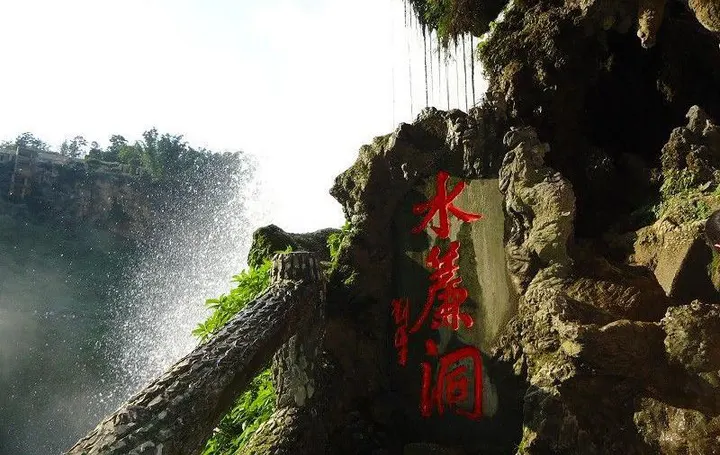
The cave runs along the waist of the fall for 134 m: six windows, five chambers, three springs, six passages, walked one way only. The windows are simply openings in the rock with the curtain falling outside them, so that the green hills, the visitors and the teahouse opposite all sit behind a sheet of moving glass. Some sections are narrow enough that you turn sideways, the floor is wet all year, water drips from the roof, and a rain jacket beats an umbrella by a wide margin.
The rainbow seen from a window is the real performance here: on a sunny morning the mist over Rhino Pool throws a double arc that drifts with the wind. The best spot is beside the inscribed stone at the cave mouth, which sits in the refraction zone before noon. That is the honest reason to book an early slot for the cave — not for the cave itself, but for that angle.
Doupotang: wide, flat, quiet
A kilometre upstream from the Great Waterfall, five minutes by shuttle. The crest is 105 m across, the widest in the group, but the drop is only 21 m, so the water does not crash; it spreads. It slides over a flat rock lip, lands on travertine steps below and leaves in several channels. A flock of ruddy shelducks lives in the pool, orange bodies motionless on the stones, and children will watch them far longer than they watch the fall.
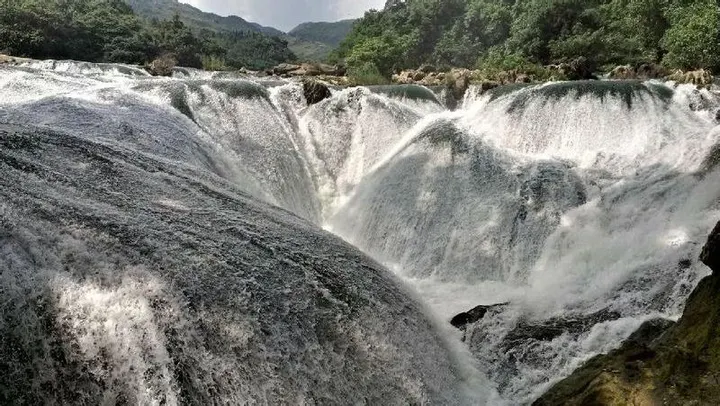
Below Doupotang, the sheet breaking into channels over mossy travertine steps
The 1.2 km loop is essentially flat, the only part of the park that is genuinely friendly to wheelchairs and strollers. Coach groups shoot it in forty minutes and leave, so twenty extra minutes and a walk to the downstream platform will halve the crowd around you.
Tianxingqiao: stone, water and trees grown into each other
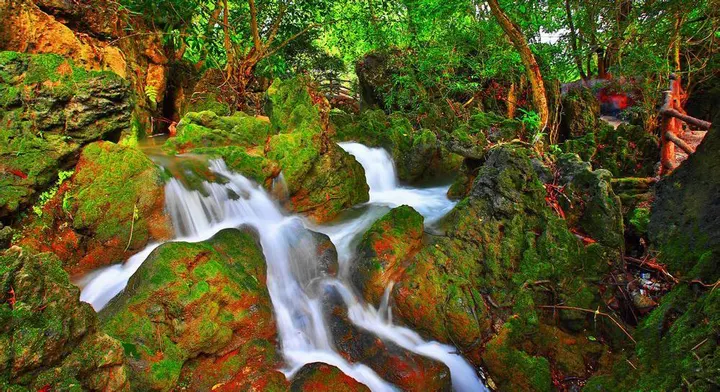
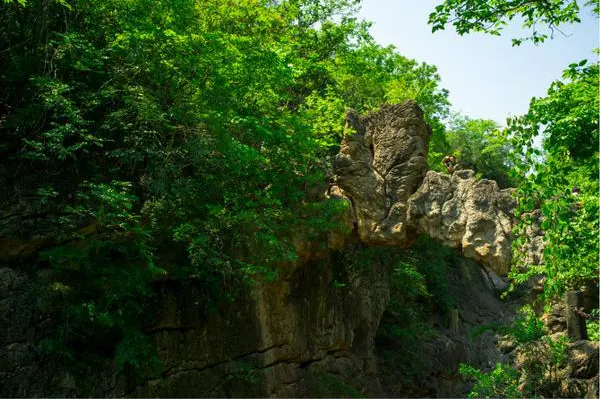
Three and a half kilometres of trail in two halves. The upper half is a water stone forest: pinnacles rising out of the stream, banyan roots gripping the rock and driving down into it, the path threading between stone and water. It is laid out almost like a garden, one view per bend, and the birthday stones sit in the middle of it. Coach groups usually turn back at Gao Laozhuang, a Journey to the West location, which means the upper half is often emptier in the afternoon than in the morning.
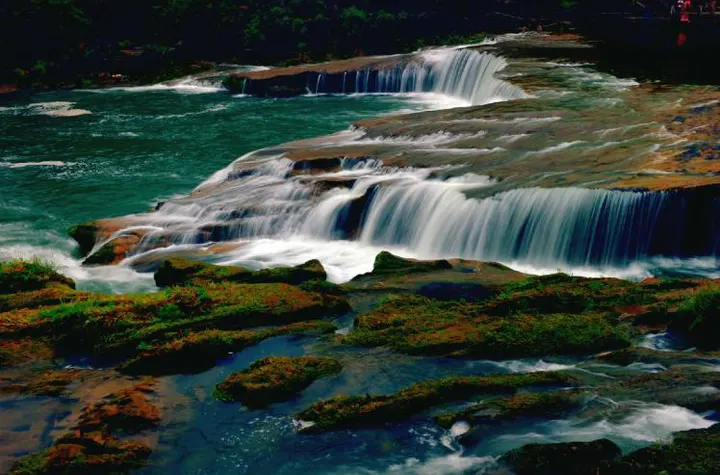
The lower half is a different world: the gorge narrows, the sound rises, the path follows the stream and ends at Yinlian Falls. Its shape is unusual — the water does not tip over a single lip but spreads across a cluster of rock lobes curled like lotus leaves, is cut into thousands of threads by their edges, and falls into a trough-shaped pool below. Only about ten metres high, but that unfolding motion is better than a great many taller falls.
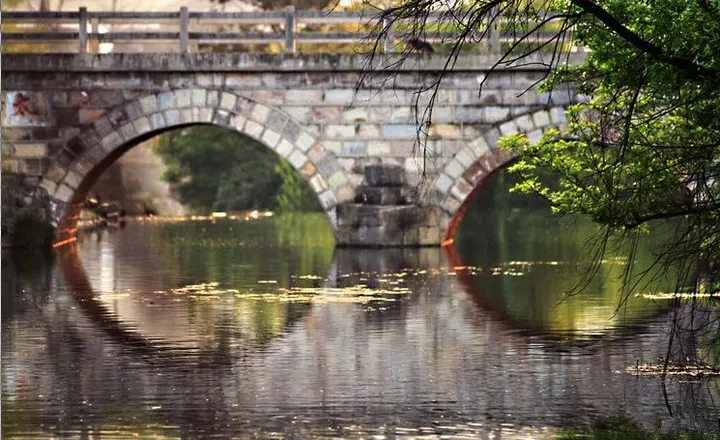
The travertine shelf above Yinlian Falls, water stepping down through turquoise terracesA channel between boulders at Tianxingqiao: moss, red algae and water-smoothed rockA two-arch stone bridge, duckweed and its reflection on the water below
Tianxing Cave sits halfway along the lower route: a limestone cave, not first-rate stalactites, but cool. It was closed from 19 October to 2 November 2026 for a lighting upgrade, and whether it reopens on schedule is a matter of official notice — check Anlütong before you walk down there and find a locked gate.
Shitou Zhai and Huashishao: villages inside the boundary
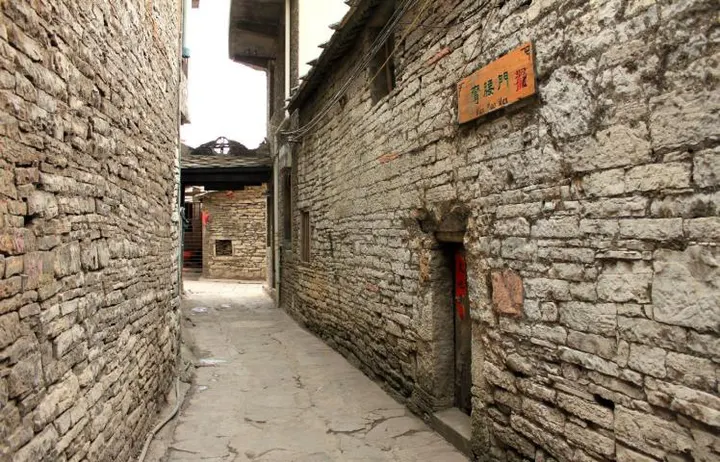
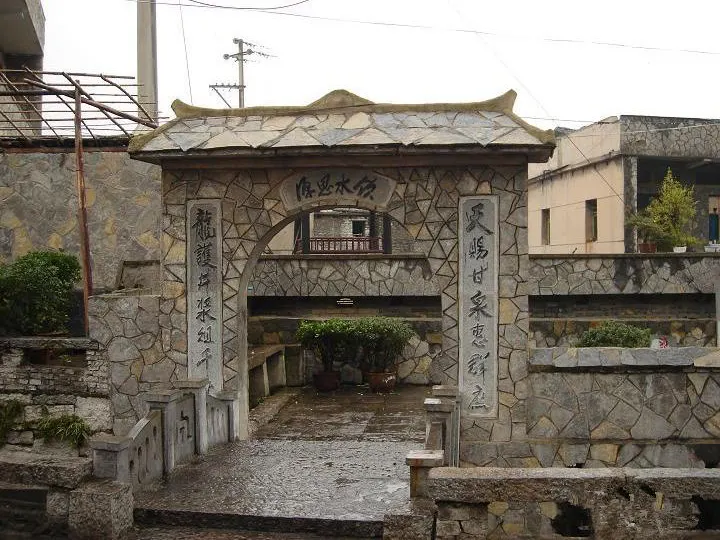
Six kilometres from the Great Waterfall, Shitou Zhai is a Bouyei village six hundred years old, built entirely of block stone and shale with slab roofs, its lanes narrow enough that two people turn sideways to pass. It calls itself the home of Bouyei batik: eighty per cent of adult women can draw with wax, and half the households keep a dye vat. There is no entry fee, a batik session costs ¥20–30, and the whole process from waxing to dyeing takes over an hour. It cannot be hurried.
The stone gateway at a village entrance, couplets carved above and on both sides
Huashishao sits on the road to Tianxingqiao and was the first Bouyei village designated for protection; smaller than Shitou Zhai, with fewer visitors, it is a twenty-minute stop on the way past. Both villages lie inside the scenic area boundary but are not part of the ticketed park — worth being clear about, since a park ticket does not get you a bed in either.
06Beyond standing in front of water
Photography: two good windows a day
The Great Waterfall takes the morning sun on its face and goes backlit after about two. Doupotang gets the early sun straight on, so the hour after sunrise is its best. Tianxingqiao lies in a gorge where the ridge blocks the sun, which means direct light only between ten and two and diffuse light the rest of the day — better for detail than for vistas. The sensible photographic day is therefore: the Great Waterfall at 07:30 for the wide shot, Tianxingqiao from ten for rock and water close-ups, Doupotang at three for raking side light. Bring a polariser; cutting the surface glare lets you see the stones on the pool floor.
A karst pinnacle at Tianxingqiao pushing through the canopy, shrubs growing on its crown
Night shows: the fall as a different object
The Great Waterfall night show, roughly ¥200, projects onto the falling water and the cliff behind it, so the image moves with the water. Doupotang's Journey to the West staging, about ¥240 and often discounted, is a live performance with a plot and is the better pick with children. The argument is the obvious one: some people think lighting a natural wonder is vandalism, others that it is the only way to see the fall after dark. My view is that if you are sleeping at the park anyway and have nothing else on, the Great Waterfall show is worth one evening. Do not rebuild a trip around it.
Batik: draw your own cloth
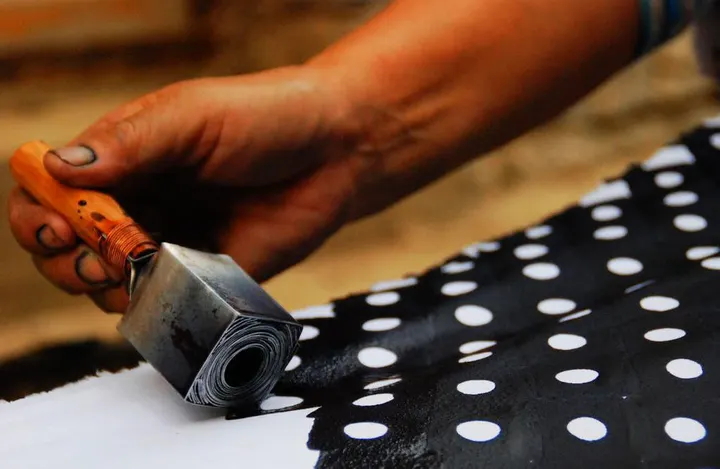
A brass knife loaded with beeswax, drawing a field of dots by hand
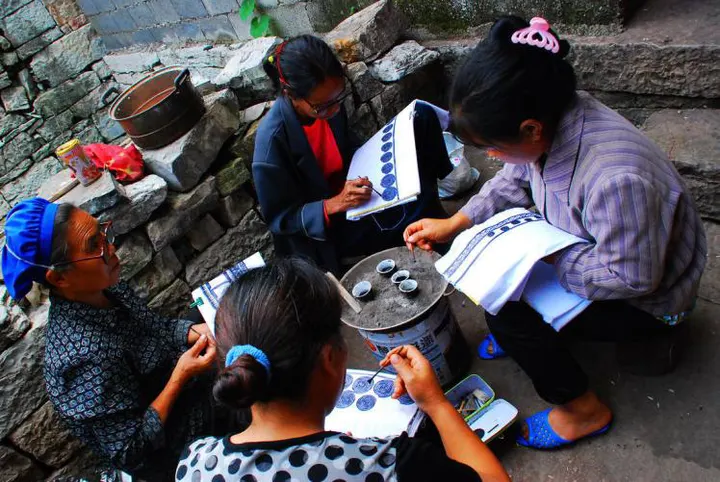
The batik session at Shitou Zhai is the best hour you can spend at Huangguoshu. The process is simple enough: draw a pattern on white cloth with a brass knife dipped in hot beeswax, let the wax set, dip the cloth in an indigo vat several times, then boil the wax out. Where the wax was, the cloth stays white; everywhere else it turns blue. The hand has to be steady and the wax has to be at the right temperature — too hot and it bleeds, too cold and it will not take. ¥20–30, and the piece needs to dry before you can carry it.
Four women drawing wax in a Shitou Zhai courtyard, white cloth spread across their knees
Rafting and walking
Six kilometres below the Great Waterfall there is a rafting run with thirty-odd metres of drop and twelve rapids, genuinely lively when the river is up; the ticket is ¥158, but it operates only in the wet season, so confirm on the day. The other option is to walk it: the park publishes a hiking loop of about 23 km around all three sites, five hours of pure walking and a full day with sightseeing, which suits anyone with good legs and no patience for shuttle queues. Parts of it run beside the road — keep right and watch for falling rock.
07Three places to sleep, three trade-offs
Get the names straight first. Huangguoshu can mean three things: the park; Huangguoshu New Town at its gate, where the ticket centres, the restaurant strip and most hotels are; and Anshun city, forty kilometres away. Read the address when you book — anything listed as Huangguoshu Tourism Area is almost certainly the new town, anything in Xixiu District is in Anshun, and the two are an hour apart.
New Town, around the ticket centre: five to fifteen minutes' walk from the gate, guesthouses and chain hotels, ¥200–400 in ordinary season and ¥500–800 over National Day and the summer holidays. The gain is being in the first batch at 07:30 and having late-night food downstairs; the cost is ordinary rooms and thin walls.
Inside the park, near the falls exit and Banbian Street: a handful of older hotels at ¥400–700. The advantage is silence at night, no morning transfer, and in some rooms the sound of the fall. The fittings are dated; do not expect city-hotel standards.
Anshun city, Xixiu District: ¥150–350, and the same money buys a visibly better room, with the Gufu Street food strip and the Confucian temple in the evening. Good if the next day is Longgong or an early train. The cost is two hours of driving a day.
Shitou Zhai homestays: ¥100–200 in converted Bouyei stone houses, plain but atmospheric, and on a misty morning the whole village seems to float. Best for drivers with time to spare; ring a day ahead.
Two warnings. In peak periods — May Day, the summer holidays, National Day — do not arrive and look: new town capacity is finite and fills a week ahead. And many guesthouses advertising free station pickup mean Anshun West, forty kilometres away, usually only for guests who have hired a car or for an extra fee. Ask the price when you book rather than at reception.
08Sour, hot and sticky
Food inside the park exists to stop you being hungry: a snack street at the falls exit sells noodles for ¥20–30 and they are merely adequate, and the restaurants around the ticket centre run twenty to thirty per cent high. The cooking worth planning around is in Anshun and in Zhenning county town, where ¥40–50 a head buys a proper meal. The local grammar is sour, hot and sticky: fermented sour broth, chilli used as paste or charred, and rice or potato under everything.
What to order
Sour soup fish: rice broth fermented to a red sour, used to poach river catfish, cleanly sour and gently hot, ¥80–120 for a pot feeding two. The farmhouse restaurants below the falls do it best, with fish out of the tank.
Duoduo fen: rice tofu cut into cubes and simmered in a sour-hot broth with fried pork, bean sprouts and fish mint, around ¥20 a pot, and what people in Anshun actually eat on a weekday. The name comes from the bamboo skewer you stab them with.
Rice-sheet rolls: a thin rice wrapper spread with chilli paste, pickled radish, sprouts and crushed peanuts, rolled and eaten in one bite, ¥8–12 a portion. Sold everywhere; works as breakfast or as a mid-afternoon stop.
Silk-doll rolls: a stack of thin rice wrappers and a dozen shredded vegetables you roll yourself, finishing with a spoonful of sour broth. Fun to eat and mild, which makes it the safe order for anyone who cannot take chilli.
Changwang noodles: egg noodles, congealed pig's blood and braised intestine in a bright red broth, ¥12–18. Both Guiyang and Anshun treat it as breakfast; it is rich enough that you will not be hungry at noon.
Buckwheat jelly, sliced and dressed with fermented bean curd, chilli oil and crisp soybeans, is the best thing to eat in July; and fried-cake porridge, an Anshun breakfast of rice paste with golden fried glutinous cakes dropped in, salty, soft and filling.
Where to eat
The new town food street is fine for a functional meal at ¥40 a head. To eat well, drive fifteen minutes to Zhenning county town, or back in Anshun try Gufu Street and Rulin Road, where ¥50 a head fills a table. June to August is the season for Zhenning honey plums, sold by the jin at roadside stalls, crisp and very sweet. Dog meat from Huajiang is the famous dish around here; most visitors will not order it and do not need to — there is plenty else.
09What travels well is mostly made by hand
Huangguoshu is not a shopping destination, but two things are genuinely worth carrying home and are not expensive if you buy them right: batik and dixi masks. The rule is to buy the handwork rather than the packaging, and to negotiate per piece instead of paying the first tourist price.
Batik: at Shitou Zhai and in Anshun, on tablecloths, scarves, bags and clothes, from ¥50 to ¥300–400. The test is crude and reliable: turn it over and look at the boundary between blue and white. Hand-drawn wax cracks into fine veins where the wax broke, while printed cloth has edges as clean as a poster.
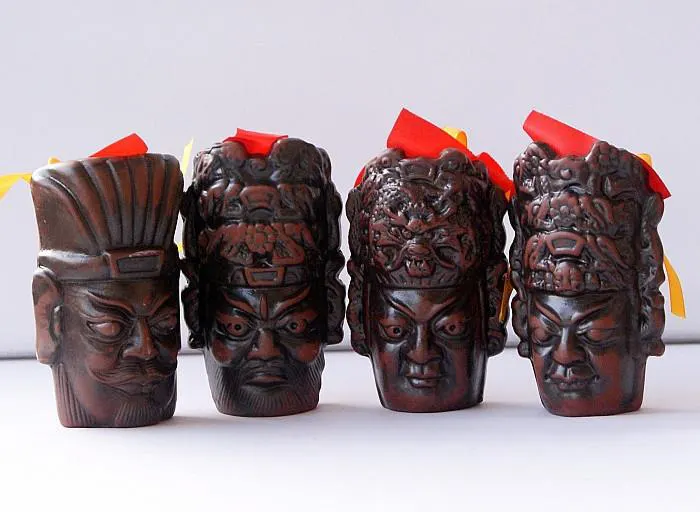
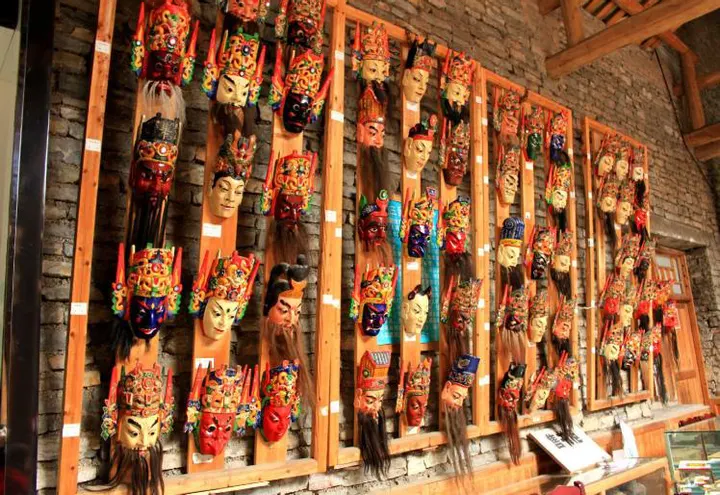
Dixi masks: sold at Tianlong Tunpu and on the Anshun old street, ¥80–150 for a small display piece, ¥300–600 for a full face you can wear. These masks, called lianzi, carry a bit of divinity for the people who perform in them; buying one as decoration is fine, treating it as a joke is not.
Bobotang: a Zhenning specialty of malt sugar rolled in sesame that dissolves the moment it hits your tongue, ¥20–30 a box. Good for gifts, but it crushes — do not bury it at the bottom of a pack.
Rosa roxburghii products and Duobei tea: the fruit is extraordinarily high in vitamin C and fiercely sour, sold as juice, dried fruit and slices, all easy to pack; Duobei is the local green tea, light and clean, ¥100–300 per 500 g.
Two things to leave on the shelf. The famous Anshun three knives — kitchen, scissors, leather — are excellent and will be confiscated at any station or airport. And any unidentified wild gastrodia or dendrobium: there is no price benchmark and forgery is routine. If you want herbs, buy them in a proper pharmacy in town.
10Rail to Anshun West, then forty minutes into the valley
Rail: make sure it says Anshun West
Guiyang North to Anshun West on the Shanghai–Kunming high-speed line takes as little as twenty-eight minutes, usually a shade over thirty, for ¥46–50 in second class, with more than sixty trains a day from just after six in the morning until about nine at night. Anshun West sits in Yaopu, Xixiu District, roughly forty kilometres from the park. Three stations need separating: Anshun West is the high-speed one and the one you want; Anshun station is the old conventional station on Zhonghua South Road with no high-speed services; and the station named Huangguoshu handles no passengers at all, so do not select it.
The transfer is the step people get wrong. To the right of the exit is Anshun West bus station, where the official park shuttle leaves: ¥22, forty to fifty minutes direct to the Huangguoshu ticket centre, departing when full in high season and about every twenty minutes otherwise. Tickets can also be bought on Anlütong or Ctrip. A crowd will meet you at the exit with signs claiming shared cars are faster or that the shuttle does not reach the gate; ignore all of it, because the shuttle stops at the ticket centre door. A taxi is ¥100–150, and only makes sense split four ways.
Flying and driving
Anshun Huangguoshu Airport sits south of the city, forty-two kilometres from the park, with seasonal services to Beijing, Shanghai, Xi'an and Chongqing; frequency is low, and you still finish by taxi or airport bus. Driving from Guiyang on the Shanghai–Kunming expressway is 130 km and about two hours, tolls from ¥56. Cars must be left in the new town car park and you continue by shuttle; private vehicles cannot enter the core. Guizhou roads are tunnel-heavy with tight bends and slick in rain — if you do not often drive mountain roads, do not start here.
Inside: one loop, three stops
The shuttle is the only transport inside: ¥50, valid three days from first scan, running a 23 km loop that links Doupotang, Tianxingqiao and the Great Waterfall, about an hour for the full circuit. The buses are blue, they start at the ticket centre, and they run a fixed circuit rather than stopping on request. There is no footpath between the three sites, so do not plan to walk across; the official hiking loop is a separate thing altogether, 23 km and five hours of pure walking.
One last thing: the way back. The shuttle from the ticket centre to Anshun West runs into the late afternoon, timed to the last trains — confirm the final departure at the ticket centre when you arrive, because it moves with the timetable. If you have a night-show ticket, you will be taking a taxi back to Anshun at ¥100–150 or staying at the park. Do not book a train after seven and then add a night show; there is no public transport in between.
Check trains and fares from Guiyang to Anshun West
Hours: gates open at 06:30 from 1 July to 31 August, 07:00 from 1 March to 30 November, and 07:30 from 1 November to 28 February. Closing: the Great Waterfall and Doupotang at 18:30 (18:00 in winter), upper Tianxingqiao 18:00 (17:30 in winter), lower Tianxingqiao 17:40 (17:00 in winter); last entry is generally 17:00. Check the park notice before you go.
Numbers: park hotline 400-800-9998, rescue 0851-33592133, park police 0851-33592274. Police 110, ambulance 120, fire 119.
Hospitals: every visitor centre has a first-aid room and kit for sprains, heat and cuts; anything serious goes to Anshun People's Hospital at 140 Huangguoshu Avenue in Xixiu District, 0851-33222131, about an hour by road.
Signal: 4G holds along the main paths at all three sites, drops in the deep parts of the Tianxingqiao gorge and inside caves, and is essentially absent in Water Curtain Cave. Screenshot your ticket QR code, your cave booking and a map before you go in.
Money: QR payment works at the ticket centres, on the shuttle and at the escalator, and Alipay's international version links Visa and Mastercard. Some stalls take cash only, so carry two or three hundred in small notes.
Rules: no smoking outside designated areas; no drones, and bags are checked at the gate; never enter the water, wade or climb the railings, because the river has undercurrents and whirlpools; and do not climb on rock faces or trees.
Access: wheelchairs, walking sticks and strollers are lent free at the visitor centres, and shuttle stops have wheelchair ramps. Doupotang and the upper level of the Great Waterfall work with a wheelchair; Tianxingqiao does not, and neither does the cave.
Toilets and water: facilities at all three entrances and the main platforms, thin on the ground in the middle of Tianxingqiao, so go before you start. Bottled water inside is ¥5–8; carry your own.
12Two things to book, five things to pack
Huangguoshu now runs on the principle of no booking, no visit. Buy the ticket on Anlütong one to fifteen days ahead, and tick the Water Curtain Cave slot in the same order — it is free, but only 6,000 a day are released. Without those two steps you will be looking at the fall through mist from outside the barrier. Tickets bought on third-party platforms still require a separate Anlütong booking for the cave; do not assume it comes bundled.
Bookings: ticket one to fifteen days out, and a week ahead for May Day, the summer holidays and National Day. For the cave, take a slot between 08:30 and 09:30 or after 15:30 to miss the coach wave.
Clothing: quick-dry shirt plus a light jacket, since the valley swings ten degrees between morning and evening. A rain jacket beats an umbrella; disposable ponchos are sold at the gate but tear. Footwear has to grip, because the boardwalks, the cave and the stone steps are permanently wet.
Sun: at around a thousand metres the UV is stronger than the altitude suggests, so hat, sunglasses and sunscreen. In summer, spray plus sun means you can be sunburnt and chilled at the same time.
Food and water: choice inside is thin and priced up, so carry bread, bars and fruit, and at least a litre of water per person per day, a litre and a half in summer.
Kit: a waterproof phone pouch, a lens cloth you will use a dozen times a day, and a spare battery. A tripod is fine for slow shutter work, but do not open one across a crowded platform.
Cash: two or three hundred in small notes, because stalls and village batik workshops sometimes take nothing else.
Four traps. Anyone offering to get you into the cave without queueing, or to book on your behalf, is selling nothing: the official slot is free and there is no paid channel. The ¥200 car-and-guide packages at the gate generally reach the car park only, and you still transfer to the shuttle. Do not arrive at the Great Waterfall at ten in the morning on a National Day or summer holiday; that is queueing, not sightseeing. And do not wear new shoes or a long skirt at Tianxingqiao — the steps are wet, and one fall ends your day.
13How one river cut eighteen waterfalls into limestone
Geology: water is more patient than rock
Huangguoshu sits on the Bai Shui River, upper reach of the Dabang, a tributary of the Beipan in the Pearl River basin. The bed is thick-bedded limestone, and in karst country water does not only run on the surface: it works down through joints, dissolving the rock and hollowing it out. When the roof of a hollow collapses, the river bed acquires a step, and a waterfall is born. The water lands, swirls, undercuts the plunge pool, the cliff retreats, and the fall migrates upstream year by year. The position the Great Waterfall occupies now is where several tens of thousands of years of retreat have brought it.
Along the same stretch of river this process has cut eighteen surface falls and four underground ones, and the whole set is what people mean by the Huangguoshu falls group — one of the largest clusters of its kind anywhere. The Great Waterfall, 77.8 m high and 101 m wide, is neither the tallest nor the widest in the family, but it is the only one you can walk behind: the cave runs laterally along its waist, with six windows opening onto the falling water.
Water: a hundredfold difference across the year
Rainfall here is about 1,300 mm a year, seventy per cent of it between May and October. At flood the discharge reaches 2,000 cubic metres a second, the whole cliff face disappears under water and the roar carries for miles; the ordinary flow is only eight to twelve. From the driest months, January to April, the Wang'er River reservoir upstream releases water daily to hold the flow above eight cubic metres a second, which is why the fall never stops in winter. It is a maintained landscape, and most visitors have no idea.
People: Bouyei stone, Tunpu opera
Zhenning, the county the park sits in, is a Bouyei and Miao autonomous county, and the villages are mostly Bouyei. The Bouyei build in stone — block walls, slab roofs, even the pestles, mills and water troughs — because limestone is abundant, timber is not, and stone houses resist fire, damp and bandits. Batik is the other thread: indigo dyeing has been practised in these hills for a thousand years, and eighty per cent of adult women in Shitou Zhai can still draw with wax.
A ring further out live the Tunpu: when Zhu Yuanzhang sent armies south in the early Ming, soldiers from the lower Yangtze were settled around Anshun to farm and garrison, and six hundred years later their descendants still live in stone watchtowers, the women still wear Fengyang-style Han dress, and the men still perform dixi, the military exorcist theatre the camps brought with them. Dixi stages only war stories, wears carved wooden masks, and runs on one gong and one drum with a high, hard vocal line — a living fossil of Han theatre, and the best human sight around Huangguoshu.
14A cave, a stone village and a bridge
Longgong (half a day, 32 km)
Thirty-two kilometres towards Anshun, Longgong is a water cave: you go in by boat along 1,260 m of underground river, stalactites low overhead, the boatman poling off the walls. Outside, Longmen Falls drops fifty metres inside the cave mouth, the largest cave fall in the country. Entry is ¥60, the boat ¥70, the shuttle ¥20 and the lift ¥20, so about ¥170 all in. Whether it is worth it depends on how many caves you have seen; if you know Guilin's or Benxi's, skip it.
Tianlong Tunpu (half a day, 65 km)
Dixi in the drill hall: embroidered war skirts, carved masks, small triangular banners on their backs
East of Anshun, a Ming garrison village of stone houses, slab lanes and narrow alleys, and the reason to come is the dixi: from nine to six, on the hour, the drill hall stages ten-minute scenes with carved masks strapped to the actors' foreheads and blue cloth covering the lower face, performing the duel of the three heroes at Hulao Pass. ¥79 covers the village, the shuttle and Tiantai Hill; ¥35 gets you the lanes and one performance. By rail, Pingba South is closer, twenty kilometres away.
Four dixi masks in dark carved wood, red cloth ties at the sidesA wall of masks, generals to clowns, no two the same size or expression
Shitou Zhai and the Baling River bridge (half a day, 6 + 20 km)
Shitou Zhai is free, and ninety minutes covers the stone houses and the batik. Twenty kilometres west is the Baling River bridge: a 1,088 m main span with the deck 370 m above the gorge floor, the first kilometre-class steel truss suspension bridge built in mountain country. From the viewing platform the red truss hangs between two ridges, and when mist rises out of the gorge it appears to float. There is a bungee off the deck — 370 m, billed as the highest commercial jump in the world — booked ahead.
Zhijin Cave and Getu River (a day each)
Zhijin Cave, in Bijie's Zhijin county, is ¥110 in high season and ¥100 in low, with 6.6 km of passage and one of the most complete collections of cave formations in China; two and a half hours by road from Huangguoshu. Getu River in Ziyun is ¥50 and shows a karst gorge, a blind valley and the cliff-climbing spider men; two hours from Anshun. Both deserve their own day, and neither belongs in the same day as the falls.
15You have seen this water on a screen
Television
Journey to the West (1986, dir. Yang Jie): the closing credits, with the pilgrims leading their horse across the top of a waterfall, were shot at Doupotang. Nobody is allowed on the crest now and you watch from the platform, but two generations of Chinese viewers hear that refrain and see this hundred-and-five-metre sheet of water. Water Curtain Cave then doubles as the Monkey King's cave behind the falls, and plenty of visitors recite the line as they walk in.
Film
So Young (2013, dir. Zhao Wei): the small town where the heroine grows up was filmed in Anshun, the second lead's home village is Shitou Zhai, and the bridge in the final scene is the Baling River crossing at Guanling. The film is not a masterpiece, but it photographs Anshun beautifully — wet stone lanes, old school buildings, the light of a summer afternoon. See it before Shitou Zhai and the village feels like a set you have already walked through.
Books
Dai Mingxian's One Man's Anshun: a portrait of the small city in the 1940s — its manners, its food, its eccentrics, its dialect — with a hundred old photographs. Dai studied under Shen Congwen and Wang Zengqi, and the prose is plain and warm. It is not a guidebook, and it is more use than most guidebooks.
Music
Song Zuying's 'Huangguoshu Waterfall' is better than most scenic-area anthems: a Miao vocal line over an orchestral arrangement, and when the chorus lifts it genuinely sounds like water coming down from height. Local drivers play it constantly; ask them to put it on repeat.