One mountain, three cableways, sixty-three thousand steps
Ticket valid three daysTiandu needs its own slotLotus Peak still closedSummit beds from ¥200
In short
Mount Huangshan (黄山, Huángshān) rises in the south of Anhui, and it is not one peak but a granite range: three summits — Lotus Peak at 1,864.8 m, Bright Summit Peak at 1,860 m, Tiandu Peak at 1,829.2 m — surrounded by more than eighty others above a thousand metres, stitched together by 85 km of trail and some 63,000 stone steps. UNESCO listed it for both culture and nature in 1990. Entry is ¥190 in the main season (21 January to 19 December 2026) and ¥150 in winter (20 December 2025 to 20 January 2026), valid for three consecutive days with re-entry, though each further day needs a fresh booking; the three cableways cost ¥80 one way (Yungu, Taiping) to ¥90 (Yuping), and the West Sea Grand Canyon funicular is ¥100. Everything is real-name, timed and direction-specific, booked on the official Huangshan platform at least a day ahead. High-speed rail arrives at Huangshan North: 2h22m from Shanghai for ¥193–253, then a ¥30 coach for fifty minutes to the Tangkou interchange and a ¥19 park bus to Yungu Temple or Ciguang Pavilion. Two days is the minimum — up the back side by the Yungu cableway, through Beihai and the West Sea Grand Canyon, a night on the summit for sunrise, then Aoyu Peak, the Hundred-Step Ladder and the Guest-Greeting Pine at Yuping before the front cableway down. One day buys you Beihai and Yuping by cable car and nothing of the canyon. Lotus Peak has been closed for its rotation since December 2023 and stays closed through 2026; Tiandu Peak reopened in May 2024 but needs its own booking and caps at 3,000 people a day. Beds on the mountain run ¥200–500, ordinary rooms from ¥800, and two mid-range days cost ¥1,200–2,200 excluding travel to Anhui.
Key facts
Known for
pines · granite peaks · cloud sea · West Sea Grand Canyon · Bright Summit
Budget
¥1,200–2,200 for two days with one night on the mountain, mid-range
Days needed
2–3 days
Comfort
Demanding — 15 km or so over two days, almost all of it steps; cableways save two or three hours but not the climbing
Best time to go
Late October to November and April to May are best; plum rain mid-June to early July; December to February for snow and rime, with the canyon floor and Tiandu Peak closed
01A mountain strung together by steps
At seven in the morning the queue at Tangkou's Zhaixi interchange is already moving. A ¥19 park bus takes people and luggage up to Yungu Temple at 890 m, and from there you have two choices: eight minutes on the cableway to Bainiuling, or six and a half kilometres on foot, 700 m of ascent, two and a half to four hours. Few take the second option, but everyone who does understands, at the first Huangshan pine, that this mountain's character is not in a cable car.
What makes Huangshan is four things layered on each other: granite pinnacles, pines growing out of cracks in that granite, cloud that fills the valleys for half the year, and hot springs at 42°C. The old formula calls them the four wonders — pines, rocks, cloud sea, hot spring. They are not four separate sites but four expressions of the same massif at different heights and in different weather, which is why Huangshan cannot be ticked off. It has to be sequenced around the forecast and your legs.
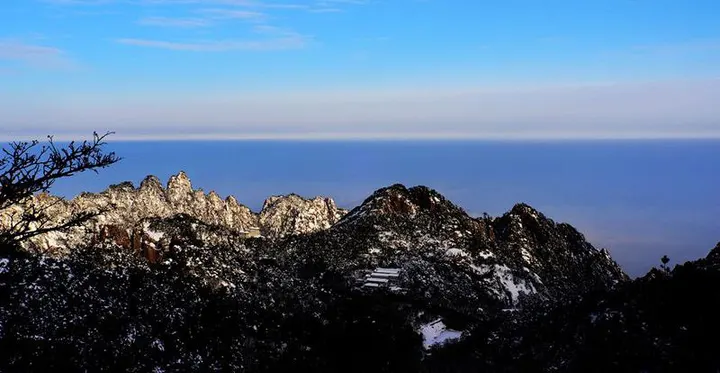
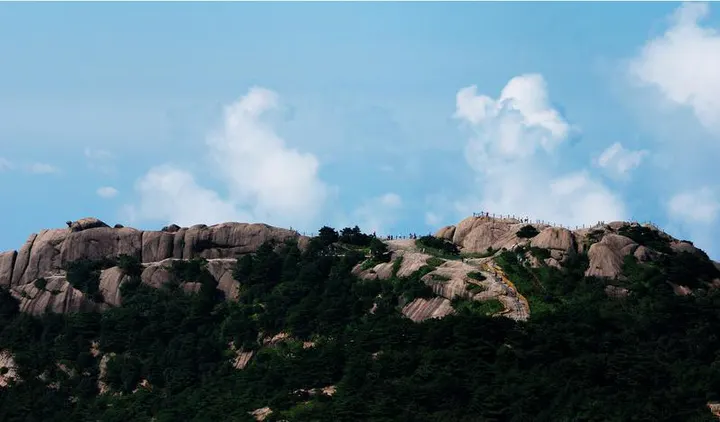
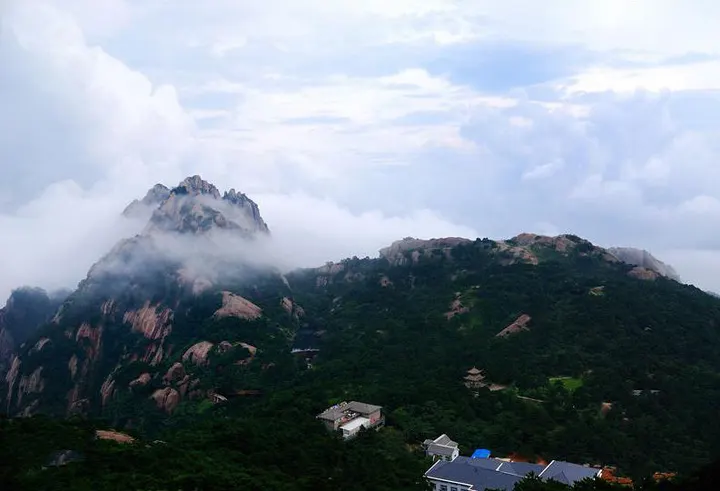
Snow-dusted summits above a flat bank of cloud, white still clinging to the north faces
The mountain has a front and a back, and that is not poetry but two actual routes. The front runs from Ciguang Pavilion through Yuping and Tianhai: steep, step-heavy, and where the famous sights cluster — the Guest-Greeting Pine, the Hundred-Step Ladder, Tiandu Peak. The back runs from Yungu Temple to Bainiuling, Beihai and Shixin Peak: gentler, more wooded, dense with pines. Almost everyone goes up the back and down the front, which puts the hardest gradient under your feet on the descent, where your knees will thank you.
Get the money straight, because it comes in four separate bills. The ticket covers three days; cableways, summit beds and the park bus are all extra. Entry is ¥190 in the main season, ¥150 in winter; Yungu and Taiping cableways are ¥80 one way, Yuping ¥90, the canyon funicular ¥100; the park bus is ¥19. Two cable rides, one night on the summit and two simple meals therefore land between ¥1,200 and ¥2,200 for two days, mid-range. The room to save is in the bed: dormitory beds run ¥200–500, less than half a standard room.
Within the four seas and beyond, there is nothing like Huangshan of Huizhou. Climb Huangshan and there is no other mountain under heaven; here seeing stops.
Xu Xiake, Ming dynasty
Xu Xiake climbed Huangshan twice, once in the winter of 1616 and again two autumns later, and his notes were later compressed into the line every brochure opens with: after the Five Great Mountains no other mountain is worth seeing, and after Huangshan not even those. Strip the rhetoric and what he recorded is practical — snow to the knee, wet stone steps, nights spent thawing by a temple fire. Four hundred years on the snow still falls the same way; the steps are now granite slabs with a grip pattern, 85 km of them, 63,000 in all.
One blunt conclusion: the problem at Huangshan is not whether it is worth it, but that a day does not fit inside it. Tangkou to the summit eats two and a half hours before you have seen anything, and the three summit districts — Beihai, West Sea, Yuping — are two to three hours apart on foot. So the first principle of any plan is not one more sight but fewer retraced steps: up the back, down the front, and use the canyon funicular to turn the route's deep V into a W. That trick only became possible when the canyon funicular opened in 2013.
02Six things worth rearranging the day for
Sunrise at Bright Summit Peak: step out of the door and you are there1,860 m
Bright Summit Peak is the second-highest point on the mountain and the hinge between front and back: flat on top, 360 degrees of view, and the one place where you can catch sunrise, sunset and cloud sea without moving. Arrive forty minutes early. A dark red line appears in the east, then the cloud below you lights up from underneath and rolls upward in layers. In summer the sun is up around five, in winter after half past six, and every hotel lobby posts the next morning's time and likelihood — set the alarm an hour before it.
Elevation:1,860 m, the second-highest summit
From Baiyun Hotel:500 m, all uphill steps, 20–30 minutes
West Sea Grand Canyon: turning a V into a W400 m of drop
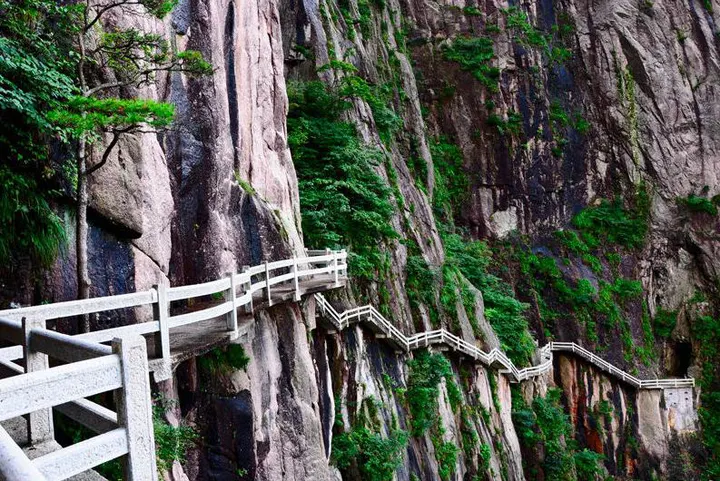
From the Paiyun Pavilion entrance the path drops through the first and second rings, cut into the cliff face with several hundred metres of air below the railing. Opened only in 2005, this is the closest Huangshan comes to expedition, and the emptiest part of the mountain — coach groups simply do not go down. The floor is about three kilometres and two hours away; from there you either take the 892 m funicular up to Tianhai in four to eight minutes for ¥100, or climb back out. Almost everyone takes the funicular, and that is not laziness but a way of saving your legs for tomorrow.
Paiyun to the floor:About 3 km, two hours down, steps throughout
Funicular:892 m, 497 m of rise, ¥100 one way
Shixin Peak: the pine showroomNo Shixin, no Huangshan pines
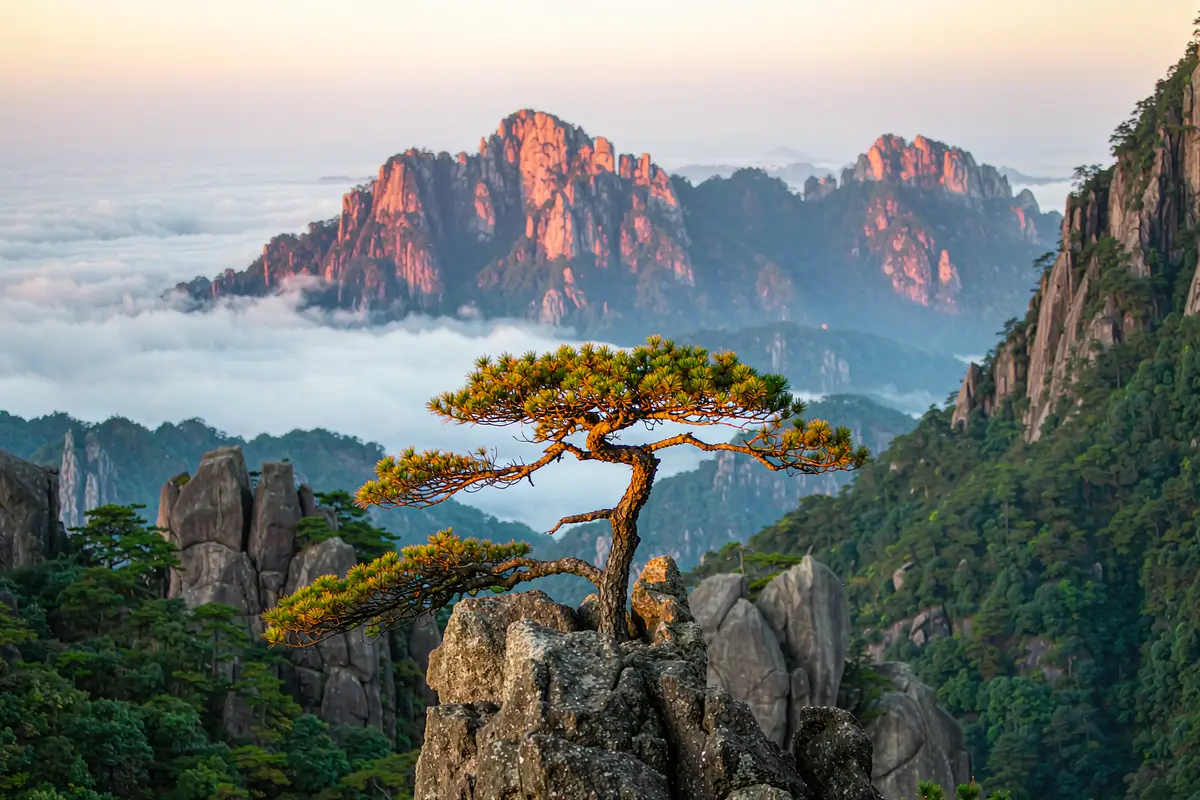
Five hundred metres from Bainiuling, this is the first place on the back route worth stopping at. The peak is not high; the pines are the point — Greeting, Black Tiger, Twin Trunk, Dragon Claw, Crouching Dragon, Sea-Probing, all crowded onto one small outcrop of granite, every one of them growing where there is no soil. Look for three things: why the trunks bend (constant wind from one direction), why the crowns are flat (the weight of snow), and how the roots hold on (they exude acid and slowly dissolve the rock). Once you see those three, the pines stop being pretty and start being logical.
From Bainiuling:500 m, fifteen minutes, almost flat
Allow:40–60 minutes
Yuping and the Guest-Greeting Pine: one pose for a thousand yearsA 7.6 m branch
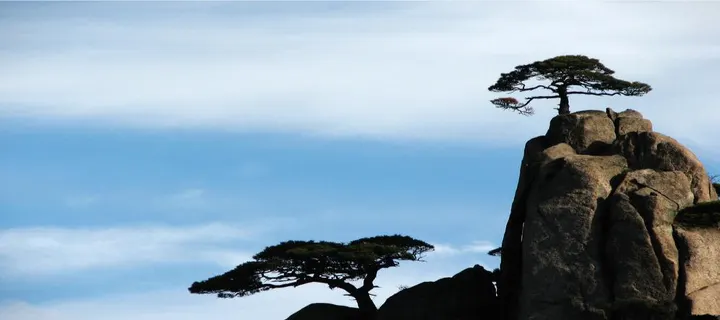
The Guest-Greeting Pine stands east of Yuping House at 1,670 m, more than eight hundred years old, two branches reaching 7.6 m in the same direction like an arm extended to usher you in. It is probably the most photographed tree in China and certainly the most guarded: a dedicated carer, a railing, props under the limbs, and ice removed by hand in winter. Come early. Coach groups arrive after nine and the railing goes three deep. It is only 200 m from Yuping House, and the See-Off and Companion pines nearby are worth the extra ten minutes.
Elevation:1,670 m
Crowds:Emptiest before 09:00, worst 10:00–14:00
Tiandu Peak: the 85-degree carp's back3,000 a day
Tiandu Peak is 1,829.2 m — lower than Lotus Peak and far more exposed. The route climbs the cliff at up to 85 degrees and passes the Carp's Back, a stone ridge with a thousand metres of nothing on either side, narrow enough that people turn sideways to pass. It was closed for rotation in December 2018 and only reopened on 20 May 2024; it now needs a separate real-name booking, caps at 3,000 a day with 500 on the peak at once, and closes to new arrivals after 15:00. If you cannot get a slot, do not mourn: Aoyu Peak, Shixin Peak and the canyon give up views nearly as good without a queue.
Booking:Separate slot on the official platform; no booking, no climb
Season:Normally 1 April–30 November, from 07:00, exit-only after 15:00
The hot spring: 42°C after the descentAt 850 m
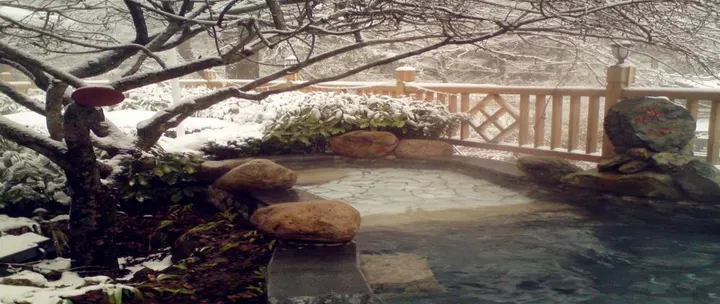
The hot spring sits at the foot of the mountain below Ziyun Peak, 42°C year-round, bicarbonate-heavy, clear and tasteless. Legend has it the Yellow Emperor bathed here for seven days, shed his age and rode off on a dragon — the mountain's name comes from that story. Today it is a spa with a few dozen pools strung along the stream, and it earns its keep in winter: mist on the water, snow on the railing, cold on your shoulders, heat everywhere else. An hour here after two days of steps does more than any massage.
Water:42°C all year
Where:Wenquan, between the interchange and Ciguang Pavilion
03Seven questions to settle before you climb
Should I go up the front or the back?
Up the back, down the front — that is the default, for reasons of gradient and crowds. The Yungu cableway lands you at Bainiuling at over 1,600 m with Shixin Peak and Beihai a gentle walk away and Paiyun Pavilion two hours off. The front route from Ciguang Pavilion means climbing fifteen li of almost unbroken steps in three hours and reaching Yuping with your legs gone just as the sightseeing starts. Reversed, that steep front section becomes a descent — hard on the knees, far easier on the lungs. Two exceptions: stay at Yuping House, or be first in line for Tiandu Peak, and the front makes more sense; travelling with parents or small children and interested mainly in Beihai and the West Sea, go up and down the back and skip the front entirely.
Is it worth sleeping on the summit?
If you want sunrise, yes. The first park bus leaves at 06:40 and the cableways start at seven, while a summer sunrise comes around 05:10 — from Tangkou you cannot make it by any arithmetic. The price of sleeping up there is the price: ¥800–1,500 for a standard room on a weekday, ¥1,500–2,500 at weekends and holidays, another ¥200–300 for a view. Beds are the escape hatch at ¥200–500, shared bathrooms, plain but clean. Book ahead — two or three weeks for an ordinary weekend, a month for May Day or National Day — and use the official platform, where availability is real. The other option is Baie Villa (White Goose): out of the way, dated, but ¥700–800 on a weekday and the cheapest room on the summit.
How many days do I need?
Two days is the floor; three is comfortable. Two days: cableway up the back on day one, Shixin Peak, Beihai, Paiyun Pavilion, then down into the canyon through both rings in the afternoon and the funicular up to Tianhai, sleeping at Bright Summit or Baiyun for the sunset. Day two: sunrise, then Aoyu Peak, the Hundred-Step Ladder, Yuping and the Guest-Greeting Pine, Tiandu if you have a slot, and the Yuping cableway down. Call it fifteen kilometres. One day gets you Beihai and Yuping by cable car with the canyon abandoned and no sunrise at all. Three days adds the hot spring, Emerald Valley, or a night in Hongcun on the way out.
When is the cloud sea?
November to May gives the best odds, above all on the first clear morning after rain or snow. The conditions are specific: damp air in the valleys, little wind, and a temperature inversion pressing the cloud below 1,000 m so that from 1,600 m you are looking at a white floor. Summer has cloud too, but mid-June to early July is the plum rain, when mist sits for days and visibility can drop to five metres. The reliable windows are late October to November — dry, clear, big day-night temperature swings — and January to February, when snow, cloud sea and rime arrive together at the cost of cold and closures. You need to be on the summit: be in place forty minutes before sunrise, because an hour after it the cloud starts to burn off.
Lotus Peak or Tiandu Peak — which is open now?
As of October 2026: Tiandu is open, Lotus is closed. Lotus Peak, at 1,864.8 m the highest point on the mountain, has been in closed rotation since 1 December 2023 and has not reopened. Tiandu Peak, 1,829.2 m, was closed from December 2018 and reopened on 20 May 2024; it now requires a separate real-name booking and caps at 3,000 a day. The two peaks rotate on a three-to-five-year cycle, so which one is open changes every few years — check the official platform before you travel. And to be clear: Lotus being shut does not spoil the mountain. You still see its shape from Yuping and from the Hundred-Step Ladder; you simply cannot stand on top.
Do I still go up if it rains?
Light rain, go. Thunderstorms, stay off the peaks. Huangshan has two kinds of rain. One is the fine, low-cloud drizzle that erases the view entirely — paying to look at fog, better spent on Tunxi Old Street or the hot spring. The other is a squall line: twenty minutes of hard rain, then half an hour later the cloud sea fires up, and that is the best weather the mountain offers. The test is a radar loop — if the band is narrow and passes in two hours, wait for it; if it covers southern Anhui, reschedule. In thunder, never go near Tiandu or Lotus, do not hold the chain handrails, do not shelter under a tree, and switch the phone off; lightning on that ridge kills people most years. Umbrellas are banned inside the park — bring a rain jacket.
How long are the cableway queues?
Worst in the morning: between 08:30 and 10:30 in high season both Yungu and Yuping can run sixty to 120 minutes, and two hours over May Day or National Day. On ordinary days it is ten to thirty minutes, and after three in the afternoon usually under ten. Three fixes: be at the gate before the first car (cableways open at seven; be there at 06:40), shift your climb to after 14:30 or stay on the summit and stop moving, or change gates — the Taiping cableway from the north gate is the quietest, eight minutes, at the cost of an hour's extra drive around to Taiping. Of the three, Yuping is the shortest ride and the longest queue, Yungu moves the most people, Taiping is emptiest. Weekends double the volume, so do not plan around public holidays alone.
04Two days is the answer; one day is a compromise
Two hard constraints shape every Huangshan plan: the first and last cableway, and the time of sunrise. The first decides which gate you must be standing at, and when; the second decides where you slept. Everything else is sequencing. Three shapes follow by number of days: the two-day route nine people in ten should take, a one-day version for those who cannot spare more, and a three-day version for anyone who wants the whole canyon and a hot spring at the end.
Distances first. The times below assume an average adult walking steadily with short pauses, no children and no long queues; in practice every photograph and every wait for cloud adds to them.
Yungu Temple to Bainiuling: eight minutes by cableway, or 6.5 km on foot with 700 m of ascent, two and a half to four hours, almost all of it steps.
Bainiuling to Shixin Peak to Beihai: 2.5 km, one hour, gentle and shaded.
Beihai to Paiyun Pavilion: 2.5 km, one to one and a half hours.
Paiyun Pavilion to the canyon floor: 3 km, two hours down, with the steps packed tight through both rings.
Canyon floor to Tianhai: four to eight minutes by funicular, or about five hours on foot via Buxian Bridge.
Tianhai to Bright Summit: 500 m, 20–30 minutes uphill.
Bright Summit to Aoyu Peak to the Hundred-Step Ladder: 2 km, one and a half hours, the ladder itself about 200 steps and near vertical.
Hundred-Step Ladder to Yuping: 1.5 km, one hour, passing Lianhua Pavilion.
Yuping to Ciguang Pavilion: 7 km, three hours down; the Yuping cableway takes six to ten minutes.
D1
At the Zhaixi interchange by 06:20, first park bus at 06:40 to Yungu Temple, cableway up to Bainiuling at seven. Shixin Peak for the pines by eight, Beihai and then Paiyun Pavilion by 09:30, into the canyon from the north entrance at 10:30 — right fork on the first ring, left on the second — reaching the floor at 12:30 and riding the funicular up to Tianhai for ¥100. Lunch at Tianhai, Bright Summit by two for the four-way view, out to the Flying-Over Stone and back for sunset at four. Sleep at Bright Summit Villa or Baiyun Hotel, lights out at eight, alarm at 04:50.
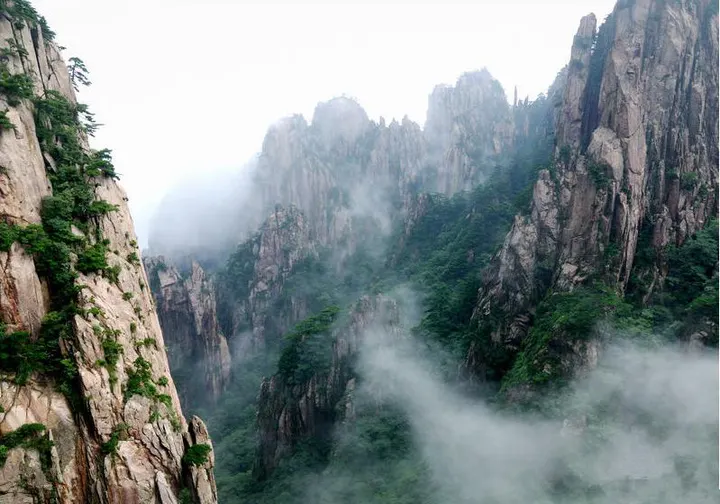
A ravine in the West Sea: cloud rising from the floor and cutting the peaks into layers
D2
Be on the Bright Summit platform forty minutes before the posted sunrise — around 04:20 in summer, when the sun is up at five, and before six in winter, when it comes after 06:30. Breakfast and check-out by seven, away at eight for Aoyu Peak, up the Hundred-Step Ladder — about 200 steps, near vertical — at 08:40, and at Lianhua Pavilion by 09:30. Lotus Peak is closed, and this is the best angle from which to see its shape. Yuping House and the Guest-Greeting Pine by 10:30. With a Tiandu booking, up the old path at eleven, two to three hours return; without one, the Yuping cableway down. Ciguang Pavilion and the bus back to Tangkou by 14:00, in the hot spring by three.
D3
Give the third day to the foot of the mountain. Emerald Valley in the morning — ¥60–75, six kilometres out, a stream bed of several hundred coloured pools in blue-green water, two hours on foot — or Nine Dragon Waterfalls at ¥60, nine falls in a chain. Back through Tangkou in the afternoon and on to Hongcun (¥104 at the gate, ¥94 online, ¥159–186 combined with Xidi), sleeping by the village entrance so as to see the South Lake before anyone else. Routes, rooms and the sketching season in Hongcun are covered in our separate Hongcun guide; they are not repeated here.
With one day, cut the canyon rather than cram it. A workable version: Yungu cableway at seven, Shixin Peak, Beihai, Bright Summit, Aoyu Peak by 11:30, Yuping and the pine by 12:30, Yuping cableway down at two. Six to seven hours, eight kilometres or so, and you will have seen the mountain's famous face — but not its quiet one. There are no coach groups in the West Sea Grand Canyon, and it is the only place on Huangshan where you can hear the wind.
05Three districts, three ways of walking them
Beihai and Shixin Peak: pines first, peaks second
The back cableway leaves you at Bainiuling, above 1,600 m, and Shixin Peak is five hundred metres on. This stretch is the mountain's antechamber: level path, dense pines, open views, almost no effort. Shixin stands with air on three sides, its top a few dozen square metres, and from it you see farmland towards Taiping, Lion Peak to the north and Danxia Peak to the west. The name is a plain sentence: a sceptic walked up here and only then began to believe.
West from Shixin, past the Black Tiger Pine, the Brush-Tip Blooming rock, Lion Peak and on to Beihai Hotel is two kilometres and forty minutes. Walk it slowly, because the density is absurd: the Brush-Tip is a free-standing stone column with a pine growing out of its crown; the Monkey Watching the Sea is a boulder shaped like a crouching animal on the flat top in front of Lion Peak, gazing at cloud when there is cloud and at the Taiping valley when there is not. Qingliang Terrace and Shuguang Pavilion are the old sunrise spots — fewer people than Bright Summit, at the cost of a climb in the dark.
Bright Summit and the Flying-Over Stone: the crossroads
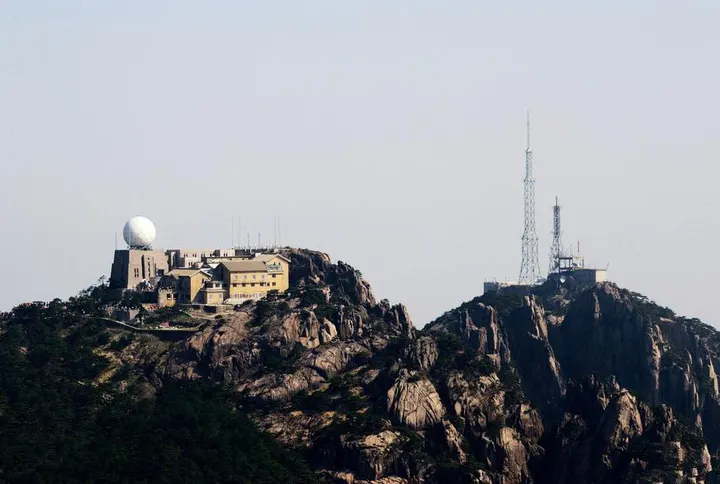
The weather station on Bright Summit: white radome and lattice tower, the highest observation point in eastern China
At 1,860 m, Bright Summit is the second-highest point and the hinge of the whole mountain. It is flat on top with 360 degrees of view: East Sea to the east, West Sea to the west, Lotus and Tiandu to the south, Beihai to the north — which is why the local saying about not seeing Huangshan until you stand here is not much of an exaggeration. A weather station occupies the top, white radome and steel tower, the highest meteorological post in eastern China and the building most often mistaken for an observatory in photographs.
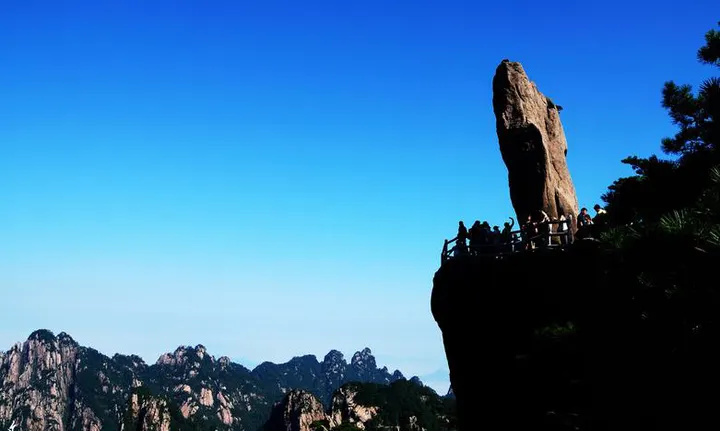
Five hundred metres north-west stands the Flying-Over Stone: a block about twelve metres high resting on a base so small it looks ready to roll. Legend makes it the leftover from the goddess Nüwa's repairs to the sky, which is to say the stone at the heart of The Story of the Stone, and the 1987 television adaptation shot its title sequence here. A narrow gap runs underneath, and local custom says three touches bring luck, which keeps a queue there most of the day. What actually deserves the time is the view west: the whole canyon opens below the stone, cloud moving through it at walking pace.
West Sea Grand Canyon: the wildest part of the mountain
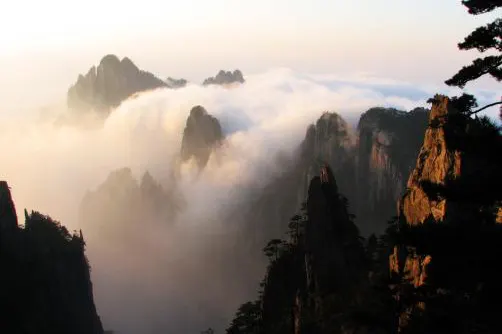
Also called the Dream Scenic Area, the canyon runs about twelve kilometres from Paiyun Pavilion to Buxian Bridge in a U, with 400 m between rim and floor. Before the trail was completed in 2005 only climbers got in; today the first and second rings — walkways pinned to the cliff — are the most exposed and the best-looking part of the route. Go right at the first ring and left at the second, which is the accepted order: the right fork opens the view, the left drops deeper. The path is about a metre wide with several hundred metres of air beyond the rail. Anyone afraid of heights will sweat, but the surface itself is even, and the trick is not to look down over the edge.
Cloud filling the gorge to the height of the summits, with light coming in sideways
The floor sits around 1,200 m, the warmest place on the mountain, and in April the rhododendrons run from the bottom of the gorge to the rim. From the floor you either take the funicular straight up to Tianhai or climb back via Sanxi Bridge and Buxian Bridge — five hours, with an official sign advising against it for older or unfit visitors and after 15:00. Note that from early December to the end of March the floor trail and the funicular close for maintenance; you can still walk from Paiyun Pavilion to the north entrance for the view down, but you cannot descend.
Yuping, the Guest-Greeting Pine and Tiandu Peak
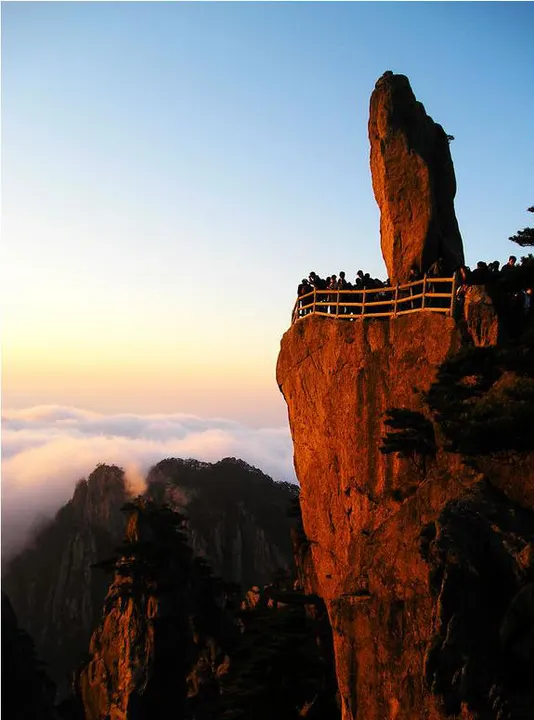
Yuping House is the centre of the front mountain at 1,680 m, the spot Xu Xiake called the finest on Huangshan. A flat yard sits in front, Tiandu to the left, Lotus to the right, and the Guest-Greeting Pine on the cliff edge to the east. South from the house, past the Three Isles of the Immortals and the One-Line Sky, is the old entrance to Tiandu; north down the Hundred-Step Ladder is the way to Tianhai. So Yuping is both a junction and a resupply point — toilets, a shop, hot water, at three times valley prices, which you will pay anyway.
Low sun turning a granite pillar orange, the railing lined with people waiting for the light
Tiandu rises south-east of Yuping, two to three hours return from the old entrance. It is thirty-five metres lower than Lotus and far more serious: the steepest pitch approaches 85 degrees, and the Carp's Back is a bare stone ridge with a deep valley on each side where people instinctively crouch when the wind gets up. Access is capped at 3,000 a day, booked separately in advance, and closes to new climbers after 15:00. With modest fitness or small children, walk as far as the junction below the summit for the view and turn around; you do not have to go to the top.
Lotus Peak: visible, not climbable
Lotus Peak, 1,864.8 m, is the highest point on the mountain, ringed by lesser summits so that the whole mass reads as an unopened lotus. It has been in closed rotation since 1 December 2023 and remains shut in 2026; reopening depends on ecological monitoring, on a cycle that usually runs three to five years. Three places show it best: looking up from the yard at Yuping, looking back from the middle of the Hundred-Step Ladder, and the long view south-east from Bright Summit. The rails of love locks on its summit will not be seen this cycle.
The hot spring, Yungu Temple and Ciguang Pavilion: three old places at the foot
The hot-spring district below Ziyun Peak at six hundred-odd metres was once called the Peach Blossom Spring, and its sights are the Character-Ren Waterfall, the Hundred-Zhang Spring and the Three-Step Cascade. The first splits into two streams in mid-air, which is what the character ren looks like; the second is a white rope in the wet season and a damp stain in the dry. Ciguang Pavilion, a Ming temple now housing the Huangshan Museum, is the start of the front route; Yungu Temple, its original halls gone and replaced by a Hui-style resort, is the start of the back. Neither is a sight. Both are where you sort your pack before climbing.
06Beyond walking
Photography: two and a half good hours a day
The massif faces every direction, but the rule holds: the forty minutes after sunrise and the forty before sunset give raking light that pulls the texture out of granite, and that is when the mountain has depth. From ten to three the light is overhead, the rock flattens, the sky bleaches, and everything photographs grey. So: sunrise east of Bright Summit, pines at Beihai in the morning with the light behind you, a rest at midday, the West Sea after three for cross-light, and sunset back at Bright Summit or Paiyun Pavilion. Bring a polariser to cut both the haze and the sheen on rock, and a long lens — the peaks in a cloud sea only separate when they are compressed.
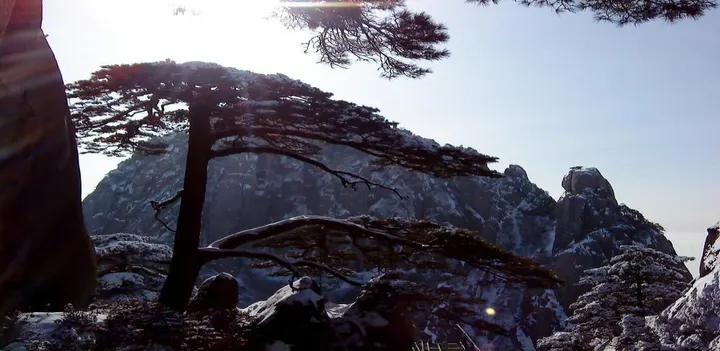
Huangshan pines in winter, snow on the horizontal branches, sun breaking over the cliff
Winter: snow, rime and minus fifteen
December to February is the most underrated season here. Snow reduces the granite to black and white, rime coats every branch, the cloud sea is more likely than at any other time, and there are fewer people, lower room rates and a ¥150 ticket. The cost is cold: minus ten to fifteen at dawn on the summit, colder with wind, ice on the steps that needs spikes (¥10–20 in the valley, more to rent up top), the canyon floor and Tiandu closed, and cableways stopping in high wind. Photographers love these three months for a reason: Huangshan's snow has been painted for centuries, and only standing in it explains why those paintings leave so much paper blank.
Walking: putting back what the cableway skips
Walking the whole thing is a different mountain. Yungu Temple to Bainiuling is six and a half kilometres with 700 m of ascent, two and a half to four hours; Ciguang Pavilion to Yuping is seven kilometres and a thousand metres, three hours. Do both and add the summit transfers and you have fifteen to eighteen kilometres and eight to ten hours, which is a route for people who climb often. The reward is concrete: the hour you would have spent queueing becomes the best part of the day, and the rock formations and pavilions along the way — the Immortal Flipping a Table, Rusheng Pavilion, Banshan Temple, Lima Bridge — are invisible from a cable car. If your knees are dubious, walk up and ride down; that is the combination that saves the joint.
The hot spring and two valleys below
The first thing to do after coming down is get in the hot spring. Three kilometres from the interchange, pools strung along the stream at 42°C, bicarbonate water, and half the ache leaves your legs. Two valleys nearby deserve half a day each: Emerald Valley (¥60–75) is famous for its pools, several hundred of them shading from pale green to deep blue, and Nine Dragon Waterfalls (¥60) chains nine falls into one run, powerful in the wet season. Both are six to ten kilometres east of Tangkou, and a half-day car is ¥150–200.
07Eight hotels up top, two towns below
Sort the names out first. Huangshan is a prefecture-level city whose urban core is Tunxi; the scenic area lies forty kilometres south with its south gate at Tangkou; Huangshan North is the high-speed station west of Tunxi, while Huangshan Station is the old conventional station in town. A booking that says Tangkou, Zhaixi or South Gate is at the foot; Tunxi or Old Street is in the city; Beihai, Tianhai, West Sea or Yuping means you are on the summit. The difference between up and down is not the price. It is an entire sunrise.
Cloud spilling off a summit above the roofs of the summit hotels
Bright Summit Villa: on the summit itself, one minute from the platform, the least effort any sunrise ever cost. Standard rooms around ¥1,000 on weekdays, ¥1,500–2,000 at weekends and holidays, another ¥200–300 for a view; beds ¥200–300 low season and up to ¥500 in peak. Rooms are dated and some have no window — ask before booking.
Baiyun Hotel: at Tianhai, dead centre between front and back, ten minutes from Bright Summit and Aoyu Peak and twenty from the canyon's south entrance. Standard rooms from ¥1,000 all year, about ¥1,200 at weekends; triples just over ¥1,000 in peak, which beats dorm beds for three people travelling together. The safest choice on a first visit when you are unsure of your route.
Beihai Hotel and Shilin Hotel: both in Beihai, five minutes apart, in the densest cluster of sights on the mountain. Beihai was rebuilt and reopened in 2025 and has the newest fittings up here; Shilin is photography-themed with guides on staff. Shilin starts at ¥900, about ¥1,300 at weekends; Beihai runs fifteen per cent more. Twenty to thirty minutes from the top of the Yungu cableway, which matters if you are carrying a bag or travelling with parents.
Paiyun Xinglv and Xihai Hotel: both in the West Sea beside the canyon's north entrance and Paiyun Pavilion, the most convenient base for the gorge. Paiyun Xinglv was rebuilt in 2021 with a younger pitch — ¥1,100 on weekdays, ¥1,300 at weekends, star-view rooms ¥1,500–2,000; Xihai splits into A and B wings, A near five-star from ¥1,400, B two or three hundred less. Choose these for sunset; sunrise is a thirty-to-forty-minute walk.
Baie Villa: on Bainiuling, twenty minutes' walk from the top of the Yungu cableway, the cheapest bed on the summit. ¥700–800 on weekdays, about ¥1,000 at weekends; dorm beds from just over ¥100 low season to ¥300-odd in peak, in rooms of six to twelve with private bathrooms. Out of the way and dated, but quiet, with a viewing platform at the door.
Yuping House Hotel: beside the Guest-Greeting Pine, the only hotel on the front mountain, a dozen minutes from the top of the Yuping cableway. Rooms from ¥1,000, view rooms more. Sunrise at Bright Summit is fifty minutes away and the route doubles back, but for anyone with limited mobility, or planning to be first on Tiandu, it is the only sensible option.
Tangkou at the foot: three hundred-odd guesthouses and hotels around the interchange, ¥150–400, five to twenty minutes from the gate. Good for an early start or for collapsing after the descent. Ask how far from the Zhaixi interchange — some places listed as Tangkou are three kilometres out.
Tunxi in the city: ¥200–500, visibly better rooms for the money, with the old street, late food and a hospital in the evening. The cost is two hours of transfer a day and no chance of sunrise. Right for a day trip or a late train arrival.
Three honest notes. There are only a few thousand beds up there: book a month ahead for May Day, National Day or a summer weekend, two or three weeks for an ordinary one, and use the official platform, where availability is real — third-party sites will happily confirm a room that is gone. Do not book a windowless room; the summit is damp and the bedding in those rooms is damp with it. And in winter the hotels close in rotation for maintenance, so ring ahead between December and February unless you want to find your booking locked at minus ten.
08Heavy oil, deep colour, long heat
Huizhou cooking is the least southern of China's eight great cuisines: heavy oil, deep colour, long cooking, strong on braising, stewing and steaming, insistent on the ingredient's own flavour and never light. The reason is practical. Huizhou had more mountain than field, boys left to trade at thirteen, and the household left behind needed food that kept — hence the whole grammar of salting, drying and fermenting. Stinky mandarin fish, hairy tofu, cured pork and laba tofu are all preservation that turned into flavour.
Four things to order
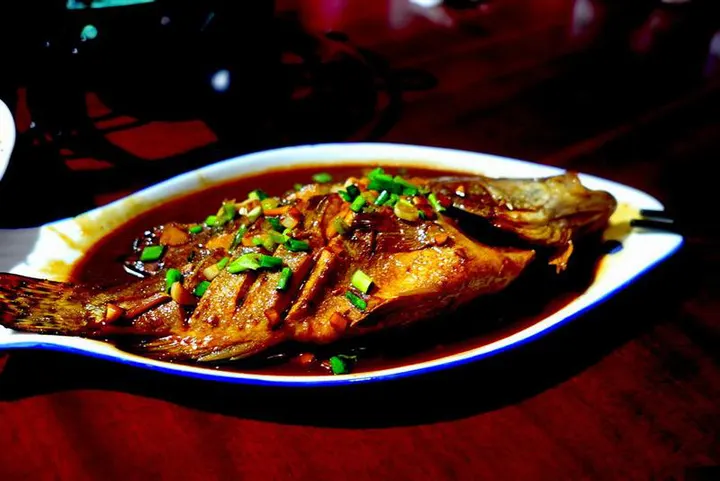
Stinky mandarin fish: the dish the cuisine is judged by. Mandarins are salted for six or seven days until the flesh ferments just enough to smell strong and taste deeper, and the texture firms rather than softens. It is braised with bamboo shoots and pork dice in a thick sauce, ¥128–188 a portion, enough for two.
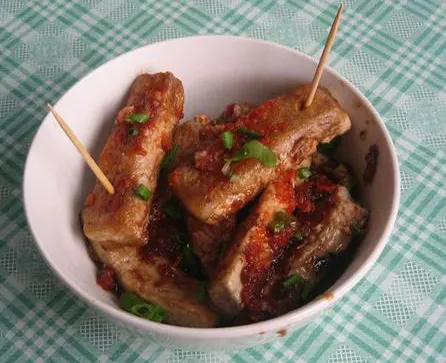
Hairy tofu: bean curd deliberately cultured until a white mould covers it, then pan-fried to a golden, blistered skin and eaten with chilli sauce. Crisp outside, custardy inside, and far more savoury than ordinary tofu. ¥25–40 a plate, from street stalls or restaurants alike.
Rock fungus stewed with rock frog, locally the Twin Stones of Huangshan. The fungus is a lichen scraped off cliff faces; the frog — farmed these days — is stewed with it in a clear broth, delicate and, unusually for this cuisine, neither oily nor hot. ¥168–268, done best and dearest in the summit hotels.
Dried bamboo shoots braised with pork belly, and cured pork served on a camphor board. The shoots are spring bamboo dried and used to drink up fat, braised with belly until amber; the pork is cured, sliced, steamed and brought to the table on a plank of camphor wood that lends its scent. Both are rice food, and a bowl of rice makes a meal.
Stinky mandarin fish braised whole in a dark sauce, spring onion scattered over the topHairy tofu fried to a blistered golden crust, served with chilli sauce
Where to eat
Eating on the summit follows one logic: enough. Restaurants at Bright Summit, Baiyun and Beihai run ¥70–100 a head, buffet breakfast usually included in the room; a bowl of noodles at the snack counter is ¥45–60, fried rice ¥40. Do not expect pleasure, and do not carry much food — the cost of hauling weight up steps is higher than ¥60 for noodles. Chocolate, jerky and nuts are the sensible load.
Down below it loosens up. The Yanxi Street strip in Tangkou is all restaurants at ¥40–60 a head; First Tower on Tunxi Old Street runs ¥60–80 and does a dependable stinky mandarin fish, with cheaper places around it. For the real thing, head into Tunxi proper rather than eating at the gate. Spring-water fish, Huizhou dumplings, laba tofu and Huizhou cakes are all worth ordering, and Maofeng tea is usually topped up free.
09Tea, ink, inkstones — and a pile of things not to buy
What travels home from Huangshan falls into two groups: things for a desk, and things from a hillside. Three rules before you pay — taste the tea, look at the carving, check the dryness. At the park gate, the cableway stations and hotel lobbies prices run about double the city, so buy elsewhere when you can.
Huangshan Maofeng: one of China's ten famous teas, grown around the scenic area, best before the Qingming festival. The dry leaf is fine and flat, ivory in colour; the liquor is pale and smells of orchid. Prices swing wildly — ¥200–400 per 500 g for everyday leaf, ¥800–2,000 for pre-Qingming top grades. Ask for a brew on the spot and check that the leaves are whole and free of smoke.
Taiping Houkui: from Taiping, now the Huangshan district north of the mountain, with the largest leaf of any green tea — two leaves clasping a bud, opening in the cup like a small flag. More orchid in the nose and a thicker body than Maofeng. ¥300–1,500 per 500 g, far more from the core Houkeng plots; look for the geographical indication.
Huizhou ink and She inkstones: two of the four treasures of the scholar's desk. Ink has been made around Shezhou since the Southern Tang, with the Hu Kaiwen workshop the most famous in the Qing; a good stick breaks like glass and rings clear. She inkstone stone comes from the Longwei ridge in Wuyuan, and collectors look for the eyebrow and gold-star markings. Entry-level sticks are ¥100–300 and stones ¥200–600; anything past a thousand is collectible, and not for the uninformed.
Hill produce: dried bamboo shoots, shiitake, rock fungus, walnuts, dried kiwi. Judge by dryness — shoots should snap, mushrooms should smell of mushroom rather than mould, fungus should be light with a fine nap underneath. ¥40–80 per 500 g for shoots, ¥200–400 for rock fungus. Skip the loose wild dendrobium and gastrodia at roadside stalls: no benchmark price and no way to tell real from fake.
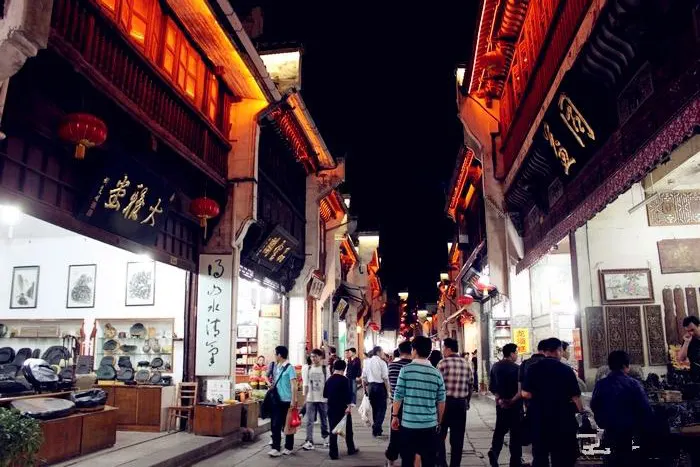
Tunxi Old Street after dark: timber shopfronts, red lanterns, stone paving, shops open past nine
Two places to buy. Tunxi Old Street runs 1.5 km with its Song, Ming and Qing street pattern intact and the old shop names still on their original sites — the Tongderen pharmacy, the Chengdexin soy shop — and rewards a slow walk. Yanxi Street in Tangkou is short, a little cheaper, and good for restocking on the way down. As for the gift hampers labelled Huangshan specialities, half the contents are pastries made elsewhere; two tins of tea are a better purchase.
10Rail to Huangshan North, then fifty minutes to the foot
Rail: three station names to keep apart
Huangshan North is the high-speed station, west of Tunxi, where the Hefei–Fuzhou, Hangzhou–Huangshan and Nanchang–Jingdezhen–Huangshan lines meet. From Shanghai Hongqiao or Shanghai South the fastest runs take 2h22m, most two and a half to three hours, at ¥193–253 in second class, with thirty-odd departures a day; Hangzhou West is about 1h20m; Nanchang and Fuzhou have direct services. Huangshan Station is the old conventional station in town — do not book it by mistake. Huangshan West sits at Taiping in the Huangshan district, convenient for the Taiping cableway and the north gate but far from the south gate.
The transfer is the step people get wrong. Two hundred metres to the right of the exit is the Huangshan tourist bus station, where the official coach leaves: ¥30, fifty minutes direct to the Zhaixi interchange at Tangkou, from 06:55 to 20:00, every twenty to thirty minutes and whenever full. Buy at the window or on the official platform. Men at the exit will tell you the coach does not reach the gate or that a shared car is faster; ignore them, because the coach stops at the interchange door. A taxi is ¥100–150, only sensible split four ways, and nearer ¥200 after eight in the evening.
The interchange: where every vehicle stops
Zhaixi at Tangkou is the main gate for the south entrance. Private cars, coaches and ride-hailing all stop here; beyond it you ride the park bus: ¥19 one way or ¥38 return to Yungu Temple or Ciguang Pavilion, twenty-five to thirty minutes. Hours follow the park — in season, uphill runs 06:40 to 16:30 on weekdays and from 06:10 at weekends. A return ticket saves a second queue, but watch the last bus: miss it and you walk down, because there are no taxis on the mountain.
Cableways: three, each with a job
Yungu cableway, back route: Yungu Temple to Bainiuling, 2,666 m, eight minutes, ¥80 in season and ¥65 in winter. The highest capacity and the fastest queue, and the default way up. First car at seven, 06:30 at weekends, last car with park closing.
Yuping cableway, front route: Ciguang Pavilion to Yuping, 2,176 m, six to ten minutes, ¥90 in season and ¥75 in winter. The shortest ride and the longest queue, worst between nine and eleven. Use it downhill, which puts the Guest-Greeting Pine at the end of the day.
Taiping cableway, north gate: Songgu Nunnery to Songlin Peak, 3,709 m with 1,014.5 m of rise, eight minutes, ¥80 in season and ¥65 in winter. One of the longest passenger cableways in Asia, with 100-person cabins and the thinnest crowds. Reaching the north gate means driving round through Taiping, an extra hour, which suits drivers coming from Hefei or Tongling.
West Sea Grand Canyon funicular: Paiyun Creek to Tianhai, 892 m with 497 m of rise, four to eight minutes, ¥100 in season and ¥80 in winter. Not a cableway but a rail car climbing a 70-degree slope, two cabins passing at the midpoint, turning the canyon's V into a W. Closed from early December to the end of March.
Driving and flying
Driving from Shanghai on the G60 and Hangzhou–Huangshan expressways is 400 km and four and a half hours; from Hangzhou, 240 km and three. Cars stop at the Zhaixi interchange car park, charged by the day, which fills on holidays — arrive before seven to be safe. The mountain roads are bendy and foggy and not worth doing at night. Flights land at Huangshan Tunxi (TXN), five kilometres from town, with services from Beijing, Guangzhou, Shenzhen and Chengdu; frequencies are low, and a taxi to the north station or bus station takes twenty minutes.
Finally, the way out. The descent peaks between four and six, with queues at the Yuping cableway and the interchange. Work backwards from your train: fifty minutes from the interchange to Huangshan North, plus queueing and security, so leave the summit two hours before departure. If you miss the last cable car there is exactly one remedy — walk down towards Ciguang Pavilion, three hours, with a head torch.
Check trains and fares from Shanghai to Huangshan North
Hours: 5 March–30 November, 07:00–17:10 Monday to Friday and 06:30–17:40 at weekends and long weekends; 1 December–4 March, 08:00–16:40. The walking-gate ticket check closes at 15:00, after which it is exit only. Cableways follow park hours.
Tickets: ¥190 (half ¥95) in the main season, 21 January–19 December 2026; ¥150 (half ¥75) in winter, 20 December 2025–20 January 2026. Valid three consecutive days from first scan with unlimited entries, but each further day needs a new booking on the official platform, capped daily; windows do not handle re-entry. Free under 1.2 m or six years, half price for 6–18 and 60–64, free over 65.
Bookings: everything is real-name, timed and direction-specific. Buy on the official Huangshan platform at least a day ahead, three days for public holidays, and note that the gate you choose — south, north or west — cannot be changed. Tiandu Peak needs a separate slot on the same platform, 3,000 a day, gone when gone.
Numbers: park information 0559-2590999, around the clock; police 110, ambulance 120, fire 119; complaints 12345. Every summit hotel can call a doctor and the visitor centres keep first-aid rooms.
Hospitals: the summit has first-aid rooms only, good for sprains, cuts and the lightheadedness that is really fatigue plus low blood sugar. Anything needing an X-ray or stitches goes to Huangshan People's Hospital in Tunxi, about an hour from Tangkou; there is also emergency care near Huangshan North.
Signal: 4G and 5G hold on the summits and at the main platforms, and drop on the canyon floor, in the tunnels and in the deep parts of the gorge. Screenshot your ticket QR, your Tiandu booking and an offline map before you go up.
Money: tickets, cableways, park buses and hotels all take QR payment, and Alipay's international version links Visa and Mastercard. Summit kiosks occasionally take cash only, so carry two or three hundred in small notes. Bottled water up top is ¥10–15; hot water is free in hotel lobbies.
Rules: smoking only at marked points; no drones, with bag checks at the gate; umbrellas are banned because the wind makes them dangerous, so bring a rain jacket; do not climb railings, step over barriers or carve anything into rock or pine; in thunder, stay off the peaks, let go of the chain handrails and keep away from trees.
Access: wheelchairs can ride the cableways, but the summit is almost entirely steps, so in practice it works only for short stretches at Yuping, Bright Summit and Beihai. Strollers are useless and anyone under five will need carrying. There are no lifts, so the less luggage the better.
Toilets and supplies: at cableway stations, the main platforms and every hotel. The canyon has one, at the floor, so go before you descend. There are no convenience stores up top, only hotel kiosks at three times valley prices.
12Three bookings and one packing list
Huangshan runs on no booking, no entry: ticket, cableway and summit bed, all three settled in advance. Buy the ticket on the official platform and choose gate and time slot; cableway tickets can be bought on the day, but buying them in the same order saves a queue in peak season; the bed is the tight one — two or three weeks ahead for an ordinary weekend, a month for a holiday. If you want Tiandu Peak, that is a fourth booking, made separately from the ticket.
Footwear: the one thing not to economise on. Treaded soles, uppers that hold the ankle, nothing new, nothing flat, no sandals. The granite steps are grooved but still slippery when wet, and on descents your toes jam into the front — half a size too small will cost you two toenails.
Clothing: the summit runs eight to ten degrees cooler than Tangkou, so even in summer you want a light jacket morning and evening; in winter, down plus a windproof shell, hat and gloves. Sunrise is windy, and hotels rent heavy coats for ¥30–50.
Rain gear: a jacket, not an umbrella. Umbrellas are banned and in wind they become kites. Buy a thick one; the disposable ponchos tear within half an hour up there. Add a pack cover.
Poles and knee supports: descents damage joints more than climbs, two poles take about a third of the load, and a brace helps any old injury. ¥20–60 a pole in the valley supermarkets, more to rent up top.
Water and food: 1.5 litres per person per day, two in summer, plus chocolate, jerky, nuts and salt tablets. Instant noodles are ¥20 and water ¥10–15 up top; do not haul a crate of bottles, the weight costs more than the difference.
Also: a head torch, essential for sunrise; a power bank, because cold drains batteries; sun cream, since 1,800 m burns; some cash; and your passport or ID, scanned at every gate. In winter add spikes, ¥10–20 a pair below.
Four traps. Anyone offering a back route to skip the ticket or a way in without a booking is selling nothing: every gate scans ID and there is no back route, and the penalty is a fine plus the walk back. Do not follow touts in Tangkou to a cheaper hotel — it is usually kilometres out with no transfer. Do not plan Huangshan in the morning and Hongcun in the afternoon; forty kilometres of mountain road and a whole mountain sit between them. And do not push up Tiandu in a thunderstorm; people are caught by lightning there every year.
13Granite, pines, cloud — and the people who carry things up
Geology: an intrusion, then a hundred million years of unloading
Huangshan is granite. Around 125 million years ago magma pushed into older strata deep underground, cooled slowly and crystallised into one huge body. Uplift later stripped the sedimentary rock above it, exposing the granite; relieved of that weight the mass expanded and cracked along a grid of vertical and horizontal joints, cutting the block into cubes. Ice, water and freeze-thaw then worked those joints for millions of years, and what is left is the forest of pinnacles, pillars and rounded boulders you walk among.
In the 1930s the geologist Li Siguang found striated surfaces and erratic boulders in Huangshan and argued for a Quaternary glaciation here. The claim has been disputed for decades, with opponents reading the same marks as weathering and debris flow. The argument matters less than what it explains: why the valley floors are littered with rounded boulders, and why some cliff faces look polished. Walking the canyon boardwalk today, the smooth blocks under your feet are the objects of that quarrel.
The name: from Mount Yi to Huangshan
The mountain was once called Yi, for the blue-black of its rock. In 747, in the Tianbao era of the Tang, an imperial order renamed it Huangshan after the legend that the Yellow Emperor refined his elixir and ascended here. That single edit plugged a regional mountain into the central story of China: from then on it was not only scenery but a stage for the Yellow Emperor. In 1990 UNESCO listed it for both culture and nature, one of the few double listings in China, and the citation named not only its landforms and biodiversity but its long influence on Chinese landscape painting.
Pines: growing where there is no soil
The Huangshan pine is its own taxon, Pinus hwangshanensis, growing in granite crevices above 800 m. It manages three tricks: roots that exude organic acids and dissolve minerals out of the rock surface for food; a root plate two or three times wider than the crown, locked into the first crack it finds; and short, dense needles that limit water loss. Wind bends the trunks one way, snow flattens the crowns, and the names follow — Greeting, Crouching Dragon, Black Tiger. The shape comes first; the name is added afterwards.
People: fifty kilos to eighteen hundred metres
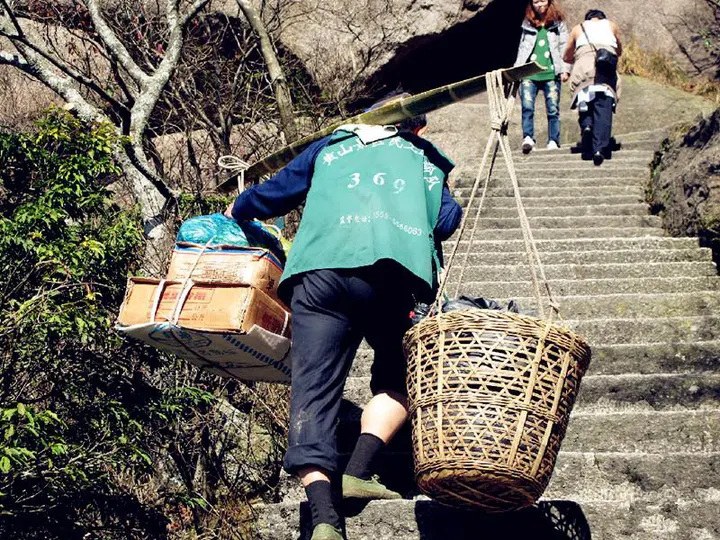
A porter with a bamboo pole, cardboard boxes on one end and a woven basket on the other, on the same steps as everyone else
Everything on the summit — sheets, beer, cement, tiles — comes up on a porter's shoulder. A bamboo pole with forty or fifty jin on each end, a rest every few hundred steps, two or three loads a day at a few dozen yuan each. When you meet one on the steps the etiquette is simple: stand still on the mountain side, never on the drop side, do not stop suddenly to take a photograph, and do not steady his load with your hand. Cableways move some building material, but linen, food and the rubbish going down are still muscle. Summit prices are triple partly because of this road.
14Water, villages and an old trade road at the foot
With half a day or a day left after the descent, do not rush off. The ring below Huangshan is the densest part of Huizhou: west to Hongcun, Xidi and Tachuan; east to Emerald Valley and Nine Dragon Waterfalls; north to Taiping Lake; south to the Huizhou–Hangzhou trade road. None of it is far. The only question is picking one thing rather than three.
Hongcun and Xidi (half a day to a day, 40–55 km)
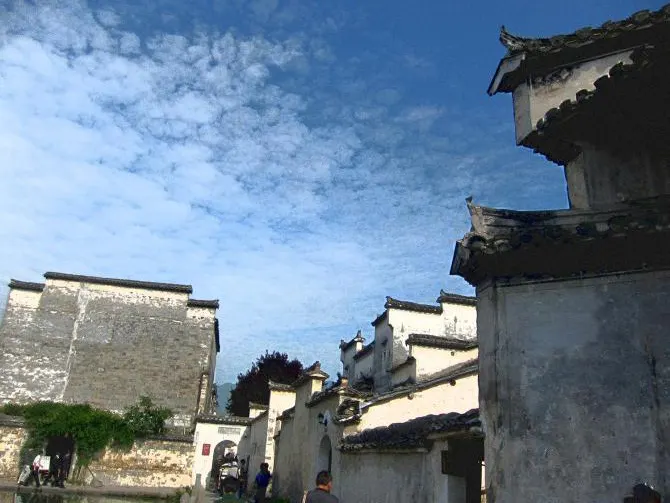
Hui-style houses: white walls, grey tiles, stepped horse-head gables against a washed blue sky
Hongcun and Xidi, an hour from Tangkou in Yi County, are the two models of the southern Anhui village — one built around water, one laid along a street. Tickets are ¥104 each (¥94 online) and valid three days, or ¥159–186 for both; direct buses run from Huangshan North and Yixian East. Routes, rooms, the sketching season and dawn viewpoints are in our separate Hongcun guide, and are not repeated here.
Emerald Valley and Nine Dragon Waterfalls (half a day each, 6–10 km)
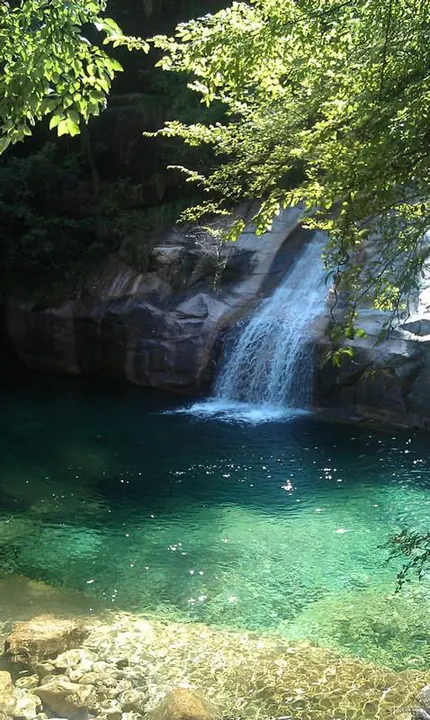
A pool in Emerald Valley: water dropping over a rock lip into a green so clear the stones show through
Emerald Valley, also called Lovers' Valley, lies six kilometres east of Tangkou: several hundred pools shading from pale green to deep blue as mineral content and depth change. ¥60–75, a two-hour loop on gentle ground, which is what tired legs want after a descent. Nine Dragon Waterfalls is ten kilometres further the same way, nine falls in a chain with more than three hundred metres of total drop, best when the water is up; ¥60. Both fit into one day, with a half-day car at ¥150–200.
The Huizhou–Hangzhou road and Qingliang Peak (two days, 60 km)
This is the trade road that followed the Silk Road and the Tea Horse Road: Huizhou merchants carrying salt, tea and cloth over the mountains from Jixi to Hangzhou. The usual walk starts at Yuchuan village near Fuling in Jixi, passes the First Pass South of the Yangtze and Lantian Hollow, and ends in Lin'an in Zhejiang — about twenty kilometres, two days, one night in a farmhouse. Qingliang Peak, the highest point of the Tianmu range at over 1,700 m, is a five-hour return from Lantian Hollow. The mountain is closed from November to March, so do not force it, and tell someone your route: there is almost no signal.
Mount Qiyun and Taiping Lake (a day each)
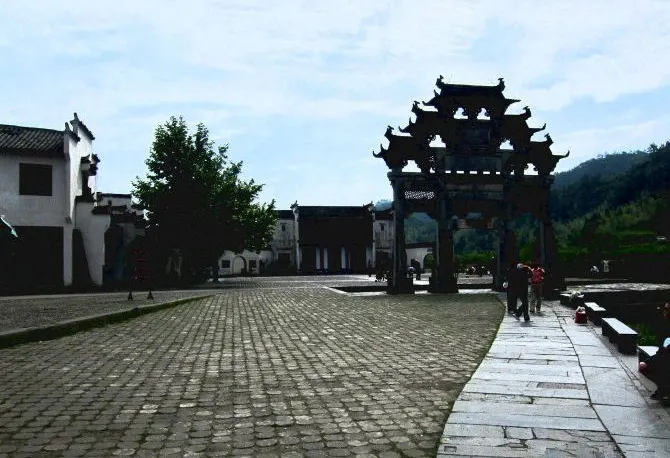
A stone memorial archway at a village entrance, three bays and five roofs, carved through under every eave
Mount Qiyun in Xiuning is a Taoist mountain of red sandstone, tickets from ¥58 with the cableway extra, forty minutes from Tunxi. It is not high, but its cliff inscriptions run from the Tang and Song to the Ming and Qing — over a thousand of them, denser than on many more famous peaks. Taiping Lake in the Huangshan district is the reservoir behind the Chencun dam, 88 square kilometres of water good for a boat or a bicycle, an hour from Tangkou. Both fill a spare half day before a train; neither is worth rebuilding a trip around.
15A mountain painted for four hundred years
Television: the opening shot of a stone
The 1987 television adaptation of The Story of the Stone opens on a boulder with cloud below it, the camera pulling slowly back: that boulder is the Flying-Over Stone. The novel was originally called The Story of the Stone and concerns exactly this — a leftover from the goddess Nüwa's repairs, sent down to live a human life. By shooting the titles here, the director Wang Fulin let a real mountain gloss a myth. Stand under the stone today and you can still find the angle; the rock has not moved, only the railings and the interpretation board are new.
Painting: the Huangshan school and sketching every peak
In the late Ming and early Qing, painters moved onto the mountain — Jianjiang, Shitao, Meiqing, Xuezhuang — to paint granite nobody had painted. Jianjiang's work is severe: a few lines make a peak and blank paper outnumbers ink. Shitao's line about sketching every strange peak until the drafts run out means looking until the mountain is inside you, so that the brush has something to stand on. The school they founded shaped three hundred years of landscape painting, and Huang Binhong, Liu Haisu and Li Keran all made the pilgrimage. The right order may be: look at the mountain, look at the paintings, then look again — the second pass shows what the first missed.
Poetry: Li Bai needed two lines
Li Bai wrote two lines about Huangshan — four thousand ren of mountain, thirty-two lotus peaks — and in fourteen characters disposed of both height and shape. He never reached the main summits; in the Tang the path stopped around the hot spring. Xu Xiake's diary is the practical companion: which stretch held deep snow, where the stone steps were slick, which temple he slept in. If you carry one book up, carry the Huangshan chapters of Xu Xiake's travel diary. It beats any guidebook, because it describes a mountain with no cableways, no railings and no steps.
Eating: geography on a plate
Every Huizhou dish traces back to a line of geography. Stinky mandarin fish exists because fish shipped up from the Xin'an River were salted on the road. Hairy tofu is tofu left too long in damp mountain air. Cured pork is a pig killed at New Year and eaten across twelve months. Dried bamboo is spring's surplus. Which is why the honest way to eat this cuisine is four dishes and a bowl of rice in a small place at the foot of the mountain, not a set menu in a summit hotel with the word special on it.