Grass, forest and a border river — three landscapes inside one prefecture
No high-speed rail, one night on a slow trainA car and driver from ¥500 a dayID checks on the border roadJuly–August beds cost 30–50% more
In short
Hulunbuir (呼伦贝尔, Hūlúnbèi'ěr) fills the northeastern corner of Inner Mongolia — 250,000 square kilometres, slightly larger than Shandong and Jiangsu put together — and is run from Hailar. It is really three places stitched into one: grassland in the west around the Mergel River and Hulun Lake; the Greater Khingan forest in the north, at Moerdaoga, Genhe and Mangui; and a border river in the northwest, the Argun, with the villages of Enhe, Shiwei, Linjiang and Qiqian strung along it. There is no high-speed rail, only slow trains: Harbin to Hailar overnight, Beijing in twenty-eight hours. That makes a chartered car or your own vehicle the backbone of any trip — six to eight days on the northern loop, two more if you add Manzhouli. The grass is greenest from mid-June to mid-September, the forest turns in the last week of September, and beds cost thirty to fifty per cent more in both windows. A mid-range trip runs ¥4,000–6,000 before travel to and from the region.
¥4,000–6,000 for seven days, mid-range, sharing a car between two, excluding travel to the region
Days needed
6–8 days
Comfort
Moderate — 150–250 km of driving a day, simple rooms in the villages, heavy mosquitoes
Best time to go
Mid-June to mid-September for green grass; late September for the forest turning; deep winter below −30 °C
01What Hulunbuir actually is
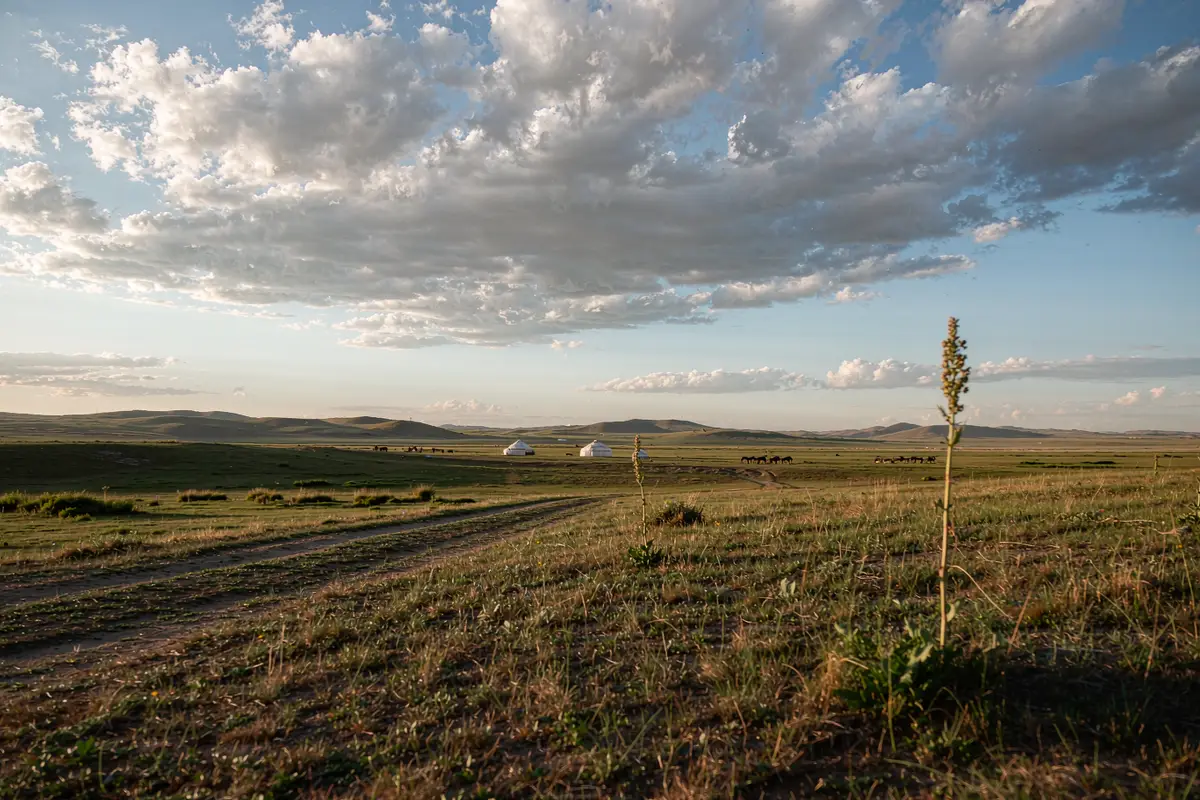
Ten minutes out of Hailar airport the buildings stop. Ten minutes after that there is nothing on either side of the road but grass running to the edge of sight, broken now and then by a row of poplars, a red roof, a flock moving slowly. Hulunbuir's first impression is not a sight but an absence: no ridge to close the view, no village to break it, and a sky that takes up most of the frame. Hailar sits at 612 m — low enough that breathing is not an issue, but the wind is constant, the sun is brutal, and an August afternoon that burns your arms turns cold the moment it sets.
The prefecture covers 253,000 square kilometres — a little more than Shandong and Jiangsu combined — and holds barely 2.2 million people, fewer than nine to the square kilometre. On a map it looks like land divided by three things. Grassland in the west, running from Hailar out to Hulun Lake and the two Barga banners. Forest in the north, where the Greater Khingan begins around Yakeshi and continues past Genhe to Mangui. And a river in the northwest, the Argun, flowing south to north with Russia on the far bank and the villages of Enhe, Shiwei, Linjiang and Qiqian spaced along it.
What travellers call Hulunbuir is usually one of three routes. The northern loop is the classic: Hailar, Ergun, Enhe, Shiwei, Linjiang, Moerdaoga, Qiqian and back — a bit over eight hundred kilometres in six to eight days, taking in grass, birch forest, border river and taiga in one go. The southern run is short: Hailar to Manzhouli and Hulun Lake, two days, one border city and one very large lake. The western run goes deep into open pasture — the Mergel River, Heishantou, the New Barag Left Banner — for meanders and sunsets, one or two days. The three can be combined, but the combination runs past ten days with four or five hours in the car daily, and by day five the driving starts to tell.
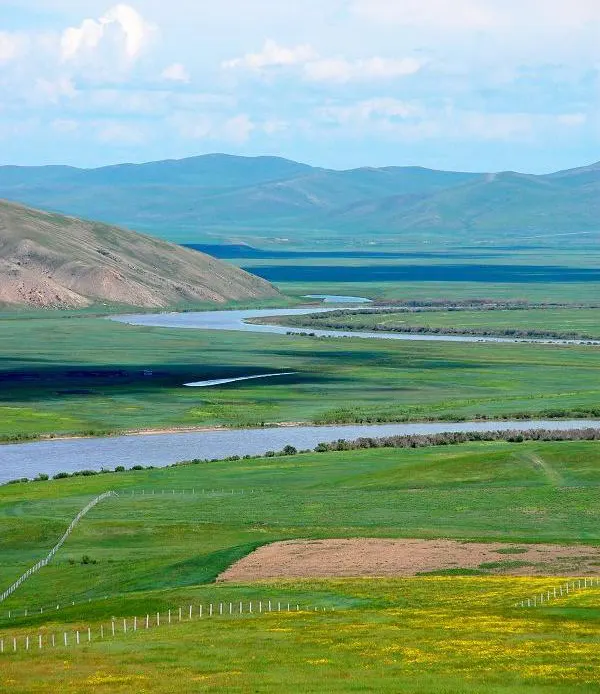
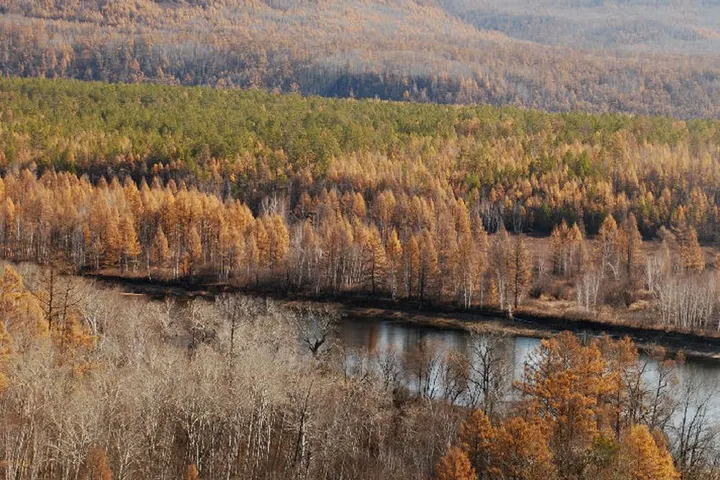
The border river in late September — wide water, larch and birch on both banks already gold
Transport sets the shape of every itinerary here, so start with it. There is no high-speed rail in Hulunbuir; the nearest fast trains stop at Qiqihar. You reach Hailar by plane or by slow train — one night from Harbin, twenty-eight hours from Beijing. Locally it gets harder still. Buses will put you in Ergun, Genhe or Manzhouli, but they do not go to the Mergel River overlook, into the birch forest, out to Eagle's Beak, or up to Qiqian, and those are the parts worth the journey. The workable combination is a flight or train into Hailar plus a chartered car for the loop; buses make sense only on a tight budget or a single-destination trip.
Then there is the season. The window is narrow: grass greens up in mid-June and starts to yellow in mid-September, three months at most. Late September to early October is the second window, when birch and larch turn together — the forest looks better than the grass then, but the wind is up and mornings sit near zero. The tenth of July to the twentieth of August is the peak, with the highest room rates, the most cars and a queue for every horse. Early June has short grass and half the people; late September has cut hay and the same advantage. November to March is another world altogether: minus thirty is routine, Genhe has recorded minus fifty-eight, and unless you are chasing snow and rime ice, ordinary itineraries should stop in October.
02Six reasons to add a day
The Mergel River: one bend after anotherForty kilometres from Hailar, mostly free
The Mergel comes down off the western slopes of the Greater Khingan and runs more than three hundred kilometres across open pasture, narrow as a rope, doubling back on itself until the bends nest inside one another. The local phrase for it is the finest meander in the land. The way to see it is from above: take provincial road 201 north out of Hailar, forty kilometres to the water, then walk up whichever slope looks highest. From the top the river lies below you in loops, cattle are small dark marks, and cloud shadow drifts across the grass. The river itself costs nothing; one stretch has a boardwalk and a viewing deck charging about ¥80. Walking up a hill outside the gate works just as well from a slightly lower angle. Arrive an hour before sunset, when the light comes in sideways and each bend catches a thin line of silver.
Ticket:The banks are open; the boardwalk deck is about ¥80
Getting there:¥300–400 return by car from Hailar, half a day; self-drive on the S201
The Ergun wetland: twenty minutes from townOne deck, the whole meander
Ergun town is small; walk west from the bus station for twenty minutes and you are at the wetland gate. The wetland is a broad meander of the Gen River looping through meadow, the channel split into braided strands by grass flats, willow and birch along the banks, and ridge after ridge of hills behind. A boardwalk and viewing deck sit above it, reached by a ¥15 shuttle or a forty-minute walk. At dawn vapour lies flat on the water as if something were boiling underneath; by evening the meadow goes ochre and the channels hold the sky. This is the least effortful stop on the whole route — no driving, no three-hour pre-dawn start.
Ticket:¥65, plus ¥15 for the shuttle
Hours:08:00–17:30, last entry 17:00; best at dusk
Enhe and Shiwei: log houses and a border riverWorth a night, not an hour
Enhe and Shiwei are both log-house villages: whole trunks stacked horizontally, notched at the corners, tin roofs, window frames painted blue or white, flowers in the yard and a wooden board by the gate listing how many beds are free. Families of Russian heritage live here; breakfast is a loaf baked at home, blueberry jam, milk from the cow that morning and boiled eggs, and the accent in their Mandarin is northeastern. Shiwei sits right on the Argun, with a boardwalk along the bank and a Russian village on the far side — a few dozen metres of water, cattle grazing separately on each bank. Sleep one night and walk the village at five or six in the morning; it beats any viewing platform.
Beds:Family guesthouses ¥150–300 in ordinary weeks, ¥400–700 in July–August, breakfast usually included
Distances:Ergun to Enhe 70 km; Enhe to Shiwei 50 km; Shiwei to Linjiang 10 km
Moerdaoga: ride the 4184523 km, 31 stops, ¥37
Train 4184 on the Yalin line leaves Hailar at 08:15 and reaches Mangui at 21:20: 523 kilometres, thirty-one stops, ¥37 for a hard seat. The carriages are old, the windows open, and the pace is slow enough to read the bark on individual trees. It crosses the whole western flank of the Greater Khingan; the further north it goes the denser the forest, gold larch out the window in late September, bare grey branches and snow by mid-October. Get off at Genhe for Lengji village, the cold pole, where the lowest temperature ever recorded in the Chinese weather network, minus fifty-eight, was registered nearby. The train is not transport to the destination; it is the destination. Ride it end to end and you lose a day, ride Hailar to Genhe, about eight hours, and you lose half of one.
Service:4184/4181 Hailar 08:15 to Mangui 21:20; the return 4182 leaves Mangui at 07:10 and reaches Hailar at 19:35
Fare:¥37 end to end; about ¥25 to Genhe
Manzhouli: the gate, the dolls, a street of facadesTwo hours from Hailar by train
Manzhouli is where the Binzhou line ends, a city that grew up with the Chinese Eastern Railway in 1901. The buildings are Russian in style, the signs are in two scripts, and the shops sell chocolate and nesting dolls. The gate sits nine kilometres west of town: the fifth structure on the site, 105 metres across, with a viewing deck above the railway tracks and the boundary marker below. The matryoshka square is on the east side, dozens of painted dolls standing about, the tallest five storeys high, lit after dark. Both charge admission, neither is large, and ninety minutes each is enough. As for whether they are worth it: the gate is about the fact of standing at a border, the square is about scenery. Doing one is defensible.
Tickets:Gate ¥60 plus shuttle; the tower ¥98; a combined ticket ¥130; the doll park from ¥50
Getting there:Two to two and a half hours by train from Hailar, ¥23–29; the bus is ¥40
Hulun Lake: the biggest water in Inner MongoliaForty minutes from Manzhouli
Hulun Lake, also called Dalai Nur, covers around two thousand square kilometres depending on the year — the largest lake in Inner Mongolia and the fifth largest freshwater body in China. There is no hill on the shore; the water runs flat to the horizon and a strong wind puts up a foot of chop, so it reads as sea. The ticketed area is on the Zhalainuoer side, with a boardwalk and boats, ¥32. You can also simply stop somewhere on the ring road for nothing: the reed beds hold swans, greylag geese and gulls, thickest in September. Hulun and Buir are sister lakes, but Buir straddles the Mongolian border, the road is rough and there is a checkpoint, so ordinary itineraries skip it. Eating fish by the lake is standard; the famous whole-fish banquet is more ritual than meal, and two or three dishes will do.
Ticket:¥32; stopping on the ring road is free
Allow:Two to three hours, best at sunset; the wind is strong, bring a jacket
03Seven questions worth settling early
How many days does Hulunbuir need?
Six days is the floor, seven is comfortable, eight gets you a night at Qiqian. The standard six: day one Hailar, day two to Ergun via the Mergel River, day three through the birch forest to Enhe, day four Enhe to Shiwei and Linjiang, day five Linjiang to Hailar via Moerdaoga, day six a return run to Manzhouli or Hulun Lake. Seven splits the Moerdaoga night out and puts you inside the forest; eight adds Qiqian, 150 km north of Moerdaoga with no bus service, car only. Three days buys one route only — grass and Ergun, or Manzhouli and the lake. Cramming both means spending the whole time in the vehicle.
Do I need a car and driver? Can I self-drive? Will buses do?
Buses will not do it, and that is settled. Hailar's long-distance station runs to Labudalin (Ergun) for ¥33, Manzhouli ¥40, Genhe ¥62, Moerdaoga ¥80 and Mangui ¥110, which gets you to towns and no further; from a town to the river, into the forest or out to Eagle's Beak there is nothing. Self-driving is the freest option — the roads are mostly sealed and decent, petrol stations cluster in the towns, so fill up before entering the forest. A car with driver is the least work: ¥500–700 a day for a five-seat sedan, ¥900–1,100 for a seven-seat van, fuel, tolls and the driver's own food and bed included. Most drivers are local and know which slope is climbable and which ford is worth stopping at. For two people the arithmetic lands close to buses plus taxis plus wasted afternoons, and you keep the afternoons.
When is the best time, and is autumn worth a separate trip?
It depends what you want. The grass is greenest from mid-June to mid-September, with the tenth of July to the twentieth of August as the peak: tallest grass, wildflowers and rapeseed out, the most settled weather, and the highest prices and crowds. Early June is newly green, softer in colour, half as busy and windier. By mid-September the hay is being cut and the grassland turns into a field of golden bales, which photographers like. The twentieth of September to early October belongs to the forest: birch turns first, larch after, and the stretch from Enhe to Moerdaoga looks varnished in gold — that is the week to weight the itinerary north and give the grass less time. After the tenth of October the leaves are down and the wind is cold; unless you are after rime ice and snow, there is little left to see.
How much do rooms rise in July and August, and how early should I book?
Thirty to fifty per cent is normal; the character accommodation doubles. Business hotels in Hailar and Manzhouli run ¥200–350 in ordinary weeks and ¥400–600 in season; Ergun town ¥200–400; the log-house guesthouses in Enhe and Shiwei ¥150–300 normally and ¥400–700 in July and August, breakfast included; yurt camps on the grass ¥500–1,200 at peak, more with a private bathroom. Between the tenth of July and the twentieth of August, beds in Enhe, Shiwei and Heishantou sell out a month ahead, weekends first. The order of business is simple: book the Enhe or Shiwei night first because it is tightest, then Hailar because it is never tight, and leave Ergun until last. Families should avoid the first weekend of August, when the whole region goes driving.
Do I need a permit for the border? How do checkpoints work?
Chinese citizens do not need a border permit for the Kaxian road — the border highway through Shiwei, Linjiang and Heishantou, named for the guard posts set along the river in the Qing — only an ID card. There are checkpoints; you stop, show the card, sometimes answer where you are going and where you are sleeping, and it takes a minute or two. Foreign travellers should carry a passport, and a few stretches and forward villages such as Qiqian may be closed to them; if that happens, take another road rather than argue. The hard rules: never cross a fence or a boundary marker, never trade across the river, do not photograph border installations, and do not fly a drone near the line — the hill behind Enhe is one of the few places where it is allowed, and you should ask before launching. The Kaxian runs 170 km on sealed road with no fuel along it; fill the tank before you start.
How bad are the mosquitoes? Do I need to worry about ticks?
Mid-June to mid-August is insect season. Mosquitoes work the grassland in daylight and peak at dusk, and the biting midges in the forest, known locally as xiaoyao, are worse than the mosquitoes — a bite itches for a week. The countermeasures are unglamorous and effective: long sleeves and trousers, cuffs tucked into socks, repellent with DEET or picaridin, a camp pitch in the wind, and no sitting in long grass for photographs. Ticks are active May to August, mostly in forest and deep grass; after a walk check calves, waist, armpits and hair. If one has attached, do not yank it — grip the head with tweezers close to the skin and pull steadily, or go to the local clinic. If you develop a fever or a spreading red patch within two or three weeks, see a doctor and say where you have been. Rabies is not a routine worry, but do not pet the herders' dogs.
What does riding cost, and is it safe?
Riding is sold by the hour or by the route: around Heishantou an hour costs ¥100–200 and a longer line out to the wetland or the river ¥200–400; Enhe and Shiwei charge much the same. Four things keep it safe. Choose a horse with a saddle, a helmet and someone leading or accompanying, not one of the loose animals touted at the roadside. Agree the duration, the route and the price before you mount, and establish whether an hour means sixty minutes or one lap. Always approach from the left front, never from behind. And no fooling about in the saddle, no phone calls, no slapping somebody else's horse. If you have never ridden, do not take the reins and kick: the grassland looks flat and is full of pika holes and ditches, and a horse that puts a foot wrong will put you on the ground. Horses are scarce and riders plentiful in July and August, so take the first batch in the morning when they are fresh.
04Eight days north: grass in, forest out
There is one sequencing rule worth keeping: grass first, forest second. The grassland is open, and the first day or two of excitement and sunburn is best spent acclimatising; the forest roads are narrow, bendy and shaded, and putting them in the back half means fatigue gets overruled by scenery. The reverse works, but the last two days become a three-hundred-kilometre run out of the trees to Hailar and you arrive in pieces. Put Ergun first as well: it is the only town on the route with a proper supermarket, a wetland within walking distance and Enhe an hour up the road, which makes it the place to stock up.
D1
Hailar. Start at the Xishan forest park on the west edge of town, fifteen minutes by taxi: straight trunks, flat crowns, the only natural pine stand for a long way. The prefectural museum in the afternoon sets up the geography and the peoples you are about to drive through, and two hours covers it. Eat boiled mutton in town at night and buy whatever you still need — beyond the city limits there is no proper supermarket.
D2
Hailar to Ergun via the Mergel River, 140 km. Leave in the morning on the S201, forty kilometres to the water, then walk up whichever slope is highest for an hour of meanders. Lunch around the Golden Horde camp, then north again; reach Ergun at two, take the shuttle up to the wetland deck, walk the boardwalk to its end and back, two hours. Sleep in Labudalin, eat boiled mutton or a iron-pot stew.
D3
Ergun to Enhe through the birch forest, 70 km. The birch reserve in the morning: ¥50 plus ¥15 for the shuttle, a pure stand with trunks that throw back the light, an hour to walk. Enhe by early afternoon, log houses starting at the roadside; spend the rest of the day in the village looking at yards, fences and cattle, then climb the hill behind it at five — twenty minutes up, the whole place beneath you. Sleep in Enhe, eat at the guesthouse, and ask for a glass of the home-made berry wine.
D4
Enhe to Linjiang via Shiwei, 60 km. North in the morning; Shiwei sits on the Argun with the port and the riverside boardwalk at its northern end, an hour's worth. Then ten kilometres south along the water to Linjiang, a stretch worth walking, the road hugging the river with birch and meadow taking turns. Linjiang itself is tiny — one street, a few trees, pole fences — and Eagle's Beak is a few kilometres north, a rock shaped like a hooked bill above the valley with wheat on the slope behind; go at sunset. Sleep in Linjiang.
D5
Linjiang to Moerdaoga via Taiping, 150 km. The forest starts here: narrow road, constant bends, phone signal coming and going, the scenery shifting from grass slope to mixed larch and birch. Lunch around Taiping, Moerdaoga town by three — a forestry town with one main street, shops on both sides. Drive partway up Longyan hill for sunset over the sea of trees. Sleep in Moerdaoga.
D6
Moerdaoga. The national forest park in the morning: ¥100 entry, another ¥100 for the little forest train that covers 9.8 km through old-growth with three or four stops. Without the train, drive in yourself and give White Deer Island and the Nine Ridges half an hour each. Back to town in the afternoon, or sit by the river outside it. This is the only day on the route with no driving to do — do not fill it.
D7
Moerdaoga to Qiqian, 150 km, no bus, car only. The road empties as it goes north; the last forty kilometres are trees and tarmac and nothing else. Qiqian has hills on three sides and the river on the fourth, and holds a handful of households plus a military post; there is a checkpoint at the entrance where you register your ID. Spend the afternoon in the village — log walls, fences, cattle, dogs — and a long time on the shingle by the water. No street lights at night, and the best stars on the whole trip. Sleep in a village house; the rooms are plain, and you should expect that.
D8
Qiqian back to Hailar via Moerdaoga: 480 km, seven hours. One more walk by the river, away at seven, lunch in Moerdaoga, in Hailar around six in the evening. Part of the day retraces yesterday's road, which is what the back seat is for. Catching an evening train is too tight; take another night in Hailar and leave in the morning. The easier version is to put the car on the road a day earlier and take the 4167 slow train from Moerdaoga, out at 06:05 and in at 15:42 — restful, and it saves the vehicle a day.
Two more days for Manzhouli: put it at either end, two and a half hours from Hailar by train, one night there. The gate and the doll square on day one, Hulun Lake on day two with fish for lunch and back to Hailar in the afternoon. The reverse also works — fly into Manzhouli, work west to east, leave from Hailar — and the airfare is often cheaper that way.
05From Hailar north to Qiqian
Hailar
Hailar is the seat of the prefecture, named after the river north of town — the Mongol word behind it means wild chive, which used to grow thick on both banks. The town was founded in 1734 as Hulunbuir City. Today it is an ordinary northern city of six-storey blocks and wide roads, and for travellers it is mainly an airport, a railway station and a place to stock up. Three things are worth an hour: the Hailar national forest park, which locals still call Xishan, a pure stand of Scots pine at ¥30 and ten minutes by taxi from the centre; the prefectural museum, free, with three halls on the peoples and archaeology of the north; and Genghis Khan Square, free, full of people dancing and flying kites at dusk.
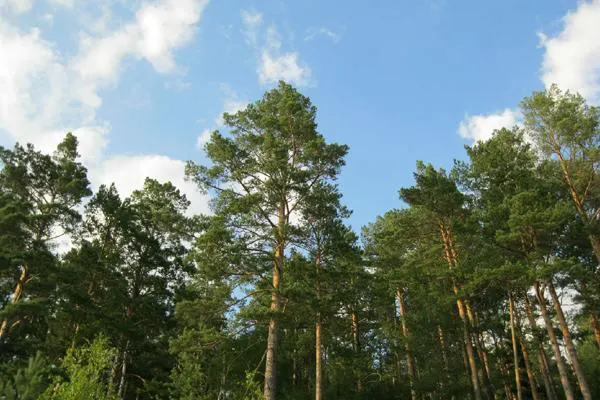
Scots pine on the western edge of Hailar — straight trunks, flat crowns, a hard blue sky
Two practical notes. Hailar station is five kilometres from the centre with taxis at the forecourt; the airport is east, five to seven kilometres out, with a shuttle timed to arrivals for about ¥10 or a taxi for around ¥30. Restaurants cluster along Central Street, and this is the place to buy water, fruit, repellent and cash before heading north — the next proper supermarket is a hundred kilometres away.
The Mergel River and the open grass
North of Hailar the S201 runs alongside open pasture, and after forty kilometres a very thin river appears at the roadside: the Mergel. It wanders more than three hundred kilometres across the grass, bend inside bend, a step wide at its narrowest and never much more than a dozen metres. The right way to look at it is to leave the road — find a dirt track up a slope, park at the bottom, walk to the top, and the river lies below in shining segments. No trees block the view and there are no fences, but this is grazing land: walk anywhere, drive nowhere.
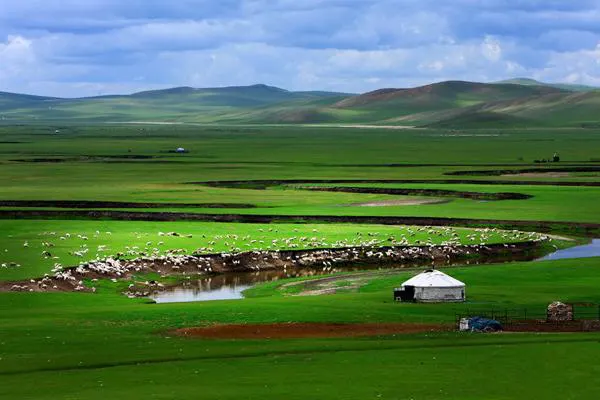
A meander, a flock and one white yurt: the standard composition out here
There are two ways to look at this grassland. One is water: the Mergel, the wetland at Heishantou, the meanders at Ergun — all of them seen from above. The other is grass itself: wildflowers in July, waves of it in August, bales after the cut in September, all seen at ground level. In mid-July the rapeseed comes out and whole fields of yellow appear at the roadside; that is a farm crop rather than a wildflower, fine to photograph and not fine to walk into.
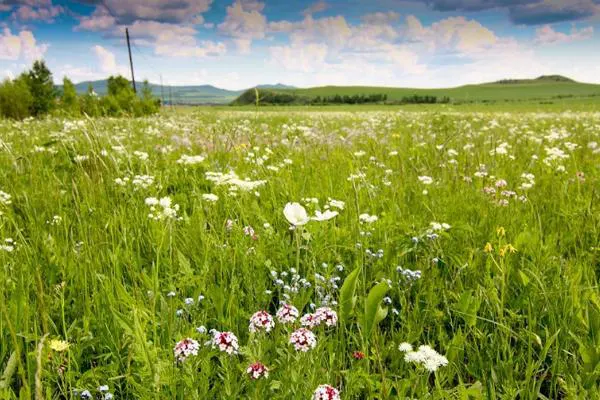
Meadow in the first week of July — white umbels and small pink flowers running to the foot of the hill
The Ergun wetland and the birch forest
Ergun has three wetlands and they are not the same thing. The one on the northwest edge of town, simply called the Ergun wetland, is the easiest: ¥65 plus ¥15 for the shuttle, with the deck directly above you. The national wetland park thirteen kilometres east is larger and wilder at ¥60. The Lev wetland estate at Heishantou is a third proposition, ¥45, and it is about sunset and meadow rather than meander. For a first visit the first is enough: forty minutes round the boardwalk, three or four bends of the Gen River visible from the top.
The birch reserve sits on the road between Ergun and Enhe: ¥50 plus ¥15 for the shuttle. It is a pure stand, trunks white enough to shine, going grey after rain, with a fuzzy halo of light along the edges when the sun is behind them. A boardwalk loops through in an hour, climbing once for a view of unbroken canopy. In late September the leaves are fully yellow and come down in the wind, laying a soft carpet. There is wild birch on both sides of the public road outside the gate for nothing, much the same to look at, minus the boardwalk.
Enhe, Shiwei, Linjiang
Three villages in a line along the Argun, each with a different temperament. Enhe is set back from the water among grass slopes and birch, the quietest of the three, with the best-kept log houses and the most guesthouse beds — the one to sleep in. Shiwei is on the river, with a port, a riverside boardwalk and boats, and the heaviest commercial traffic in daylight. Linjiang is the smallest, one street end to end, the quietest, and closest to Eagle's Beak and Moon Lake. Families of Russian heritage live in all three; the houses are log-built, and the food includes a home-baked loaf, blueberry jam, pickled cucumber and home-made drinks. That is daily life rather than a show, and should be treated as such.
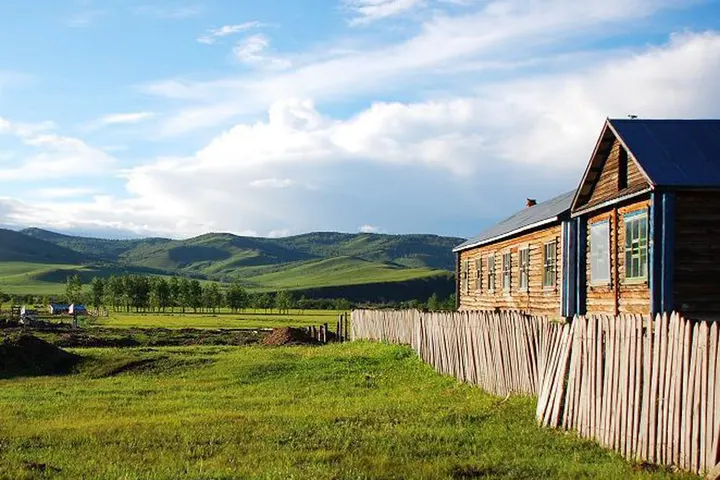
A log house behind a fence of split poles, grass slopes stacked up behind it
The boardwalk at Shiwei is free; ten minutes gets you to the water with the Russian village of Olochi on the far side — houses, fences, cattle all legible across a few dozen metres of river. Boats run from the bank for a bit over ¥100, forty minutes out and back, no landing. The port building can be viewed from the gate; going in costs extra and adds little. Ten kilometres south is Linjiang, and that stretch is worth walking part of: the road hugs the water, river on the left, birch and wheat on the right, an hour on foot far better than ten minutes in a car.
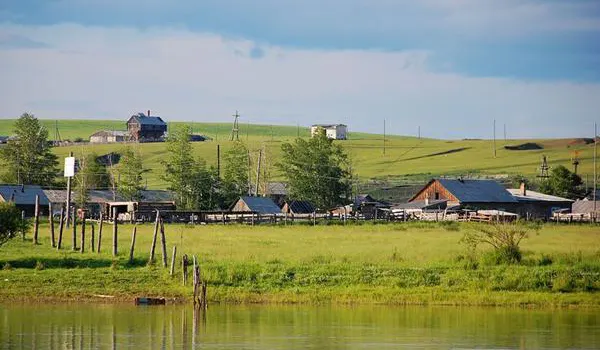
The village from the water — log walls, pole fences, a grass slope rising behind the roofs
Eagle's Beak is a few kilometres north of Linjiang: a rock jutting out above a river valley with wheat on the slope below, best an hour before sunset when the light comes in from the side and the wheat goes gold. Moon Lake is twenty-three kilometres due north, a crescent-shaped pond with smaller pools scattered around it, on an ordinary road that turns to mud after rain — ask in the village whether it is passable before setting out. Neither charges admission and neither has any facilities at all.
Moerdaoga and Qiqian
Moerdaoga is a forestry town: one main street, old bureau buildings, shops and guesthouses, a population just over ten thousand. The national forest park is eleven kilometres out, ¥100 to enter and another ¥100 for the little train, which covers 9.8 km of old-growth with three or four stops in two hours. The headline sight is White Deer Island, a small peninsula enclosed by a river bend, at its best in autumn, and the Nine Ridges viewpoint, where nine ridgelines stack up one behind another. The park is large and driving yourself is more flexible, though many of the tracks are dirt and poor after rain.
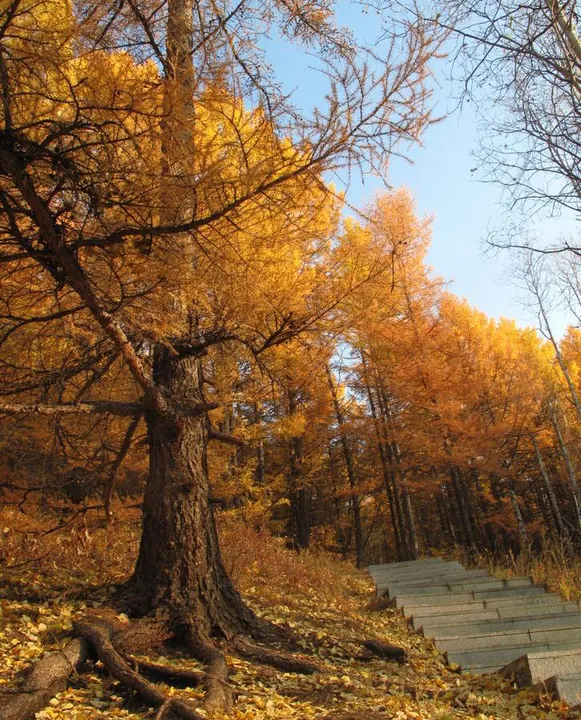
Larch and a flight of stone steps at the end of September, the ground already covered
Qiqian is 150 km north of Moerdaoga, hills on three sides and the Argun on the fourth — locally called the Mo Tuo of the north, after the remote Tibetan county. A handful of households remain, with a military post next door, no shop, no fuel, no street lights and phone signal by luck. There is a checkpoint at the entrance where you register your ID, and whether you are waved through depends on the day; foreign travellers are often turned back. What the village offers is quiet: log walls, fences, cattle, a shingle beach by the river, stars at night, and nothing else. Rooms in village houses run ¥100–200, and you eat where you sleep.
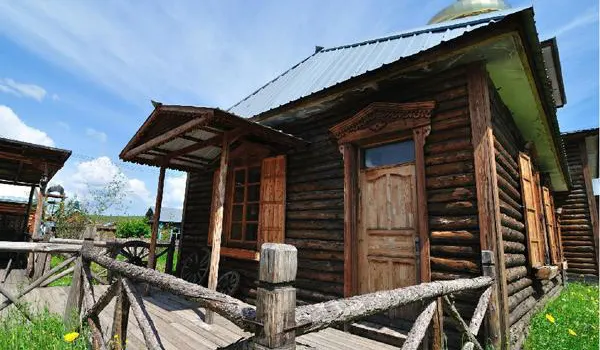
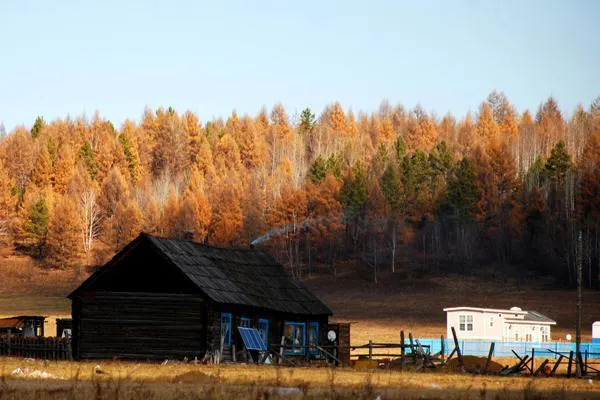
A timber cabin in early October — blue window frames, the whole larch slope behind it turned
Genhe: the cold pole and the reindeer
Genhe is one of the coldest inhabited places in the country: the lowest temperature in the Chinese record, minus fifty-eight, was registered in this area on 31 December 2009, at Jingling near Jinhe. A thermometer sculpture in town marks the fact, and in winter the display reads minus forty. On the edge of the city, the Aoluguya reindeer settlement is where Ewenki families have been resettled; entry is around ¥70, and you can see reindeer, birch-bark work and the conical tents called choluo. The reindeer range in the trees and a basket of lichen costs ¥10. Fifty-five kilometres north is Lengji village, a former forestry settlement turned rural-life site, free to enter, with sled dogs and the throwing-boiling-water trick in winter.
Manzhouli and Hulun Lake
Manzhouli's shape was given to it by the railway: when the Chinese Eastern Railway opened in 1901 this became the first major station inside Chinese territory, and a century on the yards are still in the middle of town, stacked with container trains waiting to change bogies. The streets worth walking are Zhongsu Jinjie and the old buildings around the station — Russian, Japanese and eclectic fronts mixed together, many of them originals from the 1910s and 1920s. The gate is nine kilometres west of the centre; the fifth structure on the site spans 105 metres, and the viewing deck above it looks down on the tracks, the boundary marker and a Russian town on the far side.
The matryoshka square — painted dolls the height of a house, castle fronts behind, storm cloud overhead
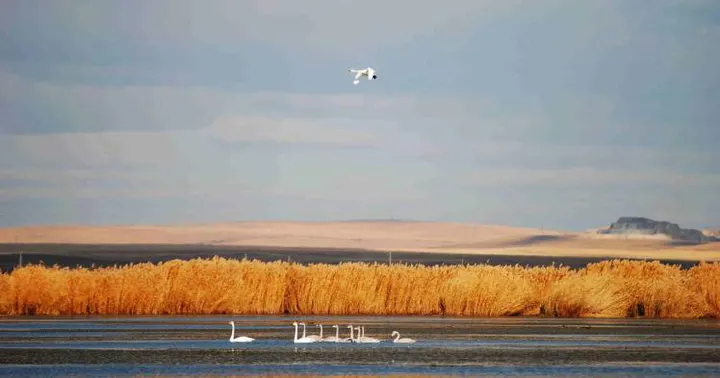
Hulun Lake lies forty kilometres south of Manzhouli, around two thousand square kilometres of water and the largest lake in Inner Mongolia. The ticketed area is on the Zhalainuoer side at ¥32, with a boardwalk into the reeds and boats for a bit over ¥100. The free part is just as good: the ring road runs between grass and shore, you can pull over anywhere, and the reed beds hold swans and greylag geese, thickest in September. The fish restaurants along the shore do carp, crucian and whitefish, one fish two ways, about ¥200 for three. The wind is strong; bring a jacket even in summer.
06Ride, ride slowly, watch a festival
Riding on the grass
The horses here belong to herders rather than riding schools: small, tough, and jolting at every gait. Riding is concentrated at Heishantou, Enhe, Shiwei and the yurt camps — ¥100–200 an hour, ¥200–400 for a longer line, and if it is priced by the hour, establish whether that means sixty minutes or one lap. Four questions before you mount: is there a helmet, is anyone leading, how far is the route, does the price include the handler. Mount from the left, left foot in the stirrup, swing over, and nudge with the heels to walk on; to stop, close both hands on the reins gradually rather than snatching. The grass looks flat and is full of pika holes and tussocks, so if you cannot ride, do not take the reins and gallop.
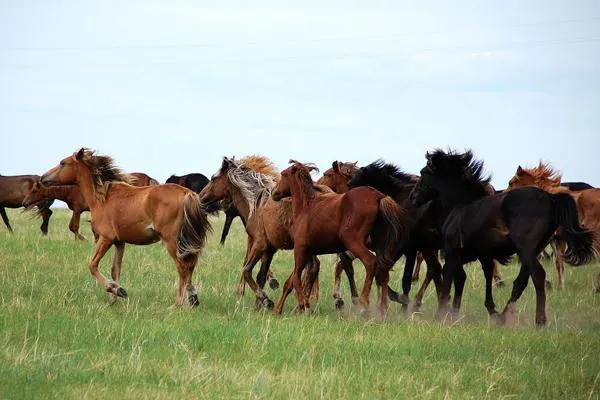
A herd moving across the grass, manes lifted by the wind
Take the slow train
Train 4184 runs from Hailar to Mangui, out at 08:15 and in at 21:20, thirty-one stops, a third of them request stops with no platform and no staff — the train pauses, and you step down into the grass. The carriages are the old 25G type with windows that open halfway, and the draught coming in smells of resin. It is the best way to watch the country change: pasture giving way to conifer, trees getting taller, houses thinning out. Bring food; the trolley sells instant noodles and sausages and nothing else.
Naadam and the ovoo
Naadam is the Mongol gathering, and its core is three contests: bokh wrestling, horse racing and archery. Dates differ by banner and cluster from late June to August — the grassland naadam of the New Barag Left Banner in early July, race meetings in Chen Barag through July and August, and the Ewenki Sebin festival fixed on 18 June, which opens with an ovoo ceremony at dawn followed by wrestling and knucklebone games. Much of it is free to watch, and the small naadam staged by a group of herder households is better than the big one: fewer people, and the horses run past close enough to feel. Ovoo ceremonies fall in the fifth lunar month, when herders add stones, walk three circuits and offer milk food. Visitors may watch, should walk clockwise with everyone else, and should neither climb the cairn nor touch the offerings on it.
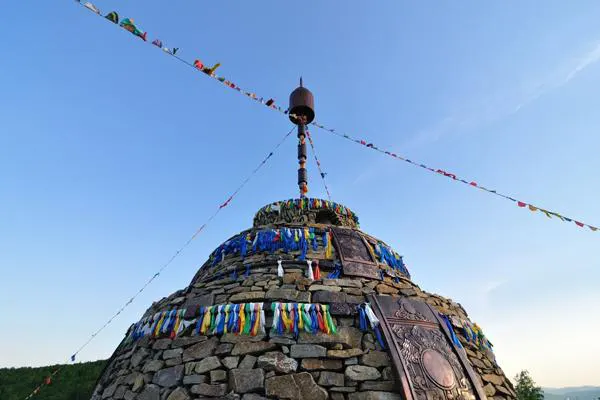
An ovoo on a ridge — stones piled into a cone, prayer flags running out from the top, a bronze bell above
Baking bread in a Russian-heritage household
Many guesthouses in Enhe and Shiwei offer bread baking: you mix and shape the dough with the household, it goes into the oven, and an hour later you take the loaf away — a few tens of yuan each. The same session usually includes painting eggs, making jam and somebody playing an accordion. This is a sideline the families run themselves, so agree the price before starting, and do not treat it as a folk performance to be filmed. If you want something quieter, sit in the yard and watch how the milk is brought to the boil and the jam reduced; that is the real part of the meal.
Looking up
Qiqian, Linjiang and Moerdaoga have no street lighting, and two kilometres out of any of them it is properly dark. Late July to mid-August is when the Milky Way is brightest, arching from northeast to southwest with the dust lane visible to the naked eye. Bring a headtorch with a red setting and a warm layer: nights run to fifteen degrees on the grass and below ten in the forest. For photographs, a tripod, a fast lens and twenty seconds will do, with a birch trunk or a fence for foreground.
07Five bases, five standards
Judge beds here on four things rather than stars: a private bathroom, reliable hot water, sound insulation and how cold the night gets. Log walls hold heat well and sound badly — you will hear the next room talking. Yurts come in two kinds: the improved version with plumbing from ¥500, and the real felt tent at around ¥200 where the toilet is a walk outside. Book a month ahead for July and August, and for the forest in late September; the rest of the year you can arrive and look.
Hailar: densest along Central Street and around the station, business hotels ¥200–350 normally and ¥400–600 in season. Right for the first and last nights — dependable hot water and wifi, and easy shopping before you leave town.
Ergun, also called Labudalin: a small town, hotels and guesthouses ¥200–400, with a few smaller places on the street running to the wetland. The night before Enhe, and the place for a supermarket, a pharmacy and a tyre repair.
Enhe and Shiwei: log-house guesthouses, doubles ¥150–300 in ordinary weeks and ¥400–700 in July and August, breakfast usually included. Ask three questions: private bathroom or shared, what hours the hot water runs, and which way the room faces. The older houses transmit sound; bring earplugs.
Linjiang and Qiqian: the thinnest choice on the route — a dozen places at Linjiang, a handful of households at Qiqian. ¥150–300 and ¥100–200 respectively, plain rooms, shared bathrooms common. Qiqian has no shop: you eat where you sleep, so arrange dinner when you arrive.
Moerdaoga: a forestry town, hotels ¥200–400, newer rooms than the villages and steady hot water. Forest nights are cool — you want a duvet even at the end of June. A few cabins sit outside town in the trees at ¥600–900, quiet, with nowhere to eat at night.
Yurt camps on the grass at Heishantou and along the Mergel: ¥500–1,200 in season, more with plumbing and air conditioning. The real felt tents are cheaper and colder, with more insects and a distant toilet. With children, take the improved version.
One more thing worth knowing: from mid-July to mid-August the beds at Enhe, Shiwei and Heishantou go first at weekends, while weekdays often see cancellations. If those are your only dates, shift to Tuesday to Thursday and the rate drops ten to twenty per cent with half the traffic. The two best-value windows are mid-June and early September — green enough, half as many people, and ordinary prices.
08Boiled mutton, pot tea, a loaf and a bowl of milk tea
This is cold-country food: heavy on meat and dairy, light on vegetables, and served in quantities that defeat most tables. Mongol cooking runs to boiled mutton, milk tea, dried curd and roasted millet; the forest towns eat northeastern — stews, mushrooms, cold-water fish; and the border villages add a layer of home-baked bread, blueberry jam, pickles and cream from the Russian-heritage households. Order cautiously: four people and three dishes is usually too much, and meat is sold by weight.
What to order
Boiled mutton: bone-in lamb in salted water with scallion and nothing else, eaten with the hands and a small knife. Sold by weight, ¥60–90 a jin. The test is that the meat comes away in strips, smells of nothing but sheep, and the fat looks translucent.
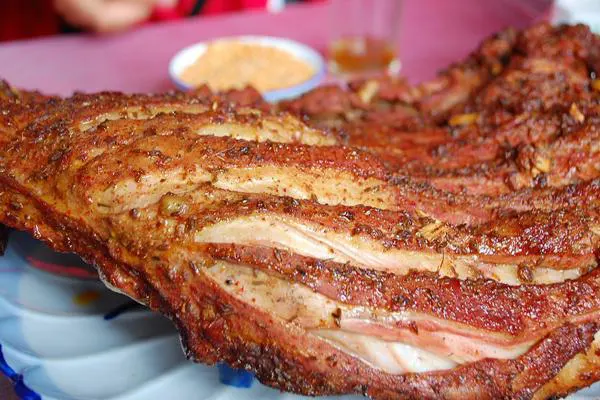
Roast lamb rack: a whole rack marinated and roasted, charred outside and still juicy within, ¥100–180. The restaurants in Hailar and Manzhouli are the most reliable; camp kitchens tend to overcook it.
Pot tea: brick tea simmered for three hours, cut with milk and salt, then loaded with butter, dried curd, roasted millet and dried beef, stirred as it heats. Savoury, thick and faintly salty, ¥40–80 for a pot that serves three or four. Best as breakfast.
Buryat dumplings: the Mongol version from around the Ewenki banner, thin-skinned, generously filled and full of broth — bite a hole and sip first. Eight to a steamer, ¥25–40.
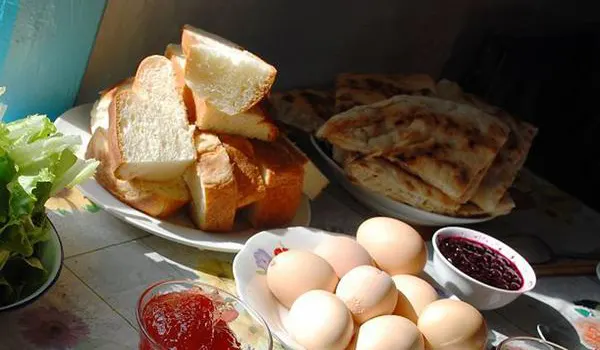
Bread and blueberry jam: the big Russian loaf with a hard crust and soft crumb, sliced and spread with wild blueberry jam, plus a spoon of smetana, the thin sour cream locals call ximidan. Standard breakfast in Enhe and Shiwei.
Cold-water fish: carp, crucian, whitefish and the small local minnow from Hulun Lake and the Argun, either stewed plain or deep-fried. Lakeside kitchens cook one fish two ways for about ¥200 between three.
Dairy: dried curd, milk skin and hard curd, sweet or salted, eaten as a snack or dropped into tea. ¥30–40 a jin loose; the vacuum packs in supermarkets travel better.
Hailar beer and blueberry juice: the local lager is light and cuts through mutton, and the blueberry drink is sweet-sour and on every menu. Fermented mare's milk is low in alcohol with a distinct dairy tang — one glass is enough to know.
Breakfast at a family guesthouse — sliced loaf, fried flatbread, boiled eggs, blueberry jam and preserves
Where to eat, in route order. Hailar's Central Street has the widest range — Mongol, northeastern, hotpot. Ergun is small enough to walk in two streets, mostly boiled mutton and iron-pot stew. In Enhe and Shiwei you eat where you sleep, breakfast in the room rate, dinner arranged in the morning. Moerdaoga and the forest towns do mushrooms and stews, and the white mushroom is expensive: ¥60–70 for a small plate. Manzhouli has Russian cooking worth the name — borscht, beef in a pot, kvass. Per head: ¥20–40 for noodles or a quick lunch, ¥50–80 for a proper dinner, with mutton by weight on top.
A whole roast rack, the crust blistered, a dish of dry dip behind it
Three notes. Portions are large: two people from the south need one dish and a staple, not the number they would order at home. Prices in grassland kitchens move with the season, so ask what a dish costs before ordering — not distrust, just peak-season pricing. And in pastoral country water is scarce, so do not waste it; do not carry your own bottle into a yurt either, and when the host offers a drink, take it and touch it to your lips rather than draining it.
09Dried beef, curd, jam — and what to leave on the shelf
Hulunbuir is not a shopping destination, but a few things are worth carrying home: dried beef, dairy, blueberry jam, and the black fungus and mushrooms from the forest. Buy in two kinds of place. Supermarkets — the local chains in Hailar, Manzhouli and Ergun — have clear prices and printed dates. Morning markets and farmers' markets are cheaper and let you taste, though you should read the packaging. The gift shops at ticket gates charge thirty per cent more; skip them where you can.
Dried beef: choose packs listing only beef, salt and spice, ¥25–40 per 100 g. Anything much cheaper is usually duck or soy protein. Vacuum packs travel by train and plane.
Dried curd and milk skin: ¥30–40 a jin loose; the vacuum packs cost more and keep longer. Milk skin is high in fat and does not survive summer travel — fine for a short trip, not for a long one.
Blueberry jam and juice: wild berries from the Greater Khingan, jam at ¥20–40 a jar, juice as a local soft drink. Read the label — if sugar is the first ingredient it will be very sweet.
Black fungus and mushrooms: forest products, fungus at ¥60–120 a jin, dried white mushroom dearer. With loose goods, smell them — mustiness is easier to catch than a date stamp.
Russian small goods: nesting dolls, chocolate, kvass, linen, thickest in Manzhouli and Shiwei. Dolls run from ¥20–30 to several hundred; the difference between lathe-turned and hand-painted is obvious once you turn one over and look for a signature.
Leave alone: Mongol knives, which cannot fly or travel by train and are often refused by couriers; the wolf teeth and bear claws sold at roadside stalls, which are of unknown origin and usually cattle bone; and loose antler, which belongs in a licensed pharmacy.
One last thing: if there is still forest and villages ahead of you, do the buying in the last town rather than carrying it. Dried beef and curd survive being bounced around; jam does not. The big loaf is bulky, keeps three or four days and is awkward on a plane — eat it on the road.
10No high-speed rail: get to Hailar, then decide
Leg one: reaching Hailar
Flying is quickest. Hailar airport sits five to seven kilometres east of the centre, with direct flights from Beijing, Tianjin, Shanghai, Hangzhou, Guangzhou, Shenzhen, Xi'an, Chengdu and Harbin — more in summer, fewer in winter. The shuttle is timed to arrivals at about ¥10, a taxi around ¥30. Manzhouli has its own airport west of town with flights to Hohhot, Beijing and Tianjin, which saves two hundred kilometres if you are coming from the south.
The train is slower, and on this route that is the point. Harbin to Hailar: K7091 leaves at 20:55 and arrives at 06:15, a night's sleep for a little over ¥100 in a hard seat or the low ¥200s in a hard sleeper. Beijing to Hailar: K1301 out at 11:43 and in at 16:10 the next day, twenty-eight and a half hours, ¥229 seated and ¥416 in a sleeper; K1303 continues past Hailar to Manzhouli. There are also services from Shenyang, Dalian, Qiqihar and Hohhot — Qiqihar is seven or eight hours and the most useful change of train from the northeast.
Leg two: between towns
Hailar's long-distance station, at the eastern edge of town and close to the railway station, is the hub for everything. Labudalin, that is Ergun, is ¥33 with fourteen departures between 06:40 and 17:30, two hours. Manzhouli is ¥40, hourly from 08:30 to 16:40. Genhe is ¥62, nine a day. Moerdaoga is ¥80 with a single departure at 14:00, and Mangui ¥110 at 11:00. Yakeshi is ¥24 and the most frequent of the lot. Toward Yakeshi and Zhalantun there are also slow trains whose fares are almost implausibly low.
The train beats the bus to Manzhouli: seven or eight a day, two to two and a half hours, ¥23–29, mostly before eight in the morning and after five in the afternoon. Toward Yakeshi, Zhalantun, Moerdaoga and Mangui the slow trains on the Yalin and Binzhou lines are slower than the road and far better out of the window; 4184, Hailar 08:15 to Mangui 21:20, is the famous one.
Chartering: dearer, and it buys the day
A five-seat sedan with driver runs ¥500–700 a day, or ¥600–800 between mid-July and mid-August; a five-seat SUV ¥600–800; a seven-seat van ¥900–1,100; a Land Cruiser-class 4x4 ¥800–1,200. Fuel, tolls and the driver's food and bed are usually included, but not always — some quotes add ¥30 a meal and ¥50 a night, so ask. A three-day northern mini-loop, Hailar to Ergun, Enhe, Shiwei and back, costs ¥2,000–2,600 for the vehicle; eight days runs ¥4,500–6,000. Shared seats are ¥200–300 a head per day on fixed routes.
Book through your guesthouse, the hotel desk or an introduction, not from the touts in the station forecourt. Fix the terms out loud: start time, finish time, overtime rate, whether Qiqian is included — it adds 150 km and many quotes quietly exclude it — who pays for the driver's food and bed, and whether the border road is on the plan. The roads are generally good, but the forest ones are narrow and bendy and livestock crosses without warning; without experience, do not drive them at night.
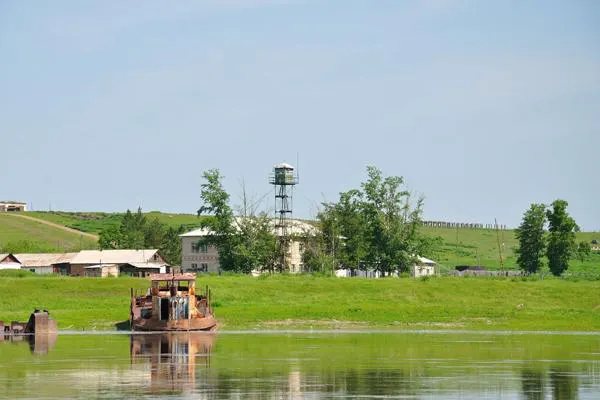
A landing stage on the border river — a barge, a watchtower, village roofs along the bank
One road deserves its own paragraph: the Kaxian, the border highway along the Argun from Shiwei to Heishantou, 170 km of sealed surface and some of the best scenery on the trip. Chinese citizens need only an ID card; there are checkpoints along it, so stop, show it and answer the questions. Near the line, drones are off limits, border installations cannot be photographed, and the wire is not to be crossed. There is no fuel anywhere on it and nowhere decent to eat, so fill the tank and carry water.
Emergency: police 110, ambulance 120, fire 119. Signal gaps are common in forest and pasture, so when you call, give the road number and the distance to the nearest town before anything else.
Hospitals: Hulunbuir People's Hospital in Hailar, at 20 Shengli Street opposite Genghis Khan Square, is the largest in the prefecture. Ergun, Genhe and Manzhouli each have a people's hospital, adequate for injuries, stomach trouble and tick bites.
Money: WeChat and Alipay both link foreign cards and QR payment works in towns. Village guesthouses, herders selling rides and morning markets often want cash, so keep three to five hundred yuan in small notes.
Phones: 4G is solid in Hailar, Manzhouli and the county seats; it comes and goes in the forest, on the border road and around Qiqian. Screenshot maps, addresses and phone numbers before you lose the signal.
Documents: carry your ID card — hotels register you, checkpoints ask, and train tickets need it. Foreign travellers should carry a passport; a few forward border villages may refuse entry, in which case take another road.
Manners: enter a yurt to the left of the stove, sit on the west or north side, never stand on the threshold, and do not block the images hung on the north wall. Take tea with the right hand; with a drink, touch it to your lips. Walk around a herd rather than through it, and do not sound the horn to scatter animals.
Toilets: flush facilities at sights and petrol stations queue in season, and most of the grassland is a long drop, so carry tissues and wipes. Take rubbish out with you — the forest and the wetlands are protected areas.
Fire season: April to June and September to October are the dangerous months. Entering the forest may mean registering and handing over lighters, and smoking or open flame is banned inside it, camp barbecues included.
Two smaller things. The ultraviolet will peel skin in July, cloud or no cloud: SPF50, reapplied every two hours, and a hat with a chin strap because the wind takes them. And the temperature swing: thirty in the afternoon and twelve at midnight is normal, wider on the grass, so keep a jacket in the car rather than at the bottom of the case.
12What to sort out, and when
Three to four weeks out: book flights or trains to Hailar or Manzhouli, and in July or August book the Enhe or Shiwei night at the same time — those fill first.
One to two weeks out: fix the car and put the route, the number of days, whether Qiqian is included and whether the border road is on the plan in writing. Check the bus timetable once and write it down.
Three days out: watch the forecast and the fire-risk level. Two days of rain can close the forest tracks and the road to Qiqian; high wind cancels riding on the grass.
Clothing: short sleeves by day, a fleece or light down for morning and evening, a windproof shell, two pairs of trousers — they keep mosquitoes off and grass from cutting your legs — boots you can walk dirt in, a wide hat, sunglasses. Add a warm coat and a thermal layer for late September.
Insects and sun: repellent with DEET or picaridin, mosquito coils, long sleeves, SPF50 and lip balm. Check for ticks after any walk in the trees.
Medicine: something for the stomach, an anti-diarrhoeal, cold tablets, painkillers, antihistamines, plasters and iodine. A week of mutton sits heavily; bring a digestive.
Extras: a power bank, a car charger, offline maps, three to five hundred yuan in cash, a thermos, wipes, a rubbish bag. Do not fill the case — you will come back with dried beef and jam.
Altitude is a non-issue here — Hailar is 612 m and the highest point on any ordinary route is barely over a thousand — which makes the whole place easier than the Tibetan plateau. What does need managing is sun, insects and temperature swing. With children, keep daily driving under three hours and use the car for naps; with older parents, watch the morning and evening chill, because the wind out here is harder than in town. Riding, go-karts and grass-sliding are all judgement calls, and nobody needs to do them out of a sense of obligation.
13One range divides the place in two
Geography and climate
The Greater Khingan runs north to south through the prefecture and divides it into two worlds. West of the range is grassland: three to five hundred millimetres of rain a year, semi-arid, grass short and thick, sheep and horses the main business. East is forest and farmland: five to eight hundred millimetres, sub-humid, larch and pine and birch in unbroken stands, wheat and rapeseed in the valleys. The line is not drawn but rained: the mountains strip the moisture coming up from the southeast, and what comes over the top is dry.
The climate is continental and both extremes are severe. Summer tops out around thirty-five, then drops to twelve at night; winter sits at minus thirty as a matter of course, and the Genhe area has recorded minus fifty-eight, the lowest in the Chinese record. The frost-free season lasts ninety to a hundred and twenty days, which is why the grass comes up in a rush in mid-June and starts to yellow as soon as the cold arrives in September. The only thing a traveller needs to remember is that there is no mild season here, only a green face and a white one.
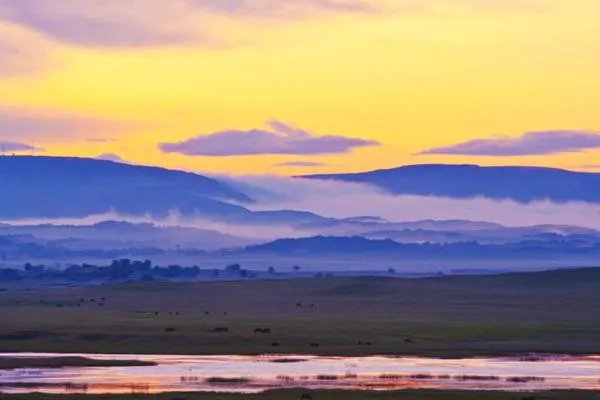
Dusk on the steppe — fog lying in bands across the far hills, a strip of water holding the last light
History: from the Xianbei to the railway
People have lived around Hulun Lake for twenty or thirty thousand years; archaeology calls them the Zhalainuoer people. In the second century BC the Xiongnu pushed the Donghu out and the region came under a Xiongnu prince; in the first century AD the Tuoba Xianbei moved down from the depths of the Khingan to the lake, turned from hunting to herding, and eventually went on to found the Northern Wei dynasty in the central plains. In the twelfth century Genghis Khan fought several decisive battles here, and after uniting the plateau he granted most of this grassland to his younger brother Jochi Khasar, whose seat was at the old walled town of Heishantou on the Argun.
The modern turn came in 1901, when the Chinese Eastern Railway opened and Manzhouli and Hailar became major stations overnight. Russians, Japanese and traders from the interior arrived, and the log houses, the station buildings, the church and the goods yards all date from those decades. In 2001 the league was reconstituted as a prefecture-level city, which is the shape it has now. The built landscape therefore has two layers — one the railway brought, one put up in the last thirty years — and the pasture and forest in between have barely changed at all.
Who lives here
More than thirty ethnic groups live in the prefecture. Mongols herd on the grassland, and some trade in the banner towns. The Daur are concentrated around Molidawa, farming, fishing and keeping cattle. The Ewenki split in two: one group herds on the Ewenki grassland, another keeps reindeer in the forest around Genhe. The Oroqen hunted until the second half of the twentieth century and are now mostly settled near Alihe. Families of Russian heritage live along the Argun at Enhe, Shiwei and Linjiang — descendants of Russian migrants who arrived between the 1890s and the 1920s and married locally, speaking Mandarin at home while keeping Orthodox holidays, the bread oven and the accordion. These are facts about households, not labels for visitors.
The year's fixed points
A few dates are worth knowing. The Ewenki Sebin festival falls on 18 June, with an ovoo ceremony at dawn and wrestling and racing through the day; the Oroqen bonfire festival is the same date. Ovoo ceremonies in the pasture country happen in the fifth lunar month, at dates that vary from village to village. Naadam runs from late June to August by banner — the New Barag Left Banner in early July, race meetings in Chen Barag through July and August. The Russian-heritage Basque festival, Orthodox Easter, follows the old calendar and moves each year; for several days around it the villages bake and dye eggs. Every one of these dates should be checked against that year's announcement, because pastoral timings move.
14Four directions, half a day to three
Manzhouli and Hulun Lake (two days, 400 km return from Hailar)
Two and a half hours from Hailar by train, seven or eight a day for the low twenties; the bus is ¥40 and takes three hours. Day one in town: the gate, the doll square, the old facades along Zhongsu Jinjie, and the lighting after dark, which is deliberate — whole streets outlined in coloured tubes. Day two, forty kilometres south to Hulun Lake, fish for lunch, then back to Hailar along the ring road, or back to Manzhouli for an evening train. Two days is right; one is rushed.
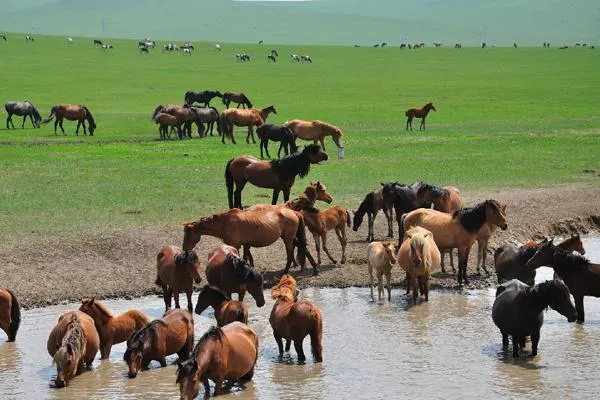
Horses drinking at a shallow pool, more of the herd up the slope, the grass at its July green
Arshan (three days, 380 km each way)
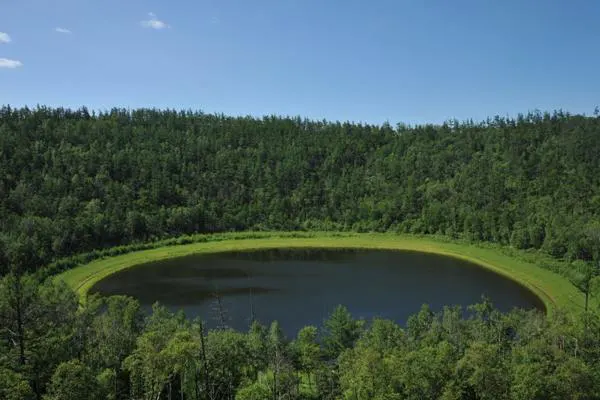
Southwest from Hailar through Honghuaerji to Arshan is 380 km, a day's drive. Arshan is volcanic country: Tianchi is a circular crater lake ringed with conifer, the surface flat as sheet metal; the mineral springs come in four temperatures from cold to near-boiling and the sanatorium lets you soak; and the station is a 1937 Japanese-built timber building, yellow walls and green frames, the most photogenic structure on this route. There are direct buses from Hailar, or charter a car. Three days: Honghuaerji's old pine forest on the first, the lake and springs on the second, the drive home on the third.
A crater lake — almost perfectly round, ringed the whole way by conifer forest
Yakeshi and Zhalantun (three days, one to four hours by rail)
Both sit east of the range, where forest meets farmland, and the scenery is nothing like the west: steeper hills, denser trees, rivers turning in the valley floor. Hailar to Yakeshi is an hour and a bit by train for very little money; Yakeshi to Zhalantun four hours, with plenty of services. Yakeshi has Fenghuang villa and Lama hill; Zhalantun has Chaihe, the Jierguo crater lake and rafting on the Yalu. Few travellers come this way, beds are cheap, and it is a good place to hide in high season.
Mangui and Mohe (three days, on into Heilongjiang)
The 4184 gets into Mangui at 21:20; sleep in town, then take the bus or a shared car to Mohe the next morning, three and a half to four hours for ¥80–300, and from Mohe a forty-minute bus to Beiji village. This is the way to link Inner Mongolia with Heilongjiang, and the drawbacks are distance, thin schedules and winter cold of minus thirty to forty. In summer the days are long — in late June there is still light at ten at night.
15A little homework
Long song, horse-head fiddle, throat singing
Three things in Mongol music are instantly recognisable. The long song, urtiin duu, holds a single syllable for half a minute, the melody circling high before dropping away, and its subject is grass, horses and parents. The morin khuur, the horse-head fiddle, has two strings and a carved horse at the top of the neck, and a tone close to the human voice, the low register like wind. Khoomei, throat singing, produces a drone and a melody at the same time; it comes from the Altai side and turns up in both concerts and recordings. For a live performance, Mongol restaurants in Hailar usually have a singer in the evening and every naadam has one; to prepare, find a long-song collection and put it on in the car, which suits the country better than any generic grassland playlist.
The accordion, and the Basque festival
In the villages along the Argun many households keep an accordion and will play a tune when someone visits; there is a bread oven in the yard, the loaf is their own, and the jam is boiled from berries picked on the hill. The biggest day of the year is the Basque festival, Orthodox Easter, which follows the old calendar and moves: before it, rooms are whitewashed, pastries of a dozen shapes are baked and eggs dyed; on the day, people knock eggs against each other, visit, sing and dance. This is a religious and family occasion rather than a programme laid on for visitors. If you happen upon it you may watch, but ask before walking into a yard.
Film
Tuya's Marriage (2006, dir. Wang Quan'an) is set on dry Inner Mongolian grassland: a herder is disabled digging a well, and his wife Tuya agrees to remarry only on condition that the new husband supports him too. Shot on location in the pasture country, in a mix of Mongol and Mandarin, it took the Golden Bear at Berlin in 2007. It is not a film about scenery but about choices in herding life that cannot be resolved, and it changes what you look at when you get there. Wolf Totem (2015, dir. Jean-Jacques Annaud), from Jiang Rong's novel, is about the relationship between herders and wolves — beautiful to look at and much argued over; watch it as landscape cinema.
Books
Chi Zijian's The Last Quarter of the Moon (2005) is told by a ninety-year-old Ewenki woman looking back on a life of moving through the Greater Khingan with reindeer and then being settled. It won the Mao Dun prize, the prose is steady and unsentimental, and it is the best door into this forest — the river, the trees and the reindeer in the book line up with what you will see. Jiang Rong's Wolf Totem (2004) draws on his years sent to the Ergun grassland in the 1960s; the argument is contested, the detail about pasture ecology and herding life is specific, and it rewards a critical reading.
Two songs
Hongyan, a Urad folk song that the Ergun Band made famous, has the bones of a long song and words about drink, grassland and a home you cannot go back to; it is the right thing to play on the road here. Pu Shu's Birch Forest (1999) took its story from the Soviet era — accordion, birch trunks, waiting — and for a great many listeners it was the first time the words birch forest produced an image. In Enhe and Shiwei the birches are actually there in stands along the road, and the song lands.