A hundred and eight lakes in a single Y-shaped valley
Book before you goThree valleys, one YFour hours from ChengduOctober: best and busiest
In short
Jiuzhaigou (九寨沟, Jiǔzhàigōu) is a thirty-kilometre limestone valley in Jiuzhaigou County, northwest Sichuan, holding 108 travertine lakes and a chain of waterfalls along a single Y-shaped road. The right arm, Rize Valley, has the best of it — Five Flower Lake, Pearl Shoal, Mirror Lake — while the left arm, Zechawa, is really only Long Lake and Five Colour Pond, at the highest point of the park. The middle arm, Shuzheng, is what you drive through on the way in and out. Ticket plus shuttle is ¥280 in high season, ¥160 in low; everything is real-name and online, and there is no ticket window at the gate. Since the Sichuan–Qinghai Railway opened in August 2024, Chengdu East to Huanglong Jiuzhai takes as little as 1h39m, and a ¥51 shuttle covers the last two hours to the entrance — four hours from Chengdu, the biggest change in thirty years. One day covers the highlights, two days stops it feeling like a sprint. Mid-October is the most beautiful and the most crowded; July and August have the most water; winter is cheap and gives you blue ice. Budget ¥2,200–3,800 for three or four days, excluding travel to Sichuan.
Key facts
Known for
Five Flower Lake · Nuorilang Waterfall · autumn colour · travertine lakes
Budget
¥2,200–3,800 for 3–4 days, mid-range
Days needed
2–4 days
Comfort
Comfortable — a shuttle covers every stop, but you are at 2,000–3,100 m
Best time to go
Mid-to-late October for colour; July–August for water volume; mid-November to March for blue ice and low prices
01What kind of valley this is
The shuttle climbs away from the gate and gains a quiet three hundred metres in twenty minutes. First come Tibetan timber houses and prayer flags, then a staircase of small lakes, then a whole forest standing in water — trunks bleached grey, half submerged, half still in leaf. You have not reached a single viewpoint yet, and the point of the place has already landed: this is not a mountain or a lake but a valley that produces water from end to end.
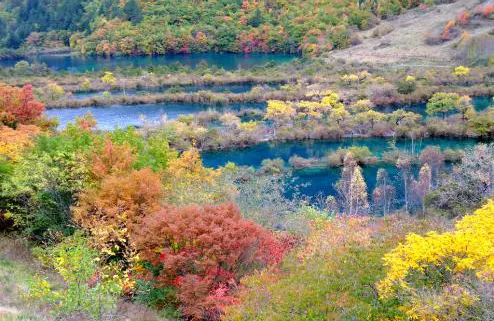
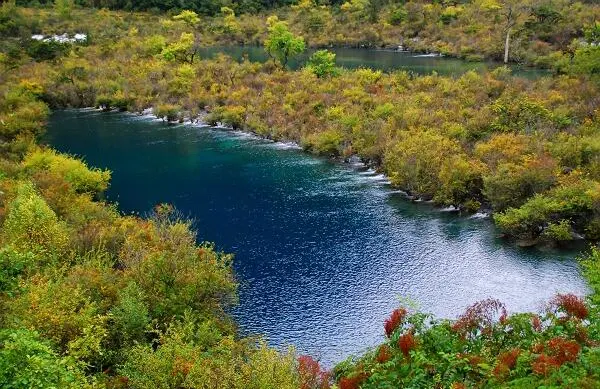
The geology is legible. The valley is limestone; snowmelt sinks into it, dissolves calcium carbonate, and when the water comes back out the pressure drops and the mineral precipitates — coating fallen trunks, branches and whole root systems until they turn to stone. Layer by layer this builds travertine dams across the valley floor, and the water backs up behind them into a staircase of lakes, which locals call haizi, sons of the sea. One hundred and eight of them, plus the waterfalls where a dam has given way: that is the entire grammar of Jiuzhaigou.
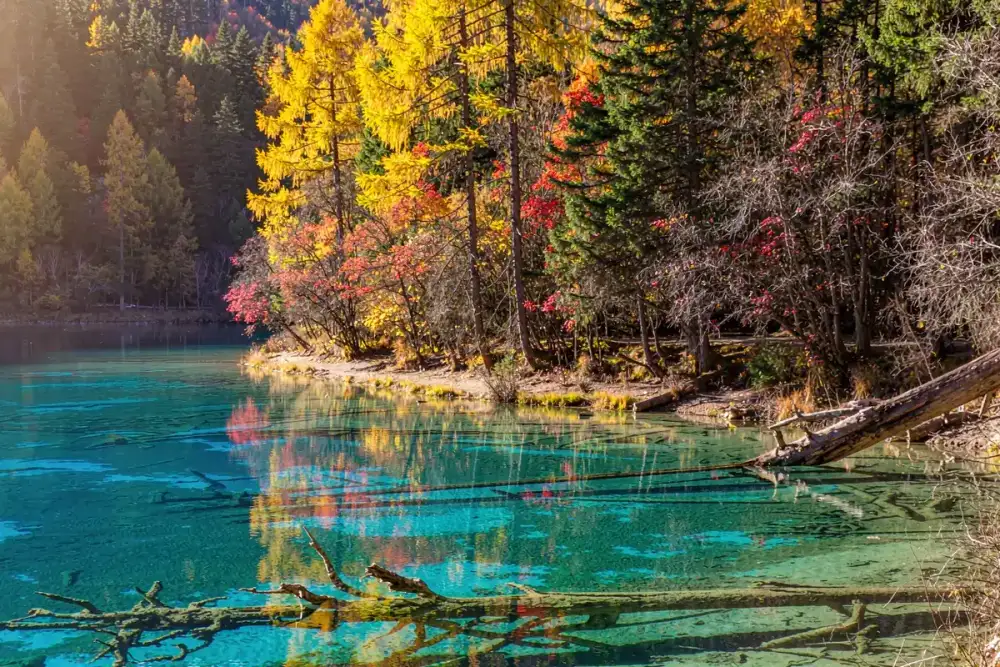
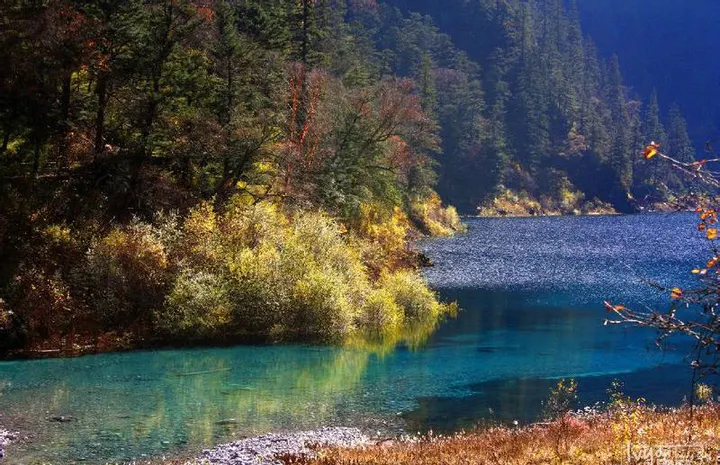
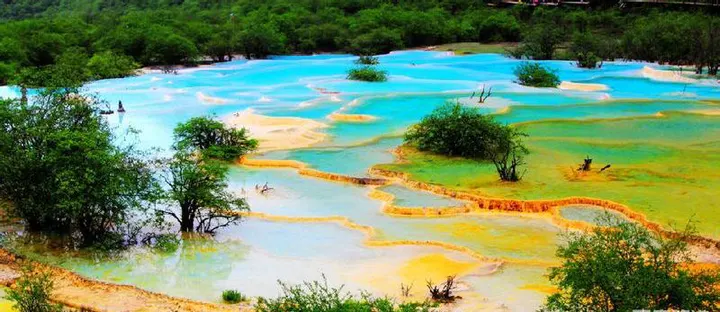
Travertine lakes stepping down the valley one after another, ringed by colour
The park is a Y. The trunk is Shuzheng Valley, fourteen kilometres from the gate up to Nuorilang; from there the right arm, Rize, runs eighteen kilometres and holds most of the scenery; the left arm, Zechawa, runs eighteen kilometres for essentially two things, Long Lake and Five Colour Pond. Nuorilang is the only interchange and the only place to eat. Every itinerary is therefore the same question: how do you cover three valleys with the fewest possible backtracks?
Within the Tibetan territory of Yangdong the gorge runs several li; the water floats green, and the forest mist is mirrored in it.
Gazetteer of Nanping County, Qing dynasty
The outside world found it late. Until the 1960s there were only horse tracks; in the 1970s a logging crew came in, took one look at the water and could not bring themselves to cut, and the forest survived. It became one of China's first national scenic areas in 1982, a World Natural Heritage site in 1992 and a UNESCO biosphere reserve in 1997. Then on 8 August 2017 a magnitude 7.0 earthquake broke Sparkling Lake and Nuorilang Falls; the repair took four years, and the park only reopened in full on 28 September 2021. The colour you see today was rebuilt. The travertine grew back on its own.
02Six things worth the trip
Five Flower Lake: where the extra twenty minutes goColour in layers
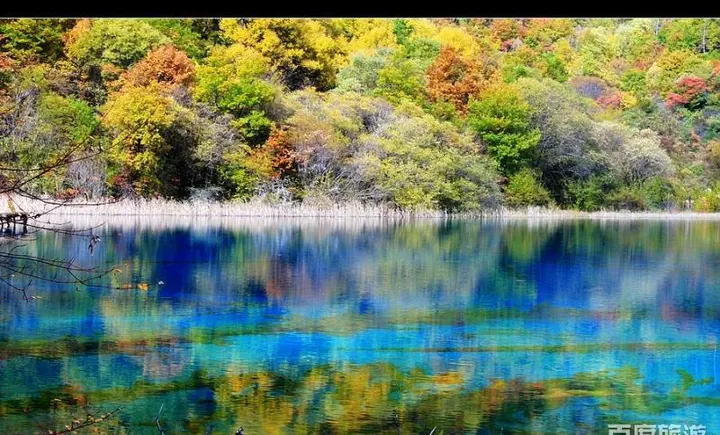
Four hundred metres long, with travertine, algae and sunken timber stacked on the bed, each bouncing light back differently — which is why one lake holds ochre, emerald, cobalt and near-black at once. From the shore you cannot see it. Walk fifteen minutes up to Tiger Mouth and the whole thing resolves into a peacock's tail. It is the one climb in the park that is genuinely worth the sweat.
Pearl Shoal and its waterfallWater breaking into beads
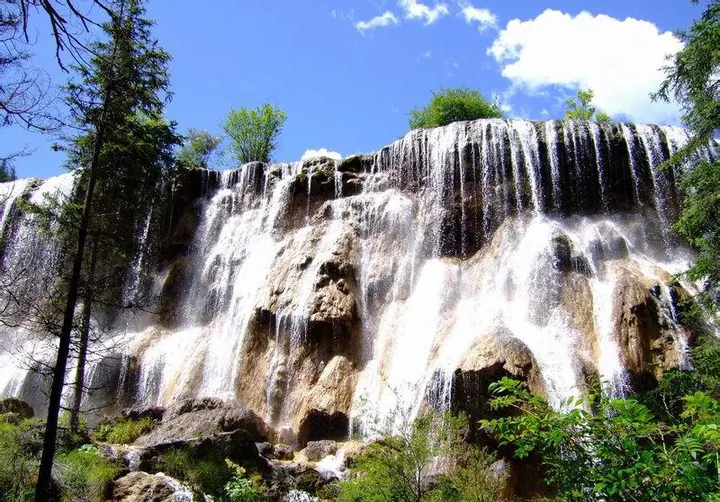
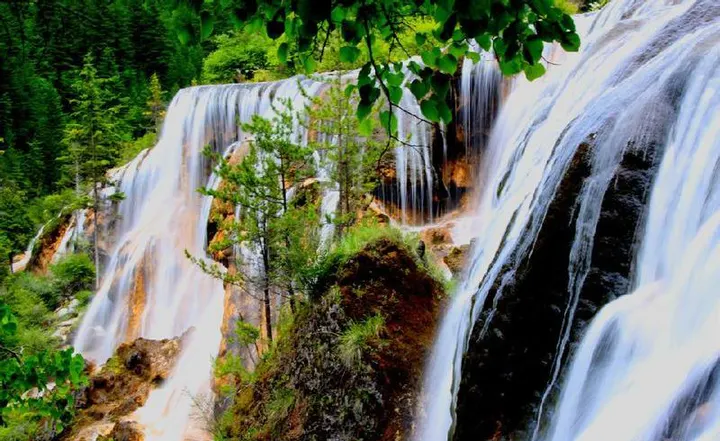
A fan of travertine sloping at less than ten degrees, with water sliding across it and breaking on thousands of pinholes in the surface until the whole sheet sparkles like spilled beads. At the far edge it goes over in one crescent drop of forty metres. The closing shot of the 1986 television adaptation of Journey to the West was filmed here, and a great many Chinese visitors arrive and only then realise they have known this rock their whole lives.
Nuorilang: a 320 m curtainChina's widest travertine fall
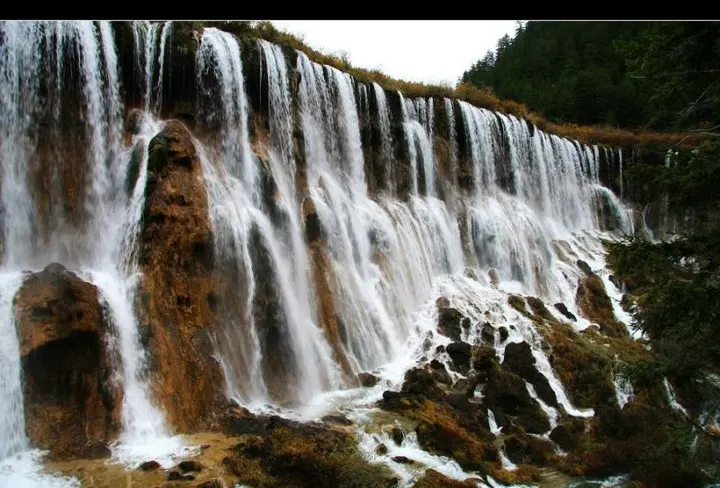
In Tibetan the name means magnificent and vast, and belongs to a male mountain god. The fall is 24.5 m high and 320 m wide, pouring off a single travertine lip, split by the ledge into several hundred strands and recombining into one white sheet below. Shoot it between 09:00 and 11:00; by afternoon the whole face is in shadow and reads flat grey against a blown-out sky.
Long Lake and Five Colour PondAbove three thousand
Long Lake is the biggest, deepest and highest in the valley: over four kilometres long, ninety metres down at the deepest, with no outlet at all — the water drains away through fissures in the bed to reappear downstream, which is why locals call it the gourd that never fills and never empties. Ten minutes on the shore is enough. The real reason to come up this arm is the one-kilometre walk down to Five Colour Pond, a pool the size of a basketball court that is blue in a way water should not be.
The October woodsA one-week window
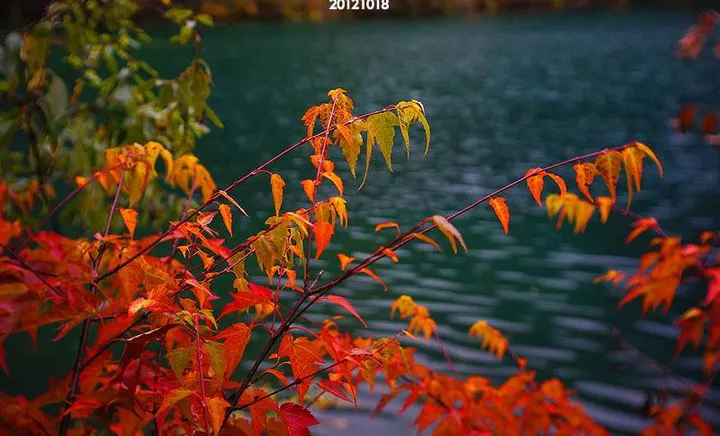
The forest is mixed — birch, maple, rowan, larch — and they do not turn together. Colour moves up the slope and along the spectrum, yellow to orange to red, over roughly three weeks, and the peak week usually falls between 15 and 25 October, give or take four days. Red maple against deep blue water is the image the whole place is sold on, and it is the only reason hotel prices double.
Blue ice in winterA different park, half price
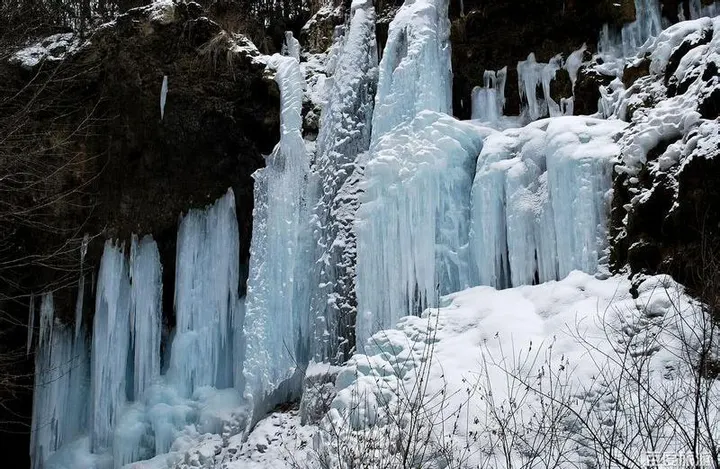
From late November the falls freeze mid-drop — water caught on its way down, hanging off the rock lip in a row of columns that go blue when the sun gets inside them. Lakes freeze to the middle and stay open at the edges, drawing a curve between white ice and black water that photographers wait all morning for. In low season ticket and shuttle come to ¥160 and the boardwalks are empty enough that you can stand on one for half an hour without seeing anybody.
03Seven questions to settle before you book
Can I do it in one day, and how should I sequence the valleys?
Yes, at the cost of two things: the primeval forest and Huanglong. The day that works goes like this. Enter at 08:00 and ride straight to the top of Rize Valley — the primeval forest in high season, Arrow Bamboo Lake when the upper road is closed — then walk down: Arrow Bamboo, Panda Lake, Five Flower Lake with the Tiger Mouth detour, Pearl Shoal and its waterfall, Mirror Lake, all on downhill boardwalks, and back to Nuorilang for lunch. In the afternoon switch to the Zechawa arm for Long Lake, walk the kilometre down to Five Colour Pond, ride back to Nuorilang, see the waterfall, then work down Shuzheng Valley stop by stop to the gate. Six to eight hours, around fifteen thousand steps. Remember one rule and the day works: buses going up do not stop, buses coming down stop everywhere. Always ride to the far end first, then walk back.
Should I stay at the gate, at Chuanzhusi, or in the county town?
At the gate. Pengfeng and Longkang villages and Zhangzha town sit five to twenty minutes' walk from the entrance, which gets you into the first batch at 08:00 and back to a hot shower and dinner at night; it is the only sensible default. Chuanzhusi, next to Huanglong Jiuzhai station at 2,977 m, is still ninety-odd kilometres and two hours from the gate — fine if you have an early train or are doing Huanglong first, useless otherwise. Jiuzhaigou county town, Yongle, is forty kilometres out and is where locals actually live: cheaper rooms, two extra hours of driving every day. Only worth it if you are staying a week.
When is it best — October colour or summer water?
Decide whether you want photographs or breathing room. The colour peaks around 15–25 October and nothing else comes close, at the price of 41,000 people a day, doubled room rates, tickets gone within hours and queues on the boardwalks. July and August are the wet months: maximum water, the falls at their loudest, the whole valley green to near-black, but more cloud and less of the famous translucency. April and May, with meltwater just running, give the clearest water of the year. Late November to March brings blue ice, the smallest crowds and the cheapest tickets, but the top of Rize Valley is shut. If you come once, come mid-to-late October and make your peace with the crowds.
Will I get altitude sickness, and can children or older parents manage?
The gate is at 2,000 m, roughly Kunming, and almost nobody feels it. The section that matters is Long Lake: 3,101 m, eleven hundred metres above the gate, reached in forty minutes by bus with no acclimatisation at all. The drill is simple — walk slowly for ten minutes before you start photographing, do not run, do not squat and stand up fast, no alcohol, drink warm water. Headache, nausea or a racing pulse means walking downhill; altitude fixes itself on the way down. Children and older parents are fine: the Long Lake to Five Colour Pond stretch is a gentle one-kilometre descent on boardwalk with buses throughout, easier than most city parks. The place to actually talk someone out of is Huanglong, where the top pools sit at 3,576 m — four hundred metres above anything in Jiuzhaigou, and not for anyone with heart or lung trouble.
How do I get tickets, and can I buy at the gate?
Nothing is sold at the gate — not one ticket. It is all real-name booking through the official WeChat mini-program, Jiuzhaigou Tourism, or the Aba Tourism site, released fourteen days ahead with new quota appearing at 08:00 each morning. High season is ¥190 entry plus ¥90 shuttle; low season ¥80 plus ¥80; insurance is ¥10 and optional. For National Day and the colour weeks, dates sell out within hours of release; a waiting list opens afterwards, and cancellations are flushed back into the system at 08:00 and 17:00 daily, which is worth refreshing. Even free and discounted categories — over sixty-five, under six, under 1.2 m — must book, at a price of zero. Enter your passport number exactly; the gate scans the document and the name has to match.
What is the fastest way from Chengdu — train, plane or bus?
The train, without argument. Chengdu East to Huanglong Jiuzhai station runs as fast as 1h39m, second class ¥128–143, up to thirty services a day between about 06:00 and 21:00. Fifty metres to the right outside the exit is the park shuttle: ¥51 a head, two hours to the gate, timetabled around train arrivals. Call it four hours door to door for under ¥200. Flying looks quicker and is not: the airport is still 88 km and ninety minutes by bus from the gate, so six hours all in, and the field closes in bad weather — from 25 October 2026 it went into its seasonal suspension with no scheduled flights at all. The long-distance bus is ¥145–168 and five to eight hours, worth considering only once the trains are gone.
Can I hop off the shuttle mid-route, and can I stay inside the park?
Getting off is fine; getting on depends on direction. The ticket is unlimited for the day, but the rule is that buses heading up the valley do not open their doors and buses heading down stop at every stop. So ride to the far end and walk back — do not plan on flagging anything down halfway. Note also that the two outer arms stop sending buses up at 16:30, after which only Shuzheng return services run; miss that and you are stuck at Long Lake. Sleeping inside the park is prohibited outright — the official phrasing is tour inside, stay outside. Tree-shaped village households used to take in visitors quietly; that has effectively ended, and the stay-inside guides still circulating online are years out of date.
04Two days is comfortable, one day is possible
One constraint shapes everything: tickets are sold by the day, and leaving means buying again. So do not spend two days in the same arm, and do not cram Huanglong into a Jiuzhaigou day. The sane four-day shape is: arrive at the gate and acclimatise, one full day in the valley, one day at Huanglong, then out. With only two days, give the first entirely to the valley and do Huanglong in the morning of the second.
D1
Leave Chengdu East around 07:00, reach Huanglong Jiuzhai in ninety minutes, take the shuttle from the forecourt, and be at the gate before noon. Plan nothing for the afternoon — a walk around Pengfeng village at 2,000 m is enough, then a bowl of yak hotpot and an early night. The point of this evening is to let your body catch up so that Long Lake the next morning does not ambush you.
D2
In at 08:00 and straight up Rize Valley. The forty-minute loop through the primeval forest is optional — it is a fir wood with no view, and if time is short skip it and start walking from Arrow Bamboo Lake. Then Arrow Bamboo, Panda Lake, Five Flower Lake with the climb to Tiger Mouth, Pearl Shoal, Mirror Lake, all downhill, reaching Nuorilang at midday. Afternoon: Long Lake and Five Colour Pond, the waterfall on the way back, then Shuzheng stop by stop to the gate. Out before 18:00.
D3
Huanglong. Share a car or take the shuttle to Huanglong Jiuzhai station, then thirty minutes onward to the gate — two and a half hours in total. The cable car is ¥80 up and takes twenty minutes; from the top it is a bit over two kilometres of boardwalk to Five Colour Pond at 3,576 m, which is the slowest two kilometres in Sichuan. Walk down through the Golden Sand Beach travertine slope, two and a half hours. Back to the gate for the night, or stay at Chuanzhusi for an early train.
D4
Out. If your train is in the afternoon, spend the morning at Shenxianchi, forty minutes from the gate, or walk the Tibetan village at Zhongcha Valley. You can also buy a second day in the park — but that is a second full ticket, and whether it is worth it depends on how much walking you have left in you.
05Three valleys, read from the top down
Rize Valley: where the scenery is
The right arm runs eighteen kilometres upstream from Nuorilang and holds the densest run of lakes and drops in the park; it is also where everyone gets off. Buses run to the very top without stopping, so the order is always ride up, walk down.
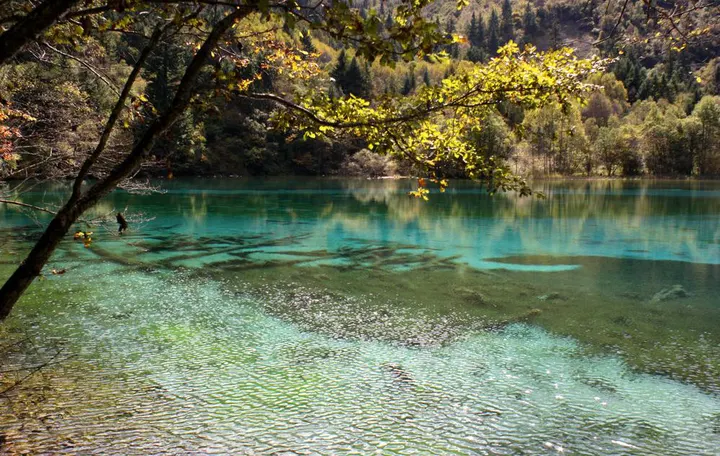
At the shore the colour thins over the shallows, and fallen leaves settle on the travertine
Past Arrow Bamboo comes Panda Lake, named for the animals said to drink there, with an eighty-metre fall immediately below it — the biggest single drop in the valley. Winter does something counter-intuitive here: Arrow Bamboo, higher up, stays open and glittering while Panda, lower down, freezes over. Then Five Flower Lake, 450 m long and nine metres deep, with travertine, algae and sunken timber stacked in three layers on the bed, so the colour comes in patches rather than a gradient.
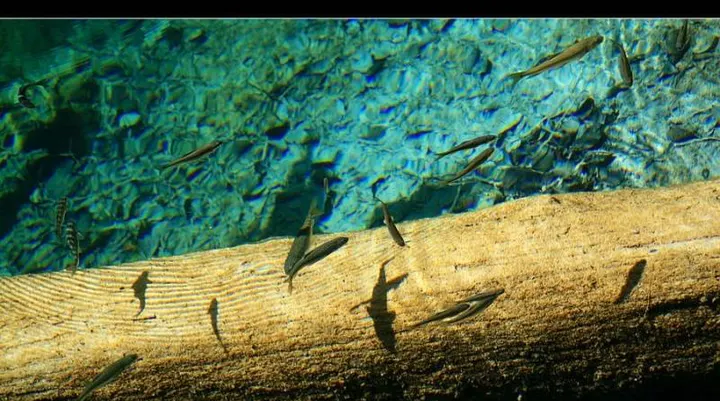
Sunken logs under clear water, their bark sheathed in calcium so they never rot
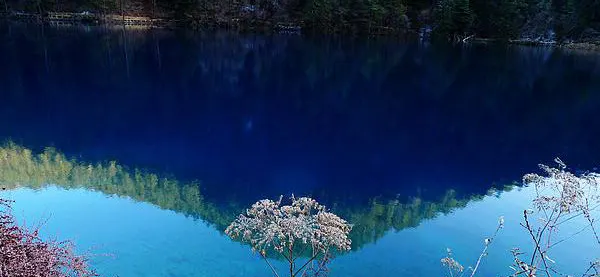
Walk the 1.8 km between Pearl Shoal and Mirror Lake rather than riding it; it is the best stretch of trail in the park. Pearl Shoal is a fan of travertine under ten degrees of slope, water spreading over pale yellow moss and breaking on countless pinholes into beads; at the far edge the whole sheet drops forty metres in a crescent, and the noise ricochets between the walls. Mirror Lake needs an early start — on a windless morning the far bank sinks whole into the water and birds appear to fly along the bottom. One gust or one hour of sun and the mirror is gone.
On a windless morning the far bank sinks whole into the water
Zechawa Valley: two stops, both worth it
Eighteen kilometres with only two real stops: the upper and lower seasonal lakes are drive-by only. Long Lake is a glacier-dammed basin, 4,350 m long and ninety deep, with no surface outlet at all — it drains through fissures to reappear downstream, which is why it neither spills in the wet season nor dries in the dry. The ridge on the far side carries snow from early autumn, and against the near-black water it makes the coldest colour pairing in the park. A gentle kilometre downhill brings you to Five Colour Pond, small enough to walk around, and the one lake that refuses to freeze even when everything around it is solid: shallow water over dark travertine warms fast in the sun, which is also why the blue survives the winter.
Shuzheng Valley: you pass through twice, so use it
A bend of the lake lined with willow scrub and reeds, gone yellow-brown by autumn
The trunk runs fourteen kilometres from the gate to Nuorilang, and most people treat it as a corridor. It is the most lived-in part of the park: Shuzheng village, a working water mill, a prayer-wheel house, a white stupa, all mixed in with lakes and small falls. Shuzheng Qunhai is nineteen lakes arranged down the valley floor one behind another, linked by trees and low silver spills — from above it reads as a staircase. Sparkling Lake earns its name at sunrise and sunset, when the surface breaks into a field of points of light.
Reed Lake is half marsh: a clear channel threading through a stand of reeds, green on green in spring, uniformly gold by winter. There is no stop, which means a half-hour walk from the nearest one — and, precisely because of that, almost nobody. If you want one photograph of Jiuzhaigou with no people in it, this is the stretch. Bonsai Shoal is the last stop before the gate: a film of water over travertine with azalea, willow and pine growing straight out of it.
The peaks and the primeval forest
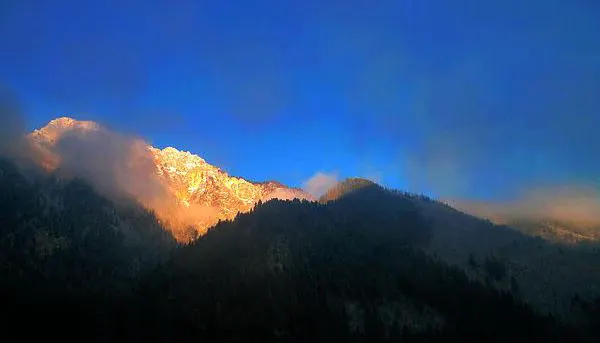
Before sunset the light reaches only the highest ridge; the valley floor is already dark
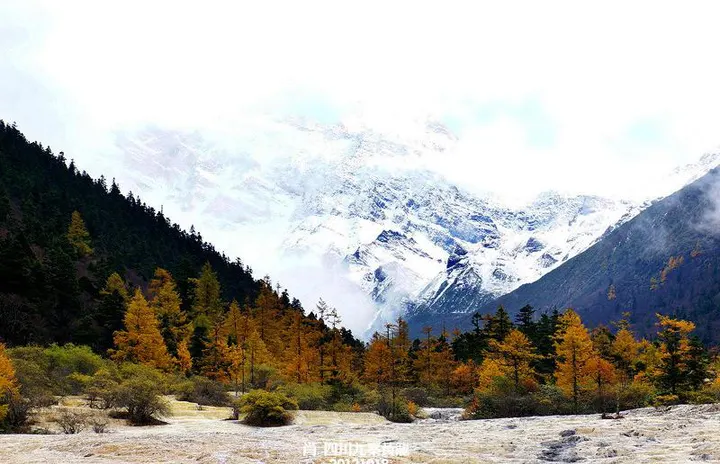
The ridges on both sides run above 4,000 m, reaching 4,500 at the southern rim, snow-covered year round, and none of it is walkable — you look up at it from the valley. The primeval forest at the top of Rize sits around 3,000 m; a forty-minute loop over moss and needles, with wind in the firs and birds in it. But there is no view: the forest is the sight. On a one-day trip this is the first thing to cut. For photographers or anyone teaching a child about plants, forty minutes is well spent.
06Beyond looking at water
Photography: there is no bad hour
Close up, the water drops step by step over moss-covered ledges
All three valleys run north to south, and the sun is in them roughly from 08:00 to 17:00, which means Jiuzhaigou does not require the dawn-and-dusk chasing other landscapes demand — any hour works. What matters is the local timing. Mirror Lake needs stillness before 08:00 or there is no reflection. Five Flower Lake is a shore shot at 09:00 and a Tiger Mouth panorama at 16:00. Pearl Shoal's fall takes raking sun from 10:00 to 14:00. Nuorilang is front-lit from 09:00 to 11:00 and in full shadow by afternoon. Shuzheng is a morning valley because you shoot east from the western road. Overcast days are not a loss — diffuse light holds the layers better — just keep the sky out of the frame.
Villages and prayer flags
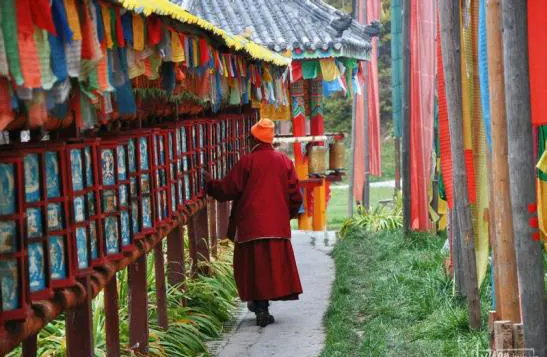
A prayer-flag walkway in the village, a figure in red walking through
Nine villages are still inhabited; Shuzheng is the largest, with more than four hundred of the valley's thousand residents. Houses are stone and timber, white quartz set on the parapets, painted friezes under the eaves — and, unusually, built with Han details: bracketed eaves, carved hanging columns, upturned corners, moon gates. Jiuzhaigou sits exactly where Tibetan, Han and Qiang territory meets. Prayer flags run from roofs to trees, and every gust is reckoned to recite the sutra again. You are welcome to walk through; do not open courtyard doors, and never touch anyone's head, which is a real taboo here.
The evening show
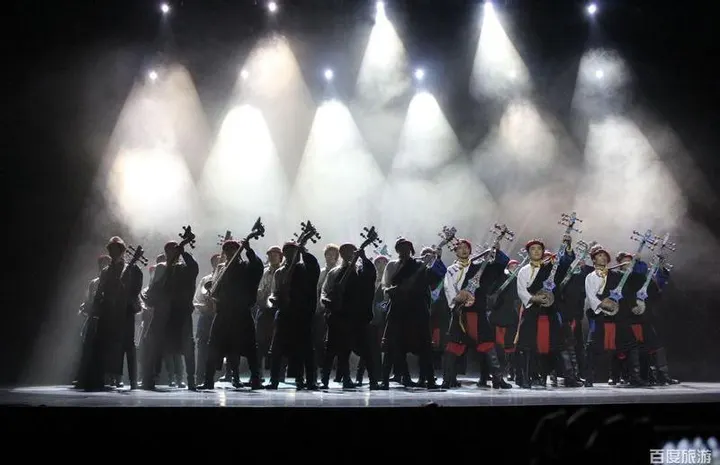
The nightly Tibetan-Qiang song-and-dance show at the gate: spotlights, massed ranks, graded seating
Several shows run year-round at the gate. The oldest is Zang Mi, staged by the dancer Yang Liping and the singer Rongzhong Erjia, following an old Tibetan woman on pilgrimage; 19:30, two hours. The other is Jiuzhaigou Romance, heavier on lights and moving scenery, from about ¥199 in the ordinary seats to ¥380 for the front. Both share one problem: two hours of theatre after a full day on your feet puts a lot of people to sleep. Families with children tend to think it was worth it.
Winter ice
December to February the falls freeze into solid curtains, the lakes freeze half and stay open half, and the boardwalks are laid with wire mesh for grip while genuinely dangerous sections are simply closed — so it is safe walking. Winter reduces the palette to three colours: white, blue, near-black green. Photographers wait for the two days after snowfall, when the snow has settled on the last of the autumn branches and nobody has trampled the ice yet. Dress for it: minus five to minus ten in the valley by day, colder at the edges.
07There is one right answer: stay at the gate
Get the geography straight first. Jiuzhaigou names three different places at three scales: the park itself, Zhangzha town where the gate stands — Pengfeng, Longkang, Bianbian Street — and the county town of Yongle forty kilometres away. When travellers say they are staying in Jiuzhaigou they mean Zhangzha, because that is where the ticket gate is. Accommodation inside the park is prohibited; there is no workaround worth chasing.
Walking distance of the gate — Pengfeng and Longkang: guesthouses and homestays, ¥150–280 a double in low season, ¥400–800 in high, doubling again over National Day and the colour weeks. The upside is being in the first batch through the gate at 08:00; the downside is that rooms at this price are small.
Chain hotels on Bianbian Street and in Zhangzha: Atour, Manxin, Vienna and similar, ¥800–1,500 in high season, with underfloor heating, oxygen-equipped rooms and free parking. With children or older parents this is the low-friction choice.
Further into Zhangzha — Erdaoqiao, Congya: three or four kilometres out, ¥10 by taxi, family lodges at ¥100–150 in low season. Plain but quiet, usually run by local Tibetan families who will make you butter tea.
Chuanzhusi and the county town: Chuanzhusi sits beside Huanglong Jiuzhai station at 2,977 m, useful for an early train or a Huanglong-first plan. Yongle is the cheapest of the three but adds two hours of driving a day, so only for long stays.
Two practical notes. Highland hotels generally have underfloor heating but often no air conditioning, which makes summer rooms stuffy — ask before booking. And while many guesthouses advertise station pickup, they mean Huanglong Jiuzhai station ninety-three kilometres away, usually for a fee or only for guests who have hired a car; ask the price when you book rather than on arrival.
08Eat adequately inside, well outside
Everything is trucked in, so inside the park it is expensive and limited. Nuorilang is the only real kitchen: a buffet at ¥60–68, simple plates ¥45–70, edible rather than good. The smarter play is to buy barley bread, dried yak and fruit at the gate the night before and eat on a boardwalk platform with water in front of you. Outside food is allowed; carrying your rubbish out is not optional.
A fall inside the forest, its noise swallowed by trees until you are almost on it
What to order
Yak hotpot: clear broth, thick-cut yak, radish and wild mushrooms, ¥88–118 for a small pot feeding two or three. Nothing works better on the first cold evening at altitude.
Potato ciba: steamed potatoes pounded to a paste in a wooden tub, formed and boiled, dressed with pickled greens and chilli. Smooth, filling, and the most everyday thing on the menu at around ¥15.
Cheese-curd buns: fresh curd, sour and white, used as filling. Dried curd eaten as a snack defeats most visitors, but the buns are universally liked.
Butter tea and barley wine: the tea is brewed from coarse Ya'an leaf, churned with butter and milk, and served salty — it cuts through fat better than anything. Barley wine is pale yellow, sweet-sour and weak enough to drink with lunch; locals call it Tibetan beer.
Morels and mountain produce: the local speciality, growing where subalpine conifer forest gives way to meadow above 3,000 m, usually stewed with chicken or duck. Fresh in July and August, dried the rest of the year.
Where to eat
The gate area runs on Sichuan cooking, with Hui restaurants and a few Tibetan places mixed in. Pengfeng village has the most and the cheapest — ¥50 a head fills you up. Bianbian Street and the Tiantangkou square cost more but offer range, plus grills at night. Tibetan restaurants run ¥60–100 a head; note that traditionally beef, horse and dog are not eaten and in some households fish is out too, so asking before you order is polite rather than awkward.
09Only a few things travel well
Jiuzhaigou is not a shopping destination, and the list of things that travel well and are hard to get wrong is short. The rule is simple: food yes, medicinal herbs no, knives never.
Dried yak: the safest purchase. ¥70–80 per 500 g at the cheap end, over ¥100 for good cuts, and always taste before buying. Watch the upselling trick — ask for a small bag and get handed double, with the price to match.
Morels, wood ear and dried fern: local mountain produce, light and durable, and genuinely useful in a soup. Buy loose and check for mould and insect holes.
Qiang embroidery and yunyun shoes: Qiang needlework is bold in colour, and the shoes are cloth boats with a lifted toe and cloud patterns on the upper, ¥50–200 — easy gifts.
Tibetan silver, prayer beads, flags: sold at the gate market and on Bianbian Street. Fine as souvenirs, never as antiques. Real silver is sold by weight, so insist on the scale.
Two things to leave alone. Tibetan knives: sharp, and they will be confiscated at airports, on high-speed rail and in the metro — blunt ones included. And any cordyceps, fritillary or musk you cannot identify: forgery is routine and there is no price benchmark, so you are simply paying tuition. If you want herbs, buy them in a proper pharmacy in Chengdu.
10Getting there and getting around
High-speed rail: the default since 2024
The Zhenjiangguan to Huangshengguan section of the Sichuan–Qinghai Railway opened on 30 August 2024. Chengdu East to Huanglong Jiuzhai takes as little as 1h39m, usually around two hours, with up to thirty trains a day running from early morning into the evening and the last one towards Huanglong Jiuzhai leaving around 18:40. Second class is ¥128–143, first ¥210–230. Check the station name: Huanglong Jiuzhai, not Songpan and not Huangshengguan. Songpan works too but adds an hour and a half to the gate, so treat it as a fallback for sold-out dates.
The transfer is the part people get wrong. Huanglong Jiuzhai station sits at 2,977 m; escalators take you down to the forecourt, where fifty metres to the right is the park shuttle bay. ¥51 a head, two hours to the visitor centre at the gate, departures timed to train arrivals and leaving when full. Buy on the Jiulü Yuexing mini-program or at the bay. Shared cars cost about ¥10 more, save half an hour and drop you at your hotel door.
Flying: fast when it happens
Jiuzhaigou Huanglong Airport (JZH) sits at 3,448 m, one of China's three high-altitude fields, 88 km and ninety minutes from the gate: ¥45 by airport bus, ¥200–300 for a taxi. The problem is the schedule. Through the 2026 summer season only Sichuan Airlines from Chengdu Tianfu and Air China from Beijing Capital flew with any regularity — and from 25 October 2026 the airport entered its seasonal suspension with no scheduled passenger flights at all. Locals joke that nine out of ten flights turn back. Call the airport on 0837-7243770 or check the airline before you book, and never build a tight connection on it.
Bus and driving
Buses leave Chengdu's Chadianzi and Xinnanmen stations for the gate at ¥145–168, taking five to eight hours; Chadianzi also runs a direct service on the Mianyang–Jiuzhaigou expressway for ¥110, three departures a day. The new expressway has cut the time substantially, but it is still most of a day. Driving the western route — Chengdu, Dujiangyan, Wenchuan, Mao County, Songpan, Jiuzhaigou — is about 440 km; the eastern route via Mianyang, Jiangyou and Pingwu is 480 km. Both are mountain roads with constant bends, and without high-altitude driving experience they are not a good idea.
Inside the park: one vehicle, one rule
There is no cable car in the valley; the only transport is the green shuttle, ¥90 in high season and ¥80 in low, unlimited for the day. One rule covers everything: buses going up run to the far terminus without opening their doors, buses coming down stop at every stop. Ride to the top first, then walk back. Nuorilang is the only interchange, with three separate queues by direction — join the wrong one and you start again. Both outer arms stop sending buses up at 16:30, after which only Shuzheng return services run, so do not leave Long Lake for after four.
Check trains and fares from Chengdu to Huanglong Jiuzhai
Numbers: park information 0837-7739753, tickets 0837-7769999, shuttle 0837-7766016, complaints 0837-7739309, rescue 0837-7738818. Police 110, ambulance 120, fire 119.
Hospitals: the county people's hospital is in Yongle, forty kilometres away, on 0837-7732146. At the gate there is a park clinic — the first stop for altitude symptoms, a turned ankle or a bad stomach.
Signal: 4G holds at the gate and along the main boardwalks, drops out towards Long Lake and the primeval forest, and there is Wi-Fi at Nuorilang. Screenshot your ticket QR code and a map before you go in.
Money: QR payment works everywhere at the gate, and Alipay's international version links Visa and Mastercard. Inside the park Nuorilang is the only place to spend anything, and it takes QR too. Carry a couple of hundred in cash anyway.
Rules: no smoking anywhere except the designated area at Nuorilang; no drones; no wading, swimming or feeding the fish and ducks; and do not step off the boardwalk. Travertine compresses under a foot and takes decades to come back.
Drones and pets are both barred at the gate, and bags are checked. Strollers work but have to be lifted over steps; the main boardwalks in Shuzheng and around Nuorilang are gentle enough for a wheelchair, the Long Lake stretch is not.
12Packing list and pitfalls
Bookings: fourteen days out on the official Jiuzhaigou mini-program, and Huanglong separately through Aba Tourism. Set an alarm for 08:00 on release day in the October window. One wrong digit in a passport number and the gate will not let you in.
Clothing: a shell over fleece is the standard kit, because a day can run from twenty degrees to five. October mornings and evenings want a down jacket; winter wants a proper one plus hat and gloves. Footwear has to be waterproof and grippy — the boardwalks are wet.
Sun and water: at two to three thousand metres the UV is roughly double Chengdu's, so hat, sunglasses and SPF50 are not optional. The air is dry — two litres a day, and bring lip balm.
Altitude: people start taking rhodiola three to five days ahead; the evidence is thin but it does no harm. What actually works is walking slowly, drinking water, skipping alcohol and going to bed early on the first night. Canned oxygen is sold at gate pharmacies for ¥20–30 and you do not need a big cylinder.
Food: buy barley bread, jerky, chocolate and fruit the night before. Nuorilang is the only kitchen in the valley and a forty-minute queue is normal. Fill a thermos — hot water is more welcome at altitude than anything else you can drink.
Camera: spare cards and batteries, kept in an inside pocket because the cold drains them. A polariser earns its place on water — it cuts the surface glare and shows you the bed.
Five pitfalls. Anyone offering to get you in without a booking, or via an inside channel, is selling nothing — there is genuinely no ticket window. Do not believe offers of a bed inside the park; being caught means a new ticket plus a fine. There is no VIP lane on the shuttle, so do not pay for a fast track that does not exist. In October do not arrive at the gate without a room. And do not schedule Long Lake after 16:00, because the last bus will not wait.
13How a valley like this gets made
Geology: travertine is a slow business
Quaternary glaciers left their marks all over this valley: U-shaped floors, moraine, erratic boulders. When the ice went, meltwater circulated through limestone, picked up calcium carbonate, and dropped it on release — preferentially onto anything it could cling to, a stone, a fallen trunk, a clump of weed. Those got sheathed in lime, the sheath thickened, and eventually a dam grew across the valley. Water backed up behind it: a lake. Water broke through it: a waterfall.
The system is extraordinarily fragile. Travertine grows a few millimetres a year, so one footstep is charged against decades. The valley was logged hard for twelve years in the 1960s and the primary forest badly damaged; some of the timber that fell into the water became the nucleus of new travertine, which is the closest thing to a silver lining in that story. Protection from the 1980s onwards is why the place exists today. The 2017 earthquake broke the dam at Sparkling Lake, the water drained overnight and the calcified trees on the bed were left standing in the open; the repair took four years, rebuilding the dam course by course with local stone and sticky-rice mortar.
People: nine villages, two faiths
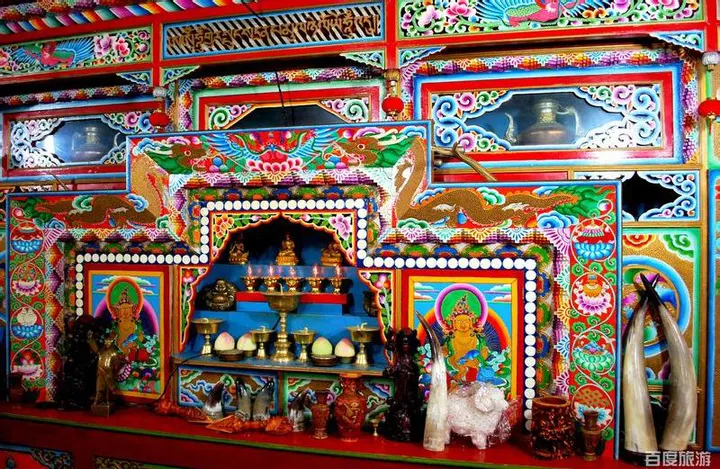
A temple front painted red, gold and blue — Tibetan decoration at its densest
Nine villages gave the valley its name: Shuzheng, Zechawa, Heijiao, Heye, Panya, Yala, Jianpan, Rexi and Guodu. The religion here is not mainstream Tibetan Buddhism but Bon — more precisely the reformed white Bon that evolved after Buddhist contact, worshipping the spirits of sky, earth, mountain, forest and water. Zaru Temple, the only one in the valley, is the local centre of it. The biggest date is the Mazi festival on the fifteenth day of the third lunar month, when everyone turns out in best dress to burn incense, circumambulate the mountain and present khata, with Tibetan opera and circle dancing at the fair.
The architecture shows where the valley sits: on the seam between Tibetan, Han and Qiang territory. The houses are Tibetan in structure — stone walls, timber frames — but routinely use Han details: bracketed eaves, carved hanging columns, upturned corners, moon gates. And the white quartz set on parapet corners and above doors is identical to the Qiang white-stone cult of Mao County and Wenchuan. This is not compromise; it is several hundred years of traffic.
Climate: the arithmetic of four seasons
A wet highland climate with snow on the summits all year. Spring runs nine to eighteen degrees and changes hourly; summer sits at nineteen to twenty-two with cold nights that want a sweater; autumn is the most stable season but swings fifteen degrees between day and night, and the ground starts freezing in late October; winter stays below zero. Rain is scarce and seventy to eighty per cent of it falls in July and August. So the question of the best month is really a question about which you want: colour, water, or space.
14Huanglong, and two alternatives
Huanglong (1 day, 130 km)
Huanglong's terraced pools, shallow enough to read the travertine floor through the water
Huanglong is the same geology written differently: a 3.5 km valley climbing from 3,070 m at the gate to 3,558 m at Huanglong Temple, its floor paved with travertine shoals and terraced pools, ending at the top in a set of 693 basins that make up Five Colour Pond. Entry is ¥170 in high season (1 June to 15 December) and ¥60 in low; the cable car is ¥80 up and ¥40 down; the local shuttle ¥20. Gates 08:00–18:00, with cable-car tickets sold until 16:30. The daily cap is 25,000 and booking is real-name like everywhere else.
There is one piece of route advice: cable car up, boardwalk down. Twenty minutes to the top, then a bit over two kilometres to Five Colour Pond at 3,500 m, which is the exhausting part — go slowly and stop often. The descent takes two and a half hours past Golden Sand Beach, the Washing Cave and the Sala pools, with water sliding over pale yellow travertine that genuinely looks like running gold in the sun. There is no restaurant in the valley, only instant noodles and boxed meals at the visitor centre at unfriendly prices, so carry something calorie-dense.
Shenxianchi (half a day, 40 km)
Forty kilometres northwest of the gate, a small travertine terrace system hidden in forest and far quieter. ¥94 entry, with a shuttle from the gate. It suits two situations: you could not get Jiuzhaigou tickets, or you have already seen the big show and want somewhere quiet to sit for an afternoon. It is not Huanglong and should not be sold to yourself as a substitute.
Songpan and Chuanzhusi (half a day)
Songpan is a Ming frontier town with its wall intact and gate tunnels thick as a road, one main street selling dried yak and silver. Chuanzhusi is smaller but has become the real transport hub of the area because Huanglong Jiuzhai station sits beside it. If you came by train, two hours in Songpan on your last morning and then boarding at Chuanzhusi fits the schedule neatly.
15You have seen this place on a postcard
Film
Hero (2002, dir. Zhang Yimou): the duel between Tony Leung and Jet Li on the surface of Arrow Bamboo Lake, the two of them retreating inch by inch while the ripples spread outward, made the lake famous across China and put Jiuzhaigou into popular culture for the first time. Journey to the West (1986, dir. Yang Jie): the closing credits, with its famous refrain about carrying the pole and leading the horse, were shot at Nuorilang Falls — two generations of Chinese viewers see that curtain of water and know the pilgrims are on the road again.
Books
Zeng Zhen, A Village in a Nutshell: a photographer's record of the valley's villages — prayer flags, timber houses, grain drying, unnamed wildflowers — the least textual and most informative book on the place. Deng Yi, Jiuzhaigou Forever: written by someone who was both witness and administrator, the first half on what the logging crews did in the 1960s, the second on how it was saved in the 1980s. For the near-miss history of this forest, it is the only account.
Music
Rongzhong Erjia's 'Magical Jiuzhaigou' is a song Chinese children grow up hearing — a Tibetan melody in pop arrangement, its chorus simply oh, magical Jiuzhaigou, heaven on earth — and nearly every domestic visitor can hum it. At the other extreme is Huang Yung-chan's piano album Quiet as Poetry, written in 2001 for an NHK documentary on the valley; it is far quieter, and the right thing to walk the boardwalks with.