A river through the city, a bowl of noodles to wake it
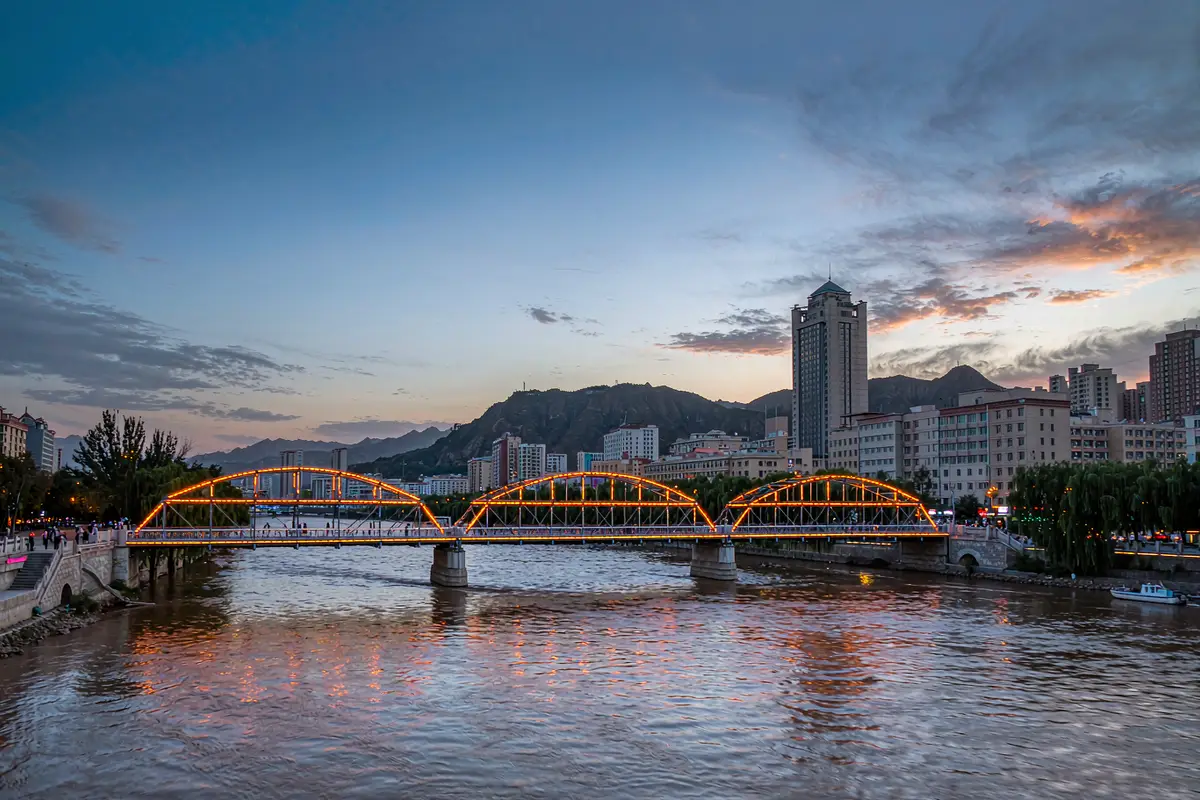
A river through townThe 1909 iron bridgeThe ¥8 noodle bowlNight markets past midnight
In short
Lanzhou (兰州, Lánzhōu) is the only provincial capital the Yellow River runs straight through, and it has been the gateway to the Hexi Corridor for two thousand years — the place where Silk Road caravans, Hui traders, beef-noodle breakfasts and China's fastest trains all meet. The city stretches more than 40 km along a narrow river valley at about 1,520 m, with mountains walling it in on both sides and one broad, silty river down the middle. Most travelers treat it as a transfer point for Dunhuang or Gannan, but it deserves two nights: a ¥8 bowl of beef noodles at dawn, the Galloping Horse at the Gansu Provincial Museum mid-morning, Zhongshan Bridge and the White Pagoda hill at dusk, and the Zhengning Road night market after dark. The sights cluster tightly, so two days covers the city and one more buys a day trip to the Shuimo Danxia badlands or the old river town of Qingcheng. A mid-range budget runs about ¥800–1,500 for two to three days, excluding long-distance transport.
May–October, best in early autumn (September–October); spring brings dust storms
01First, accept its shape: a city stretched by a river
Lanzhou sits in central Gansu, where the Yellow River crosses from west to east and two mountain ranges squeeze the built-up area into a strip more than 40 km long and only a few kilometres wide at its narrowest. That geography shapes the local grammar of direction: people rarely say left or right, they say east or west. The city stands at about 1,520 m, milder than the popular image of the northwest — summers are warm rather than scorching, winters come with reliable indoor heating — but the air is aggressively dry.
The first look often disappoints: no desert, no camel caravans, just a wide brown river, dense blocks on both banks and mosque domes scattered through the skyline. Give it a day and the impression turns. At six in the morning the noodle shops light up first, steam rolling out of the door; by mid-morning the museum is showing China's most famous horse; at dusk the iron bridge fills with people walking for no particular reason; at two in the morning the night market is still carving meat, turning skewers and taking money. Lanzhou is blunt, gritty and entirely without pretense.
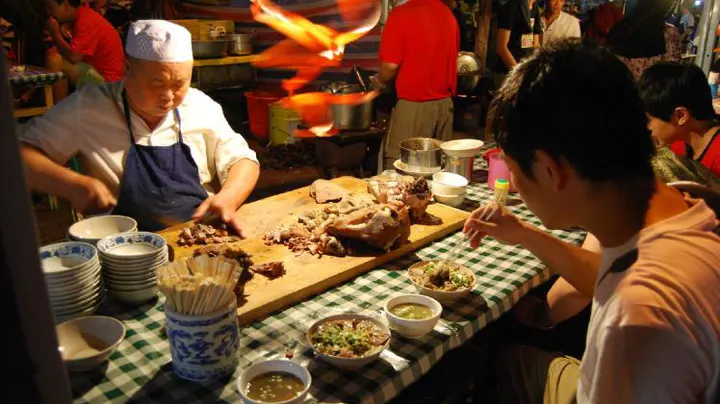
Lanzhou's nights are genuinely alive. At two or three in the morning the food stalls are still up, most of them run by Hui families, and the customers keep coming.
"Summer Trip to the Gannan Sky"
There is no need to rush. The city is organized around the Yellow River promenade: Zhongshan Bridge, the White Pagoda hill, the Waterwheel Park and the Yellow River Mother sculpture line up from east to west within walking distance of one another. The Gansu Provincial Museum sits in Qilihe, Wuquan Mountain in the south of town, and the eating and shopping cluster around Zhengning Road, Zhangye Road and Xiguan. Two days covers the urban core; keep a third for the badlands north of the city or the old river town to the east.
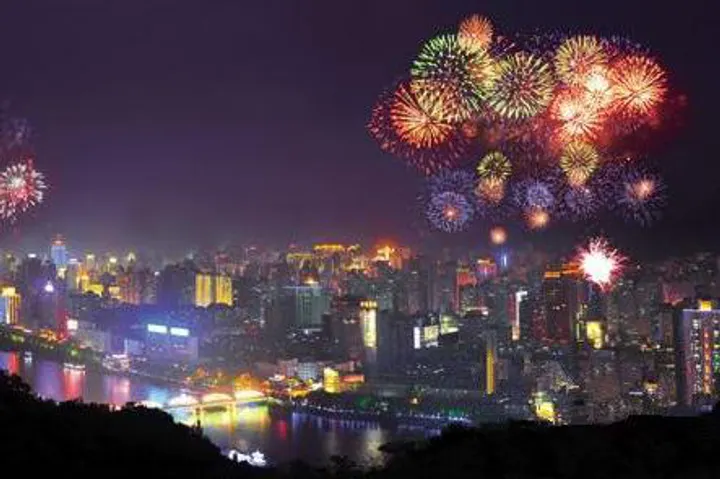
The Yellow River banks after dark, with fireworks opening above the city
02Six things you should actually do here
Walk across Zhongshan BridgeThe first bridge over the Yellow River
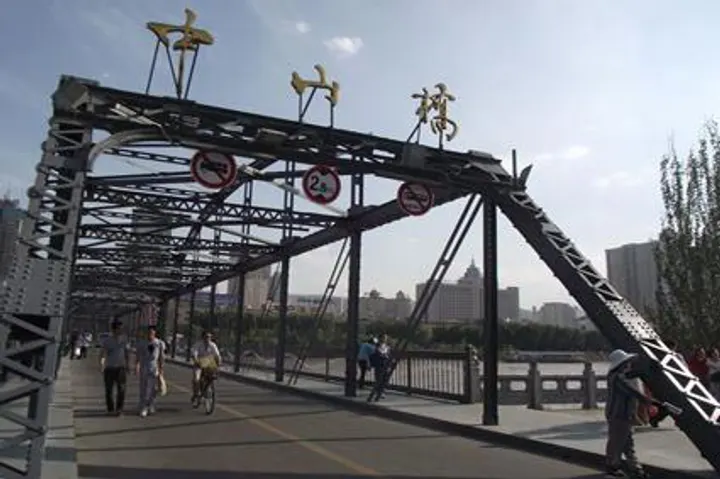
Opened in 1909 with steel shipped from Germany, this is the first permanent iron bridge anyone built across the Yellow River. It now carries only pedestrians and cyclists, and the crossing takes five unhurried minutes. Come at dusk, when the trusses light up and the whole structure turns gold against the water.
Ticket:Free, open around the clock
Look up at the Xiguan MosqueA white dome in the old town
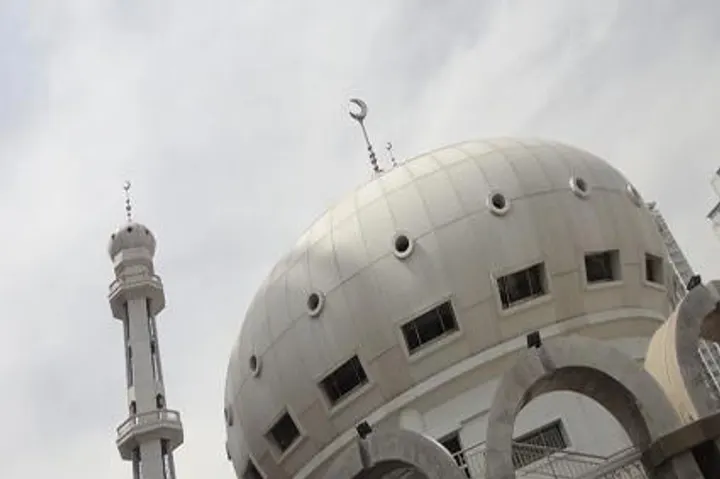
Mosques crowd Chengguan District, and Xiguan is the largest: a white dome with a slender minaret that appears the moment you turn off Zhangye Road. Visiting is free outside prayer times; women should cover their hair, everyone should dress modestly, and no one enters the hall or photographs worshippers during services.
Location:1 Cuiyingmen, walkable from Zhangye Road
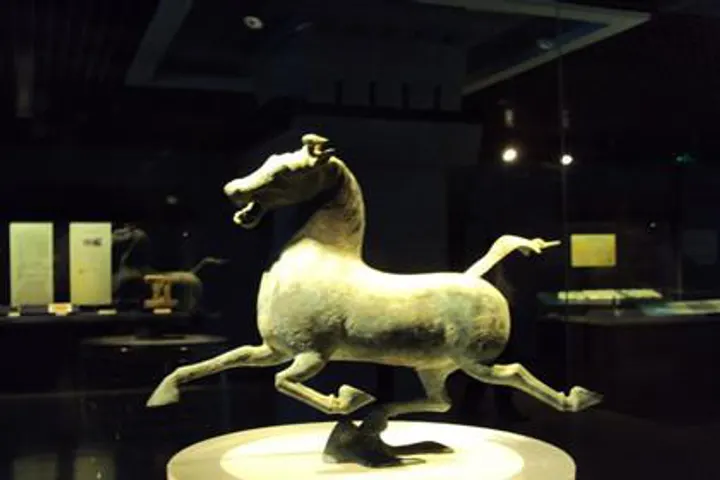
Meet the Galloping HorseThe logo on every China Tourism sign
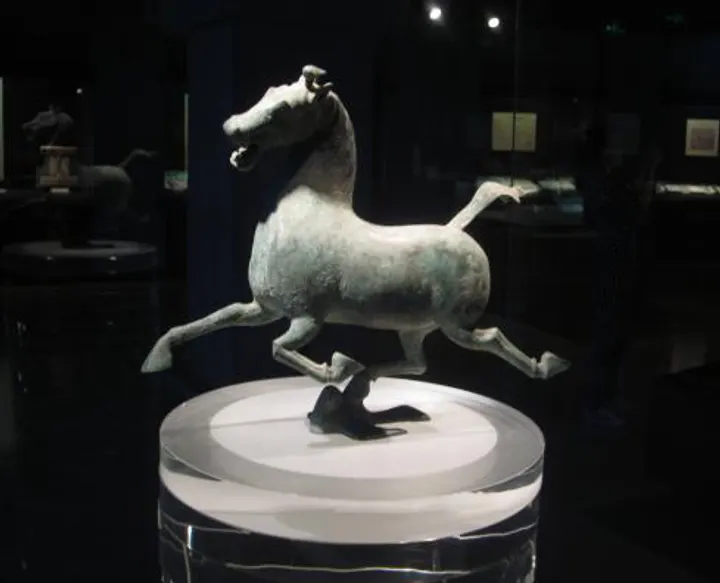
Excavated in 1969 from a Han tomb at Leitai in Wuwei, the bronze horse runs with three hooves in the air and one resting on a flying swallow — the single most famous object in Gansu and the model for the China Tourism emblem. It stands on the second floor of the Gansu Provincial Museum, in the Silk Road gallery. Entry is free, but you must book ahead.
Booking:Free; reserve up to 3 days ahead on the official WeChat account
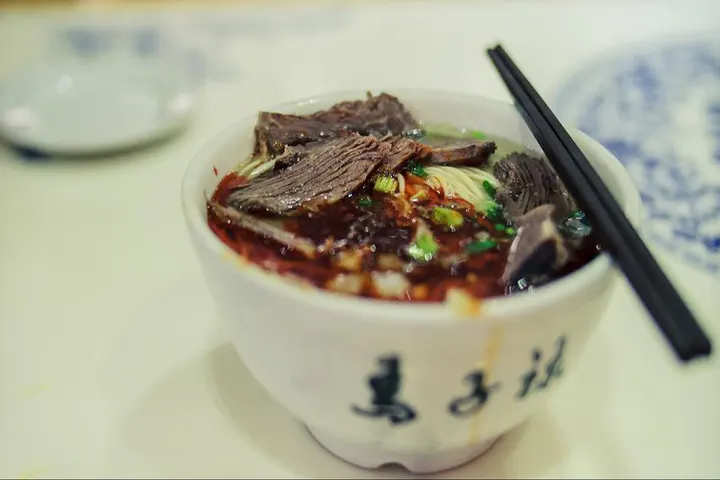
Eat beef noodles at breakfastHow the city wakes up
Locals call it niurou mian, or niuda for short — never 'Lanzhou pulled noodles'. The catechism is 'one clear, two white, three red, four green, five yellow': clear broth, white radish, red chilli oil, green garlic sprouts and coriander, yellow alkaline noodles. A bowl costs ¥8 and contains no beef by default; you add the meat separately.
Timing:6:00–14:00; many shops close in the afternoon
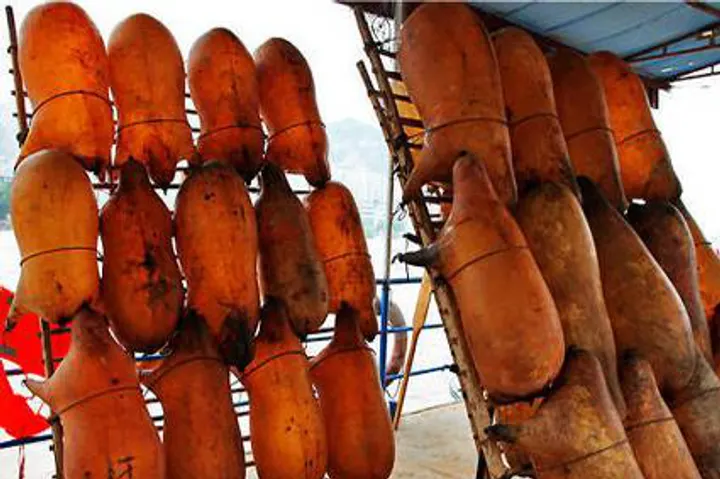
Drift the Yellow River on a sheepskin raftThe oldest way across
A dozen inflated sheepskins lashed under a wooden frame: this is the craft that carried goods and people across the Yellow River for centuries. Rides run in summer only, setting out from the wharves near Zhongshan Bridge or the Waterwheel Park for ten-odd minutes on the water. Wear the life jacket and bag your phone.
Price:About ¥60–100 per person, depending on the route
Eat through the Zhengning Road night marketOne street, most of the northwest
A 220-metre lane packed with more than a hundred stalls, all smoke, tungsten light and noise after dark. Work your way through milk-and-egg fermented rice, grey-pea porridge, fermented oat drink, lamb skewers, mutton offal and cold noodle sheets; ¥30–40 per person buys a serious feast.
Hours:Stalls set up around 18:00 and run past midnight
03Seven questions travelers ask first
When is the best time to visit Lanzhou?
May to October works, with September and early October the sweet spot: fruit is still in the markets, the heat breaks, and the river runs full. July and August are sunny rather than sticky. Spring (March–April) can bring dust storms, while winter is dry and cold but wonderfully quiet — no queues at the noodle shops.
Is Lanzhou worth a stop, or just a transfer point?
Give it two nights. Day one follows the river: Zhongshan Bridge, the White Pagoda hill, the Waterwheel Park and the Yellow River Mother sculpture, then the night market. Day two starts at the provincial museum and ends at Wuquan Mountain or Zhangye Road. Treating it as a pure transfer misses the best of the city — breakfast noodles and the midnight food streets.
How do I book the Gansu Provincial Museum, and where is the bronze horse?
Entry is free but ticketed: reserve through the museum's official WeChat accounts, up to three days ahead. The daily cap is 12,000 visitors split across four time slots. Opening hours are 9:00–17:00, with booking closing at 16:00 and last entry at 16:30; closed Mondays except public holidays. The Galloping Horse stands in the Silk Road gallery on the second floor. Metro Line 1 to Xizhanshizi, exit A, then 500 m east.
How far is Zhongchuan Airport, and what is the best way into town?
The airport sits at Zhongchuan in Yongdeng County, about 70 km from downtown, and all flights now use Terminal 3. The intercity train is the default: 35–45 minutes from Zhongchuan Airport East to Lanzhou West, roughly ¥18.5–30 in second class, or about ¥21.5 to Lanzhou Railway Station. Trains start around 06:00 and the last runs between 21:30 and 22:30 depending on the day, so late arrivals fall back on the bus (¥30, about an hour) or a taxi (¥150–200). The metro does not reach the airport.
What is the difference between Lanzhou Station and Lanzhou West?
Yes, easily. Lanzhou West is the high-speed hub: G and D trains toward Xi'an, Xining and Urumqi leave from here, with Metro Line 1 underneath. Lanzhou Railway Station, in Chengguan District near the old center, handles K/T/Z conventional trains plus the intercity service to Zhongchuan Airport, and sits on Metro Line 2. The two are about 10 km apart with no direct rail link; the metro transfer takes around 30 minutes, so allow two hours between trains. Check whether your ticket says Lanzhou or Lanzhou West.
Is the food spicy, and what are the rules in halal restaurants?
Lanzhou food is not aggressively hot: the chilli oil is fragrant rather than punishing, and you can ask for less. Beef noodles, hand-grabbed lamb, liangpi and grey-pea porridge are mild or not spicy at all. Halal restaurants serve no alcohol and no blood-based dishes, and bringing outside food is frowned upon. In mosques, remove your shoes, dress modestly, carry a scarf if you are a woman, and never photograph people at prayer.
Is Lanzhou expensive? What does two days cost?
Cheap by provincial-capital standards. A bowl of noodles is ¥8, a night-market dinner ¥30–40 a head, a chain hotel ¥200–400 a night and a hostel bunk ¥50–90. Almost all the sights are free; the exceptions are the river cable car (¥80 return), the sheepskin raft (¥60–100) and Shuimo Danxia (¥80 plus a ¥20 shuttle). Budget ¥800–1,500 for two mid-range days, excluding long-distance transport.
04Two days in town, a third out of it
Lanzhou's sights line up along the river, so the only planning rule is to move with the water and avoid crossing the city twice. Give the museum one half-day, the river promenade another half to a full day, and every evening to the food streets. Save the third day for the countryside.
D1
Start with noodles, then cross Zhongshan Bridge and climb to the White Pagoda for the city view. Walk down and follow the south bank west to the Waterwheel Park and the Yellow River Mother sculpture. Lunch on Zhangye Road's Dazhong Lane, spend the afternoon at the Xiguan mosque and the antique stalls in the City God Temple, and finish at the Zhengning Road night market, ideally well past midnight.
D2
Give the whole morning to the Gansu Provincial Museum — book three days ahead, head straight for the bronze horse and the Postal Courier brick relief on the second floor, then the painted pottery upstairs. After lunch, ride a bus or taxi south to Wuquan Mountain for the five springs and the Ming halls of Chongqing Temple. Come back via Zhangye Road for lily bulbs and sanpaotai tea.
D3
Pick one: north to the Shuimo Danxia badlands (¥80 entry plus ¥20 shuttle; best light in late afternoon), or east to Qingcheng, an old river town of walled courtyards. Back in the city with time to spare, claim a plastic chair at a riverside tea stall and order a bowl of sanpaotai before you leave.
05From the iron bridge to the bronze horse
Zhongshan Bridge
Built between 1907 and 1909, Zhongshan Bridge was designed by an American engineering firm, supplied and overseen by the German firm Telge & Schroeter, and assembled by Chinese workers — with every steel member shipped from Germany to Tianjin and hauled overland to Lanzhou. It was the first permanent iron bridge across the Yellow River and is still called 'the first bridge under heaven'. Renamed in 1928 for Sun Yat-sen, it runs about 233 m and now carries only foot traffic, free and open all day. The north end faces the White Pagoda hill; the south end opens onto the riverside tea stalls. Lights come on after about 19:30.
White Pagoda Mountain Park
The hill rises on the north bank and takes its name from a 17-metre white stupa first built in the Yuan dynasty. The park is free and open roughly 6:00–18:00; the climb from the north end of Zhongshan Bridge takes 20–30 minutes on good steps. At the top, the stupa stands beside Cien Temple and a row of halls, and a little higher up the Mudan Pavilion opens the whole river valley and the bridge below. The Yellow River cable car runs from the base, ¥50 up, ¥30 down, ¥80 return, 09:00–17:00.
Waterwheel Park
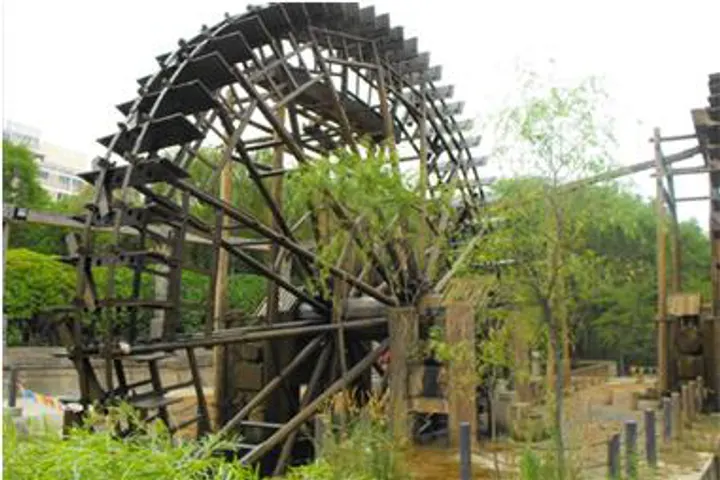
A giant wooden waterwheel in the Waterwheel Park, its spokes towering over visitors
Lanzhou was once called the city of waterwheels: from the Ming dynasty onward, 16-metre wheels along both banks lifted river water into irrigation channels. The park, built in 2005, reconstructs that landscape with a dozen wheels lined up along the south bank, divided into a wheel garden, a wheel plaza and a culture square. Entry is free, 8:00–18:00, extended to 20:00 in summer. In winter the river drops and the wheels often stand still, so do not come solely to see them turn.
The Yellow River Mother sculpture
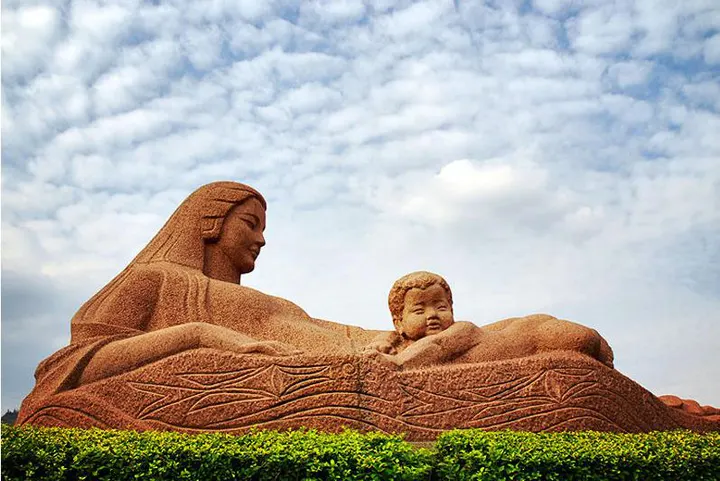
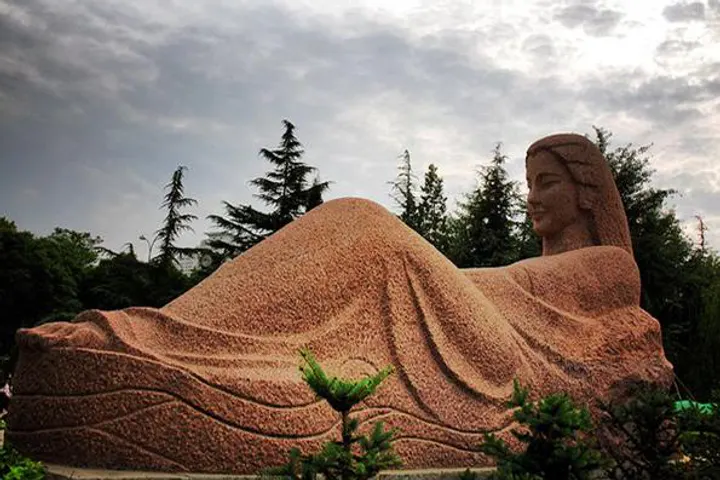
The granite Yellow River Mother, a sleeping infant in her arms
Sculpted by He E in 1986, the piece shows a reclining mother with a baby boy in her arms — the river and the people it feeds. The granite is polished soft, the composition deliberately simple, and the result is the city's most recognizable symbol. It stands on the middle stretch of the south promenade, north of Xiaoxihu Park: free, open all day, about 20 minutes on foot from Zhongshan Bridge or bus 26 to the Yellow River Mother stop.
Wuquan Mountain Park
Wuquan Mountain sits at the northern foot of Gaolan Mountain in the south of the city, named for five springs: Hui, Meng, Ganlu, Juyue and Mozi. The park is free and opens roughly 6:00–21:00. Its oldest surviving structure is the Vajra Hall inside Chongqing Temple, built in 1372; three routes climb the slope, past Mani Temple and Dizang Temple on the west, Junyuan Temple and Wanyuan Pavilion in the middle, and a scatter of pavilions on the east. A statue of the Han general Huo Qubing stands at the entrance, rubbed shiny by locals for luck.
Gansu Provincial Museum
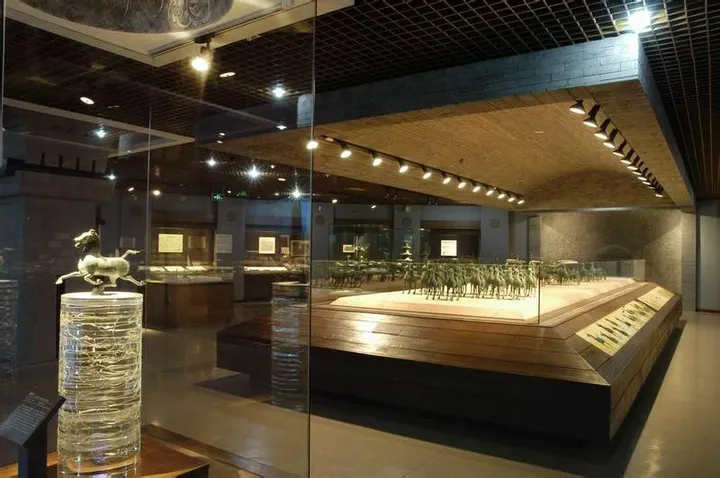
Inside the Gansu Provincial Museum: the bronze horse in front, a bronze chariot procession behind glass
The collection runs to roughly 350,000 objects, from Cretaceous fossils and Majiayao painted pottery through Shang and Zhou bronzes to Han and Tang Silk Road treasures. The Galloping Horse is on the second floor in the Silk Road gallery, sharing the floor with the Postal Courier brick relief; the third floor holds painted pottery and Buddhist sculpture. Entry is free but requires a reservation up to three days ahead, capped at 12,000 visitors a day, closed Mondays. Metro Line 1 to Xizhanshizi, exit A, then 500 m east. Allow two to three hours.
The Galloping Horse up close, three hooves airborne and one resting on a flying bird
Xiguan Mosque
Lanzhou has a large Muslim population and Chengguan District is full of mosques; Xiguan is the biggest, a white dome with a slender minaret that stands out against the old town skyline. The present building is a late-20th-century reconstruction rather than an antiquity. Visiting is free outside prayer times; women should cover their hair and everyone should dress modestly, and no one should enter the prayer hall or take photographs during services.
06On the water, after dark, over tea
Sheepskin rafting
The skins are inflated, lashed under a wooden frame, and a boatman crouches at the front, pulling the raft off the bank one stroke at a time. The ride lasts ten-odd minutes; when the current is strong it bucks hard and you will get splashed. It runs in summer only, from wharves near Zhongshan Bridge, the Waterwheel Park and the Yellow River Mother, at about ¥60–100 per person. Life jackets are mandatory and non-swimmers are fine, but leave nervous small children on shore.
Sanpaotai by the river
Sanpaotai is tea in a lidded bowl, brewed with dried longan, goji berries, red dates and rock sugar. Hot water goes in again and again, the sweetness arrives slowly, and you keep topping up until the leaves give out. Rows of open-air tea stalls line the west side of Zhongshan Bridge and the south promenade; a reclining chair, a bowl and the river are enough for an afternoon. Expect ¥15–25 a bowl, refills free.
The river and the bridge at night
After dark the bridge, the White Pagoda hill and the buildings on both banks switch on together, and the river stretches every light into a long stripe. This is Lanzhou's best two hours. Walk from Zhongshan Bridge to the Yellow River Mother, or take a sightseeing boat from the Baita Mountain wharf (about ¥49, 40 minutes). The wind on the bridge is strong even in summer — bring a light layer.
The Dunhuang Art Museum
On the south promenade near the Readers publishing building, this small museum is free, needs no booking, and opens Tuesday–Sunday 9:00–17:00 with last entry at 16:30; closed Mondays. Inside are full-scale replicas of Mogao caves, high-resolution mural reproductions and painted sculpture, lit far better than the real caves, which makes the details easier to read. There is usually a guided talk around 11:00, and the Waterwheel Park is a short walk away.
Lanzhou guzi and hua'er
Lanzhou guzi is a local seated ballad form, sung to sanxian and yangqin, listed as national intangible heritage in 2006. Hua'er is the high, piercing mountain song of Gansu, Qinghai and Ningxia, added to UNESCO's intangible heritage list in 2009. Regular performances are rare; you are more likely to stumble on them at festivals, in parks or among amateur groups along the river. When you do, stop and listen.
07Old town or the high-speed station
The city is a long strip, so the wrong end means a taxi every day. First-timers should base themselves around Xiguan, Zhangye Road and Nanguan: Zhongshan Bridge, Zhengning Road and the shopping streets are all within twenty minutes on foot, and Metro Line 1 stops at Xiguan. If you have an early high-speed train or flight, the area around Lanzhou West works better, though there is nothing to wander at night.
Xiguan and Zhangye Road: the most convenient base, chain hotels ¥200–400, walking distance to the river and the night market.
Nanguan and Dongfanghong Square: the metro interchange, plenty of malls, easy for both railway stations.
The riverfront at Beibinhe Road and Yantan: rooms with river views ¥400–700, quiet and good for a slow stay, though farther from the food streets.
Lanzhou West: the stress-free choice before an early train, ¥200–350, newer buildings but mediocre food nearby.
Hostels: a handful of international hostels around Xiguan and Chengguan, bunks ¥50–90, good for solo travelers hunting company.
Rates jump in July–August, during National Day and around the marathon, so book two weeks out. Hotels are generally cheap, but many sit in older buildings: check for a lift and a private bathroom before booking, confirm heating in winter and air conditioning in summer.
08One bowl of noodles, and the street that surrounds it
Lanzhou's flavor starts at six in the morning, when the noodle shops open with broth that has simmered all night and chilli oil just poured. By one in the afternoon many have sold out and shut. Beyond beef noodles, the daily repertoire runs through liangpi, grey-pea porridge, fermented oat drink, hot winter pear, sour-soup noodles, hand-grabbed lamb and milk-and-egg fermented rice. The register is salty and savory rather than fiery, and halal kitchens dominate. Old shops move and change their hours, so check the address on a map before you go.
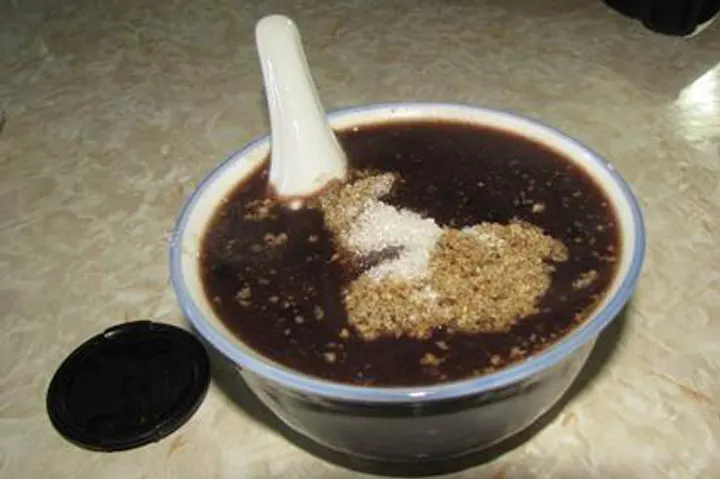
Grey-pea porridge, thick and dark, finished with a spoon of sugar
Nine things to eat
Beef noodles: ¥8 a bowl, clear broth, white radish, red chilli oil, green herbs, yellow noodles. No beef comes with it; add a portion for ¥8–10.
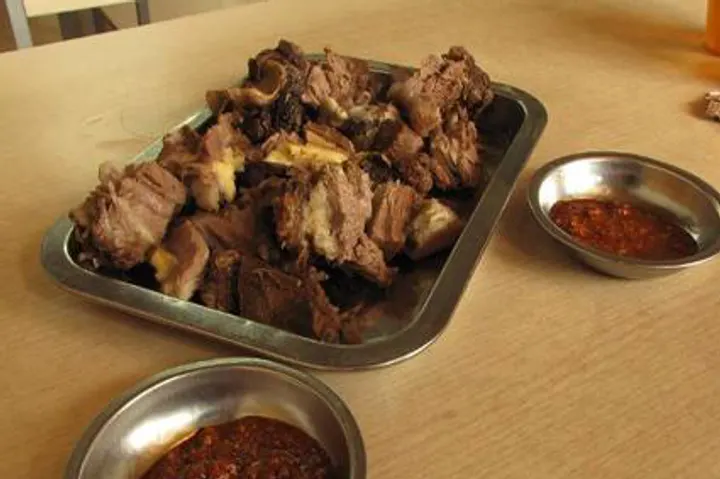
Hand-grabbed lamb: big bone-in pieces boiled until tender, dipped in salt-and-pepper or garlic paste, rich but not greasy; about ¥40–60 for half a jin.
Liangpi: steamed sheets of wheat or starch batter cut into ribbons and dressed with chilli oil, vinegar, garlic water and gluten; ¥6–10 a plate.
Grey-pea porridge: speckled peas and red dates cooked to a dark paste, sweetened at the table and served chilled in summer.
Tianpeizi: fermented naked oats or highland barley, faintly sweet with a beery tang, served cold; ¥5–8 a bowl.
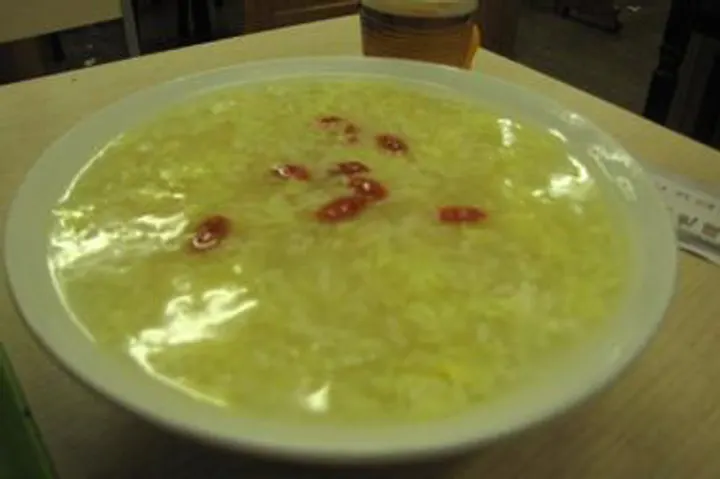
Milk-and-egg fermented rice: milk, egg and rice wine simmered together, topped with sesame, raisins and goji; hot, sweet and filling at ¥10–15.
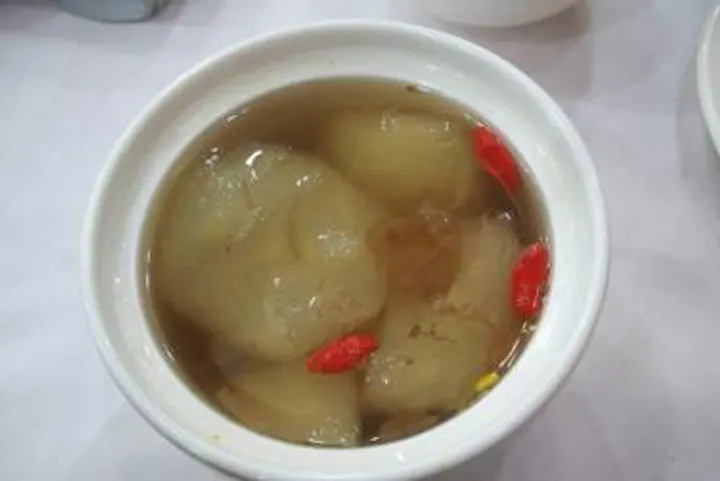
Hot winter pear: winter pears stewed with rock sugar and goji until soft, drunk with the syrup — the local remedy for dry throats.
Jiangshui noodles: noodles in a fermented, lightly sour broth, clean and cooling, best in summer; ¥10–15.
Potato slices and clay-pot stews: the Tongwei Road stalls sell sliced potato, tofu skin and sweet rice cakes, while small clay pots bubble with vermicelli and meatballs — the local afternoon snack.
Ordering by noodle gauge
Noodle gauge is a vocabulary of its own. Maoxi is hair-thin and softens fast; xi, the default, is a little thicker than a matchstick and what most locals order; erxi has real bite and is the safest first choice; sanxi is thicker still; jiuye is flat like a leek leaf; kuan is a finger-wide ribbon; dakuang is one continuous belt per bowl; and qiaomaileng, triangular in section, is the rarest. Say 'erxi, extra chilli' and you are done. Eat within three minutes of it reaching the table, before it goes soft.
Hand-grabbed lamb, bone-in and barely seasoned, with chilli-salt on the side
Where to eat
Ma Zilu (86 Dazhong Lane): the famous name, now crowded with visitors; ¥15–30 a head. For local taste, try Jinding or Mogouyan below.
Jinding (368 Pingliang Road / 211 Zhongshan Road): the locals' pick, and home to the fourth-generation noodle master who appeared in the documentary series A Bite of China; ¥12–20.
Mogouyan (around Xiguan): an old shop with a dawn queue and a notably clear broth; ¥10–15.
Du Ji Sweet Shop (Dazhong Lane off Zhangye Road): grey-pea porridge, hot pear and liangpi, mostly sweet; ¥10–15.
Ma Laoliu (17 Tongwei Road): refined hand-grabbed lamb and lamb dishes in comfortable surroundings; ¥60–80 a head.
Zhengning Road night market: the Lao Ma stall has the longest queue for milk-and-egg fermented rice, though the versions are much alike; lamb skewers ¥2–3, apricot juice ¥5.
Milk-and-egg fermented rice, with a few goji berries floating on topHot winter pear, stewed in rock-sugar syrup with a few goji berries
09What is worth carrying home
Lanzhou has more to take home than you would guess: lily bulbs, roses, sanpaotai tea sets, carved gourds, Tao inkstones and the museum's green-horse merchandise. Supermarket specialty aisles are the stress-free option — fixed prices, vacuum packing, no haggling. The shops on Zhangye Road and near the station are convenient but marked up; the Eastern Wholesale Market is cheaper for dried fruit and lilies in bulk.
Six things worth buying
Lanzhou lily bulbs: fat, sweet and almost unheard of elsewhere in China; vacuum-packed at ¥30–60 a jin.
Kushui roses: small, intensely perfumed buds from Yongdeng; rose jam and rose tea travel well.
Sanpaotai sets: tea packed with longan, goji, dates and rock sugar in a lidded bowl; boxed sets ¥30–80.
Carved gourds: landscapes, figures or miniature calligraphy incised into egg-sized gourds — a Lanzhou craft, from a few dozen yuan to several hundred.
Tao inkstones: dark green stone from the Tao River, fine-grained and heavy; gifts from several hundred to over a thousand yuan.
Museum merchandise: the green-horse plush based on the bronze galloping horse, fridge magnets and painted-pottery washi tape; the shop at the museum exit has the fullest range.
Where to browse
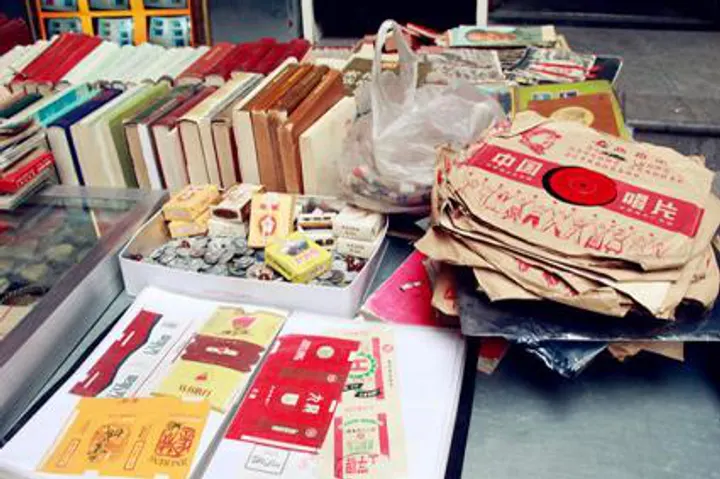
An antique stall at the City God Temple: old books, cigarette packets, stamps and stacks of vintage paper
Zhangye Road is the old shopping spine, Lanzhou's answer to Wangfujing, mixing department stores, specialty shops and snack stalls. Guofang Department Store on Dongfanghong Square is a step smarter, with a supermarket below. The antique market inside the City God Temple is good for browsing — old books, cigarette packets, stamps, photographs — but judge everything yourself, and remember that any 'excavated relic' offered on a blanket is certainly fake.
10Two stations, a distant airport, one metro line
Arriving by train
High-speed and D trains from Xi'an North to Lanzhou West take between 2 h 40 min and 3 h 30 min, with second class around ¥174.5–216 and departures from early morning to about 22:00. Lanzhou West is the high-speed hub with Metro Line 1 directly below; Lanzhou Railway Station handles conventional trains plus the airport intercity service. The two are about 10 km apart — check your ticket, and allow at least two hours for a cross-town transfer.
Flying in through Zhongchuan
Zhongchuan Airport lies at Zhongchuan in Yongdeng County, about 70 km from downtown, and all flights use Terminal 3. The intercity train is the way in: 35–45 minutes from Zhongchuan Airport East to Lanzhou West, ¥18.5–30 in second class, or about ¥21.5 to Lanzhou Railway Station. The first train leaves around 06:00 and the last runs between 21:30 and 22:30; after that, take the airport bus (¥30, about an hour) or a taxi (¥150–200). The metro does not serve the airport, so do not wait for one.
The metro
Line 1 runs east–west across the city from Chenguanying to Donggang, stopping at Lanzhou West, Xizhanshizi (for the museum), Xiguan (for Zhongshan Bridge and Zhangye Road) and Dongfanghong Square. Line 2 runs north–south from Yanbai Bridge to Dongfanghong Square, calling at Lanzhou Railway Station. Fares start at ¥2 for 4 km and cap at ¥8; QR codes work at the gates. Service runs roughly 6:30–22:30, and the last trains are early — do not cut it fine at night.
Taxis and ride-hailing
Taxis start at ¥10 for 3 km, then about ¥2 per kilometre, with a ¥12 night flag; most trips inside the city cost ¥10–25. Didi or Amap is easier than hailing, and the fixed-price touts at the station and airport exits should be ignored. The river corridors jam between 17:30 and 19:00, so add twenty minutes if you are catching a train.
Buses, bikes and walking
City buses cost ¥1–2 and go almost everywhere, but crossing the long city takes time. Shared bikes run about ¥1.5 per half hour and are perfect along the river promenade, though north–south streets are steep. For the core stretch — Zhongshan Bridge to the Waterwheel Park to the Yellow River Mother — just walk: about 3 km, two hours with stops.
Emergency numbers: police 110, ambulance 120, fire 119; the 12345 hotline handles tourism complaints and general inquiries.
Major hospitals: the First Hospital of Lanzhou University (1 Donggang West Road) and Gansu Provincial People's Hospital (160 Donggang West Road), both in Chengguan with 24-hour emergency departments.
Payment: WeChat Pay and Alipay work everywhere, including metro gates; big malls and chain hotels take foreign cards, but street stalls are QR-only.
Altitude and health: the city sits at 1,520 m, low enough that altitude sickness is rare; the air is dry and the UV strong, so drink water and carry sunscreen and lip balm.
River safety: the current is fast and full of eddies, and swimming is forbidden; wear the life jacket on rafts and boats.
Etiquette: remove shoes in mosques, dress modestly, never photograph worshippers at prayer; halal restaurants serve no alcohol and frown on outside food.
12Bookings, moisturizer and pitfalls
Reservations: book the Gansu Provincial Museum three days ahead on its official WeChat account — 12,000 places a day, closed Mondays. The Dunhuang Art Museum is free and needs no booking.
Seasonal kit: temperatures swing hard between day and night, so pack a light layer even in summer, plus sun sleeves, a hat, sunglasses and SPF50; a proper down coat in winter.
Moisture: lip balm, face cream, body lotion and a hydrating spray — Lanzhou is drier than most visitors from southern China expect.
Stomach medicine and a mask: night-market food is oily and spicy, and spring brings dust, so pack both.
Electronics: power bank and plug adapter; install Alipay or WeChat, a map, a translator and a ride-hailing app — gates, tickets and menus all run on QR codes.
Cash: almost never needed, but carry ¥100 in small notes in case a stall's connection drops.
Four pitfalls: first, do not confuse Lanzhou Station with Lanzhou West — they are 10 km apart; second, the last airport train goes between 21:30 and 22:30, so plan a fallback for late flights; third, 'antiques' at night markets and stalls are usually artificially aged, so never pay relic prices; fourth, hotel rates double during May Day, National Day and the Lanzhou Marathon — travel off-peak if you can.
13Two thousand years of Jincheng, and one river
Geography and climate
Lanzhou occupies a river valley in the upper Yellow River basin, walled in by Gaolan Mountain to the south and the White Pagoda hill to the north, with the built-up area stretched along the water. At 1,520 m, it averages about 10°C a year and receives roughly 300 mm of rain, while evaporation runs several times higher — hence the dryness. The seasons are sharp, summers are not oppressive, winters are cold but bearable, and spring brings dust carried in on northwesterly winds.
A short history
In 86 BC the Han established Jincheng County here; the name, 'golden city', is variously explained as gold found during construction or as a reference to an impregnable fortress. Under Emperor Wen of Sui it became Lanzhou. With the Silk Road open between the Han and Tang, the town grew into the ferry crossing and trading post between the Central Plains and the Hexi Corridor — silk heading west and Ferghana horses heading east both passed over this stretch of river. The iron bridge opened in 1909, the city was taken in 1949, and from the 1950s it became northwest China's oil-refining, chemical and railway hub.
Peoples and faiths
Lanzhou has a large Hui population and mosques crowd Chengguan District; Gansu's own Dongxiang, Bao'an and Yugur minorities also live in the city. Beef noodles, hand-grabbed lamb and lidded-bowl tea all grew out of this everyday mix. Tibetan and Chinese Buddhism, Daoism and Islam coexist here: the temples on the White Pagoda hill, the halls of Wuquan Mountain and the dome at Xiguan are visible from one another across the water.
A reclining Buddha carved in stone on a lawn, pines behind it
Readers, noodles and basement bands
The magazine Readers was founded in Lanzhou in 1981 and spent years among the highest-circulation periodicals in the country, giving the city a cultural identity beyond noodles. Beef noodles were created by Ma Baozi in 1915 and listed as national intangible heritage in 2021. The city also has its own rock lineage: more than two hundred bands have formed since the 1990s, and Low Wormwood's song 'Lanzhou Lanzhou' functions as the unofficial anthem.
14Four routes out of the city
Shuimo Danxia (half to full day)
In Shuping, Yongdeng County, half an hour to an hour from downtown, this is the largest expanse of banded badlands near Lanzhou. Entry is ¥80 plus a ¥20 shuttle, open 08:30–17:30; three hours covers the standard route, while a deep-visit package with camel cart and dome cinema runs about ¥328. Side light after 16:00 is the best, and rain deepens the colours. Shuttle buses from the city start at ¥39 one way.
Qingcheng old town (one day)
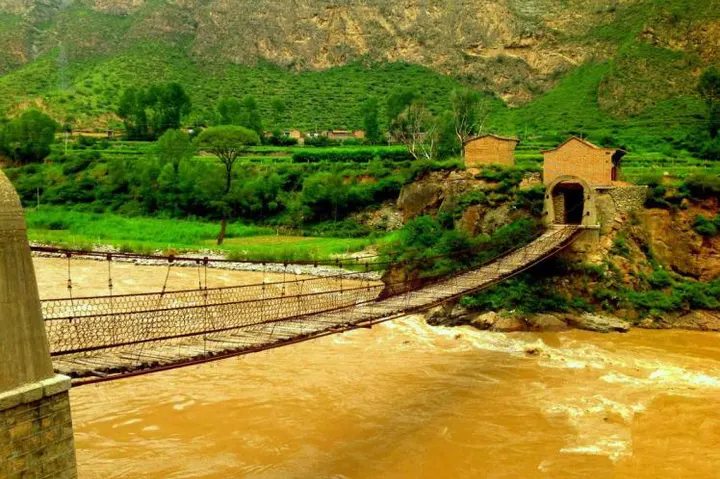
A chain suspension bridge over the silty Yellow River, with loess hills and a brick gateway on the far bank
Qingcheng sits at the northern tip of Yuzhong County on the south bank of the Yellow River, the only provincial-level historic town in Lanzhou. Whole streets of Ming and Qing houses survive, along with the Luo family compound, the Gao ancestral hall and the City God Temple. The town itself is free to wander, with individual courtyards ticketed; it is about two hours by road, or a bus to Baiyin followed by a local connection. Pear blossom comes in spring, and the river flats are at their best in autumn.
Xinglong Mountain (one day)
Southwest of Yuzhong county town and about 50–60 km from Lanzhou, this is the closest national nature reserve to the city: two peaks with the Xinglong gorge between them and the Yunlong Bridge slung across. The eastern Qiyun peak holds the Hunyuan Pavilion and Chaoyun Temple; the western Xinglong peak has the Erxian Terrace and Taibai Spring. Entry is about ¥40, open 6:00–21:00, and a small ski hill operates in winter for beginners and intermediates.
Liujiaxia and Bingling Temple (one day)
The Liujiaxia dam lies in Yongjing County, about 75 km west of Lanzhou, where the Yellow River backs up into a broad reservoir. Boats leave the dam wharf and head upstream between red rock cliffs for about an hour to the Bingling Temple caves, cut from the Western Qin through the Ming and Qing, with the great Tang Buddha of Cave 169 as the highlight. Boat and cave tickets are separate, the round trip takes a full day, and the last boat back is not one to miss.
15Read and watch a little Lanzhou first
Books
Zhang Hailong's 'North by Northwest, a Man with a Knife' is a portrait of the region around Lanzhou, mixing dialect, food, folk song and geography in a cold, exaggerated voice — the fastest route into the city's character. Pair it with an anthology from Readers, the Lanzhou magazine that once reached the whole country, to see what all those pages were actually about.
Music
Low Wormwood's 'Lanzhou Lanzhou' is the obvious starting point: a Lanzhou folk-rock band singing about the river, beer, late nights and people who leave. Play it once, then walk onto Zhongshan Bridge and the wind does the rest. Add Wild Children's 'Yellow River Ballad' for the earlier, rawer sound of a generation leaving the northwest.
Film and documentary
'Lanzhou 1949' (2009) was the first feature film named for the city, a thriller about ordinary residents smuggling intelligence on the eve of liberation, with a strong sense of the real streets. The four-part documentary 'Jincheng Lanzhou' (2016) runs from the Han-era county through the industrial twentieth century; watch it before the museum and the exhibits line up more easily.