The Potala needs bookingPermit before ticketNo stairs on day oneSweet tea by the cup
In short
Lhasa (拉萨, Lāsà) sits in a river valley at 3,650 m, where three thousand hours of sun a year have earned it the name Sun City. The Jokhang Temple and the Barkhor circuit around it are the centre; the Potala Palace stands a kilometre west on its rock; Norbulingka and the new town lie beyond that. Foreign passport holders cannot travel here independently — a Tibet Travel Permit arranged through a licensed agency has to be in hand before you board. The Potala runs on real-name reservations a week or more ahead; the Jokhang takes bookings a day before. Four or five days covers the city and one lake, May–June and September–October are the kind months, and a mid-range trip costs about ¥2,500–4,500 before long-distance transport.
¥2,500–4,500 for 4–5 days, mid-range, excluding long-distance transport
Days needed
4–5 days
Comfort
Demanding — 3,650 m, and the first two days run at half speed
Best time to go
May–June and September–October; July–August is wet, November–March is cheap but Namtso can close
01What kind of city Lhasa is
The train comes off the Nyainqentanglha pass in the middle of the afternoon and runs down into the Lhasa valley. The hills outside are bare, the river flats are planted in rows of poplars, the new blocks of Liuwu slide past the window, and then the brakes go on. You are at 3,650 m, where the air carries a little over sixty per cent of the oxygen you are used to. The platform tells you the rest: your feet arrive a beat behind you, a sentence costs a breath, the sun burns and the wind cuts, sometimes in the same minute.
The city comes in two pieces. The old town around the Barkhor is a knot of lanes barely wide enough for two people to pass, whitewashed walls, black window frames, prayer flags on the roofs. The new city runs west along Beijing Road in a straight line of malls, banks and chain hotels that could be any provincial capital. You will spend nearly all your time in the first, because everything worth walking to sits inside a one-kilometre radius.
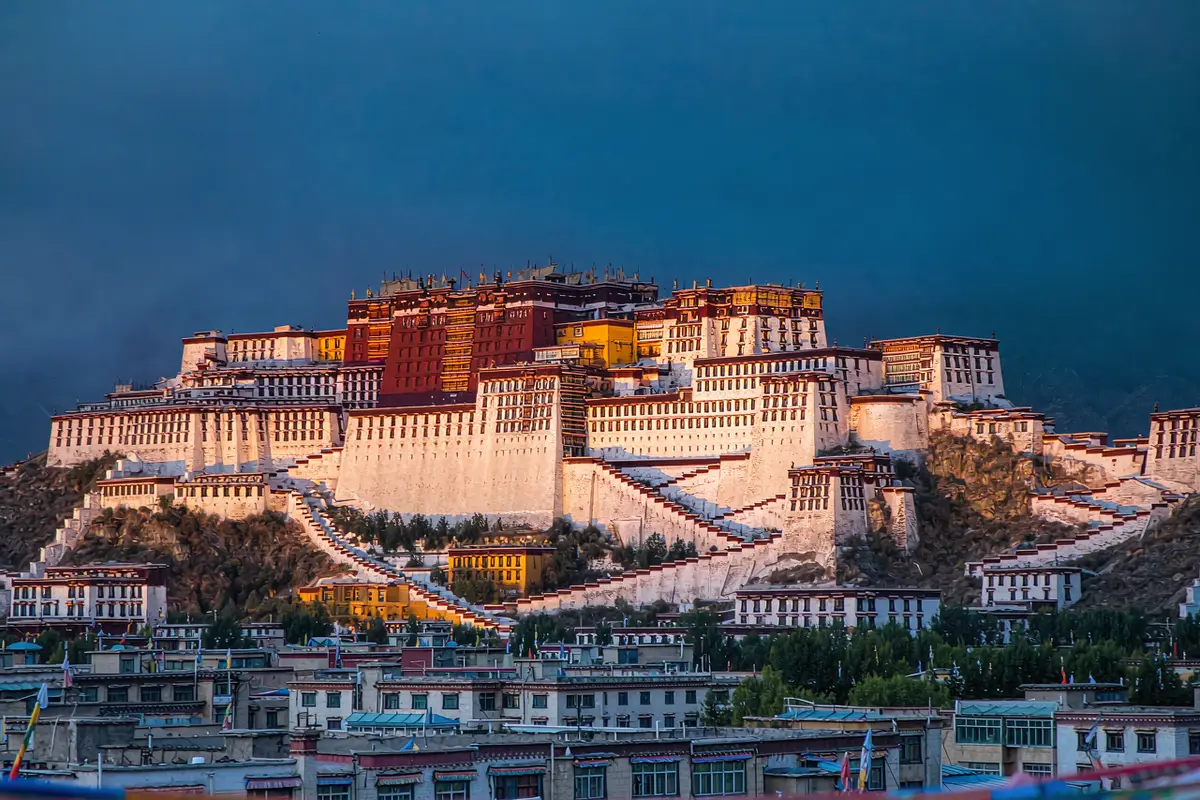
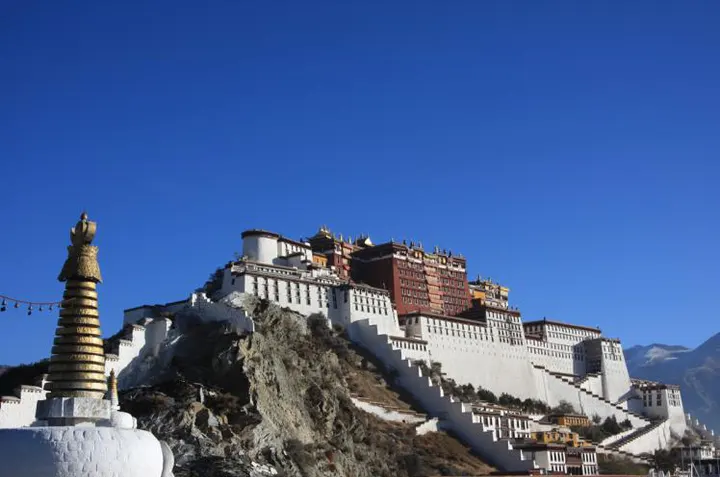
The Potala climbs Marpo Ri in stages, white below and red above; the chorten at its foot is where the kora begins
Everyone who has not been to Lhasa is certain that one day they will stand in front of the Potala. Everyone who has left knows they will come back.
Editor's note, the source guide
So do not turn Lhasa into a checklist. Give the first day nothing at all beyond an evening walk around the Barkhor with the crowd; put the Potala on the second morning and the Jokhang in the afternoon; leave the city on the third. Three days is the floor. Four buys you an entire afternoon in a teahouse, and that afternoon usually does more for the trip than one more sight would.
02Six things worth the altitude
The Potala: three hundred steps, then the darkThirteen storeys, one batch at a time
From the square it reads as thirteen storeys of white and red stacked on a rock. Inside it is something else: low passages, ladders steep enough to want your hands, the smell of butter, halls with almost no light in them. Security, then the stairs, then the White Palace, then the Red — and one hour on the clock from the moment you are in. No photography inside. If the altitude catches you, stop on a landing; nobody hurries you, but the hour does.
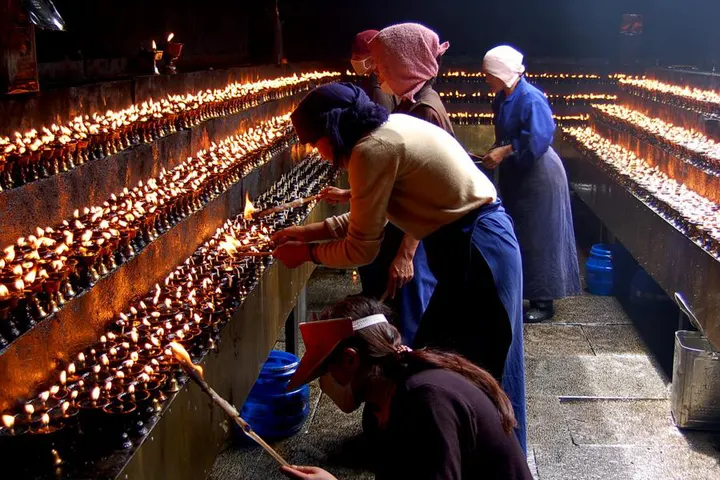
The Jokhang: butter lamps and polished stoneThe centre of the circuit
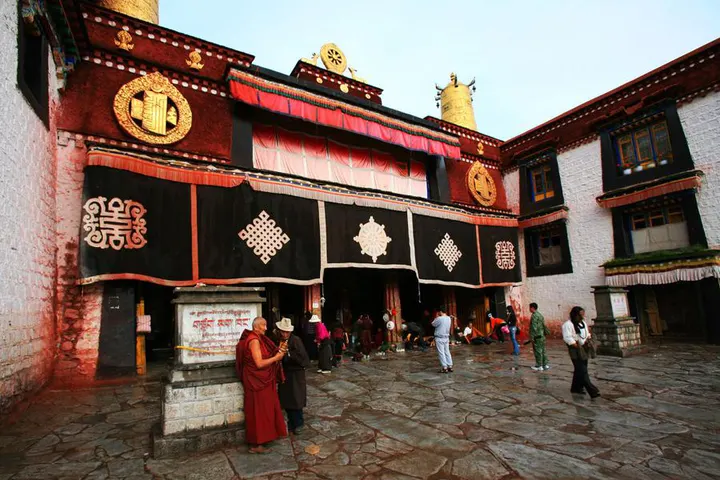
Queues form before daylight, mostly locals with thermos flasks and bags of butter. The flagstones in the courtyard have been polished by decades of full-body prostrations, and the black cloth hangings over the porch carry white endless-knot motifs. Hats and sunglasses come off at the door; shorts and short skirts are turned away; photography stops at the threshold; everyone, pilgrim or visitor, moves clockwise. In the lamp hall several thousand butter lamps burn at once and the heat hits you in the face, while a steady stream of people top them up.
The Barkhor: a kilometre round, and it takes all eveningAlways clockwise
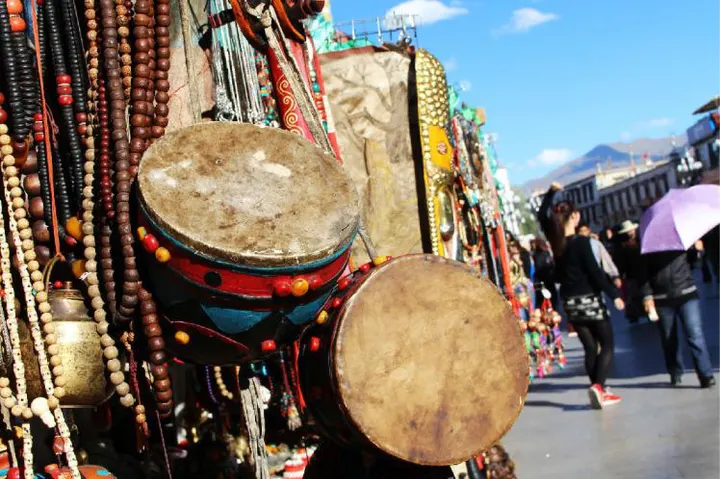
One circuit is about a kilometre, forty minutes at pilgrim pace. The flow has a single direction; walk against it and you will be bumped the whole way. Stalls sell prayer beads, hand-held prayer wheels, 'Tibetan silver' jewellery, old brass and small Nepali bronzes, with opening prices around three times what they will take. Ask before you photograph anyone — a lens in a stranger's face goes down badly here.
The debate yard at SeraThree o'clock, a clap, a question
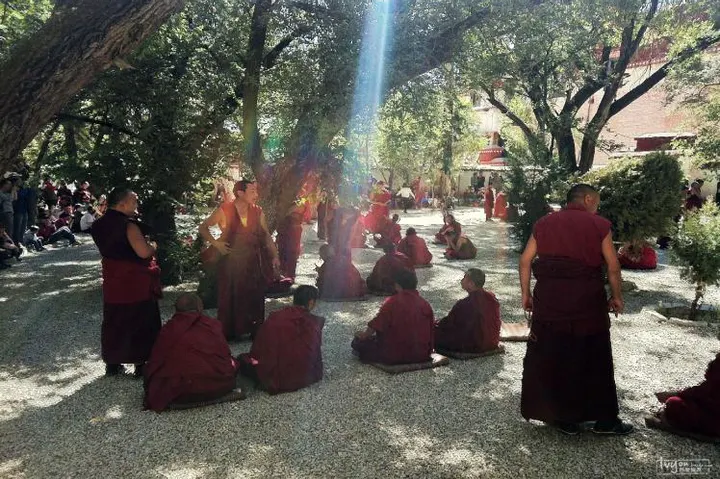
At three the yard fills with monks in two rows: the standing one claps his hands to press a question, the seated one answers from memory. Claps, stamped feet and recitation arrive all at once. Visitors line the edges — photographs are fine without flash, but do not plant yourself between a monk and his text. Afterwards, twenty minutes up the hill behind the monastery gets you the whole city below.
Norbulingka: lawns, shade, a summer palaceWhere Lhasa takes the day off
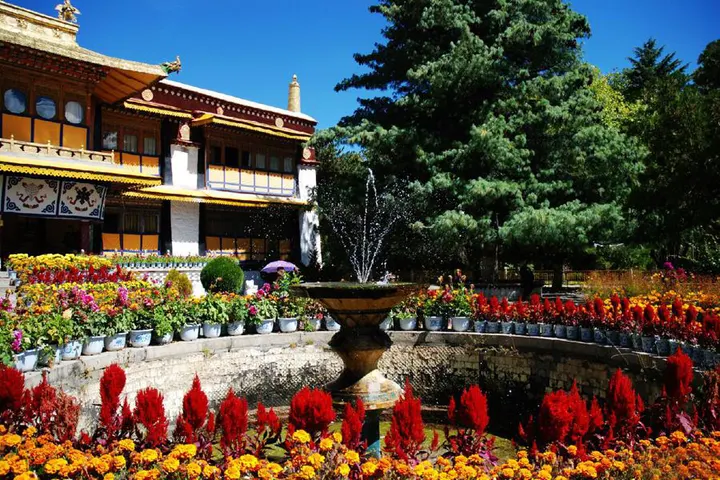
A walled grove of poplars and pines, a few lawns, and several yellow-walled pavilions with gilded roofs. Local families arrive at weekends with a mat and a flask and stay until the light goes; children run on the grass. The beds are at their best from May to October, and during Shoton the city's opera troupes take over the lawns for a week.
A window seat at Makye AmeThe best angle on the Barkhor
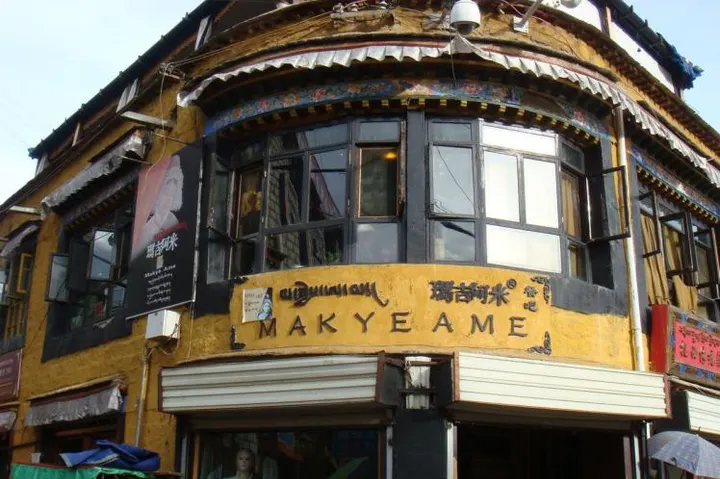
The yellow corner house at the southeast of the Barkhor. From the upper windows you look straight down the length of the circuit. The food is expensive and middling; what you are paying for is the seat, a pot of sweet tea, and the crowd going round below, with guestbooks stacked on every table.
03Seven questions worth settling early
How do I actually handle altitude — pills beforehand, and what do I do the first night?
Altitude sickness is not an illness so much as a body running behind schedule. Three things work. Go up slowly — the train beats flying, and the first two days involve no stairs, no running, no hauling a heavy case. Drink properly, two to three litres a day, until your urine is pale. And drop alcohol, hot baths and late nights for the first 48 hours. Rhodiola is taken for a week beforehand; the evidence is thin but the risk is nil. Acetazolamide is the one with real evidence behind it: start a day before, ask a doctor first, and expect tingling fingers as the usual side effect. Oxygen canisters cost ¥20–30 — a few breaths when the headache spikes, not a mask all night. The first night is the worst; keep water by the bed and breathe out slowly when you wake. If you cannot walk a straight line, slur your words, or cough up pink froth, stop being brave: descend and get to a hospital.
How does the Tibet permit work, how long does it take, and can I just go?
Foreign passport holders cannot travel independently, and no agency will sell you the permit on its own. The Tibet Travel Permit is issued only through a licensed Lhasa-based agency, and only to travellers who have booked an itinerary, hotels and a guide. Send clean scans of your passport photo page and Chinese visa; processing normally takes 8–10 working days, so apply 15–20 days ahead, and allow more in July–September. The permit names your entry city, dates and approved route, so changing plans means reapplying. The original is checked when you board a train or a flight into Tibet, which is why agencies courier it to your last hotel before the border. Anything beyond Lhasa — Shigatse, Everest, Ngari — needs a separate border permit, usually arranged by your guide after arrival. Get the order right: itinerary first, tickets second.
How do I get Potala tickets, and what separates line 1 from line 2?
Reservations only, real name, and nothing sold at the gate — not even to walk-ups. The sole official channel is the Potala's own WeChat mini-program, which releases peak-season tickets 7–10 days ahead (the window has moved around inside that range lately) at 08:30 each morning, against a daily cap of roughly 7,000. Line 1 costs ¥200 and covers the main halls of both the White and Red palaces; line 2 costs ¥100 for a shortened route and usually opens only when the day's visitor count passes five thousand. Pay within fifteen minutes of reserving or the slot is released, and one passport can succeed only once in seven days. Bring the physical passport, reach the south gate an hour early, and do not be late. If it is sold out, watch for cancellations around 08:30 and again between 14:30 and 15:30 — or come in winter, when it is ¥100 and nobody fights you for it.
When should I come — is the July–August rain worth dodging, and is winter a good idea?
May–June and September–October are the steady months: clear skies, little rain, good visibility, and walking that does not feel like work. July and August bring the monsoon — a hard shower most afternoons, cloud sitting on the mountains, and a road to Namtso that occasionally washes out; in exchange you get the most oxygen, the greenest grassland and the longest days. From November to March the crowds go, prices halve (the Potala drops to ¥100 and some sights are free), daytime sits in the low teens and a light down jacket is enough in the sun, while nights fall well below freezing. The costs are real: snow can shut the Namtso road without notice, some guesthouses close, and the air is drier still. Want an empty Barkhor? Come in winter. Want Namtso and Shigatse in one trip? Do not gamble on July.
Train or plane — does it really make a difference?
It is mostly a question of the altitude curve. The train climbs from Xining at 2,200 m through Golmud at 2,800 m and over the Tanggula Pass at 5,072 m, giving your body twenty-odd hours to work on the problem; most people step off at 3,650 m merely light-headed. A flight drops you from a few hundred metres to 3,650 m inside an hour, and a fair number of passengers spend day one in bed. The train's price is time: 21–22 hours from Xining, 36 from Chengdu, 40 from Beijing. The comfortable compromise is to fly to Xining, sleep there, and take the train the next day — no time wasted, and you still get the gradual ascent. If luggage or a short holiday decides it, fly, book a room with oxygen, and go straight to sleep.
No shower, no drinking, no exercise — is any of that real?
Yes, and for concrete reasons. A hot bath dilates the blood vessels and speeds heat loss; catching a chill at this altitude is easy, and a chest infection at 3,650 m can travel downwards fast. Sponge down for the first two days, shower on the third, keep the water lukewarm, keep it short, dry off and dress immediately. Alcohol works the same way: a drink or two pushes the heart rate up and wrecks the night's sleep, which is the thing you have least of up here — skip it entirely on night one. Hard exercise, whether running, jumping or charging the steps up Chagpori, drops your blood oxygen in seconds, and that is where the dizziness and nausea come from. Walk hills at sixty per cent of your normal pace, and use talking as the test: if you cannot finish a sentence, slow down.
Is Namtso doable in a day?
Yes, but it is a long day. The lake is 240 km out, four to five hours each way over the Lagen La at 5,190 m, and you get two or three hours on the Tashi peninsula before turning round — twelve hours or more door to door. At 4,718 m the lake sits a kilometre above Lhasa, and plenty of people find their headache gets worse here. Staying the night is the better trade: arrive in the afternoon, watch the light go, look at a sky with nothing in it, and drive back after sunrise. In winter ice closes the road at short notice, so call the scenic area or have your driver confirm conditions the day before.
04Four days, at altitude pace
One constraint overrides the rest: when your body catches up. So give the first day and a half nothing that involves climbing, put the Potala on the second morning, and leave town no earlier than day three. Your Potala slot is whatever you managed to reserve, so fix that first and build around it. Everything in the old town is walkable inside a kilometre — no car needed.
D1
Arrive in the afternoon and do nothing. Drop the bag, drink two glasses of water, lie down for an hour. Go out around six, walk one clockwise circuit of the Barkhor — watch the flow, learn the lanes, sit in a teahouse when your legs ask. Eat something plain, noodles or curry rice, no alcohol, and be asleep by ten. The less you walk today, the better tomorrow goes.
D2
The Potala in the morning: at the south gate an hour before your slot, up through the White Palace into the Red, one hour inside, then down and around the outside clockwise with the kora. Lunch on Deji Road, then a real nap. Enter the Jokhang after three, come out as the Barkhor turns gold, and take a window table upstairs for a pot of sweet tea. Finish at the palace square after dark, where the fountains run until about nine.
D3
Drepung in the morning — it is built up a hillside, so the walking is the visit; good shoes, no hurry, two and a half hours. Back into town for lunch. Be at Sera by half past two for the three o'clock debate, then climb the path behind the monastery for the view down. In the evening, choose: the 'Princess Wencheng' outdoor show, which runs May to October, or a proper dinner in a Tibetan restaurant.
D4
Leave the city. For a lake, Namtso is a twelve-hour day and Yamdrok about eight on a better road. For quiet, Ganden is 57 km east with a morning bus from the Jokhang square. If you only have half a day, Norbulingka and the Tibet Museum face each other on Norbulingka Road and fill it neatly — the museum closes Mondays.
05From the rock to the circuit
The Potala Palace
A palace went up on Marpo Ri in the seventh century under Songtsen Gampo; the present structure was rebuilt and enlarged in the seventeenth as the Dalai Lamas' winter palace — thirteen storeys, the White Palace for administration, the Red for chapels and reliquary stupas. The walls are recoated every autumn with lime and milk, which is why they read as white rather than grey. No drawings survive: the proportions were carried in the masons' heads and handed on by apprenticeship.
The route runs one way: security at the south gate, up the steps to the White Palace's east assembly hall, through the Red Palace, down the western side — one hour in total. No photographs, no hats, no stepping on thresholds, no pointing at statues. The stairs are steep and narrow, so when the person ahead stops, you stop; do not overtake on a ladder. Inside it is several degrees colder than the square, which is what the extra layer is for.
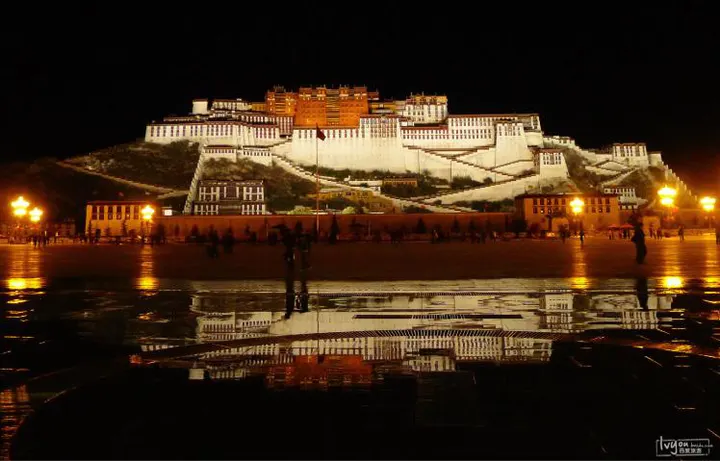
Three free angles for the classic shot: the square opposite, lit from the front in the afternoon; the Chagpori viewing platform, side-lit at dawn, which is the view printed on the back of the ¥50 note; and Zongjiao Lukang park behind the palace, where the lake takes the reflection. For the night version, wait until every lamp is on — and after rain, when the paving holds a second copy of the building.
The Jokhang and the Barkhor
The Jokhang porch — black hangings with white endless knots, flagstones worn smooth
The Jokhang went up in the seventh century as Lhasa's first temple, and it is the reason the old town has the shape it does: the Barkhor is simply the path worn around it. Three storeys under gilded roofs, flagstones in the courtyard hollowed by prostrations. Hats and sunglasses off at the door, trousers past the knee, sleeves past the elbow, cameras away inside.
The Jokhang opens straight onto the Barkhor — a kilometre of circuit that doubles as a shopping street. On one side, prayer wheels turning and beads clicking as people walk fast; on the other, stalls, teahouses, thangka shops and costume-rental studios. Seven in the morning is the quiet hour, with the light coming into the lanes sideways; by evening it is packed and the air tastes of butter and juniper smoke. Keep with the flow, and do not stop dead in the middle to take a picture.
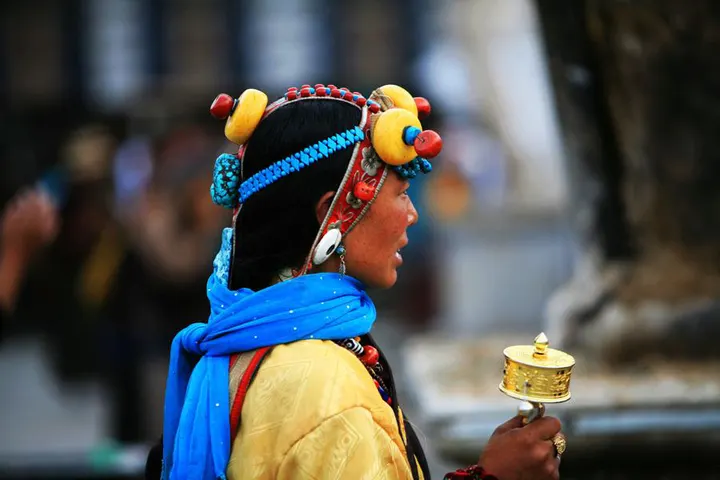
Wheel in one hand, beads in the other, another circuit
Norbulingka
Norbulingka was the summer palace and is now a 36-hectare park: poplars, pines, lawns, a handful of walled courtyards, a small zoo. The buildings are Tibetan in plan with a Chinese turn to the eaves — yellow walls, gilded roofs, painted porches — and nothing like the weight of the Potala. After the palace courtyards, half an hour under a tree is the least effortful thing you can do in Lhasa. ¥60, bought on the official mini-program, gates at 09:30.
Sera and Drepung
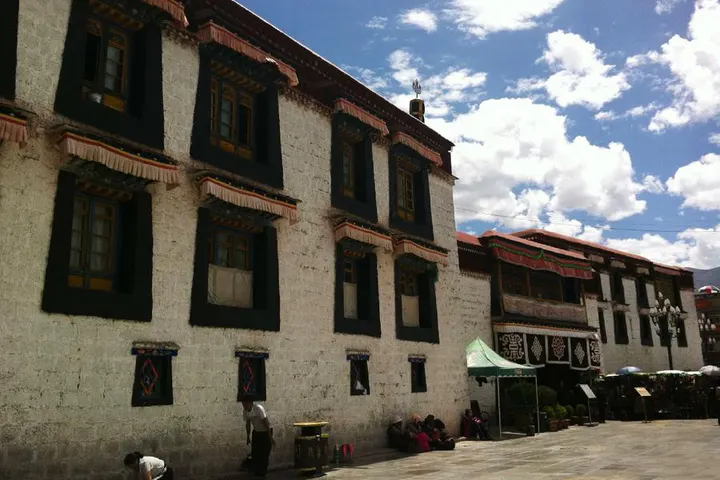
Whitewash, black window surrounds, pleated valances above each window: the standard monastery facade
Sera sits at the foot of the hill north of town, founded in 1419, ¥50 at the gate. Two reasons to come: the debate, Monday to Saturday from three to five, held under trees that are older than most countries; and the horse-headed protector in its own chapel and the Ming-era painting in the assembly hall. Twenty minutes up the path behind the monastery puts the whole Lhasa valley under your feet.
Drepung fills a fold in the hills west of town and is the largest monastery here — white walls stacking up the slope until it reads as a small town from a distance. Inside there are more lanes and steps than you expect, so follow the signs and give it two and a half hours. ¥50–55. The Shoton festival's great thangka is unrolled on the hillside here at the end of the sixth lunar month, in August or September, and on that morning the whole city comes up.
Ramoche, the Tibet Museum, the river
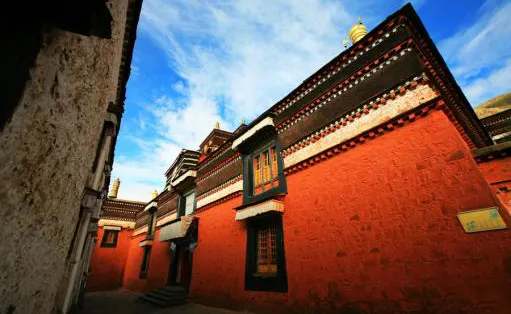
Red wall, white band, gilded finial: monastery walls keep to three colours
Ramoche is five hundred metres north of the Jokhang and a fraction of its size: few monks, few visitors, around ¥30, ten minutes inside, worth it if you are passing. The Tibet Museum faces Norbulingka, is free, closes Mondays and wants a real-name booking through its WeChat account. Give the thangka and folklore galleries on the upper floor ninety minutes — see the museum before the monasteries and half the details suddenly make sense.
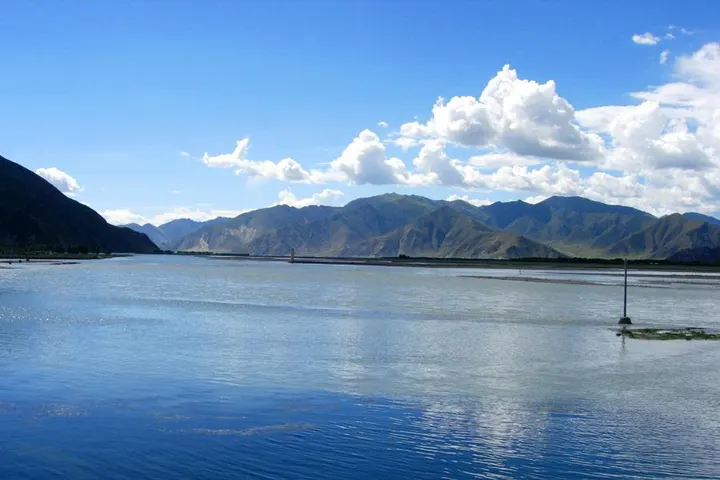
The Lhasa River — wide gravel flats, meltwater colour, mountains straight behind
The Lhasa River bends around the south of the city with wide gravel flats, grey-blue water and mountains directly behind. Walk the riverside road at dusk — the wind is strong and the temperature drops fast once the sun is gone. A night cruise now runs from Binhe Park, past the lights on both banks with the Potala in outline beyond; tickets are tiered by boat and sold on the day or through booking apps. If you would rather not pay, ten minutes on the bridge gets you most of it.
06Walk, drink tea, watch
The early circuit
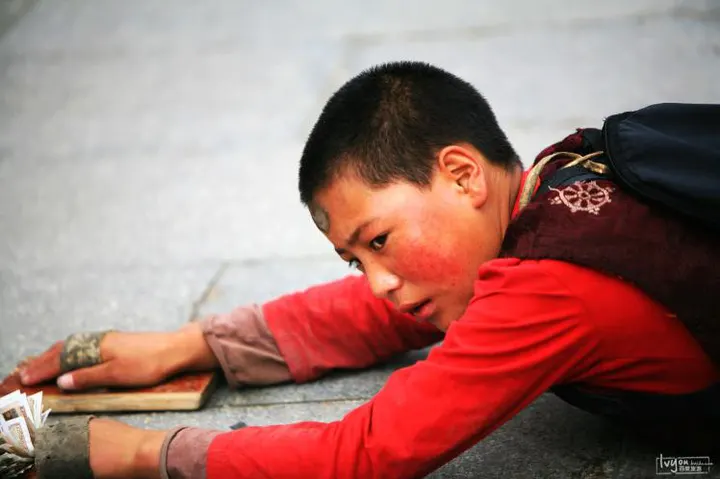
Mid-prostration, wooden boards strapped to the hands
Out at half six, when the light is still flat, and the Barkhor is already full: older people turning wheels, younger ones carrying flasks of butter, and a few going down and up again in front of the temple doors. Walk with them. You do not need the words; your feet find the rhythm by the second corner. One circuit takes about forty minutes, which lands you at a teahouse in time for breakfast. When someone is prostrating, stand to the side and leave the space in front of them clear — and keep the camera out of their face.
Losing a morning in a teahouse
Sweet tea is black tea boiled with milk and sugar, about ¥1 a glass. Glasses land on long tables and a server walks the room with a kettle, topping up anything empty; you settle at the end by counting cups. Guangming Gangqiong is one of the oldest of these places — long wooden tables, plastic stools, a wall of conversation, locals playing cards or eating noodles or staring at their phones. Three hours passes without anyone bothering you. Bring small notes; some of the old rooms still do not take phone payments.
Shoton: the thangka and the opera
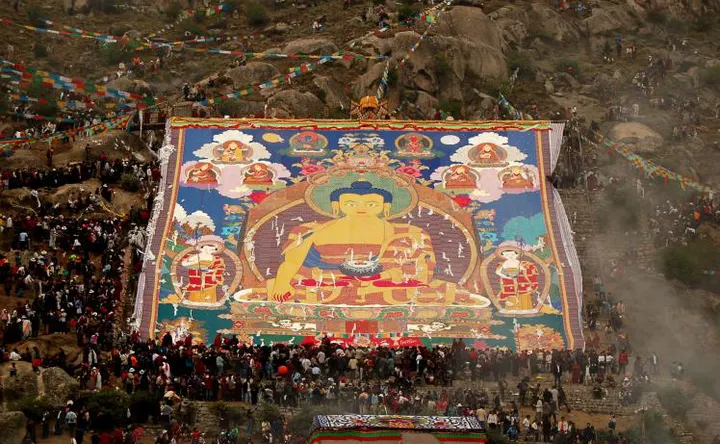
Shoton — the great thangka unrolled down the hillside, the crowd there before dawn
Shoton falls at the end of the sixth lunar month, usually in August. Before first light on the opening day a thangka tens of metres high is unrolled on the slope behind Drepung, and the hillside fills with people who walked up in the dark. For the following week, Tibetan opera companies perform in rotation at Norbulingka and in courtyards across town, drums and cymbals going all day. The date moves with the lunar calendar, so if the festival is the reason for the trip, look up that year's Gregorian dates before booking anything.
The night show, and a roof at dusk
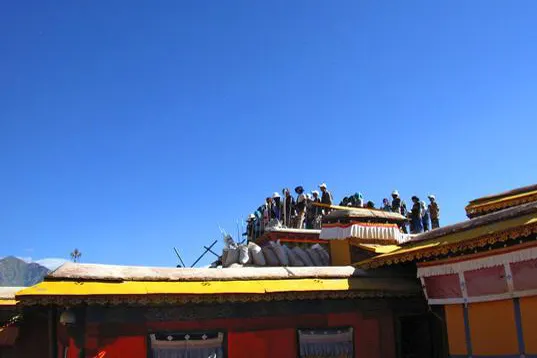
Figures on a roof terrace, a red wall and a band of yellow cornice below them
'Princess Wencheng' plays outdoors at Cijuelin in the south of the city, one show a night from May to October, with the mountainside as the set and several hundred performers coming down the slope. Tickets run ¥298–698, dearer toward the middle. It gets cold sitting still at 3,700 m for two hours — rent the padded coat they offer. If a show is not your thing, find a roof instead: plenty of guesthouses and restaurants around the Barkhor have terraces, and at dusk you can watch the sun drop behind the western ridge while the rooftops go dark one row at a time.
07Old town or new town
For a first visit, stay in the old town. The block bounded by the Barkhor, Beijing East Road and Yuto Road puts the Jokhang five minutes away and the Potala fifteen, with teahouses, Tibetan restaurants and shared-car notices all downstairs. The new town along Beijing West Road has newer rooms and lower rates, but you will take a taxi for everything and there is nothing to walk to at night. Liuwu, by the station, is the worst of both: ten kilometres out, with nothing around but guesthouses and Sichuan restaurants.
Hostel bunks: ¥40–120, thickest around the Barkhor, with shared-car boards, oxygen and hot water in the common room. Book ten days out in high season.
Budget and comfort hotels: doubles ¥180–280, small but clean, most offering oxygen-enriched rooms or an in-room concentrator for another ¥30–80.
Four-star and boutique: ¥280–500, bigger rooms, underfloor heating, often a 'Potala view' category — ask whether that means a window or a glimpse past a tree.
Five-star: from ¥900 at the St Regis or Shangri-La, with airport pickup, spa and a pool; winter rates can fall by half.
Two practical points. Oxygen: an in-room concentrator earns its keep on the first night, but do not sleep with it running — you dry out and start to depend on it; an hour before bed is plenty. Heating: from November to March many old-town buildings rely on electric blankets and air conditioning, so ask about underfloor heating or radiators when you book. It affects your sleep more than the oxygen does.
08Sweet tea first, then noodles
Everyday eating here rests on three things: sweet tea, noodles and yak. Tibetan cooking itself is plain — meat boiled soft, seasoning restrained, the staples being tsampa and wheat noodles — and it can taste underpowered at first, then quietly grows on you. Sichuan kitchens are everywhere, and a few Nepali and Indian places are genuinely good, so there is always a fallback if your stomach disagrees.
What to order
Sweet tea: black tea, milk, sugar, about ¥1 a glass or ¥10 a pot. With noodles at breakfast, with conversation at four, it works at any hour.
Tibetan noodles: alkaline dough, yak-bone broth, a firm bite, a few slices of meat and a spoon of chilli paste. ¥6–15 a bowl.
Butter tea: brick tea churned with butter and salt — savoury, and worth its weight in calories. The first mouthful usually puzzles people; by the second it is obvious why it holds a morning together. ¥15–30 a pot.
Tsampa: roasted barley flour worked into a ball with butter tea, by hand. Doing it once teaches you more than watching ten times — if it crumbles, add tea.
Yak: sliced cold with chilli, curried over rice, or dried into strips. The flavour is stronger than beef, the fat much less, and it rewards chewing.
Yogurt: set in a pottery jar, sour without apology, eaten with two spoons of sugar. ¥5–10 a jar from the corner shops on Beijing East Road and in the Barkhor lanes.
Where to eat
Guangming Gangqiong: the old sweet-tea room, long tables, ¥1 a glass, noodles at six, more locals than visitors. ¥10–20 a head.
Makye Ame: the yellow house on the Barkhor, unbeatable for the view, ordinary food, prices to match the view. ¥60–90 a head.
Snowland Restaurant: careful Tibetan cooking — potato dumplings and minced meat with mashed potato are the orders — with staff in Tibetan dress. ¥60–80 a head.
Namaste: Nepali thali and Tibetan-Western dishes, dal with rice and curry, a quiet room. ¥40–60 a head.
Deji Road and Beijing East Road: Tibetan, Sichuan, noodle shops and grills in one run, still serving at ten at night. ¥30–60 a head.
Three notes. Digestion runs slow up here, so keep the first two days light and go easy on the oil. Most teahouses take cash only — carry a few tens in small notes. And in Tibetan restaurants, do not bring your own alcohol or leave half-eaten meat lying about on the table; it reads badly to the people sitting next to you.
09What to buy on the Barkhor, and what to leave
The Barkhor sells two things: objects, and objects that look like objects. Prayer beads, hand-held wheels, woven seat cushions, handmade paper and beaten brass are the first kind and fairly priced. Anything labelled 'Tibetan silver' is usually cupronickel, and the 'old' bronze Buddhas were mostly made recently. Opening prices run about three times what they will take, so start at a third; if the seller will not move, walk, because twenty other stalls have the same thing.
Beads and prayer wheels: bodhi seed, wood, brass and silver, from tens to hundreds of yuan. Spin the wheel before you buy — it should turn smoothly, feel weighted, and not rattle.
Cushions and Tibetan carpets: hand-woven cushions run from a few hundred to over a thousand yuan; machine-made ones start around ¥100. Turn it over — handwork has messy, strong knots, machine work has a tidy row.
Thangka: a few hundred yuan buys a print with hand-painted gold highlights; tens of thousands buys months of a painter's work. Ask directly whether it is hand-painted and how long it took, and only buy from a shop willing to write a receipt.
Saffron and Tibetan medicine: not on the Barkhor. Go to a proper pharmacy or a Tibetan medicine factory shop, buy by the gram, and take the receipt. Saffron runs from tens to over a hundred yuan a gram — a bargain is a warning.
Dried yak and barley cakes: supermarkets and specialist shops are about thirty per cent cheaper than the stalls, and vacuum packs travel fine. Check your own country's rules first, though — Australia, New Zealand and the United States all restrict meat imports.
Tibetan knives: handsome, and useless to a traveller — they cannot go in cabin baggage, and most airlines treat them as restricted items in checked luggage too. Look, do not buy.
To compare in one walk, use the ethnic crafts market beside the Barkhor: fixed prices, returns honoured, a little dearer than the stalls and a lot less tiring. For everyday shopping, locals go to Chongsaikang market for dried yak, butter and barley flour — busiest in the morning.
10Getting in, getting out
The Qinghai–Tibet Railway: how to buy
Every train into Tibet passes through Xining, and the 1,956 km from there to Lhasa is the part that matters. Z6811 leaves Xining at 20:15 and arrives at 18:26 the next day, twenty-two hours; Z6801, Z8981 and Z8991 cover the same ground at slightly different times. Hard seat ¥224, hard sleeper ¥495, soft sleeper ¥781. From Lanzhou, Z917 takes about twenty-three and a half hours for ¥522–550 in a hard sleeper. Chengdu's Z322 and Chongqing's Z223 run thirty-four to thirty-six hours at ¥627.5; Beijing's Z21 is forty hours at ¥720, Shanghai's Z164 forty-five at ¥793.5, and Guangzhou's Z264 fifty-three at ¥865.
Three ways to buy. First, 12306 online, which requires passport verification first and frequently rejects international cards — test the payment before you rely on it. Second, a station ticket window with your passport in hand; permit checks apply on Tibet-bound services. Third, an agency, which adds ¥100–200 and is realistically the only route to a peak-season berth. The presale window is only about two weeks, lower berths go first, and you want to be online the morning sales open.
Which berth, and which departures to pick
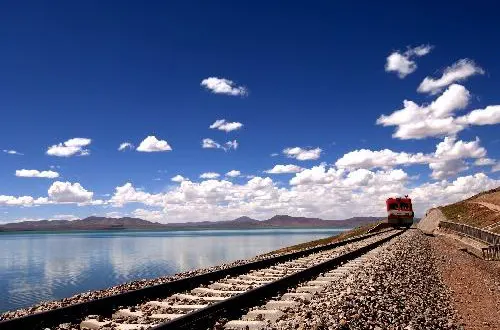
The railway running along a lake shore, ballast almost at the water
A hard sleeper is an open six-berth bay, three tiers: the lower lets you sit upright and keep your bag beside you, the middle is the one nobody wants, the upper is cheapest and a climb. A soft sleeper is four berths behind a door for roughly ¥300 more — worth it or not depending on how much you want that door. Ask for lower, accept upper, avoid middle. Oxygen feeds start after Golmud and there is an outlet at every berth; you do not need to buy a canister for the train.
Everything worth seeing is between Golmud and Lhasa: the Kunlun pass, Hoh Xil, the Tuotuo River, the Tanggula Pass at 5,072 m, a long lake the line runs beside, and then the drop into the Lhasa valley. So there is one rule for choosing a departure — put that stretch in daylight. Z6811 out of Xining at night does exactly that: you wake up in Hoh Xil, cross Tanggula after lunch, and reach Lhasa in the evening. Trains from Chengdu and Chongqing stop at Xining; wipe the outside of your window before you reboard, because a day of dust costs you half the plateau.
Pack earplugs, an eye mask, wet wipes, a lidded cup for the boiling-water taps at each end of the carriage, instant noodles, fruit and a power bank. The dining car serves hot meals for ¥30–40. Nobody showers for the whole run, and by the second afternoon everyone smells the same, which is oddly comforting.
Lhasa Station into town
The station sits in Liuwu on the south bank, eight to ten kilometres from the centre with the Liuwu bridge in between. The bus stop is to the right as you come out; routes 1, 13 and 14 all run into town for ¥1, reaching the Beijing East Road area in half an hour, and they wait for every train however late it is. Taxis meter at ¥20–30 but often refuse the meter and wait for four passengers at ¥30 a head; ride-hailing comes in around ¥30. With heavy bags or a bad head, skip the bus — ten extra minutes standing on the platform can cost you the whole first night.
Flying in
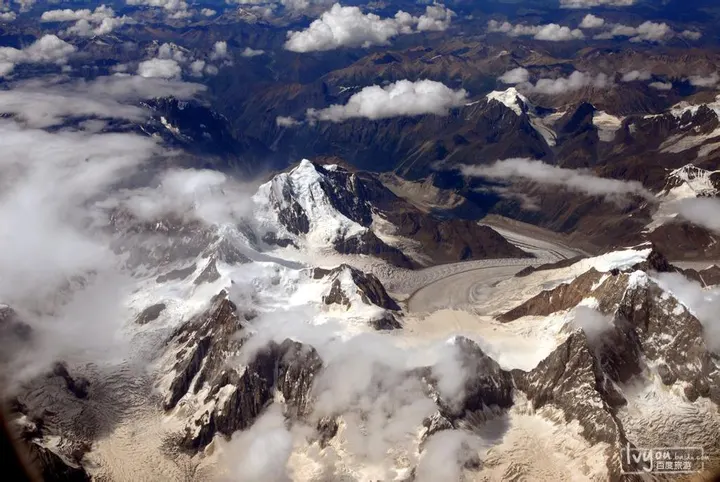
On the way in, the aircraft crosses the Himalaya; on a clear day the peaks and glaciers run to the horizon
Gonggar airport is 62 km southwest, about an hour by road. The airport bus costs ¥30, leaving from 1 Niangre Road in town on a rolling schedule from 04:30 to 19:30; coming in, it picks up outside gate 5 of T3, stops at the railway station and the Liuwu bridge, and the last run waits for the last arrival. A taxi is about ¥200, ride-hailing ¥180–220. There are several flights a day from Chengdu and direct services from Chongqing, Xi'an, Xining, Beijing and Shanghai, plus a few weekly to Kathmandu. From Chengdu the peaks are mostly on the left; to Kathmandu, sit on the right.
Timetables shift with the season and both trains and fares change, with plateau sleepers the first thing to disappear in summer. Before you fix an itinerary, look up what actually runs on your dates and whether a berth is left, then decide where to board — Xining saves the most time, Chengdu or Chongqing saves a connection.
11Hospitals, oxygen, money, signal
Emergency: police 110, ambulance 120, fire 119. Ambulances are slow to reach you up here — if you can get yourself to a hospital, go.
Hospitals: the regional people's hospital on Linkuo North Road is the largest and has a hyperbaric chamber; the municipal hospital on Beijing Middle Road is closer to the old town. A headache that lasts three days, an unsteady walk or breathlessness at rest means go now, not tomorrow.
Oxygen: portable canisters ¥20–30 from pharmacies and convenience stores; most hotel desks have a concentrator or shared oxygen charged by the hour; guesthouses sometimes split the cost of a cylinder. Do not sleep on it — dependence sets in fast.
Money: Alipay and WeChat both link foreign cards, and QR payment works in town and at the sights. Teahouses, the older markets and village stalls still want cash, so keep two or three hundred yuan in small notes.
Documents: carry your passport. Hotels register you on arrival, and spot checks on the street are routine — show it and move on. The Potala and the Jokhang both check the physical document.
Phones: 4G and 5G are fine in town and drop out for long stretches on the Namtso and Yamdrok roads, so screenshot maps and ticket codes. Leave the drone at home — the old town and the area around the palace are no-fly.
Etiquette: no smoking in monasteries, no touching statues, no riffling through texts, no striking drums or bells, and do not sit on a seat reserved for a lama. Walk clockwise around stupas and temple walls. Ask before photographing people, especially older people and anyone mid-prostration.
Two small things. Public toilets are mostly free, though monastery ones charge a yuan or two. Tap water is best boiled or avoided in favour of bottled for the first few days, when your stomach is already negotiating with the altitude. Tipping is not expected — not in restaurants, not for drivers.
12What to sort out, and when
Four to six weeks out: fix the itinerary and start the permit through an agency. Every place you actually intend to visit has to appear on it; if Shigatse or Everest is in the plan, sort the border permit at the same time.
Two to three weeks out: book the trains or flights. Peak-season plateau sleepers vanish on release, so lock that leg first and the hotel second.
Seven to ten days out: book the Potala when the mini-program releases at 08:30, read the Jokhang's rules now even though booking opens a day ahead, and reserve Norbulingka.
Three days out: start the rhodiola if you are going to bother, clear the first day of the itinerary entirely, and check the forecast and the Namtso road.
Clothing: one shell or light down, two long-sleeved layers, two pairs of trousers, shoes you can walk uphill in, a wide hat, sunglasses, SPF50, lip balm. Monasteries want knees and shoulders covered, so leave the shorts and vests at home.
Medicine: cold tablets, painkillers, something for the stomach, glucose sachets, plasters. Bring enough of any prescription — Lhasa has plenty of pharmacies, but not necessarily your brand.
Extras: a thermos, wet wipes, a quick-dry towel, a power bank, some cash, an offline map. Do not fill the case — you will come back with dried yak and a cushion.
A few hard lines on health. Do not come up with an active cold; at this altitude it can settle into the chest. Get a doctor's view first if you have heart or lung disease, badly controlled blood pressure, severe anaemia or recent surgery, and skip it altogether with an infant. Being fit does not exempt you — but do not stop exercising beforehand either. Up here the people who walk slowly are the ones still going at the end of the week.
13A valley, a lot of sun, the shape of a city
Geography and climate
Lhasa occupies the middle stretch of its river valley, walled in by mountains, the floor ten kilometres wide at 3,650 m. Thin, dry, dust-free air lets solar radiation through nearly undiminished, which is why the ultraviolet is brutal and the annual sunshine total passes three thousand hours. Rain averages around 500 mm, eighty to ninety per cent of it between June and September, and it usually falls at night. Winter days reach the low teens and the temperature collapses after sunset — a twenty-degree swing is ordinary.
How the old town grew
In the seventh century the power centred in the Yarlung valley moved its court north into the Lhasa valley, built on Marpo Ri and founded the Jokhang and Ramoche to house images brought from Chang'an and Nepal. Houses went up around the Jokhang, the circuit worn by pilgrims hardened into a street, and that is the origin of the Barkhor: a religious route first, a shopping street a long way second. In the seventeenth century the Potala was rebuilt on the old foundations, pulling the city's weight a kilometre west, with Norbulingka laid out beyond it as the summer palace.
The old town still keeps that skeleton: an inner circuit, an outer ring road, lanes running out between them, white walls with black frames, flat roofs, prayer flags on the parapets. The new city is a matter of recent decades — a single straight line west along Beijing Road with shops, banks and housing in sequence. The railway, completed in 2006, changed the scale of the place: visitor numbers, freight volumes and the city itself.
Festivals
Two are worth planning around. Losar, the new year, falls in February or March: households set out chemar boxes and fried pastries, the streets go quiet and the temples fill. Shoton comes at the end of the sixth lunar month, in August, opening with the great thangka at Drepung and running a week of opera at Norbulingka. Both move with the lunar calendar, so look up the Gregorian dates for your year before you build a trip around them.
14Two lakes, a mountain, a city
Namtso Lake (1–2 days, 240 km)
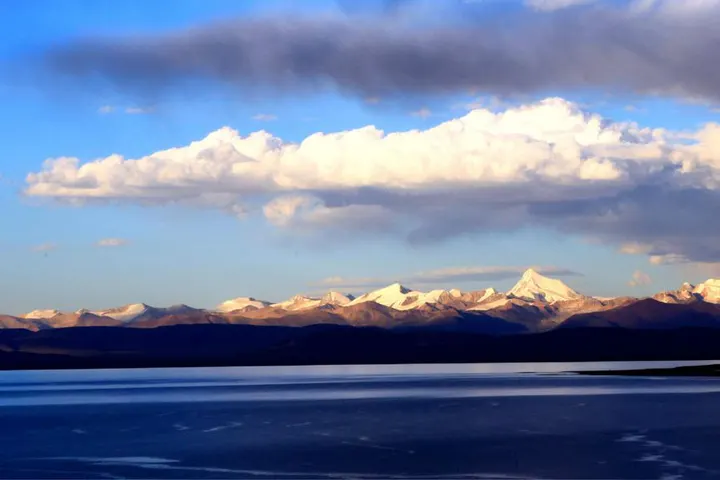
Evening on the water, the snowline on the far shore, the last sun turning the cloud pink
The lake sits at 4,718 m, the largest salt lake in the region, with the Nyainqentanglha snowline on its southern shore. Private cars stop at the visitor centre and everyone transfers to the shuttle. The peak-season package is ¥220 (¥120 entry plus ¥100 shuttle), ¥145 off-season, and the ticket allows a second entry within 48 hours. Shared cars from Lhasa run ¥180–240 a head return, a five-seat charter ¥800–1,200 a day, leaving before dawn and back after dark. The road crosses the Lagen La at 5,190 m — ten minutes at the top is enough; standing about longer brings the headache on.
It can be done in a day, but that is twelve hours plus, and the lake is a kilometre above Lhasa — plenty of people feel worse here than in town. Staying is the better trade: reach the Tashi peninsula in the afternoon, watch the light go, look at a sky with nothing in it, and leave after sunrise. The prefab rooms by the shore are basic; Dangxiong county town is lower and better equipped. In winter ice closes the road without much warning, so confirm conditions the day before.
Yamdrok Lake (1 day, about 2 hours each way)
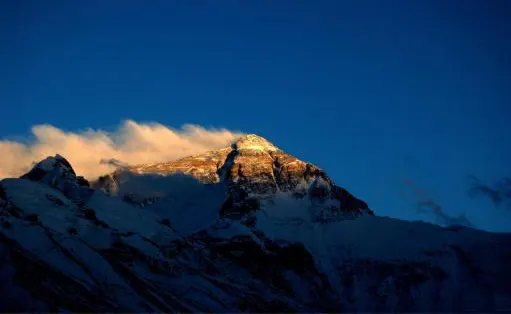
Ten minutes before sunrise the summit lights up while the flanks stay in shadow
Head southwest, climb the Gangbala pass at just under 5,000 m, and the lake opens below you in the shape of a stretched-out branch. The wind at the pass will not let you stand straight, and the viewpoints charge — roughly ¥60–120 depending on which platforms and whether you take a package. A shared day tour costs ¥150–250 a head, a charter from ¥600 a car, and the road is good enough for eight hours door to door. Karola Glacier can be added, but that turns the day into ten hours or more.
Ganden Monastery (half a day, 57 km)
Ganden stands on the south bank of the Lhasa River in Dagzê county at 3,800 m, founded in 1419 by Tsongkhapa himself and the oldest house of his school. It draws a fraction of Sera's or Drepung's crowds; buses leave the Jokhang square between seven and eight in the morning and return at four, and entry is ¥40. A kora runs along the ridge, forty minutes round, with the whole valley underneath.
Shigatse (1–2 days, 2.5 hours by train)
The Lhasa–Shigatse railway opened in 2014 and covers the run in two and a half hours for a few tens of yuan, several times a day. Shigatse is the second city of Tibet, and Tashilhunpo Monastery climbs the hillside above it, the seat of the Panchen Lamas, with a 26-metre Maitreya inside. Note that Shigatse needs a border permit: foreign visitors must have it listed on the Tibet permit and arranged by their guide — do not buy the train ticket first and discover the paperwork is short.
15Watch and read before you go
Film
'Paths of the Soul' (2015, dir. Zhang Yang): eleven villagers leave Markam and prostrate their way to Mount Kailash, two thousand kilometres over a year, with almost no music — just boards scraping asphalt and bodies going down. Walk the Barkhor afterwards and you will understand why those knees look the way they do. 'Kekexili: Mountain Patrol' (2004, dir. Lu Chuan): a volunteer patrol chasing poachers across the empty plateau, cold, sparse and unsparing. 'Once Upon a Time in Tibet' (2011): a wartime romance with a thin plot and extraordinary landscape light.
Documentary and music
'The Third Pole' (2015), a six-part documentary, follows herders, painters, mountain guides and railway workers through the practical business of living at this elevation — it explains daily life here better than any guidebook. And 'Back to Lhasa', Zheng Jun's 1994 single, is where a lot of people first heard the city: blunt, unpolished, and still the song that plays in your head on the train in.
Books
Sam van Schaik's 'Tibet: A History' is a little over two hundred pages, restrained and clear, and it sorts out how religion, power and trade fitted together — after it, the murals stop being wallpaper. For something lighter, pack a field guide to plateau plants: half the flowers growing flat against the ground at the roadside go unnamed by every visitor who passes them.