A river that turns stone blue-green, and a forest that grows on bare rock
Timed booking required15,000 a dayShuttle valid two days15 min from the station
In short
Libo (荔波, Lìbō) sits at the southern tip of Guizhou, against the Guangxi border, and almost everything worth seeing lies inside the Zhangjiang scenic area: Xiaoqikong, Daqikong, the Shuichun River, and the Maolan reserve to the west. It was inscribed in 2007 as part of South China Karst. Xiaoqikong is the reason people come. Twelve kilometres of valley where the river steps down over travertine shelves, the water running from jade to indigo, with boardwalks laid almost at water level and one stretch where you take your shoes off and wade. Entry is ¥120 in high season and ¥100 in low, the shuttle is ¥40 and compulsory, the ticket stays valid for seven days, and a combined Xiaoqikong–Daqikong ticket runs about ¥170. Booking is real-name and timed, on the Yunyou Libo mini-program, capped at about 15,000 a day; gates open at 08:00, last entry 16:30, and 07:00 in the July–August peak. High-speed rail from Guiyang North to Libo takes as little as 47 minutes for ¥75–115 in second class; from the station a shuttle reaches the east gate in fifteen minutes for ¥10, or the west gate thirty-one kilometres away for ¥20–35, with taxis at ¥50–70. Xiaoqikong takes four to six hours and fits in a day; add Daqikong or Maolan and you need two; three if you want Maolan properly. The water is clearest from October to December and March to May, and goes muddy for one to three days after heavy July–August rain. Budget ¥700–1,300 for two days, mid-range, excluding travel to Guizhou.
Key facts
Known for
Xiaoqikong · Wolong Pond · water forest · Maolan · Zhangjiang grilled fish
Budget
¥700–1,300 for two days, mid-range
Days needed
2–3 days
Comfort
Moderate — shuttles do the distance, but the boardwalks are wet and stepped, and a day runs to 15,000 steps
Best time to go
October–December and March–May for the clearest water; July–August for volume but muddy after rain; December–February for solitude
01One river, two colours, three days
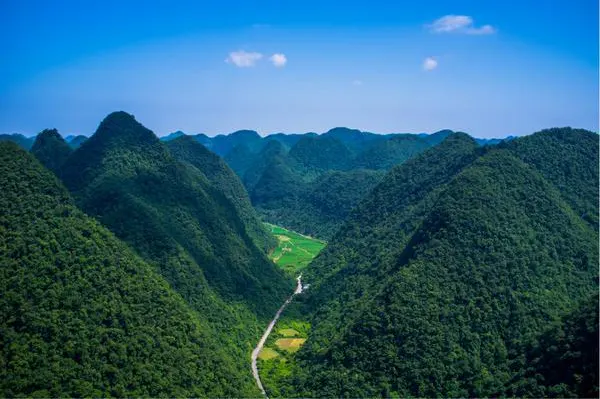
The train runs south from Guiyang through tunnel after tunnel, and after forty-odd minutes the hills change character: round, dense, packed against each other like bubbles in a pot that has just stopped boiling. This is cone karst, and Libo sits in the seams between the cones. The first impression at the station is not promising — a station building with Yao motifs, some newly planted trees, a road into town. Everything worth looking at is twenty kilometres away and hidden behind a ridge.
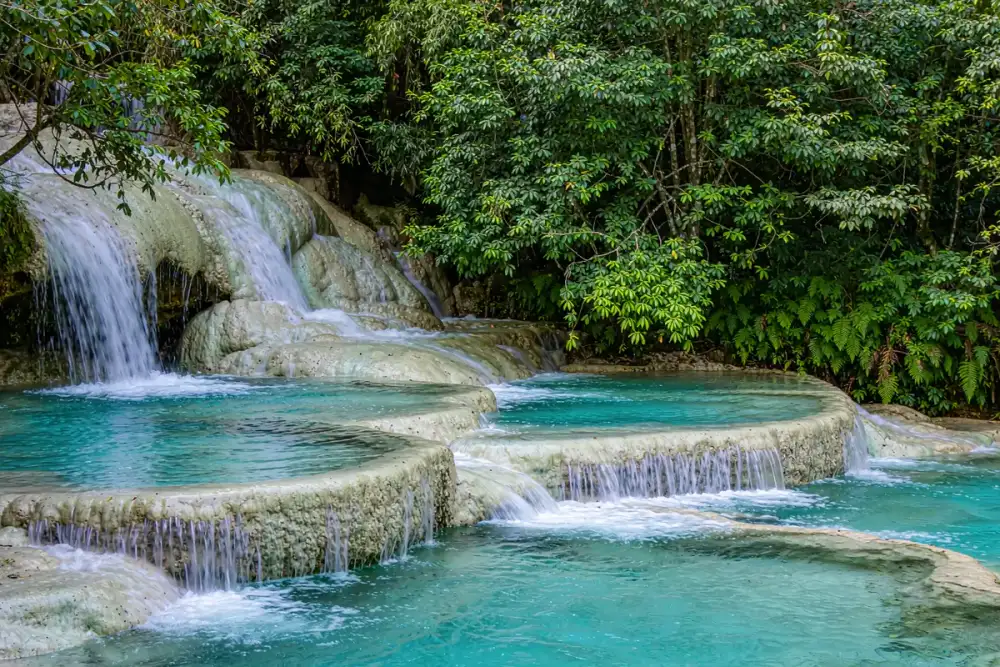
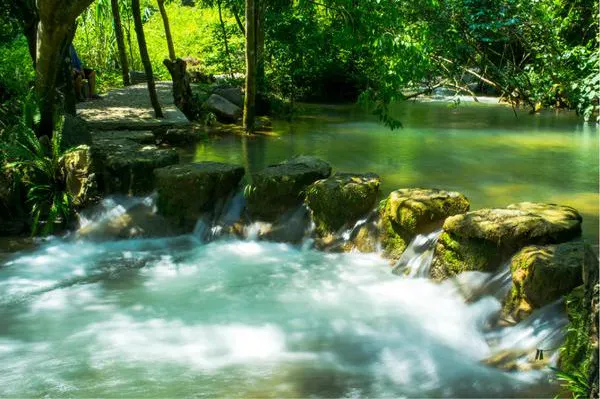
Xiaoqikong is twelve kilometres of valley. The river comes down out of the western hills and steps over travertine shelves, and the calcium carbonate encrusts leaves, twigs and stones until they become rounded dams; the water spreads across each dam, tips over the lip, spreads again. So it does not so much flow as unfold, and it is never one colour: emerald upstream, a dark indigo at Wolong Pond, milky white through the whole valley after rain. The boardwalk runs at water level and narrows to two planks in places, where a crowd simply stops moving.
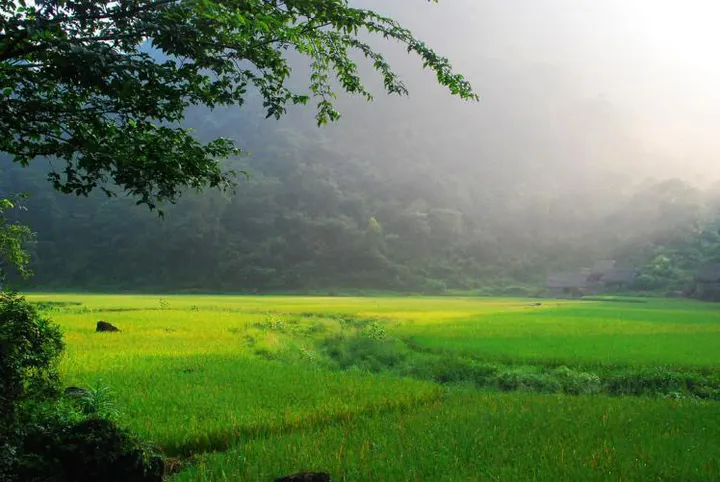
Rice fields at dawn, mist rising from the valley floor and washing the far peaks into grey-green
Half of Libo's reputation rests on a slogan: look up and you have Zhangjiajie, look down and you have Jiuzhaigou. The first half is about the peaks, the second about the water. It is a convenient comparison and a misleading one. Jiuzhaigou's water sits in high alpine travertine lakes, terraced like rice paddies; Libo's water is a river, moving, on a gradient, running over stone. Your first reaction at Xiaoqikong is unlikely to be that it resembles Jiuzhaigou. It is more likely to be disbelief at how green it is — green enough to look retouched, until you put your hand in and find it cold.
Do the arithmetic. Xiaoqikong is ¥120 in high season, ¥100 in low; the shuttle is ¥40 and unavoidable, because the valley runs twelve kilometres from gate to gate. The ticket holds for seven days and the shuttle for two, so in theory you can walk the same river twice on separate mornings. Daqikong is ¥55 alone, with a boat at ¥20 one way or ¥40 return; a combined ticket is about ¥170 including the shuttle, which pays for itself with two people. Everything is real-name and timed, capped near 15,000 a day — book a week ahead over holidays.
Look up: Zhangjiajie. Look down: Jiuzhaigou.
A local saying, quoted in the 2013 guidebook
Libo has a second identity that gets overlooked: World Heritage. In 2007 the first phase of South China Karst was inscribed, and Libo is its showcase of cone karst; the 20,000 hectares of primary forest at Maolan are part of that same geological argument. Maolan is not an attraction so much as a specimen, which is why it has a higher threshold than Xiaoqikong: core routes need a guide and prior registration, there is no phone signal, and going in alone is not adventurous but irresponsible.
Let me be blunt: the water earns the hype, and the logistics are an argument about what time you enter. Coach groups arrive between 10:30 and 14:30, and in those four hours the 1.6 km of boardwalk between the old bridge and the Stone Forest stop is the worst of it — you move at the speed of the person in front. The most useful thing you can do is not find a shortcut, because there isn't one, but book the first slot: in at 07:00 or 08:00, walk the narrow stretch while it is empty, and by the time the coaches unload you are on a shuttle heading up to Wolong Pond.
02Six things worth setting an alarm for
The old seven-arch bridge: two provinces, one crossingBuilt in 1836
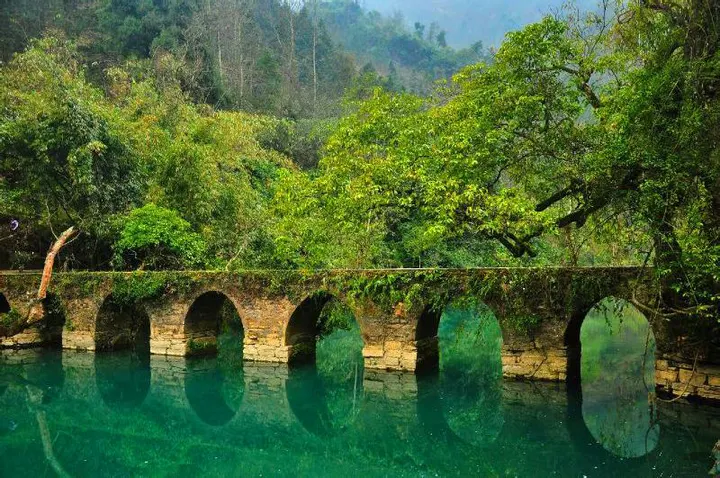
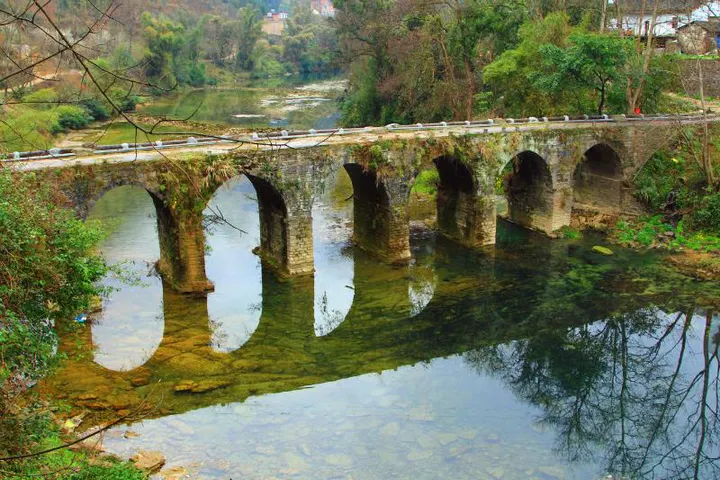
Forty metres long, four wide, with a four-metre arch and seven openings, all of it laid in cut granite and now half swallowed by vines and moss, over water so clear you can count stones on the bed. It was built in 1836, in the Daoguang reign, as the crossing on the road from Libo into Nandan county in Guangxi — Guizhou on one bank, Guangxi on the other. No vehicles use it now, and people only walk across and back. On a still morning the seven arches and the trees opposite fall into the water together, which is why this is the most photographed square metre in the county. After nine the deck is full; empty frames belong to the first slot only.
Size:40 m long, 4 m wide, 4 m arch
Timing:Quietest 08:00–09:00; backlit from afternoon
The 68-step cascade: a river you can count1.6 km, 68 steps
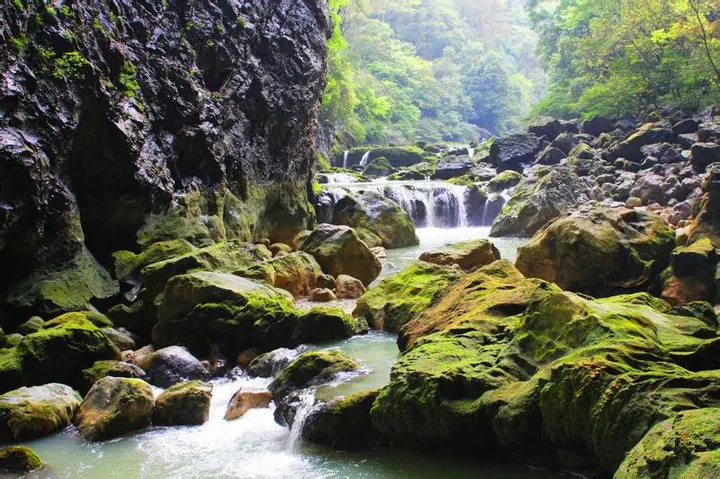
Upstream from Hanbi Pool, the bed drops in steps through 1.6 km of narrow gorge; the official count is sixty-eight. The number matters less than the sensation: water breaking white within sixty centimetres of your feet, a noise that drowns conversation, a boardwalk that twists against the rock and narrows to shoulder width. This is the most congested stretch in the park and it seizes up entirely between 10:30 and 14:30. Walking it the other way helps: enter at the west gate, shuttle to the top, and come downstream so the crowd meets you head-on and all you have to do is turn sideways.
Length:1.6 km of concentrated drop
Worst crush:10:30–14:30, bridge to Stone Forest
The water forest: take your shoes off600 m, wadeable
Six hundred metres where trees grow straight out of the riverbed, roots gripping cracks in the rock while the current runs between them. The park has laid a line of stepping stones through it; in high water they sit ankle-deep, in low water you only wet your soles. This is the one stretch where you are allowed — encouraged — to walk in the river, and anyone who brought sandals looks like a genius here. The moss on the stones is slick as grease, so watch your feet rather than filming: people sit down in the water here every week. With children, hold hands; the deeper sections reach an adult's calf.
Length:About 600 m, in two sections
Kit:Grippy sandals, not flip-flops
Wolong Pond: the blue that refuses to fadeA mirror above a weir
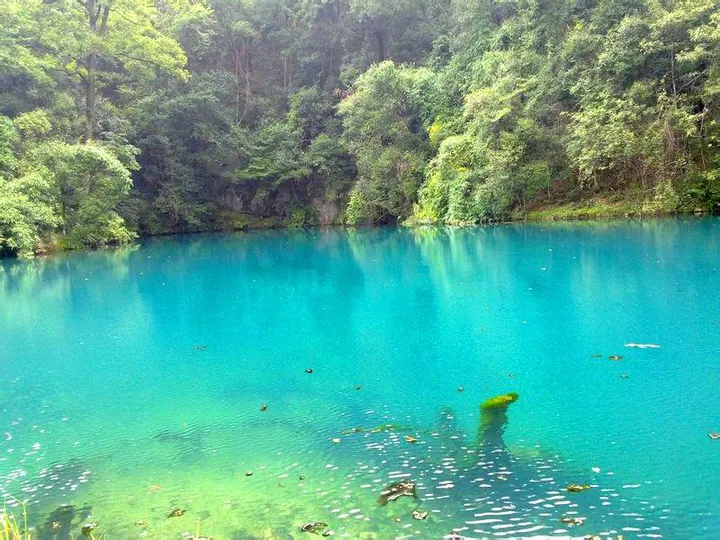
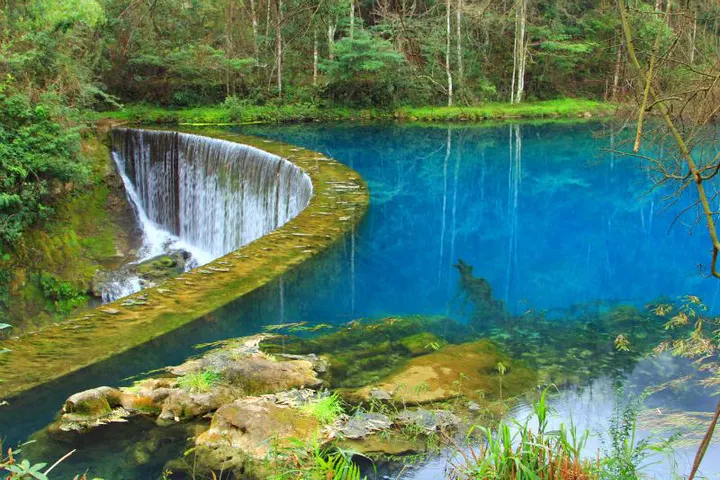
A small pool held back by a weir that curves inward, which is why the surface lies flat as glass. The colour runs from pale blue at the edges to a dark indigo at the centre, and it is bluer under cloud than under sun, when it turns green — dissolved calcium carbonate plus depth, not a filter. Fallen trunks lie at angles under the surface, old stumps furred with moss and weed, so the pool reads as a drowned wood. Two hundred metres uphill is the top of the weir, and from there the curve and the water below make the park's most photogenic composition.
Colour:Bluest under cloud, greener in sun
Where:Top of the valley, last shuttle stop
Daqikong: a gorge, a walkway and a natural gate3 km from the east gate
Daqikong has half the fame and half the crowd, and plenty of people skip it, which is a pity. You enter past a seven-arch stone bridge begun in 1847 and finished three years later on local subscriptions, originally called Wanshan Bridge, rebuilt in 1877 after a flood and renamed Shuangxi. Beyond it the gorge closes in — a stream so clear it looks black between two walls — and after twenty minutes you look up at the natural bridge: a stone span across the gorge, seventy or eighty metres high, trees growing along its deck and stalactites hanging beneath the opening. They call it the Arc de Triomphe of the East, which is overselling it, but standing under the arch and looking up does shut people up.
Entry:¥55; boat ¥20 one way
Time:2–3 hours, same path both ways
Maolan: forest growing on bare rock20,000 hectares of primary forest
Forty minutes east of town the hills change: not isolated cones but a pot of pressed-together dumplings, with hollows between them — funnels — whose floors drain straight into underground rivers. The trees grow on the walls of both, roots working down the joints, prising the limestone apart and then gripping it, which locals call tree-wrapping-stone and stone-wrapping-tree. There is no single breathtaking view here. The pleasure is slower: light, humidity, sound, and two hours of walking without meeting ten people. Core routes require a guide; do not wander in alone.
Entry:¥50; about ¥50 per car
Guide:Required for core routes, ¥200–300 a day
03Seven questions to settle before you book
Is one day enough for Xiaoqikong?
Yes, and most people do exactly that. The core route runs four to six hours: in at the east gate, shuttle to the old bridge, walk downstream past the 68 steps to the Stone Forest stop, shuttle again to the water forest, Cuigu Falls and Yuanyang Lake, finish at Wolong Pond, shuttle back. Call it 15,000 steps, very little climbing, but constant stopping. If you want empty photographs, time in the water and a look at Daqikong as well, you have to take the first slot — 08:00, or 07:00 in the July–August peak — be at the gate by 07:40, and walk the 1.6 km from the bridge first, so that when the coaches arrive at 10:30 you are already upstream. With one day and both sites in mind, I would drop Daqikong: it is an out-and-back on a single path, two hours minimum, and what it costs you is the best light at Xiaoqikong. If what you want is green water and quiet, one day on Xiaoqikong alone, with an hour in a boat on Yuanyang Lake at midday, is the best use of it.
Should I stay in Libo town or by the park?
It depends which end of the day matters. Staying at the east gate — the Bouyei-style cluster of guesthouses outside it — puts you ten minutes' walk from the turnstile, first in, with dinner and a night market on the doorstep, at ¥300–600 in peak season and ¥150–300 otherwise; the trade-off is ordinary rooms and nothing to do after eating. Libo town has more choice, lower prices (¥100–250), a night market and supermarkets, but forty minutes of driving every morning, which rules out a 07:30 gate unless you leave at 06:30. The west gate suits drivers: quick to the expressway, on the way to Maolan, but quieter than the east side, with the street empty after eight. My default: east gate for the first night and the first slot next morning; if you land in Libo in the afternoon, sleep in town and take an early shuttle. For a Maolan day, stay in the reserve or towards Yaoshan rather than commuting.
When is the water at its bluest?
October to December first, March to May second. Both windows are dry, the sediment load drops, and the indigo at Wolong Pond settles into something you can look into; below the old bridge you can see stones seven or eight metres out. July and August give the biggest water and the loudest falls, but one storm turns the river the colour of milk tea and it takes one to three days to clear — and the rain stopping is not the same as the water clearing, because what falls upstream needs hours to reach you. December to February runs low: travertine shelves emerge, the colour actually intensifies, and there is nobody around, at the price of falls reduced to a few threads. My order is November, then April, then July if you are willing to gamble, then January if you want silence. And check the weather upstream at Dushan and Sandu, not just Libo: rain there is mud here.
Does rain make the water muddy?
Yes, and fast. The Zhangjiang catchment is steep; half an hour of heavy rain can lift the river within two hours and turn it from green to yellow, at which point the park closes the wading section at the water forest and the Shuichun rafting stops altogether. The rule of thumb: light rain is fine, even good — mist on the water, deeper colour; anything heavier and the afternoon is muddy; after a storm, allow one to three days to recover. There is a crude but reliable test. Look at the water under the old bridge in the morning: if you can see stones a metre down the piers, it is clear; if you cannot, spend the day in the Daqikong gorge or the Maolan forest, neither of which depends on water colour. Wet boardwalks are the bigger worry — the stone grows algae and turns genuinely treacherous — and the poncho handed out at the gate does not solve your shoes.
Is Maolan worth a day of its own?
If what you want is greener water, no. If you want to walk into a forest that is not being managed for visitors, emphatically yes. They are different categories of thing: Xiaoqikong is a designed viewing route, Maolan is a working karst ecosystem where the paths were made by villagers, signage is sparse and there is no signal. A day gets you from town to the Ligen entrance in forty minutes, a guide, the Stone Forest, Qinglong Pond, Huangyang Gully and Latan Falls, lunch at a farmhouse, and back by evening. The through-route — funnel forest, water forest, Yaosuo old bridge — takes a full day, needs prior registration with the reserve station, long trousers and 1.5 litres of water. With parents or small children, do only the boardwalk from Qinglong Pond to Huangyang Gully: two hours, gentle. Do not go in rain; the rock is slick, the streams rise, and rescue cannot get in.
What is the fastest way from Guiyang?
High-speed rail, and there is no second answer. Guiyang North to Libo on the Guiyang–Nanning line takes as little as 47 minutes, usually an hour to ninety minutes, ¥75–115 in second class, with more than thirty departures a day from just after six in the morning until nearly nine at night. Fifty metres outside the station is the tourist shuttle stand: ¥10 and fifteen to twenty minutes to the Xiaoqikong east gate, ¥20–35 and thirty-five to forty-five minutes to the west gate, leaving when full at some hours. Taxis are ¥20–30 to the east gate, ¥50–70 to the west. Long-distance buses from Guiyang East leave three and a half to four hours and around ¥100, infrequently — a fallback when trains are sold out. Driving is 270 km and about three hours on the Lanhai expressway, tunnel-heavy; do not do it at night in rain. Flights to Libo airport are few — Guiyang, Tongren, Xingyi, Hefei, Nanchang, Taizhou — so from outside China it is better to fly to Guiyang and change to the train.
Can I bring a stroller?
No, leave it at home. The boardwalks follow the river and involve steps, stepping stones and stretches two people wide; by the 68-step cascade you would be carrying the stroller. The water forest requires wading, which rules it out entirely. The only genuinely stroller-friendly surfaces are the top of the Wolong weir, the Cuigu wetland and the few hundred metres between the east gate and the shuttle stop. Take a carrier instead, or with a child over five walk half the route — bridge, 68 steps, Stone Forest, two hours. The visitor centre lends strollers free, but only for flat ground. The real hazard is not the path but the water: children will want in, and the water forest reaches an adult's calf, so hold hands and do not let them run. Toilets are reasonably placed at the east gate, the old bridge, Cuigu and Wolong Pond.
04One day for water, two for water and gorge, three to add forest
One hard constraint shapes every plan: Xiaoqikong is a one-way valley, twelve kilometres between the east and west gates, linked by shuttle, and five hours if you walk it end to end. The second is your booking slot, which fixes the hour you must be at the turnstile. So which slot you get matters more than which sight you do first. Three shapes follow, by days, all assuming you sleep near the park and can take the first entry.
D1
At the east gate by 07:40, in with the 08:00 slot. Shuttle to the old bridge for the empty shot, then walk downstream through the 68 steps — 1.6 km to the Stone Forest stop, quietest before 09:30. Shuttle to the water forest, shoes off, twenty minutes in the river; then Cuigu Falls, climbing if you feel like it and sitting in the wetland if you do not. Yuanyang Lake at 11:30 for an hour in a hand-rowed boat (¥30 a head) to sit out the midday. Wolong Pond at one for the colour and the weir top, shuttle back to the east gate at 2:30. A bowl of noodles outside, then Daqikong at four — the gorge to the natural bridge and back by six. Eighteen thousand steps; a full day.
D2
Arrive the first afternoon and do not go into the valley. Wander Libo old town — free, rebuilt, do not expect much — and eat Zhangjiang grilled fish in town that evening. Next morning leave at 07:30 for Daqikong, in the gorge by 08:30, walking towards the light with the mist still down, at the natural bridge by 09:30 ahead of everyone. Out at eleven, lunch, then Shuichun River rafting at one (May to October), on the water by 2:30, back at the takeout to shower by five. Return to town for the night market and siwawa. Xiaoqikong is deliberately not in this day; it belongs to the third.
D3
Into Xiaoqikong at eight, the whole river, lunch inside the park, out by three. If Maolan is on your list, split it: this day for Xiaoqikong, then leave at eight the next morning for Maolan, take a guide through the Stone Forest, Qinglong Pond, Huangyang Gully and Latan Falls, eat at a farmhouse, back in town by four. Do not compress Maolan and Xiaoqikong into one day; both need legs, and they lie in opposite directions.
05Five moods of one river, and three places beyond it
Xiaoqikong: downstream or upstream
Make this decision first; it matters more than any list of sights. The east gate sits low, near Libo station and Daqikong; the west gate sits high, near the expressway exit. West to east is downstream and downhill — easier, but you walk away from the light and into the crowd. East to west climbs, but you face the water, the light is behind you, and at eight in the morning there is nobody. The park's two recommended routes are exactly these. My advice: if you arrive by train and sleep at the east gate, do not try to exit at the west, because the shuttle has to come back anyway. Go in and out at the east gate, but take the first shuttle all the way to Wolong Pond at the top and then work backwards. The shuttles run both ways, which most people never notice, and at 08:30 you will have the pond to yourself.
Wolong Pond and its weir: the most photogenic hundred square metres
The pond sits at the head of the valley, held by an inward-curving weir, so the overflow lays a half-moon of white water over the lip and drops into the dark green pool beneath. On a sunny morning it reads blue-green; under cloud it turns bluer, because suspended calcium carbonate scatters the short wavelengths and the greyer the sky the purer the blue. A boardwalk wraps half the pond, five minutes up to the weir top. The best vantage point is not beside the water but above it, on the crest: stand at one end of the arc and the falling sheet, the pool and the far treeline stack in three layers. After nine there is a queue for that spot, two minutes each.
The curved weir spreading the river into a half-moon of white, over a pool of deep blue-green
Cuigu Falls and the wetland: the stop you can skip
The shuttle stops at Cuigu, and the falls are a two-hundred-step climb above it: a white fall splitting into several strands, pleasant rather than arresting — less forceful than Laya, less colourful than Wolong. With children, good legs and time to spare, go up; it is forty minutes there and back. With one day and energy saved for the water forest, skip it and give the time to Wolong. The wetland below Cuigu is worth ten minutes on its own: shallow water, grass growing through it, a boardwalk over the top, egrets in the early morning.
Yuanyang Lake: a boat and a maze
Two large lakes and four small ones, strung together by channels, the banks a zigzag of rock and the trees growing from the shore straight into the water. The name comes from a Yao story in which a dragon's son tries to separate two lovers, who turn into mandarin ducks; the dragon dies of rage and his body becomes the river, his claws the channels. Take the legend lightly and take the boat seriously: ¥30 a person an hour, minimum four, rowed yourself into passages where the walls are root and moss and the quiet is complete enough to hear water dripping. At midday in full sun this is the coolest place in the park and the best siesta. If you are short of time, sun-shy or bad at rowing, skip it — it does not belong in the compulsory category.
Daqikong: two kilometres of gorge, an eighty-metre gate
Three kilometres by shuttle from the east gate, or twenty minutes on foot. You pass the seven-arch bridge and the walkway turns into the gorge, narrowing to a dozen metres with the water running silently below, dark as ink. This is Terror Gorge, named for three black cave mouths in the cliff and a belief that shouting brings rock down; in practice it is cool, dim and quiet rather than frightening. After twenty minutes the walls open and the natural bridge spans overhead: a stone beam tens of metres across and seventy or eighty high — sources quote 73 m and 90 m depending on what they measure, so do not argue — with trees along its deck and stalactites under the arch.
Yaofeng Cave sits at the head of the gorge; the boardwalk that once continued to the Die forest was washed out and has not been rebuilt, so you can only look at the entrance. The air pouring out of it is cold — standing there in summer is like opening a refrigerator. There is a boat, ¥20 one way or ¥40 return, but it only runs as far as the approach to the natural bridge and saves very little walking. I would not take it: the pleasure of this gorge is being inside it, and the boat puts glass between you and the walls. Walk to the end and back; two to three hours.
Maolan: forest on rock, water in the funnels
The right way to do Maolan is to walk a line, not to visit a point. The standard day: in at Ligen, the Stone Forest where roots prise the limestone apart into tree-wrapping-stone and stone-wrapping-tree; Qinglong Pond, green all year at about 17°C, mist on the surface at dawn; Huangyang Gully, where ten thousand box trees a century old grow out of cracks and the stream runs over their crowns in the wet season; Latan Falls, nearly seventy metres, the biggest in the reserve; and the Yaosuo old bridge, a single stone arch from 1831 with a tree at each end. Six to seven hours, driving plus walking.
Entry is ¥50, and a car entering the reserve pays about ¥50 more as a resource fee. Core areas and through-routes require a guide at ¥200–300 a day and prior registration with the reserve station. This is not rent-seeking: there are genuinely no signs, no signal and no rescue access inside. If you stay on the boardwalk between Qinglong Pond and Huangyang Gully — two hours — you can go without one.
Yaoshan and Yaogu: villages still being lived in
Yaoshan lies on the road to the east gate and is a White-Trouser Yao settlement: the men wear knee-length white trousers, the women's jacket is two panels joined at the shoulders, a construction that makes bending in front of strangers awkward, which is why you will see them crouch sideways. The village has been refurbished and has performances and a spinning-top ground, with a separate ticket, and opinions divide — living culture to some, stage set to others. My view: worth it during a market day or a festival, especially the top-spinning festival around Lunar New Year; on an ordinary afternoon, twenty minutes and out.
Yaogu, towards Maolan, is a Bouyei village whose best reason to stop is a paper workshop over a century old: bamboo soaked, beaten to pulp, sheeted, pressed, all by hand. Old women spin and brew, with no performance involved — you simply walk past. Entry is covered by the ¥50 Maolan ticket. Ask before photographing, especially into a courtyard.
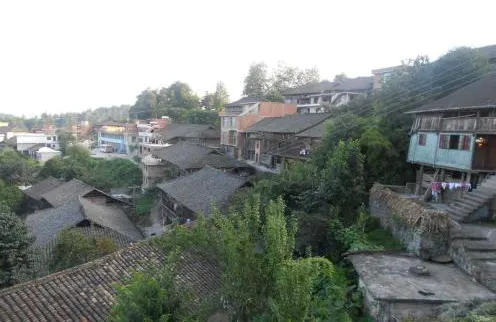
A hillside village of grey-tiled timber houses stacked upward, rooflines all at angles
Bronze Drum Bridge, and the unnamed corners at the gate
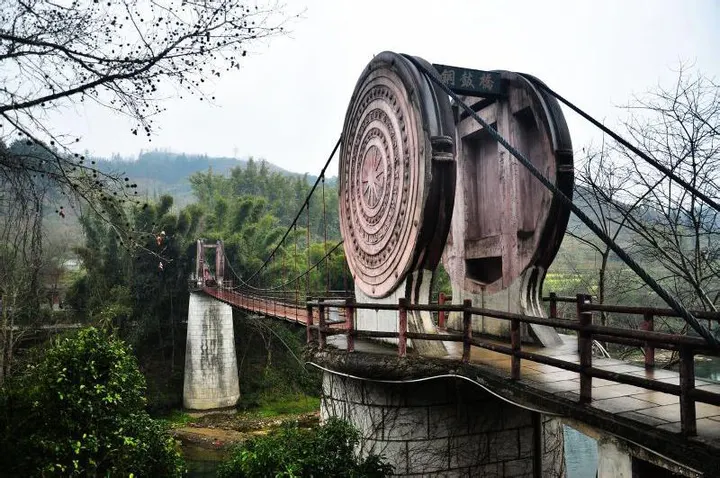
Bronze Drum Bridge is the first crossing inside the east gate, and at its head stands a drum enlarged many times over, concentric rings around a sunburst at the centre. Drums were serious objects for the Bouyei and the Shui — used in sacrifice and for signalling — and are mostly decoration now. Coach parties take one group photograph and move on, but the water below is clear and locals fish there in the morning.
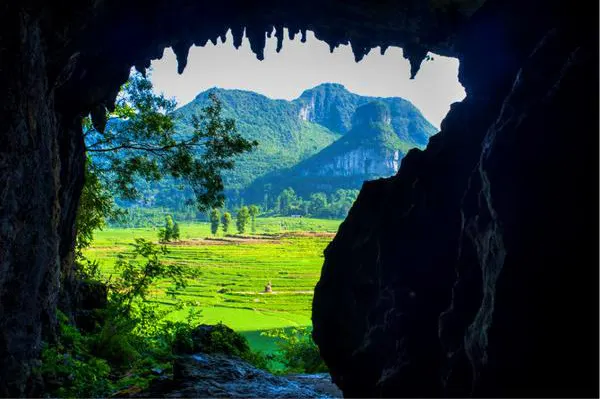
The bronze drum at the bridgehead: concentric rings around a sunburst, with the suspension bridge and valley behindLooking out of Chuandong cave, the opening framing paddy fields and a cluster of cone peaks
Chuandong, in Yongkang township, is where local militia and civilians blocked a Japanese column in December 1944 and killed more than a hundred of them; the emplacements are still inside. Today it is simply a cave you walk through, which farmers also use as a shortcut, and the far end opens onto paddy fields. Free, unlabelled, no interpretation boards, twenty minutes. Skip it if wartime sites do not interest you; it is on the Maolan road, and only a stop because you are passing.
06Four things to do besides looking at water
Shuichun River rafting: a five-month business, three hours long
The Shuichun is the prettiest stretch of the Zhangjiang, coming down off Mount Yueliang, passing east of town and dropping through twenty-nine rapids in thirteen kilometres. Rafting runs only from 1 May to 8 October, 08:30 to 16:30 with the last ticket at 16:00. ¥220 with a boatman, ¥200 if you paddle yourself, both including the ¥30 entry and ¥5 insurance; minimum age twelve, and fourteen to go alone. The first half hour is lake-flat, bamboo on both banks and Bouyei villages behind it; after Mei Rapid the river starts to fall, water comes over the bow, and by the second half you cannot keep glasses on. Not being able to swim is fine — life jackets throughout — but it is wrong for anyone afraid of water, with a bad back, or with a child under five.
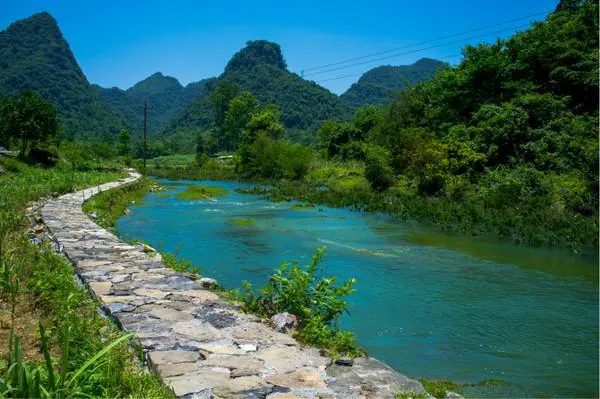
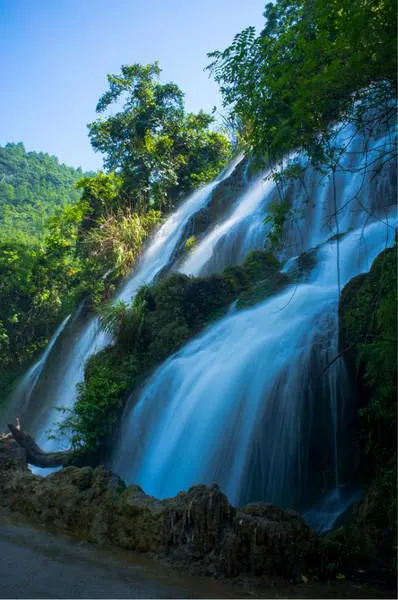
A stone-flagged path along the river, blue-green water on one side, bamboo and cone hills on the otherA fall coming down the cliff in one bright sheet, dense forest behind it
Walking: the route beyond the boardwalk
Xiaoqikong is 15,000 steps on its own, so there is no need to add a hike. The real walking is at Maolan: the twelve kilometres from the Stone Forest to the water forest, through funnels, caves and the mouths of underground rivers, four to six hours, guide mandatory. The difficulty is not distance but footing — mossy limestone that looks dry and slides when weighted — and the number of unmarked junctions, where one wrong turn costs two hours. Take a stick, wear high shoes, and do not wear shorts, because of vines and leeches.
Photography: a polariser beats a filter
The water is so clear that it reflects hard, which is why phone snapshots come out as a sheet of white. A polariser, rotated to the right angle, cuts the surface glare and reveals the stones and sunken logs beneath — the one piece of kit local photographers insist on. As for light: the old bridge is front-lit in the morning, Wolong Pond is better under cloud because the blue is purer, the 68 steps sit in shadow all day and need a higher ISO, and the weir top wants to be shot before ten, after which it is backlit. For silky water, bring a tripod, but do not set it across a narrow boardwalk.
Batik and horsetail embroidery: a two-hour craft session
Batik sessions run in town and at Yaoshan for ¥30–80: you draw a square of cloth with wax, dye it, and it takes a bit over an hour, though it will not be dry enough to pack. Shui horsetail embroidery is finer work — horsehair wrapped in silk, coiled into patterns and stitched down — and a small panel takes a fortnight, which is why it costs what it costs and why it is worth buying. Sessions are available at the county cultural centre and several cooperatives; ask a day ahead.
As for the Shuilyun Zhangjiang water-stage show, it cost ¥150–168 in 2013; whether it still runs, and on which nights, needs checking on a local official account before you go. Shows of this kind stop and restart routinely, so do not build an evening around an old guidebook.
07Four places to sleep, four trade-offs
Get the names straight and read the address when you book. Xiaoqikong East Gate means the Bouyei-style cluster outside the turnstile, five to fifteen minutes' walk from entry. Xiaoqikong West Gate is the town on the western side by the expressway exit. Libo town is Yuping, twelve kilometres from the east gate. Maolan means farmstays in and around the reserve, thirty kilometres and more from town. Prices differ by a factor of two across those four, and drive times by an hour.
East gate Bouyei town: guesthouses, ¥150–300 in ordinary season and ¥400–700 in the summer holidays and over National Day. You walk to the turnstile, there is a night market, and you make the first slot. Rooms are thin-walled and parking is tight.
Libo town: ¥100–250, and the same money buys a visibly better room, with supermarkets, a night market, pharmacies and the hospital. The cost is forty minutes each morning; for an eight o'clock entry you leave at 06:50.
West gate: ¥120–280, the driver's choice, five minutes from the expressway and on the way to Maolan. Very quiet — the street empties after eight and dinner options are limited.
Maolan farmstays: ¥80–180, plain, often without air conditioning or a private bathroom, with chicken from the yard and fish from the stream at the door. For through-hikers and anyone who wants the stars; ring ahead.
Two warnings. In peak season do not arrive and look: east gate capacity is small, summer weekends sell out a week ahead, and rates double. And many guesthouses advertising free pickup mean Libo station, twelve kilometres away, not the west gate at thirty; ask before booking which station, what time, and what it costs, rather than negotiating at reception.
08Sour, hot and river fish
Food inside the park exists to stop you being hungry: a strip at the east gate sells noodles for ¥25–35 and they are merely adequate, and the shuttle terminus has a kiosk with corn and sausages. The cooking worth planning around is in town and in the east gate cluster, where ¥40–60 a head buys a solid meal. The local grammar is sour-hot, but lighter than Sichuan or Chongqing: the heat carries fragrance, and the sour comes from pickles and fermented tomato rather than vinegar.
What to order
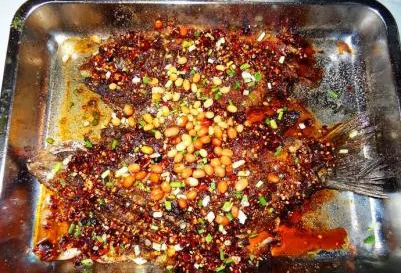
Zhangjiang grilled fish: a whole river fish split flat, charred over charcoal, dressed with chilli oil and chopped fish mint, and finished with a handful of fried soybeans — the beans are what separates it from the Chongqing version. ¥80–120 for a three-jin fish feeding two.
Sour soup fish: rice broth fermented to a red sour, used to poach river catfish, and you drink the broth first. Libo's sour is gentler than Kaili's, which makes it a safe introduction. Around ¥80–90 a pot.
Water fern: grows only in the wetlands around Libo, edible stem and all, sweet and crisp without the bitterness of ordinary bracken. Stir-fried plain or with cured pork, ¥20–30 a plate, best in spring.
Fish stuffed with chives: a Shui dish. A carp opened along the spine, filled with chives and broad greens, tied with rice straw and steamed for five to ten hours until the bones soften. Order ahead; about ¥100.
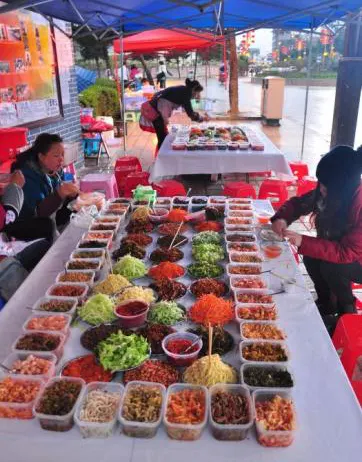
Silk-doll rolls: a stack of thin rice wrappers and a dozen shredded vegetables you roll yourself, finished with a spoon of sour broth. ¥8–12, sold along the whole night-market street, and perfectly good for breakfast.
Fermented sour greens and cured sour pork: the first smells aggressive and eats clean and appetising; the second is raw pork cured until it is safe, skin crisp, flesh dark red, eaten with dried chilli. Both are everyday food here and divisive for visitors — start with a small portion.
Zhangjiang grilled fish in a steel tray, fried soybeans and chopped fish mint over red oilA siwawa stall at the night market: bowls of fillings laid out, wrappers stacked, customers rolling their own
What to drink
Bayberry juice in summer, sold everywhere, a big iced glass for about ¥10, sour-sweet and better than fizzy drinks against chilli. Green plum wine is made from wild plums out of Maolan, pale yellow, low in alcohol, ¥40–80 a bottle and easy to carry. Local rice wine is mild and will be pressed on you at dinner; know your limit.
09What travels well is made by hand
Libo is not a shopping destination, but a few things are genuinely worth carrying home, and they share one quality: they are still made by hand. Bouyei patterned cloth, Shui horsetail embroidery, Yao batik, Maolan plum wine. Buy the craft rather than the packaging, negotiate per piece, and do not pay the first tourist price.
Bouyei patterned cloth: home-grown cotton, hand-spun, hand-woven, indigo-dyed, blue and white checks, substantial. Tablecloths, sheets, bags, ¥80–300. The test is to turn it over: hand-woven weft wanders, machine-woven is as regular as graph paper.
Shui horsetail embroidery: horsehair wrapped in silk, coiled into motifs and stitched down; a small panel takes a fortnight. Baby carriers, hanging panels, small bags, ¥200 upward. Real pieces feel stiff and sculptural; fakes are printed and flat.
Yao batik: a different process from the Bouyei, using tree resin and buffalo fat as resist, which gives a greyer, heavier black-blue. Scarves and table runners, ¥60–200.
Plum wine and dried bayberries: wine from wild Maolan plums at ¥40–80 a bottle, dried berries vacuum-packed at ¥20 a bag. The wine can go in checked luggage, not in your hand baggage.
Wind-dried suckling pig: a piglet of forty to sixty days, cured and air-dried, skin crisp and meat tender, once sent as tribute. ¥300–600 for a whole one, ¥80–150 for a vacuum-packed section. Fine as a gift, but many countries prohibit importing meat, so think before you buy.
Two things to leave alone. Wild dendrobium and gastrodia: no price benchmark, forgery is routine, and if you want herbs buy them in a proper pharmacy in town. And any cheap jewellery sold by weight as Miao silver — real silver is priced by the gram, and the bargains are copper-nickel plated, which turns black in two days.
10Rail to Libo, then twenty to forty minutes to a gate
Rail: the station is called Libo
The Guiyang–Nanning high-speed line opened in 2023, and Libo is the last station in the Guizhou section: a building with a Yao hip roof and Yao king's seals on the facade. From Guiyang North the fastest service takes 47 minutes, most take an hour to ninety, second class ¥75–115, more than thirty a day from just after six until nearly nine at night. Trains from Nanning and Hechi also stop, about two hours the other way. When booking, note that the station is simply Libo — do not buy to Dushan or Mawei and change, which was the 2013 workaround before the line existed and now costs you two hours.
Out of the station: fifteen minutes to the east gate, forty to the west
Fifty metres outside the exit is the tourist shuttle stand, with boards for Xiaoqikong East Gate, Xiaoqikong West Gate and the Libo visitor centre; you buy by QR code. East gate ¥10 and fifteen to twenty minutes; west gate ¥20–35 and thirty-five to forty-five minutes, with fares that shift by time of day and departures that run when full, roughly every half hour. A taxi is ¥20–30 to the east gate and ¥50–70 to the west, worth it split four ways. City bus 11 goes to the east gate for ¥5 in fifty minutes, the cheapest option.
Why plenty of people pay the extra twenty yuan for the west gate: entering there means walking downstream the whole way to the east gate with no climbing, then a fifteen-minute ride back to the station from the east side. Reverse it and you first sit in a shuttle for forty minutes to the west gate before heading back, which costs an hour. With parents, small children, or only one day, that order is worth the twenty.
Inside: the shuttle is the only transport
Twelve kilometres separate the two gates, and the shuttle costs ¥40 for two days, running a one-way loop with stops at the old bridge, Stone Forest, water forest, Cuigu, Yuanyang Lake and Wolong Pond. The buses are green, leave when full, and involve five to twenty minutes of waiting; at midday the longest queues are at Wolong and Yuanyang. Daqikong is not on the loop — it is three kilometres from the east gate by a separate shuttle, or twenty minutes on foot.
Flying, buses and driving
Libo airport sits twelve kilometres north-east of town, thirty minutes by airport bus. In the 2026 summer season it serves Guiyang daily plus Tongren, Xingyi, Hefei, Nanchang and Taizhou, mostly three or four times a week, and the winter schedule shrinks. The old Guangzhou and Chongqing services are gone — the flight numbers in the 2013 guidebook no longer exist — so from overseas the reliable route is fly to Guiyang, then train.
Long-distance buses leave Guiyang East for Libo, three and a half to four hours, about ¥100, infrequently — a fallback when trains are sold out. Driving is 270 km and three hours from Guiyang on the Lanhai expressway, then twelve kilometres and twenty minutes to the east gate, thirty and forty to the west. Guizhou roads are tunnel-heavy with tight bends and rockfall in the wet season; if mountain driving is not routine for you, do not do it at night. There are car parks at both gates, and both are effectively full after nine on holidays.
One last thing: the way back
The last shuttle from the east gate back to Libo station runs in the early evening, timed to the final trains, and the time moves with the timetable — check the board or ask when you come out. Services from the west gate are fewer and further apart; if you are cutting it fine, take a taxi at ¥50–70. Do not book a train that leaves after the last shuttle, because there is no other public transport on that stretch.
Hours: gates open 08:00, ticket sales stop 16:00, last entry 16:30; from 28 July to 20 August opening moves to 07:00, and over National Day to 07:30. Daqikong stops entry at 16:00. Check the scenic area's official account before you go.
Tickets: Xiaoqikong ¥120 high season (1 March–30 November), ¥100 from December to late February; shuttle ¥40, valid two days; the ticket allows repeat entry for seven days; a combined Xiaoqikong–Daqikong ticket is about ¥170 including the shuttle; Daqikong alone ¥55; its boat ¥20 one way or ¥40 return; Yuanyang Lake rowing ¥30 a person an hour, minimum four.
Booking: the Yunyou Libo WeChat or Alipay mini-program, Yimayou Guizhou, Ctrip, Meituan or Douyin, up to fifteen days ahead, five time slots, capped near 15,000 a day, with facial recognition at the gate. Visitors from Hong Kong, Macau, Taiwan and overseas buy online and then verify documents at the ticket window — screenshots are refused, so bring the physical passport.
Numbers: scenic area 0854-3516115 and 0854-3516116; Maolan reception 0854-3618881; Libo airport 0854-3789111; police 110, ambulance 120, fire 119.
Hospital: Libo People's Hospital, 121 Shichang Road, 0854-3612120, about twenty-five minutes from the east gate. Visitor centres have first-aid rooms for sprains, cuts and heat.
Signal: 4G holds on the main paths, disappears in the deep gorge and across most of Maolan. Screenshot your ticket QR code, your slot and a map before entering.
Money: QR payment works for tickets, shuttles and boats, and Alipay's international version links Visa and Mastercard. Stalls and farmstays sometimes take cash only, so carry two or three hundred in small notes.
Rules: no smoking outside designated points; no drones; no swimming and no climbing the railings — at the water forest you stay on the stepping stones; no picking plants or catching insects, and Maolan is a reserve where that carries a fine.
12Three things to arrange, five to pack
First, book. Xiaoqikong has no walk-up window; everything is timed and online, and a week ahead is sensible for summer and National Day. Second, if you travel on a foreign passport, allow time at the verification window and do not book the tightest slot of the day. Third, check the weather — and check it upstream at Dushan and Sandu, because rain there muddies the water here, and while tickets can be changed, holiday slots rarely can.
Footwear: grippy sandals for the water forest plus trainers with tread. The boardwalks grow algae, so canvas flats and flip-flops will not do.
Clothing: quick-dry shirt, light jacket — the valley runs three or four degrees cooler than town — and long trousers against insects and vines. A rain jacket beats an umbrella, which is a nuisance on a narrow boardwalk.
Sun and insects: only about 500 m of altitude, but water doubles the UV, so hat and sunscreen; July and August bring mosquitoes, so carry repellent.
Food and water: inside there is a kiosk and the east gate strip, so bring bread, bars and fruit, and 1.5 litres of water a person a day, two in summer.
Kit: polariser, lens cloth, dry bag. You will wipe the lens a dozen times a day, and a phone pouch is essential on the raft.
Cash: two or three hundred in small notes, because Maolan farmstays, village workshops and some stalls take nothing else.
Four traps. Anyone at the gate offering to get you in without a booking is selling nothing: the turnstiles read faces and there is no side door. The ¥300 car-and-three-sites packages usually reach the car park only, and you still transfer to the shuttle. Do not buy a rafting ticket after 15:30 — sales stop at 16:00 and the boats come off at five. And ignore anyone telling you the water is poor today and recommending a different sight; that person is recruiting.
13Why the water is blue and the hills are dumplings
Geology: how long it takes to dissolve a mountain
Three hundred million years ago this was shallow sea, laying down kilometres of limestone. Then the seabed rose into a plateau and water went to work: rain absorbed carbon dioxide, became a weak acid, seeped down joints and carried calcium carbonate away. Cracks widened into conduits, conduits collapsed into sinkholes and hollows, and the remaining rock was cut into cones — cone karst, of which Libo is one of the most complete examples anywhere. Maolan's 20,000 hectares of forest grow on those cones and funnels, where the soil is a few centimetres deep and roots have no choice but to follow the cracks.
The colour is the same chemistry. The river runs over limestone, loading up on calcium carbonate along with magnesium and trace metals; those particles scatter the short wavelengths back at you, which is why deep water reads blue-green to indigo. Travertine is the reverse process: calcium carbonate precipitates onto shoals, roots and fallen leaves, coating them layer by layer into rounded dams and steps. Every surface at Xiaoqikong that makes the water spread rather than fall was built by biology and chemistry together.
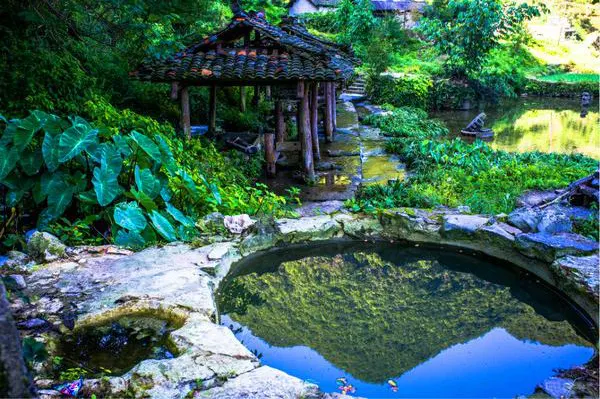
A stone-rimmed spring pool, still enough to hold the sky and the trees, with a small timber pavilion beside it
People: four peoples, four ways of living
Libo has twenty-two recognised ethnic groups, and minorities make up more than ninety per cent of the population: Bouyei, Shui, Yao and Miao above all. The Bouyei live in the valleys and flats, in timber houses with tiled roofs, growing rice and weaving patterned cloth. The Shui live upstream on the Zhangjiang, keep a script of their own — shuishu — and are known for horsetail embroidery. The Yao divide into three branches with distinct dress and burial customs: White-Trouser Yao at Yaoshan, Blue-Trouser Yao at Yaolu, Bunu Yao in Maolan. The Miao live under Mount Yueliang, and their silverwork and batik are the finest here. None of this is staged: the old woman spinning in a doorway is spinning thread she intends to use.
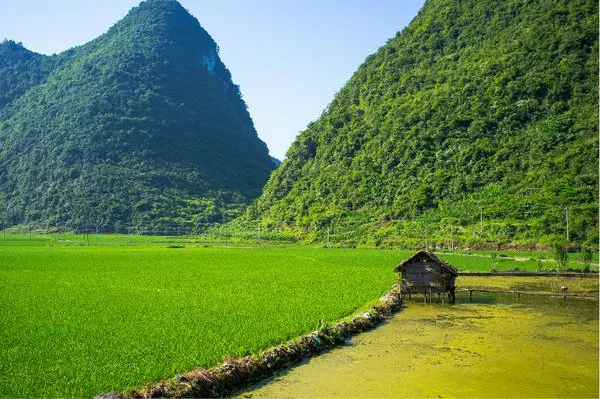
Paddy fields below the cone hills, with a small field hut standing among them
One man: from a Shui village to the founding congress
Deng Enming was born in 1901 in a Shui village at Shuiyao, left for Shandong at seventeen, and became a delegate to the founding congress of the Chinese Communist Party — the only non-Han delegate among the thirteen. He was executed in Jinan in 1931, aged twenty-nine. His former residence and a small memorial in town are free and take half an hour; the exhibits are plain, which makes them more moving than many grander halls. There is a second thread to Libo's modern history: in 1855 the scholar Zheng Zhen arrived as director of studies, opened schools and wrote poetry, and the county's literary connection to the wider Chinese tradition dates from him.
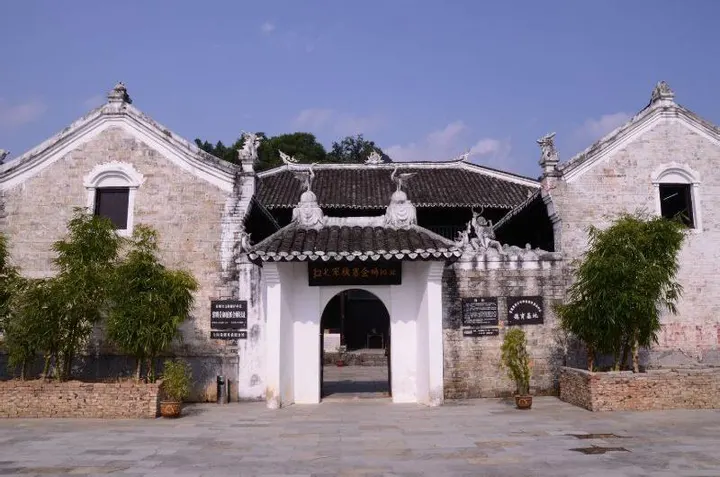
A courtyard behind stone walls, with a whitewashed gatehouse under dark tiles and two potted plants at the door
14A new old town, a village and the upper river
Libo old town (1–2 hours, free)
Let us be clear: this is not an old town. It is a pseudo-historic street built after 2010 on the edge of town, partly to resettle reservoir migrants and partly to host a night market. Stone paving, horse-head walls, red lanterns — photogenic, with no history whatsoever. Its use is the evening: stalls open at six, grilled fish, siwawa, bayberry juice and skewers in a row, with locals eating there too, which keeps prices honest. Come in daylight and you will be disappointed; come at seven and it works.
Yaoshan village (half a day, 8 km south of the east gate)
A White-Trouser Yao settlement fifteen minutes from the east gate, with a direct shuttle from the station at ¥20. The village climbs a slope and has granaries on stilts, a top-spinning ground and performances on a fixed daily schedule — ask the times first. My judgment: during the top-spinning festival around Lunar New Year, or on a market day, it earns half a day; on an ordinary afternoon an hour is enough, and the time is better spent in the valley.
Upper Shuichun and Deng Enming's house (half a day)
You can see the Shuichun without rafting it. A road follows the river east of town, and the upper reach is mirror-flat between bamboo and villages, at its best in morning mist. Twenty minutes' drive to Shuichun village, park, and walk a stretch of bank — you see more detail than you do from a raft. On the way back, stop at Deng Enming's former residence in town: free, half an hour.
Further out: Duyun, Sandu, Huanjiang
Duyun, the prefectural capital, is half an hour by train and has a stone-slab street and the Wenfeng Pagoda — half a day. Sandu, an hour north-east, is the country's only Shui autonomous county, with a shuishu script museum and the Zenlei Shui village; a day if written scripts interest you. South across the border, Huanjiang is a Maonan autonomous county where the Mulun reserve joins Maolan, and drivers can make a loop. None of the three belongs in the same day as Xiaoqikong.
15Filmed, but not yet filmed well
Film
Young Deng Enming (2013, dir. Jiang Ping and Li Zuonan) follows Deng from Libo to Jinan, and was shot on location — terraces, Shui villages, stilted houses. As a commemorative film its storytelling is flat, but the landscape is real, and seeing it before visiting Shuiyao gives the place a frame.
Books
Yang Zhengwu's Guizhou: The Secret Terrain covers the province's landscapes and peoples, and the karst chapter is the best of it. The author's argument is blunt: the value of a place like Maolan is not that it is beautiful but that it is intact. Carry it into the reserve and it does more than any interpretation board.
Music
The Bouyei mountain song If You Do Not Sing You Forget the Song, also known as the Gulu song, is fast, playful and the most widely known tune around Libo; Zeng Xiaoyan's recording is the one you will hear. Local drivers usually have it in the car — ask them to put it on repeat.
Festivals
The Yaoshan top-spinning festival falls around Lunar New Year; White-Trouser Yao call the season the top festival, and young men compete with tops weighing one to one and a half kilos, the last one spinning winning, with social rewards attached. The Miao skipping festival at Datu, in the first lunar month, has a reed-pipe band circling a carved pole and, at the peak, a custom of throwing guests into the air — they keep going until you shout uncle three times, then hand you three cups of bamboo-tube liquor. Neither is for anyone who dislikes noise or being lifted.