A mountain with a town on top, and a cinema that shows one film
A town of 20,000 on topFog on 191 days a yearTicket valid seven daysSeven minutes by cable car
In short
Mount Lu (庐山, Lúshān) is a fault-block massif in northern Jiangxi, just south of Jiujiang: Hanyang Peak tops out at 1,474 m while the Poyang Lake plain at its foot sits barely above sea level, so the mountain does not rise so much as stand — a wall between a river and a lake. On its shoulder, at 1,167 m, sits Guling town, home to twenty thousand people, with a main street, a wet market, banks and a hospital. Buy a ticket, ride up, and you have entered a small city in the cloud. That is what separates Mount Lu from every other famous peak in China. The great ticket is ¥160 and valid seven days with unlimited re-entry, covering Sandie Quan, Bailudong Academy, Xiufeng and the ring of scenic areas around the mountain. The shuttle bus is ¥90 including the climb from the gate, valid a week, and close to compulsory. The 3S cable car is ¥120 return and takes seven minutes from the valley floor to the town. You can see the main sights without climbing anything, but the floor of Sandie Quan costs 1,300 steps down and 1,300 back up, and the Wulao Peaks ask for 700 to the first summit. Budget ¥1,800–3,200 for three or four days, excluding travel to Jiangxi.
Key facts
Known for
mist · the villa district · Sandie Quan · Guling · Romance on Lushan Mountain
Budget
¥1,800–3,200 for 3–4 days, mid-range
Days needed
2–4 days
Comfort
Comfortable — a town on top and buses everywhere, but steps, mist and damp
Best time to go
July–August to escape the heat, mid-October to November for cloud seas, December to February for snow
01A mountain people have lived on for 130 years
From Jiujiang the mountain does not read as a peak. It reads as a long green wall lying across the southern horizon with a lid of cloud on it, giving away nothing about its height. The road up from the north gate has more than four hundred bends in twenty-odd kilometres and takes forty minutes, and somewhere in the middle a good proportion of the passengers quietly stop talking. Then the bends end and there is a street: shopfronts, street lamps, plane trees, parked minibuses, an old man carrying vegetables. You are at 1,167 m. This is Guling.
That single fact determines everything else. On most Chinese mountains the summit is a temple, a viewing platform, a cable-car station: you go up, you look, you come down. On Mount Lu the summit is a town — twenty thousand permanent residents, a primary school, a police station, a post office, ATMs, and Guling Street running two kilometres along the ridge in a shallow arc, six hundred shops deep, which locals call the street in the sky. So a trip here is not a climb. It is a stay in the mountains with a bus ride to a few places each day. First-timers often take half a day to adjust to it: the suitcase rolls into the room, dinner is a choice rather than a necessity, and there is a film showing after dark.
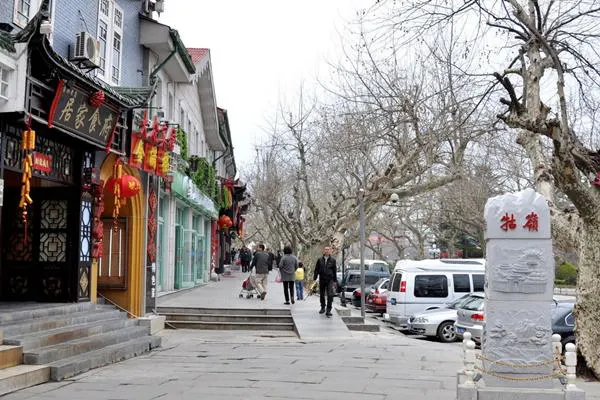
Guling Street — flagstones, plane trees, shops selling mountain produce, and a stone marker carved with the town's name
The shape is geological. A Yanshanian uplift around a hundred million years ago lifted this block of crust between two faults, so there are no gentle shoulders: the massif ends in cliffs on all sides — Scissors Gorge to the north, Shimenjian to the west, a straight drop to Poyang Lake in the east. Quaternary ice then scored U-shaped valleys across the top, and it was here in the 1930s that the geologist Li Siguang hunted for glacial erratics, igniting an argument about eastern China's ice age that scholars still have not finished. The practical result is waterfalls. Ninety-odd ridges, deep gullies, water going straight off a lip — which is why the old formula runs: of all the falls at Kuanglu, Sandie Quan comes first.
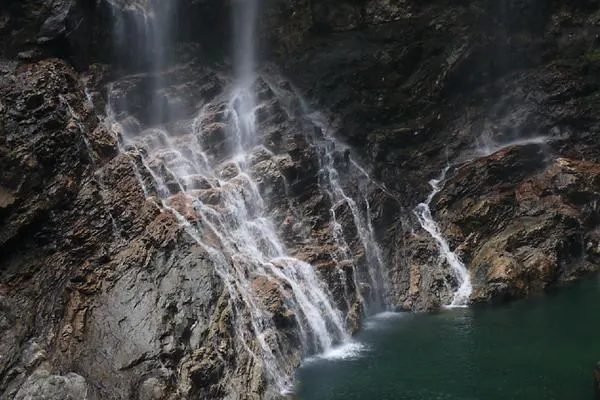
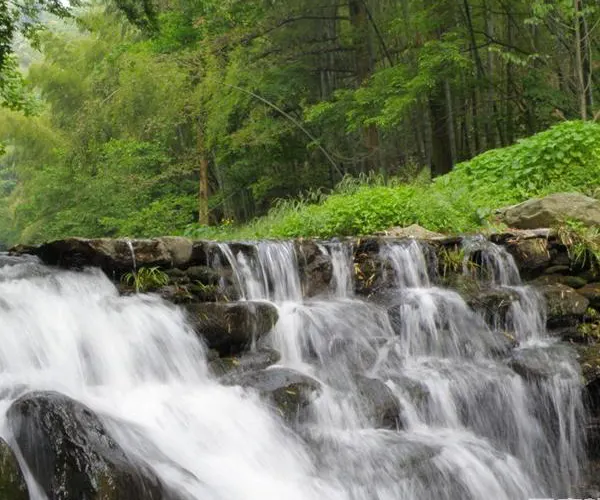
A pool in one of the valleys — water spreading down a wet rock face into water the colour of dark jade
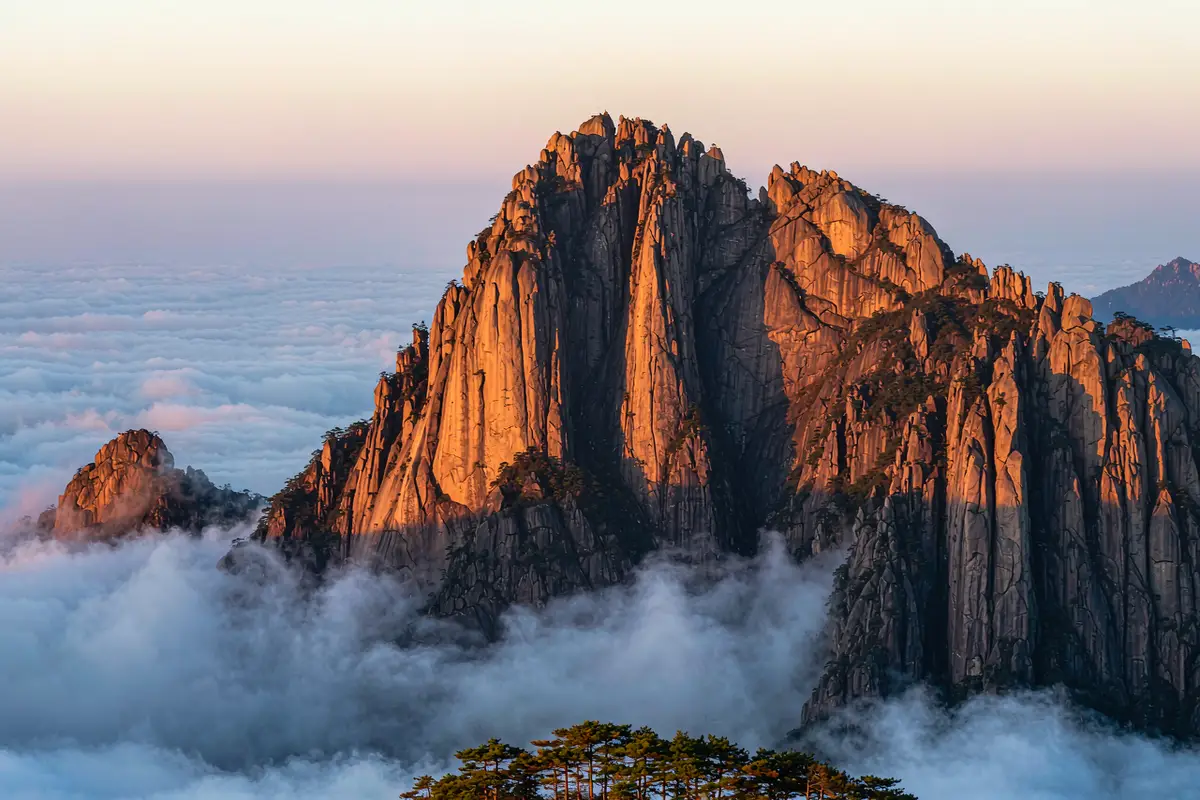
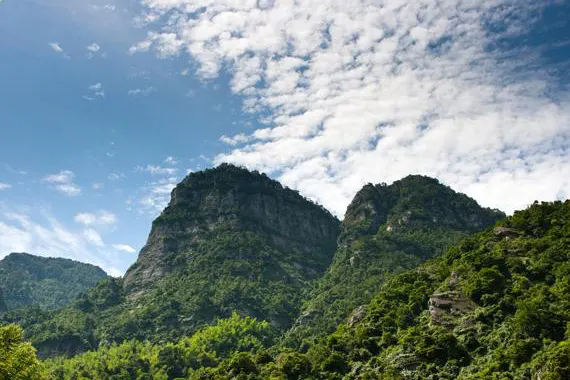
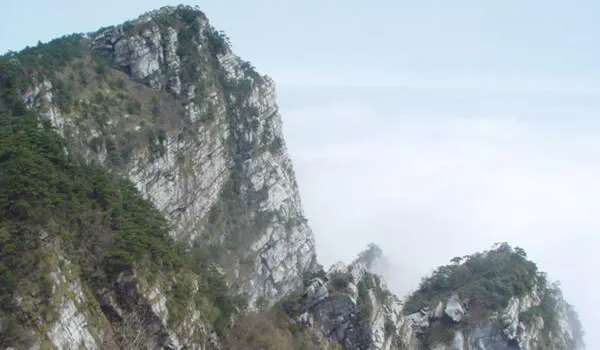
Fog is the other determinant. The weather station at Guling logs an average of 191 fog days a year, twenty a month from March to May, and July is the only month that lets up. Which means there is a fair chance that one morning you will open the curtains onto white nothing. It also means the cloud sea is not a matter of luck: let it rain one day and clear the next, and the valley below Hanpokou fills to the brim with cloud while the Wulao Peaks poke through it like five knuckles. Half of what makes a photograph of this mountain look the way it does is water in the air.
From the side a ridge, from the front a peak; near or far, high or low, it is never the same shape. The true face of Mount Lu stays unknown — and the reason is that you are standing inside it.
Su Shi, written on the wall of Xilin Temple, 1084
The fog also explains the mountain's odd modern history. In 1895 a British missionary, Edward Selby Little, leased the slope above Changchong from local landowners, renamed the ridge Guling after the English word cooling, and sold it off in plots to foreign residents escaping the summer. Over the next forty years people from more than twenty countries built six hundred-odd villas here — stone footings, corrugated iron roofs, timber shutters, set one above another on the hillside. In the 1930s the Nationalist government used the town as its summer capital; after 1949 it became a place for conferences and convalescence. A single mountain that has been a concession, a summer capital, a sanatorium and a county town is a thing only Mount Lu has managed.
02Six things worth the time
Sandie Quan: 155 metres in three dropsThe mountain's signature fall
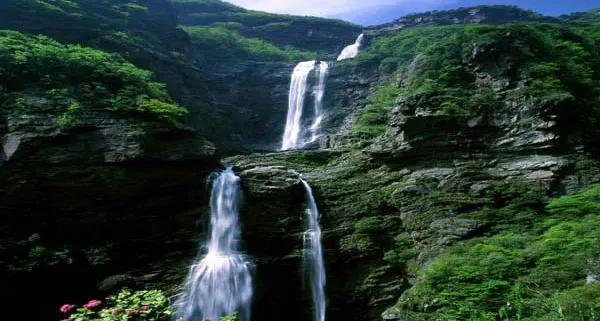
The water gathers from the gullies of the Wulao Peaks and the Damu ridge, then leaves the lip in three stages: twenty metres straight down, fifty metres curving in against an arched wall, eighty metres slamming whole into the pool with a noise that bounces twice around the gorge before it dies. It was only found by a woodcutter in 1191, which is why Li Bai's line about three thousand feet of falling water is not about this fall at all but about Xiufeng, on the southern side — a point locals do not rush to raise. Spray hangs over the pool year round; stand there five minutes in summer and your clothes are through.
The Wulao Peaks: five summits in a rowThe most vertical hour on the mountain
The five peaks were one summit until the saddles cut it apart; from below they look like five old men seated in a row, which is where the name comes from. Peaks one to four are a single continuous ridge walk, and the fourth is the highest and the most open — southeast you get a white thread of Poyang Lake. The fifth sits lower along a rougher path, and it is the only walking exit towards Sandie Quan: 4.7 km, two hours, all downhill, a descent your knees will remember.
Hanpokou: waiting for the cloud to fill the valleyWhere the sunrise happens
A gap splits the ridge between Hanpo Ling and Hanyang Peak, aimed straight at Poyang Lake as if to drink it, which is what the name means. At 1,286 m this is the easiest sunrise on the mountain: the shuttle gets you there, and the viewing pavilion is a ten-minute walk from the stop. What is worth the alarm is not the sun but the twenty minutes before it — cloud climbing off the lake, over the ridge, then flattening out under your feet. On a foggy morning you see nothing at all, which is also true, so give yourself a second dawn.
The villa district: stone, iron and peeling paintSix hundred houses, a century of weather
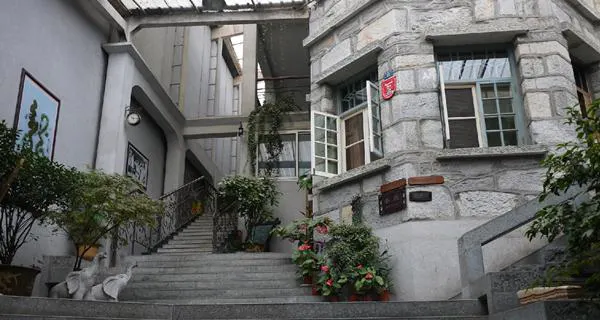
The eastern valley holds the densest cluster; ten minutes of walking passes seven or eight of them — rough stone footings, corrugated roofs rusted to a dull red, timber shutters with the paint gone, old vines reaching from the corner up to the second floor. Meilu is the famous one: built by an Englishman in 1903, the Chiangs' summer house in the 1930s, lived in by Mao in 1959, and since July 2026 a free museum you book rather than buy. Next door, the Old Villas Story strings six century-old houses into one ticketed walk and explains how the plots were laid out, how the houses went up, and who slept in them afterwards.
Ruqin Lake, Flower Path, Brocade Valley: the western walkHalf a day, almost no climbing
Ruqin Lake is artificial, dammed in 1961, shaped like a lute with a small pavilion at its centre; on a still morning the whole ridge drops into it. West of that is the Flower Path, where Bai Juyi wrote that April flowers are finished on the plain while the temple peach is just opening, now a hillside park of azaleas and peach. Beyond lies Brocade Valley — a kilometre and a half of cliff walk cut across a rock face, wall on one side and air on the other, ending at Immortal Cave. This is the stretch that feels most like a mountain, and the one where you are most likely to meet the monkeys.
Snow, and rime on everythingA northern scene in a southern province
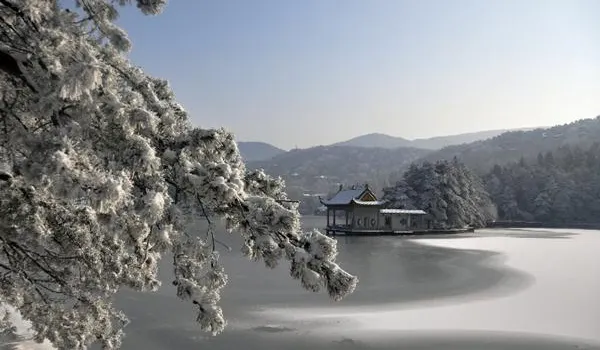
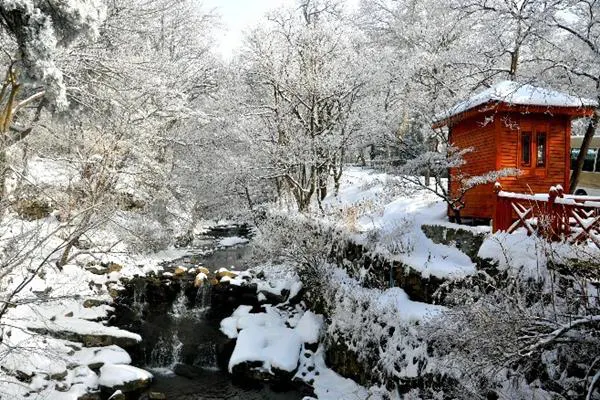
Mount Lu gets around thirty snow days a year: the first fall can arrive in late November, the last can hold on into early April, and the reliable window is late December to the end of February. Snow settles on the pine needles and turns to rime until whole trees look like white coral; Ruqin Lake skins over and the pavilion stands alone in the middle, which is the photograph everyone takes. The price is ice on the road, closures at short notice, mandatory shuttle or cable car, and a pair of crampons — ¥15 in a shop down in Jiujiang, ¥30 up here.
03Seven questions to settle before you book
Should I stay up on the mountain or down in Jiujiang?
Up on the mountain, unless you have exactly one day. Guling has three hundred-odd places to sleep, from a ¥60 dorm bed to a ¥1,500 villa hotel, and staying there buys you an evening walk, the film, and a 06:00 start for Hanpokou without buying another ticket or sitting through the forty-minute road again. Jiujiang is cheaper and eats better, but every day costs an hour each way, and the shuttle pass and the ticket clock both start over. For anything longer than a day it rarely adds up. The exceptions are a single-day visit, or an itinerary built around the ring of sites at the foot — Bailudong, Xiufeng, Donglin Temple — which are all down in the valley anyway.
How many days do I need?
Two days covers the essentials, three is unhurried, four lets you add the sites at the foot. The two-day shape: day one on the western line — Ruqin Lake, Flower Path, Brocade Valley, Immortal Cave, Great Heavenly Pool, Dragon Head Cliff — then back to Guling for the villas and the conference hall. Day two on the eastern line: sunrise at Hanpokou, the botanical garden, the Wulao Peaks, Sandie Quan, then out through the east gate or back to town. With three days, split the east: one full day for the peaks plus the waterfall, which is the hardest eight hours on the mountain, one for Hanpokou and the west, and a last morning for the villas and the museum before dropping down to Bailudong. One day is possible but means riding to Hanpokou and the top of Sandie Quan and leaving; that is a visit to the car park, not to the mountain.
Is Sandie Quan worth those three thousand steps?
Get the numbers straight first. From the funicular station down to the pool is 1,300 steps, so there and back is 2,600. The three thousand in circulation refers to the east-gate route, which climbs roughly 3,000 steps from the valley floor in about an hour. Ride the funicular and you are facing 1,300, not 3,000. Whether it is worth it comes down to water and knees. June to August the fall has real weight; in winter and early spring it thins into three white threads. Downhill is easy — the climb back is the gate you have to pass, 1,300 steps of it, steep and narrow, with two or three landings to stop on. Bad knees, heavy build, elderly parents, small children: ride to the station, look, turn around. Nobody there will think less of you.
What if the fog closes everything down?
Accept one thing first: with 191 fog days a year, you are more likely to hit fog than a clear sky. But fog here is not all or nothing. It moves — it pours up out of the valleys in waves, and a ridge that was white ten minutes ago will open up and then close again ten minutes later. So the answer is not to replan the trip but to change the rhythm: when it closes in, go and look at the human things — the villas, the conference hall, the museum, Bailudong Academy — and the moment visibility opens, get on a bus for Hanpokou or the peaks. The other trick is altitude: the cloud often tops out around 1,200 m, so the upper Wulao Peaks are frequently above it. What you genuinely need to avoid is heavy rain, when the paths flood and the waterfall section can be closed.
Can I drive my own car up?
It depends on the date. During the two holiday periods and the two summer months — May Day, National Day, July and August — private cars are simply not allowed up: you park at the north gate, south gate or the cable-car base and continue by shuttle or cable car. That is a standing order, republished every year. Outside those windows there is a limited online quota, booked in advance through the One-Trip Lushan mini-program, and parking runs ¥45 for seven days. Ice closes the road at any time of year, chains required even for local cars. Honestly, with parking tight on top and Guling Street strictly controlled, leaving the car below is the easier life; the cable-car base car park is ¥15 a day.
How do I get here from Nanchang, Wuhan or Jiujiang?
The trains arrive at two different stations, and mixing them up is the classic mistake. Lushan Railway Station is the high-speed one, out in Chaisang district about a dozen kilometres from the cable-car base: a ¥10 shuttle from the forecourt takes twenty to forty minutes, then seven minutes up by cable car. That is the easiest line in. Jiujiang Railway Station is the old station in the city — closer to the mountain gate, further from the cable car: bus 57 runs to the cable base for ¥3 in about an hour, bus 86 reaches the north gate for ¥1, or take a taxi. Nanchang West to Jiujiang is 55 minutes for a little over ¥40, to Lushan station ¥38. Wuhan to Lushan station is as fast as 1h07m from ¥71, to Jiujiang 1h39m for ¥89. There is also a through bus from Jiujiang's main coach station to Guling, ¥15.5, running 06:00–18:30, which stops at the gate so you can buy your ticket.
Which month is best?
It depends what you are buying. July and August are for escaping heat: 39 °C down in Jiujiang, a July mean of 22.6 °C up top, a blanket on the bed at night — at the cost of the biggest crowds, the highest room rates and cable-car queues that can run to two hours. October and November are for cloud seas: less rain, big day-night swings, more clear mornings, and a better chance of the valley filling up than in the plum rains, with autumn colour thrown in. This is the window photographers trust. Late December to February is for snow, rime and ice on the falls, with thin crowds and low prices, if you can live with sudden road closures. May and June are the most comfortable temperatures and the foggiest weeks of the year, twenty days a month on average — come for quiet, not for photographs.
04Three days: west, east, then down
One logic shapes every Mount Lu itinerary. The western line sits close to Guling, dense with sights, gentle underfoot and heavy on history — that is your arrival afternoon. The eastern line runs away from town, Hanpokou then the peaks then the waterfall, and it is the hardest day on the mountain, so give it a whole block. The third day goes downhill, collecting the sites around the foot — Bailudong, Xiufeng — all of which are already paid for by the ¥160 ticket, and skipping them is simply waste.
D1
Reach Guling around midday, drop the bags and take the western line. Shuttle to Flower Path, half a circuit of Ruqin Lake, then into Brocade Valley for the kilometre and a half of cliff path to Immortal Cave, and on to Great Heavenly Pool, where a few hundred steps down the southwestern side bring you to Dragon Head Cliff. Back in town by evening: a walk along Hexi Road past the villas, the central park before dark. At seven, the cinema — two shows a night, 19:00 and 20:30, ¥40, no reserved seats.
D2
Give this day to the east, and expect five and a half hours of it to be road and steps. Out at 06:30 for sunrise at Hanpokou — book the sunrise bus at the station the day before, or take a taxi — back through the botanical garden at eight, at the Wulao Peaks gate by 09:30. Seven hundred steps to the first summit, an hour along the ridge to the fourth, which has the best view, then back the same way. In the afternoon, shuttle to Sandie Quan: funicular both ways saves an hour, 1,300 steps down to the pool, 1,300 back up, three hours end to end. If you have legs left and dislike retracing, walk from the fifth peak straight down to the waterfall — 4.7 km, two hours — and leave by the east gate.
D3
Morning for the human layer: Meilu, the conference hall and the Lushan Museum, all in the eastern valley, walkable or one stop apart. Meilu is free but needs a booking on the mini-program. Check out at noon and go down by cable car or shuttle; luggage can be sent ahead to the gate. In the afternoon, Bailudong Academy — the one Zhu Xi rebuilt in 1179, with its gate, library and bridge still standing — an hour is enough. If time remains, Xiufeng, for the waterfall Li Bai actually wrote about, cable car ¥40 return. Away from Jiujiang or Lushan station in the evening.
05Water in the west, rock in the east, people in between
The western line: hardly a climb in it
The western line starts at the conference centre and runs through the main street, Flower Path, Immortal Cave and Great Heavenly Pool to the power-station dam. Buses cover all of it, and the walks between stops are ten or twenty minutes. Ruqin Lake is the Flower Path stop: about ten hectares, made by damming the Changchong River in 1961 and named for its lute shape. The lakeside boardwalk takes forty minutes, and before seven in the morning there is nobody on it and the pavilion's reflection sits unbroken on the water. April brings azalea all along the shore, October brings ginkgo and dawn redwood.
A stream breaking over stones by the path, bamboo and broadleaf behind
The Flower Path carries Bai Juyi's name. In 817 he wrote here that the April flowers were finished on the plain while the temple peach was just coming out — not a poetic flourish but phenology: every hundred metres of altitude delays spring by three or four days. Today it is a park with a couplet over the gate, peach and azalea inside, and a reconstruction of Bai's thatched cottage. West of it the Brocade Valley path begins, cutting along the cliff face, two abreast at its narrowest, rock on the left and several hundred metres of nothing on the right, ending at Immortal Cave.
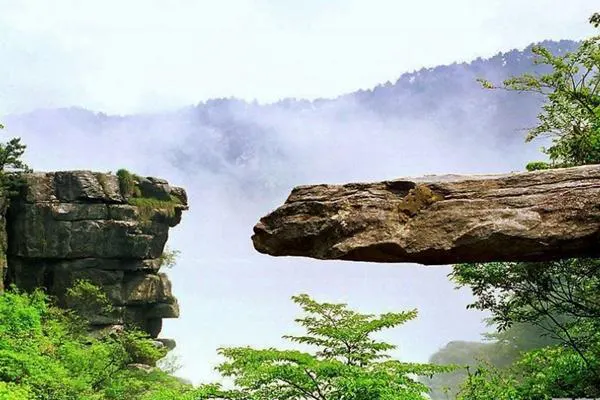
The Heaven Bridge — a slab jutting out over the valley while mist rises underneath
Immortal Cave is a natural hollow, small at the mouth, with an altar to the immortal Lu Dongbin inside and incense that has never quite gone out. A 1961 poem made it famous across China, and made the rock outside, labelled Perilous Peak, a place where people queue for photographs. Two stops further is Great Heavenly Pool, once the release pond of a temple that no longer exists. A few hundred steps down from its southwestern corner brings you to Dragon Head Cliff: one slab of rock pushed out over the gorge like a head on a neck, with nothing visible below, at its most convincing when the cloud is coming up.
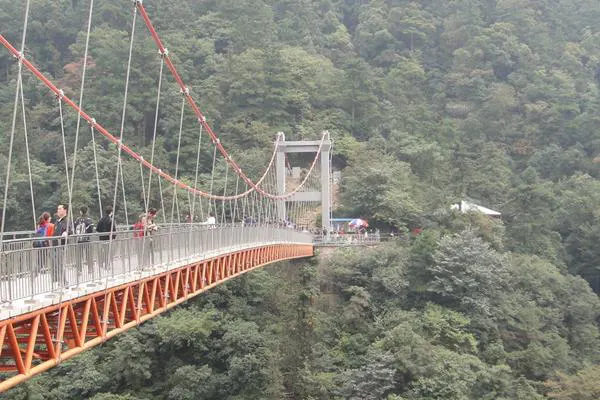
Keep descending from Dragon Head Cliff and you reach a steel suspension footbridge slung across the gorge, plated deck, a certain sway underfoot, wooded slopes falling away on both sides. Cross it and a short cable car — thirty-odd yuan one way — lifts you back to the Great Heavenly Pool entrance, which spares you the climb. Descend, cross, ride up: the best value in leg-work on the whole western line, because every step of it is downhill except the ones you are sitting down for.
The footbridge over the gorge — orange steel truss, cables, walkers midway, trees on both banks
The eastern line: Hanpokou, the peaks, the waterfall
The eastern line is where the mountain shows its size. Ten minutes from the Hanpokou stop stands the viewing pavilion, and on a clear day you get Poyang Lake and the Wulao Peaks in one frame, the lake a bright white line to the southeast. The botanical garden is back the way you came — founded in 1934, three thousand species, a mixed stand of fir and maple that goes off in layers in autumn, and almost nobody in it. It is the most underrated stop on the mountain. Two stops beyond it is the gate for the peaks.
The fourth peak is the best lookout on the whole ridge: Poyang Lake southeast, the red roofs of Guling north, Hanyang Peak west. The third is the exposed one, the path pinned to the edge with a chain and air beyond it. Fourth to fifth is a twenty-minute descent on a narrow, quiet path, and most people turn back at four — if you intend to walk down to Sandie Quan from the fifth, note that the junction sits between the two, and getting it wrong means climbing back up for the privilege.
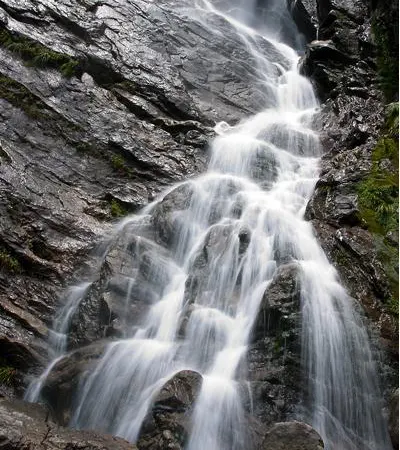
Water coming down a stacked rock wall, fanning out ledge by ledge over wet black stone
Sandie Quan is the last act. The shuttle drops you at the stop, the funicular station is beside it — it is really a rack railway, six minutes, and it removes fifty minutes of easy but endless walking that you could equally do on foot. The steps start where the train ends: 1,300 of them, steep, narrow, wet, with uphill and downhill traffic sharing one line and two or three landings to squeeze past on. At the bottom you look up at 155 metres of water in three stages, the third the biggest, and the wind of it pushes spray fifteen metres out — standing there in summer is like being rained on.
The middle: the town is the sight
Guling Street runs about two kilometres, and its eastern stretch is a half street — buildings on the uphill side only, the other side simply falling away, so you stand at the kerb and watch cloud go past below your feet. There are banks, a post office, a pharmacy, a wet market and a courier desk. Between seven and half past, locals do their shopping and the visitors are still asleep, and for that half hour the town is most like itself. The central park sits in the middle of it, with dancing, chess and dogs in the evening.
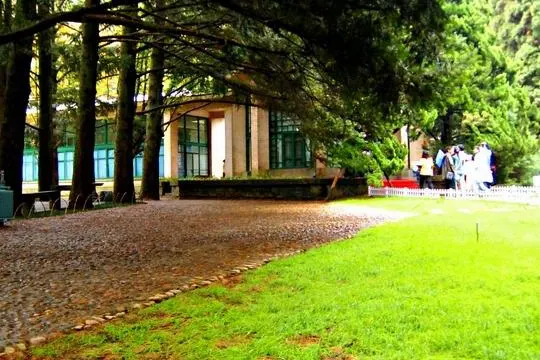
Gravel and lawn in front of an old villa, light broken up by pines, a few visitors walking in with umbrellas
The eastern valley holds the villas. Walking from Meilu towards Lulin Lake they come one after another: stone walls, pitched roofs, corrugated iron, timber windows — some restored and run as hotels, some empty with half the glass gone. Lulin Lake is a reservoir dammed in 1955, its bridge and dam in one structure thirty metres high, a film of mist usually on the water. Above it stands the Lushan Museum, once a residence, with one bedroom kept as it was and a collection of paintings and calligraphy.
06Beyond looking
Waiting for a sunrise
Hanpokou is the standard answer, but the town has two easier options. Little Heavenly Pool sits north of Guling at 1,213 m, forty minutes on foot, good for both sunrise and cloud, with a Tibetan Buddhist shrine beside it — an unusual thing to find this far south. The Cloud-Watching Pavilion above Scissors Gorge is better for sunset. Watch the last bus: 19:00 in high season, 17:30 in low, and sunset watchers routinely end up walking back or paying for a taxi. The sunrise bus is booked on the mini-program and leaves from the conference centre.
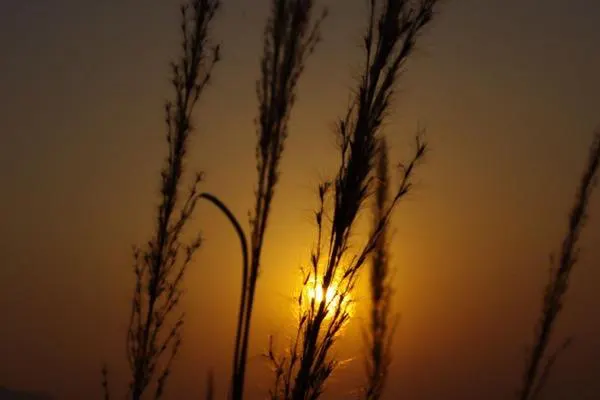
Backlit grass at sunset, the sun caught behind the stems and the sky gone orange
A cinema with one film on the programme
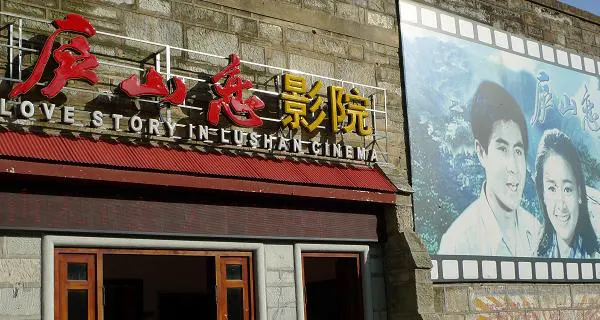
The cinema is at 19 Hexi Road, fifteen minutes' walk from the main street. It opened on 12 July 1980 and has screened one film ever since — a Guinness record in 2002 for the longest continuous run in a single cinema. The auditorium is a converted old building with red plush seats and slightly muffled sound. Tickets are ¥40, two shows a night at 19:00 and 20:30, no clearing between them, no seat numbers, doors at 18:30. The film looks plain now, but it recorded 1980's Mount Lu whole: Ruqin Lake, the Flower Path, Hanpokou, Bailudong, all appearing on the screen a few hours after you stood in them.
The cinema front, its red-lettered name above the door and the two leads on a poster beside it
A pot of mountain tea
There are plenty of teahouses along Guling Street: a pot of cloud-and-mist tea is twenty or thirty yuan and the water keeps coming. The more serious ones will tell you which slope the leaf came from, what date it was picked, before or after the Qingming festival. If you want to buy properly, taste at a tea factory's own shop and then decide; if you do not, sitting at the kerb watching the fog arrive and leave is its own reward. At twenty-something degrees in summer, hot tea beats air conditioning.
Rafting in summer, ice in winter
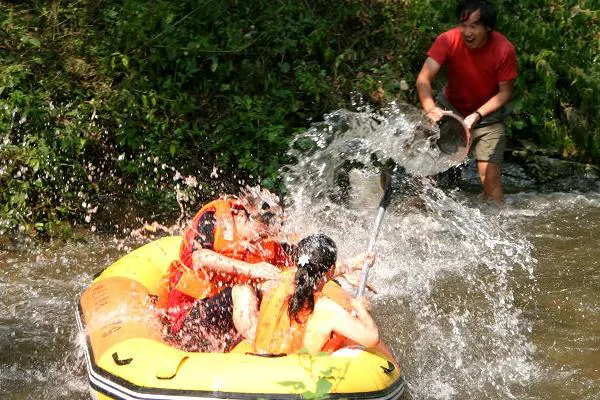
Rafting — a yellow boat, orange life vests, and two people already soaked
The southern valleys run rafting trips from May to September — Taohua Stream, Scissors Gorge, Shimenjian — an hour or so on the water for a little over ¥100. The drops are modest but the current is not, capsizing is routine, and the phone goes in a dry bag. Winter reverses it: the falls freeze into curtains, rime coats every needle, the paths ice over, and while the buses and the cable car keep running, some trails close. Few people come up then, and it is quiet enough to hear the ice crack.
07The answer is nearly always Guling; the question is which end
Get the shape of the town first. Guling is drawn out along the ridge: the eastern end is Guling Street and the central park, the busiest part; the western end is quieter, towards Flower Path and Ruqin Lake; the north side faces Little Heavenly Pool, convenient for sunrise but far from the shops; and the eastern valley is the old villa quarter, where the buildings are the best-looking. The bus terminus, the top cable-car station and the coach station are all in town, so where you sleep affects your evening walk and your window view rather than your transport.
Hostel beds: a handful of places still run dorms at ¥60–120 a bed with shared bathrooms, and the owner will usually tell you exactly which bus goes where and when. Good for solo travellers on a budget who do not mind noise.
Guesthouses and homestays: the bulk of the three hundred-odd places in town, ¥150–300 outside the season and ¥300–600 in summer and over National Day. Most have underfloor heating or air conditioning and a dehumidifier, which on a mountain that sits at 78 per cent humidity is not a luxury. When choosing, check two things: how far from a shuttle stop, and whether they collect you.
Converted villa hotels: in the eastern valley and along Zhongshan Road, stone houses with pines in the yard, ¥800–1,500 a night. You are paying for the building — 1930s window frames, the original stairs, a fireplace in the hall. Soundproofing and plumbing are the standing weaknesses of houses this age; do not expect a business hotel's consistency.
Guling main street: the best position, restaurants and buses at the door, from ¥800 in high season and double that over holidays. Right for a single night when every hour should go to the mountain.
Two practical notes. There is no food delivery up here, so after nine at night your options are whichever kitchens are still open — if you are staying out of the centre, ask what time they close. In winter, ask about heating and whether hot water is time-limited: old houses lean on electric blankets and split units, and in a year when pipes freeze at minus five the hot water goes. In summer, ask about a dehumidifier and a fan; at twenty degrees after dark the air conditioning barely earns its keep.
08Three stones, one tea, and a plate of greens
Lushan cooking is Jiangxi food at altitude: heavy oil, deep colour, dried bamboo and pickles, but less chilli than Nanchang. Everything arrives by truck from below, so prices sit about thirty per cent above Jiujiang — twenty-something for a plate of greens, seventy or eighty for a fish. Eating splits into three tiers: the frontage places on Guling Street, the most expensive and most institutional; the old rooms up the side alleys, cheaper and larger; and the snack stalls near the central park, the most casual.
What to order
Rock frog: a species that lives in stream crevices, denser than bullfrog and finer than chicken, usually braised, ¥80–100 a portion. What you are served is farmed — wild ones have been protected for years. If frog is not your thing, skip it without guilt.
Rock fish with egg: finger-length stream fish, dried, then stir-fried hard with egg — salty fish, soft egg, about ¥40, and the most everyday dish on the mountain. It is also the easiest introduction to the local kitchen.
Rock fungus with chicken: a lichen that grows flat against cliff faces, ear-shaped, slippery and chewy once soaked, stewed two hours with a free-range bird until the broth goes dark brown. The real and the fake are far apart — anything called wild rock fungus chicken under ¥50 is wood ear with a story.
Lushan bok choy: grown cool and high, thick-leaved and tender, stir-fried plain or in lard, and sweet. It is what locals order most and the hardest dish to get wrong.
Fresh bamboo and pork: May and June bring fresh shoots, ¥20–30 for a braised plate; the rest of the year it is dried shoot and sheath braised with pork belly, the most solid rice-accompanying dish on the mountain.
Tea cakes and osmanthus crisps: the cakes are tea oil, wheat flour, black sesame and osmanthus, thin, crisp and faintly sweet — Su Dongpo wrote of them as chewing the moon. The crisps are sweeter and shorter. Both travel well.
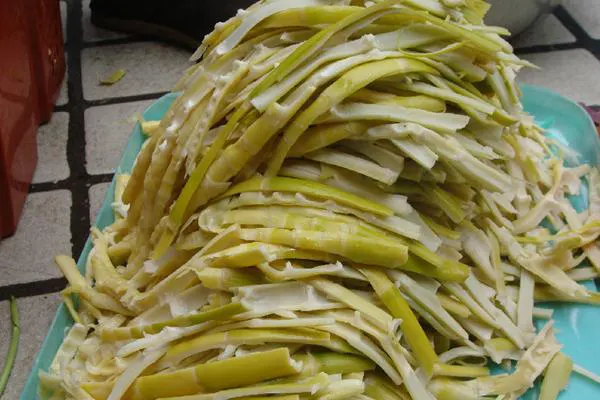
Spring shoots just peeled at the market, sliced into strips and still faintly green
Where to eat
Shiniu, on Guling Street, has been going for more than thirty years: braised pork with dried shoot and rock fish with egg are the signatures, around ¥60 a head. Up the alleys off the main street there are family places locals actually use, under ¥50 a head and generous. The old residential blocks along Yaowa Road have a row of small kitchens doing fish and greens — plain rooms, correct cooking. For something cheap and hot in the morning, find a rice-noodle shop: a bowl in chicken broth is ¥5, ¥7 with an egg, and beats any convenience store.
09Tea is the one thing worth buying carefully
Of the six hundred-odd shops on Guling Street, half sell tea and mountain produce. The rule is simple: tea yes, but know the price; herbs no; anything described as an antique, assume it was made last month. Paying more up here than down in Jiujiang is transport cost, not fraud — but the spread between two shops on the same street can be threefold, and that requires a little judgement.
Lushan cloud-and-mist tea: one of China's ten famous greens and a tribute tea as far back as the Song. The leaf is thick, blue-green and downy, the liquor pale and slow to sweeten. The price bands are clear: ¥150–300 per 500 g for everyday drinking, ¥500–1,500 for a pre-Qingming pick, ¥300–800 for a gift box. Shops here often quote by the kilo, so when you hear eighteen hundred, check which — usually the kilo, which is nine hundred a jin. Below ¥150 a jin it is almost certainly not from this mountain.
Rock fungus: sold by weight, ¥30 for a 50 g vacuum pack, which swells three or four times when soaked — three to five grams will do a whole chicken. Check the underside for grit and the bag for a musty smell.
Dried bamboo shoot, shoot sheath and dried beans: light, keeps, and genuinely gets used, ¥20–30 a bag. Buy loose and look for insect holes and mould.
Tea cakes, osmanthus crisps and cloud-slice cake: sold on Guling Street and at the cable-car base, ¥20–40 a box, and the safest gift on the mountain. Check the date, and keep the crisps from being crushed.
Three things to leave alone. Anything sold as wild rock fungus or wild rock frog — the wild ones are protected, and both the selling and the buying are illegal. Unidentified herbs and home-brewed medicinal liquor of the ancestral-recipe variety. And villa carvings or old photographs with no provenance. If you want something with weight, a few of the design shops on Guling Street put the mountain's poems on tea caddies and the villa window frames on bookmarks, which is at least honest.
10Two stations, three ways up
First, tell the two stations apart
Lushan Railway Station is the high-speed one, out in Chaisang district a dozen kilometres from the cable-car base: a ¥10 shuttle from the forecourt takes twenty to forty minutes, or a ¥12 bus runs to the north gate transfer centre. Jiujiang Railway Station is the old one, in the city, twenty-odd kilometres from the cable base: bus 57 runs there directly for ¥3 in around an hour, bus 86 reaches the north gate for ¥1, a taxi is about ¥30. A ¥5 express bus, route 90, connects the two stations and started in April 2025. The conclusion is blunt: on high-speed rail, book to Lushan; on a conventional train or coming from Nanchang, Jiujiang is handier.
Way one: the cable car, seven minutes
The Lushan cable car is one of Asia's earlier 3S installations: 2,864 m long, 873 m of vertical, seven to ten minutes from valley floor to town, thirty people a cabin, and luggage rolls straight on. Return is ¥120, up only ¥75, down only ¥65, with half price for residents of Jiujiang and Nanchang. Normal hours are 07:30–18:30, extended to 21:00 over May Day, National Day, Spring Festival and through July and August. It shuts for annual maintenance in May or June — 11 May to 9 June in 2026 — and on those weeks the bus is the only way up. Heavy fog or wind stops it temporarily, announced over the speakers.
Way two: the shuttle, forty minutes of hairpins
From the north or south gate transfer centre the shuttle takes forty minutes over more than four hundred bends, and anyone prone to carsickness should take something half an hour before. The pass is ¥90 including the climb and descent, valid seven days; mountain-only is ¥70, with short passes at ¥65 for 24 hours and ¥80 for 72. You tap in with your ID card and get on and off at will. The two lines leave from separate stands in town: east for Meilu, the conference hall, Lulin, Hanpokou, the botanical garden, the peaks and Sandie Quan; west for the main street, Flower Path, Immortal Cave, Great Heavenly Pool and the dam. Buses run 07:00–19:00 in high season and 07:30 or 08:00 to 17:30 or 18:00 in low.
Way three: the through bus, or your own car
Jiujiang's main coach station runs through buses to Guling for ¥15.5, from 06:00 to 18:30, leaving when full, an hour door to door. The bus stops at the gate so everyone can buy a ticket, then continues to the coach station up in town. It is the cheapest way up and the hardest on the stomach. Driving: private cars are barred entirely over May Day, National Day, July and August, parked at the north or south gate transfer centre or the cable-car base at ¥15 a day or ¥45 for seven; outside those dates you need an online vehicle reservation through the mini-program, on a limited quota; and ice closes the road without notice. Parking on top is tight and Guling Street, Hexi Road and Dalin Road are strictly controlled, so do not count on luck.
Getting around once you are up
The town itself is small: twenty minutes end to end on foot, and most days you will walk it. Sights are the shuttle's job; do not count on taxis, of which there are very few and which only work the town and its edges. The bus company also runs a luggage transfer now — box from the cable-car station or coach station to your hotel for a few tens of yuan per piece, and back down on the day you leave — which is genuinely useful with big bags.
Numbers: visitor information 400-900-6162, shuttle dispatch 0792-8296666 (south gate 8296667, north gate 8296668), complaints 0792-8287906. Police 110, ambulance 120, fire 119.
Hospitals: the Lushan People's Hospital on Dalin Road in Guling is the only one up here with an emergency room, and it handles sprains, stomach trouble and mild altitude symptoms; anything serious means an hour down to Jiujiang. There are first-aid rooms at several of the main sights.
Signal: 5G through the town, 4G at the main sights, and it drops behind the Wulao Peaks and at the bottom of Sandie Quan, where there is none at all — agree a meeting time before you go down.
Money: QR payment works throughout the town, Alipay's international version links Visa and Mastercard, and tickets, shuttle and cable car can all be bought online. Carry a couple of hundred in cash for the moments when the signal fails and the QR will not load.
Rules: no smoking outside designated areas, drones need permission and are largely banned in the core zone, and there is no wading, no feeding the monkeys and no climbing the railings. The Brocade Valley and Sandie Quan paths are genuinely slippery after rain, and smooth-soled shoes are a bad idea.
Tickets and bookings: since January 2026 everything is real-name and online, through the One-Trip Lushan mini-program on WeChat or Alipay, or via Ctrip and Meituan. A staffed window remains for older visitors and anyone who needs it. The great ticket is ¥160 for seven days, covering the core and the ten ring sites; the museum, Meilu and the conference hall have been free since July 2026 but still require a booking.
12Packing list and pitfalls
Bookings: a week ahead on the mini-program for ticket and cable car, two weeks for holidays. The ticket lasts seven days, so do not lock the trip into a single entry; if you want the sunrise, book the sunrise bus at the same time.
Clothing: seven to ten degrees cooler than Jiujiang, and even July nights sit around twenty. Short sleeves plus a light layer in summer, a proper down jacket, hat and gloves in winter. Rain gear all year — 1,900 mm of it, and it arrives fast.
Footwear: grippy, waterproof, with tread. The 2,600 steps at Sandie Quan, the wet flagstones of Brocade Valley and the ice after snow all test the sole. Bring a spare pair of socks.
Damp: 78 per cent humidity year round means nothing dries in the room. Bring a couple of dry bags for camera and documents; batteries fade in the cold, so keep a spare in an inside pocket.
Travel sickness tablets: four hundred bends in forty minutes, and a good chance of feeling it the first time. Take them half an hour before, not after.
ID and cash: the national ID card is the key to everything here — gate, bus, hotel, ticket. Foreign visitors book with a passport number and go through the staffed lane at the gate for verification.
Five pitfalls. Anyone at the cable-car base or coach station offering a private car up, or a way in without a ticket, is selling nothing — there are three ways up, and none of them is that. Do not buy tea at the sight entrances; fifty metres up the same street the price halves. The sedan-chair service at Sandie Quan opens at three or four hundred for one way and will come down to two, and it is still poor value for a forty-minute walk. At holiday time the cable-car queue reaches two hours, and arriving before 07:30 is the only reliable fix. And do not schedule a sunset past the last bus — 17:30 in low season, and the walk back takes over an hour.
13A block of rock that went up, and a century of tenants
Geology: a fault block, and an argument that never closed
The origin is straightforward enough. A Yanshanian uplift around a hundred million years ago raised this block of crust as a unit while the ground on either side dropped along faults, which is why there are no foothills: the mountain ends in cliffs and the plain and the lake begin. Geologists call it a fault block, the same family as Mount Tai and Mount Hua. After that, Quaternary ice cut U-shaped valleys, cirques and erratics across the top, of which the Wangjiapo valley is the textbook example.
In the 1930s the geologist Li Siguang worked these slopes and read the boulders and striations as glacial transport, and on that basis argued for a Quaternary ice age in eastern China. The claim was contested from the day it was published — opponents read the same boulders as debris-flow and weathering deposits — and the argument has run for nearly a century without a clean verdict. The rounded erratics you pass on the trail are the physical evidence in an unfinished academic dispute, which is not something most Chinese mountains can offer.
Culture: an academy, a temple, six hundred villas
In the fourth century the monk Huiyuan founded Donglin Temple on the northwestern slope and taught salvation by recitation of the Buddha's name, which is why he is counted the first patriarch of Pure Land Buddhism and why Mount Lu enters Chinese Buddhist history at that point. In the same period the Daoist Lu Xiujing compiled scriptures here and established the Lingbao school. Over the following millennium the mountain carried as many as five hundred temples and shrines. In 1179 Zhu Xi came to teach at Bailudong Academy and wrote its charter — study broadly, inquire carefully, reflect, discriminate, and then act — which became the standard for academies across East Asia.
After 1895 the mountain acquired a different kind of tenant. Edward Selby Little divided the slope above Changchong into plots and sold them to missionaries, merchants and diplomats of various nationalities, on condition that they build, plant and make roads. Within twenty years people from more than twenty countries — Britain, America, Germany, France, Russia, Sweden, Norway among them — had put up six hundred-odd villas, running from English cottage to German Jugendstil, mostly built from what was on the ground: granite footings, corrugated iron roofs, timber windows. From 1928 the Nationalist government made Guling its summer capital and moved offices up with it, and the town's political weight peaked in the 1930s and 1940s. After 1949 it became a place for conferences and rest homes; three central meetings were held here in 1959, 1961 and 1970, in the auditorium completed in 1937 that is now the Lushan Conference Site, a free museum.
Climate: why there is fog on 191 days
The Yangtze lies to the north, Poyang Lake to the southeast, and both are large bodies of water; humidity here sits near eighty per cent most of the year. Warm moist air rises off the lake, hits the mountain, cools, and condenses — so the fog is not weather so much as terrain. Guling's annual mean is 11.5 °C, July averages 22.6 °C, roughly seven degrees below Jiujiang on the plain; annual rainfall is 1,900 mm, twice the surrounding lowland; and fog occurs on 191 days, twenty a month from March to May. String those numbers together and you have both the entire case for calling this a summer resort, and the physical reason a poet could stand inside the mountain and still not see its face.
14Four courtyards at the foot, and two counties beyond
Bailudong Academy (half a day, included in the ticket)
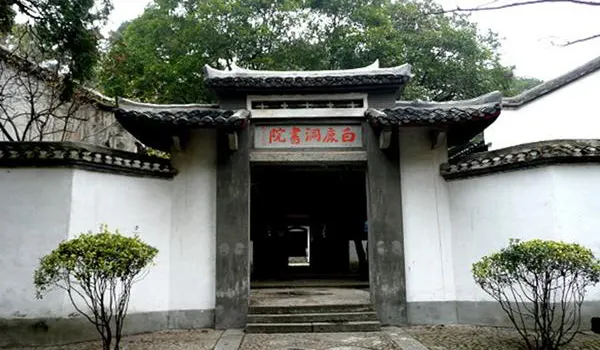
The academy gate — white walls, grey tiles, upturned eaves, its name carved above the door
In Haihui town, in a fold of the southern slope below the Wulao Peaks. Teaching began here around 940, and Zhu Xi rebuilt and lectured at the academy in 1179; with Yuelu, Suiyang and Songyang it is counted one of the four great academies, usually first among them. What stands today is a Qing reconstruction: the gate, the semicircular pond, the imperial library, the lecture hall, the White Deer Cave itself, rising courtyard by courtyard to a bronze of Zhu Xi and the carved text of his charter. Old pines, few visitors — the quietest site on the mountain. The gate price is ¥36, but the ¥160 ticket already covers it.
Xiufeng (half a day, included in the ticket)
The waterfall Li Bai described as three thousand feet of falling water is here, not at Sandie Quan. Xiufeng is a separate site on the southern side: an hour's climb from the gate to the foot of the fall, or a cable car (¥40 return) most of the way. There are two falls, Horse Tail and Kaixian; in the wet season they carry the weight the poem claims, and in the dry months they thin to two threads. Below them are the ruins of Xiufeng Temple and a set of cliff inscriptions, including characters by Mi Fu and Huang Tingjian. Gate price ¥56, also inside the ¥160 ticket.
Donglin Temple and the Donglin Buddha (half a day, free)
Donglin Temple sits on the northwestern slope, founded by Huiyuan in 386 and the ancestral home of Pure Land Buddhism; the memory of the White Lotus Society is kept here, and pilgrims come from Japan and Korea. Beside it stands the Donglin Buddha, a 48 m gilded bronze Amitabha consecrated in 2013 — large enough that you stop talking when you look up from the gate. Both are free, half an hour by taxi from Jiujiang and fifteen minutes from the cable-car base.
Jiujiang itself (half a day)
If you have a few hours before a train, the city earns a circuit. The Xunyang Tower on the riverbank is where, in Water Margin, Song Jiang wrote his rebellious poem; the present building is a 1989 reconstruction, and from the top you get the Yangtze. Lock River Tower and Nengren Temple are nearby, and Yanshui Pavilion sits out in Gantang Lake on the site of Zhou Yu's old reviewing stand. Breakfast is better down here than up the mountain: radish cakes, fried rice noodles, soup in a clay pot, ten yuan for the lot.
Wuyuan and Jingdezhen (a day each)
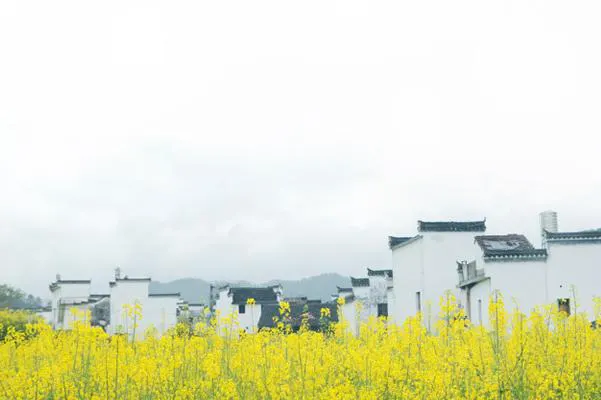
Wuyuan in March — rapeseed to the horizon, whitewashed Hui houses showing above it
Wuyuan is 200 km east of Jiujiang, three hours on the Hangzhou–Ruili expressway, with buses as well. For about twenty days at the end of March the rapeseed terraces at Jiangling run from the ridge to the valley floor with Hui villages caught in them; the rest of the year it is a different kind of quiet — drying racks, old houses, camphor trees. Jingdezhen is closer, ninety minutes by high-speed rail, and worth half a day at the China Ceramics Museum and Taoxichuan, with the imperial kiln site in the middle of town. Both can be done from Jiujiang without coming back up the mountain.
Southern Anhui: Hongcun and Xidi (3 days)
Northeast from Jiujiang, past Jingdezhen and over into Anhui, three hours brings you to Yi County. Hongcun and Xidi are the two most complete Hui villages in southern Anhui — white walls, black tiles, horse-head gables, skywells — and were listed together as a World Heritage site in 2000. Hongcun's water system was designed rather than inherited: a stream is led in behind the village, runs down the lanes as a grid of channels and empties into the South Lake, which is where the ox-shaped plan comes from. Xidi is quieter, with its archways and ancestral halls intact. Half a day each, and a night in a guesthouse converted from an old merchant house for ¥200–400.
15How a mountain became a screen
Film
Romance on Lushan Mountain (1980, dir. Huang Zumo) was the first Chinese film after the Cultural Revolution to put a love story at its centre. The plot is simple: Zhou Yun, daughter of a Nationalist general living in America, comes back to visit the mountain, meets a local young man called Geng Hua, and the two of them walk through Ruqin Lake, the Flower Path, Hanpokou and Bailudong — walking off, along the way, two generations of political estrangement. At one point Zhang Yu kisses him on the cheek. It was called the first kiss on New China's screens, and audiences still laugh at that moment — not mockery, but the collective, faintly embarrassed laugh of a room remembering. Zhang Yu won both the Golden Rooster and the Hundred Flowers awards that year; her Hundred Flowers vote count was 12.6 million, a record nobody has touched.
After the premiere on 12 July 1980 the mountain built a small cinema that showed nothing else. By January 2020 it had run more than fifty thousand screenings to seven million people, and in 2002 it was certified by Guinness as the longest continuous run in a single cinema anywhere. The building itself was a Protestant chapel put up in 1897 and converted in 1960 — brick and timber, the bronze plaque on the outside wall. Projection is digital now, with one or two 35 mm screenings a week; on film the image weaves and the sound roughens, and it looks more like 1980 than the digital does.
Poetry
No other mountain in China has been written about this much. By one count more than 3,500 writers left over 16,000 poems here, at least four of which every Chinese schoolchild memorises: Li Bai on the Xiufeng waterfall, three thousand feet of falling water; Su Shi on the temple wall, the true face that stays unknown; Bai Juyi on the Flower Path, where April is over on the plain and the temple peach is just opening; and Mao's line about the view being finest at the perilous peak. Four poems, four centuries, four angles — a mountain can be written about this often because it looks different every time, and the fog changes its face.
Books and music
Yu Qiuyu's Cultural Perplexities contains an essay on Mount Lu about what happens to a mountain that has been used and reused by poets and politicians — uncomfortable reading, and more honest than any guidebook. Zhang Guohong's Religion and Mount Lu is a scholarly account of how Buddhism, Daoism, Christianity and Islam each arrived and left, and it explains how one mountain came to hold five hundred temples and shrines. On the music side, Xu Wei's Joy has a line about the evening bell at Donglin, down at the foot; and the theme song of Romance on Lushan Mountain 2010, sung by Dou Peng and Hu Weina, is thirty years later still on the same subject.