Six dynasties, one long wall, and a river of lanterns
Walkable Ming wallThree free museumsPlane trees and 1930s streetsMetro to every sight
In short
Nanjing (南京, Nánjīng), the capital of Jiangsu, is an old imperial city on the lower Yangtze: a 35 km Ming wall still loops the centre, Dr Sun Yat-sen's Mausoleum and the Ming Xiaoling Mausoleum sit side by side on the south slope of Purple Mountain, and the Qinhuai River carries lantern light through the Confucius Temple quarter. Three of its best sights — the mausoleum, the Nanjing Museum and the Nanjing Massacre Memorial Hall — are free but require real-name booking; the Presidential Palace costs ¥35 and the Ming Xiaoling ¥70. Two days cover the mountain and the old south city, three is comfortable, and late October to late November is the season, when the stone-elephant avenue turns gold and Qixia's maples redden. A mid-range trip runs about ¥1,800–3,200 for 3–4 days excluding long-distance transport.
Key facts
Known for
Ming city wall · Dr Sun Yat-sen's Mausoleum · Qinhuai River · Republican-era streets · salted duck
Budget
¥1,800–3,200 for 3–4 days, mid-range
Days needed
2–4 days
Comfort
Comfortable
Best time to go
Late Oct to late Nov for ginkgo and maples; Feb–Mar for plum blossom
01What kind of city Nanjing is
Nanjing sits on the lower Yangtze, capital of Jiangsu and home to more than nine million people. Purple Mountain rises to the east, the Yangtze rolls past to the west, and inside the city you find Xuanwu Lake, a complete ring of Ming wall and the Qinhuai River sliding through the old south quarter. Mountain, river, wall and lake packed into one urban centre — few Chinese capitals manage that.
The city has been standing for nearly 2,500 years and served as capital to the Wu Kingdom, the Eastern Jin and the four southern dynasties of Song, Qi, Liang and Chen — then again to the Southern Tang, the early Ming, the Taiping Heavenly Kingdom and the Republic of China. The result is a layered city: a 1930s villa at the foot of a Ming wall, a Southern Dynasties temple next door, a shopping mall across the road. Ten minutes of walking can carry you across several dynasties.
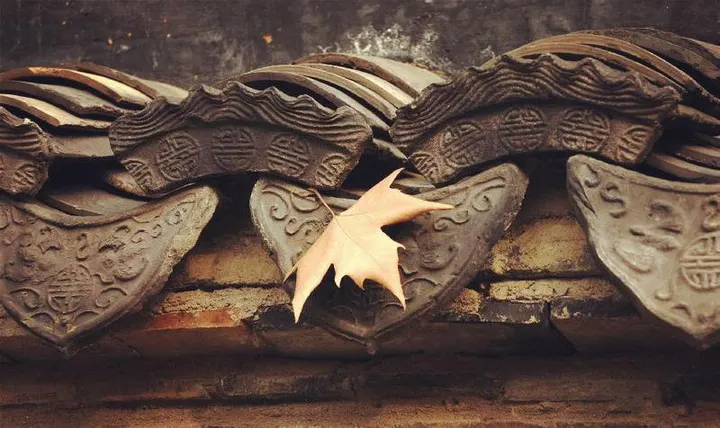
A fallen leaf on Ming roof tiles: autumn here is short and precise
For a visitor the advantage is density: the mausoleum, the Ming tomb, the Nanjing Museum, the Presidential Palace, the Confucius Temple and Zhonghua Gate all sit within two or three metro stops of each other. The disadvantage is scale: Purple Mountain alone eats a full day, the Ming wall runs more than 35 km, and the Confucius Temple at night is close to impassable. So travel by district — one day for the mountain, one for the centre and the wall, one for the old south city — rather than criss-crossing.
Wandering Nanjing is like wandering an antiques shop: everywhere you look, you find the marks of time.
Zhu Ziqing, "Nanjing", 1934
One quality resists listing: Nanjing knows loss intimately, and so it does not boast. Plane trees close over whole streets, someone sings Kunqu in a teahouse, and nobody elbows for a photo in the museum. You do not have to rush here; sitting still counts as part of the itinerary.
02Six things that define the city
Climbing the 392 steps of Dr Sun Yat-sen's MausoleumFree, but you must book
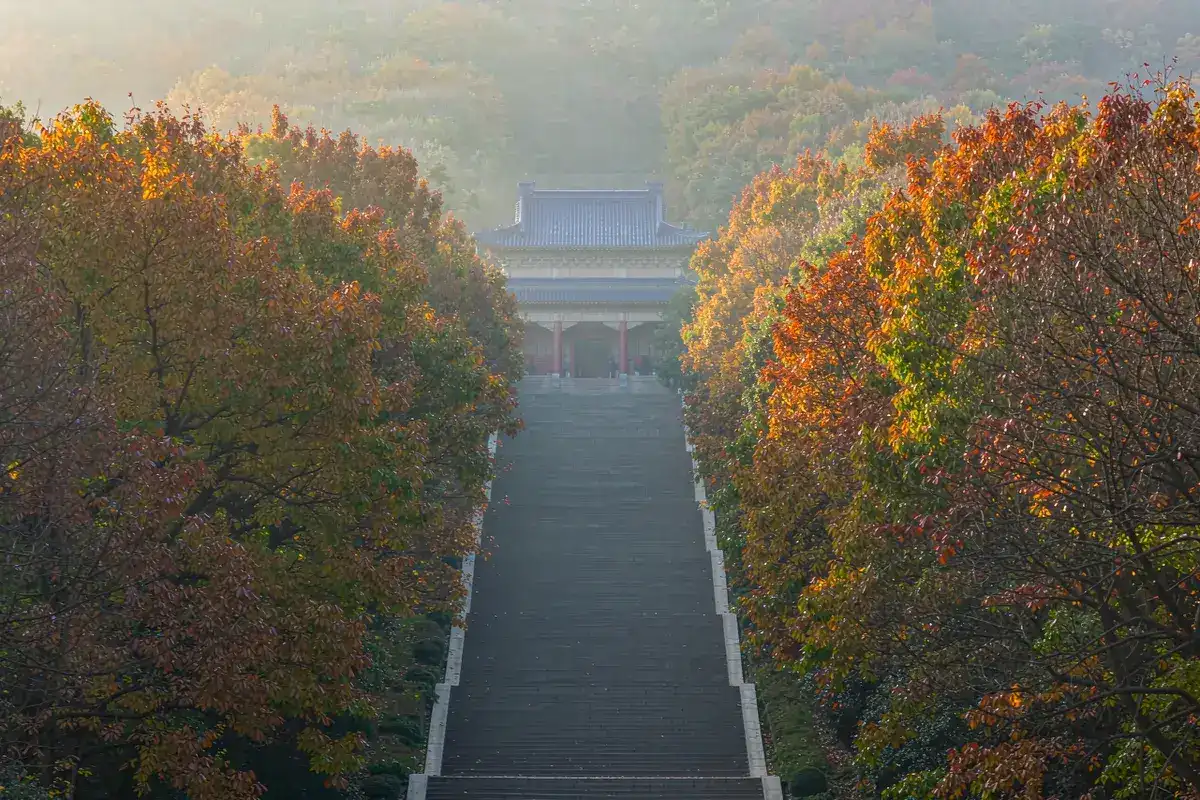
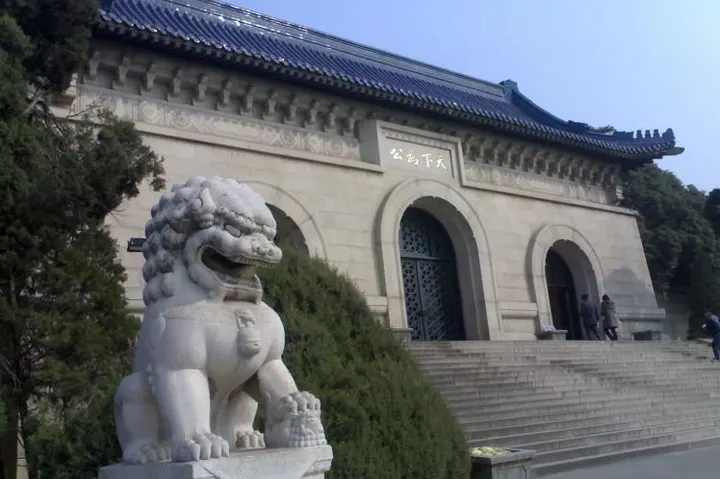
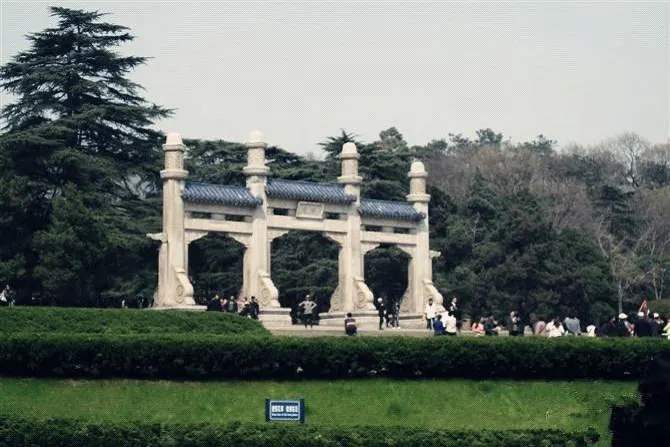
The mausoleum climbs the hillside in blue tile and white granite, 392 steps from the Bo'ai Archway to the Memorial Hall. The design hides the landings from below and the steps from above. The area above the gate is open 08:30–17:00 and closes on Mondays.
Walking the stone-elephant avenue at the Ming Xiaoling MausoleumSix hundred metres, six hundred years
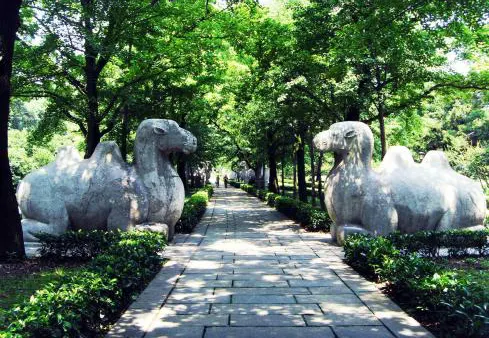
The joint tomb of the Ming founder Zhu Yuanzhang and Empress Ma, and a World Heritage Site. Its spirit path deliberately bends around Plum Blossom Hill, lined with twelve pairs of stone animals — lion, xiezhi, camel, elephant, qilin and horse. In mid to late November the ginkgo and tallow trees turn, and these become the most crowded 600 metres in Nanjing.
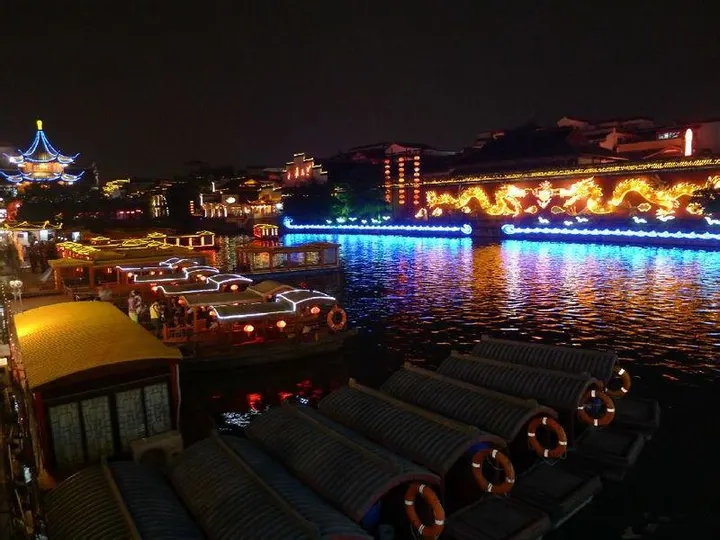
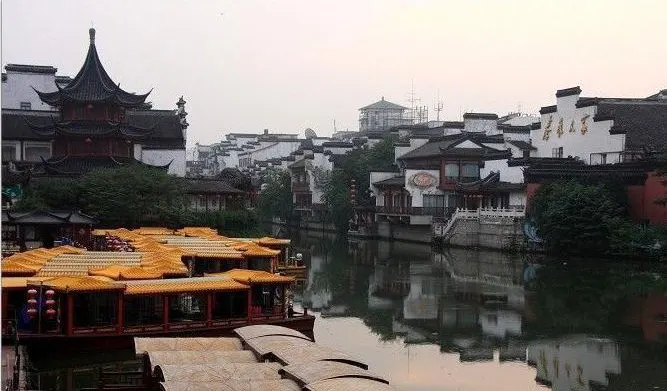
A painted boat on the Qinhuai River after darkOars, lanterns, reflections
Boats leave from the Panchi dock beside the Confucius Temple for a 40-minute loop past lit-up gables, white walls and the dragon relief on the river wall. Day trips are about architecture; night trips are about light, and locals will tell you the Qinhuai only exists after dark. Fares float by season, with evenings ¥20 above daytime.
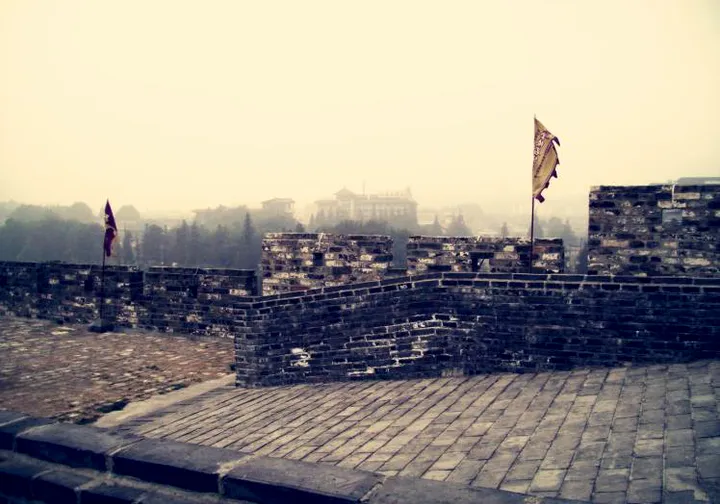
Walking a stretch of Ming wall at Zhonghua GateThe largest surviving castle gate in China
Zhonghua Gate was the south gate of the early Ming capital: three barbicans, four archways and 27 troop chambers that once held 3,000 soldiers. Brick faces still carry the names of the kiln workers who fired them, an early quality-control system. No bicycles up here — walking only.
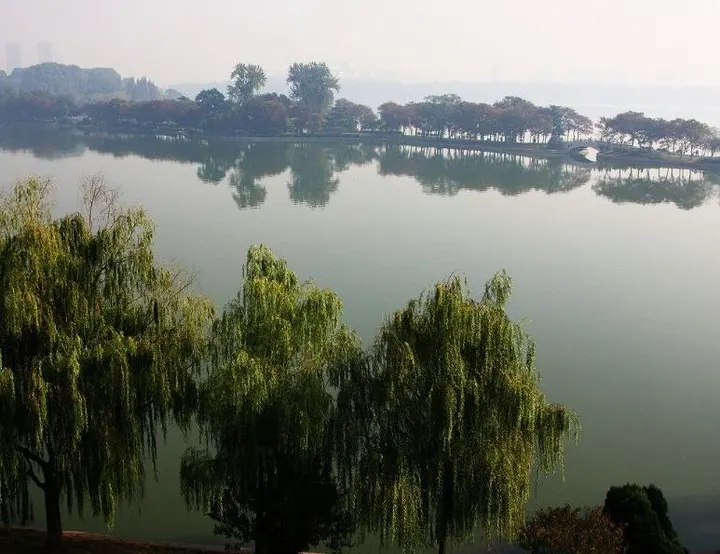
Half a lap of Xuanwu LakeA free lake inside the walls
Xuanwu Lake lies between Xuanwu Gate and Jiefang Gate, its five islets linked by causeways and bridges, the shoreline running about 15 km. Mornings bring choirs and old men with erhu; evenings bring the best reflections. Free, no booking, and Metro L1 Xuanwu Gate puts you at the water.
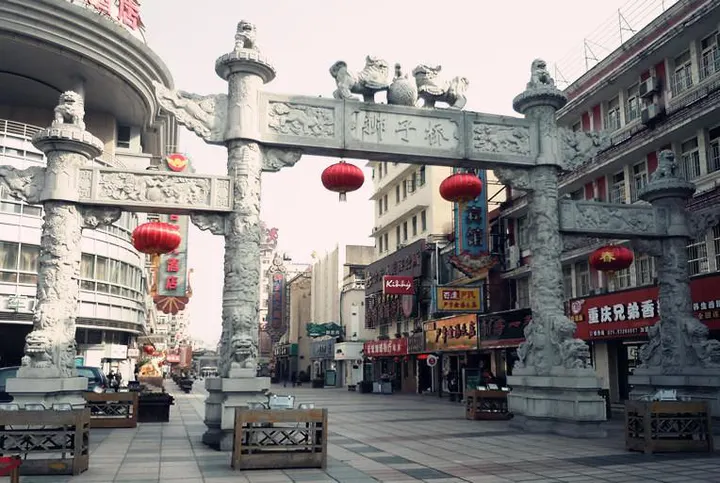
Eating your way down Shiziqiao330 metres of snacks
A pedestrian food street off Hunan Road, entered under a carved stone archway flanked by bronze figures of old trades. Duck-blood vermicelli, chicken-broth soup dumplings, potstickers and plum-blossom cakes line up at prices kinder than the Confucius Temple. Metro L1 Xuanwu Gate, cross the road, arrive.
03The questions everyone asks first
Nanjing South or Nanjing Railway Station — which should I book?
Both are in the city and they do different jobs. Nanjing South Railway Station, in Yuhuatai district, is the high-speed hub: nearly every G and D train from Beijing, Shanghai and Hangzhou calls here, Metro L1/L3/S1/S3 meet underneath, and the S1 airport line starts here. Nanjing Railway Station sits on the north shore of Xuanwu Lake, takes almost all K/T/Z conventional trains plus some Shanghai-bound G services, and puts you ten minutes' walk from the lake, two metro stops from Xinjiekou and four from the Confucius Temple. Staying in the old city and targeting the lake and Hunan Road? Nanjing Station is easier. Arriving from the north, or heading for the airport or Jiangning? Nanjing South wins. The two are 35–40 minutes apart by metro.
Do I need to reserve Dr Sun Yat-sen's Mausoleum in advance?
Yes, and it is not optional. Entry is free but tied to a real-name timed slot: bookings open seven days ahead, tickets release at 16:00 daily, and there are four windows — 08:30–10:30, 10:30–12:30, 12:30–14:30 and 14:30–16:30. Six tickets per order, one per ID per day. Book through the Nanjing Zhongshan Scenic Area WeChat account, the mausoleum ticket service account, or Meituan; there are self-service machines on site, but on holidays they run dry. It closes Mondays except on public holidays and the anniversaries of Sun's birth and death, and the burial chamber opens Tuesday to Friday only. For empty steps, be there at 08:30.
Is two days enough for Nanjing?
Enough for the skeleton, not the detail. Two days split cleanly: day one on Purple Mountain — mausoleum, the stone-elephant avenue at the Ming tomb, then Meiling Palace or the Open-Air Music Hall — back to town for dinner; day two for wall and south city, meaning Taicheng or Zhonghua Gate, the Presidential Palace or the Nanjing Museum, Laomendong, and the Confucius Temple after dark. Three days lets you give the museum and the memorial hall half a day each without sprinting. Four or five add Qixia Mountain, Niushoushan or the Tangshan hot springs. Watch Monday: most museums and memorial sites close, so fill that day with outdoor sights.
When exactly should I come in autumn for the ginkgo and the maples?
Autumn is short here and the window is late October to late November. The ginkgo and tallow trees along the stone-elephant avenue usually peak in mid to late November, with the emptiest hours just after dawn. Qixia's maples start turning in early November, hit their best in mid to late November and hold into early December; the official 2025 season was declared from around 27 November, and the 2026 maple festival runs 18 October to 18 December. Plum blossom runs the other way: Plum Blossom Hill peaks from late February into mid March. Cold fronts move the dates, so check the scenic area's own photo feed two days before you go.
How do I book the Nanjing Massacre Memorial Hall, and how should I behave there?
Entry is free but strictly by real-name booking: reserve one to seven days ahead through the official WeChat account, tickets released at 08:00 daily, with the three exhibition halls booked separately. One entry per person per day, one booking per person per month. It is open 08:30–17:30 with last entry at 16:30 and closes Mondays except on public holidays. Metro L2 Yun Jin Lu, exit 2, then walk to Gate 1. Inside, keep your voice down and do not run; do not pose for photographs in front of the remains or the wall of victims' names, and do not photograph human remains or personal effects where signs prohibit it. Dress plainly. This is not a photo stop — allow two to three hours, and sit in the Peace Park afterwards before you leave.
How long does it take from Shanghai or Beijing?
Shanghai Hongqiao to Nanjing South takes as little as an hour, with most trains at 1h00–1h25 and second class at ¥115–170; at peak there is a departure every five to ten minutes. G trains from Shanghai Station to Nanjing Station run about two hours, while conventional K trains take 3.5–4 hours for roughly ¥50 in hard seat. Beijing South to Nanjing South is 3h14 at best and typically 3.5–4.5 hours, second class ¥400–560. So Shanghai works as a day trip and Beijing wants three days.
Where do I eat soup dumplings and salted duck without getting the tourist version?
For soup dumplings, go to Jiming Tangbao (branches at Laomendong and Hunan Road) or Yinshi Chicken-Broth Tangbao: thin skin, clear broth. Nip a hole, drink the soup, then eat — do not bite straight through. For salted duck, buy it freshly chopped at Han Fuxing or Guihua Ya, sold by weight with breast and leg priced separately; locals eat it around Mid-Autumn, when the birds are fattest and it earns the name osmanthus duck. For a full table, Nanjing Dapaidang (several branches, including Deji Plaza) is the painless first visit — salted duck, roast-duck buns and sweet taro soup in one order. Shiziqiao and Kexiang are the streets where locals actually snack. Skip the vacuum-packed ducks in the Confucius Temple core: higher price, worse flavour.
04Two days as a base, three to do it properly
Nanjing's sights clump into three groups: Purple Mountain in the east (mausoleum, Ming tomb, Linggu, Meiling Palace), the centre (Presidential Palace, Nanjing Museum, the Changjiang Road strip), and the Qinhuai quarter in the south (Confucius Temple, Laomendong, Zhonghua Gate, the memorial hall). Each cluster is 20–40 minutes from the next by metro, and two clusters a day is the ceiling. This three-day route runs east, then centre, then south, with no backtracking.
D1
Mountain day: reach the mausoleum before 08:30 on the first slot while the steps are empty, come back down the same axis, then walk or take the shuttle to the Ming Xiaoling's Gate 3 and enter via the stone-elephant avenue — spirit path, then the square-city tower, about two hours. Lunch near Maquyuan metro station. In the afternoon take Meiling Palace or the Open-Air Music Hall, and add Linggu if your legs agree. Descend at dusk for snacks on Shiziqiao, or back to Xinjiekou.
D2
Centre and wall: climb the Taicheng stretch at Jiefang Gate in the morning and walk the kilometre to Xuanwu Gate, where Jiming Temple's yellow walls, the lake and the Zifeng Tower line up in one frame; drop down and walk a stretch of lakeshore. After lunch take the Presidential Palace (closed Mondays, quietest after 15:00). If you would rather see objects than rooms, swap in the Nanjing Museum — but book seven days out. Evening on Hunan Road or in the 1912 bar block.
D3
South city: Zhonghua Gate at 09:00 for the barbicans and troop chambers, plus a look over the old rooftops from the wall; ten minutes on foot to Laomendong for lunch and lanes. In the afternoon the memorial hall (booked ahead, closed Mondays) for two to three hours. Return to the Confucius Temple at dusk, wander Wuyi Lane and Gongyuan Street, then take a painted boat once the lights are on.
05From Purple Mountain to the Qinhuai
Painted boats waiting on the Qinhuai below the Confucius Temple
Purple Mountain and Dr Sun Yat-sen's Mausoleum
The Bo'ai Archway, where the 392 steps begin
Purple Mountain, also called Zhongshan, rises to about 448 m and forms the whole wooded eastern flank of the city. The mausoleum sits on its south slope: begun in 1926, completed for the 1929 interment, designed by Lü Yanzhi on a plan shaped like a bell. Archway, processional way, gate, stele pavilion, steps, memorial hall and burial chamber climb a single axis. Entry is free but timed-booking only; the area above the gate opens 08:30–17:00 and closes Mondays. Eight landings break up the staircase — stop, turn around, look at the city. Visitors with prams or bad knees can use the asphalt service lane about 800 m up the left side, bypassing every step.
The Ming Xiaoling Mausoleum
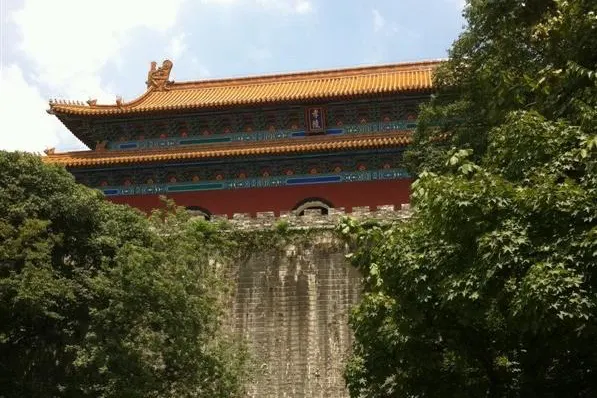
The Square City and Bright Tower at the end of the Ming tomb's processional route
Begun in 1381 and built over more than thirty years, the Ming Xiaoling holds Zhu Yuanzhang and Empress Ma and set the template for imperial tombs for the next five centuries, including Beijing's Ming tombs and the Qing cemeteries. Its spirit path is a rarity: it bends deliberately to avoid Plum Blossom Hill, said to hold the tomb of Sun Quan. The stone-elephant avenue runs 600 m with twelve pairs of animals in six kinds, one seated and one standing. Admission is ¥70, or ¥100 for a two-day combo covering the tomb, Meiling Palace, the Open-Air Music Hall and Linggu — worth it from two sites upward.
The observatory and the ridge
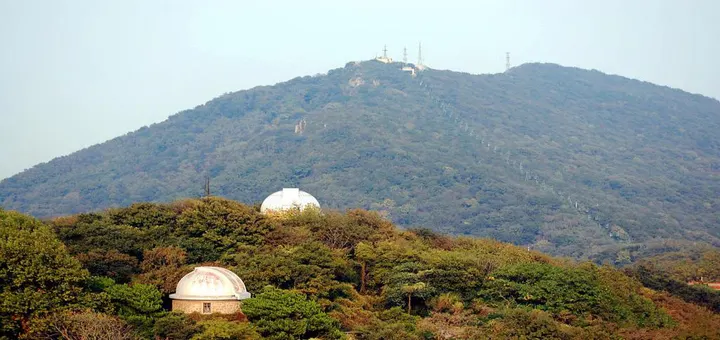
Observatory domes on the summit ridge of Purple Mountain
The observatory sits on the western ridge, founded in 1928 as the birthplace of modern Chinese astronomy, with replicas of Ming armillary and equatorial instruments on the terrace. Entry is around ¥15, and the path continues to Toutuo Ridge, the summit, for sunrise and the full city at night. The cable car runs about ¥60 one way and ¥100 return, saving two hours of climbing. Supplies up here are thin — carry water.
The Confucius Temple and the Qinhuai Scenic Belt
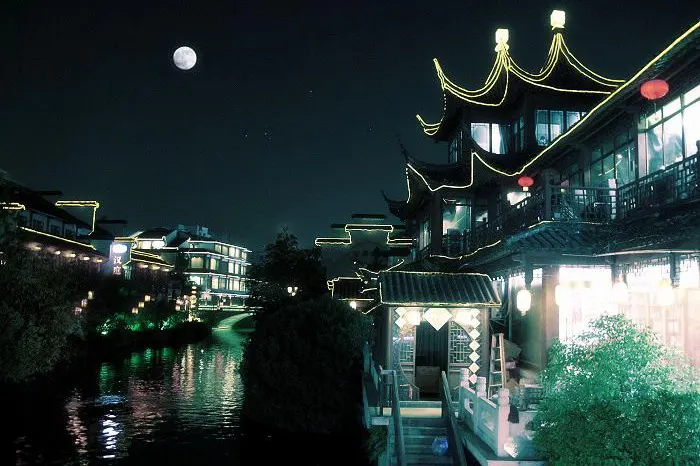
Night at the Confucius Temple, gables outlined in light
The temple complex combines a Confucian hall, an academy and the Jiangnan examination hall, rebuilt in Ming-Qing style in 1985. The streets are free and open all day; the charges sit inside. The Great Hall of Confucius is about ¥30, and the Chinese Imperial Examination Museum about ¥50 — the latter is worth it, four storeys underground, roofed over the original exam cells. Wuyi Lane, a few dozen metres southwest, is short and quiet. At night the whole riverbank lights up, and so does the crowd.
Zhonghua Gate and the Ming city wall
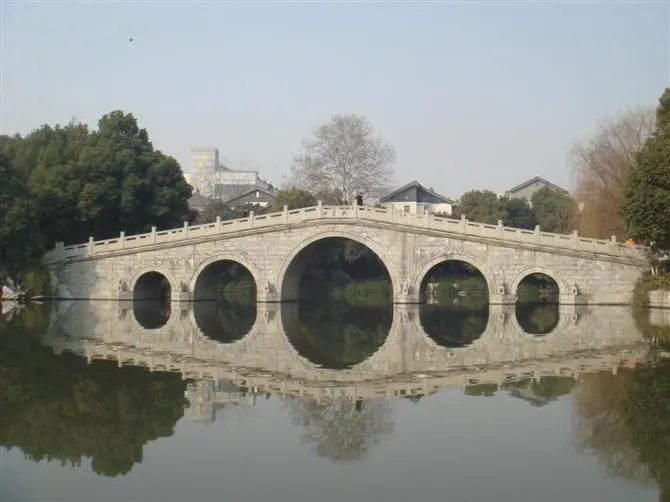
A five-arch stone bridge outside the wall, better in reflection
The Ming wall was begun in 1366 and about 25 km survive, the longest ancient city wall anywhere. Tickets are sold by section and the sections do not connect — a ticket for Taicheng will not get you to Zhonghua Gate. The northern Taicheng stretch (Shence Gate to Taiping Gate) costs ¥30 and frames mountain, lake and skyline in one view, with Xuanwu Lake and Jiming Temple just outside Jiefang Gate. The southern Zhonghua Gate section costs ¥50 for barbicans and troop chambers, and puts you out at Laomendong. A ¥70 combo covers both; the eastern Fugui Hill–Lanqi Street stretch is ¥5; the western Stone City stretch is free. Zhonghua Gate runs a light-and-projection show at night, with an evening ticket including it at ¥90. The bricks are uneven — no heels.
The Presidential Palace
Number 292 Changjiang Road has held many identities in six centuries: a Ming noble's residence, the Qing governor-general's office, the Taiping Heavenly Palace, the hall where Sun Yat-sen took office as provisional president, then the Nationalist government's presidential palace. It is now the country's largest museum of modern history. The central axis gives you the gate tower, great hall and Zichao Building; the west side holds the Xu Garden and its stone boat; the east has the Executive Yuan and an air-raid shelter. Admission ¥35, closed Mondays, 08:30–18:00 in high season and 08:30–17:00 in low, capped at 30,000 a day and booked through the official mini-program. After 15:00 the tour groups thin out.
The Nanjing Museum
One of China's three great museums, descended from the National Central Museum project that Cai Yuanpei championed in 1933. It now runs six galleries under one roof: the history gallery for Jiangsu's archaeology and the headline pieces, a reconstructed 1930s streetscape in the Republican-era gallery (the most photographed room), plus temporary exhibitions, art, digital and intangible-heritage galleries. Entry is free but booked: seven days ahead, released at 18:00 daily, split into morning 09:00–13:00 and afternoon 12:00–16:00 slots, closed Mondays, last admission 16:00. Foreign passports are verified at the green-channel desk east of the main gate. Afternoon slots run about thirty per cent quieter.
The Memorial Hall of the Victims in Nanjing Massacre by Japanese Invaders
The memorial stands at 418 Shuiximen Avenue in Jiangdongmen, on the site of one of the mass burial grounds, and opened in 1985. Japanese forces took Nanjing on 13 December 1937; in the weeks that followed, a large-scale massacre and mass rape took place, and the death toll is recorded as 300,000 — the figure established by the post-war trials and carried in the memorial's exhibition. The displays fall into three parts: the plaza, the excavated remains, and the historical record, with a separate gallery on the road to victory. Entry is free and by real-name booking (one to seven days ahead, released at 08:00 daily, each gallery booked separately). It opens 08:30–17:30 with last entry at 16:30 and closes Mondays. Metro L2 Yun Jin Lu, exit 2. Keep quiet, dress plainly, do not pose for photographs.
Yuhuatai
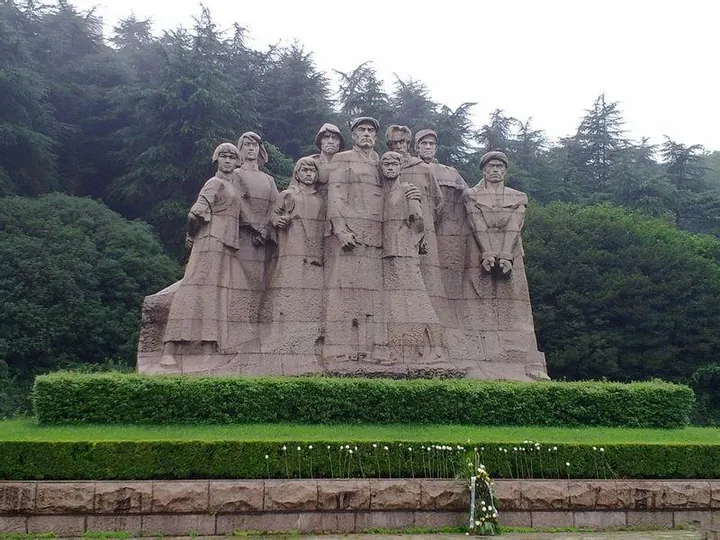
The martyrs' sculpture group at Yuhuatai
A kilometre outside Zhonghua Gate, this is half woodland, half memorial ground. In the Southern Dynasties the area was a Buddhist centre, and legend says a monk's preaching moved the heavens to rain flowers — hence the name. Between 1927 and 1949 large numbers of communists and dissidents were executed here; today it is a martyrs' cemetery with a 42.3 m obelisk (the height encoding 23 April 1949, the date Nanjing fell to the People's Liberation Army) and a U-shaped exhibition hall. Entry is free and the grounds are made for walking. The yuhua pebbles sold inside come from Luhe and are overpriced; buy them at Qingshan or Chaotiangong instead.
Qixia Mountain
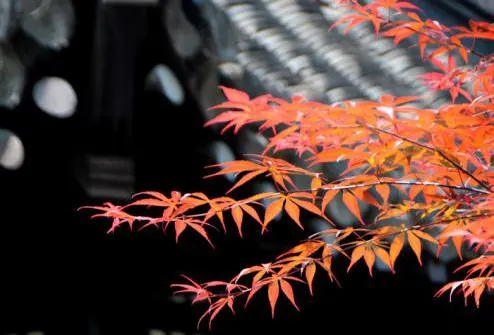
Maple and eaves: the classic Qixia autumn frame
Twenty-odd kilometres northeast, Qixia's main peak reaches only 286 m, but a working temple plus a hillside of maples fills half a day. Qixia Temple was founded in 484 and became a Southern Dynasties Buddhist centre; behind it the five-storey, eight-sided reliquary pagoda dates from the Five Dynasties rebuilding, and the Thousand Buddha Cliff holds more than 200 niches and 500 figures, the largest Southern Dynasties carving group in the region. Admission is ¥50 normally and ¥80 during the maple season (18 October to 18 December in 2026). Metro L6 terminates at Qixia Mountain station, about 50 minutes and ¥7 from Nanjing South.
06Time your trip to an event
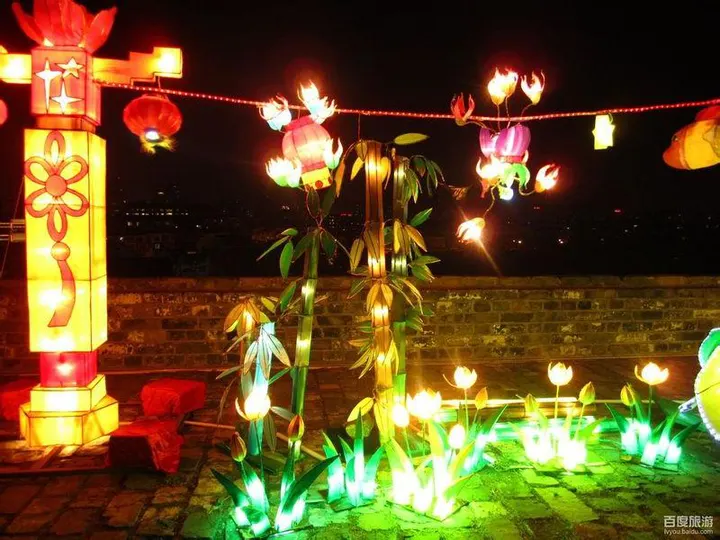
Lantern groups for the Qinhuai festival, rebuilt on the wall each year
The Qinhuai Lantern Festival
From the last lunar month until the eighteenth day of the first, the Confucius Temple and Laomendong disappear under lanterns. Old Nanjing says that a New Year without lanterns at the temple is no New Year at all. The installations are rebuilt each year along the wall, around the Panchi pond and at the mouth of Wuyi Lane, and the crowds are genuine — after 19:00 you move at the speed of the person in front. Free, one-way flow, hold children tightly.
Plum blossom on Plum Blossom Hill
The plum is Nanjing's city flower, and Plum Blossom Hill inside the Ming tomb grounds holds more than 30,000 trees across 200-odd varieties — one of China's four great plum areas. Peak is late February into mid March, with the festival usually opening in late February. Come at opening time for soft light and empty paths; Gate 3 of the Ming Xiaoling is the quickest way in.
Zhonghua Gate after dark
After dark the barbicans host a projection-and-live-action show, images thrown onto six-hundred-year-old bricks, telling the gate's story of siege and defence. The evening ticket with the show is ¥90; wall access without it is ¥50. Only the Zhonghua Gate section opens at night, and a daytime ticket will not carry over. Show times shift with the season — check the scenic area's notice before you go.
Hot springs at Tangshan
Tangshan lies about 30 km east, drawing on hot springs used for 1,500 years, water at 35–65°C and rich in calcium-magnesium sulphates. The town is dense with pools — Yishang, Tangshan No. 1, Ziqing Lake, Hantian and Yipin — with entry from ¥108–158 and most open past 22:00. Coming down off the mountain into a hot pool in winter beats any souvenir. Metro S6 to Tangshan, then ten minutes by taxi.
Folk performance at the intangible-heritage gallery
The Nanjing Museum's intangible-heritage gallery runs teahouse-style performances — Kunqu, pingtan storytelling, Nanjing baiju — for a few dozen yuan and about an hour; the Jiangsu Kunqu Theatre also stages weekend excerpts. You do not need the words; the slow cadence of Kunqu carries on its own. Listings go up on the venues' WeChat accounts, usually a week ahead.
07Four districts, four rhythms
Nanjing is affordable, but the district decides your day: choose badly and half of it disappears underground. For a first visit, Xinjiekou–Daxinggong is easiest, with Metro L1, L2 and L3 crossing there and Purple Mountain, the south city and the Presidential Palace all inside thirty minutes. To open a window onto the Qinhuai, stay at the Confucius Temple or Laomendong — at the cost of holiday noise and thin walls in old buildings. To be on the mountain at dawn, base at Maquyuan near the mausoleum. With children or an early train, Nanjing Station by Xuanwu Lake is the practical choice.
Xinjiekou–Daxinggong: the densest cluster of business hotels and grand old five-stars, with Deji, Golden Eagle and Central Mall on foot and the Mingwalang food lanes for late hunger. Roughly ¥350–900.
Confucius Temple–Laomendong: guesthouses and hostels, the river at the door, and real noise on holiday nights. Dorms ¥60–120, doubles ¥250–600.
Maquyuan–Zhongshanling: for photographers and morning runners who want the 08:30 first slot; thin dinner options. About ¥400–800.
Nanjing Station–Xuanwu Lake: five minutes from the platform to the water, close to Hongshan Zoo, good with kids and early departures. About ¥300–700.
Two warnings. Holiday pricing in Nanjing rises 60–120 per cent, and chain hotels near the sights rise further — book two weeks out. And plenty of old-city hotels sit right on the water, so rooms turn damp in the plum rains from mid June to early July; if that bothers you, ask for a high floor or a newer building.
08A city that has made peace with the duck
Nanjing cooking was once called Jing-Su cuisine: savoury with a sweet edge, built on original flavours, portions modest, technique fine. What locals brag about is not the banquet but the street — duck, soup dumplings, vermicelli soup, potstickers, rice cakes. The claim that Nanjing eats over a hundred million ducks a year is not much of an exaggeration: salted duck, roast duck, duck-fat pastries, duck-blood vermicelli. Nothing is wasted.
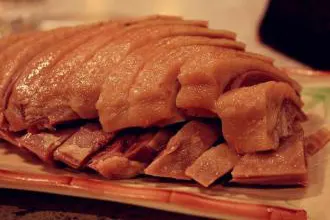
Salted duck, chopped to order: white skin, pink flesh
Five things to eat
Salted duck: brined, then poached at low heat, skin pale, flesh tender, salt edged with a faint osmanthus perfume. Fattest around Mid-Autumn, when it takes the name osmanthus duck. Sold by weight, breast dearer than leg.
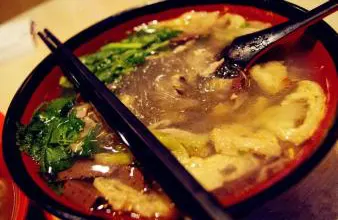
Duck-blood vermicelli: blood curd, intestine, gizzard and tofu puffs in clear broth with glass noodles, finished with coriander and chilli oil. Breakfast or midnight food, ¥10–20 a bowl.
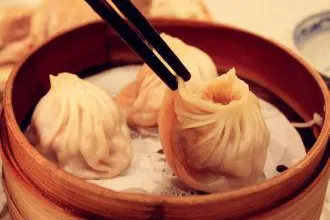
Soup dumplings: skin thin enough to see the broth through. Jiming Tangbao and Yinshi are the two safest names; order a bowl of egg-ribbon soup alongside.
Pork-skin noodles: fried pork rind soaked in broth until soft with a bounce, Nanjing's own noodle bowl. Xiangji and Bazi both draw queues.
Rice cakes: red-bean dumplings at Fangpo, five-colour cakes at Lianhu. Sweet without cloying, glutinous without glue. Sold by weight, ¥10–30.
Soup dumplings: open a window, then drink
Restaurants worth the queue
Nanjing Dapaidang (several branches, including Deji Plaza): a late-Qing shopfront with real pingtan and real shouting. Salted duck, roast-duck buns, sweet taro soup and lion's head meatballs in one order, ¥70–100 a head.
Jiangsu Restaurant on Zhongshan North Road: the old guard, still cooking proper Jing-Su dishes such as squirrel-shaped mandarin fish. ¥120–180 a head.
Li Ji Halal (Pingshi Street): beef potstickers and beef soup, crisp skin, full juices, queues from 07:00. Around ¥20.
Lüliuju on Taiping South Road: the vegetarian old name, its mock goose and vegetable buns convincing enough to rest a duck-heavy week. ¥50–80.
Duck-blood vermicelli: a bowl is a meal
Two traps. The 'eight delicacies' set meals on the Confucius Temple main street are assembly-line platters; eat properly on Kexiang, Mingwalang or Pingshi Street instead. And do not buy vacuum-packed duck at the gate — get it freshly chopped and vacuumed at a supermarket or an old-brand shop on your way out; the difference is considerable.
09Taking Jinling home
Nanjing has three clear souvenirs: brocade, yuhua pebbles and salted duck. The first two are about craft; the third is about freshness. Gold-leaf pictures, Jinling folding fans and Gaochun bone china are bonuses — judge the work, not the box.
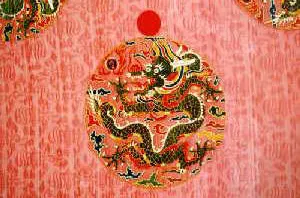
Nanjing brocade, where the dragon roundel shows the skill
Nanjing brocade: imperial supply in the Yuan, Ming and Qing, woven on wooden looms at five or six centimetres a day. Buy at the Nanjing Brocade Research Institute in Jiangdongmen or the Jiangning Weaving Museum; small pieces start in the hundreds, full bolts in the tens of thousands.
Yuhua pebbles: agate gravel, best kept in a bowl of water where the banding shows. The Qingshan antiques market and the weekend stalls at Chaotiangong have them — a handful of ordinary stones for a few dozen yuan, a fine single stone in the thousands.
Salted duck and dried sausage: the vacuum packs from Han Fuxing and Guihua Ya travel well by train but keep badly, so buy the day's production. A whole duck runs ¥70–120.
Books and design objects: Librairie Avant-Garde's Wutaishan shop occupies a former underground car park, with a postcard wall and a genuinely good selection. The Nanjing Museum's shop works from the collection and wears better than the souvenir stalls.
Where to shop
Xinjiekou is the retail centre: Deji Plaza for luxury, Central Mall and Golden Eagle for the middle. Laomendong suits craft and small labels, dense along Bianying and Santiaoying. The Confucius Temple night market is for cheap trinkets — bargain. For a single sweep of local products, the speciality counter of a big supermarket is calmest, with prices on the label.
10Getting there and around
Two stations, two jobs
Nanjing South Railway Station in Yuhuatai is the high-speed hub: lines to Beijing, Shanghai, Hangzhou, Anqing and Hefei all converge, Metro L1/L3/S1/S3 interchange below ground, and the S1 airport line starts here. Nanjing Railway Station on the north shore of Xuanwu Lake takes almost all conventional K/T/Z trains plus some Shanghai-bound G services, and is ten minutes' walk from the lake. The two are about 15 km apart, 35–40 minutes by metro. Read the station name on your ticket: G and D trains do not all stop at the same one.
From Shanghai, Beijing, Suzhou, Yangzhou
Shanghai Hongqiao to Nanjing South is an hour at best, 1–1.5 hours typically, ¥115–170 in second class, and frequent enough that you need not book far ahead. G trains from Shanghai Station to Nanjing Station take about two hours; conventional services take 3.5–4 for roughly ¥50 in hard seat. Beijing South to Nanjing South is 3h14 at best and 3.5–4.5 hours in general, ¥400–560. From Nanjing South, Suzhou North is 44 minutes away at best (¥76–125), Yangzhou East 46–70 minutes (¥60–75), and Zhenjiang about 28 minutes (¥33).
The metro: your default
Fares are distance-based: ¥2 for the first 4 km, ¥3 for 4–9 km, ¥4 for 9–14, ¥5 for 14–21, ¥6 for 21–28 — almost every sight-to-sight trip inside the city lands in the ¥2–5 band. The stations you will actually use: L2 Maquyuan for the Ming tomb's Gate 3, L2 Xiamafang for the shuttle up to the mausoleum, L2 Minggugong for the Nanjing Museum, L2 Yun Jin Lu for the memorial hall, L3 Fuzimiao, L1 Xuanwumen and Zhonghuamen, and L3/L4 Jimingsi for the Taicheng wall steps. Alipay, WeChat Pay and UnionPay QR codes all work at the gates, and single tickets can be bought from machines with a passport.
Flying in
Lukou International Airport sits about 35 km south. Metro S1 runs from the terminal to Nanjing South in 35–40 minutes, then L1 or L3 takes you into town: 50–70 minutes total for under ¥10, and by far the most reliable option. Airport coaches serve several downtown points for around ¥20. A taxi to Xinjiekou runs ¥120–150 and 45 minutes — worth it only for a late landing.
Buses, ferries and taxis
Buses cost ¥2, mostly air-conditioned, with a set of night routes. The ferry from Zhongshan Wharf to Pukou Wharf costs ¥2 and crosses the Yangtze in about fifteen minutes — the pleasant way to reach the old Pukou station, and worth it at dusk. Use an app for taxis and the price is fixed before you book; hailing on the street is cheap but hard near sights at peak. Shared bikes work well inside the wall, though the core of Purple Mountain is closed to them.
Emergency numbers: police 110, ambulance 120, fire 119. Tourism complaints and general help: 12345, staffed around the clock with English available.
Major hospitals: Jiangsu Provincial People's Hospital (300 Guangzhou Road, 025-8371 8836) and Nanjing Drum Tower Hospital (321 Zhongshan Road, 025-8310 6666). Both run international clinics — call ahead to confirm hours.
Money: malls, hotels, the metro and chain shops all take mobile payment, and Alipay's international version links Visa and Mastercard. Small shops and markets are often QR-only, so carry ¥100–200 in cash as backup.
Connectivity and ID: carry your passport — train tickets, sights and hotels all check it. Most bookings run through WeChat mini-programs, which accept foreign numbers; if yours will not cooperate, present the passport at the on-site service desk.
Facilities: metro stations, malls and museums all have free toilets, while Purple Mountain and the wall sections are sparse — go before you climb. Drinking fountains are rare; carry a bottle.
12Booking checklist and pitfalls
Booking list: the mausoleum (7 days ahead, released 16:00), the Nanjing Museum (7 days ahead, 18:00), the memorial hall (1–7 days, 08:00) and the Presidential Palace (official mini-program, 30,000 a day). All four are real-name — get the passport number right.
Avoid Monday: the mausoleum, Nanjing Museum, Presidential Palace, memorial hall and Six Dynasties Museum all close, public holidays excepted. Put the lake, the wall and Laomendong on that day instead.
Shoes: a mountain day starts at 20,000 steps, wall bricks are uneven and the spirit path is stone slab. Trainers are the minimum; no heels, no new shoes.
Seasonal kit: layers for the sharp March–April and October–November swings; a sturdy umbrella for the plum rains from mid June to early July; sun cream and repellent for the humid July–August; and a proper coat from December to February, when damp cold bites harder than the thermometer suggests.
Photo etiquette: no posing or flash in the memorial hall; no selfie sticks or tripods in museum galleries; keep quiet inside the Memorial Hall at the mausoleum. Walls and temples are fair game, but stay behind the railings.
Four traps: snack set meals on the Confucius Temple main street are pricey and ordinary — two streets over, Kexiang and Mingwalang are normal; the 'day tours' and 'skip-the-line' offers at scenic gates are marked-up packages, and booking yourself is cheaper; the wall sells by section, so one ticket will not walk the whole circuit; and buy Qinhuai boat tickets only at the official dock, since freelance boats carry no life-saving equipment.
13Two thousand years, ten capitals
Geography and climate
Nanjing lies on the lower Yangtze where the Nanjing–Zhenjiang hills run west, low ridges covering more than sixty per cent of the municipal area. The Yangtze passes to the northwest, fed here by the Qinhuai and Chu rivers. The climate is subtropical monsoon: four clear seasons, an annual mean near 15°C and about 1,100 mm of rain. Summer is famously fierce — grouped with Wuhan and Chongqing as the 'three furnaces' — winter is damp and cold, and spring and autumn are short and very good.
Six dynasties, then the Ming
In 472 BC, after conquering Wu, King Goujian of Yue had Fan Li build a fort on the Qinhuai — the beginning of the city. In 229 Sun Quan made it his capital as Jianye, and the Eastern Jin and the four southern dynasties followed, together the Six Dynasties. Jiankang's population passed a million, making it one of the largest cities on earth. In 1368 Zhu Yuanzhang proclaimed the Ming here, the first time Nanjing ruled a unified empire; in 1421 the Yongle emperor moved the court to Beijing and Nanjing became the auxiliary capital, its ministries retained.
The Republic, and 1937
In 1912 Sun Yat-sen took office in Nanjing as provisional president of the Republic of China; in 1927 the Nationalist government made the city its capital, and over the following decade public buildings and official residences went up, along with the ranks of plane trees still shading the streets. On 13 December 1937 Japanese forces took the city, and in the weeks that followed a large-scale massacre and mass rape occurred; the death toll is recorded as 300,000, the figure established by the post-war trials and carried by the memorial. The government returned in 1946, the People's Liberation Army entered in April 1949, and Nanjing has been the seat of Jiangsu's provincial government since.
Letters, walls and brocade
The city has always been a literary subject: Xie Tiao, Li Bai, Liu Yuxi and Wang Anshi all wrote about the Qinhuai and the Taicheng wall; Zhu Ziqing's 1934 essay compared Nanjing to an antiques shop; and Ye Zhaoyan, Su Tong and Bi Feiyu continue the line today. The wall dates from 1366 and about 25 km stand, each brick stamped with its place of manufacture and the names of the men who fired it — a Ming-era traceability system. Brocade was woven on great timber looms worked by two people, advancing five or six centimetres a day, and supplied the imperial court for three dynasties.
14Three cities inside the one-hour rail ring
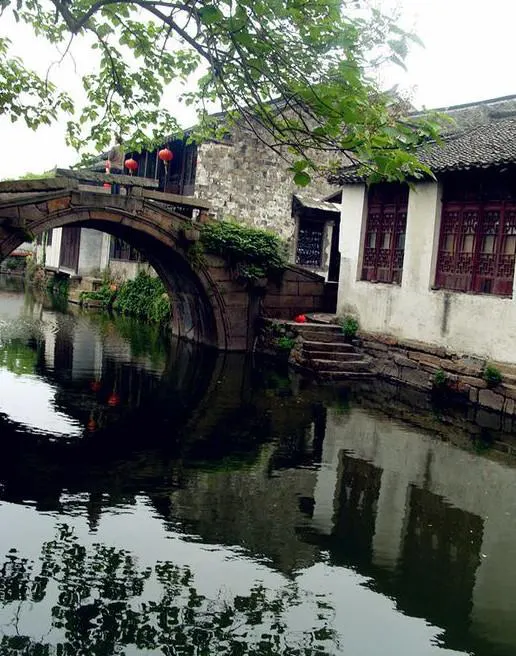
A stone bridge and riverside houses in a Jiangnan water town
Yangzhou (1 day)
Nanjing South to Yangzhou East takes 46–70 minutes for ¥60–75 in second class. Yangzhou offers three things: the Twenty-Four Bridge and white dagoba on Slender West Lake, the four-season rockery in the Ge Garden, and the old shops of Dongguan Street. Better still is morning tea — buns, shredded dried tofu and jade-green shaomai at Fuchun or Yechun, which can fill a whole morning. Take an early train; you need to be in Yangzhou before eight to eat it properly.
Zhenjiang (1 day)
High-speed trains reach Zhenjiang in about 28 minutes for ¥33 — closer than most people assume. Jinshan Temple, famous from the White Snake legend, climbs the hillside in stacked halls; Xijindu is a well-preserved old ferry quarter on the Yangtze with cart ruts still in the flagstones; and Beigu Hill holds Ganlu Temple and a carved boast about the finest landscape under heaven. The three are close together, a clean day, and there is a bowl of pot-lid noodles for the way back.
Suzhou (1–2 days)
Suzhou North is 44 minutes from Nanjing South at best, usually about an hour, ¥76–125 in second class. The formula is a garden plus a street: the Humble Administrator's Garden and the Suzhou Museum sit next door to each other for half a day, then Pingjiang Road or Shantang Street for the other half. For water towns, connect onward to Zhouzhuang or Tongli, about an hour each. Gardens need booking in season, the Humble Administrator's most of all.
Tangshan (half a day)
Thirty kilometres east, on Metro S6. Beyond the hot springs there is the Yangshan quarry, where a single stele blank was cut for the Ming Xiaoling in the Yongle reign; stood upright it would have been about 78 m tall, and it was abandoned in the hillside because nothing could move it. The three cut faces are still there. Pools plus quarry: half a day to a full one.
15Watch and read before you go
Film
"The Flowers of War" (2011, dir. Zhang Yimou), from Yan Geling's novel, is set in December 1937 inside a church where schoolgirls, sex workers and wounded soldiers are trapped. Its treatment of the atrocity is dramatised, and you should go in prepared; at the least it explains why the city is both silent and exact about that history.
"City of Life and Death" (2009, dir. Lu Chuan) is shot in black and white and moves between a Chinese soldier and a Japanese one; it is contested, and it offers a second angle. Neither film is pre-trip entertainment — both are better watched before the memorial, not after.
Books
Zhu Ziqing's essay "Nanjing" (1934) runs to a few pages and turns the city into an antiques shop — the fastest way into its temperament. Ye Zhaoyan's "Old Photographs of the Qinhuai" pairs more than 300 images with text, showing how walls, wharves and lanes layered up. Iris Chang's "The Rape of Nanking" (1997) was among the first full accounts in English and asks for more time than a walk through the memorial does.
Music
Li Zhi's "I Love Nanjing" (2009) is a folk record made in the city, singing about plane trees, the Yangtze and leaving. Locals recommend it to visitors not because it is the best but because it is the truest. Listen once, then walk Yihe Road, and the streets line up.