A wall you can walk right roundChina's first draft bankStill lived inNoodles and beef
In short
Pingyao (平遥, Píngyáo) is a Ming-Qing county town in Shanxi, inscribed by UNESCO as a whole in 1997 along with Shuanglin and Zhenguo temples outside the walls. You can walk the 6.4 km circuit on top of the wall, stand in the courtyard where the Rishengchang draft bank started Chinese modern banking in 1823, and find the county office, Confucian temple, escort agencies and money shops still on their original plots. Walking the streets costs nothing; a ¥125 pass covers 22 sights for three days. One day covers the main street, but you need a night to see the two Pingyaos — the empty lanes at dawn and the lanterns after dark.
¥800–1,600 for 2–3 days, mid-range, excluding long-distance transport
Days needed
1–3 days
Comfort
Comfortable
Best time to go
April–May and September–October; the photo festival lands in mid-September; winter is emptiest and best after snow, but cold
01First thing to understand: it is a county town, not a park
Pingyao is not an emptied film set. It is a working county town: roughly 6.4 km of wall, and inside it tens of thousands of people going about ordinary days. At seven someone sweeps the pavement on South Street; at noon a scooter noses out of a lane; at dusk an old woman carries a stool to her doorway. The courtyards you buy a ticket for — draft banks, escort agencies, the county office — sit between all of that.
UNESCO listed the Ancient City of Pingyao in 1997, together with Shuanglin and Zhenguo temples outside the walls, and the citation is not about prettiness. It is about completeness: fortifications, streets, shopfronts, temples, government offices and houses — an entire 14th-to-19th-century county town still in its original places. China has finer individual buildings; it has no second county town preserved whole.
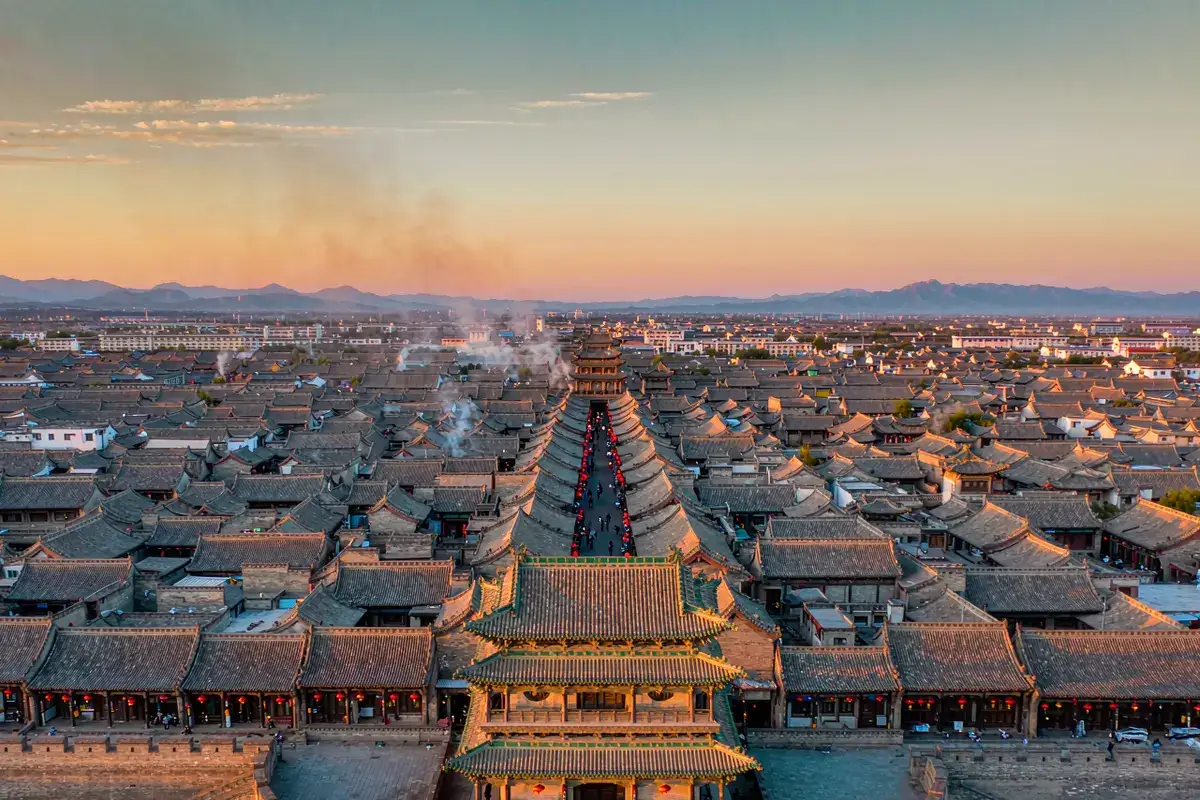
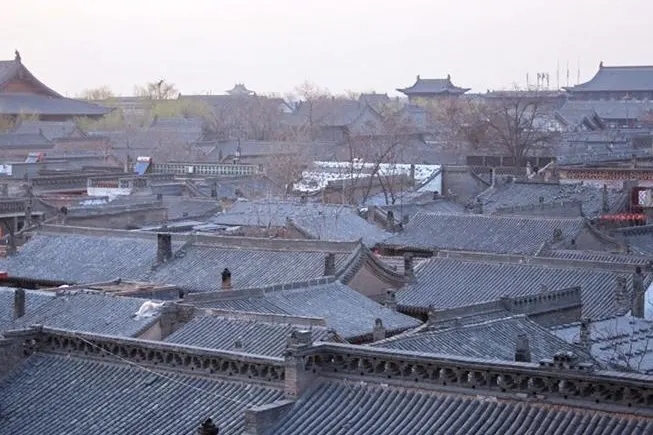
Grey tile roofs, courtyard after courtyard, seen from above
Some say Pingyao has gone off — that the quiet girl from a good house has turned into a hostess forever flattering the guests. Say what you like: Pingyao is still there.
"Pingyao", Imalvyou guidebook, 2013
So here is the honest version first: Pingyao has commercialised. Half the shops on South Street sell things with no connection to draft banking, and the bar street is still loud at 23:00. But the concentration is easy to step out of. Thirty metres into any lane the noise drops, the walls are still grey brick, and the doors are still half shut.
Set against Lijiang or Fenghuang, Pingyao is further north, harder, and puts on less of a show. Lijiang is made of water, Pingyao of earth and brick. Lijiang's night is staged; Pingyao's simply falls quiet after nine. The wind comes off the loess plateau and stings in winter — and that same dryness is why the town has survived so intact.
02Six reasons to stop walking and look up
Walking the wallSix kilometres, one town in view
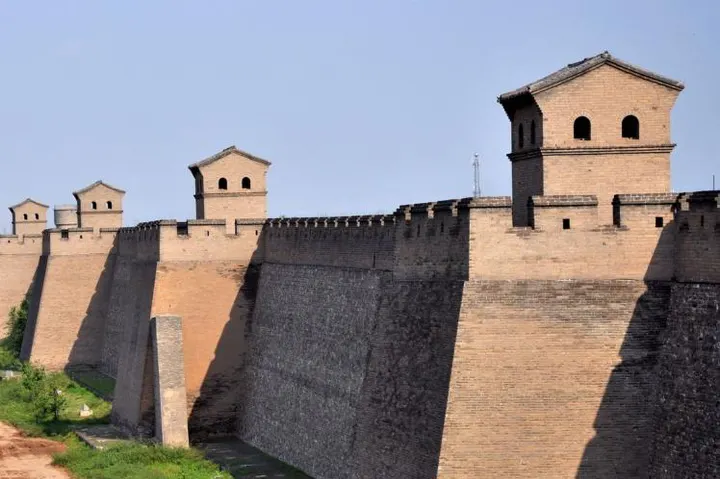
The wall went up in 1370, the third year of the Ming Hongwu reign: about 12 m high, 6.4 km around, with 72 watchtowers and some 3,000 crenellations. Enter at the south gate and walk half the circuit in ninety minutes; roofs stack away to the horizon and the word 'county town' suddenly means something.
Rishengchang and XietongqingWhere money learned to travel
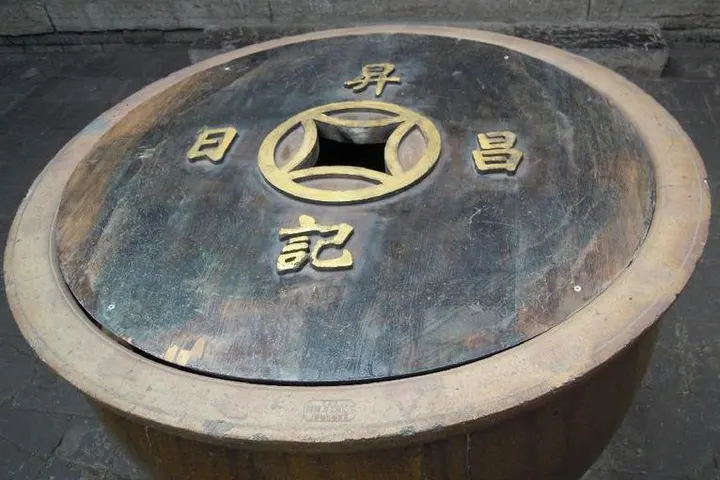
In 1823 a dye shop on West Street became a draft bank called Rishengchang. It ran branches in 35 cities and turned silver into paper — moving money by code word and reputation instead of carts. Next door, the Xietongqing money shop keeps its vaulted cellar, the single most affecting room in town.
South Street and the Market TowerThe street they called China's Wall Street
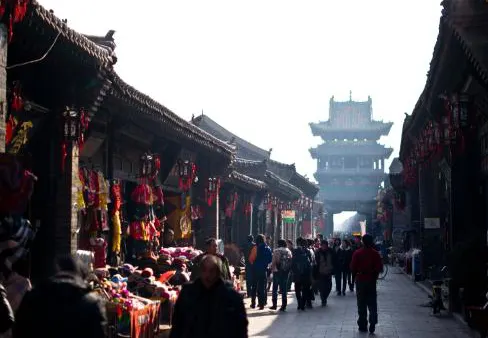
South Street is the spine of the town, and in the Ming and Qing it carried the densest run of money shops, silk houses and pawnbrokers in north China — hence the old tag, China's Wall Street. At its centre stands the 18.5 m Market Tower, three eaves deep, built over the 'golden well' that gives it its other name.
The County Government OfficeThe largest surviving county office in China
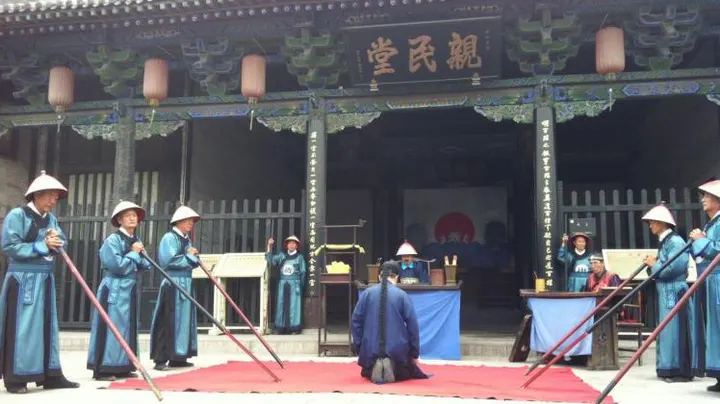
Founded under the Northern Wei and fixed in its present shape under the Ming and Qing, with the oldest building dated to 1346. The axis runs over 200 m: court in front, residence behind, civil offices left, military right, jail and garden court intact. Mock trials run at 9:30, 11:00 and 15:30, with a different case each time.
Shuanglin and Zhenguo templesClay figures and a 10th-century frame
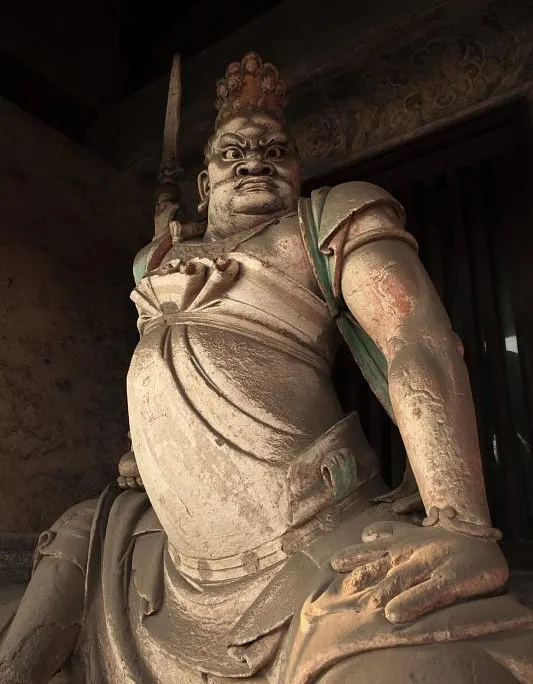
The two temples outside the wall are what specialists actually come for. Shuanglin holds more than 2,000 painted clay figures across five dynasties, its Skanda and Thousand-Hand Guanyin reproduced in every Chinese sculpture textbook. Zhenguo's Hall of Ten Thousand Buddhas went up in 963 and is one of the few Five Dynasties timber frames left in China. Both need separate tickets.
Pingyao at dawn and after darkOne street, two towns
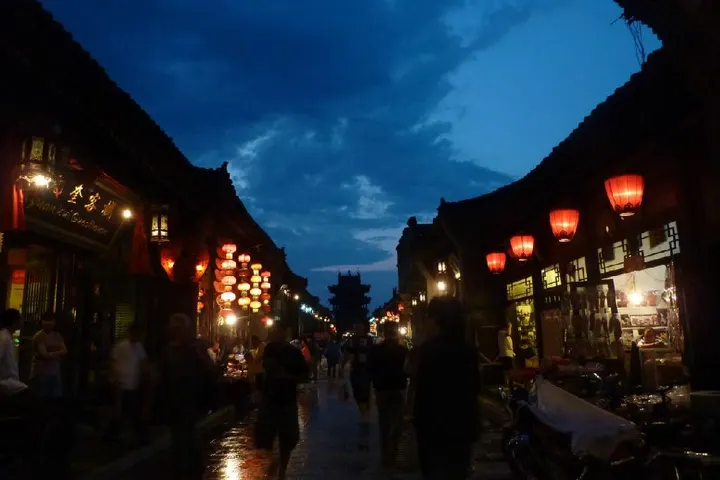
Before seven, South Street belongs to sweepers and vegetable deliveries; the flagstones are damp and the light comes in low from the east. After nine the lanterns are on, the crowd has thinned, and what is left is the sound of shop boards being fitted back. Those two hours are the entire difference between staying the night and not.
03Seven things worth settling before you book
I arrive at Pingyao Ancient City Railway Station. How do I get in?
Pingyao has two stations and they are not interchangeable. Pingyao Ancient City Railway Station is the high-speed one, about 7 km out: bus 108 costs ¥1 and takes roughly 40 minutes (north loop to the north gate, south loop to the county offices), or a taxi is ¥20–30 and 15 minutes. Pingyao Railway Station is the old conventional station, about 1 km west of the lower west gate — a 15-minute walk and you are inside. Dragging a suitcase over flagstones is miserable, so ask your inn whether they will collect luggage by tricycle.
Is the ¥125 pass worth it, and what costs extra?
The pass is ¥125 for 22 sights inside the walls, valid 72 hours from the first gate scan, and the wall is included; students and ages 6–18 pay half (¥62.5), over-60s and under-1.2 m go free. Individual sights inside the town are not sold separately, so the pass is the only way in. Only three things cost extra: Shuanglin Temple ¥35, Zhenguo Temple ¥25 and the "See Pingyao Again" show at ¥238. Walking the streets, eating and sleeping costs nothing at all. One trick: the clock starts at your first scan, so if you arrive in the afternoon, do not scan — start the next morning and you get three full days.
Is one day enough, and should I stay the night?
A day trip from Taiyuan works: half an hour by rail, then the wall, Rishengchang, the county office and South Street before the evening train back. But the two best hours — the empty lanes before seven, the lanterns after nine — both fall outside the last departure. A night is cheap: ¥200–300 in low season buys a room in a genuine old courtyard. If you truly have one day, drop Shuanglin and give the time to the wall and West Street.
Is it noisy inside the walls, and is there heating in winter?
It depends entirely on the address. South Street and the bar strip stay audible past eleven; lanes off it, the north gate area and the streets by the county office are much quieter. Ask point-blank whether the room faces the main street and request one in a back courtyard. Winter is fine: the old walls are thick, most rooms have underfloor heating or a heat pump, and a heated kang is genuinely warm — the cost is dryness, so bring lip balm. Summer is the reverse: kang rooms can get stuffy, so confirm there is air conditioning.
Qiao Family Compound or Wang Family Compound?
Two directions, two different things. The Qiao compound at Qi County costs ¥115 and owes its fame to Zhang Yimou's Raise the Red Lantern; it is compact, with superb brick and wood carving, and reachable in 20 minutes by rail to Qi County East plus a 10-minute taxi — easy from Taiyuan. The Wang compound at Lingshi costs ¥55 in peak season and ¥35 off-season and is on another scale entirely: a quarter of a square kilometre, over a thousand rooms, and from the wall at Hongmen Fort the lanes below spell out the character for Wang. Go to Wang for scale, Qiao for convenience. People who see both tend to remember Wang.
Is "See Pingyao Again" worth ¥238?
This is not a show you watch from a seat. For ninety minutes the audience walks with the performers through a series of indoor stages, following a draft-bank family that trades one life for another to keep its line alive. The staging is genuinely impressive and the sentiment is applied with a trowel — most first-time visitors to Chinese immersive theatre are moved; people who see a lot of it may find it manipulative. Shows at 14:00 and 19:00, Tuesday to Sunday, closed Mondays; under 1.2 m free; gates open an hour before. If you dislike crowds, darkness or sudden loud noise, skip it.
When is it quietest?
November to March, excluding the fortnight of Spring Festival. Weekday mornings and evenings are best; the middle of the day belongs to tour groups. Avoid 1–7 October, the first fifteen days of the lunar year, and July–August weekends — the daily cap in peak season is around 50,000. Mid-to-late September brings the photography festival: busier, but with better atmosphere, and the exhibitions spread through the county office, the old diesel engine plant, the cotton mill and the Martial Temple make it a good time to be here.
04One, two or three days
The sights are dense but the town is only 2.25 square kilometres, so the real planning problem is not distance but legs: a day here is 20,000 steps on flagstones. Put the outdoors — wall, streets — in the morning and at dusk, and the indoors — draft banks, county office, museums — in the hot middle of the day. That single rule saves you.
D1
Arrive in the morning and go straight up the wall — in at the south gate, out at the north, about ninety minutes — and look at the town from above. Come down for a bowl of knife-cut noodles, then spend the afternoon on West Street at Rishengchang and Xietongqing: paper drafts, code words, the cellar where the silver actually sat. Back on South Street at dusk as the shop lights come on, dinner in a courtyard. After nine, do not go to your room — walk the lanes. That is Pingyao's best hour.
D2
A full day inside. The county office first thing for the 9:30 trial, then the Confucian Temple for the only surviving imperial exam script, then east to the Qingxu Taoist temple. Retreat to your courtyard for an hour at midday — the midday sun here does not negotiate. In the afternoon: the City God Temple, the escort agency museum and Lei Lutai's house, which completes the banking thread. Take the 19:00 "See Pingyao Again" and come out to lanterns.
D3
Out of town. Shuanglin Temple first, 6 km southwest by taxi or bus 108 — the Hall of a Thousand Buddhas and the Bodhisattva Hall hold those 2,000-odd figures, and you want ninety minutes minimum. In the afternoon either continue northeast 15 km to Zhenguo for the 963 hall, or switch direction entirely to the Wang compound at Lingshi. Back for luggage, out via the high-speed station. With only half a day, do Shuanglin and nothing else.
05From the wall to the two temples outside
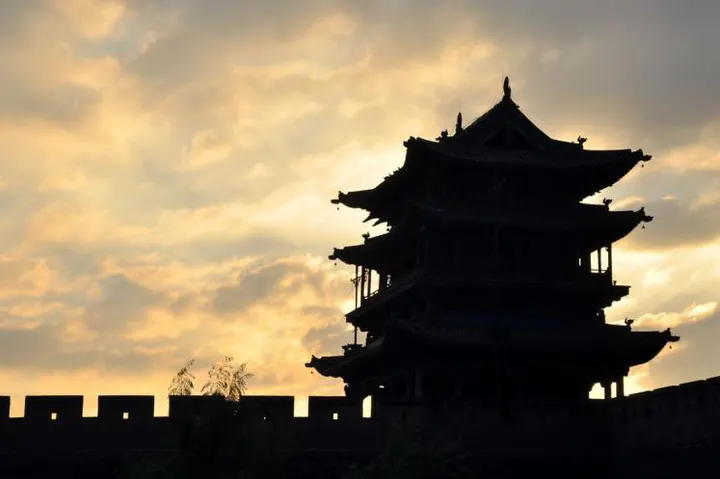
A gate tower reduced to silhouette in the last light
The city wall
The wall was rebuilt in brick in 1370 on the line of an older rammed-earth town: 6.4 km around, about 12 m high, with a moat outside. The plan is a turtle — the south gate is the head, two wells outside it the eyes; the north gate is the tail, and all the town's drainage leaves through it. Four barbicans on the east and west sides are the legs, and the outer gate of the lower east barbican was built facing straight east: the story goes that the builders, afraid the turtle might walk off, straightened its left leg and tethered it.
Seventy-two watchtowers and 3,000 crenellations are said to stand for Confucius's seventy-two disciples and three thousand students. The walk to do: up at the south gate, west and down at the lower west gate, ninety minutes, which gets you barbicans, bastions and corner towers in one line. There is not a tree up there, so between ten and three in summer you are volunteering for punishment.
The Market Tower and South Street
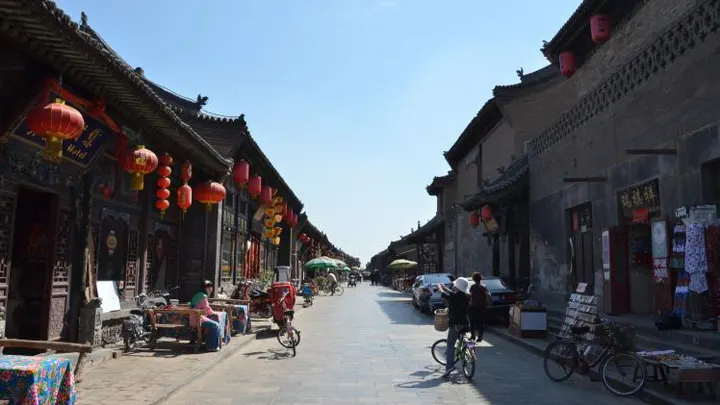
A street in the afternoon: bicycles, old shopfronts, lanterns overhead
South Street runs from the south gate to the Market Tower and was the commercial spine of the town in both dynasties. The shopfronts keep the old shop-in-front, house-behind pattern: three bays trading on the street, a courtyard behind, living quarters behind that. The tower stands in the middle of the roadway, 18.5 m tall with yellow-green glazed tiles, built over the old golden well. Climb it and the whole street lays itself out — signboards, rooflines, laundry drying on the tiles.
Rishengchang draft bank
In 1823 a dye merchant on West Street switched to remittance and hung a new board: Rishengchang. It was China's first bank devoted to moving money between cities, and it ended up with branches in 35 of them, reaching Europe and Southeast Asia — the boast on its sign was that it connected the world. The courtyard runs three halls deep, with the accounts room, the letter room and the vault left as they were; the anti-forgery systems, code words and draft papers are explained in detail and repay slow reading.
The county government office
The office sits a little southwest of the centre, facing south on an axis over 200 m long, and is the largest and most complete county administration surviving in China. The great hall heard cases, the second hall took counsel, the rear compound housed the magistrate's family; the six administrative bureaus ran down the east side, the jail along the west. Look for two boards: 'a bright mirror hung high' over the great hall, and 'heaven's principle, the state's law, human feeling' over the second — that second line is the whole institution in six characters.
The Confucian Temple and the City God Temple
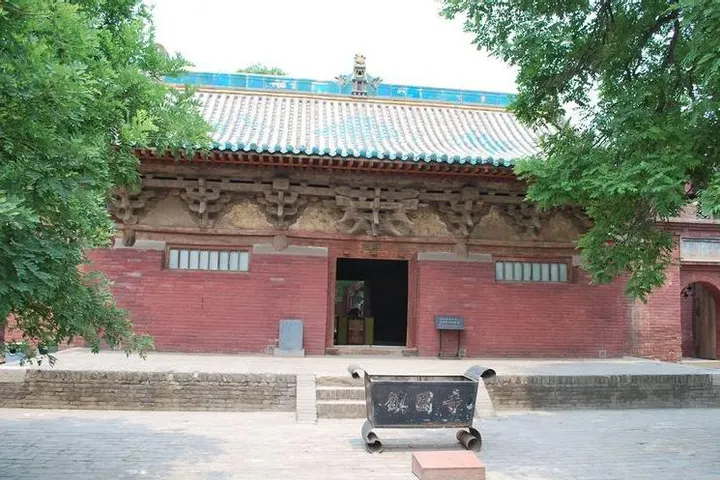
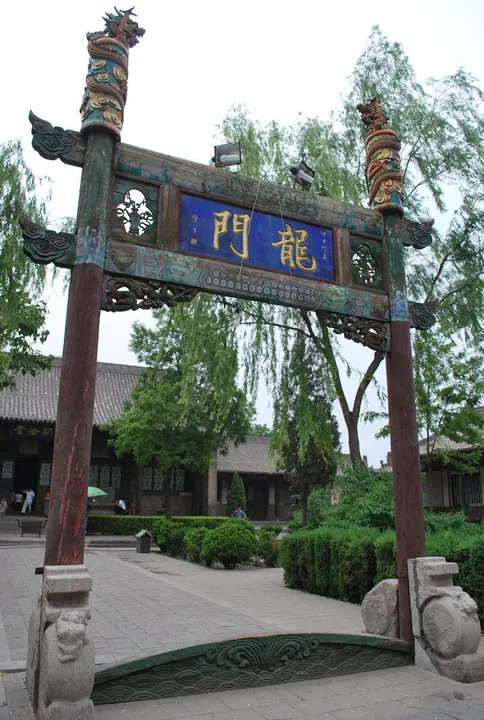
A hall at one of the temples outside the walls: red brick, glazed tile eaves, an iron censer in the yardThe Dragon Gate archway at the Confucian Temple
The Confucian Temple stands in the southeast; its main hall went up in 1163 and is among the oldest surviving in any Confucian temple in China. The treasure inside is an examination script: the palace-exam paper of a Ming Wanli-era top graduate, annotated in the emperor's own hand as first in the first rank — the only such original to survive from 1,300 years of imperial examinations. Across the street, the City God Temple combines three shrines in one compound, with the finest glazed tiles and carved brackets in town.
Escort agencies and money shops
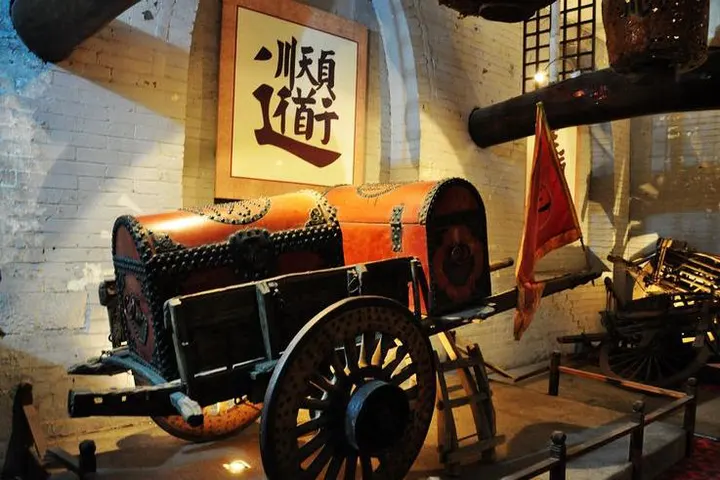
The armoured escort cart in the biaoju museum, flag still mounted
Before draft banks, silver had to travel with armed men, and that was the escort agency. The museum at 61 South Street occupies a late-Ming agency and lays out the ten great houses, the ten great escorts and the trade's rules: carts, chests, passwords, routes. The history is the interesting part — the moment draft banking took hold, the escorts' business collapsed, and once Republican-era military convoys appeared they vanished altogether. On one street you can watch an entire industry be born and die.
Shuanglin and Zhenguo temples
Shuanglin lies 6 km southwest, formerly Zhongdu Temple, pushed by its oldest stele to before 571. Ten halls hold more than 2,000 painted clay figures from the Song, Yuan, Ming and Qing; the Skanda in the Thousand Buddha Hall twists like a drawn bow and is widely held to be one of the high points of Chinese sculpture, while the twenty-six hands of the Guanyin in the Bodhisattva Hall unfold in rings that make your breathing go shallow. Zhenguo is 15 km northeast at Haodong village, its Hall of Ten Thousand Buddhas built in 963 with dated inscriptions still on the beams — a Five Dynasties timber frame you can walk around.
Both charge separately: ¥35 at Shuanglin, ¥25 at Zhenguo. Shuanglin is reachable on bus 108 or by taxi, with a hired car for the round trip traditionally around ¥30; Zhenguo is on bus 209 or by taxi, and the return car is hard to find, so keep the driver or fix a time. Few visitors, no facilities, no commerce — these are the two hours of the trip that feel most like looking at objects rather than at a destination.
06What is actually happening, hour by hour
The magistrate's court
At 9:30, 11:00 and 15:30 the great hall of the county office stages a case: guards in rank, a clerk taking minutes, the gavel, and usually a comic dispute from folk records. Free with the pass; arrive ten minutes early for the front. It is the best value performance in town precisely because it happens where cases were actually heard.
"See Pingyao Again"
A ninety-minute walk-through piece in which the audience follows the cast through five spaces, following a banking family trying to bring an heir home. ¥238, at 14:00 and 19:00 Tuesday to Sunday, closed Monday, under 1.2 m free. The theatre is at 154 Shuncheng Road, just outside the southwest corner. You stand and walk the whole time — wear the shoes you would wear on the wall. It is dark and loud.
The Pingyao International Photography Festival
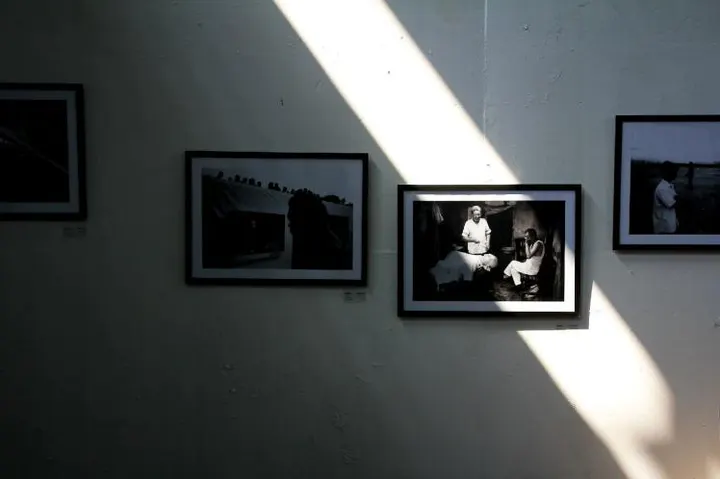
Prints on a white wall: the festival turns the whole old town into gallery space
Founded in 2001, it turns the whole town into a gallery each September. The 26th edition runs 19–23 September 2026 on the theme 'open, blended, new — building dreams with light', with 2,600-plus photographers from 34 countries showing in the county office, the old diesel engine plant, the former cotton mill and the Martial Temple. Rooms are tight and prices jump those days, but the atmosphere is the best the town has all year.
Spring Festival and the shehuo parades
Pingyao keeps northern New Year customs about as completely as any county town in China. From the twenty-third of the twelfth lunar month to the sixteenth of the first, the streets host shehuo: stilt walkers, children strapped to poles, land boats, yangge troupes and drums, processing down South Street in costume. Lanterns go up on the wall and in the offices, the Confucian Temple stages a scholars' rite, and fireworks close the Lantern Festival. Smaller parades now run at Mid-Autumn and Dragon Boat too. Dates shift each year — check the official account.
The wall light show
On clear evenings a projection show plays across the south gate and its wall, usually around 21:00, lasting a quarter of an hour, free. Times shift with season and weather — ask at your inn on the day. It ends conveniently: walk back through the south gate afterwards and the streets are already empty.
07Inside a courtyard, or outside the wall
Staying inside is half the trip. Most inns are converted Ming-Qing courtyards: a skywell at the door, rooms on four sides, possibly a kang for a bed, timber lattice windows, and thick walls doing the soundproofing. The price is that cars cannot come in and luggage arrives by tricycle; old buildings are damp and hot water is sometimes temperamental. Outside the wall is cheaper with easy parking, but you pay for it by queueing at a gate every morning.
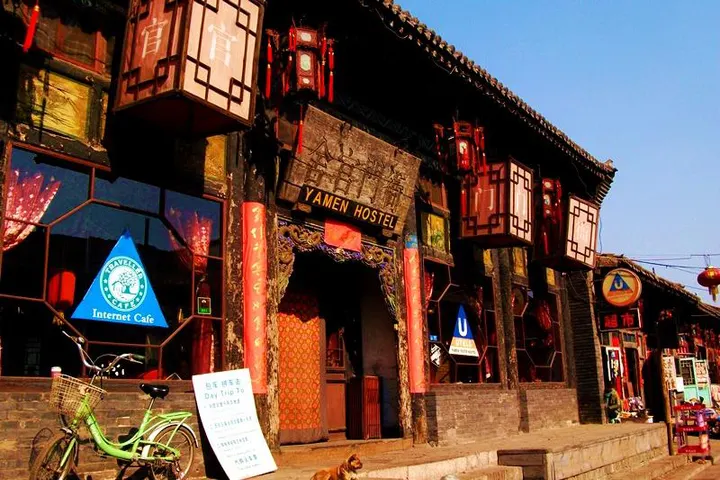
Yamen Hostel, next door to the county office and the town's first youth hostel
Hostels and bunks: clustered around the county office, dorms about ¥60–120 a bed and simple doubles ¥150–250. Best for solo travellers and tight budgets, and the easiest place to pick up route advice.
Budget inns: converted old houses in the quieter lanes, ¥150–250. Rooms are small and some open only onto a skywell — read the photos before booking.
Mid-range courtyards: ¥250–500, the bulk of the supply. Private bathrooms, underfloor heating or a heat pump, breakfast included, kang and carved timber intact. Densest on South Street, Yamen Street and Chenghuangmiao Street.
Top end: from ¥600, with private courtyards and butler service, up to ¥1,500 on holidays. These are old houses — do not expect business-hotel soundproofing.
Three questions to ask: does the room face the main street (which decides whether you sleep), is there air conditioning or underfloor heating (which decides summer and winter), and will they collect luggage by tricycle (which decides how long you drag a case over flagstones). The seasonal spread is brutal — holidays and summer weekends can double, while weekday nights from November to March are the cheapest of the year.
08Noodles, beef, vinegar — in that order
The cooking here is the cooking of the Jinzhong plain: wheat above all, savoury rather than sweet, and vinegar used without restraint. The town's so-called three treasures are beef, lacquerware and Chinese yam, two of which you can eat. Most of the dishes on the signboards are not unique to Pingyao — they belong to the whole of Shanxi and the north China plain — which does not stop them being good.
Six things to order
Pingyao beef: veal shank boiled then cured, the grain still visible, rich without grease. The old curing houses were Longshengwang, Xingshenglei and Zilicheng; today the Guanyun brand is the one everybody trusts. Beef cut fresh from the block tastes far better than the vacuum packs.
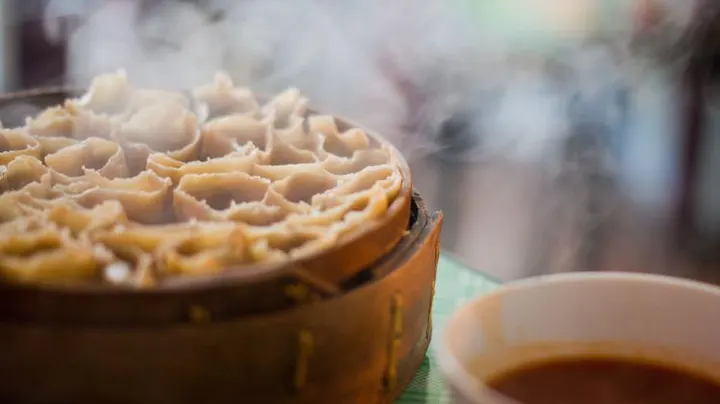
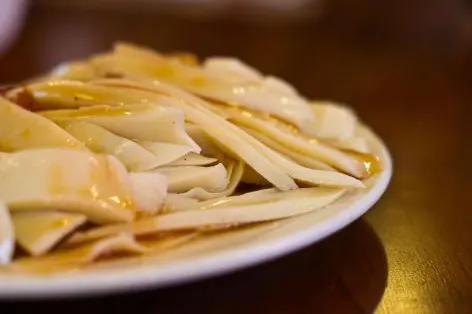
Wantuo: a wheat-flour batter steamed, cooled and cut into strips, dressed with vinegar, garlic water and chilli oil. Chewy, slippery, sour-hot and made for summer. Sold everywhere for anywhere from five to fifteen yuan.
Kaolaolao: oat flour rolled thin on a stone, curled into tubes and stood upright in the steamer like a honeycomb, then dipped in mutton or mushroom broth. It began around Xinzhou and now belongs to the whole province.
Chinese yam: a geographical-indication product here, eaten as food and taken as medicine. The preparations run to absurd lengths — candied, honey-glazed, with sea buckthorn, stir-fried, steamed — all sweet, soft and mild.
Shuijianbao: flat round buns fried golden top and bottom, crisp outside and juicy in, filled with lamb, pork or vegetables. The real thing is fried one at a time and found at street stalls; the plate of a dozen crowded together in bigger restaurants is a reheated shortcut.
Sea-buckthorn juice and Pingyao yellow wine: the berry is a loess-plateau wild fruit, bracingly sour, about five yuan a bottle. The wine is brewed from local glutinous rice; the Changshengyuan shop sits just south of the Market Tower, and it is mild enough to warm by the pot in winter.
Kaolaolao straight from the steamer, still steaming
Where to eat
The restaurants on South Street are the handiest and the dearest; the same dish costs three to five yuan more than in the lanes, which is not outrageous. Yun Jincheng (64 South Street) and Tian Yuankui (73 South Street) are the two long-runners, dining room in front and rooms behind, around ¥50–60 a head. To spend less, turn into a lane or eat outside the gates — locals do not eat in the scenic zone.
Wantuo cut into strips, dressed with vinegar and chilli oil
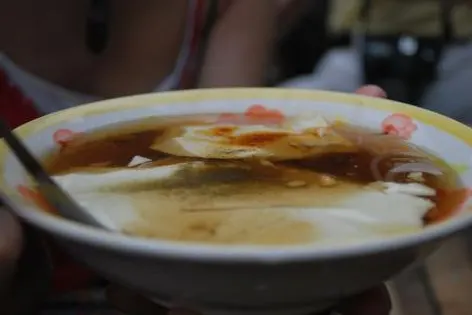
Breakfast is its own thing. Locals take doufunao with a sesame flatbread and a fried dough stick: here the soft tofu is drowned in a gravy built from vermicelli, soybeans and starch — hot, savoury, faintly sour. Add a fried bun and ten yuan buys you a proper start.
Doufunao: soft tofu under a dark savoury sauce
09Three things worth carrying home
The town is small enough to shop twice: note what you like, walk the rest of the streets, then come back — you will almost certainly find it cheaper or better. The shops along South Street carry local specialities; the newer 'artistic' boutiques sell things with no real connection to this town.
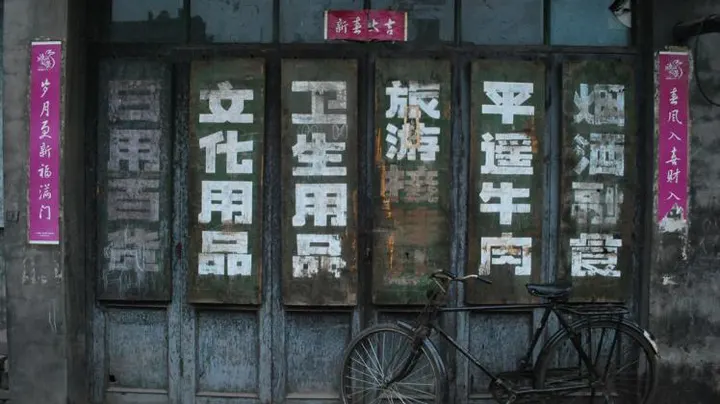
A shuttered shopfront lettered for daily goods, stationery, toiletries and Pingyao beef, with a bicycle leaning at the door
Pingyao lacquerware: polished to its sheen with the palm, built up through five stages — wood core, ash layer, lacquer, gilding, inlay — black for wood cores, red and brown for lacquered ones. Small boxes start around ¥100–200; skip the furniture, you cannot carry it.
Pingyao beef: buy Guanyun, and buy it cut fresh rather than boxed. Shops will vacuum-seal it on the spot; meat products are usually fine to carry, but import rules differ by country, so check before you fly.
Yam powder and vinegar: the powder is whisked into a gruel, sold for around ¥20 a bag; the aged vinegar of Shanxi province is far better than the supermarket stuff, but it is liquid — check it in, and not too many bottles.
Three things to walk past
First, anything described as 'just dug out of a field' — an old town is not a field of antiquities, and the coins, jade and old books on the stalls are batch-produced. Second, the 'old silver' being shouted about at doorways, which is mostly alloy. Third, the gift boxes: the same contents cost half as much in a supermarket outside the gates. Older brands such as the Liuhetai pillow or the Cao family's smoked pork knuckle are worth a look, but ask the price first.
10Two stations — get the right one
The two stations
Pingyao Ancient City Railway Station is the high-speed station, about 7 km southwest of the walls, and the word 'ancient city' is in its name. Pingyao Railway Station is the old conventional station, 1 km west of the lower west gate. Read the station name on your ticket: getting it wrong is not two extra steps, it is a dozen kilometres.
From Beijing, Xi'an and Taiyuan
G621 leaves Beijing Fengtai at 07:12 and reaches Pingyao Ancient City at 10:54 — three hours forty-two, ¥251 in second class. Later there is G625 (three and a half hours) and two departures from Qinghe that take nearly five. From Xi'an North the fastest is about two and a half hours: D2504 at 07:45 arriving 10:27, ¥150 second class, with a dozen services a day. Taiyuan South is easiest of all: 31 to 47 minutes, ¥28–29, running almost like a commuter line. There are overnight options too — K603 from Beijing West at 22:11 reaches the old Pingyao station at 10:02, a hard sleeper around ¥150.
Station to the old town
From the high-speed station take bus 108 for ¥1 — the north loop ends at the north gate, the south loop near the county offices, about 40 minutes — or a taxi for ¥20–30 in 15 minutes, with flagfall at ¥5 by day. From the old station just walk: 15 minutes and you are through the lower west gate, faster than waiting for anything. Ride-hailing is thin here, so do not stand around waiting for a car when you are in a hurry.
Flying in
There is no airport; the nearest is Taiyuan Wushe International. From arrivals, bus 201 or a taxi gets you to Taiyuan South, then half an hour of high-speed rail — about two hours door to door. A taxi all the way from the airport costs over ¥300 and is not worth it.
Inside and outside the walls
The core of the old town bans motor vehicles all day; walking is the only way and a day runs to 20,000 steps. When your legs give out, the electric sightseeing carts charge ¥10 a ride and the driver will follow the sight order. Drivers park outside the gates — south gate visitor centre, small south gate, north gate, west gate — at ¥10 by day and ¥30 overnight. Many inns rent bicycles, around ¥30 a day for a single.
To the temples and the compounds
Shuanglin is 6 km, on bus 108 or fifteen minutes by taxi. Zhenguo is 15 km, on bus 209 or by taxi, and return cars are scarce — take the driver's number. The Wang compound at Lingshi is about an hour by road, with shuttle buses from the old town around ¥50 return and shared cars much the same; the faster route is high-speed rail to Lingshi East then a fifteen-minute taxi. The Qiao compound at Qi County is twenty minutes by rail to Qi County East plus ten by taxi.
Check trains and fares from Beijing to Pingyao Ancient City
Emergency numbers: police 110, ambulance 120, fire 119. Tourism complaints 0354-567 2110 or 0354-567 4110, Jinzhong city 0354-263 6528, price complaints 12358.
Hospitals: Pingyao County People's Hospital (61 Shuguang Road, 0354-562 4307) and Pingyao County TCM Hospital (24 South Street, 0354-562 8020). There is no major hospital inside the walls; the nearest emergency room is outside them.
Cash: ATMs inside the walls are scarce and bank branches cluster outside the west gate. WeChat Pay and Alipay are accepted almost everywhere, down to stalls and the sightseeing carts, so ¥200–300 in cash is plenty of insurance.
Buy tickets through the official Pingyao scenic-area service account or at the gate ticket windows, not from touts at the entrance. The pass is tied to your ID: scan your passport or the QR code at each sight, with no paper ticket to collect.
Climate: classic warm-temperate continental monsoon — windy and dry in spring, rain concentrated in July and August, the pleasant window in autumn, cold and dry in winter. Lip balm, hand cream and sunscreen are year-round kit.
12A short packing list and four ways to not get stung
Shoes: 20,000 steps a day on flagstones, so soft soles with grip. This is the single most important line in this guide. There is no shade on the wall, and a hat beats an umbrella.
Documents: carry your passport, since the pass is ID-linked and scanned at every sight; for the show bring the ID used to book, because entry is face-checked; during the photography festival book rooms a month out.
Seasonal kit: a down jacket, gloves and a scarf in winter — the wall is far windier than the street; sunscreen and repellent in summer; a light jacket in spring and autumn, when the day swings ten degrees or more.
Electronics and money: power bank, plug adapter, Alipay or WeChat Pay linked to a foreign card, an offline map and a translator. Save your inn's address as a screenshot in Chinese to show a driver.
Four ways to avoid being stung. One: rickshaws and carts quote loosely — agree the price before you get in, and ¥10 a ride is the fair rate for the electric carts. Two: ignore anyone offering to walk you in 'by a back way without a ticket', since the pass is ID-scanned and there is no back way. Three: do not bother looking at the 'antiques' or 'old silver' on the stalls. Four: schedule nothing outdoors between eleven and three, because the midday sun in Pingyao flattens people — give those hours to the draft banks, the county office and the museums.
13Why the town looks the way it does
Geography and climate
Pingyao sits in central Shanxi on the east bank of the Fen River, at the southwestern end of the Taiyuan basin, administered from Jinzhong. Taiyuan lies north, Jiexiu and Lingshi south, and both the old Tongpu railway and the Dayun expressway run through the county. The climate is warm-temperate continental monsoon: dry and windy in spring, hot with concentrated rain in summer, clear in autumn, cold and dry in winter, with eighty per cent of the year's rain falling in June, July and August.
The turtle and its shell
The town's founding reaches back to the Western Zhou, some 2,800 years. Qin administrators set up Pingtao county here; under the Northern Wei the name became Pingyao to avoid a character in the emperor's personal name. The wall you walk today was faced in brick and extended in 1370 on the line of an older earth rampart: as late as 1349 the ground west of today's Shaxiang Street lay outside the walls, described in records as mulberry groves loud with birds. A flood in 1369 broke the west wall and left red silt; the town was enlarged the next year, the wall moved west, and Shaxiang Street came into being.
Shanxi merchants and the draft banks
Through the Ming and Qing, Shanxi merchants traded as far as Mongolia, Russia and Southeast Asia. Pingyao was their depot, described in a local saying as a town you could never fill and never empty: goods came in from every direction and went out again. In 1823 Rishengchang switched from dyes to remittance under Lei Lutai, with Mao Honghui as his deputy, and a draft could be cashed in another city without silver ever leaving the vault. For the next century Pingyao's banks moved a large share of China's money. Mao was later eased out, hired by the Hou family of Jiexiu to reorganise Weitaihou, and built the five-house 'Wei' group into a genuine rival to his old employer — a personnel dispute that is more or less the birth story of Chinese banking competition.
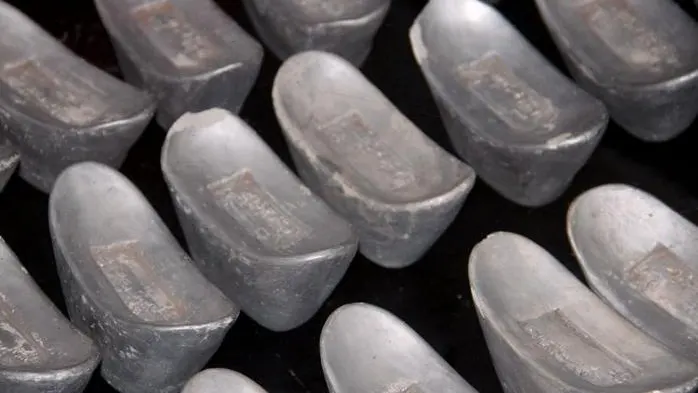
Silver sycees — the load the draft banks made unnecessary to carry
After 1997
When UNESCO listed the town in 1997 it received 50,000 visitors; by 2006 it was 920,000, and it has climbed since. The upside is that walls, banks and temples have all been repaired. The cost is that the shopfronts on South Street went from cloth and vinegar to milk tea and costume photography. There is an irony in the sequence: Shuanglin and Zhenguo were the famous sites first, and once the inscription came through it was the draft bank and the county office inside the walls that took all the attention — even the phrase 'the three treasures of Pingyao' migrated, from wall, Shuanglin and Zhenguo to beef, lacquerware and yam.
14Four ways out of town
Shuanglin Temple (half a day)
Six kilometres southwest, on bus 108 or fifteen minutes by taxi. Of the 2,000-odd clay figures, the Skanda in the Thousand Buddha Hall is the famous one: the body drawn like a full bow, the eyes on you. In the Bodhisattva Hall the twenty-six hands of the Guanyin open like a fan, and standing beneath them is the quietest moment of the trip. ¥35, students ¥15. Allow ninety minutes to two hours.
Zhenguo Temple (half a day)
Fifteen kilometres northeast at Haodong village, on bus 209 or by taxi. The Hall of Ten Thousand Buddhas went up in 963 under the Northern Han, one of the few Five Dynasties timber frames left in China, its beams carrying inscriptions that corroborate the temple's own steles. Most of the hall's figures survive, and the Three Buddhas Hall keeps Ming murals. ¥25. Almost nobody there; if you care about structure you will stand under the brackets for a long time.
The Wang Family Compound (half to full day)
At Jingsheng in Lingshi county, about an hour by road. A quarter of a square kilometre, 123 courtyards and 1,118 rooms: the summation of Qing domestic architecture. Gaojiaya and Hongmen Fort face each other across a bridge, both castle-like structures built into the loess slope. ¥55 in peak season, ¥35 off; three or four hours is not too long. The local boast is that after the Wang compound you need never look at another courtyard house — it is not much of an exaggeration.
The Qiao Family Compound (half a day)
At Dongguan in Qi County: twenty minutes by rail to Qi County East plus ten by taxi, or a direct car from Pingyao. ¥115, open 8:30–18:00 with last entry at 17:30. Famous from Raise the Red Lantern, it is far more compact than the Wang compound, with an extraordinary density of brick and wood carving, and takes two hours. It makes sense on the way from Taiyuan; from Pingyao you should decide whether the detour earns its keep.
Mount Wutai (2 days)
The first of China's four Buddhist mountains and the seat of Manjushri, five flat-topped peaks high enough to stay cool in midsummer — hence its other name, Qingliang Shan, the cool mountain. Getting there from Pingyao is awkward: the direct overnight trains take over five hours, and the practical route is back through Taiyuan or a three-hour drive. Temples on the mountain take guests and there are inns at the foot. If this trip stays inside Jinzhong, save Wutai for next time.
15Watch and read before you go
Film
Platform (2000, Jia Zhangke): three friends from a Fenyang troupe drift through the 1990s — county towns, flared trousers, Cui Jian on the tape deck. Mostly shot in Fenyang, with many scenes in Pingyao, and you can see streets not yet filled with visitors. Empire of Silver (2009, Yao Shuhua): two generations of the fictional Tianchengyuan bank, starring Aaron Kwok, filmed partly here — a faster way into how draft banking worked than any display board.
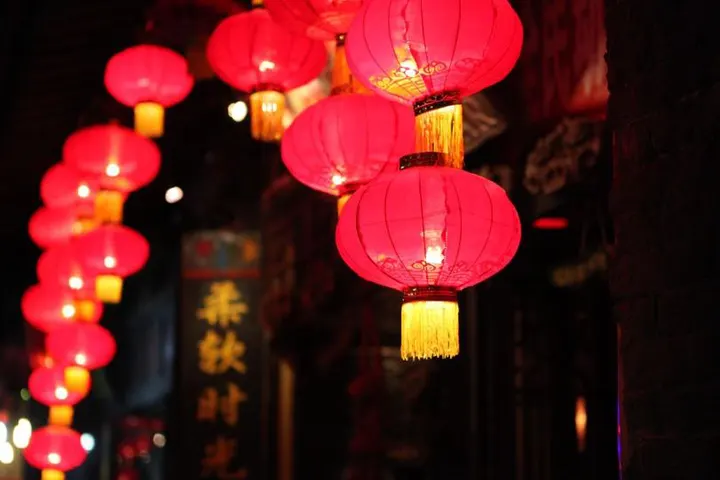
Lanterns after dark
Books
Cao Changzhi, "Pingyao Ancient City Illustrated": written by someone involved in the World Heritage nomination, heavy on drawings and light on prose, explaining the wall, the street grid, the banks and the temples one diagram at a time — the most useful book there is. Yu Qiuyu, "From Dunhuang to Pingyao": essays on the northwest and Shanxi, more atmosphere than scholarship, good for a train. For something harder, find the 1997 nomination dossier online; read it before you arrive and you will walk into a different town.
Music
Li Zhihui's "Pingyao Ancient Rhyme", from the 2005 album Our Vanishing Homeland, is Chinese-style instrumental music so widely licensed that you have certainly heard it. "Pingyao, My Home" is sung by Yan Weiwen, who was born and raised here, and the accent in it cannot be faked.