An island with no cars, and temple gates that open onto the East China Sea
Boat onlyNo cars on the islandTemple tokens: cash onlyQuietest at 06:00
In short
Mount Putuo (普陀山, Pǔtuó Shān) is a 12.5-square-kilometre island in the Zhoushan archipelago, its highest point only 291 m, and yet one of the four great Buddhist mountains of China and the sacred island of Guanyin, the Bodhisattva of Compassion. No private cars are allowed. You arrive by boat: fifteen minutes from the Zhujiajian Wugongzhi pier, ¥30 one way, departures every 20–30 minutes, the last boat leaving Zhujiajian at 21:50 and returning from the island at 22:10. The island entrance ticket is ¥160 from February to November, ¥120 in December and January, and ¥180 over the three big holiday windows. That ticket does not cover the temples: Puji, Fayu and Huiji each charge a ¥5 incense token, the Nanhai Guanyin ¥6, cash only, so carry small notes. The three great temples fit into one day, but the island is at its best at four in the morning, when the chanting starts at Puji, or after four in the afternoon, sitting on Thousand-Step Beach as the tide comes in. One night is worth it precisely because a day trip shows you the three temples at their most crowded. Budget ¥900–1,500 for two days, including tickets, boats, a room and temple meals, excluding travel to Zhejiang.
Key facts
Known for
Guanyin's island · three great temples · Nanhai Guanyin · temple meals · Thousand-Step Beach
Budget
¥900–1,500 for two days, mid-range
Days needed
1–3 days
Comfort
Comfortable — buses and a cable car help, but expect 20,000 steps and a lot of stone stairs
Best time to go
April–May and September–November are best; December–January is cheapest and quietest; avoid typhoon season and the three pilgrimage dates
01What kind of island this is
The boat docks and the first odd thing is the quiet. No engines, no horns, no scooter coming up behind you. Porters in blue cotton jackets offer to carry bags to your guesthouse for ¥20; everyone else wheels a suitcase along a stone lane between camphor trees and small shops, with a hill ahead and more sea behind it. You are on an island that has simply left cars outside.
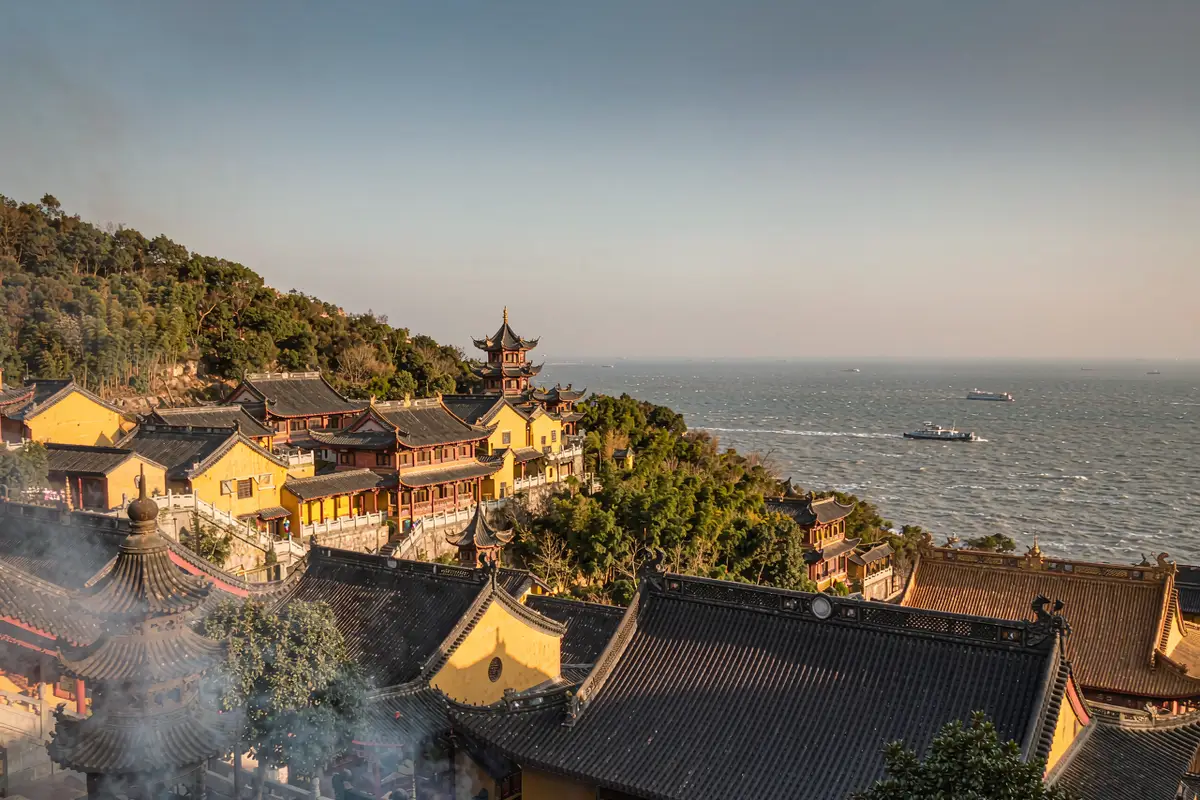
Mount Putuo (Putuoshan) lies outside Hangzhou Bay in the southeast of the Zhoushan archipelago, administratively a town within Putuo district of Zhoushan. The island is narrow east to west and longer north to south: 12.5 square kilometres, roughly 30 kilometres of coastline, and a high point of 291 m at Foding Peak — low by the standards of Chinese sacred mountains, but there is sea on every side and the temple gates face straight onto the Lianhua Yang channel, which nowhere else can offer. It divides into four parts: the southern tip around the pier and Puji Temple, known as the front hill, where the shops and guesthouses are; the north, with Fayu Temple, Thousand-Step Beach and Foding Peak, called the back hill; the southwest corner, a heap of granite boulders known as the West Heaven scenic area; and the southeast coast, where the Nanhai Guanyin, Purple Bamboo Forest, the Reluctant Guanyin Hall and Chaoyin Cave sit within a few hundred metres of each other.
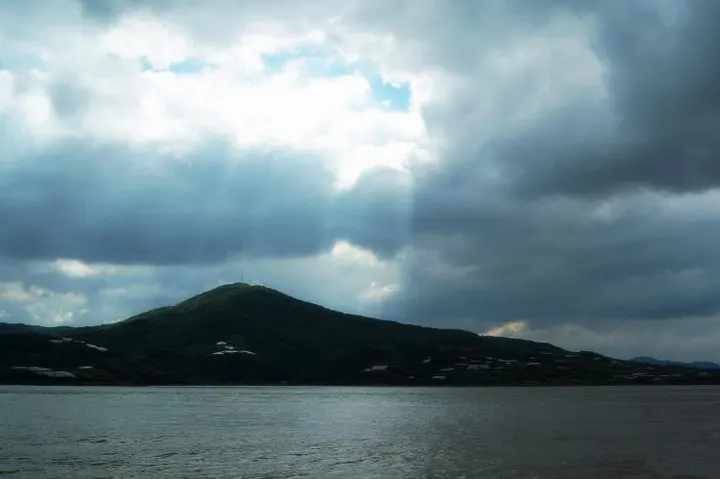
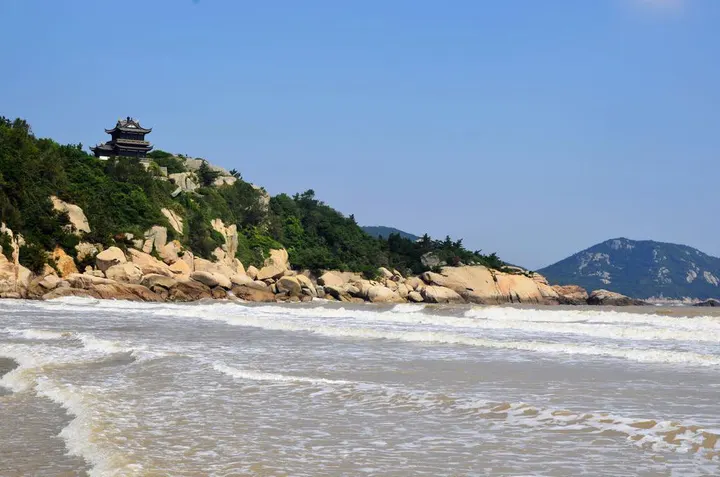
Mount Putuo from the water: a low ridge lying on the sea, light falling through a gap in the cloud
To understand the island you need Guanyin. Guanyin is a bodhisattva — in Sanskrit Avalokitesvara, the one who perceives the sounds of the world. A bodhisattva is not a god and does not create or judge; in Buddhist teaching a bodhisattva is someone who could pass into nirvana and chooses to remain in the world to help others get there. Guanyin embodies compassion, which is why people come to ask for children, for safety, for the health of a parent. The figure was male in India and became female as the tradition moved into China; almost every image on Putuo today is a woman with a calm face, a vase of pure water and a willow branch, or a wheel held in one hand.
Why this island? The sutras place Guanyin on a sea-girt mountain called Potalaka, with springs, bamboo groves and the sound of surf. Indian monks arriving in China and Chinese monks returning from India filled that imagined island in over centuries, and it finally settled here, in a place that is genuinely surrounded by water, grows purple bamboo, and has a cave into which the tide booms. Even the Potala in Lhasa carries the same name: Potala is Potalaka. Putuo was not a Chinese mountain appointed to be Guanyin's home; it is the closest real place to the island the texts describe.
The legend has a precise beginning. In 863 a Japanese monk named Egaku carried a Guanyin statue away from Mount Wutai, intending to take it home; off Lianhua Yang the boat was driven back by wind and waves, and he concluded that the image did not wish to go east, so he left it near Chaoyin Cave. A hall was built for it in 916 — the Reluctant Guanyin Hall — and the island's career as a pilgrimage centre dates from there. It flourished under the Song and Yuan, and in the Kangxi reign Puji and Fayu were rebuilt on imperial money, with timber and fittings from the Ming palace in Nanjing carried here for Fayu's Nine Dragons Hall. It became a national 5A scenic area in 2007.
A few hundred monks and nuns live here year round, the resident population is small, and there is no industry and no farmland; commerce is concentrated on the single street between the pier and Puji Temple, Xianghua Street and Mencen Road. The island is open to everyone and is not a religious enclosure: you can come purely for the sea, walk the beaches, eat a temple lunch and never light a stick of incense, and nobody will try to convert you. But it is a working religious site, and the dawn service, the silent midday meal and the quiet inside the halls are real rather than staged, so visitors are the ones who move aside.
02Six things worth rearranging your day for
Nanhai Guanyin: the sea first, then the statue33 m, on the island's southeast tip
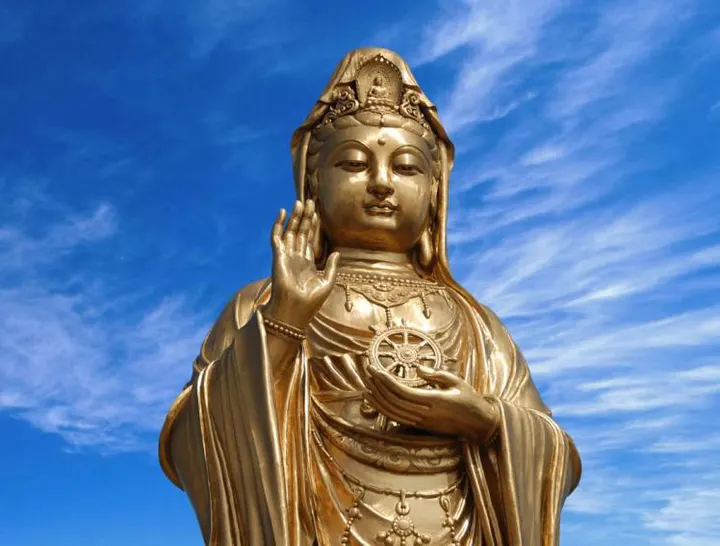
The statue stands on a ridge above the southeast shore, 33 m from base to crown: an 18 m bronze figure, a 2 m lotus, and a 13 m hall and plinth beneath. The right hand is raised in the gesture of fearlessness, the left holds a wheel, and the face is turned to the Lianhua Yang channel. Consecrated in 1997, it is younger than any of the three great temples and still the image people remember. Go after 16:00, when the sun swings round to the sea, the bronze stops looking white and the wind picks up. It is a ten-minute walk from the Purple Bamboo Forest bus stop, through camphor trees, and the figure emerges by degrees.
Puji Temple and its lotus pond: where the island beginsThree bridges and a hall that holds a thousand
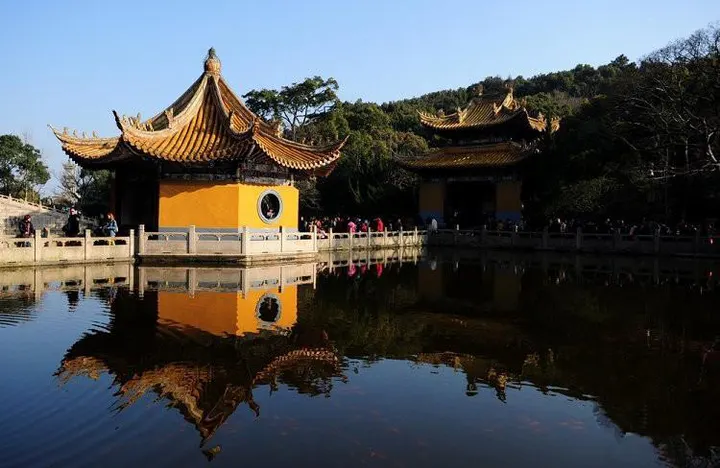
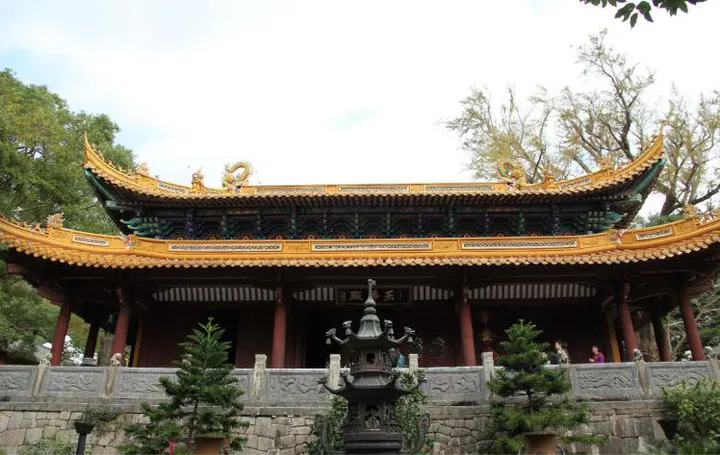
Puji, the front temple, is the island's principal Guanyin shrine, first built in 1080 and rebuilt in its present form under the Kangxi emperor. The lotus pond in front, Haiyin Pool, flowers in summer; three stone bridges cross it, and the middle one faces the Hall of Heavenly Kings — by old convention only an emperor walked it. The main hall, the Hall of Perfect Penetration, is known as the living hall because it can hold a thousand people standing, and the 8.8 m Vairocana Guanyin inside is the centre of the whole island. What is worth the early alarm is not the hall but the hour: doors at 05:00, the 04:00 service still running, chanting spilling out, mist still on the pond, and the entire front hill belonging to a few dozen local regulars.
Fayu Temple's Nine Dragons HallA hall dismantled from a Ming palace
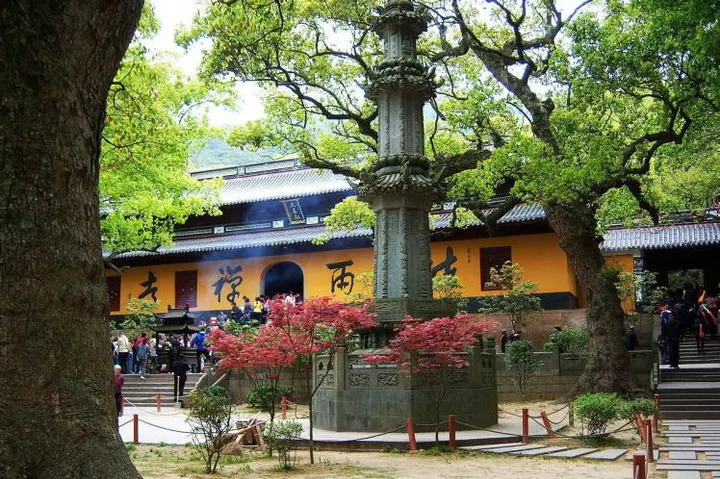
Fayu, the back temple, was founded in 1580 as a small hermitage called Sea Tide Hut. In 1699 Kangxi ordered a hall at the Ming palace in Nanjing taken down and its materials shipped here to rebuild the Nine Dragons Hall, whose coffered ceiling remains the finest piece of woodwork on the island: one dragon coiled at the apex, eight more plunging down the hanging columns, a golden pearl suspended between them. Two 12 m stone dharma pillars stand in front, and a pair of camphor trees several centuries old breaks the light into pieces. Most visitors see Puji and take the bus onward; Fayu is the higher-status building of the two and deserves twenty more minutes.
Foding Peak: 1,088 steps or seven minutes in a cable carThe island's high point, 291 m
Huiji Temple sits in a hollow on Foding Peak and is the only one of the three that has to be climbed. Two ways up: the Xiangyun Road from behind Fayu, 1,088 stone steps, forty-five minutes to an hour for a normal walker, with a tea pavilion halfway; or the cable car, seven minutes, ¥40 one way and ¥70 return, its lower station a little north of Fayu. The temple is small, its main hall roofed in sky blue, pale green and primrose glazed tiles that flare in sun. Behind it stands a Putuo hornbeam, the last wild specimen of its species anywhere, fenced off — do not touch it. The terrace above gives you the whole island and the water beyond, and earns the 291 m.
Purple Bamboo Forest, the Reluctant Guanyin Hall and Chaoyin CaveWhere the island starts
Three sites within a few minutes of each other, all covered by one ¥5 token. The Reluctant Guanyin Hall was built in 916 for the statue that refused to sail east; it now holds a Tang-style eleven-headed Guanyin, with the sea just outside the wall. Chaoyin Cave opens at sea level below the cliff, and when swell runs in the noise is like thunder; two fissures in the roof let spray shoot through. The rock here is purplish red and splits to show bamboo-leaf patterns, which is why bamboo was planted around it later. The whole stretch is stone paving and steps, and the wind is strong enough that you will be carrying your hat.
Thousand-Step and Hundred-Step beachesA beach after every temple
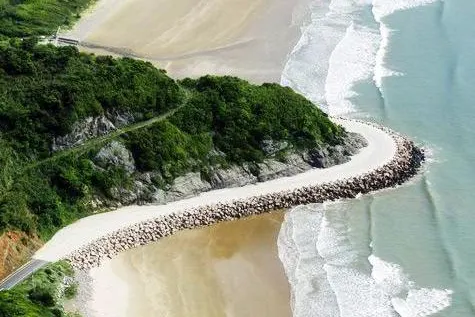
Thousand-Step Beach runs along the east side of Fayu Temple for about 1,750 m, the longest sand on Zhoushan, fine and gently shelving; walking it barefoot end to end takes twenty minutes. Hundred-Step Beach, east of Puji, is much smaller, with lifeguards and changing rooms in summer and safe swimming. They do different jobs: Thousand-Step for a dawn or dusk walk, watching the sun come out of the water or go into it; Hundred-Step for a dip when the middle of the day is too hot. The sea here is not blue — close in it is a silty yellow, courtesy of the Yangtze plume — so do not arrive expecting Sanya.
03Seven questions to settle before you book
Is it worth staying a night on the island?
Yes, and the reason is timing rather than comfort. Day trippers arrive between 09:30 and 15:00, which is exactly when the three temples are hottest, tightest and thickest with tour flags. With a night on the island you can be inside Puji for the 04:00 chanting, sit by an empty lotus pond at seven, and have the front hill finished before the 09:00 boats land; in the evening you can go back to Thousand-Step Beach after the day boats have gone. The cost is a room roughly twice the price of Zhujiajian and a thinner choice of restaurants. The compromise is to sleep near the Zhujiajian pier and take the 07:00 boat, which buys you the morning but not the evening.
When is the last boat, and what if I miss it?
The ordinary ferry from Zhujiajian's Wugongzhi pier runs from 06:30 (07:00 from November to February) until 21:50, every 20–30 minutes, fifteen minutes across; the last boat back from the island leaves at 22:10. The business fast boat runs 07:00–16:40 at ¥100 one way and is only worth it if you are chasing a connection. The Shenjiamen Banshengdong service stops at 16:10 and is not a fallback. If you do miss the last boat there are guesthouses on the island and finding a room on the spot is usually easier than people fear, though the price is not negotiable; a taxi back to Ningbo is not an option, because no bridge reaches the island. Typhoons and fog shut the whole route, so check the Zhoushan Haixing ferry account the day before rather than the weather forecast.
Do I need to buy incense, and where do I buy it without being ripped off?
No. All three great temples and the Nanhai Guanyin give out three free sticks of offering incense per person, and that is the island's official line: three sticks stand for discipline, concentration and wisdom, and more is not better. Puji has barred outside incense from the halls since 2025. Along the pier and the paths men will offer buckets of “consecrated” tall incense for ¥88, ¥128 or ¥199, telling you it cannot be bought inside — it can, and it is free. If you really want your own, the shops on Xianghua Street sell small packets for around ¥15, but there is no need. Candles are also unnecessary: open flame is banned inside the halls, and lighting points are provided at the burners.
What is the most efficient order for the three great temples?
Follow the altitude, high to low: Huiji on Foding Peak first, then Fayu, then Puji. The logic is practical — you climb the 1,088 steps only once, and you do it downward, taking the cable car up and walking the Xiangyun Road down, which is kinder to knees and lungs. In practice: bus 2 from the pier to the cable-car station, cable car up (¥40), half an hour at Huiji, walk down to Fayu (an hour, all downhill), an hour and a half for Fayu plus Thousand-Step Beach, then bus or walk to Puji, and twenty minutes on foot from Puji back to the pier. The reverse order works too, but it leaves the 1,088 steps for the moment you are most tired, or a long queue at the cable car. The traditional pilgrimage order is Puji, Fayu, Huiji — that is ritual sequence, not an energy budget.
Is the temple food any good, and how does it work?
Be clear about what it is: not food writing, just a meal. Puji's luohan zhai costs ¥10 and is a bowl of rice with a ladle of whatever has been stewed in the great pot — cabbage, tofu, glass noodles, wood ear, beans, by season — low on oil and salt, and the point is that it is hot and filling. Fayu charges ¥5, Huiji ¥10–15 because everything is carried up the hill. The genuinely good vegetarian food is in the island's private restaurants — Changsheng, Zaoshuzi, Lianhua Yangxin Yuan — where ¥60–100 a head buys you a proper kitchen. Rules in the temple refectory: lunch is 10:30–12:00, buy a ticket at the window from about 10:30 (cash only), queue, carry your own tray, take what you will eat, and return the bowl to the washing point. No talking, no phone calls, nothing left on the plate.
Can I visit during the pilgrimage dates, and how crowded is it?
You can, but know what you are choosing. The three Guanyin pilgrimages fall on the 19th of the 2nd, 6th and 9th lunar months — Guanyin's birth, enlightenment and renunciation — which in 2026 fall on 6 April, 1 August and 28 October. The crowds are not confined to the day: two or three days either side are full as well. Arrivals run three or four times normal, the queue for the boat starts at an hour, you squeeze past people at the incense burners, room rates double or triple, and you need to book a month out. What you get is the festival at full strength: processions that begin before dawn, pilgrims doing full prostrations up the 1,088 steps, lamps left burning at night. If you came for architecture and sea views, avoid those weeks. If you want to see the island actually working as a religious site, come then and halve your daily plan.
How hard is it with children or older parents?
Easier than most sacred mountains, because the island is flat, the peak is only 291 m and buses reach the main sites. What tires people is three things: steps, distance and sun. Puji to Fayu is a thirty-minute walk, Fayu to Foding is 1,088 steps (put parents and children on the cable car without debate), and the Purple Bamboo Forest to Nanhai Guanyin stretch is all up-and-down stone. Fifteen to twenty thousand steps a day is normal. A workable plan gives each day two major sites with a nap in between; strollers roll around Puji, the lotus pond and Thousand-Step Beach but not up Foding or around the West Heaven boulders; wheelchairs genuinely work only between the pier and Puji. In July and August the midday sun is brutal and the beaches have no shade, so keep older travellers out of the 11:00–15:00 window.
04One, two or three days, and what each one buys you
One hard constraint shapes everything: the boat. The first crossing is at 06:30 and the last back at 22:10, and the hours between them are your day. A second thing to settle: the entrance ticket dies when you leave, so do not plan to hop between Zhujiajian and the island in a single day. One day means three temples plus the Nanhai Guanyin; two days means giving the dawn and the dusk to the island; three days is what it takes to add Luojia Island and the West Heaven boulders.
D1
Take the 07:00 boat, be at the cable-car station before 08:00, ride up Foding and give Huiji half an hour. Walk the 1,088 steps down to Fayu — an hour, downhill; if your knees object, ride the cable car both ways. See the Nine Dragons Hall, then buy a lunch ticket at the refectory at 11:00. In the afternoon walk Thousand-Step Beach to the bus stop, ride to Purple Bamboo Forest, see the Reluctant Guanyin Hall and Chaoyin Cave, then walk on to the Nanhai Guanyin, where the light is best after 16:00. At 17:30 bus back to Puji, see the lotus pond before closing, and walk to the pier for the 19:00 boat. Eight to ten hours, twenty thousand steps.
D2
Arrive around midday on day one and stay on the front hill. The afternoon has one job: Puji and its lotus pond, unhurried, then a walk along Hundred-Step Beach to sit by the water. In the evening do the West Heaven circuit — Pantuo Rock, the Two Turtles, the Heart Stone — where there are almost no tour groups and the light is soft. Day two starts at 03:30, inside Puji by 04:00 for the dawn service (register the day before), breakfast in the refectory at 07:30, bus to Foding at 08:30, Huiji and Fayu done by noon with lunch at Fayu, Chaoyin Cave in the afternoon, then Thousand-Step Beach and the pier for the 17:00 boat. The virtue of this order is that you see the three busiest temples at their three quietest hours.
D3
Give day three to Luojia Island. Boats leave Duangu pier at 07:00 or 08:00, take twenty-five minutes, allow an hour and a half ashore for the Yuantong chapel and the pagoda of five hundred arhats, and bring you back by 09:30 or 10:00. Return for a temple lunch, then fill the afternoon with the West Heaven boulders or Chaoyin Cave, or do nothing at all and sit on Thousand-Step Beach until sunset. With a spare half day, add Zhujiajian: the sand at Nansha and the coast road over Daqing Peak, fifteen minutes by taxi from the Wugongzhi pier.
05Four quarters, walked without backtracking
Front hill: Puji, the lotus pond, the Duobao Pagoda
Twenty minutes north of the pier is Haiyin Pool, originally a fish-release pond, solid with lotus in summer. Three stone bridges cross it; the middle one faces the Hall of Heavenly Kings and was once reserved for emperors, which is why everyone uses it now and the two side bridges stay empty. East of the pool stands the Duobao Pagoda, a five-storey square tower of Taihu limestone from the Yuan dynasty, its upper three storeys carved with niches and Buddhas on all four faces. It is one of the island's three treasures and the only ancient structure here to survive unaltered. You cannot climb it, only walk around, and the reliefs read best in slanting afternoon light.
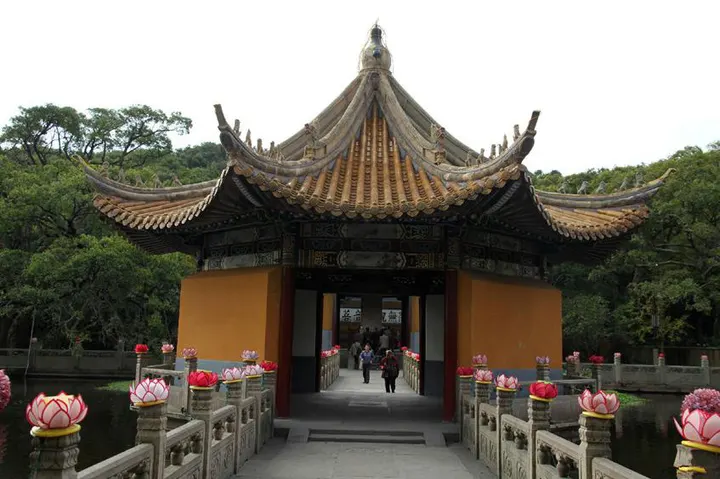
A gatehouse over water, its bridge balustrade lined with carved stone lotus lamps
Puji itself is built to imperial specification: Hall of Heavenly Kings, Hall of Perfect Penetration, scripture library, in a line. The 8.8 m Vairocana Guanyin sits at the centre of the main hall, which can hold a thousand people standing and is therefore called the living hall. Look up at the coffered ceiling, the glazed tiles and the stone balustrades, but photography inside the halls is banned and the signs are clear — keep the phone down. East of the temple is a dragon-carved stone screen, so densely worked that most people walk past it; it is far older than the statues inside.
Back hill: Fayu, Thousand-Step Beach, Foding Peak
Fayu climbs the hill in six terraces, so entering means walking up. The Nine Dragons Hall is the reason to come: both the yellow glazed roof tiles and the dragon ceiling inside were brought from the Ming palace in Nanjing in 1699, and the ceiling follows the imperial nine-five pattern — one dragon at the centre, eight plunging down the hanging columns, a golden pearl suspended between them. The pair of 12 m stone pillars in front carry the Ushnisha Vijaya dharani, and locals walk three circles around them.
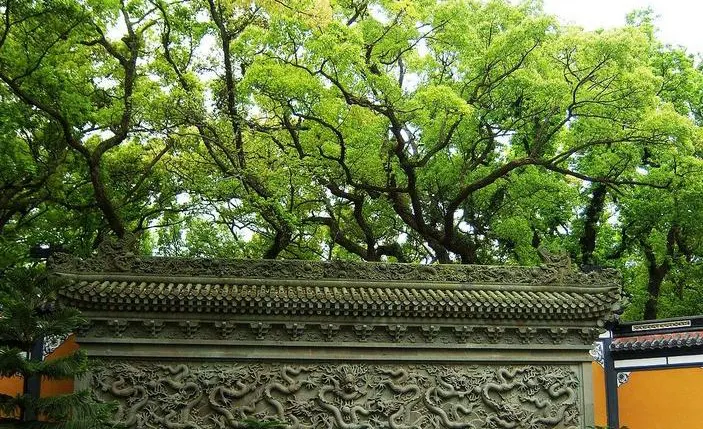
A stone screen wall carved all over with dragons, under camphor trees centuries old
Three minutes east of Fayu is Thousand-Step Beach: no ticket, no stalls, just a boardwalk and a few black pines. Foding Peak to the north, Hundred-Step Beach and the yellow walls of Puji to the south. At high tide the surf runs right up to the slope; at low tide it leaves tens of metres of wet sand, and locals walk it in the evening carrying their shoes.
This is where the island's identity as Guanyin's home begins, and the most coastal stretch of the whole place. Get off at the Purple Bamboo Forest stop, see the Reluctant Guanyin Hall first, then Chaoyin Cave, then climb the stone steps to the Nanhai Guanyin. The cave mouth is only a few metres wide; when swell runs in, the water is forced through and the sound is amplified until the railing vibrates under your hands. Ten minutes west is the South Heaven Gate, three boulders propped into a doorway with the name carved on top and, beside it, four characters by the Kangxi-era general Lan Li. Few people come, because no bus reaches it — you walk up from the Rusanmodi stop.
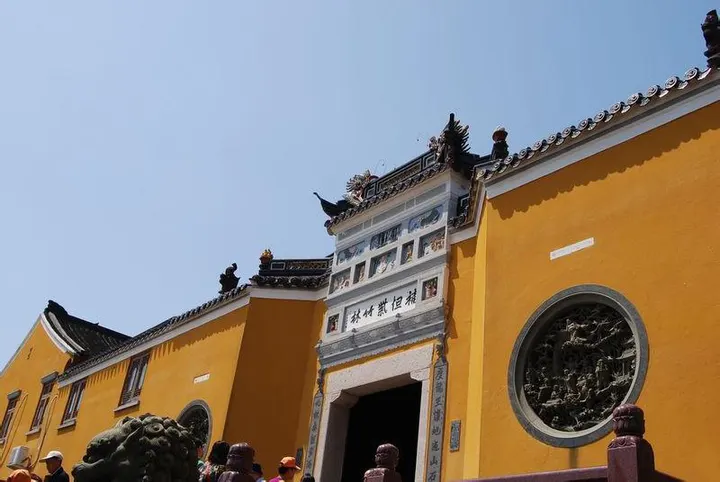
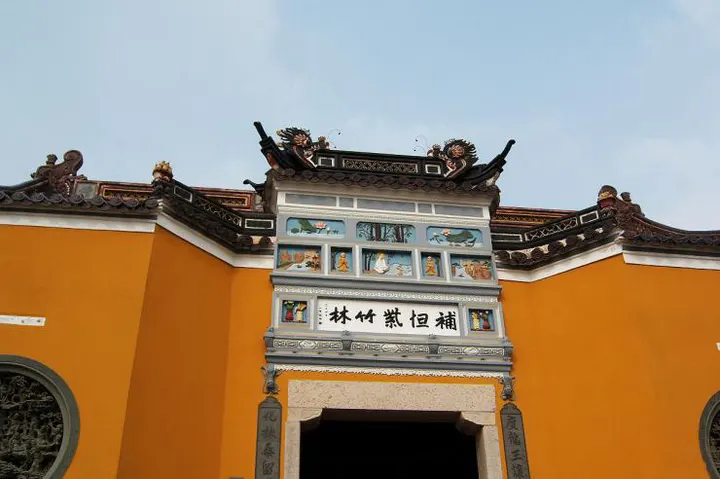
The Purple Bamboo Forest gate: yellow walls, glazed tiles, five characters on the lintel and a row of painted panels above them
West Heaven: boulders and the stories attached to them
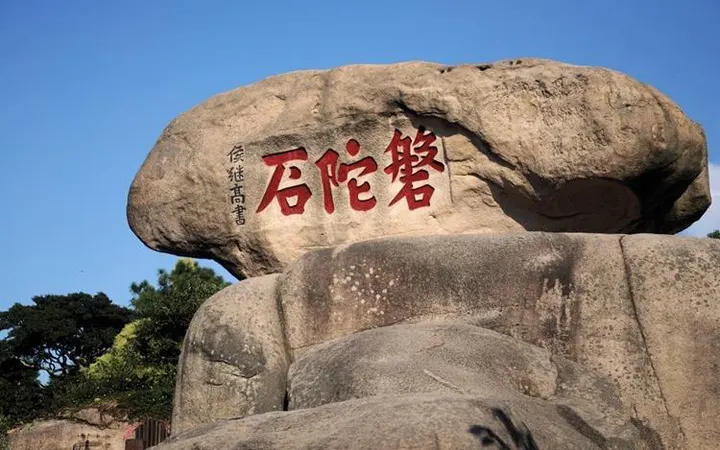
Pantuo Rock: two boulders stacked, the upper one apparently about to fall and going nowhere
The West Heaven area occupies the southwest corner, a stretch of granite hills that is never steep but constantly up and down, an hour and a half end to end. Its centrepiece is Pantuo Rock, two boulders stacked with only a few points of contact between them, apparently ready to slide and immovable for centuries. Three red characters are carved into the face, with a smaller inscription by Hou Jigao, a Ming general who fought the Japanese pirates. Further in are the Two Turtles Listening to the Dharma, rocks that read as two animals — one squatting on the cliff edge looking back, one climbing — said to be dragons' envoys sent to hear Guanyin preach who forgot to go home and were turned to stone. Below the West Heaven Gate is the Heart Stone, a single character big enough that eight or nine people can sit in its centre dot. Almost no tour groups come here; go late in the day.
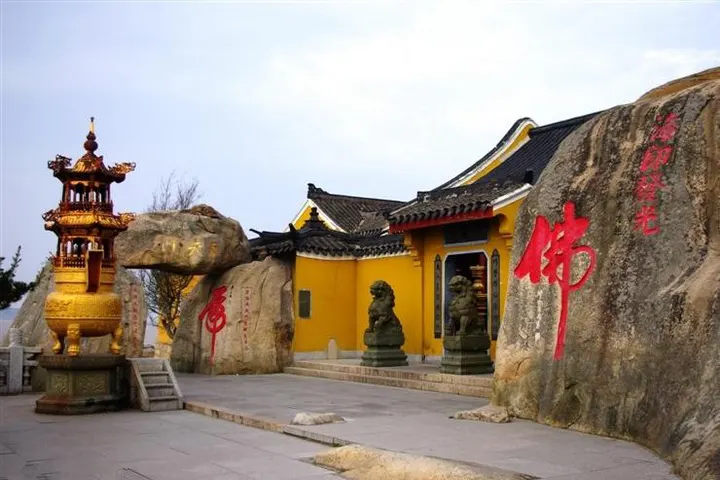
A temple gate tucked under an overhanging boulder, a bronze burner to the left and a red Buddha character cut into the rock
Fanyin Cave sits at the northeast end, facing Chaoyin across the island: a vertical fissure 70 m high and 50 m deep, its walls close enough to read as a doorway, with a stone platform and a small viewing pavilion slung between them. When swell enters, the sound ricochets and comes out lower and heavier than at Chaoyin. Buses here are infrequent; many people walk from Fayu, forty minutes, with nothing else on the route and the sea on the right the whole way.
Five minutes west of Fanyin is Shancai Cave, a natural rock hollow converted into a small shrine to Sudhana, the boy who went seeking enlightenment in the Avatamsaka Sutra. It became suddenly famous on social media a few years ago, and visitors now queue to rub banknotes against the rock wall for luck, which has polished the stone to a shine. It is interesting to watch; it is not an obligation. When the queue is long, walk around it.
06What else there is to do
Sit in on a dawn service
The dawn service at Puji is open to visitors, but you must register at the temple's Dharma affairs desk the day before. The fee is currently ¥500 for up to three names, ¥50 for each extra, thirteen maximum; on the four big dates — lunar New Year's Day and the three Guanyin days — it is ¥1,000. You are given a chit, admitted between 03:10 and 04:00, and the service runs 04:00–05:30. Inside you collect a kneeling bench, sit facing away from the image, and rise and kneel with the chanting. You do not need to know the texts or believe anything; sitting quietly is enough. Phone silent, no photographs, no getting up to wander. Breakfast in the refectory afterwards costs ¥5.
Eat in a temple refectory
All three temples serve lunch to visitors: ¥10 at Puji, ¥5 at Fayu, ¥10–15 at Huiji. Buy a ticket at the window from 10:30, cash, then queue. The food comes out of one pot — a bowl of rice, a ladle of stew — and you can go back for more, but whatever you take you finish. Your table mates will mostly be local elders and aunties who have come to burn incense; they will move over for you and ask where you are from. The point is not the cooking. It is the most ordinary face of the island, where there is no separate tourist tier and everyone eats from the same pot.
Walk the coast
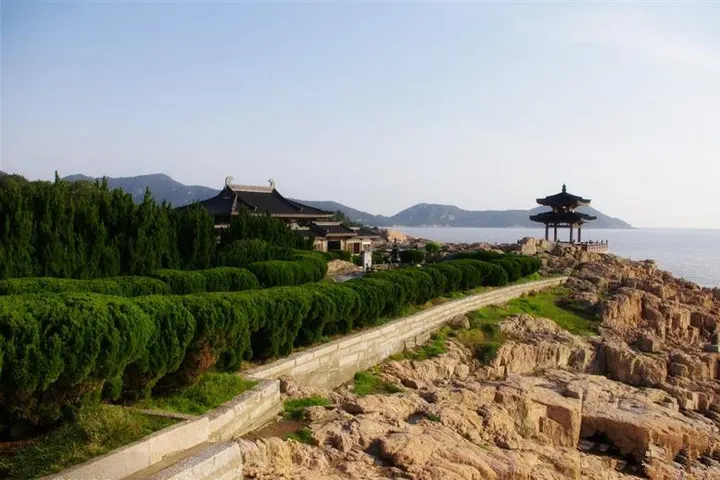
The coast path: clipped pine hedges and temple roofs on the left, rocks and water on the right
The best walk on the island is not on the sight list: from the east side of Fayu along Thousand-Step Beach south to Hundred-Step, then up the stone steps to Purple Bamboo Forest, about four kilometres, an hour and twenty minutes. Sand, rocks, pine woods and yellow temple walls, with almost no climbing. Do it at dawn and you pass monks walking and locals doing taiji on the sand; do it at dusk and the sun drops behind the western islands and the water turns the colour of gunmetal. Wear trainers, not sandals — the rock sections carry moss.
Catch a festival
The three pilgrimage dates are when religious life here is at its densest. Beyond them, November brings the Guanyin Culture Festival, mostly ritual and conference, and March the Putuo Spring Festival, mostly public events. The pilgrimage days are crowded but show you more: processions before dawn, pilgrims doing full prostrations up the hill, lamps burning all night. Stand back, do not block the route, and do not put a lens in someone's face. Dharma assemblies are not advertised to visitors; if you come across one, stand quietly at the edge rather than walking in and out.
Swimming and beaches
Only Hundred-Step Beach runs a proper bathing area in summer, with lifeguards, buoyed limits and changing rooms, hours set by the tide. Thousand-Step has no lifeguards; the slope is gentle but there is surf and there are currents, and locals only paddle. The water is silty and visibility is poor, so snorkelling is pointless. Children need an adult within arm's reach, and nobody should stand on the rocks at high tide — the wave that comes in does not go back out the same way.
07Which part of the island, and what the mainland offers instead
The geography first: rooms are on the front hill or the back. The front hill means the pier, Puji, Longsha and Xishan — food, buses and shops within ten minutes' walk of Puji. The back hill means Fayu and Thousand-Step Beach: quiet, sand at the door, but very little to eat at night and only your feet once the buses stop. There are no chain budget hotels; the stock is guesthouses, small inns and a handful of old-established hotels. Rooms are generally small and sound insulation is average; hot water and air conditioning work.
Guesthouses in Longsha and Xishan: the densest cluster, 10–15 minutes' walk from Puji. ¥280–500 for a double in low season, ¥600–900 in high, doubling or tripling over pilgrimage dates and golden weeks. Owners usually buy ferry tickets for you, store bags and sometimes meet you at the pier.
Around Puji and the lotus pond: the best position on the island, with everything on the front hill at the door. Mostly older hotels, ¥500–900 a double, rooms worn but clean, some overlooking the pond. Right for a single night when the dawn matters more than the room.
Fayu and Thousand-Step Beach: quiet, with trees or sea outside the window. Mid-range ¥600–900, better guesthouses above ¥1,000. The drawback is that after 19:00 there is almost nowhere to eat, so ask whether the place has a kitchen.
The top end: Xilei Villa, Putuoshan Hotel, Zhuxiangju, Radisson and similar, ¥1,200–2,800, with sea-view rooms, vegetarian restaurants and pier transfers. With children or older parents, this is the low-friction choice.
Off-island: around the Zhujiajian pier ¥200–400, five minutes from the ferry hall and ideal for the first boat; Shenjiamen ¥200–400 with seafood stalls at night, but a bus ride to the pier in the morning. The saving pays for a seafood dinner for two.
Two practical notes. There are no cars, so either wheel your own bags or pay a porter ¥20 at the pier — the stone lanes are hard on wheels. And sea view means less here than the phrase suggests: most front-hill rooms look onto a courtyard or a street, and the ones that genuinely face water are concentrated on Jinsha Road, around Longwan, and in a few high-end hotels. Ask for a photograph taken from the window before you book; it beats the room-category name.
08Temple food is the main event; eat seafood elsewhere
Everything arrives by boat, so it is expensive and the choice is thin. Most of the restaurants on the single street do set menus for groups — “three delicacies of Putuo”, “vegetarian set” — at prices the cooking does not justify. Two things are worth eating: the temple vegetarian meal, zhai fan, in the refectories, and the handful of restaurants that take vegetarian cooking seriously. Seafood is not forbidden, but the same money buys twice as much in Shenjiamen.
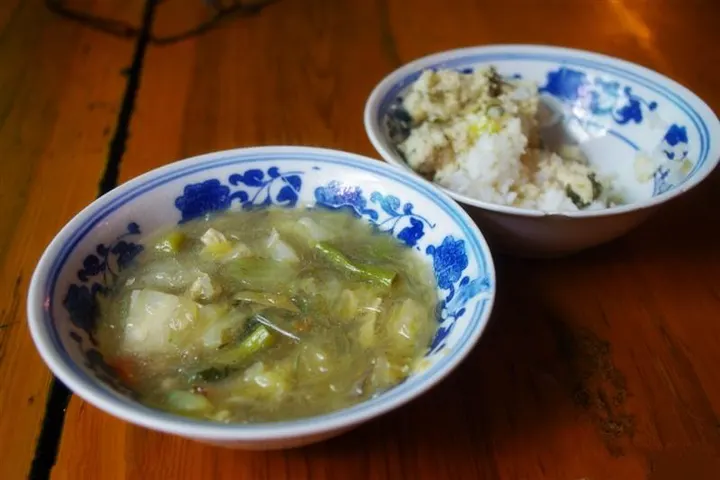
A refectory meal: cabbage and glass noodles in one bowl, rice in the other, blue-and-white porcelain on bare wood
How the temple meal works
All three temples serve lunch: ¥10 at Puji, ¥5 at Fayu, ¥10–15 at Huiji. Buy a ticket at the refectory window from 10:30 — cash only — queue, carry your own bowl and find a seat. The dish is luohan zhai: cabbage, tofu, glass noodles, wood ear, beans, potato, stewed together and changing with the season, with as much rice as you want. The rules are silence, no leftovers, and taking your bowl to the washing point. Puji also does 05:30 breakfast and 16:30 dinner, but reliably only for residents and people attending the dawn service, so ask before you turn up.
Vegetarian restaurants
Changsheng Vegetarian (51 Fayu Road): the most careful kitchen on the island, with mock chicken and goose as well as luohan zhai, ¥60–80 a head. Busy at lunch; arrive before 11:30.
Zaoshuzi (84–86 Mencen Road, near Hundred-Step Beach): a vegetarian chain, consistent cooking, clean room, ¥70–100 a head, good with children.
Lianhua Yangxin Yuan (312 Puji Road): by the water, set menus only, ¥80–120 a head, window tables need booking.
The noodle stalls outside the temple gates: ¥10–20 a bowl, shiitake, dried bamboo shoot and greens in a clear broth, morning and midday, the right answer when you are in a hurry.
Seafood and snacks
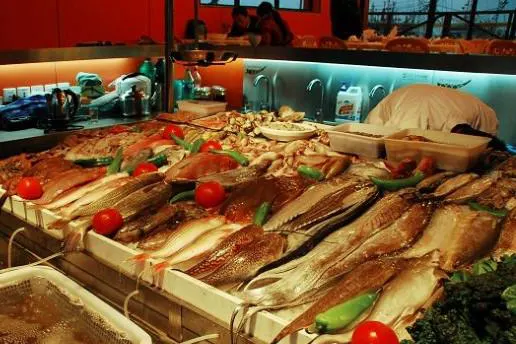
The counter of a seafood restaurant: whole fish on ice, an open kitchen behind
Island seafood clusters around the Seafood Garden, South Heaven Gate and the temple forecourts, ¥100–200 a head; always confirm the price and the unit — by weight or by piece — before ordering. Better value is a boat to Zhujiajian or Shenjiamen: the night stall street in Shenjiamen does swimming crab, hairtail, pomfret and mussels at ¥80–150 a head, much of it priced by the plate. Only two snacks are worth buying: guanyin bing, a flaky pastry with seaweed, red bean or salt-and-pepper filling at about ¥20 a box, and seafood noodles, ¥40–60 a bowl, the broth made from fish bones.
09Only a few things travel well
Putuo is not a shopping destination. The single street of Xianghua and Mencen repeats the same stock: incense, prayer beads, guanyin cakes, dried fish, plastic lotus lamps. Four things are genuinely worth buying, and all of them come from proper shops. The rule is short: food yes, incense no, and nothing “blessed” should be taken seriously.
Guanyin cakes: the safest gift. Guansutang is the old name, with a shop at 30 Xianghua Street; seaweed, red bean and salt-and-pepper, around ¥20, short shelf life, so do not stock up.
Putuo Buddha tea: grown around Foding Peak, best before the grain rains, yellow-green in the cup and lighter than Longjing. ¥200–500 per 500 g in proper shops and supermarkets; taste first, and avoid loose unlabelled packets at the roadside.
Dried fish and seafood: baby squid, small yellow croaker, dried shrimp, vacuum-packed and ready to eat, ¥20–30 a bag. Check the date, and smell loose stock for rancidity.
Putuo narcissus: the city flower of Zhoushan, blooming in late winter, a New Year plant for local households. Winter only, sold as bulbs; skip the ones already in flower, which will not survive the trip.
Three things to leave alone. “Consecrated” tall incense, sold hardest at the pier and on the paths at over ¥100 a bucket, when the temples give away three sticks and will not let you burn your own anyway. “Blessed” bracelets, jade and pixiu, with no certificate and a price made up on the spot. And loose herbs, especially “wild reishi” and “century ginseng”, impossible to verify and with no benchmark price. If you want tea and cakes, buy them in a Zhoushan supermarket on the mainland — the same goods, twenty to thirty per cent cheaper.
10Train to Ningbo, bus to the pier, ferry to the island
Step one: high-speed rail to Ningbo
There is no railway station and no road onto Putuo. The cleanest approach is high-speed rail to Ningbo: 1h40m to 2h from Shanghai Hongqiao, ¥110–150 in second class; about an hour from Hangzhou East, ¥70–90; two and a half hours from Nanjing South, around ¥200. At Ningbo the signs for the coach station lead you there in three minutes without going outside.
Step two: coach to the Zhujiajian pier
From Ningbo South coach station there are 24 departures a day to the Zhujiajian Wugongzhi pier, 05:50–18:20, ¥72, two to two and a half hours over the island bridges. Services to the Putuo long-distance station are more frequent — 48 a day, ¥59 — with a ten-minute taxi onward. Shanghai's Nanpu Bridge tourist terminal runs 16 a day from ¥150, four and a half hours, some direct to the pier; Hangzhou East has 32 a day from ¥110, three and a half hours. Book through the Ningbo Public Transport or Zizai Travel accounts, a day ahead in high season.
Step three: the ferry
The island as the boat comes in: a low hill, temple roofs hidden in the trees
Zhujiajian's Wugongzhi pier is the main terminal: ordinary ferries from 06:30 (07:00 from November to February) until 21:50, every 20–30 minutes, fifteen minutes across, ¥30 one way or ¥60 return, with the last boat back from the island at 22:10. The business fast boat runs 07:00–16:40 at ¥100 one way — wider seats, no queue, worth it only against the clock. Shenjiamen's Banshengdong pier runs 07:00–16:10 at ¥25–30, twenty-odd minutes across, useful only if you are sleeping in Shenjiamen. Buy the combined boat-and-entrance ticket on the Zhoushan Haixing or Putuo Yimatong mini-programs and pass the gate with your ID card.
Flying: you land on Zhujiajian
Zhoushan Putuoshan Airport (HSN) sits on Zhujiajian itself, ten minutes and ¥15–20 by taxi from the Wugongzhi pier, with an airport bus timed to arrivals. In the 2026 winter season it handles over 500 movements a week to about thirty cities: Beijing Daxing, Shenzhen, Xiamen, Qingdao, Chengdu Tianfu, Chongqing, Wuhan, Changsha, Zhengzhou, Jinan, Fuzhou, Tianjin, Shenyang, Dalian, Harbin, Hong Kong and more, most of them one flight a day. The 2026 winter schedule has no Shanghai or Hangzhou flights — for those, the train to Ningbo is quicker. The terminal is small and you are outside ten minutes after landing, but do not cut connections close; wind delays are common.
On the island: buses, cable car, feet
No taxis and no ride-hailing, only green shuttle buses: ¥5–10 a segment, ¥40 for a day pass, running 06:00–17:30 with a night service every half hour until 22:00. Three routes: 1 via the pier, Purple Bamboo Forest, Nanhai Guanyin, Hundred-Step Beach and Puji; 2 via Puji, Fayu and the cable-car station; 3 the long run from the pier to Fanyin Cave. Anywhere the buses do not go, you walk, which is why shoes matter. The cable car up Foding is ¥40 one way and ¥70 return, 07:00–16:30, with an hour's queue in high season.
Useful walking times: pier to Puji 20 minutes, Puji to Hundred-Step Beach 10, Hundred-Step to Purple Bamboo Forest 20, Purple Bamboo to Nanhai Guanyin 10, Puji to Fayu 30, Fayu to Thousand-Step Beach 3, Fayu to the cable-car station 15. The full circuit of the island is about 30 km — not a day's walk, and not necessary.
Cash: temple tokens (¥5 and ¥6), refectory meals (¥5–15) and Luojia top-ups are cash only, and the ATMs on Mencen Road have queues. Change ¥300 into ones, fives and tens before you come; it is the most useful thing in your bag.
Numbers: tourist information 0580-6093089, ferry terminal 0580-6091121, complaints 0580-6091538, ambulance 0580-6092388. Police 110, medical 120, fire 119.
Hospitals: Puji Hospital on 95 Mencen Road is the island's only walk-in clinic for ordinary emergencies; anything serious goes to Putuo People's Hospital in Shenjiamen (90 Gongxia Road, 0580-3012328), about an hour by boat and road.
Signal: 4G holds across the island and 5G works around the pier and Puji; Foding and Fanyin are weak. Put the phone on silent in the temples and do not take calls inside a hall.
Money: guesthouses, restaurants and shops all take QR payment, and Alipay's international version links Visa and Mastercard. Only the temple tokens and refectory meals require cash — which happen to be the two things you need every day.
Rules: no photography, no open flame and no noise inside the halls; step over the threshold, never on it; walk clockwise around a hall; keep out of monks' quarters; cover shoulders and knees, and no vests or flip-flops inside. Smoking is banned throughout the wooded areas and permitted only at marked points.
Access: the pier-to-Puji stretch is flat enough for a wheelchair; temple thresholds are high and need lifting; Foding, West Heaven and Fanyin are not wheelchair country. Strollers reach Hundred-Step Beach but have to be carried up steps.
Two small things. Luggage: guesthouses sit in lanes with stone paving and steps, which destroys wheels — travel with a backpack if you can. Toilets: at the pier, Puji, Fayu and the cable-car station, free, bring your own paper; there are none in the West Heaven area or the middle of Thousand-Step Beach, so go before you start.
12What to book, what to pack, what to ignore
Booking: buy the combined boat-and-entrance ticket on the Zhoushan Haixing or Putuo Yimatong mini-program, one to three days ahead, a week ahead for pilgrimage dates and golden weeks. ID cards go straight through the gate; passport bookings need manual verification at the window.
Shoes: the best investment on this trip is a pair of grippy trainers. The stone paving is polished smooth, the coast path carries moss, and 1,088 steps are harder on the knees going down than up. Nothing new, nothing canvas.
Clothing: island weather changes three times a day. Even in summer carry a light layer for the boat; spring and autumn swing ten degrees between morning and evening; winter is damp cold, so a down jacket plus a windproof shell. Shoulders and knees covered for the halls, or you will be stopped at the door.
Sun and rain: UV is stronger on the water, so hat, sunglasses and sunscreen; a disposable rain poncho beats an umbrella, which the wind will turn inside out on the hill. Mosquito repellent in summer, especially in the wooded sections.
Seasickness: the crossing is only fifteen minutes and most people are fine, but the boat rolls in a swell. Take a tablet half an hour before if you are prone, sit mid-ship, look at the horizon and keep off the phone.
The dawn service: to attend the 04:00 chanting at Puji, register at the temple's Dharma affairs desk on the morning you arrive, with cash and the names and addresses you want read out. Same-day places usually exist on ordinary days and never on the big ones.
Four things to ignore. Anyone at the pier offering a “guide” who can get you in without a ticket is selling nothing — the gate reads ID cards. “Consecrated” incense and bracelets are neither accepted nor burnable inside the temples, so do not pay. There are no taxis on the island, and anyone offering to drive you up is running an unlicensed car with no insurance worth the name. And a forecast of 25°C for Zhoushan is not 25°C on the island: it runs two or three degrees cooler on the water, colder still with wind, so bring long sleeves even in summer.
13How an island became a holy place
Geography: granite coming out of the sea
Putuo is one of the 1,390 islands of the Zhoushan group, lying at the southern edge of Hangzhou Bay east of Zhoushan itself, 6.5 km from Shenjiamen and 2.5 km from Zhujiajian. It is long and narrow, high in the middle and low at the edges, with Foding Peak at 291 m. The rock is granite, which is why the island is covered in rounded boulders: Pantuo Rock, the Two Turtles, the Heart Stone are all products of the same process — granite splitting along joints, sea and rain rounding the corners, the surviving core left sitting on a ridge.
The climate is subtropical maritime: an annual mean of 16.1°C, an August mean maximum of 27°C, a January mean minimum of 5.5°C, and 900–1,300 mm of rain, sixty per cent of it in spring and summer. Fog occurs on thirty-seven days a year on average, seventy per cent of it between March and June; typhoons cross between July and September and shut the ferries completely. The question of when to come is therefore half about crowds and half about whether the boat sails.
People: from the Reluctant Guanyin to three great temples
The religious history begins with the statue that would not sail in 863. A hall followed in 916, the site grew under the Song with imperial plaques, land and monks, and expanded through the Yuan and Ming. The real turn came early in the Qing: in 1689 Kangxi paid for the rebuilding of Puji and Fayu, and in 1699 simply had a hall at the Ming palace in Nanjing taken apart and its materials shipped here for the Nine Dragons Hall. An island on the maritime frontier was thereby folded into the imperial order — by building temples, the throne took charge of both the sea trade and the spiritual life of the fishermen.
Today there are three great temples — Puji, Fayu, Huiji — plus dozens of smaller convents and a few hundred resident monks and nuns. The island is simultaneously a scenic area and a working religious site: tourists by day, pilgrims and clergy at dawn and dusk, two timetables offset on the same street. Every friction that comes from that double identity — tickets, incense tokens, touts, fenced-off trees — is two sides of one thing.
The island among the four great mountains
The four great Buddhist mountains each belong to a bodhisattva: Mount Wutai to Manjushri, Mount Emei to Samantabhadra, Mount Jiuhua to Ksitigarbha, Mount Putuo to Guanyin. Only Putuo is an island, and only Putuo puts the sea inside the religious experience: the boom in Chaoyin Cave, the echo in Fanyin, the fog on Lianhua Yang, the story of the statue that refused to leave. The other mountains make you climb; Putuo makes you look outward.
14Zhujiajian, Shenjiamen, and a smaller island
Zhujiajian (half a day to a day, one bridge away)
The coast road over Daqing Peak: hill on one side, sea on the other, asphalt in between
Zhujiajian is the island across the water from Putuo, connected to Zhoushan by bridge, with the Wugongzhi pier at its western end. Three places are worth the time, plus one built attraction. Nansha, a 1.5 km beach with finer sand than Putuo's, a summer bathing area and an international sand-sculpture festival each September and October. Daqing Peak, the island's high point at 378 m, with a coast road cut around its waist — drive it or take the park bus, and the sea turns below you. Wushitang, a beach made entirely of black pebbles that rattle underfoot. Tickets run ¥20–70 each; two of the three fill half a day. The fourth is the Guanyin Dharma Realm, a vast new complex of halls and a domed stupa near the airport, ¥90, worth two hours if contemporary religious architecture interests you and skippable if it does not.
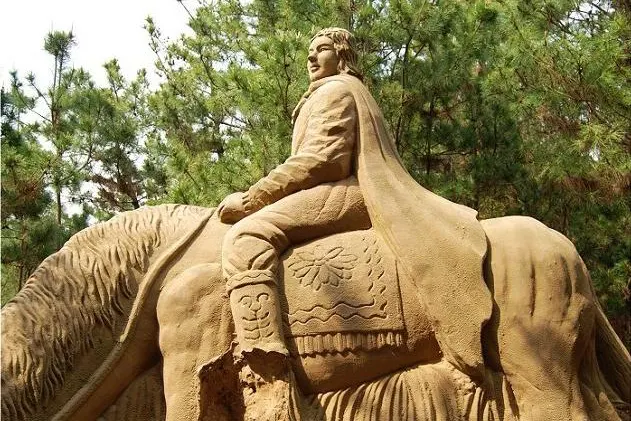
A sand sculpture on the beach: a rider on horseback, every detail pressed into the sand
Shenjiamen (half a day, one meal)
Shenjiamen is one of China's largest fishing ports, twenty minutes over the bridge from Zhujiajian, and there is one reason to come: seafood. The night stalls run the length of Bingang Road, dozens of them side by side, with the day's catch on ice — swimming crab, hairtail, pomfret, mussels, goose barnacles — cooked to order. ¥80–150 a head, half what the island charges. It gets busy after 18:00; pick a stall with a crowd and check that the fishes' eyes are clear.
Luojia Island (half a day, from Putuo)
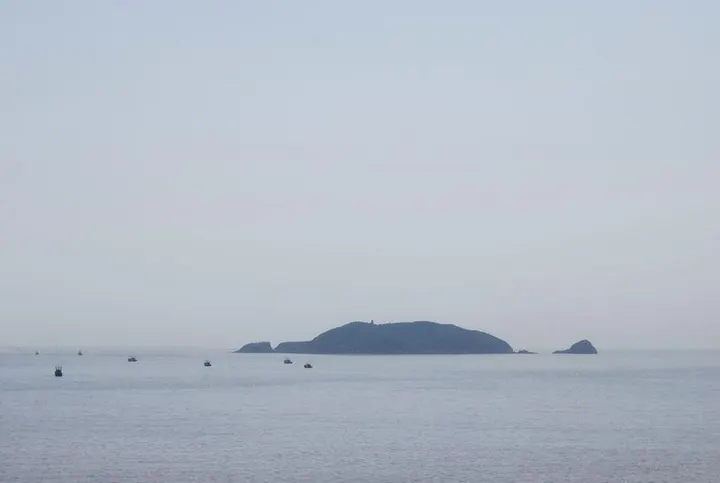
Luojia from Putuo: a low ridge floating on the water, like a figure lying on its side
Luojia lies in Lianhua Yang southeast of Putuo, twenty-five minutes by boat. It is tiny, uninhabited apart from a few convents, and tradition holds that Guanyin practised here first, which is why people say that without Luojia you have not finished Putuo. The ¥70 package covers the return boat and the ¥18 island ticket; boats leave Putuo at 07:00, 08:00, 09:00, 10:00, 12:00, 13:00 and 13:30, allow an hour and a half ashore, with return sailings from 09:00 to 15:30. From the water the island reads as a reclining Buddha — head, shoulder, chest, belly all in place — which is its most famous likeness. No shops; carry water.
15The island has been told many times
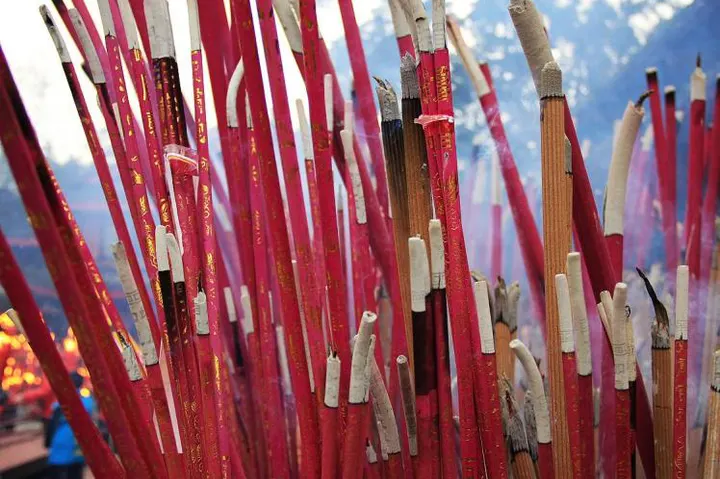
Incense in the burner, bundles at a time, red shafts showing beneath crowns of pale ash
Film
The Reluctant Guanyin (2013, dir. Zhang Xin) turns the 863 legend into a feature: Li Chun, Nie Yuan and Siqin Gaowa in a story that adds court intrigue and a Japanese embassy subplot, some distance from the historical record. It is nevertheless the only film that tells the island's founding legend from end to end, and watching it before you come puts another layer behind the hall.
Books
Wang Zeyan's Putuoshan is a slim cultural reader covering geography, plants, temples, legends and food at high density — the right length for the ferry. Liu Jianping's Dream of the Red Chamber at Putuo reads the novel's mythic mountain and its talking jade against Pantuo Rock and the Guanyin legends; the argument will not convince everyone, but the angle is entertaining and Red Chamber readers will enjoy it as a diversion.
Music
Zhang Weiliang's Gardenia Putuo is tea music — xiao and guqin, with the title track carrying the thin, clean profile of Putuo Buddha tea. Li Zhihui's Buddha Light, Mountain and Water is closer to new age, opening onto exactly the wide sea-and-sky picture the title promises. Both are good on headphones walking Thousand-Step Beach, and neither belongs inside a hall.
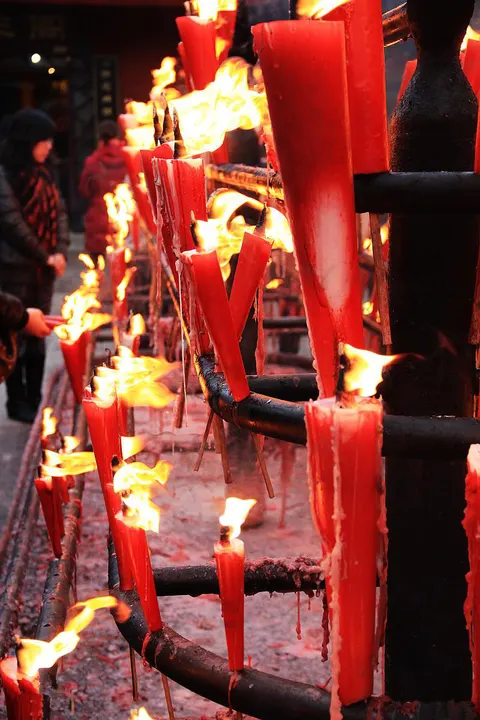
The candle rack outside a hall: red candles half burnt, wax running down the iron frame
Festivals
The 19th of the 2nd, 6th and 9th lunar months are the three pilgrimage dates — Guanyin's birth, enlightenment and renunciation — which in 2026 fall on 6 April, 1 August and 28 October. November brings the Guanyin Culture Festival, with rituals, Buddhist concerts and a lotus-lamp procession packed into a few days; March has the Putuo Spring Festival, mostly local performing arts. The pilgrimage dates show you belief; the festivals show you programming. They are not the same thing.