A German-built old townVillas of BadaguanDraft beer in a bagMount Lao above the seaFree city beaches
In short
Qingdao (青岛, Qīngdǎo) is the port city on the south coast of the Shandong peninsula, and the German lease of 1898–1914 left it with a complete European street plan, a sewer system and a brewery. Under the red roofs live people who swim before work and carry draft beer home in a plastic bag. Three days covers the old town, Badaguan and the beer museum; add one more for Mount Lao. May–June and September–October are the sweet spots, and a mid-range trip runs about ¥1,800–3,200 for 3–5 days excluding long-distance transport.
Key facts
Known for
German old town · Badaguan · beer · Mount Lao · city beaches
Budget
¥1,800–3,200 for 3–5 days, mid-range
Days needed
3–5 days
Comfort
Comfortable
Best time to go
May–June and September–October; July–August for swimming, but crowded and pricey; November–March is quiet, with gulls at the pier
01What kind of city Qingdao is
Qingdao's postcard is four words: red tiles, green trees, blue sea, blue sky. It is not marketing. When Germany leased Jiaozhou Bay in 1898 it transplanted a European street grid, sewer system and roofscape onto these granite hills, which is why the old town feels European in plan and utterly Chinese in use.
Read it in three layers. Around Qingdao Bay sits the 1900s town: Zhanqiao Pier, Zhongshan Road, the cathedral and the governor's residence all within two kilometres. East of that is 1930s Badaguan, ten streets named after mountain passes, each lined with villas in two dozen national styles. Further east is the city built after 1990 — May Fourth Square, the Olympic Sailing Center and a wall of glass, where the 2008 sailing regatta was held.
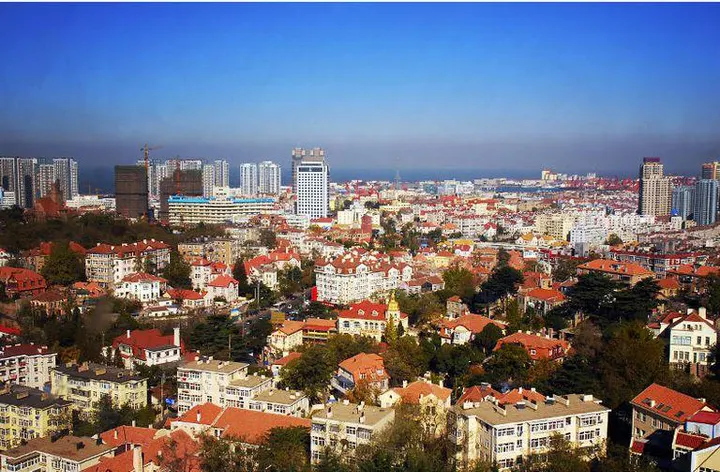
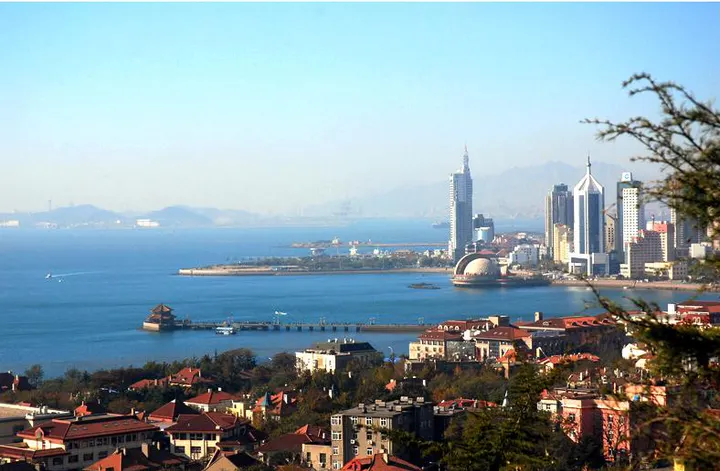
The old town from above: red tiles, green hills, the new city beyond
The city has a pull that is hard to name. The water is not the bluest you will ever see, but walk the shoreline into the wind, listen to the swell and watch the gulls, and you feel the same quiet happiness as everyone else who happens to be passing through.
"Besotted with Jiaozhou: Qingdao in Fair Weather and Foul"
What separates Qingdao from Sanya or Xiamen is that the sea here is infrastructure, not scenery. People swim at 5:30 in the morning, dig clams when the tide drops, pick up two jin of draft beer on the way home and spend Sunday at the beach until the light goes. The water is part of daily life, so what you watch is a life, not a set.
Give it three days at minimum: one on foot through the old town, one for Badaguan and beer, one for Mount Lao. Base yourself between the railway station and Zhongshan Road — shortest walks, and the best evening light finds you rather than the other way round.
02Six things worth your time
Walk in from Zhanqiao PierWhere the city starts
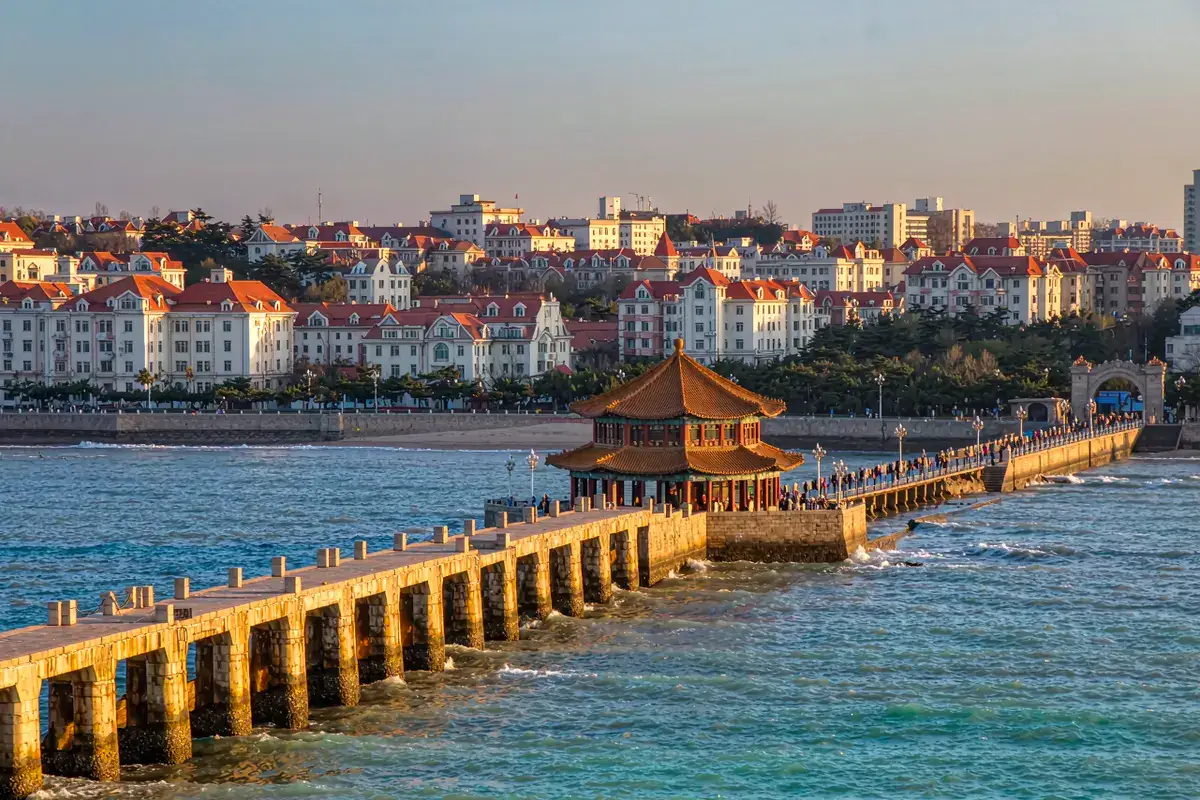
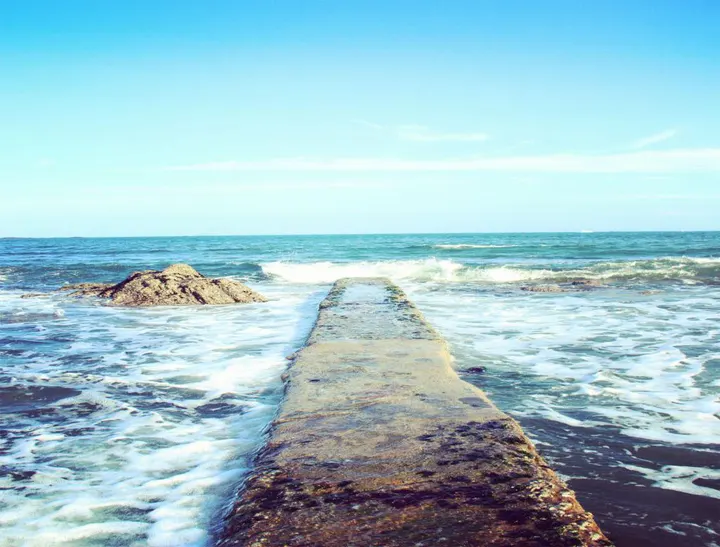
A 440-metre pier runs straight out into Qingdao Bay, the octagonal Huilan Pavilion at its tip the oldest landmark in town. Come at dawn for sunrise and the men fishing; at low tide the rocks below fill with locals hunting clams. Turn north up Zhongshan Road and the old town unfolds.
The ten streets of BadaguanA world's fair of villas
Ten streets, each named for a mountain pass and each planted with a different tree: peach on Shaoguan Road, crape myrtle on Zhengyangguan Road, ginkgo on Juyongguan, cedars on Zijingguan. The district is free and two hours of walking never wears thin. To go inside, Huashi Lou and the Princess House sell separate tickets.
Draft beer at a neighbourhood tavernSold by the bag
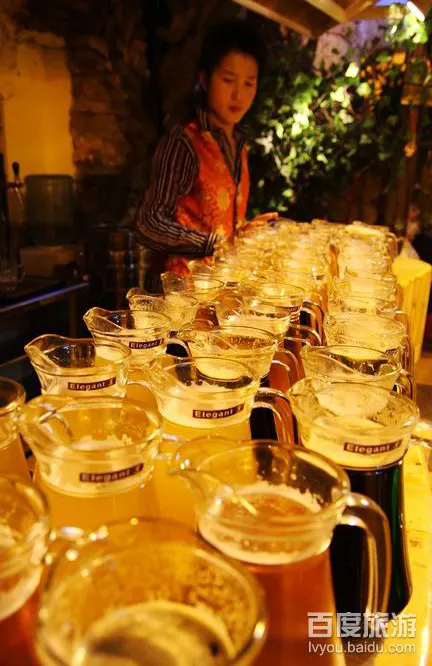
Locals do not drink beer, they 'ha' it. A stainless barrel stands at the door of the corner shop, the owner fills a plastic bag from the tap, and you walk off with a straw in it. Factory-four draft costs ¥3–6 a jin, the unfiltered original about ¥15 — and three times that on the tourist promenades.
Swim at a city beachNine beaches, no admission
Qingdao keeps nine official bathing beaches, all free of admission in 2026. No.1 has the gentlest slope and the longest season (1 June to 31 October); No.2, at the end of Badaguan, is the one for children and clam-digging; No.3 faces the Floating Hill Bay light show after dark.
Mount Lao, rising straight from the seaThe tallest coastal peak in China
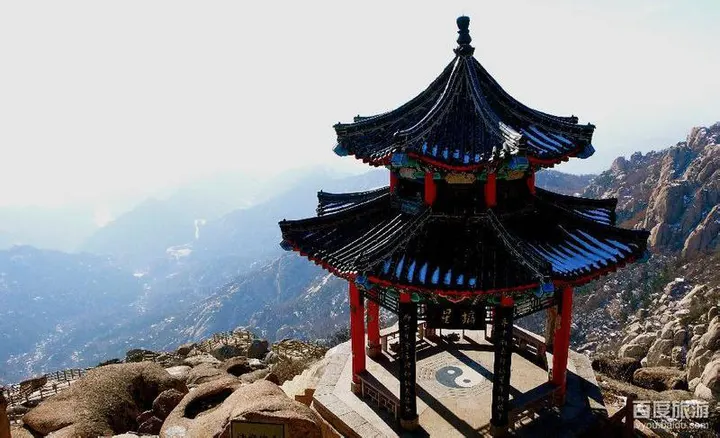
The main peak, Jufeng, stands 1,133 m and climbs almost vertically out of the Yellow Sea — the highest point on mainland China's coastline. Up top are Taoist temples, springs and passes that look straight down at the water. Each route sells its own ticket, and private cars stop at the gate; you transfer to a shuttle.
Cross Jiaozhou BayForty-one kilometres of bridge
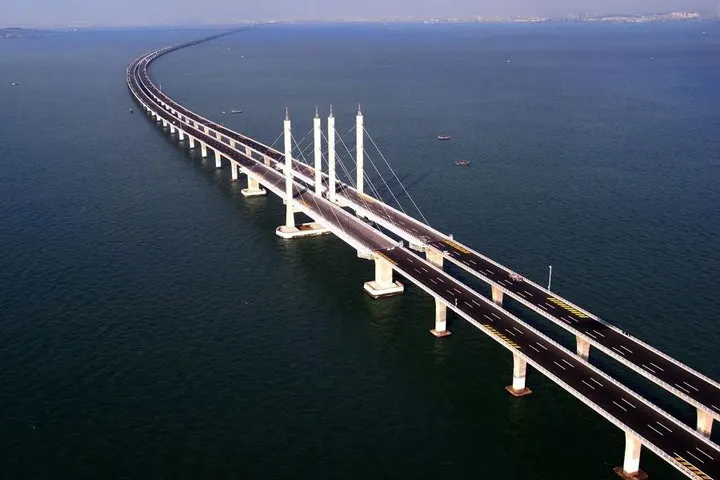
The Jiaozhou Bay Bridge runs 41.58 km and links Qingdao, Hongdao and Huangdao in one line; drivers who prefer tunnels take the undersea one under the bay mouth, six minutes from the old town to Huangdao. What used to be the city's worst geographical problem is now its best drive.
03Seven things to settle before you book
Qingdao Station, Qingdao North or Hongdao — which ticket should I buy?
Follow your hotel. Staying in the old town — pier, Zhongshan Road, Daxue Road — buy Qingdao Station: five minutes on foot to the water, with Metro L1 and L3 underneath. Qingdao North in Licang has the most departures and a three-line interchange (L1/L3/L8), about 30 minutes from the sights, so it suits connections or an eastern hotel. Hongdao out in Chengyang mostly serves the airport corridor and sits 40 km from everything. One trap: many Shanghai trains terminate at Qingdao West in Huangdao, 40-plus kilometres from the old town.
Is summer unbearable? When should I actually come?
July and August are the peak, and during the beer festival (17 July to 15 August in 2026) room rates double and the beaches are shoulder to shoulder. May–June and September–October are the sweet spots: the water is warm enough, the crowds halve and the light softens. November to March is low season — windy but empty, with overwintering gulls all along the pier, which is when the photographs are best.
How do I eat seafood without being fleeced, and how does the cooking fee work?
Locals buy at the market and cook next door: pick live seafood at Yingkou Road or Tuandao market, carry it to a nearby beer house and pay for cooking. Fees run by weight or by dish — steaming and blanching are cheapest (shellfish ¥5–8 a jin), chilli-frying and salt-and-pepper a step up, garlic-and-vermicelli or typhoon-style the priciest, with ¥5–35 a dish entirely normal. The one anti-rip-off rule: have the shop weigh your raw seafood in front of you before it hits the wok, write the weight down, then check the bill against the plates.
Is one day enough for Mount Lao, and which route?
One day buys one route. First-timers take the south route — Taiqing, Huayan, Yangkou — for temples, a fishing village and a climb with the sea below: ¥90 plus ¥40 shuttle, valid two days. For the summit, the Jufeng route (¥80 + ¥40) is the hardest walk; for shade and streams, Jiushui (¥60 + ¥30), though it never shows you the ocean. Do not try two routes in a day — the entrances are tens of kilometres apart and the tickets do not transfer.
Is the beer festival worth planning a trip around?
It depends what you want. The 36th edition runs 17 July to 15 August 2026, centred on the Jinshatan beer city on the West Coast with satellite venues in Laoshan and the old town: 2,000-plus beers and a show every night. If you like a crowd and can absorb the prices, go. If you want a quiet glass, any neighbourhood beer house is more comfortable and a third of the cost.
Which beach is best with children?
No.2, at the end of Badaguan: a gentle slope, small waves, clams and crabs at low tide, and Huashi Lou next door when the children tire of sand. No.1 is busiest but best equipped, with lifeguards and showers. Shilaoren has real surf — good for boards, wrong for small children. Swim only between the coloured buoys, and never outside the nine official beaches.
What is there to do in winter, and is it too cold?
Milder than inland cities at the same latitude — the coldest month averages -0.9°C — though the sea wind makes it feel sharper. The payoff is emptiness: the old town to yourself, no queues at the museums, and from November to March thousands of black-headed gulls gather at the pier, which locals treat as a winter ritual. Add a hot spring and a warm glass of unfiltered beer and two days will do.
04Three days as a base, five to slow down
Qingdao's sights are not dense so much as spread: the old town west, the new city east, Mount Lao 40 km northeast and Huangdao across the water. Plan one district a day and you will never cross the city twice before lunch.
D1
Old town on foot: reach the pier before 07:00 for sunrise and the fishermen, then follow the shore to Lu Xun Park and Little Qingdao. Climb Xiaoyushan in the morning for the red-roof panorama, walk down through Daxue and Yushan roads with their old walls and coffee counters, and eat lunch at Chunhelou on Zhongshan Road. The afternoon belongs to the cathedral, the Protestant church on Jiangsu Road and the former governor's residence; finish with snacks in Pichaiyuan and the Taidong night market.
D2
Coast and beer: walk Badaguan end to end in the morning, stopping at Huashi Lou and the Princess House, and let No.2 beach take the middle of the day. Lunchtime is the beer museum on Dengzhou Road — ticket includes two glasses — and the beer street is at its door. Then May Fourth Square and the Olympic Sailing Center, a late-afternoon boat on Floating Hill Bay, and the light show from Lover's Dam after dark.
D3
Mount Lao: Metro L4 to Dahedong after breakfast, shuttle into Taiqing for the palace (¥27 extra) and the coastal path, then another shuttle to Yangkou and an hour's climb to Tianyuan for the view straight down the coast. Back in town, walk a stretch of Shilaoren beach and eat seafood in Laoshan district. Expect 15,000 steps; wear trainers.
D4
Day four crosses the water: tunnel or bridge to the West Coast, a walk on Jinshatan, a swim if it is summer, then the beer city (open outside the festival too) or Langyatai for its Qin-dynasty terrace. Return to the old town at dusk and close the trip with a bag of draft beer from a corner shop.
05From the pier to Mount Lao
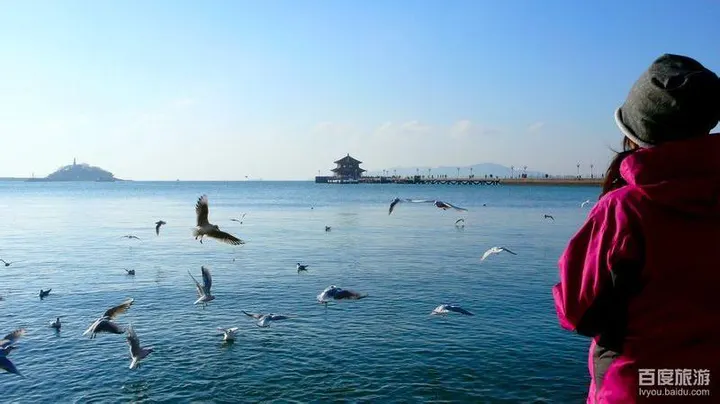
Feeding the gulls beside Zhanqiao Pier
Zhanqiao Pier and Qingdao Bay
Built in 1892 as a naval iron jetty, the pier runs 440 m to the two-storey octagonal Huilan Pavilion. At high tide the swell hits the embankment; at low tide the brown rocks appear and the clam-diggers come down with their buckets. It is also the winter gull theatre: from November, thousands of black-headed gulls arrive from Siberia and wheel around the pier until March.
Badaguan and Huashi Lou
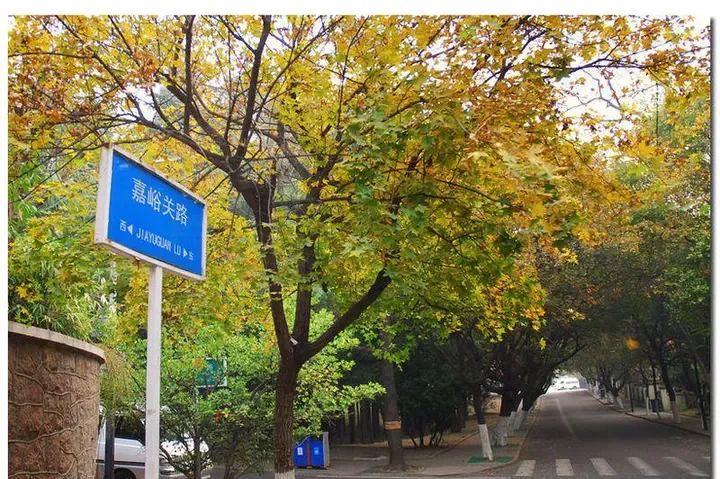
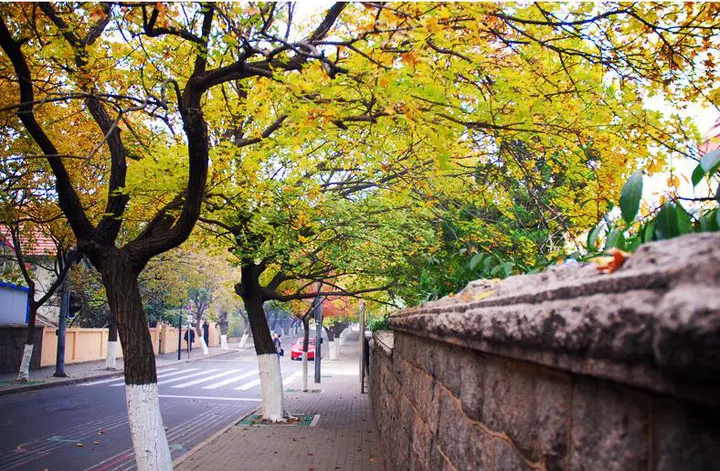
A leafy Badaguan street in late autumn
Badaguan is not a park but a residential district laid out on ten perpendicular streets, all named after famous Chinese passes. In the 1930s it became the summer quarter of officials and merchants, who built Russian, British, French, German, Danish, Spanish and Japanese houses side by side — hence 'the exhibition of world architecture'. The streets are free and open around the clock.
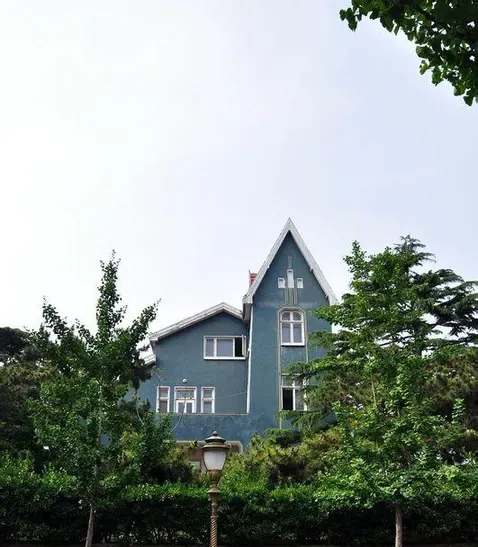
A green-gabled villa behind a granite wall
For interiors, Huashi Lou is the one: a 1930 granite castle faced in talc and pebble mosaic, with a spiral stair to a terrace over No.2 beach, for ¥8.5. The Princess House is a 1941 Danish-style villa in blue-green, around ¥17 on its own, and there are combined tickets with the Butterfly House and the Spanish villa for ¥25–50 depending on which buildings are bundled.
St Michael's Cathedral
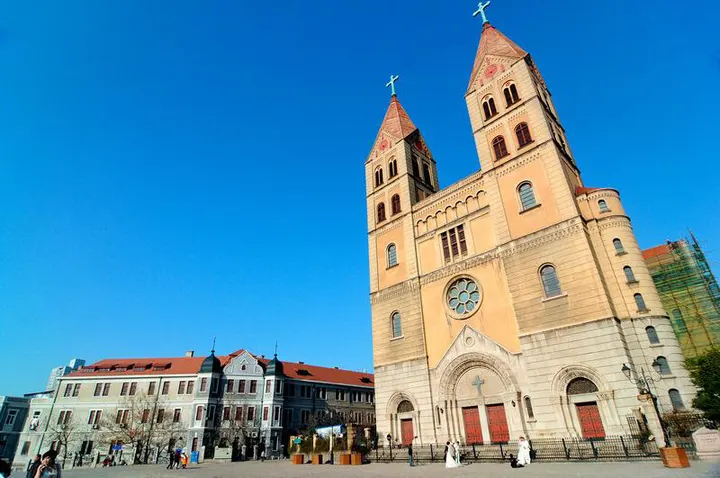
The twin towers of St Michael's Cathedral
Completed in 1934, its two 56 m spires kept it the tallest thing in Qingdao for half a century. Yellow granite outside, a great rose window on the facade, a hall for a thousand under painted vaults. The square is free; entry is ¥10 (¥5 for students), 8:30–17:00, closed Mondays and closed during Sunday morning Mass until noon.
The Protestant Church on Jiangsu Road
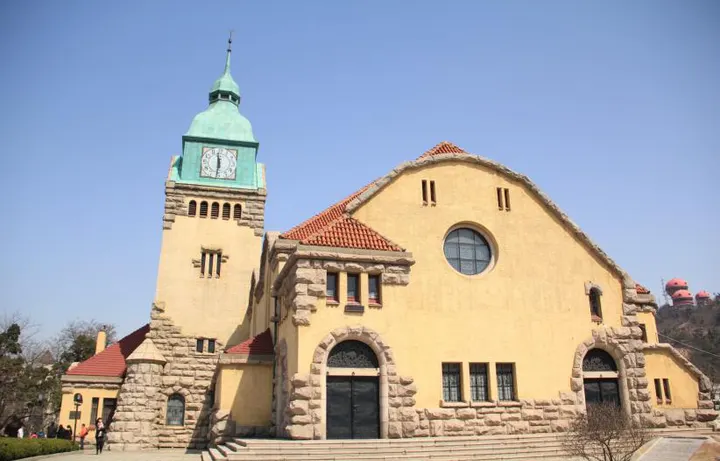
The clock tower of the Protestant Church on Jiangsu Road
Begun in 1908 and finished in 1910, a German castle-style church with a 39 m tower carrying mechanical clocks on three faces; the bells inside still keep time. Entry is ¥10 and the tower is open — climb the spiral stair to see the original German movement, then look out of the belfry window at red roofs and water.
Xiaoyushan and Signal Hill
Two high points frame the old town. Xiaoyushan is only 60 m, but its Lanzhao Pavilion looks three ways at once — pier, Little Qingdao, Huiquan Bay and Badaguan in a single sweep. The park is free, the pavilion ¥15. Signal Hill is higher, its three red-capped mushroom towers a landmark in themselves: free to enter, ¥10 for the rotating observation deck, which turns a full circle past the whole old town. Go after 16:00 at both, when the light rakes across.
May Fourth Square and the Olympic Sailing Center
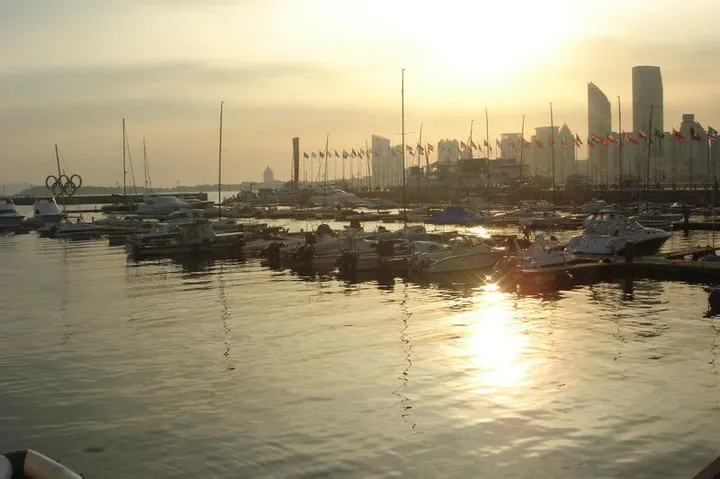
The Olympic Sailing Center marina at dusk
The red sculpture on May Fourth Square, 'May Wind', is the new city's marker — a spiral of rising wind. Fifteen minutes east along the boardwalk brings you to the Olympic Sailing Center, the 2008 regatta venue built on the old Beihai shipyard and now a national training base: white lighthouse, long breakwater, a whiff of Darling Harbour. Both are free, and the light show runs after 20:00.
Mount Lao
Mount Lao sits 40 km from the centre, and the smoothest approach is Metro L4 to Dahedong, then the shuttle into the south route. Taiqing Palace is one of the ancestral temples of the Quanzhen school of Taoism and the setting of Pu Songling's tale 'The Taoist of Mount Lao'; the camellias and cypresses in its courtyard are centuries old. The Yangkou section is a real climb — an hour to Tianyuan, with the sea directly below.
Tickets are sold by route: the south route (Taiqing, Huayan, Yangkou) ¥90 plus ¥40 shuttle, valid two days; Jufeng ¥80 + ¥40; Jiushui ¥60 + ¥30; January to March drops each by roughly ¥30. Cable cars are extra — Yangkou ¥35 one way, Taiqing ¥45, Jufeng ¥40. Reserve online with ID; on public holidays there is effectively nothing at the gate.
06Time your trip to the calendar
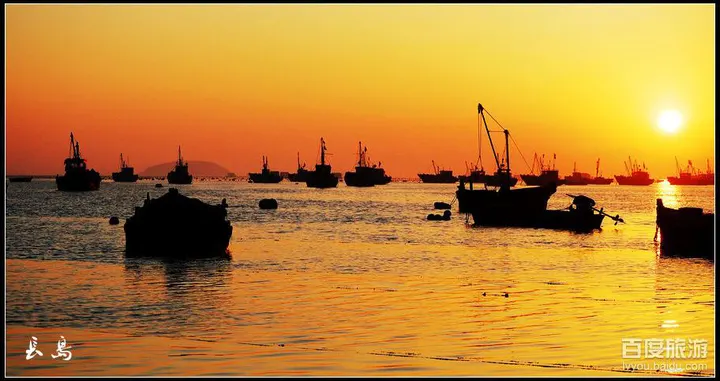
Fishing boats at sunrise
The Qingdao International Beer Festival
Running since 1991, this is Asia's largest beer festival. The 36th edition, 17 July to 15 August 2026, centres on the Jinshatan beer city on the West Coast with satellite venues in Laoshan and the old town: over 2,000 beers, 2,000-odd events, drone shows and fireworks over the water every night. Entry is free; you pay by the glass or the jin, and the big tents charge two to three times city prices.
Gulls in winter
From November the black-headed gulls come down from Siberia and winter along the pier, May Fourth Square and the sailing centre — tens of thousands on a good day. Locals call it 'feeding the gulls': stand at the rail with bread and hold out your hand. Best before 09:00 and after 16:00, when the backlight turns them into silhouettes.
Getting on the water
The sailing centre runs sightseeing boats, skippered sailing trips and private charters: about ¥150–200 for half an hour under sail, ¥80–100 for a bay cruise. Want the tiller yourself? Half-day courses are available. Take the dusk departure — from the water the old town's red roofs and the new city's glass line up better than from anywhere on land.
The Tanghulu Fair and the Ocean Festival
The Tanghulu Fair at Haiyun Temple descends from a Ming-dynasty temple market and opens on the sixteenth of the first lunar month for a week: hawthorn skewers, Maoqiang and Liuqiang opera, shadow puppets and yangge filling the street — the most local, least polished event in the city. The Ocean Festival in July is the official counterpart, with regattas, marine science exhibits and seaside concerts.
07Old town, new city or Taidong
Decide between old town and new city first. The old town — station, Zhongshan Road, Daxue Road — puts most sights within walking distance and has the best conversions of old buildings, at the cost of hills, one-way streets and parking. The new city around May Fourth Square and Hong Kong Middle Road has newer rooms, sea views and easy metro, half an hour from the old town. Taidong sits between them, with the night market and seafood market downstairs and the best value in town.
Old-town boutique stays: converted courtyard houses around Zhongshan Road and Dabaodao, small rooms with fine ceiling heights, ¥300–500 in low season and double in August.
New-city sea-view hotels: the ring around May Fourth Square and the sailing centre, high floors over Floating Hill Bay, ¥400–700 low season, from ¥900 during the festival.
Taidong and Licun: chain hotels and hostels, doubles ¥180–350, dorm beds ¥60–100, night market at the door.
Jinshatan on the West Coast: resort hotels and serviced flats, sea-view rooms ¥300–500 low season — for drivers or anyone coming specifically for the festival.
The pattern is simple: July, August and public holidays cost two to three times the norm and must be booked early, and even weekends in May–June and September–October creep up. The compensation is November to March, when a room that goes for ¥1,500 in summer costs ¥400–500.
08Seafood, Shandong cooking and a bag of beer
Qingdao cooking belongs to the Jiaodong branch of Shandong cuisine: savoury and fresh, built on heat rather than seasoning, with seafood mostly steamed, blanched or stir-fried with chilli. The local routine never varies — buy at the market, carry it to a beer house, pay for cooking, add a bag of draft. It costs half what a seafood restaurant charges and is the truest version of the city.
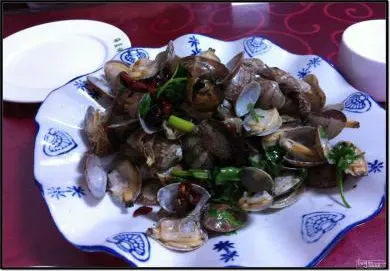
A plate of stir-fried clams
Five things to order
Chilli-fried clams, gala in the local dialect: no heat at first, then it climbs. A plate costs a little over ¥10 and exists to be eaten with draft beer.
Mackerel dumplings: spring mackerel minced with nothing but scallion and ginger, thin-skinned and juicy. The local saying goes 'when the mackerel jumps, the father-in-law smiles' — a son-in-law is expected to deliver the fish.
Seaweed jelly: set from agar weed into a translucent block, dressed with garlic, coriander, vinegar and sesame oil. A few yuan a portion and the best thing in August.
Pork ribs with rice: braised until the bone slips, the gravy poured over the rice. The city's default lunch, around ¥20.
Liuting pig's trotters: braised to a gelatinous softness, better eaten cold, and sold vacuum-packed in supermarkets if you want to take some home.
The draft beer price ladder
The same city, a six-fold spread. At a neighbourhood shop or next to a wet market, factory-four draft is ¥3–6 a jin; around Taidong about ¥5; a jug in a beer house ¥28–39; factory-one unfiltered roughly ¥15. On the beer street, the promenades and at the sights the identical beer is ¥15 a jin. Judge by cold chain, not price: the barrel should be iced, the glass poured to order, and two hours later it is already tired.
Places worth the queue
Chunhelou (146 Zhongshan Road): open since 1891, the old guard of Shandong cooking — crisp chicken, nine-turn intestines, shrimp dumplings, ¥80–120 a head.
Wang Jie Barbecue (113 Zhongshan Road): squid grilled by part — head, tentacle, beak — with a house dip, about ¥20 a head. Do not come for the decor.
Wanhechun (Taidong Eighth Road): ribs falling off the bone, gravy thick enough to stand a spoon in, a small chain, ¥20 a head.
Haidao Yucun (40 Yunxiao Road): the veteran seafood hall, generous portions, correct cooking, around ¥90 a head.
09Taking the sea home
The good souvenirs here are practical: dried seafood, Laoshan green tea, Jimo rice wine, shell craft, and a bag of pork crackling for the train. Buy dried seafood at the wholesale shops on Shichang Third Road or Nanshan market rather than at the sights — roughly a third cheaper.
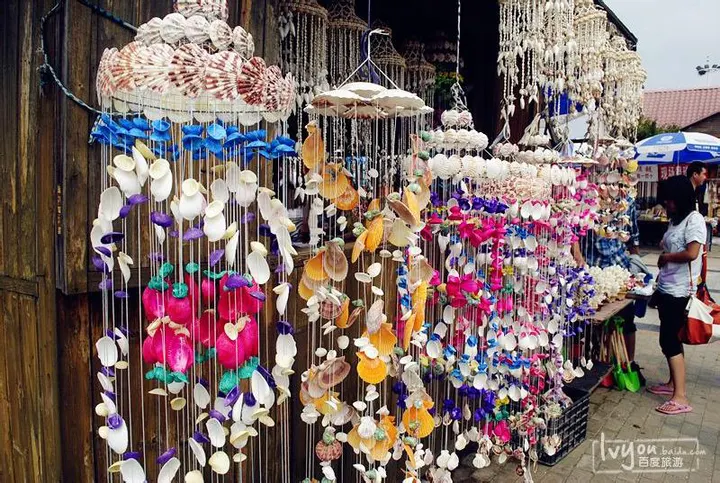
Shell mobiles for sale at a seaside stall
Dried seafood: sea cucumber, dried shrimp, scallops, squid. Sea cucumber varies wildly — priced by the piece, from a few hundred to a few thousand a jin; the state-recognised Haibin food shop (143 Zhongshan Road) is the safe counter.
Laoshan green tea: one of the few tea districts this far north, bean-sweet and forgiving of repeated brewing. Buy from growers up the mountain or in proper tins downtown, from about ¥100-plus per 50 g.
Jimo laojiu: a millet yellow wine, once called lao wine, drunk warmed and treated locally as a tonic. ¥20 to ¥100-plus a bottle.
Shell craft and pork crackling: shell pictures and jewellery built from the natural colour of spiral shells; the crackling is pressed pork belly, crisp and chewy, for snacking or with beer.
Three shopping districts: Taidong is the most everyday (Liquan store, the pedestrian street off Taidong Third Road), Zhongshan Road the most touristed (old brands and speciality shops), Licun the most local. Skip glass bottles of beer for the trip home — cans survive the luggage hold, or buy at the airport.
10Getting there and around
Arriving by train
Beijing South to Qingdao is 3 h 34 min at best (G879, 08:11 to 11:45 into Qingdao Station), ¥342–406 in second class, with a departure nearly every hour. Shanghai takes 4.5–6.5 hours for ¥280–340; the quickest, G688, leaves Hongqiao at 15:32 and reaches Qingdao West at 20:11 — but that is Huangdao, another 40 minutes from the old town.
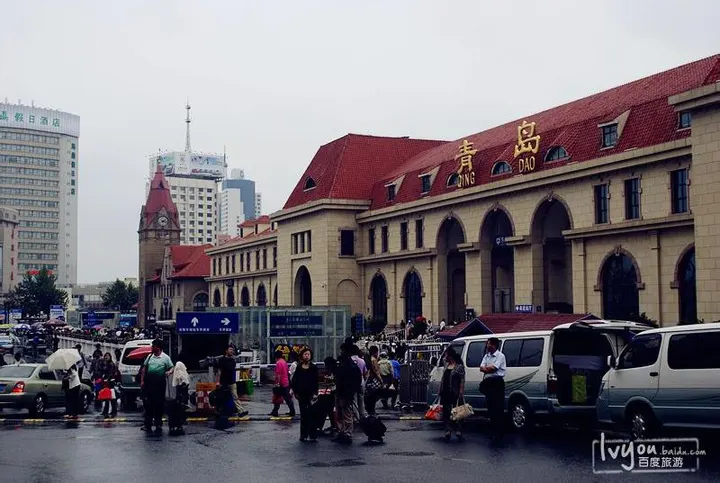
The four stations do different jobs. Qingdao Station on Tai'an Road is the 1901 original, its red roof a sight in itself, five minutes from the pier and served by Metro L1 and L3. Qingdao North in Licang carries the most trains and interchanges three lines (1/3/8), about 30 minutes from May Fourth Square. Hongdao in Chengyang mostly handles the airport corridor and is more than 40 km from everything. Qingdao West serves Huangdao — do not mistake it for a city-centre station.
Qingdao Railway Station, red roof and all
Flying in
Jiaodong International Airport sits out in Jiaozhou, about 40 km from the centre. Metro L8 reaches Qingdao North in roughly 28 minutes for ¥7, where you change to L3; airport coaches cost ¥20–30; a taxi is ¥80–180 and 50 minutes. If you are connecting straight to a train, board at the airport station or Hongdao.
The metro: your default
Eight lines — 1, 2, 3, 4, 6, 8 plus the Blue Silicon Valley and West Coast express lines — reach almost every sight. Fares are distance-based: ¥2 for the first 5 km, ¥8 at the far end, with a ¥15 day pass and ¥35 three-day pass. L3 links Qingdao Station, Zhongshan Park, May Fourth Square and Qingdao North and is the one you will use most; L4 runs out to Dahedong at Mount Lao.
Buses, ferries and bikes
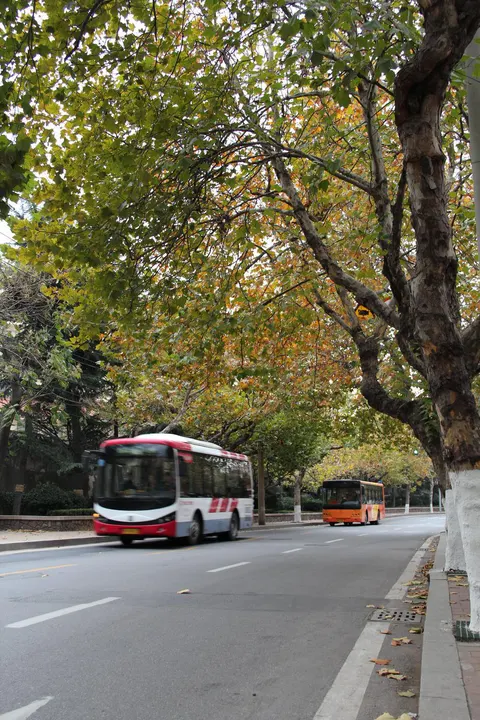
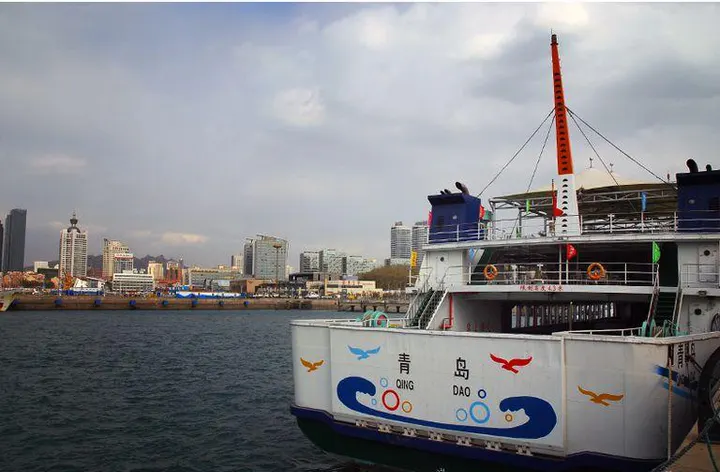
Buses cost ¥1–2, and routes 26, 316 and 501 run the coast past the pier and Badaguan. For Huangdao take the ferry (about 30 minutes) or a tunnel bus, which crosses in six minutes. The old town is all hills and one-way streets, so bikes only make sense along the waterfront boardwalk; taxis start at ¥10 and a city trip is usually ¥15–30.
Buses under the plane treesA ferry at the Qingdao terminal
Emergency numbers: police 110, ambulance 120, fire 119; sea rescue 12395; transport hotline 0532-8281 7777.
Hospitals: the Affiliated Hospital of Qingdao University (16 Jiangsu Road, 0532-8291 1847) and the Municipal Hospital East (5 Donghai Middle Road, 0532-8593 7676).
Money: malls, hotels, the metro and most stalls take Alipay or WeChat Pay, and the international version links Visa and Mastercard. Carry some cash anyway — morning markets and small stalls sometimes take only cash or a local QR code.
Tides: check a tide table before clamming or scrambling on the rocks — the flood comes faster than you expect. Stay off the reef at the pier, Badaxia and Lu Xun Park when the tide is rising.
Power and data: 220V with the Chinese flat two- or three-pin plug. Airports and stations offer free Wi-Fi, usually verified by phone number.
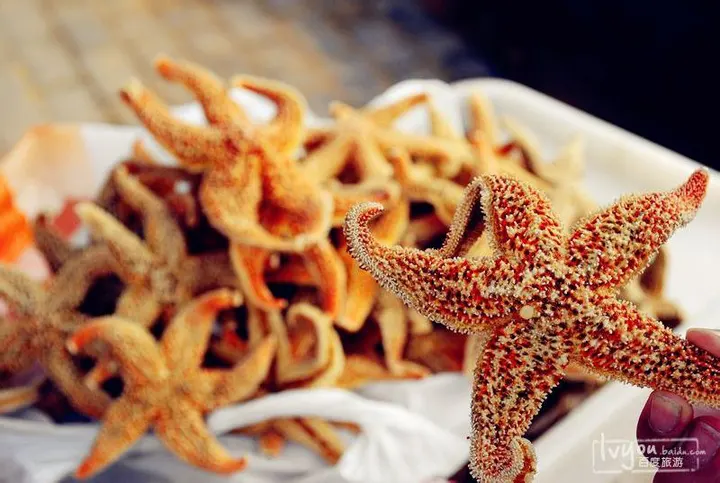
Starfish at a beach stall
12What to pack, what to avoid
Clothing: even summer evenings are cool and the sea wind is constant, so bring a light windbreaker or long sleeves; winter needs a proper shell and a hat. One pair of trainers for Mount Lao and the old-town hills, one pair of sandals that can get wet.
Sun and medicine: the UV off the water is fierce, so sunscreen, sunglasses and a hat. Add rehydration salts and an antihistamine — a first serious seafood meal does occasionally bite back.
Bookings: Mount Lao requires a real-name online reservation, the beer museum often sells out on the day in season, and the cathedral stays shut on Sunday mornings. Sort all three the day before.
Swimming: only at the nine official beaches, only between the coloured buoys. Stay out with open cuts, after a meal or after drinking, and do not linger on the rocks as the tide turns.
Five things to avoid: taxis soliciting at the station forecourt (use an app instead); cut-price 'Mount Lao day tour, ticket included' touts, who are usually selling a shopping stop — take Metro L4 yourself; seafront restaurants, which mostly exist for visitors and which locals skip; ordering seafood without asking the price and weighing it before cooking; and boats that will not quote a fare and a route before you step aboard.
13A city rewritten by a lease
Geography and climate
Qingdao occupies the south coast of the Shandong peninsula, sea on three sides and hills behind, its centre built directly on granite — hence excellent foundations and relentless slopes. Mount Lao's 1,133 m summit is the highest point on mainland China's coast. The climate is temperate monsoon moderated by the sea: the hottest month averages around 25°C, with fewer than a week of days above 30°C all year, and the coldest averages -0.9°C — milder than inland at the same latitude, but windy.
The German lease and May Fourth
In 1897 Germany used the murder of two missionaries as a pretext to seize Jiaozhou Bay, and in 1898 imposed a 99-year lease. Three German decisions fixed the city's shape for the next century: a port and the Jiaozhou–Jinan railway, a sewer and drainage system to European standards, and a town plan that separated a European quarter from a Chinese one. In 1903 British and German merchants founded the Germania Brewery — the ancestor of Tsingtao's No.1 plant.
In 1914 Japanese and British forces took the city, and in 1919 the Paris Peace Conference awarded Germany's Shandong rights to Japan — the spark for the May Fourth Movement, whose loudest slogan was 'give us Qingdao back'. The city was returned in 1922 and made a special municipality in 1929. That history explains the faintly complicated pride locals carry when they talk about the city's character.
Between literature and beer
In the 1930s National Shandong University drew Wen Yiduo, Liang Shiqiu, Shen Congwen, Lao She and Hong Shen to town. Lao She wrote Camel Xiangzi at 12 Huangxian Road; Shen Congwen finished his autobiography at 3 Fushan Road. On the same streets the brewery chimneys were smoking — high literature and working-town life grew up together here, and still share a postal code.
14Three ways out of town
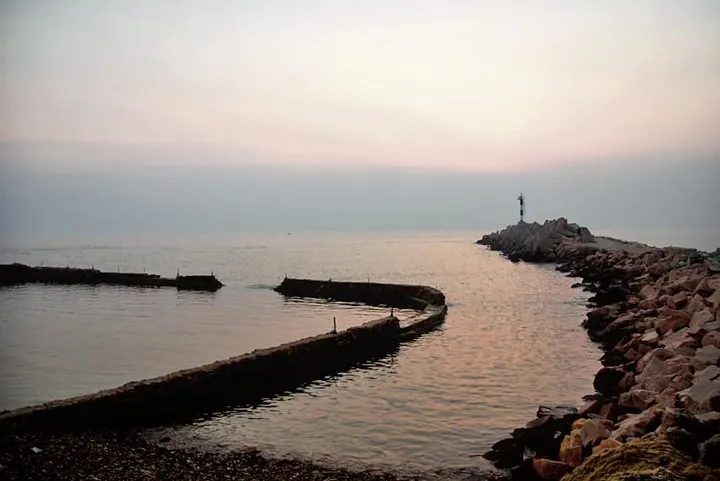
A breakwater and beacon at dusk
The West Coast (1 day)
Through the tunnel or over the bridge lies Huangdao. Jinshatan, the 'first beach in Asia' by local billing, has fine sand, a gentle slope, no admission and lifeguards in summer. Further south is Langyatai, the terrace where the First Emperor came three times on his eastern tours and from which Xu Fu's fleet supposedly sailed for the immortals. Metro L1 now reaches the West Coast, and tunnel buses cross in six minutes.
Jimo and the hot springs (1–2 days)
Jimo Ancient Town is a rebuilt Ming-Qing county seat with walls, a magistrate's office and memorial arches — better after dark when the lanterns come on. The local rice wine is made here and the winery takes visitors. East of it lies Wenquan, the hot-spring town, where the salt-water springs are at their best in cold weather. The Blue Silicon Valley express line (L11) runs to Jimo.
The Jiaodong peninsula: Yantai, Penglai, Weihai (3 days)
The coastal high-speed line runs east: about 1.5 hours to Yantai, two to Weihai. Penglai Pavilion is one of the four great towers of antiquity and, on a lucky day, the place to see a mirage. Liugong Island off Weihai was the Beiyang Fleet base and the site of the 1894–95 war's final act. The motorway between the three cities is excellent, so driving gives you more freedom — and more seafood stops.
15Watch and read before you go
Film
"He-Man II" (2011, dir. Ding Sheng): Liu Ye plays a discharged sailor chasing robbers through Qingdao's streets, with Badaguan, the pier and the waterfront boardwalk all shot on location — the most direct commercial-film look at the city's texture.
Books
Wang Zhanjun, "Qingdao Blues": essays on the city's temperament and on how European elegance and working-town life share the same red roofs. Lao She, "Camel Xiangzi": written on Huangxian Road in the 1930s — read it, then go and look at the house. Shen Congwen, "Scenes Under the Moon": short stories reworked from Buddhist scripture, also written during his Qingdao years.
Music
MC Shazhou, "Strolling the Pier": Qingdao-dialect rap recorded in a bedroom on one computer, its lyrics a map of Taidong, the pier and clams. The fastest way into how this city sounds.