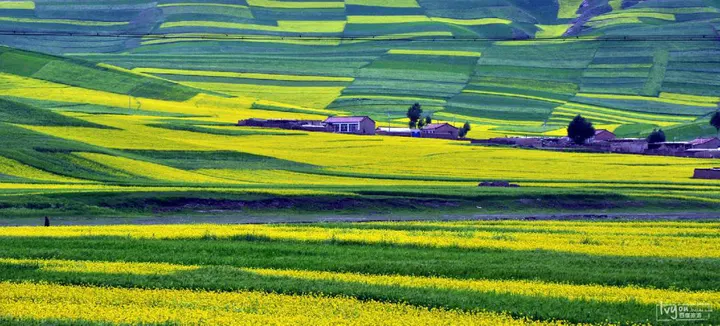
An inland sea, three thousand two hundred metres up
360 km aroundSunrise just after sixBird Island shut for nine yearsBook the ticket a week out
In short
Qinghai Lake (青海湖, Qīnghǎi Hú) sits at 3,196 m in northeastern Qinghai and, at 4,658 km² in September 2025, is China's largest inland salt lake. It is not a gate you buy a ticket at but a 360 km ring of shoreline. Erlangjian, the old 151 Base, is the most built-up of the paid sites: ¥90 in peak season plus ¥20 for the internal shuttle, no ticket window any more, booked 3–7 days ahead on the official Zhiyou Qinghaihu mini-program and capped at 12,000 visitors a day. Heimahe, on the west shore, is free and is where everyone goes for sunrise; the town sits 1.7 km back from the water and a ¥30 shuttle closes the gap. Xiannü Bay in the north is ¥60. Bird Island and Sand Island have been closed for ecological protection since 2017 and are now permanently sealed no-build zones, so do not plan around them. Trains reach Xining only — 4h10m to 4h25m from Xi'an North, ¥265–298 in second class — and Xining is the only realistic gateway, with another two to three hours by road to the lake. Budget ¥1,300–2,600 for two or three days, excluding travel to Qinghai. Rapeseed peaks between 10 and 25 July, which is also the most crowded and most expensive week of the year.
Key facts
Known for
the loop road · sunrise · rapeseed · 3,196 m · naked carp
Budget
¥1,300–2,600 for two or three days, mid-range
Days needed
2–4 days
Comfort
Basic — rough rooms, rough toilets, 3,200 m, twenty-degree swings
Best time to go
Early-to-mid July for rapeseed, September–October for clear skies and quiet, May–June for birds, January–February for the frozen lake
01A blue line, then an inland sea
West of Xining the road climbs through Huangyuan and over the Riyue Pass at 3,520 m, where wind finds every gap in the window frame. Then the grassland opens out, and fifteen minutes later a blue line appears on the horizon — darker than the sky, harder than the sky, with an edge as straight as a ruler. That is Qinghai Lake. Most people go quiet for a few seconds, because it does not behave like a lake: no far bank, no trees, just water running all the way to the foot of the mountains with the same width as the sky.
The numbers matter. The surface sits at 3,196 m. In September 2025, at the seasonal high, it covered 4,657.92 km² — the largest lake in China, about two-thirds the area of Shanghai municipality. Average depth is sixteen to twenty metres, the deepest point twenty-six. Salinity runs about twelve grams per litre, roughly a third of seawater, which is why it freezes in winter, why the waves carry no white foam, and why you float more easily than in fresh water. More than forty rivers feed it, the largest being the Buha, and nothing flows out: a geological uplift around 130,000 years ago blocked the eastern outlet and turned a freshwater lake into this brackish basin.
The second thing to get straight: there is no front gate. The loop is 360 km and the waterline a little over 600, and the places where you can stop and walk to the water are spread across three counties. The 2013 playbook — hand a herder ten yuan and drive down his track to the shore — largely stopped working in 2023, when the informal lakeside attractions were shut en masse. The 2026 zoning is explicit: Erlangjian, Heimahe and Xiannü Bay are the three sanctioned visiting areas, twelve standardised eco-viewpoints are strung around the shore, and sensitive ground such as Bird Island and Sand Island has been designated a permanently closed no-build zone. So you are not entering a scenic area. You are picking three or four points and joining them along a ring road.
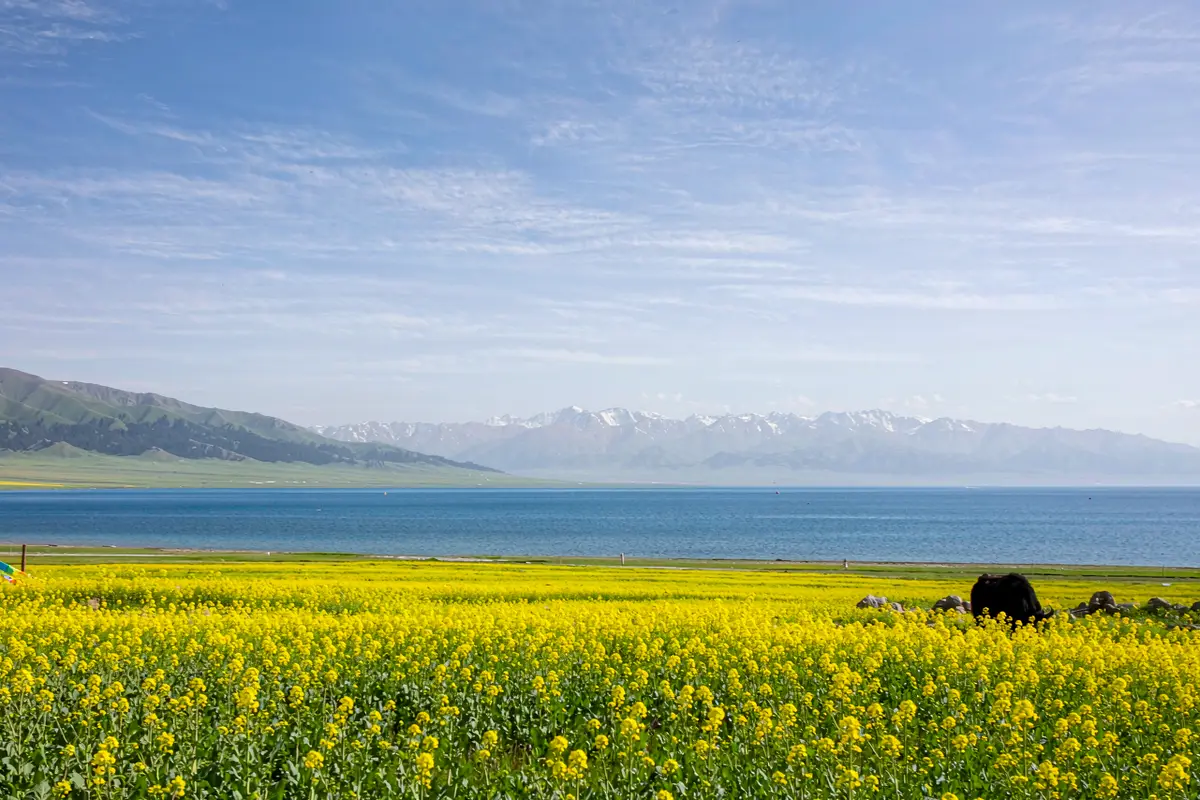
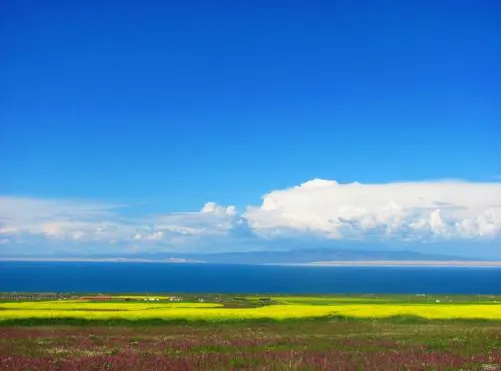
The south shore in July — a band of rapeseed, then the lake almost level with the horizon under stacked cumulus
The lake's character is decided by light. Between noon and four the sun is overhead, the water flattens into one bright, depthless blue that photographs like a paint chip, and the glare makes everyone dopey. The good hours are at the ends: twenty minutes before sunrise the surface is lead grey and the sky runs purple to orange; in the last hour before sunset the wind usually drops, the water turns deep cobalt, and the rapeseed is backlit until its edges glow. That is the whole argument for sleeping at the lake — not for the comfort, but for those two windows of light.
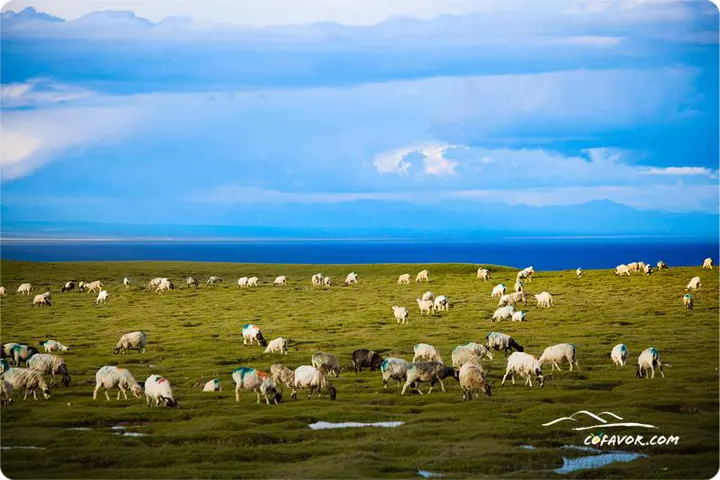
A flock grazing the shore meadow, the lake and a ridge of hills behind, grass running right down to the water
How long you need depends on how you go round. Two days by chartered car covers the south, west and north shores, one sunrise and a side trip to Chaka; three is unhurried and fits Kumbum and the atomic town; four days by bicycle is the classic loop, sixty to ninety kilometres a day, where a headwind at 3,200 m turns flat road into a climb. Most people need two days, but be honest about what that means: two days gives you four fragments of the lake, not the lake. What people remember is rarely the stone marker at Erlangjian. It is a stretch of empty asphalt on the west shore, water on one side, flowers on the other, and not another vehicle for ten kilometres.
02Six things worth the alarm
The west shore road: forty kilometres with the water beside youThe best stretch of shore on the lake
From Heimahe north to Shinaihai the road runs 41 km and stays closer to the water than anywhere else on the loop: often less than three hundred metres from asphalt to shoreline with no village, no fence and no second road in between. Three places earn a stop. Twenty-one to twenty-three kilometres out of Heimahe, the shoulder gives onto a gravel flat where, on a still morning, the far mountains stand upside down in the shallows. Further north the Dongger viewpoint has a boardwalk that reaches the water in two hundred metres. And at the long bend by Shinaihai the road follows the shore in a single arc — the classic shot of asphalt, lake and sky. Before eight in the morning and after six in the evening, there is hardly a coach on it.
Length:41 km, Heimahe to Shinaihai
Cost:Free, including the roadside viewpoints
When:Before 08:00 or after 18:00, to miss the coaches
Heimahe sunrise: in position by 05:30The lake's classic sunrise spot
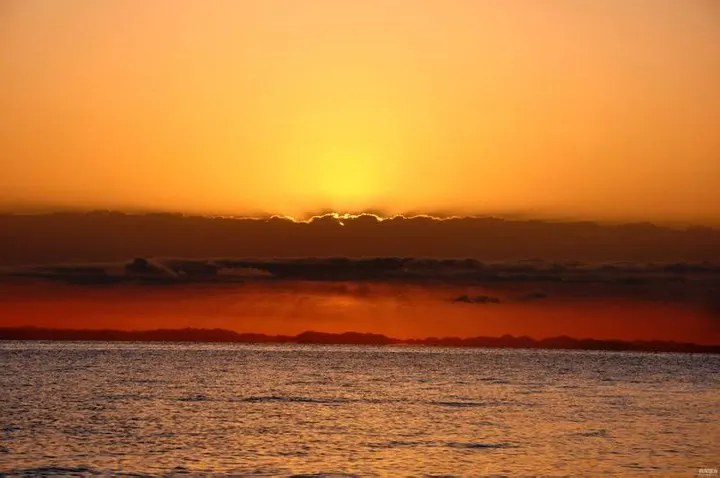
In mid-July the sun clears the far ridge between 06:05 and 06:20; by mid-September it is closer to 06:50. The real event is the twenty minutes before: the sky goes from grey-blue to purple, an orange band burns along the horizon, the clouds flatten into black strips, and the water stays cold and colourless underneath it all. Heimahe town is 1.7 km from the shore, twenty-five minutes on foot, or take the shuttle from the edge of town (¥30 return). At five to eight degrees with wind coming off the water, a down jacket is not an overreaction. Back in town afterwards, a bowl of hot noodle soup is the best half hour of the day.
Sunrise:06:05–06:20 mid-July, about 06:50 mid-September
To the shore:25 minutes on foot, or ¥30 return by shuttle
Temperature:5–8 °C at dawn, always windy
Erlangjian: a sand spit, and a torpedo stationThe one fully built-up paid site
Erlangjian sits on the south shore 151 km from Xining, which is where the old name 151 Base comes from. In the 1960s this was China's first torpedo test range: sited in 1965, first domestic torpedo fired on 24 September 1968, decommissioned in 1984 after validating more than three thousand of them. The red-brick cabin standing out in the water, carried on eighteen steel piles driven into the lakebed, was the launch station and is now a small museum. The site itself is a narrow sand spit running into the lake, with boardwalks, a pier, boats and the most reliable toilets on the shore. Honestly: for quiet water the ¥90 is poor value; with parents, children, a boat ride or an interest in that piece of cold-war engineering, it earns one visit.
Ticket:¥90 peak, ¥40–50 low; shuttle ¥20
Booking:3–7 days ahead on the Zhiyou Qinghaihu mini-program, 12,000 a day
Boat:¥140–180, speedboat about ¥100
July rapeseed: a gold edge, twenty daysThe postcard everyone comes for
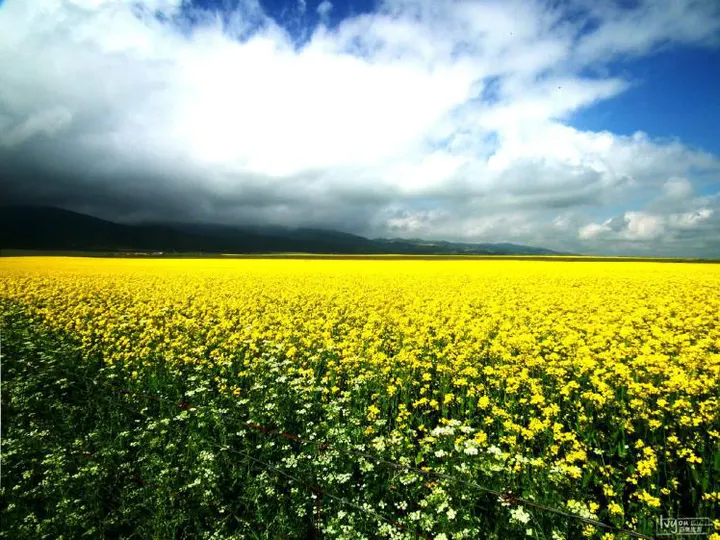
The rapeseed here is not an attraction, it is a crop. Along the south shore from Jiangxigou to Heimahe, state farms and herders rotate it every year: first flowers at the end of June, peak between 10 and 25 July, harvest from about 25 July, and by early August only odd plots are left. A wire fence and a dirt track usually separate field from water; to walk in, find the owner and ask the price, typically ¥10–20 a person. Do not trample it and do not lie down in it for an angle — it is a year's income. The best light is before seven, when the low sun makes the petals translucent, the lake goes deep blue and half the sky is rain cloud.
Bloom:Late June to 25 July, peaking 10–25 July
Where:Jiangxigou to Heimahe, east of Erlangjian; Menyuan has its own
Field access:¥10–20 a head on private plots, agree first
Xiannü Bay: wetland in the north, more birds than peopleThe closest thing to Bird Island now
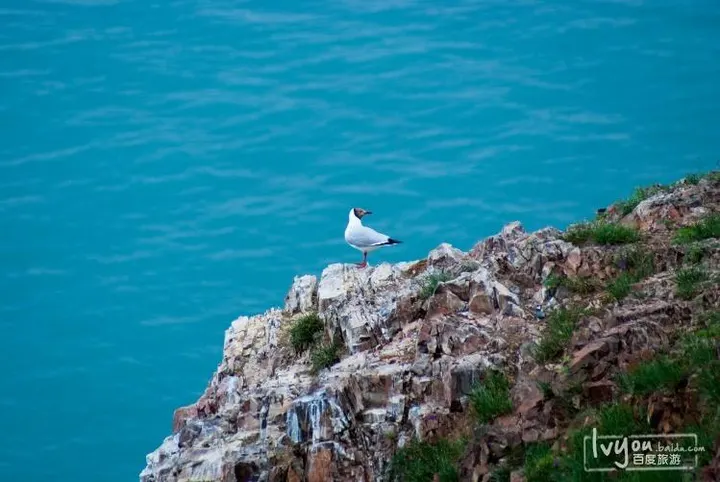
Xiannü Bay lies in Gangcha county on the north shore, and its Tibetan name means the place where the goddess lives. It is a freshwater marsh with boardwalks laid over reed and sedge, and from spring into early summer it holds breeding bar-headed geese, brown-headed gulls and ruddy shelducks, with black-necked cranes often around. Tickets are ¥60 in peak season and ¥30 in low, and the crowds are a fraction of the south shore's. May to July is for birds, November to February for whooper swans. At the far end of the boardwalk a section stands flooded — not neglect, but a record of twenty years of rising water.
Ticket:¥60 peak, ¥30 low
Birds:Breeding May–July; swans November–February
Where:Gangcha county, north shore, about 190 km from Xining
The kora: clockwise, every step of itNot a performance — somebody's practice
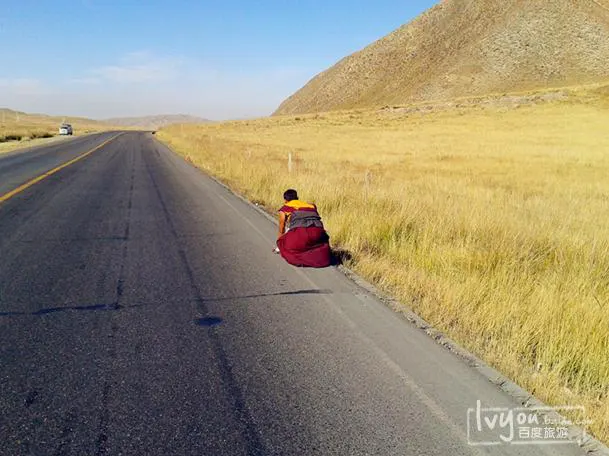
For the Tibetans who live around it, Qinghai Lake is sacred, and a circuit of the shore accumulates merit — always clockwise, the same direction as a prayer wheel or a stupa. The devout measure it with their bodies: full-body prostrations, 360 km, months on the road. Others walk, hitch or ride. You will meet them on the G109 in maroon robes or dark chuba, wooden pads on their hands, standing, praying, going down, standing again. Do not block their path, do not cut in front of them, do not put a lens in their face. If you want the photograph, step back, use a long lens, or put the camera down.
Direction:Clockwise, like a prayer wheel
Circuit:360 km by road; months on prostration
03Seven questions worth settling first
How many days do I need?
Two days is the floor, three is comfortable, four lets you add a proper ride or a slower Chaka. The standard two-day shape: leave Xining, ten minutes at the Riyue Pass, Erlangjian by noon, then down the G109 to Heimahe for the night and the sunset; up at 05:30 for sunrise, along the west shore to Shinaihai, then Gangcha, Xiannü Bay and Xihai town back to Xining by eight or nine in the evening. Three days absorbs Chaka and Kumbum and the whole thing relaxes. One day is possible — the 07:30 bus to Erlangjian, back on the road by three — but you will have seen one corner of the south shore and gambled everything on the weather.
Which way round the lake — clockwise or anticlockwise?
Clockwise, for three reasons from hard to soft. First, Tibetan practice — kora, prayer wheels, stupas — runs clockwise; going the other way means meeting pilgrims and herding families head-on all day, which is rude and occasionally unsafe. Second, clockwise from Xining puts the south shore first (Erlangjian, Heimahe) and the sunrise on your second morning, so the light arrives in the right order; the reverse works too but adds two hours of driving on day one. Third, nearly every coach goes clockwise, so matching them makes the crowds predictable: start earlier, leave each sight before they arrive. Cyclists get a bonus: clockwise on the west shore puts the lake on your right and, with the July northwesterly, mostly at your back. Ride it the other way and the wind is in your face all afternoon.
Should I stay in Heimahe or in Xining?
It depends entirely on whether you want the sunrise. If you do, sleep in Heimahe, or in a guesthouse within fifteen minutes of it on the west shore; that is the only way to be standing at the water at six. Xining is 220 km and three and a half hours away, which means leaving in the middle of the night in summer. If you do not care about sunrise and only want to see Erlangjian, Xining is the saner base: half the room rate, better food, and Kumbum the next morning. Be clear about what Heimahe costs: ¥400–600 for a standard room in peak season for something like a budget chain hotel, hot water on a timer, thin walls, no dinner after nine. Off season the same room is ¥150–300. The compromise is Jiangxigou or Shinaihai, thirty per cent cheaper and twenty minutes from the sunrise point.
How bad is altitude sickness here?
For most people it is mild, but not nothing. Xining is 2,200 m and the lake is 3,196, a thousand metres in a day; sensitive people get headaches, lose sleep, lose their appetite, and find two flights of stairs leave them breathless. The serious cases are a minority: a cold taken up here can settle in the chest, and anyone with heart or lung disease, badly controlled blood pressure, severe anaemia or recent surgery should not come. The practical rules are unglamorous. No hair-washing, no shower, no alcohol and no running on day one. Use speech as your gauge — if you cannot finish a sentence, slow down. Drink more than you want to, eat less than you want to. Start rhodiola a few days early if you like (weak evidence, no harm), and ask a doctor before acetazolamide. Oxygen canisters sell everywhere for ¥20–40; do not reach for one at the first headache or you will spend the week on it.
Is the July rapeseed worth the crush?
Yes, but pick your ten days. 10–25 July is peak bloom and also the busiest, most expensive fortnight of the year, with Erlangjian bookings the hardest to get; the same fields at sixty per cent bloom on 2 July are half as crowded and photograph almost identically. If mid-July is your only window, accept three things: book Heimahe two or three weeks out, book Erlangjian seven days out, and be on the road before seven, off the water by ten, back out after four. If you would rather not queue, late June and early July give you first flowers and the greenest grass; September gives you no flowers but the deepest blue sky and the fewest people. July is not the only month the lake looks good. It is the easiest month to photograph.
Can I still visit Bird Island?
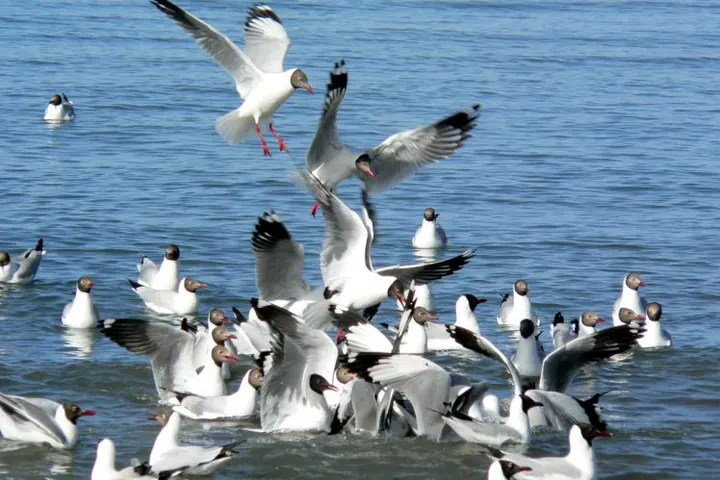
No. Bird Island was closed to tourism in 2017 and stopped receiving visitors in 2018, becoming a core protection zone; the 2026 zoning lists Bird Island and Sand Island as no-build areas under permanent closure, the Egg Island has been drowned by the rising lake, and the only way ashore now is a reserve patrol boat with permission. The internet still carries 2013-era lines about a ¥115 ticket and May being the best month — all of it expired. Those sixteen kilometres from Bird Island town to the old gate no longer have a ticket window. For birds in numbers, go to Xiannü Bay in the north (¥60), or watch brown-headed gulls and bar-headed geese from the shore at Erlangjian and Heimahe, thickest from May to July.
What does a chartered car cost?
2026 rates: from Xining, a five-seat sedan runs ¥500–650 a day, an SUV from ¥700, a seven-seat van ¥700–1,200. A two-day loop is ¥1,000–1,400 for the vehicle including fuel, tolls and the driver's own food and bed, and usually including the viewpoints he knows. Shared cars are cheaper: ¥100–150 a person for a one-day loop, ¥380–500 for two days. Settle three things before you set off: how many hours count as a day (eight is normal, overtime ¥50–80 an hour), how many kilometres are included, and who pays for the driver's meals and room. It sounds petty; those three items cause most of the arguments. Do not follow the touts at the station forecourt, and do not believe anyone offering lake access without a ticket — most of those tracks were closed after 2023 and the rest carry a fine.
04Two days for four fragments, four days for the whole ring
Every itinerary starts from Xining, because that is where both the trains and the flights end. Think of the 360 km as a clock face: Xining sits outside at three, Erlangjian at six, Heimahe at half past seven, Bird Island at nine (closed), Gangcha at eleven, Xihai town at one. Clockwise means six, half past seven, eleven, one — which happens to satisfy three things at once: the light, the direction of pilgrimage, and being half a step ahead of the coaches.
D1
Leave Xining at eight, take the expressway to Huangyuan, then climb over the Riyue Pass — 3,520 m, ten minutes for the prayer flags and the Daotang River, ¥50 and no great loss if you skip it. Erlangjian by noon: two hours for the boardwalk, the torpedo museum and lunch. Then west on the G109, where the Jiangxigou stretch is wall-to-wall flower fields — pick one, agree a price, shoot for twenty minutes. Heimahe by four: walk down to the water first to fix tomorrow's sunrise position, then check in. Back at the shore for half past six, stay for the sunset, eat in town at half past eight.
D2
Up at five, at the water by half past, sun just after six. Back into town for breakfast at seven and away by eight along the west shore: the shallows at kilometre 23, the Dongger viewpoint, the long bend at Shinaihai, twenty minutes each. Lunch in Gangcha at eleven, then Xiannü Bay for an hour on the boardwalk, and on through Halegai and Jinyintan to Xihai town for the atomic museum, which is free and takes an hour. On the expressway by six, back in Xining by half past eight. A little over 500 km all told, about eight hours of driving.
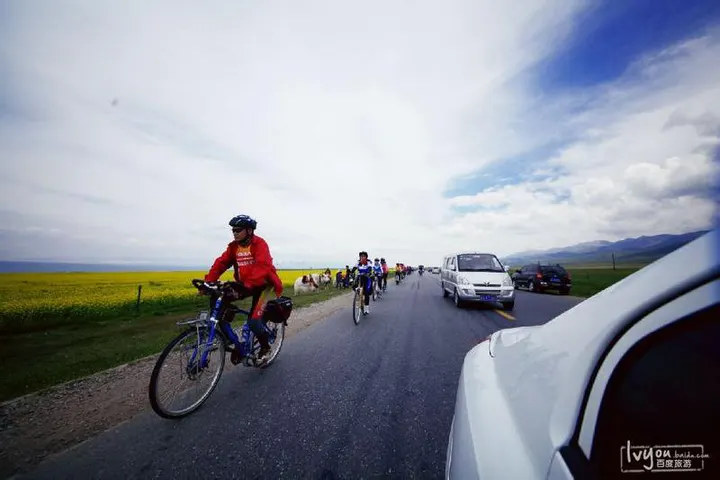
A line of cyclists on the loop road with a support van behind, shot from another car — the white door on the right is the photographer's
The three-day version inserts a day in the middle: on D2 afternoon, cross the Xiangpi Pass at 3,800 m to Chaka Salt Lake, ninety minutes each way, three hours on the salt, sleep in Chaka town; D3 sunrise over the salt flats instead of the lake — flatter, stranger, and less crowded — then back through Gangcha, Xiannü Bay and Xihai town to Xining. The four-day version belongs to cyclists: rent in Xihai town, go clockwise, D1 to 151 (70 km), D2 to Heimahe (70 km), D3 to Gangcha (100 km), D4 back to Xihai (87 km), finishing before four each afternoon to dodge the headwind and the lorries.
05Crowds in the south, water in the west, birds in the north, history in the east
The south shore: one highway, three stops
The south shore is where almost everyone meets the lake, because the G109 runs along it. Erlangjian sits at the eastern end, then Jiangxigou, then Heimahe. The advantages are real: services, petrol, phone signal. So is the disadvantage: the G109 is a freight corridor to Tibet, lorries and coaches run all day, the surface is rutted, and cyclists hug the white line. If you want flowers without traffic, turn south into the village lanes at Jiangxigou and go two kilometres — there the field runs to the water with no highway in between.
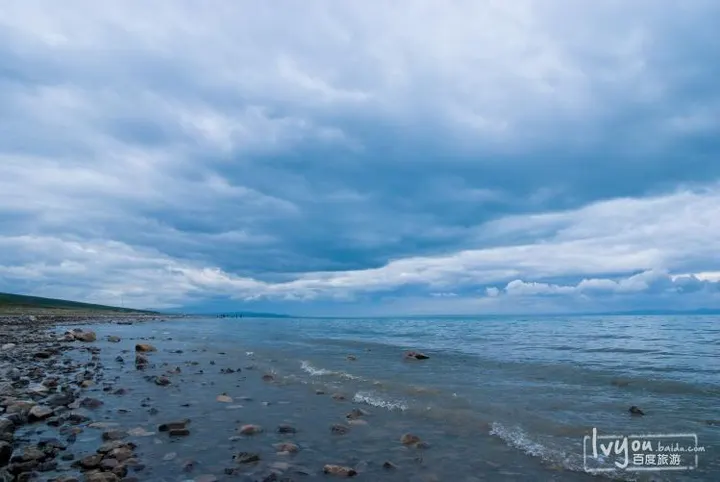
The shore under cloud — gravel, a low ceiling, grey-blue water running out of sight to the right
Beyond Erlangjian, two free places on the south shore are worth knowing. The Nanshan viewpoint climbs for ten minutes south of Erlangjian and looks down on the whole bay — good for panoramas, extremely windy. The other is the river mouth two kilometres west of Heimahe, where the Heima River enters the lake: mist in the morning, plenty of waterbirds, and locals watching the sunrise too. Neither has a ticket, and neither has a toilet.
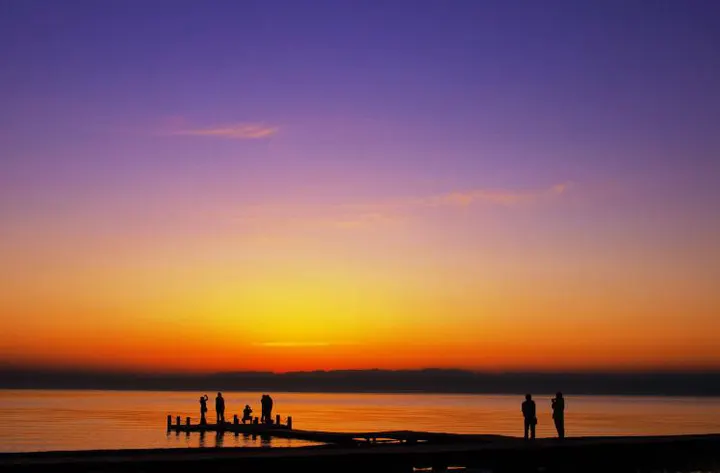
Twenty minutes after sunset — the figures on the jetty are pure silhouette, the sky runs purple to orange, and the water holds the last of the light
The west shore: where the road runs closest
The 41 km from Heimahe to Shinaihai is the most sea-like stretch on the lake: flat asphalt, little traffic, and the water on your right the whole way north. North of Shinaihai the road to Bird Island town lost its tourist function after 2017 and there is a barrier at the junction — do not force it. Gari La monastery stands on the cliff beside the west road with white stupas, prayer flags and turning wheels, almost nobody there, free, and entered clockwise. The cliff at Shengquan Bay has become the Instagram spot of the last two years: red-brown sandstone dropping straight into the lake, no entrance fee but a ¥40 shuttle.
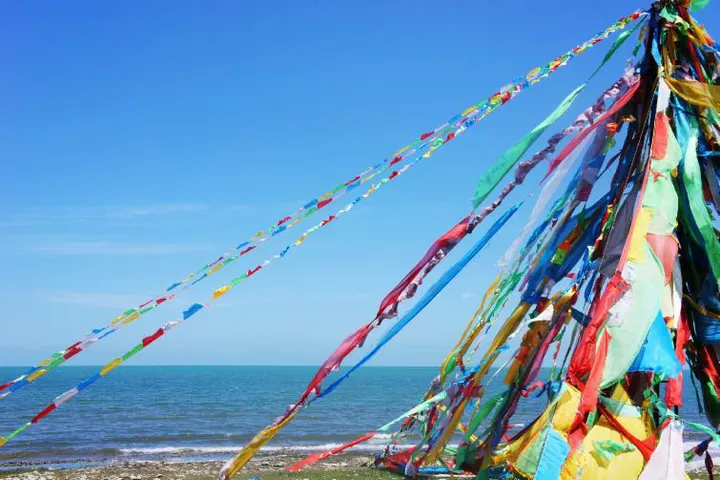
A prayer-flag pole at the water's edge, the cloth torn into strips by wind and pulling diagonally towards the lake
Haixin Island sits in the middle of the lake, a granite lump of about one square kilometre with a temple on top; Sui dynasty records are said to have posted a horse official here, and the place is famous for a legendary breed of pony. It is not open, there is no scheduled boat, and you see it only as a distant shape from shore. The Three Rocks in the south-west are the same: part of the Bird Island reserve, closed to visitors, and holding more birds than Bird Island itself — which is probably the point.
The north shore: wetland, carp and an atomic town
East from Gangcha the north shore flattens out, the pasture gets wetter and the mosquitoes get worse. Xiannü Bay is the centrepiece, with the most birds from May to July. South of Gangcha town, the Shaliu and Quanji rivers are the main spawning channels for the naked carp: in June and July the fish run upstream and in the shallows you can see backs cutting the surface — locals call it half river water, half river fish. Go at dawn, watch from the bridge, and stay out of the water.
The places that are closed — do not waste the drive
Bird Island and Sand Island. Bird Island closed in 2017, stopped taking visitors in 2018, lost its Egg Island to the rising lake, and in 2026 was formally designated a permanently closed no-build zone; Sand Island closed at the same time and the sand-sculpture festival is long gone. Haixin Island and the Three Rocks are not open. Every line in the 2013 booklet about a ¥115 Bird Island ticket, May being the best month, a ¥90 Sand Island ticket and a July sand festival is void. If a platform will still sell you a Bird Island ticket, it is not a ticket.
06Ways to use the water other than standing and looking
Cycling: four days, 360 kilometres
The loop road was one of China's first purpose-built cycling courses: smooth surface, gentle gradients, 360 km, and most people do it in four days at sixty to ninety kilometres a day. Rent in Xihai town, ¥80–150 a day for a mountain bike with helmet, panniers and basic tools, booked ahead in season. Three things actually bite: headwind (the prevailing northwesterly in July makes the southbound leg the hard one), ultraviolet (you will burn through cloud), and lorries (worst on the G109 along the south shore — ride that section in the morning). At 3,200 m the same sixty kilometres costs twenty per cent more than on the plain; do not plan at sea-level speeds.
Walk a section, not the circle
A full walking circuit takes six days, which most people do not have, but half a day is worth it: pick any five kilometres between Heimahe and Shinaihai and follow the dirt track outside the road, lake on one side, pasture on the other, more livestock than vehicles. Three warnings: the pasture is fenced, so do not climb through; what looks like grass is often marsh; and be back on the road before dark, because there is no lighting and no signal out there.
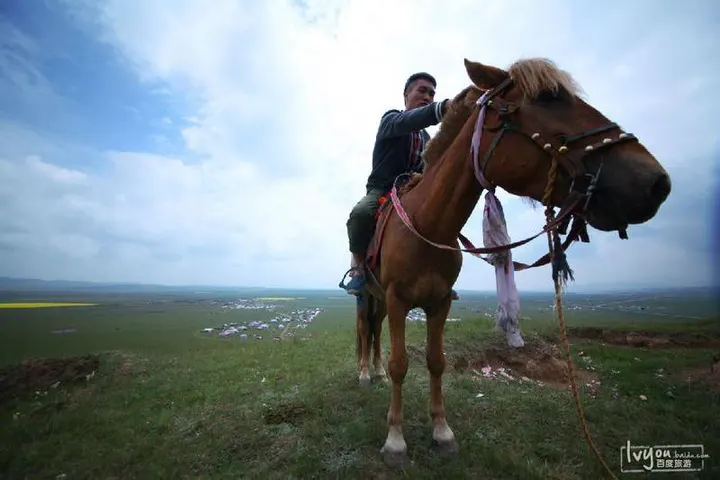
A young man on a brown horse on the grass, a plain of white tents below him and a low ceiling of cloud
Horses, yaks and what they cost
Herding families run horse rides along the shore at ¥80–150 an hour, and yak photos at ¥20–30 a person. The rule is to agree the price before you get on and to ask whether an hour means an hour or a loop to that ridge and back — most arguments start on that sentence. The horses are family animals and quiet, but the shore is windy and there is traffic, so do not put a small child up alone. For the yak photograph, do not climb on: the animal is not built for it, and the owner may not stop you, which does not make it a good idea.
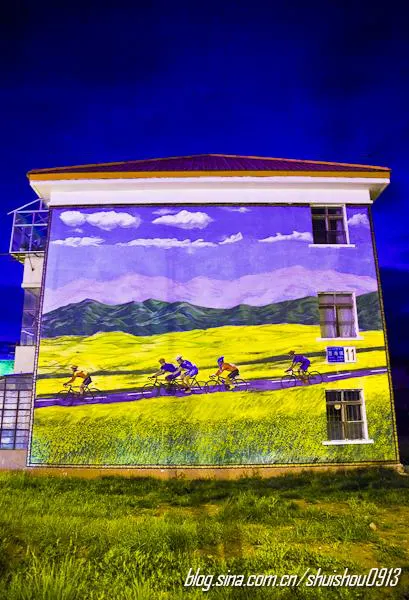
A whole wall in Xihai town painted with cyclists on the loop road, lit at night into a blue screen
Watch the carp run
From mid-June to mid-July the naked carp run up the Shaliu, Quanji and Buha rivers to spawn. The bridge over the Shaliu just outside Gangcha town is the easiest place to watch: at six or seven in the morning the light is low and you can see black backs holding in the current, now and then a whole fish clearing the surface. It is the most direct evidence of the lake's recovery — 2,600 tonnes of carp in 2002, 133,000 tonnes in 2025. Watch; do not net, feed or throw anything in.
07Which stretch of shore you sleep on decides which light you get
Accommodation splits into four blocks: Xining (the rear base, plentiful and cheap), Erlangjian (the scenic-area hotel, convenient and pricey), Heimahe (sunrise, the tightest and dearest), and Gangcha or Xihai town (north shore, best value). The romantic idea of a lake-view room mostly does not survive contact: most rooms are one to three kilometres from the water with a road, a fence and somebody else's pasture in between. The handful that genuinely look onto water charge four figures in peak season.
Heimahe: the only sensible base for sunrise. ¥400–600 for a standard room in peak season, ¥150–300 off season, dorm beds ¥80–120. The standard is roughly a city budget hotel: hot water usually on a timer (20:00–23:00 is common), thin walls, and nothing to eat after nine. Ask three questions when booking — how far from the shore, what hours the hot water runs, and whether there is an electric blanket.
Jiangxigou and Shinaihai: villages east and west of Heimahe, thirty per cent cheaper, twenty minutes' drive from the sunrise point, and much quieter. Good for drivers and chartered cars, not for anyone relying on buses.
Erlangjian: one three-star hotel inside the gate at ¥400–600 in peak season, the best facilities on the lake; guesthouses outside run ¥150–300 at a lower standard. Right for families with grandparents or small children who do not want to rough it.
Gangcha town: the most town-like place on the north shore, ¥150–250 for a standard room, with a supermarket, petrol and proper restaurants, half an hour from Xiannü Bay. On a two-day loop, sleeping here beats driving back to Xining.
Xihai town, the atomic town: the cyclists' start line, dorm beds ¥60–100, bike shops clustered around Yuanzi Road. The buildings are the old nuclear-base dormitories with fifty-centimetre walls, and they hold heat well in winter.
Tents and camping: herders run tent guesthouses on the shore, two beds to a tent, ¥80–150 a person, hot water but no shower, and a pit toilet. Nights are cold even in July, around five degrees. If you plan to camp, confirm you are in a permitted area — the marshes and the reserve core are off limits.
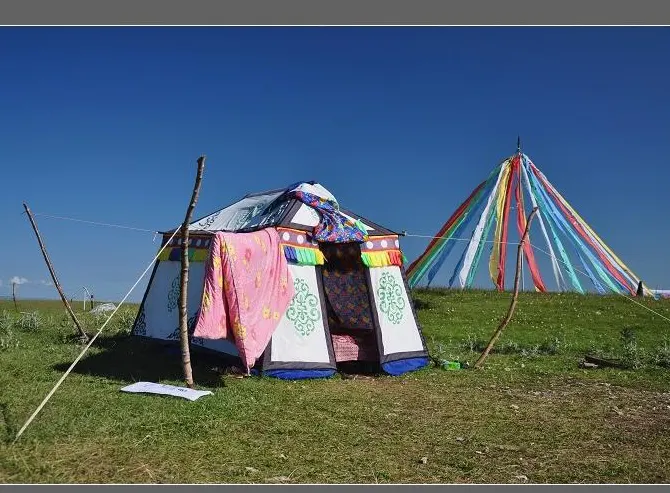
A Tibetan-style tent by the lake, an embroidered door flap and a single pole, with a white conical tent behind
Two practical notes. First, book two to three weeks ahead for July and National Day, Heimahe above all; anything left on the day will be the worst room at the highest price. Second, power cuts are not rare and both hot water and heating depend on electricity, so ask whether the place has a generator. Few people come in winter, but plenty of guesthouses shut in mid-November — confirm yours is open before you drive out.
08Lamb, yogurt, noodles — and one fish you must not order
Eating splits in two: in towns and on the roadside. The restaurants in Heimahe, Gangcha and Xihai town serve herders and drivers — large portions, heavy oil, honest prices, ¥40–60 a head. Inside the scenic areas it doubles and the cooking is ordinary. The most common kitchen along the G109 is actually Sichuanese; many of the people running restaurants here are from Sichuan, exactly as the 2013 booklet said, and it has not changed. For local food, look for the places selling hand-pulled lamb, yogurt and noodles, with a locally plated pickup parked outside.
Hand-pulled lamb: bone-in mutton boiled in water with only salt and Sichuan pepper, eaten with the hands and dipped in salt-pepper or garlic. Sheep here graze on alkaline grass, so the meat carries no rankness and the fat turns translucent. ¥60–90 a jin; a jin and a half, 750 g, feeds two.
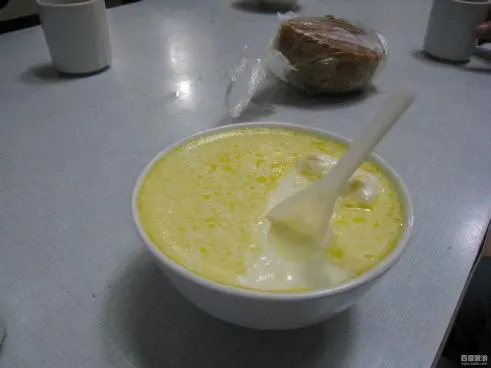
Set yogurt: solid enough to stand a spoon in, a pale yellow skin on top, cleanly sour, eaten with white sugar. ¥8–15 a bowl; Delu and Yongqing in Xining are the old names, and the lake towns make their own. You can keep the bowl at some places, against a deposit.
Ga mianpian: soft dough cut into strips and pinched into thumbnail-sized flakes straight into the pot with mutton, radish and glass noodles. ¥15–25 a bowl, and the most filling thing on the plateau.
Liangpi: cold skin noodles, chewy, dressed with vinegar, chilli oil, garlic and mustard, ¥8–12 a bowl. Everywhere on Mojia Street and Shuijing Lane in Xining, and in the lake towns; the right lunch when the altitude has killed your appetite.
Sheep-intestine noodles and offal soup: intestine stuffed with batter and blood, sliced into broth with noodles; the soup is head, heart, lung and tripe with spring onion and coriander. Both are local breakfasts at ¥10–20, both are decidedly gamy, and a small bowl is the sensible first order.
Barley wine, butter tea and milk tea: the wine is low-strength and sweet-sour; butter tea is salty and most people hate the first mouthful and want the second; milk tea is sweet and the easiest entry. At 3,200 m, go easy on the alcohol.
A bowl of set yogurt with its pale yellow skin, a plastic spoon, and a plastic-wrapped flatbread beside it
Naked carp: do not order it, do not buy it
The Qinghai Lake naked carp is a nationally protected second-class species. It takes a decade to put on half a kilo, it is the only large fish in the lake, and the entire water-grass-fish-bird system rests on it. Overfishing plus falling water left 2,600 tonnes in 2002, close to collapse; six rounds of lake-wide fishing bans, a total prohibition on catching and twenty million fry released a year have brought it back to 133,000 tonnes in 2025. Legally, catching, selling, buying and eating it are all offences. In practice someone by the shore will still quietly offer lake fish; that is both illegal and a shove at a population only just back on its feet. If a menu lists naked carp under any name, eat somewhere else.
Where to eat: the row of kitchens along the G109 in Heimahe lives off drivers, and the lamb and noodles are reliable at ¥40–60 a head; Gangcha town has more choice, including halal places doing braised lamb; Mojia Street in Xining is the concentrated solution, with Ma Zhong's stalls running from cold noodles to roast lamb at ¥30–50 a head. Restaurants inside the scenic areas are for when you have genuinely run out of time.
09Take home dried meat, barley wine and a yogurt bowl — not caterpillar fungus
Qinghai Lake is not a shopping destination; half of what the lakeside stalls sell comes from Yiwu. The things worth buying are the things you can buy in a Xining supermarket or market: dried yak, barley wine, yogurt (eaten on the spot) and Tibetan carpet. The rule is the same as at every Chinese attraction — the closer to the gate, the higher the price; fifty metres into town it drops by a third.
Dried yak: look for an ingredient list of meat, salt and spice and nothing else, ¥25–40 per 100 g. Anything much cheaper is likely beef or pork with flavouring. Vacuum packs travel well; loose unlabelled stuff does not.
Barley wine: low strength, sweet-sour, ¥20–40 for a small bottle. The brands locals drink are better value than the gift boxes. It travels by train and plane within the usual limits.
Tibetan carpet and woollen cloth: sold in Gangcha and Xining, hand-knotted in the thousands and machine-made in the hundreds. The quick test is the back — hand-knotted is irregular, machine-made is too neat.
The yogurt bowl: the small ceramic bowl is part of the ritual, and many shops let you keep it against a deposit. A ten-yuan souvenir more useful than any fridge magnet.
Three things to leave alone. Caterpillar fungus, where prices run from ¥100 to ¥800 a gram and claims about wild origin or a particular valley cannot be checked — as a visitor you have no bargaining position. Old amber and old dzi beads, which on a stall are new, without exception. And any carp product at all: dried fish, fish paste, tinned lake fish, buying or selling is illegal. For something with weight, the goji, astragalus and fern-root sweet potato in Xining's Shuijing Lane market carry transparent prices and locals shop there too.
10Train to Xining, then two or three hours by road
Leg one: everything converges on Xining
No railway station serves the lake and there is no airport. The only realistic gateway is Xining, where the Lanzhou–Xinjiang high-speed line, the Qinghai–Tibet railway and the Beijing–Tibet expressway all meet, with Caojiabao airport 28 km east of town. Xi'an North to Xining is 4h10m to 4h25m for ¥265–298 in second class, a dozen trains a day; Lanzhou West is about 1h10m; Beijing, Shanghai and Chengdu all have direct services, but at ten hours plus, most people fly. Xining station sits on the east side of the city, and the coach station is six hundred metres south of the exit — the easiest connection in the whole trip.
Leg two: bus, chartered car, or your own
The bus is the cheap option. From the coach station beside the railway station, a string of morning departures heads for Gonghe, Wulan and Chaka, all passing Erlangjian and Heimahe: ¥40–45, two and a half to three and a half hours, concentrated between 07:30 and 09:00 in high season with few afternoon services. The Bayi Road station also runs a direct tourist bus to Erlangjian for ¥35–40. The return is where people come unstuck: through buses back to Xining pass Heimahe around two or three in the afternoon, and missing one means chartering a car or staying another night. Get the driver's number on the way out and ask him to hold you a seat.
A chartered car is the comfortable option and the best value for two or more. A five-seat sedan is ¥500–650 a day, an SUV from ¥700, a seven-seat van ¥700–1,200; a two-day loop is ¥1,000–1,400 for the vehicle including fuel, tolls and the driver's food and lodging. Shared cars run ¥100–150 a person per day, or ¥380–500 for two days. Book through your hotel, a platform or an introduction, not from the forecourt touts. Even an oral agreement should fix the start time, the finish time, the overtime rate, and whether Chaka is included — Chaka adds 150 km return and many quotes quietly exclude it.
Driving yourself is the freest option. Rental in Xining runs ¥220–300 a day for an economy car, ¥450–600 for an SUV, booked two weeks ahead in season. Xining to the shore is 151 km on expressway and first-class road, about two and a half hours; the loop is 360 km at a 60–80 km/h limit with livestock crossing without warning, so do not drive it at night. Petrol is available at Erlangjian, Heimahe, Gangcha and Xihai town, with long gaps on the north shore — fill at half a tank. You may not simply pull off onto the grass; the pasture is private and fines start at ¥200.
The four legs of the loop, and where the lorries are
The loop has four legs: the east road from Xihai town down to the G109, 56 km across sand hills with constant rolling; the G109 itself along the south shore from Erlangjian to Heimahe, which carries the heaviest lorries; the west road from Heimahe to Shinaihai, 41 km, the prettiest and the emptiest; and the G315 across the north from Gangcha to Xihai, moderate freight and a lot of wind. The rule for cyclists and drivers is simple. To stay beside the water, take the west road. To make time, take the G109 but stay off it between ten and four, when the trucks own it. The east road looks wonderfully empty and hides two long climbs where a summer headwind can stop you dead.
Altitude: the lake is 3,196 m, the Riyue Pass 3,520 m, the Xiangpi Pass about 3,800 m, Chaka 3,100 m and Xining 2,200 m. Climbing a thousand metres from Xining in a day is enough for most people to notice.
Hospitals: the Heimahe township clinic handles mild altitude symptoms, stomach trouble and sprains. Chest tightness or repeated vomiting means Gonghe (about 50 km) or Xining (220 km), which have the nearest full hospitals. Ambulance 120, police 110.
Signal: 4G or 5G at Erlangjian, Heimahe, Gangcha and Xihai town; a dozen kilometres of the west road have none, and the Bird Island direction and the Shengquan cliff have essentially nothing. Download offline maps and agree a meeting time.
Money: QR payment works in the towns and both WeChat and Alipay accept foreign cards; petrol stations, private flower fields and horse rides may take cash only, so carry three to five hundred in small notes. ATMs exist only in the county towns and Xining.
Toilets: proper public facilities at Erlangjian, Xiannü Bay and Gangcha town; almost none on the west road, where petrol stations are your best bet. Carry tissues — plenty of places do not provide any.
Rules: swimming and wading are banned lake-wide, enforced since 2026, with the only exception being the designated shallows at Erlangjian where you may take your shoes off. Drones are banned in the core areas and need permission elsewhere. Do not climb pasture fences, do not touch or step over offering piles, prayer flags or mani stones, and always circle stupas, wheels and the lake clockwise.
Tickets: Erlangjian and Xiannü Bay stopped selling on site in 2026 — everything goes through the Zhiyou Qinghaihu mini-program, 3–7 days ahead, capped at 12,000 a day. Kumbum books through its own official account, Chaka sells both on site and online. Peak dates routinely sell out early, and prices and rules are revised every year — check the official channels before you go.
Weather: July days run 18–25 °C and nights 5–8 °C, and a single day can deliver sun, wind, rain and hail. The lake freezes over in winter and breaks up at the end of March; winter lows reach minus twenty. Ultraviolet is severe all year, cloud or no cloud.
Three rules deserve their own paragraph. Do not swim or paddle, except in the designated shallows at Erlangjian; the salt and the cold both take payment. Do not buy or eat naked carp; catching, selling and buying carry the same weight. And do not climb a pasture fence to find an empty piece of shore — most of those tracks were closed after 2023, fines apply, and trampled pasture is somebody's living.
12Packing list and six usual traps
Clothing: layers. T-shirt, fleece, shell — in July too — plus a thin down jacket for sunrise. It is windy enough that a hat without a chin strap will leave.
Sun: SPF50 or higher, polarised sunglasses, a wide brim, sun gloves or sleeves, lip balm. The ultraviolet comes from above and then again off the water, and the nose and ears peel first.
Medicine: painkillers, stomach medicine, cold medicine, plasters; rhodiola a few days ahead if you want it, acetazolamide only on a doctor's advice; motion sickness tablets, because the 360 km loop has bends.
Kit: camera, spare batteries (they die fast in the cold), one wide and one short telephoto, lens cloth, dry bag, power bank. It is dusty and windy; change lenses with your back to the wind.
Documents: your ID or passport for gates, hotels and buses, and screenshots of the Erlangjian and Kumbum booking codes saved offline, because the signal by the water is unreliable.
Car and fuel: fill up before leaving Xining and carry screen wash; do not wait for the warning light on the loop, where north-shore stations are seventy or eighty kilometres apart.
Six traps, in order of likelihood. Anyone offering lake access without a ticket: after 2023 it is usually a closed road or a fine. Touts at the station forecourt quoting a low charter rate and adding to it en route. Horse rides and yak photos without a price agreed first, and a ¥200 demand when you get down. Turning up in Heimahe without a booking and paying double for the worst room. Putting Bird Island in the itinerary, nine years after it closed. And assuming July is hot: sunrise is five degrees, and ten minutes of it sends you back to the car.
13A lake with its outlet blocked, and a fish that nearly went
Geology: from fresh water to brine
Two million years ago this was an open freshwater lake draining southeast through the Daotang River into the Yellow River. About 130,000 years ago tectonic movement lifted the Riyue and Yeniou ridges to the east, the outlet closed, the Daotang reversed its flow, and the lake became a closed basin. With no way out, salt arrived and stayed while evaporation took the water, and the lake grew brackish — about twelve grams per litre today, a third of seawater. The process continues, held down for the last two decades by increasing rainfall.
Water level is a separate curve. From 1955 to 2004 the lake generally shrank, hitting its instrumental low in 2004; since then it has risen for twenty consecutive years at more than twenty centimetres a year. The area passed 4,600 km² in 2021 and reached 4,657.92 km² in September 2025, the highest since monitoring began. The consequences are concrete: old roads, boardwalks and piers around the shore are drowned, Bird Island's Egg Island is gone, and a stretch of the Xiannü Bay boardwalk stands in water. Much of the abandoned-looking infrastructure you see was not abandoned — the lake caught up with it.
History: a frontier commandery, a princess, and a factory called 151
Han records call it the Western Sea; in 4 AD Wang Mang established a frontier commandery on the eastern shore and garrisoned it — the first time a Chinese state put an administration at this lake. Then came the Tuyuhun, and then the long seesaw between Tang and Tibet, the war graves Du Fu wrote about in the lines about white bones at the head of the lake. Mongols called it Koko Nor, Tibetans call it Tso Ngonpo, both meaning blue sea; the name Qinghai dates from the Northern Wei, and the province took its name from the lake. The story that Princess Wencheng's mirror became the lake in 641 is a later invention, but the mirror is still carved on the stele at the pass.
Then 1965, and a different story. Because the lake was large, deep and close to seawater in salinity, the state sited China's first torpedo test range on the south shore at kilometre 151, designated Factory 874 and known publicly as Shanying Machinery. The first domestic torpedo was fired on 24 September 1968, more than three thousand were validated over the next twenty years, and the base retired in 1984. In the same period a nuclear weapons research base went up on the Jinyintan grassland on the north shore, where China's first atomic and hydrogen bombs were built; it is now the Atomic Town, with a free museum. A lake testing torpedoes on one side and building bombs on the other is the least lyrical chapter in its history.
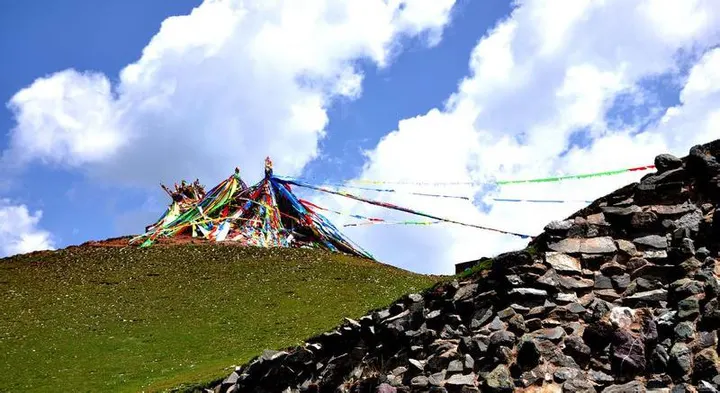
A prayer-flag cairn on a green hill with a mani-stone wall in the foreground, flags running out in every direction under cumulus
Ecology: one fish holding up a system
The naked carp is the only large fish in the lake and the pivot of the whole system: it grazes on algae and plankton, the birds eat it, the birds' guano fertilises the water and feeds the algae, and the loop closes — water, grass, fish, bird. Heavy fishing from the 1950s to the 1990s plus falling water left 2,600 tonnes in 2002. Six rounds of closed-lake spawning protection, a total fishing ban and twenty million fry released a year have brought it to 133,000 tonnes in 2025, fifty-one times the low point. The birds followed: between 2021 and 2025 the species count rose from 227 to 282, with six hundred thousand waterbirds a year, and Przewalski's gazelle went from 2,900 to more than 3,700.
Naked carp under water — the lake's only large fish, hanging in the green water in loose groups
So the closure of Bird Island was not bureaucratic laziness but the logical end of that argument. Before 2017, ten thousand visitors a year went ashore; with people came nest abandonment. After closure, bar-headed goose nests rose from 2,500 to more than 4,000, and thousands of cormorants returned to the cliff. The 2026 zoning seals Bird Island and Sand Island as no-build areas and squeezes visiting into three districts — Erlangjian, Heimahe, Xiannü Bay — plus twelve viewpoints. You have fewer places to go and there are more birds. They did that arithmetic deliberately.
14A salt lake, a monastery, a pass, and flowers further out
Chaka Salt Lake (half a day to a day)
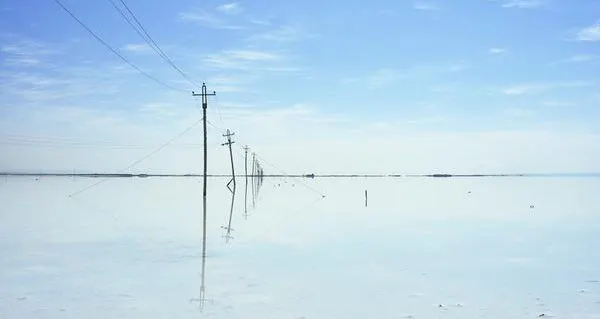
Chaka Salt Lake — power poles and wires doubling in a film of water, sky and ground almost indistinguishable
West from Heimahe over the Xiangpi Pass at about 3,800 m, eighty-odd kilometres and ninety minutes brings you to Chaka. Tickets are ¥60, half price for students; the little train is ¥50 one way and saves about forty minutes of walking; the boat is ¥90 one way and the electric shuttle ¥5; shoe covers are mandatory in the brine, ¥10 to rent with a ¥50 deposit. The ticket allows repeat entry for 48 hours, which few people realise — go in late for sunset and again the next morning for reflections and you get two lakes for one price. The mirror needs three things: shallow water, no wind, and cloud. At midday with a crowd it photographs as a white board. Sky Mirror No.1 next door is a separate park at ¥60; do not buy the wrong ticket.
Kumbum Monastery (half a day)
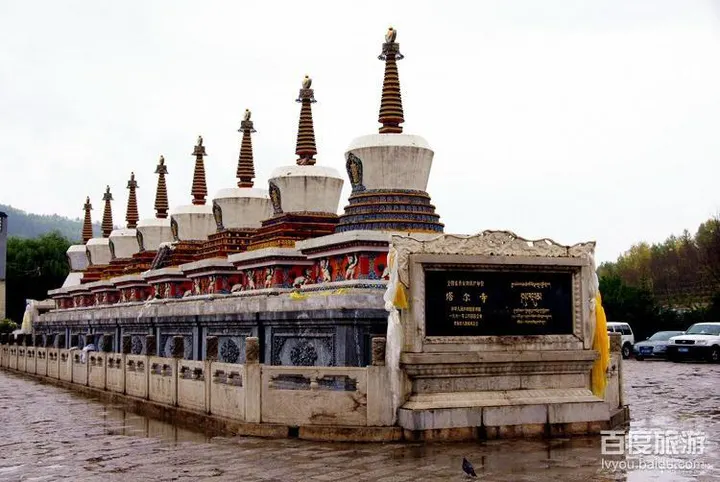
The eight stupas at Kumbum in a row on wet flagstones, with the temple's name carved on the stele in front
Kumbum sits in Lusar town, 27 km southwest of Xining: one of the six great Gelug monasteries, the birthplace of Tsongkhapa, six hundred years old. Tickets are ¥70 in peak season and ¥40 in low, booked by real name through the temple's official account and scanned at the gate with your ID. Bus 909 from Xining station costs ¥4–5 and takes an hour; a taxi is about ¥70. See three things: the eight stupas, the gilded roof of the Great Golden Hall, and the butter-sculpture hall with its cold cases and no photography. No photographs in any hall, clockwise around stupas and wheels, and no shorts or short skirts at the gate. Eight to ten in the morning is the quiet window.
The Riyue Pass and the Daotang River (an hour en route)
The Riyue Pass at 3,520 m marks the boundary between farmland and pasture in eastern Qinghai, and between two drainage worlds: water on one side runs to the Yellow River, water on the other to Qinghai Lake. There are sun and moon pavilions on top and a great field of prayer flags, and the ticket is about ¥50. Honestly the paid enclosure is thin value, but the pass itself deserves ten minutes — hard wind, snapping flags, and the horizon suddenly opening. The Daotang River runs at the foot of it, one of the few rivers in China flowing west after the uplift reversed its course. Stop on a chartered car; do not count on it by bus.
Jinyintan and the Atomic Town (half a day)
Xihai town sits in the Jinyintan grassland, where Wang Luobin wrote In That Distant Place in 1941. The Atomic Town museum in town is free, seven galleries, with a Dongfeng-2 missile as its centrepiece; the base opened in 1958, China's first atomic and hydrogen bombs were developed here in 1964 and 1967, and the site was decommissioned in 1987. It closes on Mondays outside holidays and asks for ID. The grassland is at its best from July to September, and horses run ¥80–120 an hour.
Menyuan (a day, in July)
The rapeseed terraces at Menyuan — bands of yellow and green stacked up to the village, with the hills planted too
Menyuan is 150 km north of Xining and forty minutes by high-speed rail to Menyuan station, which makes it the best value day trip in the region. From 5 to 25 July the rapeseed runs for tens of kilometres down the valley from Qingshizui to Haomen town, with the Qilian snow behind it. Three places to look: the small hill at Qingshizui (a ¥25 or so charge), the south slope by the cement plant (a forty-minute climb, flowers plus snow peaks), and the field tracks north of town for a low angle inside the crop. Menyuan is not on the way to the lake — you go back through Xining — so do not try to do both in one day.
15A sacred lake, one song, a few lines
Offering to the lake, and walking round it
Offering to the lake began as a Mongol practice — Yuan-era records list sacrifices to heaven, mountains and water — and the Qing formalised it, with Tibetans around the shore joining in. Each summer herding families bring barley, milk, khata scarves and prayer flags to the shore, burn juniper, recite, and commit offerings to the water for a safe year, good grass and healthy animals. It is not a show and there is no ticketed viewing stand. If you come across one, watch from the edge, stay out of the procession, do not photograph faces, and do not touch the offerings.
How one song happened
In the spring of 1941 the director Zheng Junli came to Qinghai to shoot a documentary and pulled Wang Luobin, then teaching in Xining, into the crew. They filmed on the Jinyintan grassland and cast a local chieftain's daughter, Zhuoma, as the shepherdess. A few days of shooting later Wang wrote In That Distant Place — there is a good girl far away, and everyone who passes her tent turns to look. The song was covered endlessly and became Qinghai's most effective piece of publicity. Teng Wenji filmed it in 1993 with Lo Ta-yu arranging the music. A stele stands on the grassland now, and in season there are people in chubas queuing to be photographed beside it.
July is not far. The birth of gender is not far. Love is not far — under a horse's nose the lake holds salt, and so Qinghai Lake is not far. Along the shore the hives stand in bundles and make me look wretchedly lovely; the green grass is in full flower.
Hai Zi, from 'July Is Not Far — for Qinghai Lake'
One more figure belongs to this water. In 1706 the Sixth Dalai Lama, Tsangyang Gyatso, was being taken to Beijing when he disappears from the record at Qinghai Lake, aged twenty-three. There is no reliable account of what followed — illness, release, escape, all three have believers. His love songs have been sung across Tibet for three centuries, and people by the lake speak of him the way they speak of a legend.
Film, books and music
Two books are worth carrying: Hai Zi's poems, where July Is Not Far was written for this lake — short, cold, exact — and Zhou Yunpeng's Green-Skin Train, by a blind singer-songwriter about slow trains and a girl he met by the water, more honest than most travel writing. For film, In That Distant Place from 1993: the plot is soap, but the Jinyintan footage is real. Two albums work well on the drive — Daichin Tana's Silent Sky and Pubu Ciren's The Call of Qinghai Lake, one a Mongol woman's voice, one a Tibetan man's, both recorded cleanly.