One mountain, one god, and a pilgrim road a dynasty spent twelve years building
1,612 m at the summitTicket valid three daysSummit capped at 12,000 a dayCable car ¥45 one way
In short
Mount Wudang (武当山, Wǔdāng Shān) rises to 1,612 m at Tianzhu Peak in Danjiangkou, north-west of Hubei's Shiyan — the Taoist mountain whose Ming-dynasty palace complex climbs from the valley floor to a gilded bronze hall on the summit, with 600-year-old stone stairways linking them. It is the mountain of Zhenwu, the Perfected Warrior — a Taoist deity of the north, of water and of war — and between 1412 and 1424 the Yongle emperor spent twelve years and 300,000 workmen turning the whole slope into his dynasty's private shrine: nine palaces, eight temples, thirty-six hermitages, seventy-two cliff chapels, listed by UNESCO in 1994 as one building complex. Visiting is simpler than that sounds. A shuttle from the gate reaches Nanyan or Qiongtai in fifty minutes; the cable car from Qiongtai takes five to eight minutes and leaves twenty minutes of steps to the summit; or you walk the Ming pilgrim road from Wuyaling, 4,600 to 5,700 steps and two and a half to three and a half hours. Tickets are ¥164 including the Golden Summit and Zixiao Palace, the shuttle is ¥76, both valid three days, and the cable car is ¥45 one way or ¥85 return. The summit caps visitors at 12,000 a day with timed entry, booked in advance. Budget ¥1,200–1,800 for three days and two nights, excluding travel to Hubei.
Key facts
Known for
Taoism · Zhenwu · the Golden Summit · Ming halls · the pilgrim road
Budget
¥1,200–1,800 for three days and two nights, mid-range
Days needed
2–3 days; one day covers the halls but not sunrise
Comfort
Better than most Chinese mountains — buses and a cable car — but steps everywhere and plain rooms up top
Best time to go
Mid-October to November for cloud and colour; March–April for the temple fair; December to February after snow
01A mountain one dynasty took over
Driving south from Shiyan, the mountain does not arrive as a peak. It arrives as a wall of rock, seventy-two summits all leaning the same way, the tallest of them Tianzhu Peak at 1,612 m. The gate sits just above 200 m, and from the moment you pass it every road, every cable, every flight of stone steps runs to the same point: the Golden Summit. That order is not geology. Somebody built it.
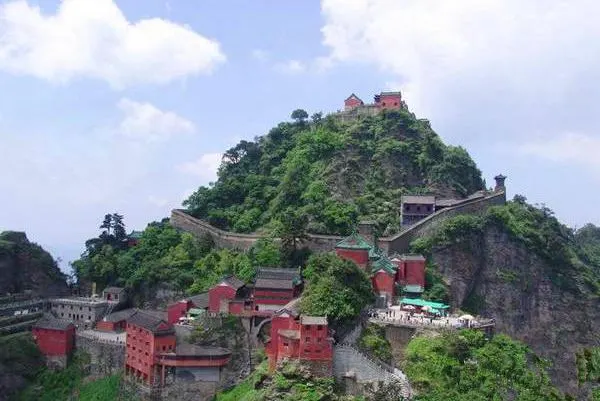
The mountain belongs to one deity. Zhenwu, the Perfected Warrior, is a Taoist god of the north, of water and of war. When Zhu Di, the third Ming emperor, marched south from the frontier to take the throne from his nephew, he credited Zhenwu with the campaign; once installed he rebuilt this mountain as the dynasty's own shrine, ranked it above the Five Great Mountains and gave it an imperial title. What you walk through is therefore not a scatter of temples but a single programme. From the stone gate at the foot, palaces, temples, hermitages and cliff chapels climb in sequence, each placed to match an episode in Zhenwu's progress towards enlightenment. Walk the road and you have walked the story.
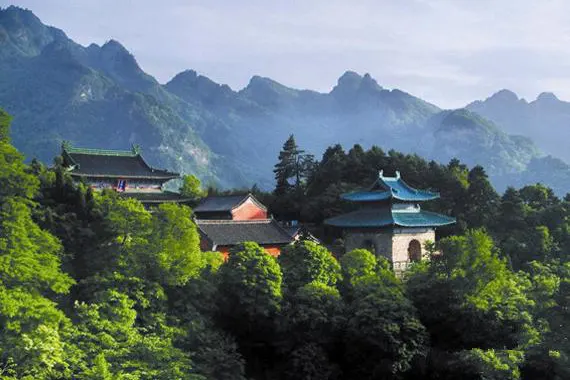
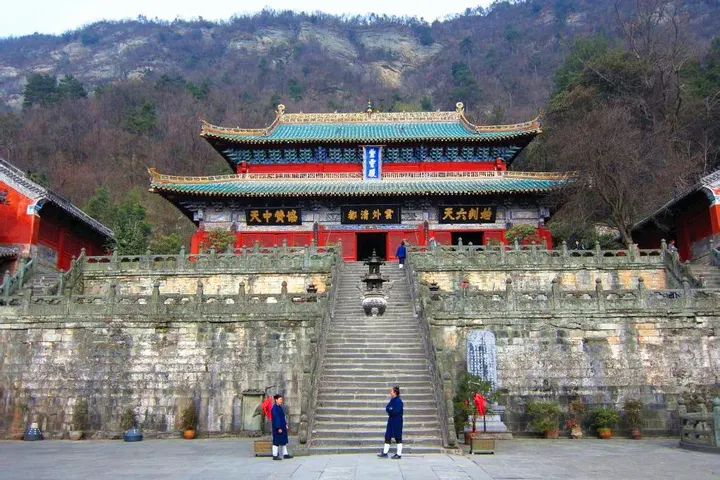
Roofs stepping back into the trees — green glaze, grey tile and red walls one behind another, with the ridge closing the view
Get the frame straight before anything else. The online ticket is ¥164 and covers the gate, the Golden Summit and Zixiao Palace; the shuttle is another ¥76, so ¥240 for both, valid three natural days, with a ¥20 shuttle supplement if you leave and re-enter. The cable car is ¥45 one way, ¥85 return — cut from ¥80 and ¥150 in 2026 — running from 08:00 to 17:30. The summit admits 12,000 people a day, 7,000 of them before noon, on timed slots chosen at the moment of booking; miss your slot and you do not go up. And the shuttle takes fifty minutes from the gate to either Nanyan or Qiongtai. This is not a mountain you connect on foot; the bus timetable matters more than the sight list.
Fronted by the Yuji Pool, its back against Zhanqi Peak.
Xu Xiake, diary of his climb, 1623
Two kinds of people use this mountain at once. Pilgrims come on the first and fifteenth of the lunar month, and in force for the temple fairs, bowing, burning incense and drawing lots with the ease of long practice. Visitors come in shell jackets with selfie sticks, hunting angles in the same courtyards. They do not collide, because the courtyards are big enough for both — several hundred people fit in front of the Zixiao Hall without anyone feeling crowded. The only skill required is knowing when to be quiet: during chanting, stand at the back and watch. Do not walk round to the front with a phone.
One honest caveat. Wudang does not win on landscape. Its cliffs are fine and its cloud seas are real, but what separates it from every other famous peak in China is the architecture: Ming imperial workmanship, glazed tiles in colours a common temple was not allowed to use, stone halls cut into cliff faces. Nowhere else has this much of it in one piece. Come to climb and you may be mildly disappointed — the steps are well made and the trees block a lot of the view. Come to see how a dynasty rebuilt a mountain into the shape it wanted, and three days is not enough.
02Six things worth arranging the day around
The Golden Summit: 1,612 m, and a hall cast in bronzeWhere every path ends
The cable car stops at the mountain's shoulder, not its top; twenty to thirty minutes of steps remain, steep at the end, windy, icy in winter. What waits there is a very small hall: cast in bronze in Beijing in 1416, taken apart, carried up and reassembled, then gilded, and still not rusted six centuries later. Zhenwu sits inside; a stone balustrade rings the platform; beyond that the Zijin Cheng wall drops away. On a clear day you get the famous view of seventy-two summits all bowing to this one. On a bad day you get wind and nothing else, which is also worth the climb.
Altitude:1,612 m
Last leg:20–30 minutes of steps from the cable-car station
Cap:12,000 a day, 7,000 before noon, timed slot required
Zixiao Palace: the most complete hall on the mountainStill a working temple
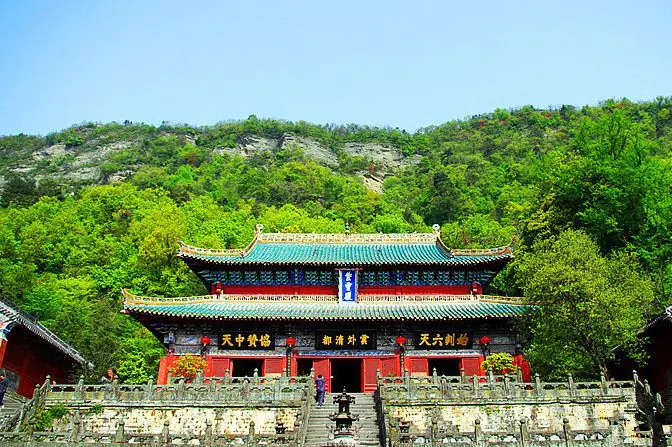
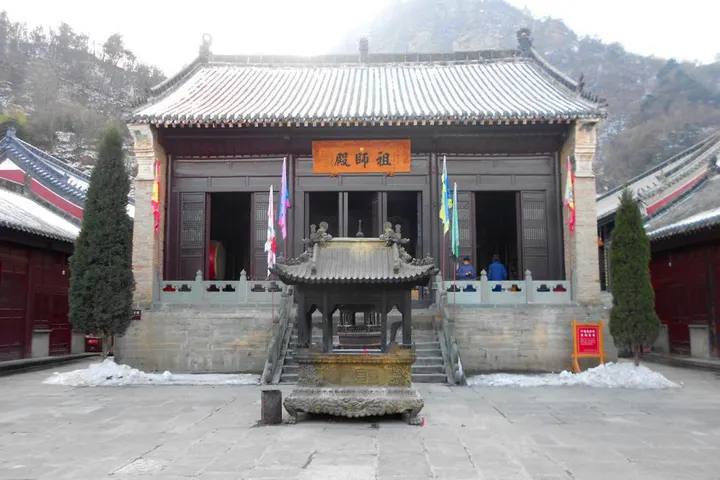
Below Zhanqi Peak the compound climbs in five stages — the Dragon and Tiger Hall, the stele pavilions, the Ten Directions Hall, the main Zixiao Hall, the Hall of Parents. The main hall is a Ming double-eaved structure under peacock-blue glaze, its brackets stepping out in layers until the roof looks bigger than the building beneath it. Two imperial stele pavilions stand in the courtyard, the stones Ming, the roofs rebuilt. This is still the headquarters of the mountain's Taoist association, with chanting at around 05:30 and again in the late afternoon; visitors may stand at the back and listen, quietly, without flash.
Ticket:¥15 alone, included in the pass
Chanting:Morning around 05:30–06:50, evening around 16:20–17:00, shifting with the season
Time:One to one and a half hours
Nanyan Palace: built into the cliffThe most exposed building on the mountain
Twenty flat minutes from the Wuyaling (Crow Ridge) car park, and then the compound is simply there, pinned to the rock: a Yuan-dynasty stone hall cut into the cliff itself, its outer gallery half over air, several hundred metres of valley below. Nothing here is symmetrical, because the cliff would not allow it — the builders worked chamber by chamber into caves and fissures, which makes Nanyan the least palatial of the palaces. Late afternoon, when the light comes in low from the west and the red walls and green tiles both darken, is the hour to see it.
Distance:About 1 km, 20 minutes, from the Wuyaling car park
Date:Stone hall Yuan; the rest rebuilt under Ming and Qing
Time:One and a half to two hours
Longtou Xiang: the incense nobody is allowed to burnLook; do not climb the rail
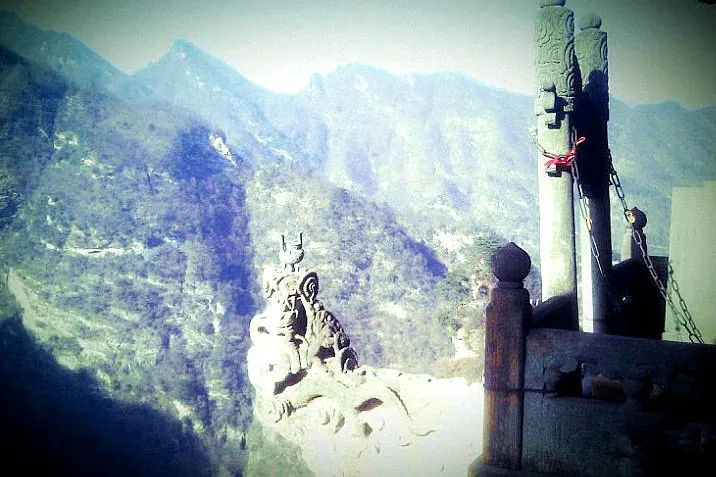
At the cliff edge outside Nanyan's Liangyi Hall, a carved stone dragon reaches two or three metres out from the rock, an incense burner on its back, its head aimed at the Golden Summit. Until the Qing, pilgrims walked out along that back to burn a stick of incense at the head; enough of them fell that the governor of Huguang had the practice banned and a stele cut to say so. The whole thing now sits behind a railing and you look at it from the side. What made it famous was never the carving. It was the position — nothing under your feet, and the highest point of the mountain straight ahead.
Where:The cliff edge outside Liangyi Hall, Nanyan
Ban:Banned by stele in the Qing; now a protected relic
Taizipo: a red wall that bendsFirst stop in, and forty minutes is enough
Every shuttle changes at Taizipo, the Prince's Slope — south to Nanyan, north to Qiongtai — which makes it the natural first stop. The Fuzhen Temple above it is built on a slope, and two things there stop people in their tracks. One is the Nine-Bend Yellow River Wall, a red wall that ripples and turns with the hillside so that walking beside it feels like walking through a wave. The other is the Twelve Beams on One Pillar in the Wuyun Pavilion: a single column carrying twelve beams, timber engineering you stand and stare at. The little Prince's Study Hall is the mountain's only place for praying over exams, and in exam season it is busy.
Look for:The Nine-Bend Wall; twelve beams on one pillar
Time:40–60 minutes; tour groups arrive after 09:30
The halls after snowThe emptiest weeks of the year
From late December to early February the mountain gets a few proper snowfalls. It settles on grey tile and green glaze, the red walls turn dark, and the courtyard reduces to one swept path and the steam off an incense burner. The steps ice over, so bring crampons (¥15 in town, ¥50 up here); high wind can stop the cable car without warning; otherwise the park runs as normal, buses and all. The crowds thin to the point where you can stand alone in front of a hall for ten minutes, which is unthinkable over May Day or National Day.
Best:Late December to early February, the first day after snow
Watch:Ice on the steps; the cable car stops in high wind
03Seven decisions to make before you book
Should I climb to the summit or take the cable car?
Know the price of each route before choosing. Cable car: five to eight minutes from Qiongtai to just below the summit, ¥45 one way or ¥85 return, running 08:00 to 17:30, then twenty to thirty minutes of steps. On foot from Wuyaling, the Nanyan car park, the path splits at Chaotian Palace. The Qing trail is about 4,600 steps and two and a half to three hours, gentle and evenly cut — the one almost everyone uses for a night climb. The Ming trail is about 5,700 steps and three to three and a half hours, with a stretch of stair pinned to the cliff face: steep, narrow, high-rised, and remembered by your knees for two days. The third option, the 2,000-step path up from behind Qiongtai, has been closed since 26 October 2026 for rock-fall clearance; check before counting on it. My advice: one day and a first visit, ride up and ride down, and spend the saved energy on Nanyan and Zixiao. For sunrise, sleep at Wuyaling, leave at 03:30 on the Qing trail and take the cable car down afterwards. Walking up and riding down is the kindest option for knees, but it rules out sunrise.
Is one day enough?
Enough to see it, not enough to feel it. The one-day shape: in at 07:00, shuttle to Taizipo for forty minutes, Zixiao for an hour, Nanyan for ninety minutes, lunch at Wuyaling, cable car up and an hour and a half on the summit, down by 17:00 — seven or eight hours, and you catch the last bus. Three costs come with it. No sunrise and no cloud sea, which only form before the day warms up. No chanting, morning or evening. And no slack: one queue, one cable-car stoppage, one downpour, and the whole schedule collapses. Two days is the sweet spot — Taizipo, Zixiao and Nanyan on day one, sleep at Wuyaling, walk up before dawn, cable car down, out by noon. Three days lets you walk the pilgrim road properly and pick up Yuxu Palace and Xuanyue Gate at the foot, which are free and which most people skip.
Stay on the mountain or down in town?
Up top there are two clusters. Nanyan and Wuyaling sit halfway, which is where sunrise happens: simple guesthouses ¥120–260, decent rooms ¥250–400, the polished ones from ¥900. Rooms are small, there are no lifts, bags go up on somebody's back, and after nine at night there is nothing to eat. Qiongtai sits beside the lower cable-car station at ¥170–420; the advantage is that the first car at 08:00 is at your door, the disadvantage is distance from Nanyan and Zixiao. Down in Wudangshan town, at the gate, guesthouses run ¥150–260 and proper hotels ¥400–800, with food, choice and a night market — and no sunrise. The only test that matters is whether you will actually get up. If yes, sleep at Wuyaling. If no, sleep in town, and do not book a mountain room for the romance of it and then sleep until eight.
Which month is best?
Mid-October to mid-November is the window I would pick: big day-night temperature swings, the best odds of a cloud sea on the morning after rain, maples and lacquer trees turning, and the longest views. Early-to-mid April, around the third day of the third lunar month, is the temple fair, when priests, pilgrims and martial-arts displays all arrive at once — genuinely lively, genuinely crowded. July and August are six or seven degrees cooler than the plain, around 25 °C by day, fine for escaping heat but with afternoon thunderstorms that put the summit in cloud most days. December to February is the coldest and emptiest stretch, and the halls under snow are the best thing this mountain does; the cost is ice on the steps and a cable car that stops in wind. Avoid two dates only: May Day and National Day, when the cap bites, the queues grow and the cable car can take two hours.
What if it rains, or the mountain closes down in fog?
Fog here is the norm, not an interruption — most mornings have some, and a cloud sea is simply fog lifted to the right height. So the answer is not to replan the trip but to reorder it. When it closes in, go and look at buildings: the bracket sets at Zixiao, the cliff gallery at Nanyan, the bending wall at Taizipo all read better in mist. The moment it opens, get up to the summit; the cloud sea is most likely on the morning after rain clears, so be in position before 07:00. What you should genuinely avoid is heavy rain and thunderstorms: the stone steps turn slick, sections of the pilgrim road close at short notice, the cable car stops in high wind, and you should stay off the metal railings on the summit in a storm. Check the park's own WeChat mini-program the night before; it beats any weather app.
Is a martial-arts class worth signing up for?
Three different things get sold under the same name. First, the performances and free teaching inside the park, at the Zixiao forecourt and around Xiaoyao Valley, usually mid-morning and mid-afternoon: students in white run through a form, visitors copy a move or two. Watch it; do not count it as a class. Second, a one-off session at a school in town — two hours, ¥100–300, a coach taking you through standing postures and a few tai chi moves. You learn something real and you get photographs, and half a day for a first feel of the thing is fair value. Third, the five-to-ten-day beginner courses at ¥1,800–3,000 by form, plus ¥280–380 a day for food and lodging. That is not a taster, that is starting a practice, and whether it is worth it depends on whether you mean to continue. One warning: ignore anyone soliciting on the street as a master, and check that a school has a fixed site and a recognised lineage before paying. Also be honest about timescale — three months of practice is where tai chi begins to make sense; one class gives you a posture, not a skill.
Which halls does the ticket actually cover?
The 2026 arithmetic: the online pass is ¥164, made up of a ¥126 gate ticket and a ¥38 bundle for the summit and Zixiao; the shuttle is ¥76 on top, so ¥240 together, or ¥250 with the optional ¥10 insurance. It is valid three natural days, with a ¥20 shuttle supplement for a second entry. Included: Nanyan Palace, Taizipo, Xiaoyao Valley, Qiongtai, Moxingjing, Zixiao Palace and the Golden Summit — in other words, once you are through the gate there is no second ticket office anywhere on the mountain except the cable car. Bought separately, the summit is ¥27 and Zixiao ¥15. Not included: the cable car (¥45 one way, ¥85 return), boats on Taiji Lake, and the Wudang Yimeng stage show. Yuxu Palace and Xuanyue Gate, down at the foot, have never charged. Discounts: half price on the gate ticket for ages 60–69 and full-time students; free gate entry for over-70s, serving soldiers, disabled visitors and children under 1.2 m, though shuttle and cable car are still payable. Holders of a Xi'an–Shiyan high-speed ticket dated within five days, resident in the five north-western provinces, get half price on the gate ticket and 20 per cent off a cable-car return until the end of 2026. And from 1 November to 31 December 2026 there is a winter promotion: free tickets on Mondays, free shuttle passes on Tuesdays and free cable-car returns on Wednesdays, 1,000 to 5,000 of each, released on the mini-program at 19:00 the preceding Friday.
04Three days: buildings, sunrise, then the foot of the mountain
One hard rule shapes every Wudang itinerary. The three core stops on the mountain — Taizipo, Zixiao and Nanyan — sit on one shuttle line and can be strung together in a day. The summit sits at the end of another, and you either go up early or go up late; the middle of the day is when the coaches arrive and the queue is longest. So the least effortful arrangement is: halls and Nanyan on day one, sleep at Wuyaling, walk up before dawn on day two and ride down, then give day three to the free things at the foot, which most people skip because they are rushing for a train.
D1
At the gate by 07:00, straight to the furthest stop, Taizipo, forty minutes away, for the bending wall and the twelve beams on one pillar. Back to Zixiao by 09:30, ahead of the coaches: main hall, stele pavilions, Hall of Parents, then lunch in the temple refectory at 11:30 — twenty-odd yuan, ordered at the door beforehand. In the afternoon, Nanyan: twenty minutes on foot from Wuyaling, then the cliff gallery, the stone hall and the dragon head, with the light improving every minute. Sleep at Wuyaling, and before dark stand at the edge of the car park watching cloud pour up out of the valley.
D2
Up at 03:30, away by 04:00 on the Qing trail. The first hour is gentle going through forest; past Langmei Shrine the steps begin in earnest, and Chaotian Palace arrives around 05:30 with lights, hot water and a toilet — ten minutes there. Then the steeper line on the right (the left is the longer, easier switchback), past the First, Second and Third Heavenly Gates, reaching the Pilgrimage Gate around 06:20 as the light comes. In summer, when the sun is up by 05:20, move the whole start an hour earlier; in winter it rises near 06:50 and 04:30 is early enough. On top, wait for the light on the terrace — the Golden Hall itself opens with the park, later. Cable car down to Qiongtai at 08:30 for a bowl of noodles at the Middle Temple, then the bus. Sleep in the afternoon, or go to Yuxu Palace at the foot, where two stele pavilions stand in a meadow with nobody in it.
D3
Morning for the foot of the mountain. Xuanyue Gate is a Jiajing-era stone archway, the old ceremonial start of the climb. Yuzhen Palace was built by Zhu Di for Zhang Sanfeng and was lifted bodily in 2012 to clear the South–North Water Transfer reservoir — you can see the seam where old footings meet new. Yuxu Palace, the largest of the Ming palaces, is now mostly platform, wall and two stele pavilions. All three are free and take two hours together. Back into town for sanhe soup at noon, then out via Wudangshan West; with half a day spare, take a boat on Taiji Lake instead, or push on to Shiyan.
05From the gate to the summit, in six stages
The foot: Xuanyue Gate, Yuzhen Palace, Yuxu Palace
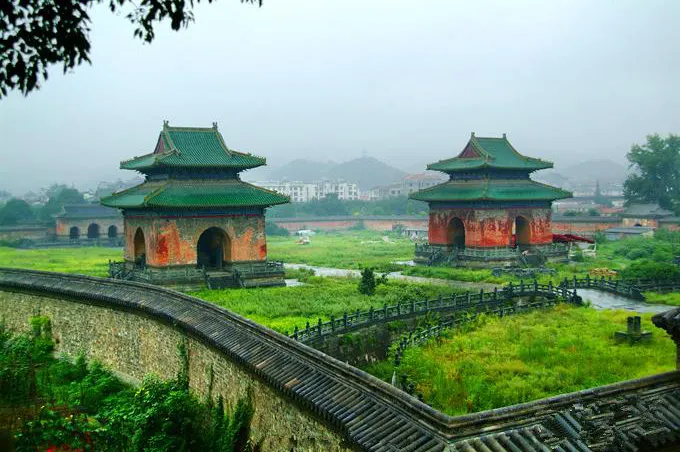
These three sit outside the ticket gate, cost nothing and are almost always empty. Xuanyue Gate is a five-roofed stone archway of 1552, its lintel carved with the words that made Wudang the Xuanyue — the mountain ranked above the Five Great Mountains — and it is the physical proof of that claim. A kilometre west, Yuzhen Palace was built for Zhang Sanfeng; in 2012, as the Danjiangkou reservoir filled, the whole group was jacked up fifteen metres, and you can still see the ring of new masonry under the old footings. Closer to town, Yuxu Palace was the largest of the nine Ming palaces and is now wall, platform and two green-glazed stele pavilions standing in long grass. At dusk, with nobody there, it is the quietest place in town.
Two identical green-glazed pavilions standing in the grass inside a walled compound — low tiled walls in front, the town's rooftops behind, mist still down
Taizipo: the Fuzhen Temple
Built in 1412 and laid out around the story of Zhenwu as a boy studying here. The compound steps up the slope, and its famous feature is the Nine-Bend Yellow River Wall: a red wall whose coping rises and falls with the hill while the walkway beside it turns, so that the wall ahead always blocks the view and always opens into another stretch. A local saying describes it as four gates in a third of a mile. In the Wuyun Pavilion, the twelve beams on one pillar are a textbook piece of timber engineering — a single column running floor to roof with twelve beams radiating from it to carry the storey above. Most visitors do not know why it stands; all of them stop and look.
Zixiao Palace: the Ming timber hall at its best
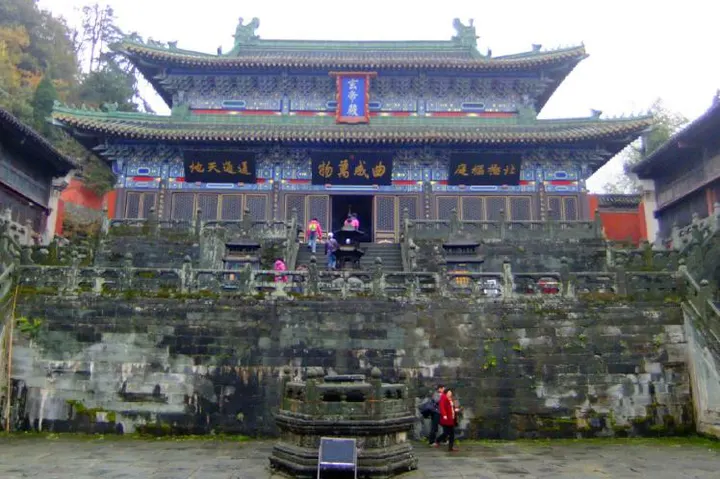
The Zixiao Hall — double eaves, peacock-blue glaze, a high stone platform below and a stair climbing its centre
Zixiao sits below Zhanqi Peak, founded in the Northern Song and rebuilt under Yongle; its main hall is the only double-eaved timber hall of this size left on the mountain. Look at three things. The roof: peacock-blue glaze, a colour reserved for imperial use in the Ming, with nine glazed dragons along the ridge. The brackets: seventy-two sets under the lower eave, fifty-six under the upper, each layer stepping outward until the eaves reach well beyond the walls. And the painted decoration inside — dragons, phoenixes, cloud and sea patterns across every beam, plus fifty-eight murals of Taoist deities on the walls. The two stele pavilions in the courtyard hold Ming stones recording how the mountain was rebuilt.
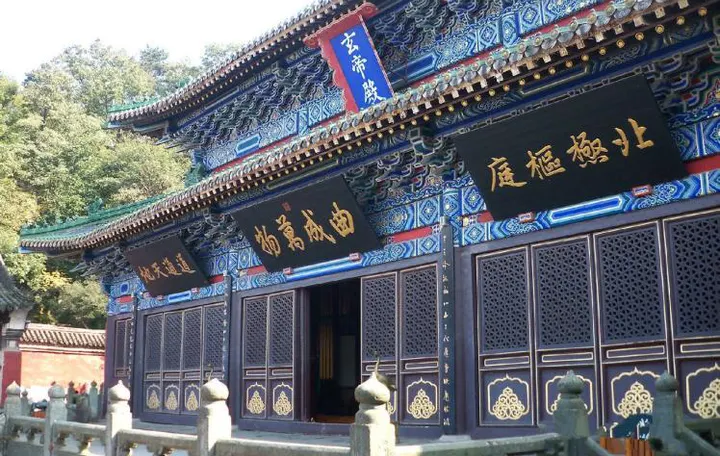
The stair up to the Zixiao Hall — broad treads polished in the middle, two figures talking at the bottomA hall front — blue-and-green painted bracketing across the whole eave, three black plaques with gold lettering, a stone balustrade running to the steps
The half hour most people do not spend at Zixiao is on the flanks: the east and west wings, which almost no visitor enters. The western range is living quarters, with laundry out and vegetables drying in the sun; the eastern side holds a small exhibition on Taoist practice. Above them stands the Hall of Parents, dedicated to Zhenwu's mother and father — an unusual feature of this mountain, where renunciation is taught alongside filial duty, and every main hall is backed by a hall for one's parents. That arrangement explains the place better than any plaque.
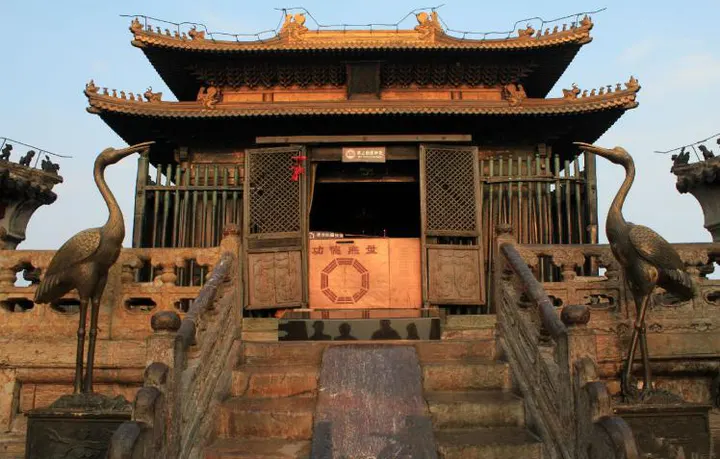
A pair of bronze cranes flanking a hall door, necks turned towards the steps; lattice doors behind, one panel painted with a roundel
Nanyan Palace: the stone hall on the cliff
Nanyan means the south-facing cliff, and it is the largest of the mountain's thirty-six rock faces. Yuan masons cut the Tianyi Zhenqing stone hall straight into it — beams, columns, brackets and tiles all stone, joints too fine to see. The Ming and Qing added the Liangyi Hall, galleries and gate in front, so the compound is half inside the rock and half hung outside it; walk the gallery and the boards ring underfoot with nothing beneath them. Three things to seek out: the Yuan stone carving inside the hall, the dragon head reaching out at the end of the gallery, and the view back to the summit from the cliff edge, where the Golden Summit is a small mark on a distant ridge and you understand how far you have come.
The Golden Summit: a walled rock and a bronze box
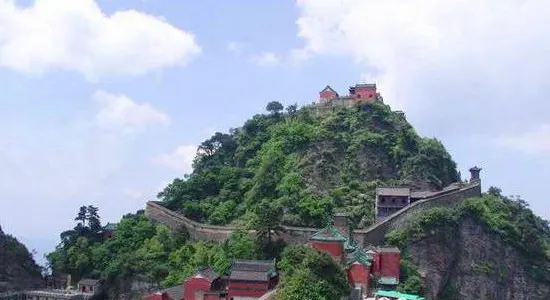
The top of Tianzhu Peak — the Zijin Cheng wall closing in from both sides, the two small halls of Taihe Palace inside it, and the Golden Hall above them
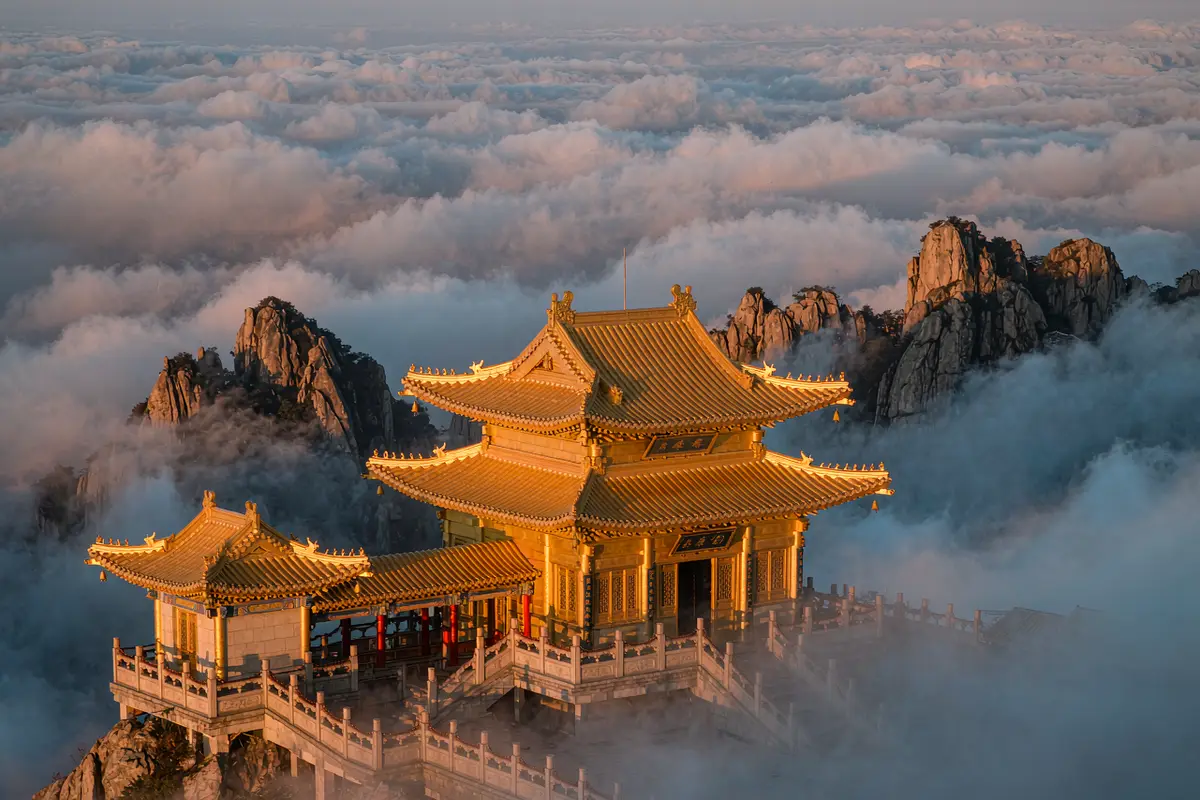
The last stage is the argument the whole mountain has been making. The Zijin Cheng wall rings the summit the way an imperial city wall rings a palace, scaled down until it can hold a single rock; inside it sits Taihe Palace, its halls of transfer, scripture and worship packed one against another because there is no room for anything else; and above them all, the Golden Hall — a bronze room less than three metres square, cast in Beijing in 1416, shipped up in pieces and bolted together, and still not rusted through after six centuries of weather. Lean on the rail and the seventy-two summits fall away in layers with the Han River glinting beyond. That view was designed. It did not happen by accident.
The pilgrim road: two ways up
From Wuyaling to Chaotian Palace the road is shared: flagstones, pines and oaks, passing Langmei Shrine, the Seven Stars Tree and Huanglong Cave. At Chaotian Palace it splits. Left is the Qing trail, about 4,600 steps, longer and gentler, and the one locals use for night climbs. Right is the Ming trail, about 5,700 steps, the imperial pilgrim route of the 1400s, running through the First, Second and Third Heavenly Gates to the Pilgrimage Gate, with a stretch of stair cut almost flush against the cliff — high risers, narrow treads, and chains to hold in the wet. The two rejoin outside the Pilgrimage Gate for the final pull to the summit. Kindest to knees: up the Ming, down the Qing. Kindest to everything else: the cable car.
06Beyond looking at halls
Sit in on a chanting service
Zixiao holds two services a day, the morning one starting somewhere between 05:30 and 06:50 depending on the season, the evening one in the mid-afternoon. This is not a performance for visitors. The priests file in blue robes, take their places, strike the bell and the bowl, and chant, with bows in between, for half an hour to an hour. You may stand at the back or along the side gallery: out of the line, silent, phone off, not photographing faces. You will not understand the words — the chant uses a reading that Chinese visitors do not follow either. What is worth the time is the rhythm. A hall full of people breathing and pausing together makes it plain that this is a working temple, not a ruin.
Eat in the refectory
Both Zixiao and Taihe Palace run refectories open to visitors: ¥20–30 a head, four or five vegetable dishes, a tureen of soup and as much rice as you want. You have to sign up at the door — lunch by about 09:30, breakfast the day before — and meals go at roughly 07:30, 11:30 and 17:30, after which the kitchen is closed. The rule is to take what you will eat, wash your own bowl and stack it back on the rack. The food is plain and light on oil, but after half a day on steps a bowl of hot soup beats anything on a menu.
The forecourt at first light
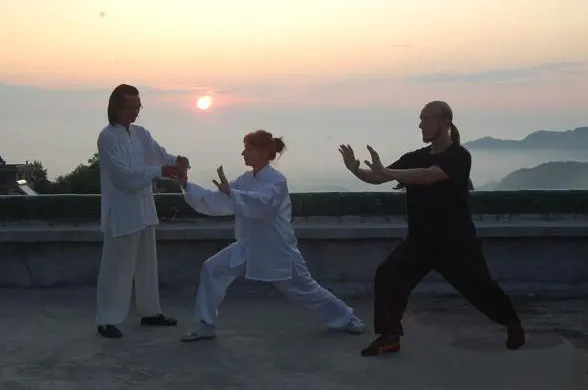
A terrace at sunrise — three people working through a two-person drill, two in white and one in black, cloud still sitting in the valley below
Between 06:30 and 08:00 there is practice everywhere: the forecourt at Zixiao, the terrace at Nanyan, the roofs of half the guesthouses at Wuyaling. Some of them are priests, some are long-stay students, some are hotel guests copying what they see. There is nothing to sign up for; stand at the edge and follow along if you like, and everyone goes their own way afterwards. The light in that hour is the best of the day — the sun clearing the eastern ridge while the mist is still down, people reduced to outlines inside it. For photographs the window is about 06:40 to 07:10; after that the mist lifts.
Take a martial-arts class
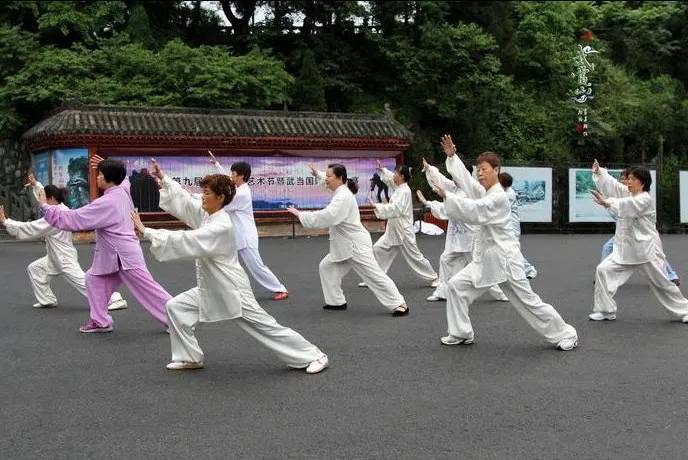
A morning class in the plaza — mostly white uniforms, one in purple, two rows deep behind the instructor, a banner strung up at the back
A dozen schools operate in the town below, most of them taking short-stay students and casual drop-ins alike. A single session usually covers three things: standing posture and how to release the shoulders, a few basic stepping patterns, and a short sequence of tai chi moves. Most coaches manage some English and fall back on demonstration, which works better anyway. Prices: ¥100–300 for a taster session; ¥1,800–3,000 for a five-to-ten-day course by form, with food and lodging at ¥200–300 a day. An international tai chi festival runs in autumn, with demonstrations and push-hands in town and on the mountain; the dates move each year, so check before you book — it is worth rearranging a trip for.
Walk Xiaoyao Valley, and listen to Taoist music
Xiaoyao Valley sits just above Zixiao: a stream gorge with a flat boardwalk, an hour or so each way, and places to paddle in summer. Wild macaques live in it — do not feed them, do not reach out, and keep plastic bags out of sight, because bags get snatched every year. Taoist music is a different matter: the sound used for temple rites, bell and drum and bowl, flute and mouth organ together, brighter in tone and slower in pace than Buddhist chant. Zixiao and Taihe Palace use it on important dates and you either catch it or you do not. Missing it costs nothing; wind and water in the gorge are part of the same music.
07Three bases, and the wrong one ruins your second morning
There are only three places to sleep at Wudang: Nanyan and Wuyaling halfway up, Qiongtai higher on the cable-car line, and Wudangshan town at the gate. The difference between them is not price. It is where you wake up on the second morning. From Wuyaling you can be walking by 04:30; from Qiongtai the first cable car at 08:00 is at your door; from town you are up at six, at the gate by seven, at Nanyan by half past eight, and the sunrise has been over for two hours.
Nanyan and Wuyaling, halfway up, the sunrise base: simple guesthouses ¥120–260 with small rooms and sometimes no window; mid-range places ¥250–400, most with a viewing terrace you can watch dawn from under a blanket; the best from ¥900 with floor-to-ceiling glass, underfloor heating and a tub. What they share: no lifts, bags carried up by hand, and nothing to eat after nine.
Qiongtai, at the lower cable-car station: ¥170–420, the most dependable value of the three. The advantage is that cable car and shuttle both leave from the door and there is no travelling on day two; the drawback is distance from Nanyan and Zixiao, and nowhere to walk at night beyond a couple of courtyards.
Wudangshan town, at the gate: guesthouses ¥150–260, hotels ¥400–800 — the Jianguo sits fifty metres from the ticket hall, the Junlan out by Taiji Lake. Food, shops, cash machines and a clinic are all here, plus a night market; the cost is an early start and no sunrise.
Temple rooms at Zixiao and Taihe Palace: a few dozen yuan a bed, bunks or a shared platform, communal washing, and the community's hours, which begin with the board at five. Worth one night as an experience; do not treat it as a cheap hotel, because it is not a hotel.
Three practical notes. Book mountain rooms a week or more ahead over May Day, National Day, the summer holidays and the temple fairs — those few dozen rooms at Wuyaling are the tightest supply on the mountain. Before booking, ask three questions: is the bathroom private, is hot water time-limited, and how far is the shuttle stop? Five hundred metres of mountain path with a suitcase is a different experience from fifty. And because the mountain is damp, ask in winter about electric blankets or heating; in summer you will not need either, since nights sit just above twenty and an open window does the job.
08Temple vegetarian food, sanhe soup, and fish from the reservoir
Wudang is in Shiyan, and the cooking is north-west Hubei: salty, chilli-heavy, generous with oil, closer to Shaanxi and Henan than to Wuhan, with more wheat than rice. Everything on the mountain arrives by truck, so prices run thirty to fifty per cent above town — twenty-odd for a plate of greens, twenty for a bowl of noodles, ten for a bottle of water. The sensible split: eat temple food and noodles up top, and save the proper meal for the town below.
Temple food: vegetables dressed as meat
Wudang's temple cooking has a signature trick: vegetables made to look and be named like meat. Tofu, wheat gluten, mushrooms and konjac are shaped and titled as fish, pork or knuckle, and taste of none of them. The reason was practical — pilgrims arriving after a long climb wanted a proper meal but could not eat meat, so the kitchens improvised. Today's refectories are simpler: a few seasonal vegetables, tofu, mushroom broth, rice, ¥20–30 a head. Zixiao's refectory serves at 11:30 and needs a sign-up; Taihe Palace's costs more but you eat with the cloud outside the window.
What to eat down in town
Sanhe soup: a breakfast, and a cure for the night before. Beef, sweet-potato noodles and a few dumplings in a sour-hot broth, ¥15 a bowl. The shopfront usually has a cauldron going with a clay pot standing in the middle of it.
Danjiangkou fish head: a big reservoir carp head, braised or in soup, ¥30–40 for a small portion that feeds two. The water is the reason it tastes of something.
Zhuxi steamed basin: the banquet dish, cured pork, chicken, egg dumplings and yam layered in a basin and steamed for hours. One basin feeds four or five at ¥50–60 a head, and it makes most sense in winter.
Cured pork with fern, rock fungus with chicken, and lan doufu — the three everyday mountain dishes. The fern is picked in spring and dried for the year; rock fungus is a lichen off the cliffs, expensive and often faked; lan doufu is a gruel of soybean solids and greens, ¥5 for a big bowl, the plainest and most comforting thing on any menu.
Wudang tea: grown around 800 m near Baxian Guan. A pot in a town teahouse is ¥20–30 with refills; to buy, ¥100–600 per 500 g is the honest range, and anything under ¥80 is unlikely to be from this mountain.
Where: the snack street along Yuxu Street in town, busiest after dark, with skewers, cold noodles, crisp-bottomed rice and fermented noodle soup at ¥30–40 a head; the Golden and Silver Streets by the gate are tourist restaurants, pricier and worse. For a proper meal, walk into the residential streets and pick a place with local number plates parked outside. Number plates are a better guide than reviews.
09Tea, walking sticks and dried goods — skip the swords
There is not much here worth carrying home, but a few things are genuine. The test is simple: will it be eaten, worn out, or given away? Anything that only works if you believe in it stays in the shop.
Wudang tea: green leaf from the gardens around Baxian Guan and Zixiao, tightly rolled and good for several infusions. Taste before buying — shops in town and on the mountain will brew for you — and expect the price at a sight entrance to be double what the same leaf costs up a side street.
Wanshou vine walking sticks: vine steamed, bent, carved and lacquered, light and springy in the hand, ¥30–120 depending on the carving — dragon head, longevity figure, monkey. The most practical thing on sale here: buy one before the pilgrim road and give it away at the bottom.
Dried mushrooms, wood ear, bamboo shoot and rock fungus: the most useful category, sold by weight for a few tens of yuan. Check three things — insect holes, a musty smell, and whether it is actually dry. Squeeze it; if it yields, it has taken damp.
Mandarins, kiwi and langmei: local fruit, best in autumn. Langmei is the mountain's own — a plum grafted onto a betel-nut tree in the old story — sour-sweet fresh, and also dried or made into wine. The season is short; buy when you see it.
Three things to leave alone. Swords and blades: Wudang swords are performance equipment, the good ones are not cheap, and they cannot travel by train or plane without a fight — most end up on a wall gathering dust. Second, anything sold as blessed or consecrated: the temples do have small shops where a charm or a string of beads costs ¥20–30, which is a souvenir; the stalls outside quoting several hundred for something that will change your luck are a business, not a religion. Third, anything advertised as wild — wild rock fungus, wild herbs, animal products. Buying and selling are both illegal.
10High-speed rail to Wudangshan West, then transfer
Three stations, one airport
Wudangshan West is the high-speed station, out at Liuliping twelve or thirteen kilometres from the gate: bus 301 from the forecourt, ¥2, thirty to forty minutes, timed to train arrivals and running until about 23:00; a taxi is around ¥30. Shiyan East has more services and sits thirty-two kilometres out: a free shuttle runs to the gate in twenty-five minutes for anyone holding a high-speed ticket, otherwise bus 202 costs ¥5 and takes an hour. Wudangshan Station is the old conventional-rail stop in Liuliping itself, ten minutes and ¥10–15 by taxi. Flying into Shiyan Wudangshan Airport, twenty-five kilometres away, the shuttle bus is ¥10–15 and takes thirty-five minutes. The rule: from Wuhan or Xi'an, book to Wudangshan West; from Chengdu, Chongqing or Zhengzhou many trains only reach Shiyan East, which is no loss, since the shuttle is faster anyway.
Inside the gate there is one mode: the shuttle
Private cars are barred from the core zone and park at the visitor centre (¥20 a day); you continue by shuttle. The pass is ¥76, valid three days, hop-on hop-off, on one main line with a branch: visitor centre to Taizipo (the interchange), then Zixiao, then Nanyan at Wuyaling; the branch changes at Taizipo for Qiongtai, the cable-car base. Either end is about fifty minutes from the gate, all of it switchbacks — take travel-sickness tablets half an hour before. Buses run 07:00–17:30 in summer (Qiongtai until 18:00) and 07:30–17:30 in winter and spring. Miss the last one and you walk down or sleep up here. That is not a figure of speech; people are left behind every year.
The cable car: five minutes for three hours of steps
The Qiongtai cable car runs from the Middle Temple to just below the summit: ¥45 one way, ¥85 return for adults, ¥22 and ¥42 for children, free under 1.2 m. Those fares are down from ¥80 and ¥150 — a genuine cut, and a rare one among Chinese scenic areas in recent years. It runs 08:00–17:30, extended at busy periods. That matters more than the price: people linger at Nanyan, reach Qiongtai at 16:30 and discover the last car went earlier than they assumed, since the low season often closes at 16:30. In high season the queue can exceed an hour; 08:00 to 09:30 is the quiet window. High wind, thunderstorms and ice stop it at short notice, announced over the speakers, and there is an annual maintenance shutdown in early-to-late December when the only way up is on foot.
On foot: three ways up
The Ming trail is about 5,700 steps and three to three and a half hours: Wuyaling to Langmei Shrine, the Seven Stars Tree, Huanglong Cave, Chaotian Palace, then the three Heavenly Gates and the Pilgrimage Gate to the summit. It is the imperial pilgrim route of the 1400s and the steepest option. The Qing trail is about 4,600 steps and two and a half to three hours, branching left at Chaotian Palace, gentler and more evenly cut — the route nearly everyone takes for a night climb. The third, up from behind Qiongtai, is about 2,000 steps and an hour and a half — and has been closed since 26 October 2026 for rock-fall work, which leaves Nanyan or the cable car as the only ways up. Few people walk all three; most go up one and down another, or walk up and ride down.
Getting here from Wuhan, Xi'an or Shiyan
From Wuhan: Hankou to Wudangshan West in as little as 2h10m, ¥209–229 in second class, a dozen or more departures a day; trains from Wuhan station are slower at 2h56m for ¥242. From Xi'an: since the Xi'an–Shiyan line opened, Xi'an North to Wudangshan West is about two hours for roughly ¥200, which puts you on the mountain by midday if you leave in the morning. From Shiyan: thirty-two kilometres to the gate, twenty-five minutes by shuttle, an hour by bus. From Xiangyang: forty minutes by high-speed rail to Shiyan East, or two hours on the G70 expressway to the gate. Driving, leave the expressway at the Wudangshan exit, two kilometres to the visitor centre, parking ¥20 a day.
Check trains and fares from Wuhan to Wudangshan West
Hours: the gate itself never closes, but entry checks run 07:30–17:00 and stop at 17:00. Shuttles run 07:00–17:30 in summer (Qiongtai to 18:00) and 07:30–17:30 otherwise. The cable car runs 08:00–17:30. Three different clocks — plan to the earliest.
Current closures: the footpath from Qiongtai to the summit has been shut since 26 October 2026 for rock-fall clearance, so you go up via Nanyan or by cable car; and the cable car takes an annual maintenance break in December (6–30 December in the 2026 plan). Both are announced in advance on the park's mini-program — check it before you travel rather than trusting any guide, including this one.
Bookings: everything is real-name and online, through the Wudangshan Smart Tourism mini-program on WeChat, or Ctrip, Meituan and Douyin. The summit needs its own timed slot (12,000 a day, 7,000 before noon) — book a day ahead, three days ahead at holiday time. Staffed windows exist, but the popular slots are usually gone.
ID: Chinese visitors tap their ID card at the gate. Foreign visitors book with a passport number and go through the staffed lane for verification, with the booking QR code and passport both in hand. Guesthouses on the mountain will also need the passport at check-in.
Money and signal: QR payment works everywhere in town, and Alipay's international version links Visa and Mastercard; most stalls up the mountain take it too. Signal is 5G in town and 4G at the main halls, dropping out altogether on the middle of the pilgrim road and behind the summit. Carry a couple of hundred in cash.
Medical: first-aid rooms at Nanyan and Qiongtai handle sprains, cuts and mild heat exhaustion; the nearest full hospital is the Taihe branch down in town, forty minutes by ambulance. For bad knees, a brace and a stick are worth more than any tablet.
Temple etiquette: step over the threshold, never on it. Do not point at statues or pose with your back to them. No flash inside, and no photographs of priests mid-chant. If you burn incense, use the three free sticks the temple provides rather than the expensive bundles sold at the gate. Address a priest as daozhang, not as monk. And if a rite is under way, either stand quietly at the back or walk on.
Also: no smoking outside marked areas; drones need permission and are largely banned in the core zone; do not feed the macaques, climb the railings or step onto unmarked rock; and carry your rubbish down, since bins up here are few.
12What to pack, and how to dodge the coaches
Footwear: grippy, treaded, good on wet stone. Parts of the pilgrim road are polished smooth by six centuries of feet and turn greasy in rain. Not new shoes, and nothing with a flat leather sole.
Clothing: the summit runs six to eight degrees cooler than the valley and is windy. Even in summer, bring a light layer and a windproof shell; in winter, a down jacket, hat and gloves. Anyone going up for sunrise needs a jacket in August, when dawn sits around 15 °C.
Water and food: ¥10 for a bottle and ¥20 for instant noodles up here, and the only shop on the pilgrim road is at Chaotian Palace. Carry 1.5 to 2 litres and something salty and something sweet.
Two winter additions: crampons (¥15 in town, ¥50 up top) and a head torch. On a pre-dawn climb a phone light is not enough, and there is no lighting on the steps.
Medicine: travel-sickness tablets for the fifty-minute switchback road, a knee brace, plasters. If your knees have history, swap the Ming trail for the cable car rather than toughing it out; the descent does more damage than the climb.
Screenshots: signal drops up there. Save the QR codes for the ticket, the summit slot and the cable car to your photo library before you go up.
The coach timetable is worth memorising separately. The standard pattern: gate at 08:30, Taizipo at 09:30, Zixiao at 10:30, lunch at Wuyaling at noon, Qiongtai cable car at 13:30, summit at 15:00. So either go two hours earlier — in at 07:00, Zixiao by 08:00, alone — or two hours later, taking the cable car after 14:00 when the groups have gone. The bad window is 10:00 to 14:00, when the Zixiao courtyard is a forest of flags and the cable-car queue runs out of the building.
Three smaller things. Summit slots are released by the hour: arriving early gets you turned away, arriving late gets you locked out, so pick a slot about an hour after you expect to reach the cable-car station. A second entry costs ¥20 in shuttle supplement, which makes going out for lunch and coming back a bad plan. And there is no ATM and no pharmacy up there — buy what you need in town.
13Taoism, Zhenwu, and one dynasty's building site
What Taoism is
Taoism is China's indigenous religion. It takes the idea of the Tao — the way things run — from the Daodejing, and builds on it a pantheon, a set of practices (seated meditation, guided movement, breath work, internal alchemy) and a ritual system. It is not the same thing as Taoist philosophy: Laozi was a thinker, and Taoism honours him as a deity; Taoism has an organised clergy, temples, monastics and lay followers. The people in blue robes at Wudang are priests; the halls are where they work; the statues are what they address. The statues are also first-rate Ming sculpture, which is a separate fact about them.
Zhenwu: the mountain's owner
Zhenwu, the Perfected Warrior, also called Xuanwu, is the Taoist deity of the north, of water and of martial force. North belongs to water in the five phases and its colour is black, which is why the earliest images show a turtle and snake coiled together; a naming taboo in the Song changed Xuan to Zhen. The scriptural story makes him a prince of the kingdom of Jingle who left home at fifteen, practised on this mountain for forty-two years and ascended bodily on the ninth day of the ninth month. That story explains the whole layout. Taizipo is where the boy studied; Moxingjing is where, ready to give up, he was shown an old woman grinding an iron rod into a needle; Nanyan is where he practised; the summit is where he rose.
What made this god a national figure was an emperor. Zhu Di rose against the court from Beijing in 1399, marched south under the banner of clearing it of corruption, and took Nanjing — and the throne — from his nephew in 1402. He needed a narrative that made him legitimate, and Zhenwu, a god of the north and of war, fitted exactly: before the campaign he announced that Zhenwu had appeared to him, and after it he issued decree after decree raising Wudang above the Five Great Mountains. This was not simple piety. It was politics and religion using each other, with both sides getting what they wanted.
Three hundred thousand people, twelve years
In 1412 Zhu Di ordered the rebuilding of Wudang: 300,000 soldiers, artisans and labourers, the imperial treasury, materials requisitioned from across the empire, and work continuing until 1424. The result was nine palaces, eight temples, thirty-six hermitages, seventy-two cliff chapels, thirty-nine bridges and twelve pavilions, in thirty-three separate complexes. The timing is the interesting part. The Forbidden City was going up in Beijing over the same years, which is why the two are always spoken of together — same craftsmen, same imperial construction manual. The Golden Hall shows what that system could do: cast in Beijing, numbered, taken apart, shipped down the Grand Canal, up the Han River and carried to the summit to be reassembled.
Zhang Sanfeng: between a man and a legend
Zhang Sanfeng was a Taoist priest of the late Yuan and early Ming. He existed; his life is obscure, and the legends grew after his death. Everything on this mountain to do with martial arts points at him — the internal schools, the thirteen tai chi postures, the principle of yielding to force. One clarification: crediting him with inventing tai chi is tradition, not documented history. The earliest surviving tai chi manuals date from the mid-Qing, three centuries later. None of which stops him being the mountain's cultural emblem. Zhu Di built Yuzhen Palace for him and sent envoys to find him, without success; the schools in town still regard him as the founder. Wudang martial arts were inscribed on the national intangible heritage list in 2006.
After 1994
In 1994 the Wudang building complex was inscribed as a World Heritage site, on the grounds of its position at the high point of Ming imperial architecture and the way the buildings answer the landform. The three decades since have been about two things: repair, and moving. Repair: Zixiao began a systematic programme on its roofs and timber in March 2025, and when the glazed finial on the main ridge was opened, 343 coins came out of it, the oldest a Northern Song piece from around 1105; the hall reopened that September. Moving: because the Danjiangkou reservoir, source of the South–North Water Transfer, was raised, Yuzhen Palace was jacked up fifteen metres entire — one of the largest such lifts in Chinese conservation.
14A lake, a dam, and another mountain three hours west
Taiji Lake (half a day)
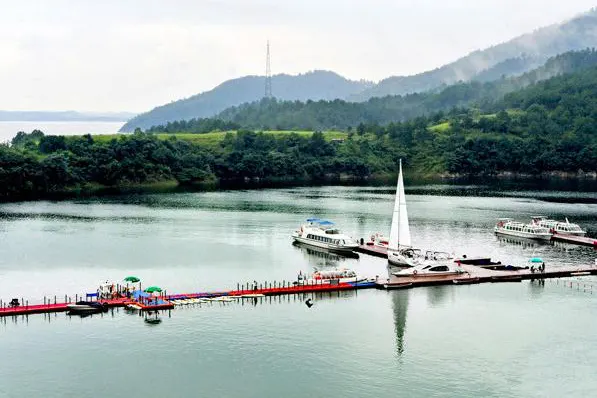
Taiji Lake — a pontoon pier running out into the water, a few tour boats tied up, wooded hills on the far shore
Four kilometres east of the gate, this is a bay of the Danjiangkou reservoir, named for the taiji shape it makes. A road runs round it and an hour on a bike covers a decent stretch; boats go out for forty minutes to an hour for a few tens of yuan. The hour worth planning for is dusk, when the sun drops behind the western hills, the water turns copper and the ridges sit against it like cut paper. The lakeside restaurants do fish three ways at ¥60–70 a head.
Danjiangkou Dam (half a day)
Forty kilometres north-east, a dam begun in 1958 and later raised, holding the water that the South–North Water Transfer sends to Beijing. The connection to Wudang is direct: raising the reservoir is why Yuzhen Palace had to be lifted, and a third of the mountain's land now falls inside the water-source protection zone. The dam area can be visited with a booking, and from the crest the water runs to the horizon. Go if engineering interests you; skip it if it does not.
Shennongjia (two days)
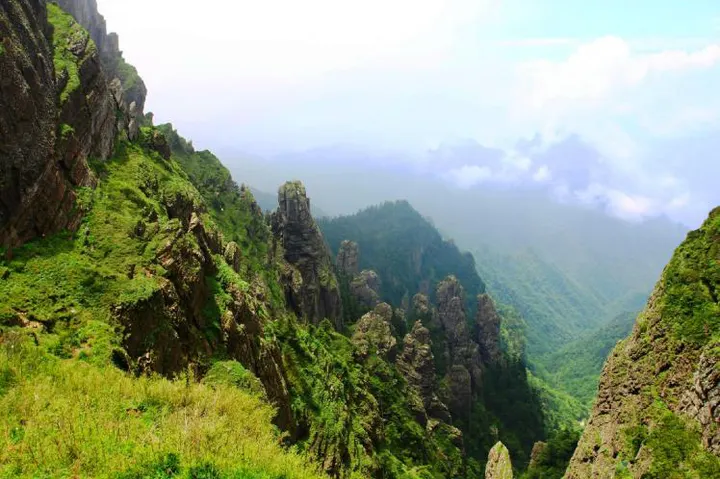
Shennongjia — a steep slope of mixed conifer and broadleaf, rock towers breaking out of the forest, cloud sitting halfway up
Two hundred kilometres south-west, about three hours by car or hired van; by public bus you change at Fangxian and lose half a day. Shennongjia is a high-altitude forest reserve whose highest point, Shennong Peak, stands above 3,100 m — a kilometre and a half above Wudang. What you come for: dawn mist over the Dajiuhu wetland, the boardwalks of Shennong Valley, the old-growth forest at Jinhou Ridge, and whatever wildlife turns up at the roadside. The ticket is a multi-day pass, valid five days, a bit over ¥200. Two days covers the main line; three is unhurried.
Dajiuhu — water divided into channels by grassy banks, a line of willows standing in it, soft green hills behind
Shiyan and Xiangyang (half a day each)
Shiyan is a car town with little to see, though the Wudang Museum earns an hour — its Ming bronzes and building fragments tie together what you have spent two days looking at. Xiangyang is further but better value: forty minutes by high-speed rail, a city wall largely intact, a stretch you can walk at the Linhan Gate, and two old temples in town. If you have a gap between trains, spend it in Xiangyang rather than Shiyan.
15How a mountain got into a martial-arts novel, and then onto film
The documentary to watch first
In Search of the Way on Wudang is a nine-part series from CCTV's Discovery strand, covering the mountain through geology, architecture, religion and martial arts, with interviews and footage shot across all four seasons. Its virtue is that it does not sell the place: how the buildings were put up, how a priest's day runs, how the fighting arts turned into health practice — all handled concretely. Watch two episodes before you go and the halls stop being just buildings.
Two films: one to take seriously, one not to
Wu Dang (2012, directed by Patrick Leung) is a Hong Kong action film: Republican era, seven treasures, a martial-arts tournament, several factions racing across the mountain to get them, with Vincent Zhao and Yang Mi. It has almost nothing to do with the real place, but it does shoot the summit, Nanyan and Zixiao, so it works as a travelogue. The other one, A Dream of Kung Fu (2012), follows a Taiwanese boy sent to study here, is plainly made, and is more honest about what training actually changes in a person.
The novel: Jin Yong's Wudang
Jin Yong's The Heaven Sword and Dragon Saber (1961) closes his Condor trilogy, spans a century, and puts Zhang Sanfeng — the mountain's legendary founder — among its central figures. In the novel Wudang is a martial sect to set beside Shaolin, with seven disciples, a tai chi sword style and a philosophy of beating speed with slowness. The distinction worth keeping: the sect is fiction, the mountain is a working Taoist complex of which martial practice is one part. But the novel shaped how several generations of Chinese readers picture the place, and for many of them it was the first they heard of it.
The travel diary: Xu Xiake's day here
In 1623 Xu Xiake climbed the mountain and wrote in his diary that Zixiao faced the Yuji Pool with its back to Zhanqi Peak, that Nanyan's gallery hung like a suspended corridor, and that at Langmei Shrine he asked the priests for langmei fruit to send home for his mother's birthday. Those lines are more accurate than any guidebook, because what interested him was how buildings sit on rock, not atmosphere. The pool outside Zixiao is the same pool. Langmei Shrine is still on the pilgrim road; the trees are long gone.