Cycling the wallThirteen dynastiesNoodle paradiseThe Terracotta Army
In short
Xi'an — the ancient capital Chang'an — is China's most history-saturated city. You can cycle the Ming-dynasty City Wall, stand face to face with a 2,000-year-old army at the Terracotta Army, and eat your way through the Muslim Quarter from breakfast to midnight. Spring (March–May) and autumn (September–November) have the best weather; plan 3–5 days with a mid-range budget of roughly ¥2,000–3,000 excluding long-distance transport. The metro reaches most sights, and headline attractions like the Terracotta Army require advance online reservation.
Key facts
Known for
Terracotta Army · City Wall · Muslim Quarter · Ancient capital
Budget
¥2,000–3,000 for 3–5 days, mid-range
Days needed
3–5 days
Comfort
Moderate
Best time to go
Spring (Mar–May) and autumn (Sep–Nov)
01What kind of city Xi'an is
Xi'an, known in ancient times as Chang'an, is one of the cradles of Chinese civilization. Thirteen dynasties — the Zhou, Qin, Han and Tang among them — ruled from here for over eleven hundred years combined, making it one of the longest-serving capitals on earth.
History here is daily life, not something behind glass. Inside the wall lies the old city; locals call the districts beyond it simply the east, west, south and north suburbs. People trace calligraphy models from the Stele Forest, sing Shaanxi opera under the South Gate at dusk, then walk into neon-lit shopping blocks.
When a glorious city fades into the years, it at least leaves behind a silhouette.
"Once You've Been, You Never Really Leave"
For travelers, Xi'an's themes are simple: history and food. One downtown day covers the wall, towers and pagodas; an eastern day goes to the Terracotta Army; Mount Hua and the western sites each deserve a day, and the rest of your appetite goes to the Muslim Quarter. Prepare for the climate above all — the air here is much drier than the south, so drink constantly and pack moisturizer.
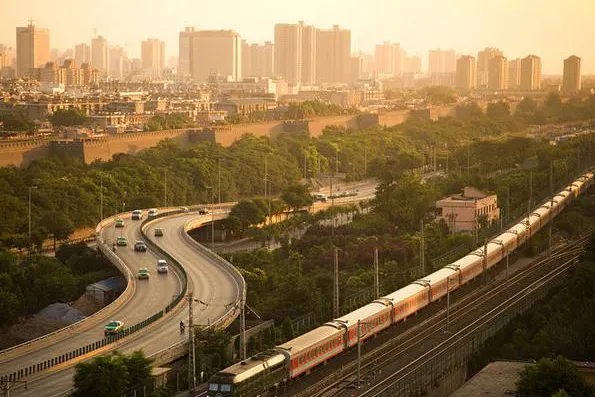
Xi'an at dusk, with a metro train sweeping through the foreground
02Six things worth remembering
Cycling the City WallThe classic move
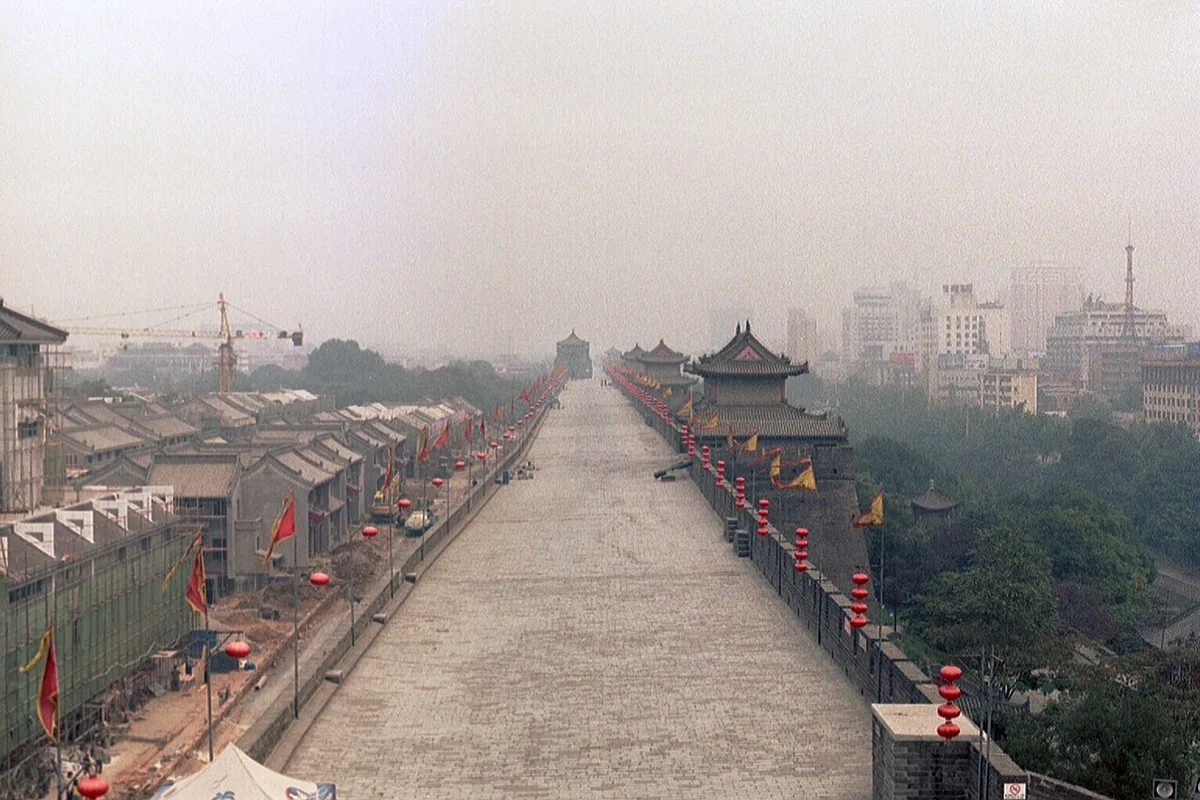
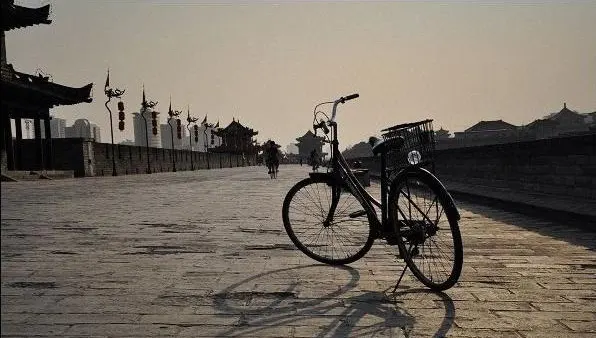
Climb the best-preserved Ming-dynasty city wall in the country and watch tiled rooftops brush shoulders with glass towers. The full loop runs 13.7 km — too far to walk — so rent a bike like everyone else and rattle along bricks laid in the 1370s; steady pedaling takes about 40 minutes.
Bell Tower and Drum TowerHeart of the old city
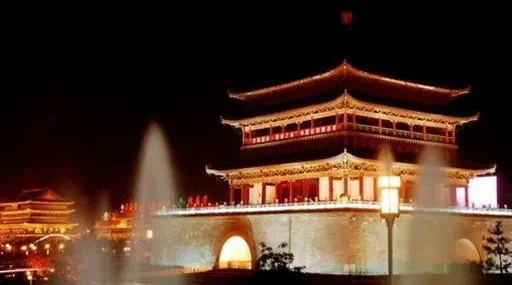
The Bell Tower anchors the crossing of the four great avenues; the Drum Tower stands 300 m west with the Muslim Quarter behind it. On a clear day the Bell Tower looks out to a city gate in each direction, and after dark both towers light up beautifully — the food street below is the logical next stop.
The Terracotta ArmyThe eighth wonder
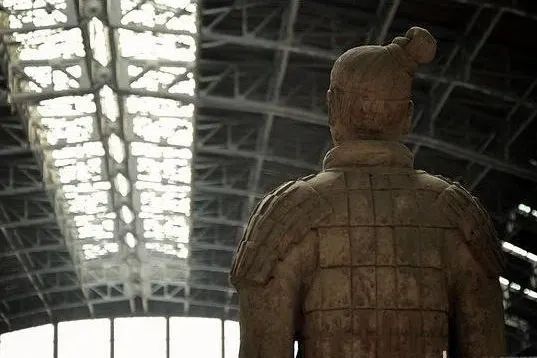
Thousands of life-size terracotta soldiers stand in the funerary pits of Emperor Qinshihuang, and no two faces repeat — every soldier was modeled on a real man. Pit 1 delivers the big wow. The pits and Lishan Garden at the mausoleum form one museum on a single ticket, with a free shuttle between them.
Feasting in the Muslim QuarterStreet-food headquarters
Yangrou paomo (lamb soup with hand-torn bread), spiced-beef roujiamo, skewers, mirror-steamed rice cakes — the Muslim Quarter is where Xi'an's street food concentrates, ideal for an afternoon of grazing. The side streets of Xiyangshi, Dapiyuan and Sajinqiao often beat the main Beiyuanmen strip on both flavor and price.
Sunrise on Mount HuaThe steepest of the Five Greats
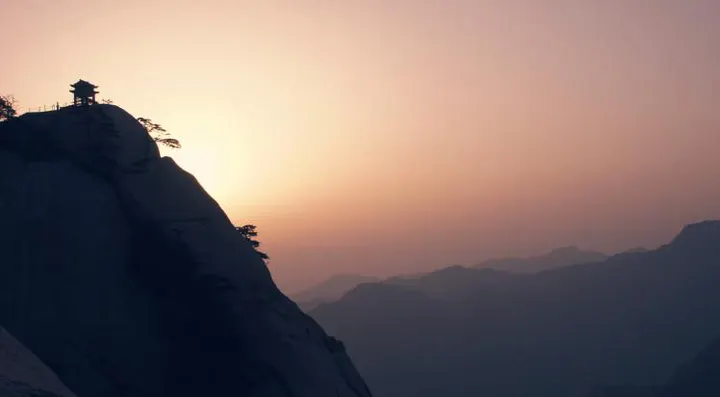
The westernmost of the Five Great Mountains, Mount Hua is famous for sheer danger: granite peaks rise like swords off the plain. At sunrise, mist floods the valleys and the sun bursts out of crimson cloud. Take the night hike for sunrise, or the cable car by day.
Thirteen dynasties in one museumPearl of the ancient capital
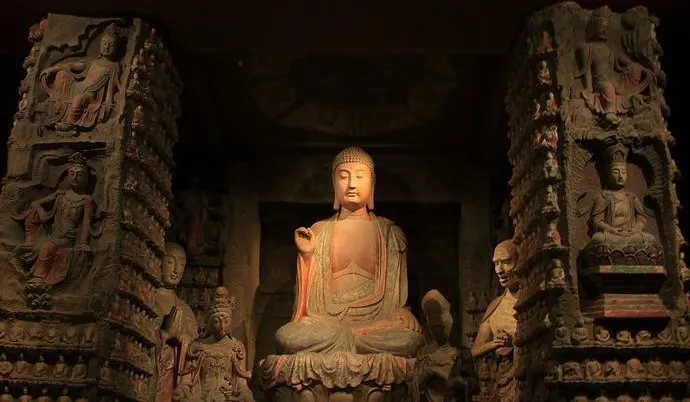
To grasp Xi'an's depth in one visit, head to the Shaanxi History Museum: Shang and Zhou bronzes, dynasties of pottery figurines, Han and Tang gold and silver, and Tang-tomb murals found nowhere else. Entry is free but strictly ticketed — reserve on the official WeChat account days ahead.
03The questions everyone asks first
When is the best time to visit Xi'an?
March–May and September–November. Spring is comfortable for the wall and Mount Hua; autumn brings fire-crystal persimmon season. Summer sun is brutal at midday; winter is dry and cold but quiet.
Will the northwestern food suit me? Anything I should know?
The food leans on wheat noodles, paomo (bread soaked in mutton broth) and beef or lamb, with bold flavors — but variety is enormous, so something will suit you. Tear the bread for paomo yourself and tear it small; halal restaurants serve no alcohol and no blood-based dishes; and choose busy stalls.
How do I get to the Terracotta Army, and how much is admission?
The site sits in Lintong District, about 35 km from downtown. Admission is ¥120 — including Lishan Garden at the mausoleum, same price all year — and you must book a real-name ticket through official channels. Transport options: a ticket-plus-shuttle package from the city (around ¥170–188), the You5 (306) tourist bus (¥6–7), or Metro L9 to Huaqingchi plus a short local bus or taxi.
Is Xi'an expensive?
Moderate overall — eating and sleeping are genuinely cheap: paomo runs ¥30–60, chain hotels ¥200–350 a night, hostel bunks a few dozen yuan. The big-ticket items are entry fees (¥120 for the Terracotta Army, the Changhen Ge show from ¥268) and extras like the Mount Hua cable car. Budget roughly ¥2,000–3,000 for 3–5 mid-range days excluding long-distance transport.
Which area should I stay in?
First-timers should stay inside the walls around the Bell Tower and South Gate: Metro L2 runs through, the Muslim Quarter and the wall are a short walk, and hotels pack every price point. Budget picks include the courtyard hostels Xiangzimen and Qixian; for comfort, stay near the South Gate or the pagoda.
How do I get into town from the airport and the rail stations?
Xi'an Xianyang International Airport is about 45 km out: the easiest run is Metro L14, around ¥7 between the airport terminals and North Railway Station, where you change to L2 or L4. Airport shuttle buses cost about ¥25; a metered taxi into the center runs ¥120–150. High-speed trains mostly use Xi'an North — the metro sits directly beneath the platforms.
Is the night climb of Mount Hua worth it?
If you want the sunrise and your legs are willing, absolutely. The night route sets off from Yuquanyuan and follows the 'single path up Mount Hua' to the East Peak by dawn, joining a river of headlamps. The summit is far colder — bring a warm layer or rent a coat up top. Otherwise take the West Peak cable car by day.
04Two days downtown, one day east
Xi'an's sights cluster neatly, which makes planning easy. Two downtown days cover the walled city and the pagoda district, the eastern line takes one more, and Mount Hua or Famen Temple each merit an extra day. Read a little about the dynasties first — the pits, towers and steles double in meaning once you know what you are looking at.
D1
The old-city day: start at the South Gate — stroll the wall there or rent a bike for the full loop while the air is cool. By noon, come down to the Bell and Drum Towers, then dive into the Muslim Quarter for yangrou paomo and liangpi. In the afternoon walk Shuyuanmen cultural street down to the Xi'an Beilin Museum — the Stele Forest — and finish at the Small Wild Goose Pagoda and Xi'an Museum.
D2
Museums and the pagoda: spend the morning at the Shaanxi History Museum (book ahead!) — half a day disappears pleasantly among bronzes, figurines and Tang murals. In the afternoon move to the Giant Wild Goose Pagoda squares and the Tang Paradise Never Night City. Catch the musical fountain on the North Square in the evening, then let the light shows run you to midnight.
D3
The eastern day: go straight to the Terracotta Army early to beat the tour buses, and consider hiring a guide — Pit 1 is the showstopper. In the afternoon continue to Lishan Garden for the bronze chariots, then on to Huaqing Palace for the imperial bath ruins. If you want the Changhen Ge night show, book tickets well in advance.
05From the wall to the Terracotta Army
Xi'an City Wall
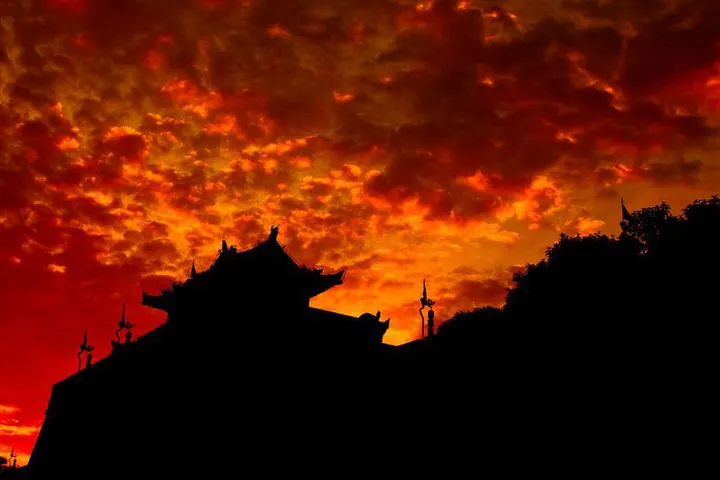
The South Gate tower against a burning sunset
The surviving wall, built between 1374 and 1378 under the Ming, is China's most complete ancient city wall: 13.7 km around, pierced by 18 gates. The South Gate is the best entrance. Admission is ¥54 (¥27 for students), open 8:00–22:00; Metro L2 Yongnimen. There is almost no shade on top — avoid midday in summer.
Bell Tower and Drum Tower
The Bell Tower, first raised in 1384, anchors the axis of the old city; the Drum Tower beside it is among the largest surviving in China. A quirk worth knowing: the Bell Tower's entrance hides inside the underground roundabout. Tickets cost ¥30 each or ¥50 combined; Metro L2 Zhonglou.
The Terracotta Army
The Emperor Qinshihuang's Mausoleum Site Museum combines the pits with Lishan Garden on one ¥120 ticket, with a free shuttle between them. Pit 1 is the largest and most theatrical; the finest single figures — kneeling archers and generals — stand in separate cases, and the bronze chariots at Lishan Garden are the crown of Chinese bronze. Crowds in high season are enormous: reserve a timed ticket and take a guide.
Shaanxi History Museum
This is the treasury of the Zhou, Qin, Han and Tang, with over 1.7 million objects — bronzes, figurines, gold and silver, and Tang-tomb murals. The permanent galleries are free but ticketed via the official WeChat account; the Treasures Hall costs extra from about ¥50, the mural gallery around ¥300. Closed Mondays; Metro L2/L3 Xiaozhai.
Giant Wild Goose Pagoda and the fountain
The Giant Wild Goose Pagoda, built to house Xuanzang's scriptures
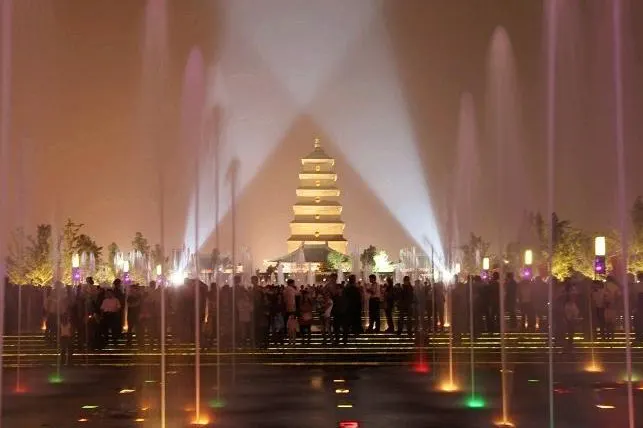
Inside Da Ci'en Temple, the Giant Wild Goose Pagoda was built in 652 to house the scriptures Xuanzang brought back from India, and it has stood for over 1,300 years. The squares are free; the temple and the pagoda climb are ticketed separately — roughly ¥30–40 and ¥25–30. The North Square fountain claims to be Asia's largest; the evening show, lit against the pagoda, is worth the wait.
The musical fountain on the North Square after dark
Tang Paradise and the Never Night City
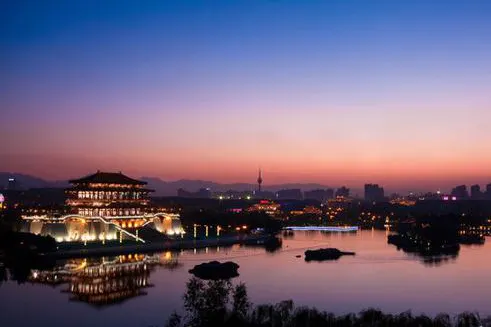
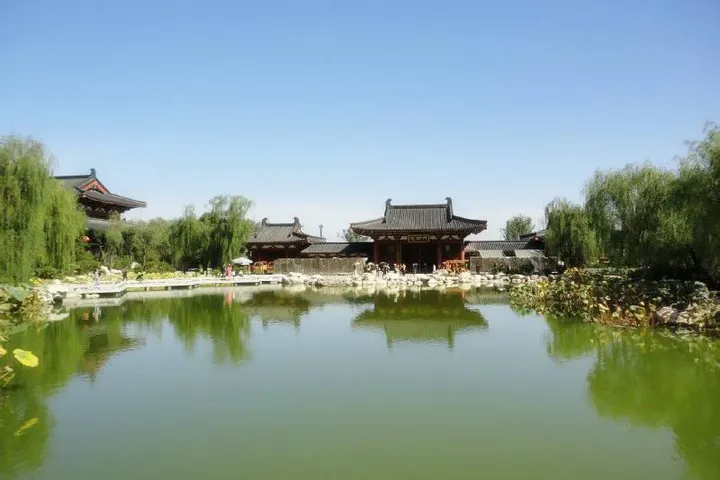
Tang Paradise by night
Tang Paradise is a full-scale Tang-style imperial garden rebuilt on the original site; it shines at night, when water-screen shows fill the lake — tickets roughly ¥60–120. Next door, the Tang Paradise Never Night City pedestrian mall is free and packed with visitors in hanfu — the postcard image of Xi'an nightlife.
Huaqing Palace
Nine-Dragon Lake at Huaqing Palace, at the foot of Mount Li
Huaqing Palace, backed by Mount Li, has been a royal retreat since the Zhou and Qin; the stone bath pools of Emperor Xuanzong and Lady Yang survive intact. Admission is about ¥100–120, and at night Nine-Dragon Lake stages Changhen Ge, the open-air dance drama (¥268–888, book early). Metro L9 Huaqingchi.
The Stele Forest and Small Wild Goose Pagoda
The Xi'an Beilin Museum — the Stele Forest — holds over 2,300 stone inscriptions including masterworks by Yan Zhenqing, Liu Gongquan and Huaiti: a pilgrimage for anyone who has ever held a brush. The Shuyuanmen street outside sells the four treasures of the study. The Small Wild Goose Pagoda is a graceful Tang brick pagoda; the free Xi'an Museum beside it admits on ID.
06Sounds and nights of the old capital
Catch some Qinqiang opera
Qinqiang is Shaanxi's own opera and one of the oldest vocal traditions in China. In the ring-city park below the wall, locals gather to sing and play; standing among them costs nothing. For a stage production, seek out the Yishe Society, one of the oldest theatre troupes on earth.
Watch the musical fountain
The fountain show on the North Square ranks among Asia's largest, typically at 12:00 and 16:00 by day and 19:00 and 21:00 with lights. It is free, but prime viewing fills up — arrive half an hour early.
Changhen Ge: the live show
Staged with Mount Li as the backdrop and Nine-Dragon Lake as the stage, Changhen Ge retells the love story of Emperor Xuanzong and Lady Yang with real mountains, water and history. Shows run nightly in season (from about 19:10), tickets ¥268–888 by seat zone, with a winter 'ice-and-fire' edition; book at least three days ahead.
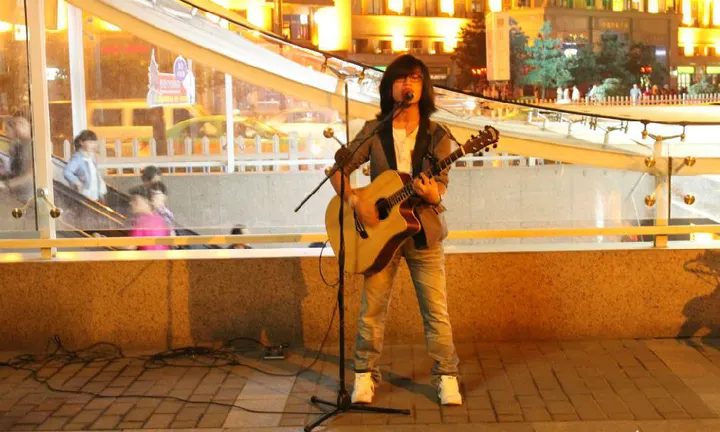
A street singer at the foot of the wall
Street rock, alive and loud
Xu Wei, Zheng Jun and Zhang Chu — three defining voices of Chinese rock — all came out of Xi'an. Young singers with guitars often set up along the foot of the wall in the evening, and bar gigs never really stop. One night of live music tells you more about the local character than any museum wall text.
07From courtyard hostels to high-rise hotels
Xi'an covers every budget, and the choice is part of the fun. Inside the walls, courtyard hostels let you sleep in a traditional house within walking distance of everything; outside, high-rises pack in chains and serviced apartments. Dorm beds run ¥60–90, chain hotels ¥200–350, five stars from around ¥500 — prices swing with the season.
Xiangzimen International Youth Hostel: a preserved siheyuan courtyard inside the South Gate, walkable to downtown; beds from about ¥60–90.
Qixian International Youth Hostel: century-old courtyards with whitewashed walls, about 1 km from the rail station and handy for the eastern-line tourist buses.
Zhengzhidao Youth Hostel: on the wall-side lane by the Small South Gate, 15 minutes on foot to the Bell and Drum Towers; cozy, clean rooms.
Jinjiang Inn (Jiefang Road): a reliable national chain near the rail station with tidy rooms, around ¥200–300 a night.
Grand New World Hotel: on Yanta Road with views toward the wall and the pagoda; rooms from about ¥500.
08Noodles, lamb and bold flavors
Xi'an's cooking has wheat noodles and beef-or-lamb at its core. When CNN named Asia's ten best street-food cities in 2012, Xi'an was the only mainland Chinese entry. Look past the main Beiyuanmen tourist strip to Xiyangshi, Dapiyuan and Sajinqiao, where locals actually eat.
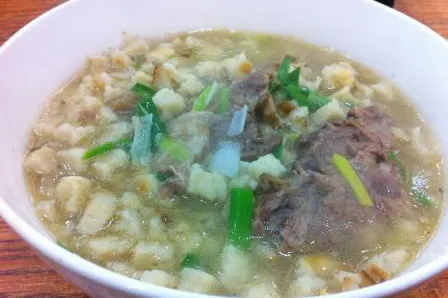
Yangrou paomo — tear the bread yourself
Eight snacks to hunt down
Yangrou paomo: the flagship Shaanxi dish. Tear the bread into soybean-sized crumbs yourself, and get it back simmered in rich lamb broth — tender meat, deeply savory soup. Lao Mi Jia Dayu is the house locals queue for.
Roujiamo, the Shaanxi flatbread 'Chinese hamburger': soy-braised pork tucked into crisp white bread, so tender it needs no chewing. The halal spiced-beef version in the Quarter is equally essential.
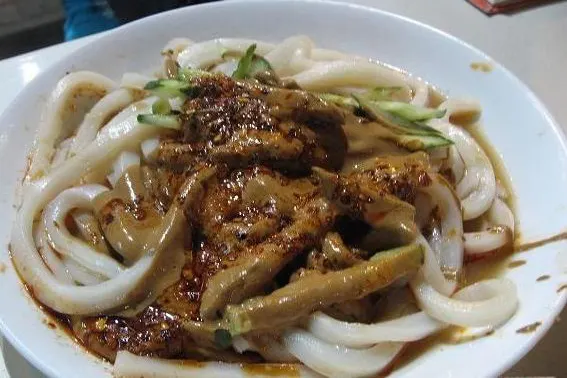
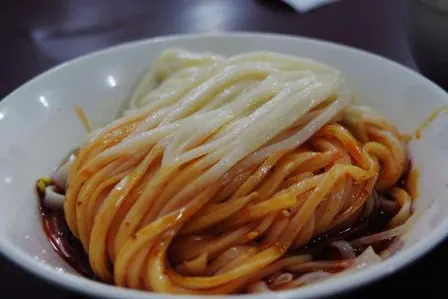
Liangpi (cold-skin noodles): three schools — Qinzhen rice skin, Hanzhong hot skin, Qishan rolled skin. The 'Guanzhong set meal' pairs liangpi with roujiamo and a cold Bingfeng orange soda.
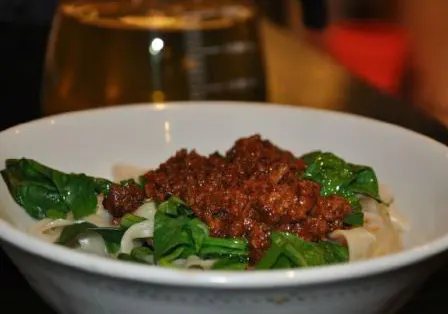
Biangbiang noodles: belt-wide ribbons topped with minced-meat sauce and sizzling hot oil — the character 'biang' is so complex it isn't even in dictionaries, a badge of Shaanxi pride.
Beef-ball hulatang: the locals' No. 1 breakfast — beef meatballs with potato and cabbage in a peppery stew, finished with chili oil and dunked with flatbread.
Zenggao: sticky rice and jujube dates steamed together — hot, date-sweet, soft without sticking to your teeth; a breakfast fixture in the Quarter.
Hulutou: paomo built on tender pork chitterlings in rich broth — clean, aromatic and never greasy. Chunfasheng is the classic house.
Jinggao and honey rice cakes: little steamed sweets from street stalls in rose, blueberry and other flavors — a two-bite dessert between sights.
Biangbiang noodles under minced-meat sauceA bowl of liangpi cold-skin noodles
Tables worth queueing for
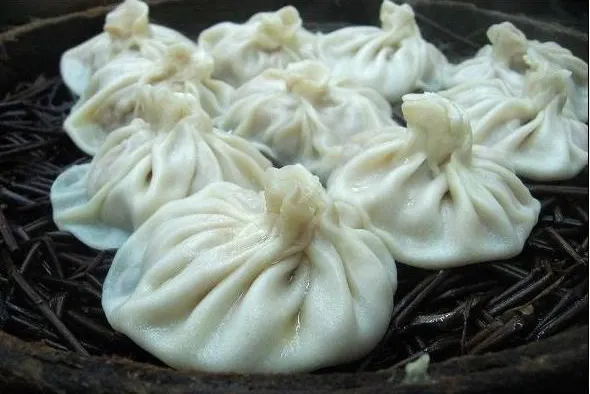
Soup dumplings in the Muslim Quarter
Lao Mi Jia Dayu Paomo (Xiyangshi main shop): the locals' paomo house — come early or wait; ¥30–60 a head.
Jia San Guantangbao (Beiyuanmen): one of the Quarter's hottest time-honored houses; thin-skinned soup dumplings, ¥20–30 a head.
Fanji Laoji Roujiamo (Zhubashi): crackling-crisp bread and melt-in-mouth braised pork; ¥12–15 buys a filling one.
Weijia Liangpi: a citywide chain doing secret-recipe and sesame-paste styles; ¥13–15 a head.
Liuxiang Noodle House (Jiqing Lane, Anban Street): thick, springy noodles and a permanent crowd; ¥12–15 a head.
Chunfasheng (Nanyuanmen): the famous hulutou house — impeccably clean tripe in a rich broth; ¥30–50 a head.
09Taking Chang'an home
Every Shaanxi specialty is buyable here: walnuts, pomegranates, crystal pastries, cured beef and rice wine all get dedicated shelves in the big supermarkets — transparently priced and easy to pack. The Muslim Quarter packs souvenir shops where haggling is expected. Craft classics: Terracotta Army replicas, stele rubbings, shadow puppets and paper cuts.
Cured beef and lamb: a Xi'an classic, vacuum-packed for travel; counters line the Quarter and the supermarkets.
Fire-crystal persimmons from Lintong: small, scarlet, paper-skinned and honey-sweet; dried persimmon cakes travel better.
Crystal pastries: flaky filled pastries, the classic Shaanxi sweet — a safe gift for elders.
Terracotta Army replicas: palm-sized to half life-size — haggle by workmanship.
Stele rubbings: impressions of famous inscriptions by Yan Zhenqing, Liu Gongquan and others; Shuyuanmen has the best selection.
Shadow puppets and paper cuts: found on Huajue Lane and in Shuyuanmen, from a few yuan to a few hundred.
Where to buy
Shuyuanmen, hugging the wall near the South Gate, deals in antiques, calligraphy and the four treasures of the study — locals shop here too. Huajue Lane behind the Drum Tower overflows with shadow puppets and clothwork, though the goods lean 'generic Chinese': browse freely, buy carefully. For volume souvenirs, supermarket specialty aisles are stress-free.
One warning: anyone selling 'ancient relics dug up from my own field' is running a scam. Don't buy it — if it were real, the right move would be calling the cultural relics bureau, not reaching for your wallet.
10Getting there and around
Arriving by train
Xi'an North is the high-speed rail hub — Metro L2/L4 sit beneath the platforms. Xi'an Railway Station, just north of the old walls, handles conventional services with its own metro stop. Check trains on this site and book online in minutes; eastern-line services to the Terracotta Army now depart from the city's east side.
Flying in, and airport transfers
Xi'an Xianyang International Airport lies about 45 km northwest. Metro L14 is the easiest way in — around ¥7 to North Railway Station, where you change to L2/L4; shuttle buses cost about ¥25 and a metered taxi ¥120–150. Landing late? Pre-book a ride.
The metro: your default
The metro reaches the Bell Tower, Yongnimen, the Giant Wild Goose Pagoda and Xiaozhai — far faster than surface traffic. Fares: ¥2 for the first 6 km, capped at ¥13; a Changantong card takes 10% off, and QR entry is easy. For the Terracotta Army, ride L9 to Huaqingchi.
Taxis and ride-hailing
Taxis start at roughly ¥8.5–9 for the first 2–3 km, slightly more at night. Insist on the meter; refuse fixed-price touts around stations and the airport. Rush hour is heavy — use Didi or Amap — and 13:00–17:00 shift changes can make cabs scarce.
Buses and tourist lines
City buses cost ¥1–2. For the Terracotta Army and Huaqing Palace, tourist buses such as the You5 (306) run from the city's east side for about ¥6–7 — the departure point has moved, so check first. Board only vehicles marked 'Shaanxi Tourist Bus Line'.
Emergency numbers: police 110, ambulance 120, fire 119; the 12345 hotline covers general and tourism inquiries.
Tourist information centers: at the Drum Tower square, the airport, the rail station and the Terracotta Army plaza.
Major hospitals: Xijing Hospital (Changle West Road, top-tier general) and Tangdu Hospital (Baqiao District). For emergencies call 120 directly.
Disputes: refuse unmetered taxis; for hard-sell or scams at any sight, call 12345 or 110.
Money and bookings: mobile payment is universal, and big malls and chain hotels take foreign cards; headline sights all require advance real-name online booking.
12Packing list and pitfalls
Documents: passport or ID always; student discounts exist but are often only 20–30% off rather than half price — still worth carrying.
Reservations: the Terracotta Army and Shaanxi History Museum require real-name booking via official channels — 3–7 days ahead in season, and the same for the Changhen Ge show.
Seasonal kit: the air is dry, so moisturizer and a water bottle are non-negotiable; serious sun protection in summer (especially on the wall and Mount Hua), a real winter coat, and comfortable sneakers — this is a walking city.
Electronics: charger and power bank; install Alipay/WeChat Pay, a map, a translator and a ride-hailing app — QR gates beat single-ticket machines.
Health: stomach remedies and plasters; the diet runs heavy on lamb and bread, so balance it out if your gut is sensitive.
Four pitfalls to dodge: never buy 'excavated relics' — always a scam; skip unmetered taxis around the stations and airport; beware cut-price day tours and temple 'giant incense' upsells that end in donation pressure; and remember that Golden Week crowds run several times normal levels — travel off-peak if you can.
13Where the ancient capital comes from
Geography and climate
Xi'an sits mid-way across the Guanzhong Plain, backed by the Qinling range and fronted by the Wei River — a natural fortress, as ancient strategists put it: 'girdled by mountains and rivers, sealed on every side.' The climate is warm-temperate semi-humid monsoon with four sharp seasons: annual average about 13.6°C, moderate rain but dry air.
A short history
Thirteen dynasties ruled from here over nearly 1,100 years, from the Zhou to the Tang. In 221 BC Emperor Qinshihuang unified China from nearby Xianyang, leaving the Great Wall and the Terracotta Army; the Han made Chang'an the eastern gateway of the Silk Road; Tang Chang'an ranked among the largest cities on the planet. The name 'Xi'an' ('Western Peace') dates to 1369.
Qinqiang and Guanzhong culture
Xi'an still lives with Qinqiang opera, paper cuts and shadow puppetry — better preserved in the surrounding villages. Buddhism, Daoism and Islam all took root here, each written into the skyline: the Giant Wild Goose Pagoda for the pilgrim-monk Xuanzang, Louguantai where Laozi is said to have composed the Dao De Jing, and the Great Mosque on Huajue Lane.
14Three routes out of town
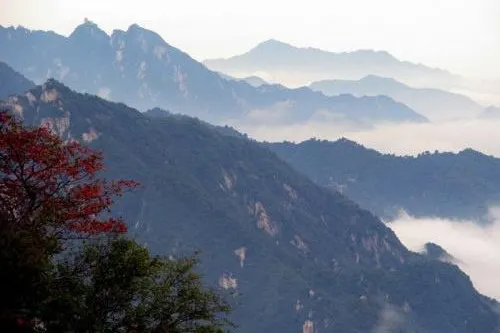
Cloud sea over the Qinling range, Xi'an's southern backdrop
Mount Hua (2 days)
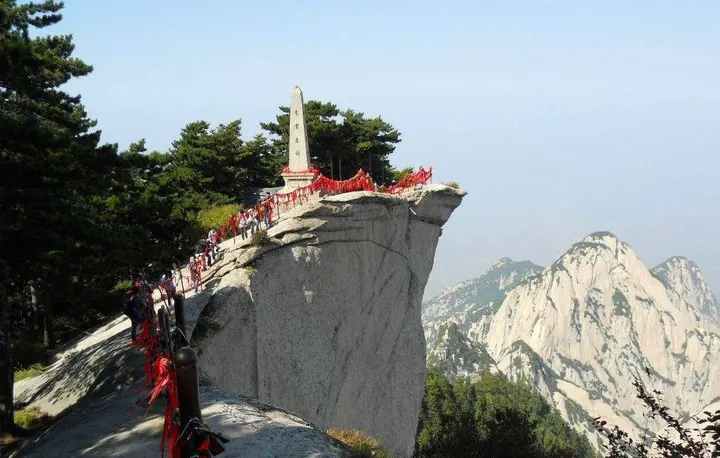
The plank walk on Mount Hua's cliff face
The westernmost of the Five Great Mountains and by far the steepest — a wall of granite rising off the wheat fields; high-speed rail takes about 40 minutes from Xi'an North. Take the night climb for sunrise or the West Peak cable car by day. The three great terrors line the walking route, and the Changkong plank walk costs extra. Tickets run roughly ¥100–160 by season; summit lodging is pricey and scarce. Not for the acrophobic.
Famen Temple (1 day)
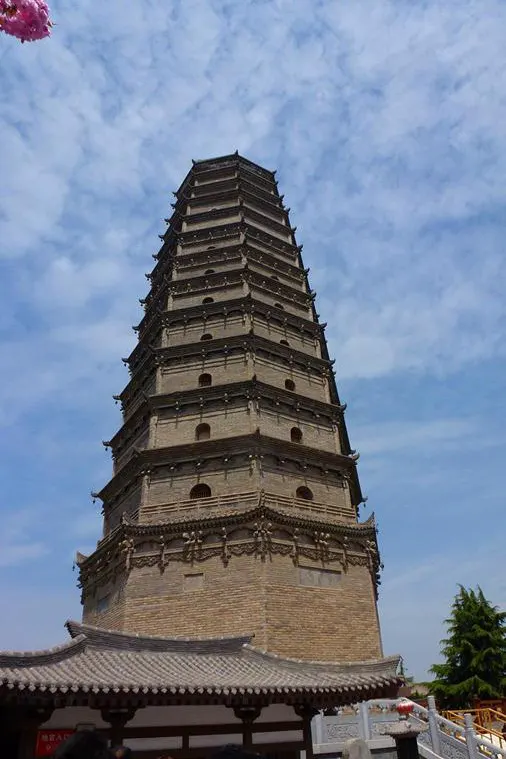
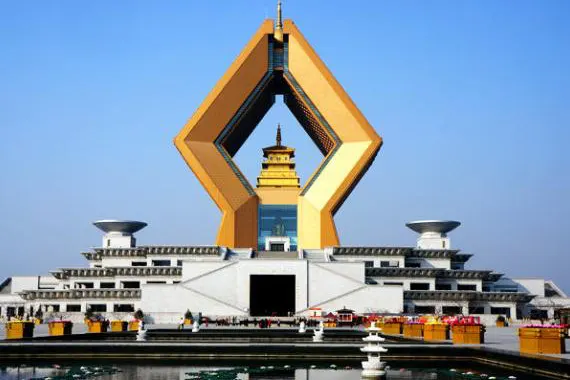
The Famen Temple's palms-together stupa
In Fufeng County, Baoji — about 120 km west of Xi'an — Famen Temple dates to the late Eastern Han and holds a finger-bone relic of the Buddha. Its crypt reopened in 1987, revealing thousands of Tang treasures. Tickets ¥100 in season, ¥90 off-season; reach it by bus from the West Passenger Terminal or on a day tour. Ignore anyone offering a 'back door'.
Yan'an and Hukou Waterfall (2 days)
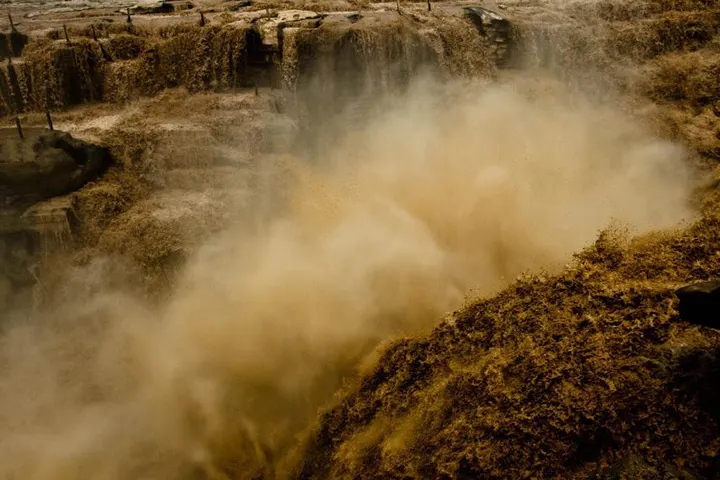
Hukou Waterfall, the largest yellow waterfall on earth
The northern route: Day 1 to the Mausoleum of the Yellow Emperor, then Hukou Waterfall; Day 2 in Yan'an (Pagoda Hill, Zaoyuan) before returning. Hukou is the largest yellow waterfall on earth — the whole Yellow River narrows into a single roaring chute. D-trains reach Yan'an in about 2 hours; Hukou needs a change at Yichuan or a tour. Go in autumn.
15Watch and read before you go
Film
"Gao Xing / Happiness" (2009, dir. A Gan): adapted from Jia Pingwa's novel, it follows Liu Gaoxing, a scrap collector making his life in Xi'an with relentless cheer — mainland China's first musical comedy, and a vivid portrait of the optimism of the city's working poor.
Books
Jia Pingwa, "Old Xi'an": a native writer's spiritual history of the ancient capital. Bill Porter, "Road to Heaven: Encounters with Chinese Hermits": the American sinologist's 1980s search for the hermits of the Zhongnan Mountains, just south of Xi'an; afterwards the Qinling range will never look the same.
Music
Zheng Jun, "Chang'an Chang'an": an album named for his hometown, washed with lazy melancholy and stripped-down swagger. Black Sha (Heisa), "Xi'an Girls": a homegrown Xi'an rap crew singing the city in Shaanxi dialect — the fastest way to get the local character in your ears.