The same rocks, twice: once in daylight, once after dark
Day and night tickets are separateTwo or three rope shows a dayDalongqiu drops 197 mCombo ticket for three areas, ¥170
In short
Mount Yandang (雁荡山, Yàndàng Shān) is a rhyolite caldera in Yueqing, on the coast of Zhejiang, about 120 million years old and cut by water ever since into a forest of vertical pillars, cliffs and caves. It is not one ticketed park but eight scenic areas with more than five hundred named points; what visitors call Yandangshan is the northern part, and its core is the trio of Lingfeng, Lingyan and Dalongqiu, strung along one valley four to ten kilometres apart. Tickets are separate: Lingfeng daylight ¥45 and its night session another ¥45; Lingyan ¥50; Dalongqiu ¥50. Combo A is ¥170 for Lingfeng day and night plus Lingyan and Dalongqiu, valid three days; combo B is ¥200 with Fangdong and Sanzhe Waterfall added, also three days; combo C is ¥220 with Yanhu, Xiansheng Gate and Yangjiao Cave, valid five. The shuttle pass is ¥40 for three days unlimited. The rope-walking show at Lingyan runs at 10:30 and 15:30 Monday to Thursday, and 10:30, 13:30 and 15:30 Friday to Sunday, free with a Lingyan ticket. Dalongqiu falls 197 m, but its catchment is under one square kilometre, so it thins to a thread in dry spells and is best a day or two after rain. High-speed trains stop at Yandangshan Station, with a free shuttle taking 15–20 minutes to the visitor centre; from Wenzhou South it is 28–34 minutes for ¥28–34. Sleep in Xianglingtou, five minutes on foot from Lingfeng; two nights covers the three core areas and the night session. Budget ¥700–1,300 for two or three days, excluding travel to Zhejiang.
Key facts
Known for
rhyolite · the Lingfeng night walk · the Lingyan rope show · Dalongqiu · Duanchang Cliff
Budget
¥700–1,300 for 2–3 days, mid-range
Days needed
2–3 days
Comfort
Comfortable — shuttles between everything, but steps at Guanyin Cave and Fangdong, and slippery stone after rain
Best time to go
April–May and September–November; chase the falls a day or two after rain, and avoid typhoons from July to September
01A volcano that water took apart
The first ten minutes at Yandangshan Station are a small disappointment. The forecourt is a few roads and a handful of grey buildings, with not a single rock pillar in sight. The free shuttle runs fifteen to twenty minutes through the streets of Baixi, turns into a lane lined with guesthouses and restaurants, and stops at Xianglingtou — where you still cannot see the mountain. Then you drop your bag, walk to the end of the alley, and two enormous rock faces are suddenly standing at your right shoulder, close enough to be a wall. That is when the scale of the place arrives: the mountain is not in the distance. It is directly behind the village.
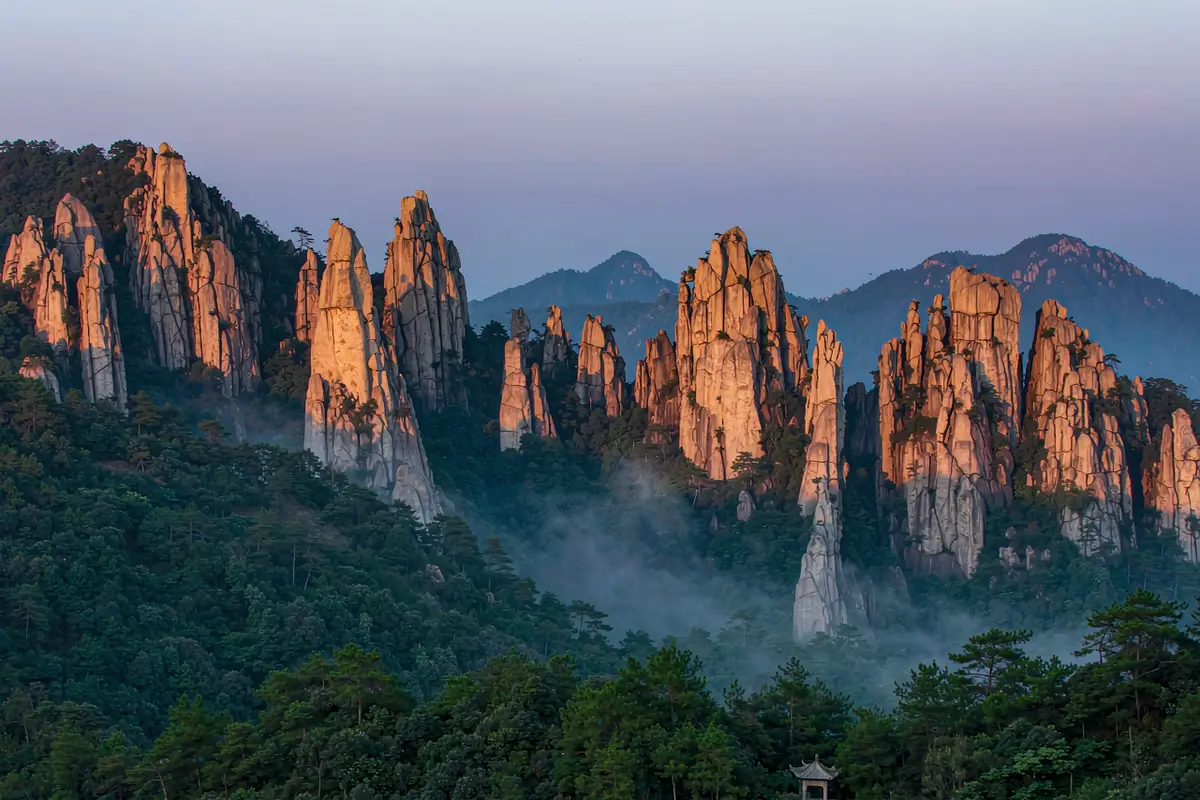
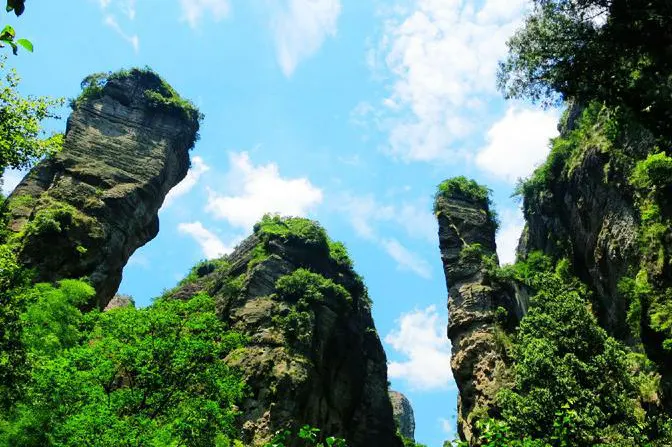
The pinnacles at Lingfeng — several rhyolite columns in a row, scrub in every joint, and a sky that looks almost too blue
The origin of these rocks is not in dispute. Around 120 million years ago this was a caldera: pyroclastic flows piled up layer on layer and welded into rhyolitic tuff some six hundred metres thick, then the chamber collapsed and later eruptions partly refilled it, at least four phases in all. For the next hundred million years water worked down the vertical joints and cut the mass into square columns, thin screens, gates and caves. That is why geologists call Yandangshan a natural museum of rhyolite, and why it became a UNESCO Global Geopark in 2005. The highest point, Baigangjian, is 1,057 m, but Lingfeng, Lingyan and Dalongqiu all sit a few hundred metres up. This is not a mountain you summit; it is a mountain you walk into.
The layout is simpler than it looks: one valley running east to west. Lingfeng is at the eastern end, pressed against Xianglingtou; Lingyan is four or five kilometres west; Dalongqiu another five or six beyond that. Shuttles link the three in about ten minutes each, and walking is possible but means forty minutes beside a road with no view and no pavement. The sensible order runs backwards: ride to Dalongqiu first, work your way home through Lingyan, and finish at Lingfeng for the night session. Done that way, you are never in the wrong valley at the wrong hour.
The thing most people miss, and the one that decides the budget, is that Yandangshan has no single gate ticket covering everything. Lingfeng by day, Lingfeng by night, Lingyan, Dalongqiu and Fangdong are sold separately; the combos are only bundles at a discount. Combo A is ¥170 for Lingfeng day and night plus Lingyan and Dalongqiu, valid three days. Combo B is ¥200 with Fangdong and Sanzhe Waterfall added. Combo C is ¥220 with Yanhu, Xiansheng Gate and Yangjiao Cave on top, valid five days. If you are sleeping two nights in the village and intend to see the night session, A already beats buying singly — ¥45 plus ¥45 plus ¥50 plus ¥50 comes to ¥190. The shuttle pass is separate at ¥40 for three days unlimited, and it is close to compulsory.
My judgement: two days is the floor, three is comfortable. On two, do Lingfeng in the afternoon and again after dark on day one; on day two take Dalongqiu early, Lingyan at midday and Fangdong in the afternoon, then leave. With three, split Fangdong and Lingyan and add a half-day at Sanzhe Waterfall or Xiansheng Gate. A single day is possible, but you will have to drop either the Lingfeng night session or the Lingyan rope show — and those two are exactly what makes this mountain different from every other one in China. The outer areas, Yanhu, Xianqiao and Yangjiao Cave, are not worth a special trip unless you have a car and a third day.
02Six things worth the time
Lingfeng by day: two cliffs and a caveThe first of the three marvels
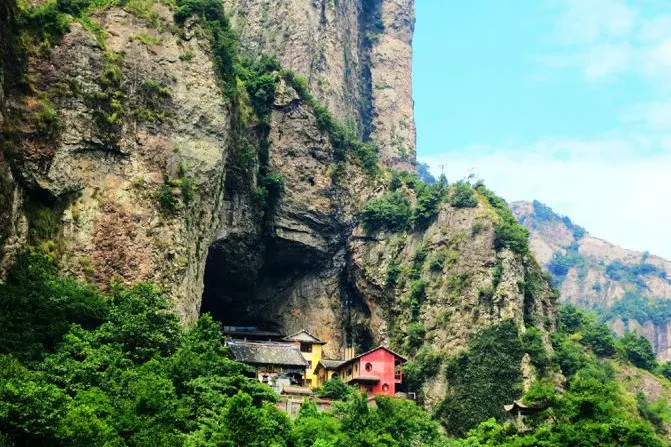
Hezhang Peak is a pair of cliffs about 270 m high standing so close together that they read as pressed palms, with Guanyin Cave wedged into the seam. The cave is 113 m tall and has a nine-storey hall built against its wall; the climb from the mouth to the top shrine is 377 to 403 steps, narrowing as it goes until one person passes at a time. Around midday the sun reaches the floor of the hall for a few minutes and then leaves; the rest of the day is dark, incense and damp. Come back down the same way and walk to the stream, where Guohe Bridge carries a stone arch over the jade-green pool of Ningbi Tan — bridge, water and cliff stacked in three planes, the most photographed corner of Lingfeng. Allow two and a half to three hours for the whole area.
Ticket:¥45, sold separately from the night session
Steps:377–403 steps into Guanyin Cave
Time:Two and a half to three hours
Lingfeng after dark: the same rock, read differentlyA mountain seen as silhouette
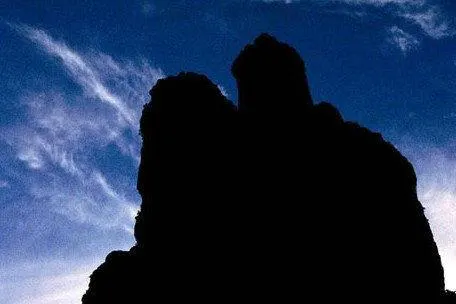
The pillars that looked sharp all day become pure silhouette after dark, and every one of them turns into something else: the Couple, the Rhino Gazing at the Moon, the Eagle Folding Its Wings, the Woman Waiting. This is not a light show. It is natural silhouette with a little fill light, and the whole trick is where you stand — three steps left and the pair is married, five steps right and they are quarrelling. That is why a local guide at ¥50 is worth it the first time: he puts you on the right stone. Otherwise you may see nothing but black. Gates open at 18:00, the session proper starts around 18:40 and ends at 21:30. Rain, fog or a full moon will ruin it, and on those nights you are better off asking for a refund.
Ticket:¥45, included in combo A
Session:Gates 18:00, start around 18:40, ends 21:30
Time:One to one and a half hours
Lingyan: a courtyard made of rockWhere the rope show happens
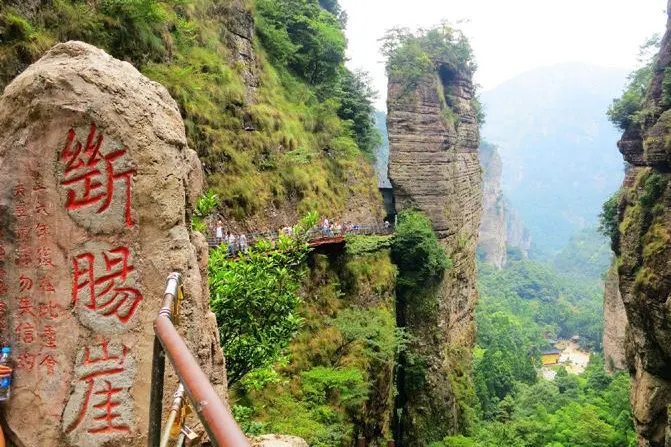
Lingyan is a valley floor enclosed by cliffs: Tianzhu Peak at 266 m and Zhanqi Peak at 260 m facing each other across the courtyard, with Lingyan Temple between them, and people instinctively lower their voices inside it. Beyond the temple lie Xiaolongqiu, Wolong Valley and Duanchang Cliff — the drop the Condor Heroes heroine jumps from, its name cut into the rock in red, with a boardwalk pegged to the cliff beside it. The rope show is strung between the two peaks above the temple: a man walks, somersaults and throws sweets at 200 m, for twenty-odd minutes, free with your ticket. Arrive half an hour early and take the steps on the temple side. Two to three hours for the area.
Ticket:¥50; Lingyan plus Fangdong ¥80
Rope show:Mon–Thu 10:30 and 15:30; Fri–Sun 10:30, 13:30 and 15:30
Time:Two to three hours including the show
Dalongqiu: a waterfall that lives on rain197 m in a single drop
A flat kilometre and a half leads in from the valley mouth, past Jianjian Peak — one rock that changes shape every ten steps, scissors, then a woodpecker, then a mast, the textbook demonstration of what the Chinese call scenery that shifts as you walk. At the end, water drops 197 m in one piece: in flood it hits the pool like thunder, in drought it is a white thread that the wind takes apart. The catchment above is only 0.98 square kilometres and holds almost nothing, so whether it is worth the ticket depends entirely on whether it rained the day before. Go one or two days after rain; after two dry weeks there is a trickle. There is also an hourly high-wire cycle act in the valley, free with the ticket.
Drop:197 m, single drop
Ticket:¥50
Time:One to one and a half hours, almost no climbing
Fangdong: an hour on the cliff faceBoardwalk, chain bridge, cliff coffee
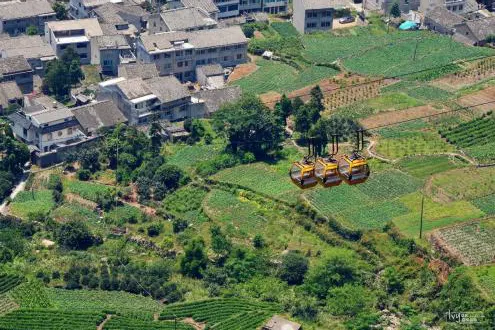
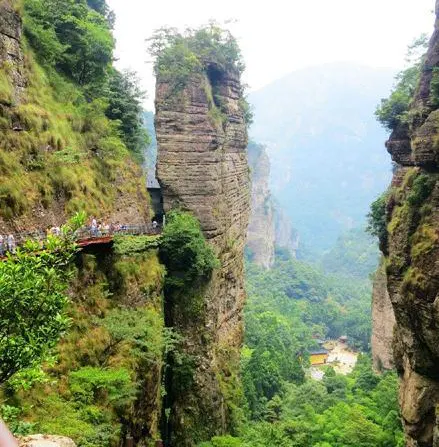
Fangdong starts at the top: a five-minute cable car (¥40 one way, ¥60 return) or the minibus from Lingyan for ¥10. What follows is a hundred-odd metres of boardwalk pinned to the cliff, with terraced fields and a village several hundred metres below, then a chain bridge, Guandao Cave, Meihua Cave and two coffee bars built into the rock, Americanos at ¥25 with a view worth more than the coffee. Almost all of it is level, with only a few dozen steps at each ticket gate, and it takes one and a half to two hours. The easy direction is to enter at Fangdong and walk down the Woyun boardwalk to Lingyan, all downhill; the reverse climbs more than three hundred metres and hurts.
Ticket:¥40; Lingyan plus Fangdong ¥80
Cable car:¥40 one way, ¥60 return, about five minutes
Time:One and a half to two hours
Fangdong down to Lingyan: the Woyun boardwalkAll downhill, the best walk on the mountain
This is the link between Fangdong and Lingyan, and the closest the mountain comes to a pure walk: a timber boardwalk pegged to a vertical wall, wet rock on the left, air on the right, treetops and a thin path below, the yellow wall of Lingyan Temple visible in the distance. There is a short glass section, shoe covers free. An hour to eighty minutes at normal pace, ninety with photographs. It ends at the back gate of Lingyan Temple; turn left for the shuttle stop, or take the ¥10 minibus back up to Fangdong if you left something behind. After rain the stone is slick, and smooth soles are a bad idea.
Direction:Fangdong to Lingyan, all downhill
Time:One to one and a half hours
Shuttle:Lingyan–Fangdong minibus ¥10 one way
03Seven questions to settle before you book
In what order should I do Lingfeng, Lingyan and Dalongqiu?
Run it farthest first, night last. Arrive in the afternoon, do Lingfeng by day (two and a half to three hours), eat, then go back in at 18:30 for the night session — it is five minutes' walk from Xianglingtou, no bus needed. Next morning take the shuttle straight to Dalongqiu, the far end (fifteen minutes each way, ninety minutes in the valley), come out before 10:30 and ride back to Lingyan in time for the 10:30 or afternoon rope show. Lingyan takes two to three hours; from there go up to Fangdong and walk the Woyun boardwalk back down to Lingyan. Three bus rides in a day, no backtracking. Lingyan before Dalongqiu also works, but the show times will dictate everything else.
Should I stay in Xianglingtou or Yandang town?
Xianglingtou, unless you are just passing through. It sits inside the scenic area, with guesthouses and restaurants packed into one street, five minutes on foot from Lingfeng and three from the shuttle stop. Walk out of the night session and you are in bed in five minutes, which is most of the point. Rooms run ¥120–300 midweek and double at weekends and holidays. Yandang town, at Baixi, sits between the station and the gate: half the price, ¥100–200 for something decent, but every evening you either pay ¥15–30 for a taxi back or skip the night session, and every morning you lose twenty minutes coming in. The only good reasons to base there are a late arrival, an early departure, or a car and a plan that includes the outer valleys.
Is the Lingfeng night session worth a separate ticket?
For a first visit, yes — but pick your night. What you are buying is not lighting but imagination: the same pillars are geology by day and stories after dark, and a guide plants you on a particular stone and says look now, and for a second the back of your neck goes cold. ¥45, one to one and a half hours. Three nights to skip: rain, thick fog, and a full moon bright enough to flatten the silhouettes. On those you will feel cheated. If you bought combo A at ¥170 the night session is already paid for, and skipping it is the waste. It is mostly level ground, but the lighting is dim and the step edges disappear, so bring a small torch for older parents or children.
Is one day enough?
Technically yes, experientially no. Take the 07:10 or 09:01 from Wenzhou South, half an hour to the station, twenty minutes on the shuttle, and you are inside before ten. Dalongqiu (ninety minutes), Lingyan (two hours with the show) and Lingfeng by day (two hours) fit, with three bus rides and one meal, and you can be back in Wenzhou by 18:30. The cost is that you must choose between the rope show and the night session, and you cannot spend an extra twenty minutes anywhere. With one day I would drop Lingfeng by day and give the time to Dalongqiu, Lingyan and Fangdong — the boardwalk from Fangdong down to Lingyan is the best hour of the whole trip. If you want the night session, you have to sleep here. There is no halfway version.
Will rain ruin the trip?
No, but it will change the plan. With 1,936 mm of rain a year, plum rains in May and June and typhoons from July to September, rain is the default. It is good for Dalongqiu: a catchment of 0.98 square kilometres holds nothing, so the fall only looks like a fall a day after proper rain. It is bad for three things. The Lingyan rope show is cancelled in rain or wind, with no replacement. The stone on Fangdong and the Woyun boardwalk turns slick and the glass section may close. And the Lingfeng night session is worthless in rain or fog. So sequence by weather: on the wet day do Dalongqiu and the Lingyan valley; on the clearing day do Fangdong and the night session. Do not push through a typhoon — the park limits numbers or closes, and the official Yandangshan account will say so.
Is it closer from Wenzhou or from Taizhou?
By rail they are almost the same: Wenzhou South to Yandangshan is 28–34 minutes for ¥28–34, Taizhou West about 20 minutes for less. The difference is frequency and connections. Wenzhou South has more trains, including the useful 07:10, 09:01 and 09:25 departures, and the airport is linked to it by metro. Taizhou West has fewer, but Taizhou's airport at Huangyan is only 60 km from the gate, about ¥200–250 by taxi, against 80 km and ¥250–300 from Wenzhou's. So: from Shanghai or Hangzhou, take whichever train suits; flying in, price both airports — Taizhou in and Wenzhou out is often the cheapest combination.
What time is the Lingyan rope show, and is it extra?
It costs nothing beyond the Lingyan ticket. Times follow the official schedule introduced in October 2025: 10:30 and 15:30 Monday to Thursday; 10:30, 13:30 and 15:30 Friday to Sunday. Holidays add shows — during National Day there were 09:00, 12:30, 14:00 and 16:00 slots. It runs for twenty-odd minutes between the two peaks above the temple; arrive twenty to thirty minutes early and take the steps on the temple side. Rain or strong wind cancels it with no replacement, so check the park's official account or ask at the gate on the morning of your visit.
04Three days: farthest first, night last
One logic shapes every Yandangshan itinerary: Dalongqiu, the far end, in the morning; the Lingfeng night session last; Lingyan and Fangdong filling the middle. The rope show and the night session run to fixed times, and those two appointments nail the day down; everything else can move around them. What follows assumes two nights in Xianglingtou, combo A and a three-day shuttle pass — the simplest and cheapest combination.
D1
Reach Xianglingtou at midday, drop the bag and walk five minutes into Lingfeng. Do Hezhang Peak and Guanyin Cave first — 377 steps to the top shrine — then back down to Guohe Bridge. Two and a half hours is enough, and it is still light at 16:30, so return to the street for an early dinner. Go back in at 18:00 for the night session, take a guide at ¥50, and let him move you through five or six viewpoints for eighty minutes. Out by 21:00, with the food stalls still open.
D2
Breakfast at 07:30 and on the bus at 08:00 for Dalongqiu, fifteen minutes away. The walk in is 1.5 km of flat path, forty minutes; come back the same way and take the 10:30 bus to Lingyan. Enter at 11:00, see the temple and Xiaolongqiu, and be in front of the temple by 11:30 for the rope show — 10:30 and 15:30 Monday to Thursday, 10:30, 13:30 and 15:30 Friday to Sunday, subject to the day's notice. After lunch walk Wolong Valley and Duanchang Cliff, leave at 14:30 and take the minibus up to Fangdong. Ninety minutes on the cliff walk, then down the Woyun boardwalk at 16:00, reaching the back gate of Lingyan at 17:00 and the bus home. About twenty thousand steps.
D3
Give the morning to Sanzhe Waterfall or Xiansheng Gate. Sanzhe is ten minutes' walk from Xianglingtou and the middle drop is the one to see, two hours there and back. Xiansheng Gate is further and needs a car: two cliffs 200 m high with barely ten metres between them, and a genuine sense of pressure at the bottom. Check out at midday and take the free shuttle back to the station. If your train is late, eat a bowl of seafood noodles in Baixi before you go.
05Two cliffs, one waterfall, two caves
Lingfeng: Hezhang Peak and Guanyin Cave
Lingfeng is the eastern gate of the mountain and the only area you can walk to from the village. The path follows the Mingyu stream, rock towers stacked one behind another and water audible underneath. Hezhang Peak is the headline: two cliffs about 270 m high split by a seam, with Guanyin Cave wedged into it. The nine storeys inside were added layer by layer from the Ming and Qing onwards; the stairs are narrow, steep and damp, the top shrine holds Guanyin, and looking back you get a slice of sky. Beidou Cave outside is a Taoist shrine, less busy and quieter. Guohe Bridge sits downstream, stone arch, deep pool and cliff stacked in three planes, and before nine in the morning there is nobody there.
Lingyan: a valley floor walled in by rock
From the Lingyan bus stop you descend a few dozen steps and the view suddenly closes into a courtyard: Tianzhu Peak on the left, Zhanqi Peak on the right, Lingyan Temple in the middle, rock on three sides and the way you came on the fourth. That enclosed feeling is the difference between the two Ling areas — Lingfeng excites you, Lingyan quiets you. Xiaolongqiu behind the temple is only a few dozen metres high and thins to a thread in dry weather; further in lie Wolong Valley and Duanchang Cliff, the boardwalk turning into the rock with a deep pool below and a strip of sky above. The glass section over Wolong Valley is short, shoe covers free, and there are stone steps beside it for anyone who would rather not.
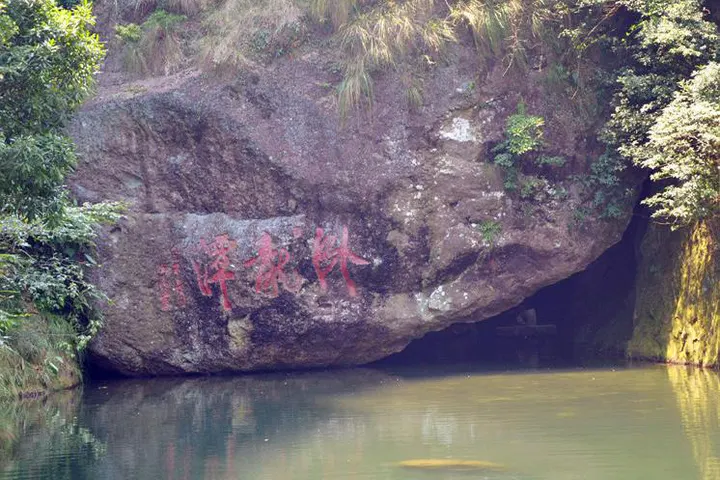
A pool on the Lingyan valley floor — red inscriptions on an overhanging wall, the water dark green and almost still
Dalongqiu: Jianjian Peak and the fall
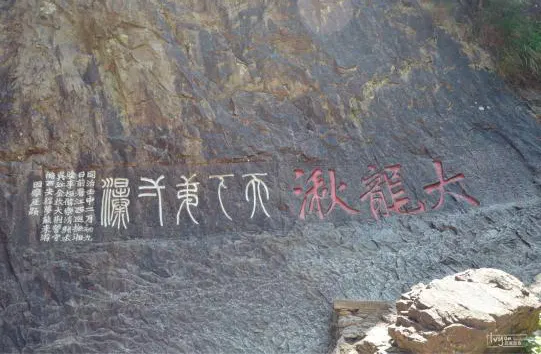
Half of Dalongqiu is the water and half is the kilometre and a half walk in. Jianjian Peak stands beside the path: from one angle two overlapping scissors, twenty steps later a woodpecker, then a mast. Every claim about scenery that changes as you walk originates here. The valley floor is flat enough for parents and small children, and at the end a circular pool takes the fall whole from a 197 m lip, the wind turning the water to mist; stand there a minute in summer and you are wet through. The rock beside the pool carries the inscription 'the first waterfall under heaven', which is more famous than the fall itself.
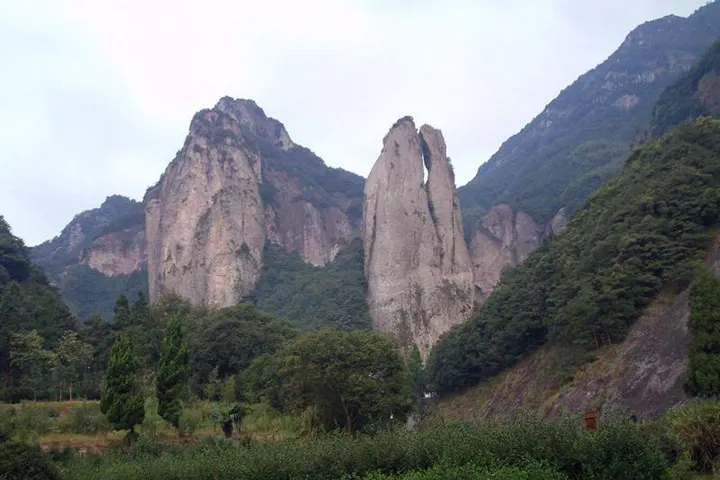
Jianjian Peak — two pillars split at the top so that from this angle they read as open scissors, with a full cliff face to the left
Fangdong: boardwalk and chain bridge on the cliff
The cave itself is small, with three drips said to be drinkable and nobody brave enough to test it. The reason to come is the hundred-odd metres of boardwalk outside: built out from a vertical wall, a metre or so wide, rock on one side and several hundred metres of air on the other, with terraces, a village and a pale road below. Ten minutes brings you to the chain bridge, timber deck, a certain sway, and beyond it Guandao and Meihua caves, where someone sells coffee for ¥25. Almost no climbing, but if heights bother you your palms will sweat; keep to the rock side.
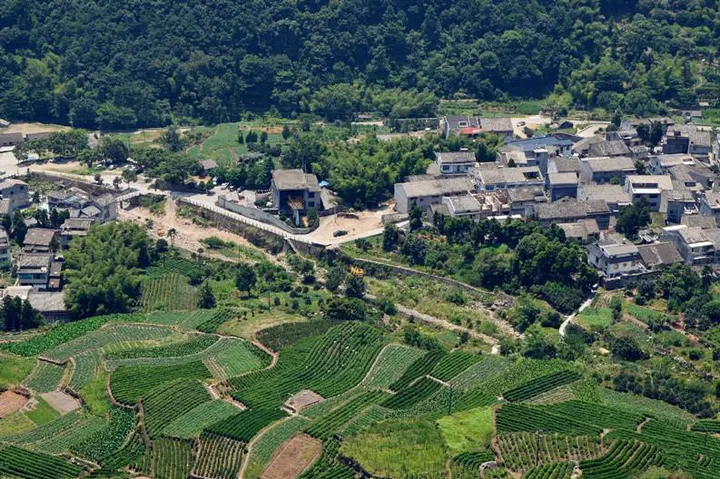
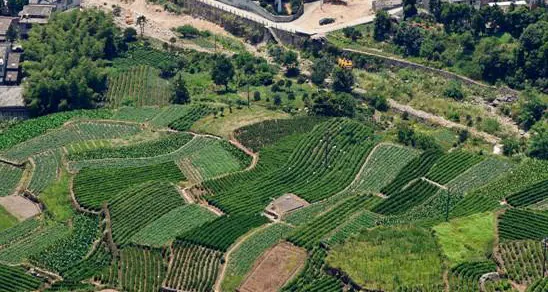
Looking down from the Fangdong boardwalk — terraced plots stepping to the village, grey-tiled roofs packed together
Sanzhe, Xiansheng Gate, Yanhu: the outer three
Sanzhe is one stream falling three times: about 50 m, then 120 m, then 70 m, the middle drop the most impressive and the only one you can walk behind. Two hours return, ten minutes' walk from Xianglingtou, and the best value on the mountain. Xiansheng Gate is in the northwest: two 200 m cliffs barely ten metres apart, vertigo at the bottom, and you need a car; the Ming archways at Nange are on the way. Yanhu is where the mountain's name comes from — a summit lake at 990 m, now silted to a pond, fourteen kilometres of winding road from the core. Only worth it with a car and time to spare.
The valley floor: Xianglingtou and Baixi
Xianglingtou is not a restored ancient town; it is a street that exists to serve the park — guesthouses, restaurants, a grocery, stalls selling swimsuits and raincoats, with a jade-green stream running behind it. Late afternoon is the good hour, when everyone comes back from the valleys and the restaurants put tables out at the kerb and the water drowns the conversation. Baixi is the old street of Yandang town, close to the station, with a wet market and seafood stalls about thirty per cent cheaper than inside the park. Neither needs its own slot in the itinerary, but one evening sitting by the stream, looking at nothing, is worth planning for.
06Beyond looking
Waiting for the rope show
The rope show began as a herb collector's trade: two steel cables strung 200 m up, one to walk, one to haul, and a man who walks, sits, rolls over and finally throws sweets into the crowd. It is not circus-polished; there is clumsiness and caution in the movements, and that is what makes it watchable. Arrive half an hour early, take the steps on the temple side, stay out of the sun. Do not leave immediately afterwards: once the crowd drains, the valley floor becomes another place, and the shadows of Tianzhu and Zhanqi creep across the courtyard.
A walk through the plantation
Many of the paths run through plantations, especially between Lingyan and Fangdong and on the upper Sanzhe climb. The trees are Japanese cedar and China fir, planted close, light coming down in shafts, stone steps and leaf litter underfoot. In summer it is thirty outside and twenty-five in here, and after ten minutes you want to take your jacket off. There is no sight at the end of it, which is the point: this is one of the few places on the mountain where you can look at nothing. With time to spare, take the woodland detour instead of adding another cave.
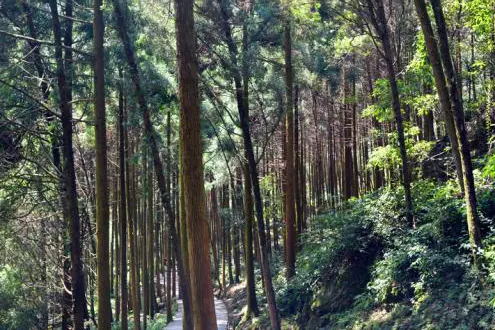
A stand of cedars — straight trunks packed up the slope, a section of stone path visible at the lower left
Sitting by the stream until dark
The best hour in Xianglingtou is between 18:00 and 19:00: the park closes, everyone comes back, the restaurants light up and the stream still holds the last of the daylight. Buy a glass of Yandang maofeng tea or a local beer, sit on the stones by the bridge, and watch the village wash vegetables, walk dogs and drag tables outside. It falls exactly between the end of Lingfeng by day and the start of the night session. Do not go back to the room; this is the hour that feels least like being a visitor.
Via ferrata: an hour on the rock
There is a via ferrata course in the climbing area, graded A at ¥188, B at ¥288 and C at ¥70, the shortest under an hour. Kit is provided, a guide leads, and a steel cable protects the whole route; no climbing experience is needed, but you should be comfortable with height and have some arm strength. The 07:00 morning slot is best in summer while the rock is still cool; by afternoon the face is hot and the gloves are soaked. If heights frighten you, do not force it — the entire selling point is that there is nothing under your feet.
A glass of local tea
Yandang maofeng, also called Yanming, is a baked green tea picked between Qingming and Grain Rain, one bud and one leaf, brewing pale green and tasting lighter than Longjing but fuller than white tea. A pot in Xianglingtou costs twenty or thirty yuan with free refills. To buy, go to a tea factory's own shop or a village cooperative: pre-Qingming leaf runs ¥500–1,500 a jin, everyday drinking tea ¥150–300, and the spread is absurd, so taste before you pay. Locals drink it hot by the stream in summer, which sounds wrong and is not.
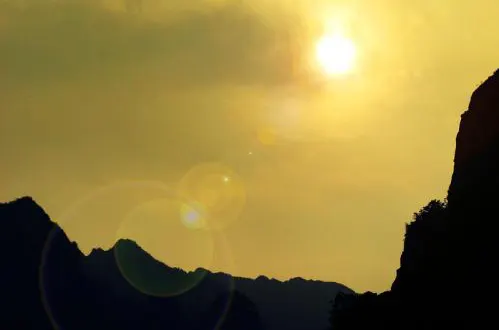
The ridge near sunset — the sun low, the near cliff reduced to a black edge, a few lens flares across the frame
07The answer is almost always Xianglingtou
Three locations, three different trips. Xianglingtou is inside the core: five minutes on foot to Lingfeng, three to the shuttle stop, and the densest cluster of guesthouses and restaurants. Yandang town at Baixi sits between the railway and the gate, cheaper but twenty minutes from everything. Inside the park a few old hotels survive — Yandangshan Villa, Furong Hotel and the like — around ¥400, rooms dated, position excellent. For a first visit of two nights, choose Xianglingtou. There is no better answer.
Guesthouses: one street and the alleys behind it, a hundred or two of them, ¥120–300 midweek and double at weekends and holidays. Check three things — distance to Lingfeng, whether they collect you from the station, and whether the room faces the stream (damper, but you sleep to water).
The old park hotels: Yandangshan Villa, Furong Hotel, Shuguang Villa, ¥300–500. You pay for position and parking; the rooms are ten years old and soundproofing is average. A reasonable choice with parents or small children, or if you do not want to drag a case up a slope.
Yandang town at Baixi: a clean double for ¥100–200, five minutes from the station, right for a late arrival or an early train. The trade-off is no night session within walking distance and ¥15–30 each way by taxi.
Camping: tents used to go up outside Lingfeng, but rules have tightened and overnight camping inside the core is largely banned. Ask about the current policy rather than following a 2013 guide with a tent on your back.
Two practical notes. Humidity averages 77 per cent, so ground-floor rooms smell of damp bedding — ask for the second floor when you book. And weekends and holidays double the price and sell out, especially May Day, National Day and the summer break; book two weeks ahead. Midweek you can arrive and choose, because Xianglingtou has plenty of rooms.
Vegetable plots on the valley floor, walled into narrow strips along the slope with stone retaining walls
08Stream fish, rock frog, green noodles
Yandangshan has sea on one side and mountain on the other, and the cooking is Wenzhou food at altitude: seafood, stream fish and forest produce on the same table, a little heavier than in the city but nowhere near Jiangxi heat. Restaurants inside the park run about thirty per cent above Baixi, ¥60–100 a head; the back-street places in Xianglingtou are ¥40–60 with bigger portions. Always ask the price and buy seafood by weight; do not let anyone assemble a plate for you.
What to order
Stream fish: small fish from the creeks, usually in tofu soup or braised, tender and full of bones, ¥30–40 a bowl. In autumn there is ayu, one of the five Yandang delicacies, best grilled; it is expensive, ¥80–90 for one, and out of season it is almost certainly trucked in from somewhere else.
Rock frog: denser than bullfrog, usually clear-simmered or braised, ¥80–120 a portion. Everything served is farmed — wild ones have been protected for years. Clear broth, white meat, a little gelatinous at the edges; this is what locals cook for guests.
Green noodles: mung bean flour cut with sweet potato starch, grey-green, as thick as a chopstick, always stir-fried with celery, oyster meat, razor clam and shredded omelette. No cabbage or spinach — they release water and wreck the texture. Twenty-something yuan, and the most distinctive starch on the mountain.
Sweet potato noodle soup: cellophane noodles simmered with pork trotter or bone, finished with egg shreds, celery, dried shrimp, seaweed, oyster meat and black vinegar. Soft, slippery, faintly sour, and served at local weddings too. A bowl in winter does more than coffee.
Clam and tofu soup, fried rice noodles, wheat flatbread: the everyday three, cheap, unspectacular and reliable. With children, or if you do not want chilli or adventure, this is the safe order.
Two traps. The seafood places that tout at the park gate are expensive and light on the scales; fifty metres up the street the same fish is thirty per cent cheaper. And at temple doors someone will hand you incense and say it is free, then ask for a donation of a size they decide — if you do not want to pay, do not take it. Both warnings were in the 2013 guide and both still hold.
09Tea and dried seafood, mostly
This is not a shopping mountain. The local specialities come down to three things: tea, dried seafood and shihu. Every shop on the pedestrian street sells them, and the spread between the tourist price and the real price is roughly double. The test is unglamorous and works: see which shop locals walk into.
Yandang maofeng: baked green tea picked between Qingming and Grain Rain, one bud and one leaf. Pre-Qingming ¥500–1,500 a jin, everyday tea ¥150–300, gift boxes ¥300–800. Sit down and taste first; the gap between price tiers in the same shop is real.
Dried seafood: shrimp, dried eel, cuttlefish, seaweed, kelp, sold by weight at ¥100–300 a jin. Judge by colour and smell; anything glossy, uniform and smelling only of salt has probably been treated.
Shihu, the precious Dendrobium orchid: Yueqing grows it, sold as dried coils or fresh stems, from a few hundred to several thousand yuan a jin. The market is opaque. If you do not know it, avoid the powder and buy whole stems you can see, or skip it entirely.
Fine-line paper cutting: a Yueqing craft, dozens of hairlines cut into a palm-sized sheet, framed and sold for ¥80–300. Lighter than tea, more durable than dried fish, and the easiest thing to carry home as a gift.
Three things to leave: anything sold as wild shihu or wild rock frog (the wild ones are protected and trade in them is illegal), old objects and antiques with no provenance, and the brightly packaged mountain-produce boxes at the gate with no visible production date. For tea, buy from a factory shop or a village cooperative, where there is someone to complain to.
10One station, two ways in
Yandangshan Station: turn left
Yandangshan Station is a small stop on the coastal line, five or six kilometres from the visitor centre. Turn left out of the exit and fifty metres along is the free shuttle, fifteen to twenty minutes to the centre, where you change to the park buses. First departure around 08:00, last around 20:30, and after that it may only run as far as Xianglingtou — ask if you are arriving late. Bus 581 also leaves from the forecourt, ¥2, running through Baixi, Xianglingtou, Lingfeng and Lingyan all the way to Dalongqiu in about 38 minutes; locals use it. A taxi to Xianglingtou is ¥15–30 and takes ten minutes.
From Wenzhou, Hangzhou, Shanghai
Wenzhou South to Yandangshan is 28–34 minutes for ¥28–34, with the useful departures at 07:10, 09:01 and 09:25; after that the next cluster is after 11:00 and the day gets tight. Hangzhou East is about two hours, Ningbo ninety minutes, Shanghai Hongqiao three and a half, Taizhou West twenty minutes. From Wenzhou's airport, take the metro to Wenzhou South and change to the train, about ninety minutes in total; a direct taxi is ¥260–320, which for three or four people is barely more than the train.
Inside the park: shuttle, minibus, cable car
The park shuttle is the lifeline, linking the eight areas. A three-day pass is ¥40 unlimited, five days ¥60, single rides ¥10–20, and the three-day pass almost always pays. Route 1 runs the visitor centre to Dalongqiu via Lingfeng, Lingyan and the Fangdong junction; route 2 shuttles between Lingyan and Fangdong; route 3 links the centre, Lingfeng and Lingyan. The Lingyan–Fangdong minibus is ¥10 one way, and private cars are not allowed up to Fangdong — you must transfer. The Fangdong cable car is ¥40 one way, ¥60 return, five minutes; if heights bother you, the minibus is just as good.
Driving and parking
By car, take the G15 expressway, exit at Yandangshan and follow signs to the visitor centre. Parking is about ¥20 a day at the centre and ¥10 a time at Lingyan. On holidays and through the summer break there is traffic control around the park and you park outside and transfer; Fangdong never allows private cars. The roads are winding and unlit at night, so park before dark.
Check trains and fares from Wenzhou to Yandangshan
Numbers: visitor hotline 0577-62178888, visitor centre 0577-62241549, complaints 0577-62243651, rescue 0577-62181699. Police 110, ambulance 120, fire 119.
Medical: Yandang town has a health centre for sprains, stomach trouble and heat exhaustion; anything serious goes to Yueqing People's Hospital, about forty minutes away. First-aid rooms at Lingyan and the visitor centre handle only the basics.
Signal: 5G in Xianglingtou and at the main sights, dropping to 4G or nothing on the Fangdong and Woyun boardwalks and deep in the valleys. Download an offline map before you go.
Money: WeChat Pay and Alipay work everywhere, and the international version links Visa and Mastercard; tickets, shuttles and the cable car can all be paid by QR or online. Carry ¥200–300 for the moments when the signal drops.
Tickets: buy through the official WeChat accounts, Yandangshan Tourism and Yandangshan Release, with real-name registration and entry by ID card or passport. Foreign visitors book with a passport number and verify at the window or staffed lane. Combo validity starts at first use, so do not burn a three-day ticket in one day.
Rules: no smoking outside designated areas; drones need permission and are largely banned in the core; no climbing railings and no swimming in the streams; and do not accept incense from a stranger at a temple. Stone steps are genuinely slippery after rain, and smooth leather soles are a bad idea.
12Packing list and pitfalls
Footwear: grippy, treaded, able to handle wet stone. The 400 steps into Guanyin Cave, the Fangdong boardwalk and Lingyan after rain all test the sole. Bring spare socks.
Rain gear: 1,936 mm a year and it arrives fast. A light rain shell beats an umbrella, which is useless on a boardwalk and takes up space in a crowd.
A torch: the Lingfeng night session is deliberately dim and step edges vanish. A phone light works; a small headtorch keeps your hands free.
Clothing: three to five degrees cooler than Wenzhou, and the night session needs a layer. Mosquito repellent in summer; in winter the boardwalks can ice over, so keep the soles soft.
ID and cash: the national ID card is the key to gate, bus and hotel; foreign visitors carry the passport itself, since copies are not accepted.
Knees: Guanyin Cave and Fangdong are both step-heavy, and descent hurts more than ascent. A brace or a stick earns its place, especially on two consecutive walking days.
Five pitfalls. Anyone at the station offering a private car into the park or a way in without a ticket is selling nothing; the only ways in are the shuttle, the bus, the park buses and the cable car. Lingfeng day and night are separate tickets, and the day ticket covers the daylight session, which ends at 17:00 and is usually cleared from 16:30 — do not plan to hide inside until dark. The rope show is cancelled by rain with no replacement, so do not leave it as the only slot on your last day. The Fangdong-to-Lingyan boardwalk is comfortable downhill and a few hundred metres of climb in reverse; do not force it with parents or small children. And the last park bus is 17:30–18:00 in low season, so do not schedule a sunset past it.
13A caldera, and a hundred million years of water
Geology: rock built from ash
The rock here is Cretaceous pyroclastic flow: magma torn into hot ash and cinders in the air, landing soft enough to weld itself together — what geologists call welded tuff. Four eruptive phases stacked six hundred metres of it across sixty-odd square kilometres, then the chamber collapsed into a caldera. The square columns, thin screens and natural gates you walk past today are what water made afterwards, working down the vertical joints that formed as the ash cooled. First the columns, then the valleys, and only then the paths.
Shen Kuo, writing in the eleventh century, described these peaks as what remains after water carries the soft material away and leaves the hard rock standing. That is fluvial erosion, argued roughly seven hundred years before Europe got there, and it is why Yandangshan is treated as one of the birthplaces of the idea. Every cliff at the valley floor is the physical version of that sentence.
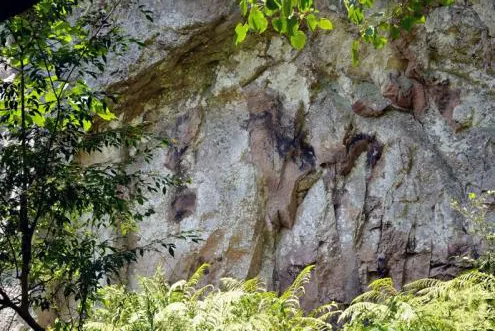
Rock close up — flow banding and weathering stains in the rhyolite, ferns rooted in every crack
Culture: one monk, three writers, one mountain gazetteer
Tradition has it that the monk Nakula arrived from the western regions in the Eastern Jin with three hundred disciples and became the mountain's founding figure; a Liang crown prince built a temple and pagoda below Furong Peak; by the Song there were eighteen temples, ten cloisters and sixteen pavilions. The man who put Yandangshan into Chinese literature was Xie Lingyun, who walked here and devised the split-toothed climbing clog that carries his name. Huaisu copied sutras in a snow cave in the Tang. And Xu Xiake came three times in the Ming, the first in 1613, hauling himself up a cliff on a strip of cloth to see the summit lake and frightening the monks stranded above.
Kang Youwei came in 1924 and left more than twenty pieces of calligraphy. The Republican-era traveller Jiang Shunan rebuilt the mountain gazetteer, printed photograph albums, drew maps and wrote guidebooks, making him the mountain's first operator in the modern sense; many of the inscriptions, archways and paths still in use trace back to him. The name is older still: a lake on the summit, thick with reeds, where wild geese stopped on the way south. The lake is a pond now. The name stayed.
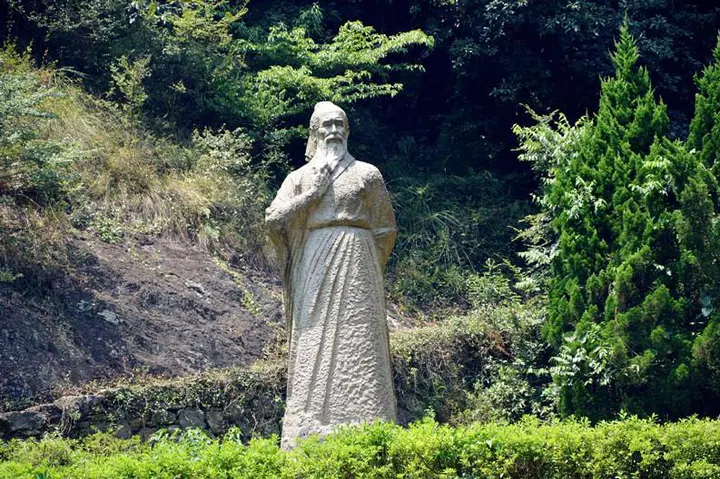
The Xu Xiake statue at the Lingyan entrance — long beard, scholar's robe, one hand holding the fold of his gown
14Is Nanxi River worth adding?
Nanxi River: only with a car
Nanxi River lies west of Yandangshan: 34 km and fifty minutes on the Yannan road to Shiyan, and a completely different landscape — slow water, rounded hills, old farming-and-scholarship villages, bamboo rafts on the river. Shiyan is a 300 m boulder standing straight out of the stream, Shiziyan has the rafts, and Cangpo and Lishui Street show the old village plan. The problem is public transport: from Yandangshan you change twice via Wenzhou or Yongjia, ninety minutes to two hours, which rules out a same-day return. The verdict is simple. With a car and a spare day, go. With buses and only two days, do not — give the time to Fangdong and the Lingfeng night session instead.
Wenzhou: another city, half an hour away
Wenzhou South is half an hour away, and the trip works in both directions. The city deserves half a day: Jiangxin Island sits in the Ou River, five minutes by ferry, with twin pagodas and the old consulates; Wuma Street and Chan Street form a restored old-quarter pedestrian zone with lamp-cake, pork-offal noodles and wontons after dark; Wenzhou cooking is light, with pounded fish and raw river crab as local signatures. If you are flying out of Wenzhou, give the last day to the city rather than squeezing in one more cave.
Taizhou: twenty minutes north
Taizhou West is twenty minutes north. Shenxianju, in Xianju county, is ninety minutes by car from either Taizhou or Yandangshan — another rhyolite mountain, cable car plus boardwalks, a full day. The Ming city wall at Linhai is a complete coastal fortress town, half a day. If you are coming from Shanghai and continuing to Hangzhou or Ningbo, Taizhou is a place you pass through, not a stop worth building in.
15Duanchang Cliff and Guohe Bridge
Wuxia: the sixteen-year promise
In Jin Yong's The Return of the Condor Heroes, Xiaolongnü carves a promise to meet again in sixteen years on Duanchang Cliff and jumps; Yang Guo waits sixteen years and gets his reunion at the bottom of the Vale of Despair. A television adaptation filmed in this valley — the cliff, the tomb exit, the peak — and the three red characters on the rock became recognisable to a much wider audience because of it. The other one is Nirvana in Fire, whose convalescence pavilion was shot around Guohe Bridge at Lingfeng, a composition of bridge, pool and cliff that needed almost no adjustment. To anyone who has not seen the shows these are just rocks; to anyone who has, the edge of the cliff feels slightly different.
Travel writing: three visits
Xu Xiake's two Diaries of a Journey to Yandang are the mountain's most famous first-hand record. He first came in 1613, and in order to see the summit lake he hauled himself up a cliff on a piece of cloth, discovered the lake was a pond, got stuck, and had to improvise a rope from his leggings to get down. The passage is embarrassing and honest, and reads better than any claim about wonders under heaven. Shen Kuo's few lines in the Dream Pool Essays did the other job: they turned the scenery into science.
Books and screen
For the mountain itself, the gazetteer rebuilt by Jiang Shunan and annotated by Lu Liyang is the base text — it tells you which rock sits beside which path. Yang Hongjian's Why Wenzhou People Think Differently is a popular, occasionally overconfident portrait of the local commercial character, and it reads fast. On screen, the thirty-six-part Wenzhou Family, directed by Kong Sheng, follows one household through thirty years of reform; it has nothing to do with the mountain, but it explains the people on this coast better than any guidebook. And the song everyone in Wenzhou can hum is Wenzhou Is a Good Place, written as a theme for a local television programme.