No ticket for the old townA river bent into a taijiA temple glued to a cliffFish in red sour soup
In short
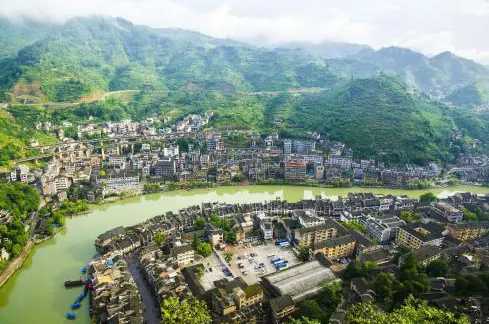
Zhenyuan (镇远, Zhènyuǎn) sits in eastern Guizhou, where the Wuyang River cuts an S through the county seat and splits the old town into a prefectural city on the north bank and a garrison city on the south. From above it reads as a taiji diagram drawn in water. The county was founded 2,200 years ago, was named a National Historic and Cultural City in 1986 and became a 5A scenic area in 2020 — yet the old streets themselves have no entrance ticket and never close. You pay only for individual sites: Qinglong Cave ¥60, Shiping Mountain ¥30, the Tiexi valley ¥50, and the river cruises. Zhenyuan Station is on the old Xiangqian line, about 2 km from the old town: twenty-odd minutes on foot, a little over ¥10 by taxi. High-speed trains stop at Sansui or Kaili South, and you transfer from there. One day covers the main streets and Qinglong Cave, but you need a night to see the lanes at dawn and the lights coming on, tier by tier, after seven.
Key facts
Known for
Wuyang River · Qinglong Cave · old lanes · sour-soup fish
Budget
¥600–1,200 for two days, mid-range, excluding long-distance transport
Days needed
1–3 days
Comfort
Comfortable
Best time to go
April–June and September–November; dragon boats at the Dragon Boat Festival; July–August is wettest and stickiest
01First thing to know: this is a county town that still works
Zhenyuan lies in eastern Guizhou, in the Qiandongnan Miao and Dong Autonomous Prefecture, with Hunan about forty kilometres east. The county was founded in 202 BC and spent two thousand years as the choke point between the Yangtze basin and the southwest: the imperial post road met the river here, Yunnan copper, Guizhou timber and Hubei cloth all changed from mule to boat on these wharves. That makes it three things at once — a garrison town, a trading port and a town of migrants — and the guild halls, opera stages and ancestral shrines you pass were all built by people who came from somewhere else.
The Wuyang River enters from the west and, near the centre, swings into a single S that splits the old town in two: the prefectural city on the north bank, the garrison city on the south. Nine hills fold around the water, a pairing locals sum up as 'nine hills holding one river, one river dividing two towns'. Stand on Shiping Mountain and the taiji diagram is not a literary conceit — it is the landform. Two lobes of old housing, one stone bridge between them, river curling through both.
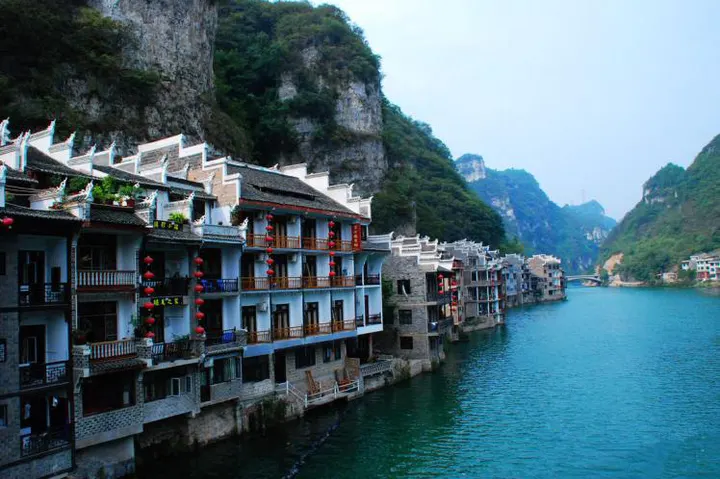
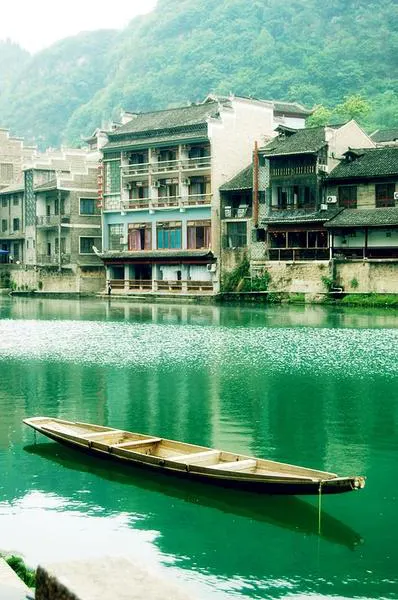
Riverside houses on the south bank: white walls, timber windows, red lanterns, a sheer cliff behind
What Zhenyuan has is a beauty that does not announce itself and does not dazzle, and yet soaks in — like the green river running through the town, moving quietly, working its way into you.
"Zhenyuan", Imalvyou guidebook, 2013
The single most useful fact: the old town has no entrance ticket. Streets, embankments, wharves, lanes — open around the clock, free. You pay at individual sites inside: Qinglong Cave ¥60, Shiping Mountain ¥30, the Tiexi valley ¥50, the Wuyang River cruise ¥100, the in-town evening boat ¥80. That changes how you travel here. There is no pass to justify, no checklist to clear, and you can treat the place as what it is — a county town where you happen to be staying two nights.
The less flattering part, up front: Zhenyuan has commercialised, unevenly. On the busiest few hundred metres of Xinglong Street and Shuncheng Street, half the shopfronts are costume photographers, milk-tea counters, ginger-sweet stalls and silver shops, and the speakers run from noon to ten. Thirty metres into any lane the noise drops away and you are among people shelling beans on a doorstep, washing lines overhead, a mahjong game audible through a half-open door. Residents still rinse mops in the river, and a vegetable seller still crosses the bridge with a shoulder pole in the morning.
Set against Fenghuang or Lijiang, Zhenyuan is cheaper, shabbier and stages far less. The Tuo in Fenghuang is largely a stage set; half of the Wuyang's banks are still in daily use. Lijiang's night is a programme; Zhenyuan's simply disperses after 21:30. The price is that nothing here has been retouched — the flagstones are genuinely uneven, rain genuinely makes them treacherous, and old timber walls genuinely transmit sound. Which you prefer depends on whether you want a town or a photograph.
02Six reasons to stop walking and look up
Qinglong CaveThree faiths, one cliff
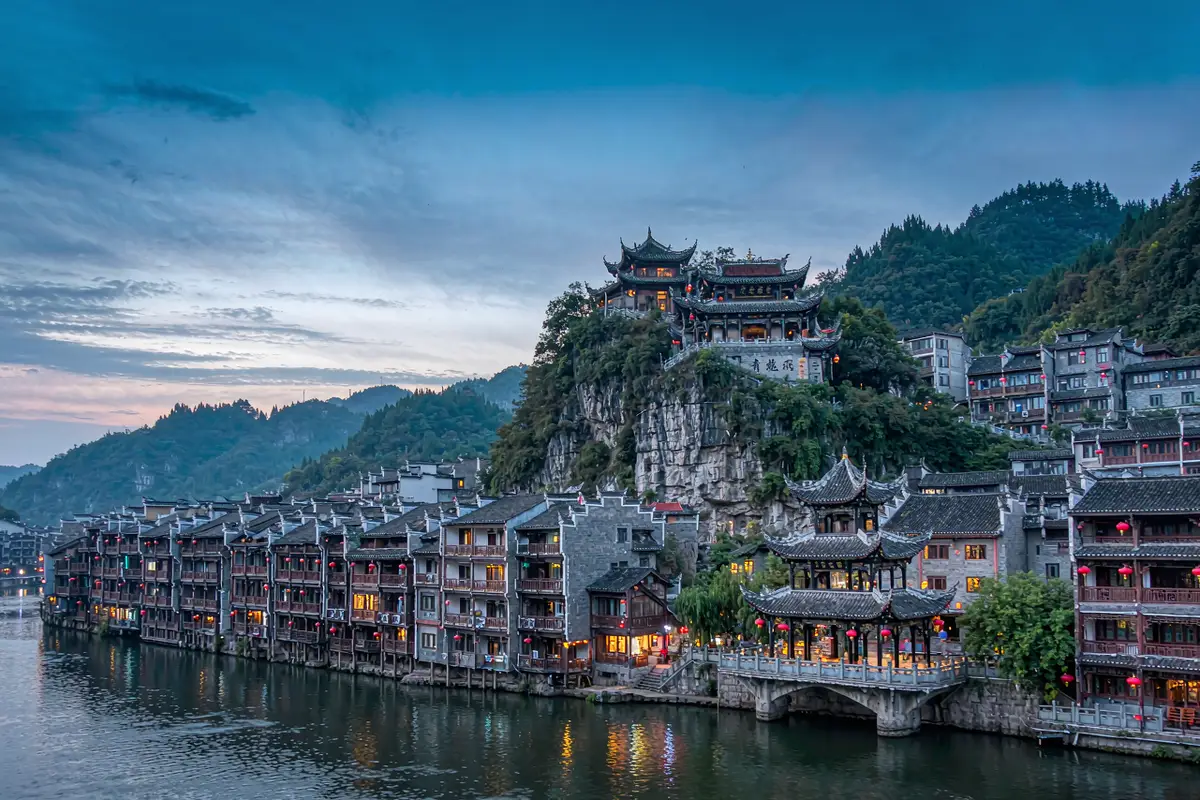
Despite the name, there is no cave to walk through. This is a complex pinned to a cliff, its beams socketed straight into the rock: begun in 1388, spread over 21,200 square metres, and made up of six groups and thirty-five buildings — Zhusheng Bridge, the Zhongyuan Buddhist courtyard, the Ziyang Confucian academy, Qinglong Cave proper, the Wanshou Palace guild hall and Xianglu Rock. A Buddhist hall houses the Taoist immortal Zhang Sanfeng; the top room of a Confucian academy is given to Laozi; the first chamber of a Taoist temple seats Guanyin. The overlap is not a guide's patter — you can see it in the statues.
Admission:¥60, half for students
Hours:08:00–17:30 (17:00 in winter); allow 1.5–2 hours
Zhusheng Bridge and the Kuixing PavilionA bridge 240 years in the making
Seven arches, 135 m long and 8.5 m wide. Work began in 1388, stalled repeatedly, and was only finished in 1628; the last great repair came in 1723, and legend has it that the work finished on the Kangxi emperor's birthday, which is how the bridge acquired the name Zhusheng, 'wishing the sage long life'. Between the third and fourth arches from the east stands the Kuixing Pavilion, a three-storey octagonal structure put up in 1878 by the prefect Wang Bingao and known locally as the Top Scholar's Tower. Standing on the bridge gives you the cheapest panorama in town.
Admission:Free, all day
Best angle:From the east end looking west, with Qinglong Cave and the far bank in frame
The view from Shiping MountainSome 490 steps for one diagram
The ridge behind the old town rises to 668 m, roughly 200 m above the water, and carries a stretch of Ming wall along its spine — locally called the Miao frontier wall, and at sunset it does look like something long lying down. The climb from the north gate side is some 490 steps, half an hour at an unhurried pace. From the viewing platform the S of the river, both fields of tiled roofs and the ridges beyond all lie open at once. This is the only place where the word 'taiji' stops being a metaphor.
Admission:¥30, 08:00–18:00
Note:No lighting on the ridge — bring a headtorch if you stay for sunset
The river after darkThe lights come on in tiers
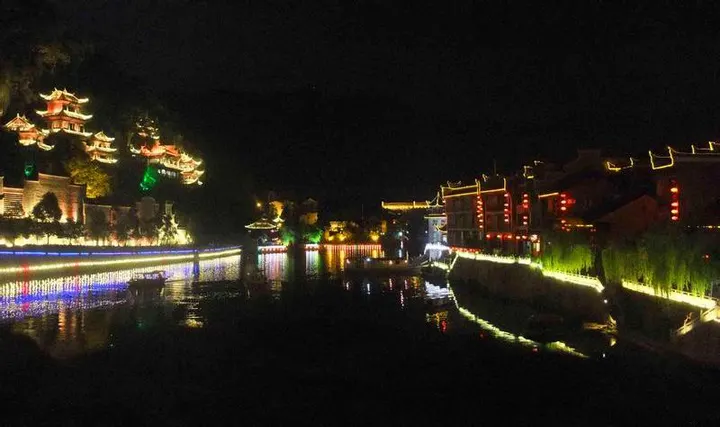
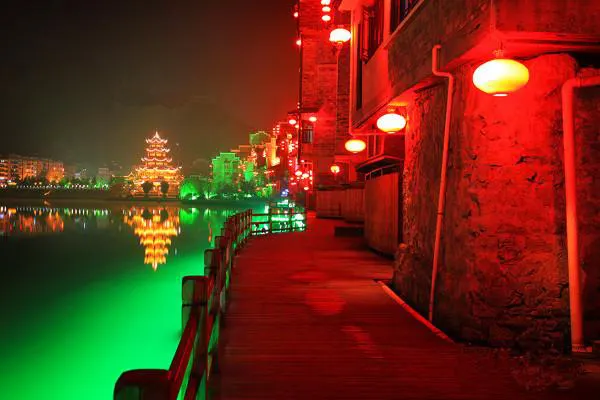
Zhenyuan's night is not made of projections or a musical fountain. It is made of outline lighting picked out along a cliff and a row of stilt houses. Lamps come on at 19:00; by 20:00 the sky is properly dark and the Qinglong face looks lit from below, its reflection drawn into long stripes on the water. Two ways to see it: ¥80 for the painted pleasure boat out in midstream, or one or two yuan for the little ferry across — ninety seconds, but in those ninety seconds the far bank comes at you head-on.
Evening boat:¥80–90, departures every 30 minutes 19:30–22:00
Ferry:¥1–2 from any small wharf, no timetable
Heping VillageA site that does not perform
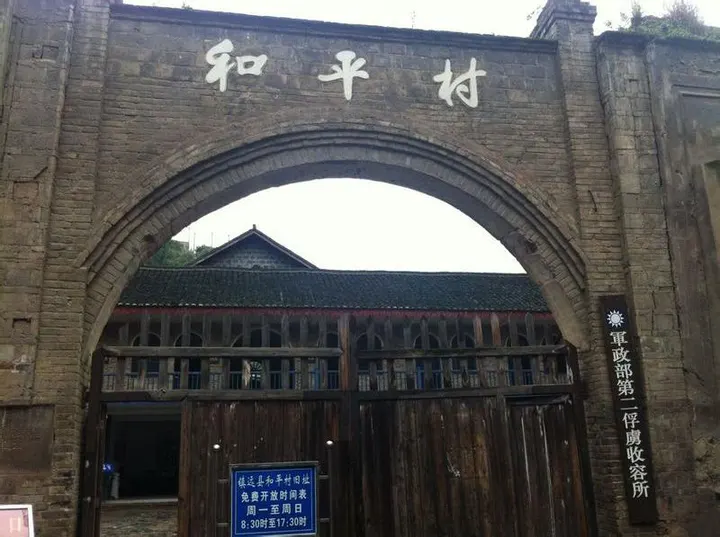
In the winter of 1938 the Second POW Camp of the Nationalist Military Affairs Ministry moved from Changde in Hunan to Zhenyuan and took over the courtyard of a late-Qing garrison headquarters. Some 600 Japanese prisoners passed through it, and 137 of them later joined the Japanese anti-war league in China. Offices, an assembly hall, guard rooms and a watchtower survive; the site was listed for national protection in 2006. It is free, and the displays are documents, photographs and objects — no interactive screens, no soundtrack.
Admission:Free, 08:30–17:30, last entry 17:00
Where:South end of Heping Street, near Zhou Dawen's former residence
Sour-soup fishThree days without sour and the legs wobble
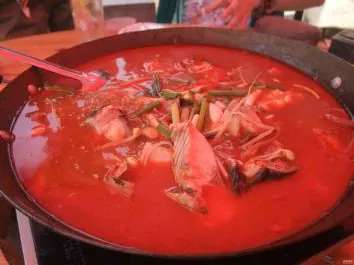
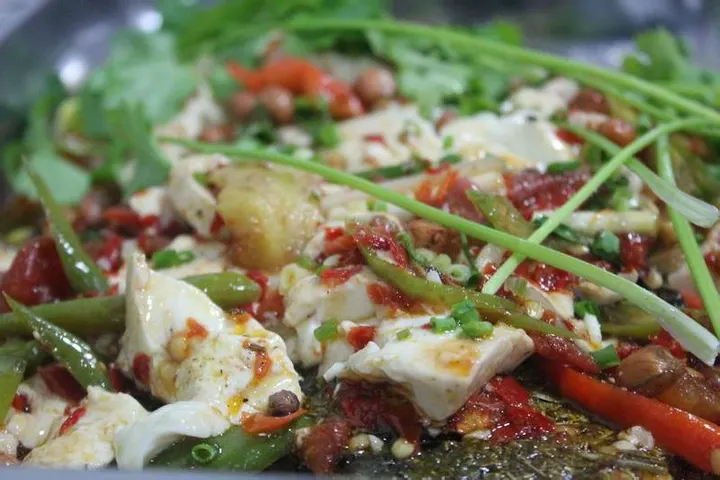
Sourness here comes from three places: white sour fermented from rice water, red sour made from wild tomatoes, and a chilli sour built on fermented peppers. Red is the common one — a scarlet broth that hits sour first and finishes sweet, with heat as an afterthought. The fish is usually river or paddy fish, killed to order; when the fish is gone you cook tofu and greens in what is left. Locals have a saying for the habit: three days without sour and your legs stop working. A pot for two or three runs about ¥120–180.
Price:¥50–80 a head
Ordering:Fish is sold by weight — confirm price and size first
03Seven things worth settling before you book
Is one day enough?
Enough to see it, not enough to feel it. A standard day goes like this: Qinglong Cave in the morning (ninety minutes), across Zhusheng Bridge into the lanes (an hour), sour-soup fish by the river at midday, up Shiping Mountain for the panorama (an hour up and down), then Xinglong Street at dusk waiting for the lights. That is the sightseeing version. What it misses is the empty flagstones at 06:30, the smoke of a coal stove being lit in a lane, and the embankment after 22:00 when all you can hear is water. Those three are the actual town. Stay a night.
Should I stay overnight, and on which bank?
Yes. Half of Zhenyuan's value is temporal: the hour before the lights come on and the hour after they go off. The north bank, around Xinglong Street and the New Bridge, is the handiest — food, boats and shops at the door — but the bars and costume photographers stay audible until 22:30. The south bank, near Zhusheng Bridge and Shuncheng Street, is much quieter and opens onto Qinglong Cave, at the cost of a ten-minute walk for a late meal. Choose the south bank with children or older parents, the north bank if you want noise, and the station area if you have an early train and want to halve the room rate.
Does the old town charge an entrance fee?
No. The old town is an open district with no gate and no turnstiles, walkable around the clock; embankments, wharves, lanes and Zhusheng Bridge are all free. You pay only at individual sites: Qinglong Cave ¥60 (half for students), Shiping Mountain ¥30, the Tiexi valley ¥50, the Tianhou Palace ¥10. The Wuyang River scenic area charges ¥40 admission plus ¥100 for the boat, separately. The in-town evening cruise is ¥80. Qinglong Cave and Shiping Mountain sell a combined ticket for around ¥70, which saves twenty. Heping Village, the Zhenyuan Museum and Zhou Dawen's former residence are free.
Is Qinglong Cave worth ¥60?
Yes, if you go at it the right way. This is not a grand hall; it is a cluster of small buildings jammed onto a cliff, with single-file corridors, steep steps, and walkways linking one shrine to the next. Even the Wanshou Palace stage, the largest space, opens onto a courtyard the size of a tennis court. What you are paying for is three things: how the structure holds onto the rock, how three faiths were folded into one another, and the angle down the Wuyang from the topmost Yuhuang Pavilion. Twenty minutes and you are out; ninety and you have seen it. If heights and narrow stairs bother you, the exterior seen from the road is enough.
What time do the lights come on, and when do they go off?
In summer the switch-on is around 19:00; in winter, with earlier darkness, it comes forward. The official line is that the lighting runs until 02:00, but that is the system schedule — on ordinary weeknights individual facades start going dark around 23:00, while the lanterns along the embankment last longer. The best window is 20:00–21:30: fully dark, boats still running, something moving on the water. For reflections, the wind usually drops around 20:30. Where to stand: the east end of Zhusheng Bridge for Qinglong Cave, the Qinglong embankment for the bridge, and the New Bridge for the whole bend.
Is it easier to come from Guiyang or from Kaili?
It depends where you start. From Guiyang, the ordinary train is simplest: four to five hours, ¥41.5 in a hard seat, boarding at Guiyang station and waking up at Zhenyuan, 2 km from the old town. For speed, take high-speed rail from Guiyang North to Sansui (about 1.5 hours), then the bus outside the station, ¥25 and an hour, into Zhenyuan — a little over three hours door to door. From Kaili, the ordinary train is 1.5 hours and ¥14.5 with frequent departures, the cheapest leg of the whole trip; Kaili South also has direct buses at ¥60 taking about 1.5 hours. Coming from Hunan, Huaihua is three hours at ¥28.5 and Yuping one hour at ¥12.5. Note that high-speed trains do not stop at Zhenyuan Station — check the station name before you buy.
Does the river flood in the rainy season, and will it ruin my trip?
It does, and this is not hypothetical. Annual rainfall is about 1,094 mm, eighty per cent of it between May and October, and a storm upstream can lift the river within hours. On 29 June 2024 the Wuyang hit its highest level on record: ground floors along Heba Street went under, and Qinglong Cave, Shiping Mountain, the Tiexi valley and every boat were closed that day. Ordinary summer showers usually only stop the cruises — high water or fast current means no sailing — and leave the streets alone. Three rules for the wet season: check the forecast and the Zhenyuan government account before you travel; if you book a low riverside room, ask how they handle a rise; and put the boat trip early in your stay so a cancellation still leaves you time.
04One, two or three days
The sights are tightly packed — a circuit of the core is under 3 km — so the planning problem is rhythm, not distance. Put Qinglong Cave at one end of the day and Shiping Mountain at the other, and give the middle to lanes and lunch. Schedule the boat for whichever evening looks dry. Everything outdoors here is weather-dependent, so keep half a day loose enough to swap.
D1
Arrive in the morning and do not rush into a ticket gate. Walk the river from the New Bridge to Zhusheng Bridge first, forty minutes, and let the shape of the place settle. Sour-soup fish by the water at midday. Enter Qinglong Cave at 14:00 and give it two unhurried hours, then cross Zhusheng Bridge and climb into the lanes at Sifangjing, working through to Renshou Lane, which drops you out by the Tianhou Palace on Xinzhong Street. Back at the east end of the bridge for dusk; when the lights come on at 19:00, take the ¥80 cruise, or spend two yuan on the ferry and cross three times for the price of a coffee.
D2
Up at 06:30 for the East Gate morning market, then walk yesterday's crowded lanes again — at that hour they are a different street. Onto Shiping Mountain at 08:30 (some 490 steps, ninety minutes up and down), a stretch of the Ming wall along the ridge, and down on the north side. Sleep for an hour after lunch. The afternoon belongs to the garrison city: Heping Village (an hour), Zhou Dawen's former residence and the Zhenyuan Museum, all free, about two hours end to end. Give the evening to the riverside food stalls by the New Bridge.
D3
Out of town. Seventeen kilometres west is the lower Wuyang gorge: ¥40 admission plus ¥100 for the boat, two hours on the water and half an hour on the boardwalk, four hours in total — the most purely scenic half-day available. If boats are not your thing, go 4 km northeast to the Tiexi valley instead, ¥50, a walk up the stream to Longtan and back in about three hours. Both are rain-sensitive: high water stops the boats, a rising stream closes the path, so ring ahead. Back in town for luggage and out via Zhenyuan Station.
With half a day, do one thing: Qinglong Cave and Zhusheng Bridge, then sit by the river and stop working. If it rains, reorder to Heping Village, the museum and Qinglong Cave, which has eaves to shelter under, and hold the boat and the mountain for a break in the weather. Rain here arrives hard and leaves quickly; there is usually a window after 16:00.
05From the temple on the cliff to the valley outside
The Qinglong Cave complex
It is built against the Zhonghe cliff and, from the far bank, looks like a row of timber boxes wedged into cracks. It took shape in the Wanli era and kept growing through the Qing until it reached six groups and thirty-five buildings: Zhusheng Bridge, the Zhongyuan courtyard, the Ziyang academy, Qinglong Cave itself, the Wanshou Palace and Xianglu Rock. Look up at three things — how the eaves project, how the posts are socketed into the rock at an angle, and how drainage is led down the cliff face. The builders had nowhere to put foundations; these three tricks are the whole answer.
The unity of the three teachings is not a slogan here; it is a floor plan. The Zhongyuan cave is Buddhist ground but honours the Taoist Zhang Sanfeng. The Ziyang cave is a Confucian academy whose best room is given to Laozi. Qinglong Cave is Taoist, and the first chamber you enter seats Guanyin. The Wanshou Palace was the Jiangxi guild hall, its stage beams carved in openwork with scenes from the Yang family sagas, and on either side of the gate a single brick panel carries the whole complex in relief — a photograph left for posterity by Qing craftsmen.
Someone at the gate may invite you to burn incense 'for free'. They are not staff, and the polite move is to keep walking. The stairs are narrow and steep, so skirts and heels are a bad idea; flash is banned inside, and tripods effectively cannot go up. Open 08:00–17:30 (17:00 in winter), ¥60, half for students, with a combined ticket covering Shiping Mountain for around ¥70.
Zhusheng Bridge
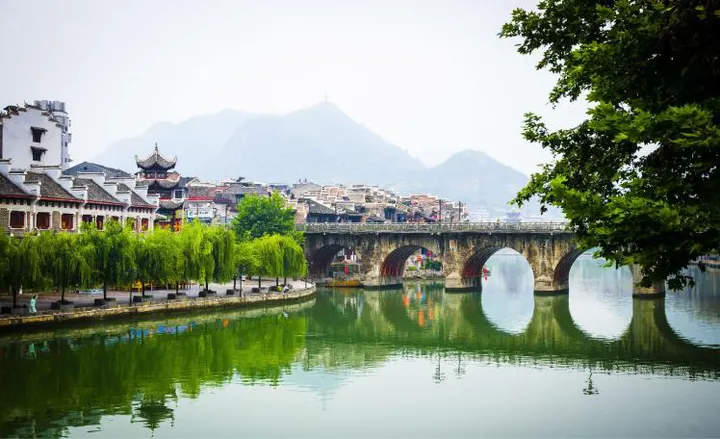
Zhusheng Bridge: seven stone arches, willows and the bridge reflected in the same water
Work started in 1388 and, between floods, wars and a feud inside the local chieftain's family, took 240 years to close in 1628. Seven arches, 135 m long, 8.5 m wide. The last great repair finished in 1723, and tradition links its completion to the Kangxi emperor's birthday; Zhusheng means 'wishing the sage long life'. The three-storey octagonal pavilion between the third and fourth arches from the east is the Kuixing Pavilion, built in 1878 by prefect Wang Bingao so that exam candidates might have the god of literature on their side.
A couplet on the pavilion reads: 'Sweeping clean the mists of the Five Streams, the Han envoy's raft pushes up to the Dipper; cutting open the double post road, the Burmese come over the bridge on elephants.' The second line records the 1819 tribute mission from Burma that crossed here on elephant-back — Lin Zexu, travelling to Yunnan that same year, noted the same procession in his diary. During the war with Japan the bridge carried the Yunnan–Burma road, and American ten-wheelers loaded with supplies from the Hump rolled over these stones on their way east.
Two good hours. At 06:30 the deck is empty and the willows hang into the water. Around 19:15, in the blue hour, each arch closes into a full circle in the river and Qinglong Cave is lit in the background. Nothing parks on the bridge — people and scooters share the deck — so wait for a gap and be patient.
Shiping Mountain and the frontier wall
Shiping Mountain runs east–west behind the old town for 2.2 km, topping out at 668 m, more than 200 m above the river. The name is descriptive: the massif stands up like a screen and puts the prefectural city in its shadow. A line of Ming wall survives along the crest, stone following the ridge, known locally as the Miao frontier wall. It is not large, but standing on it explains the siting — the river bends directly below, and both upstream and downstream are in view.
The path starts on the north gate side: some 490 steps, half an hour at normal fitness. Halfway up sits the Siguan Hall, dedicated to four Warring States generals — Bai Qi, Wang Jian, Lian Po and Li Mu — which is exactly the logic you would expect from a frontier garrison. The platform at the top is the best camera position in town: the S of the river, two fields of old roofs, ridge after ridge behind. Go up forty minutes before sunset, and bring a headtorch, because the descent is unlit. ¥30, 08:00–18:00.
The old lanes and their crooked doors
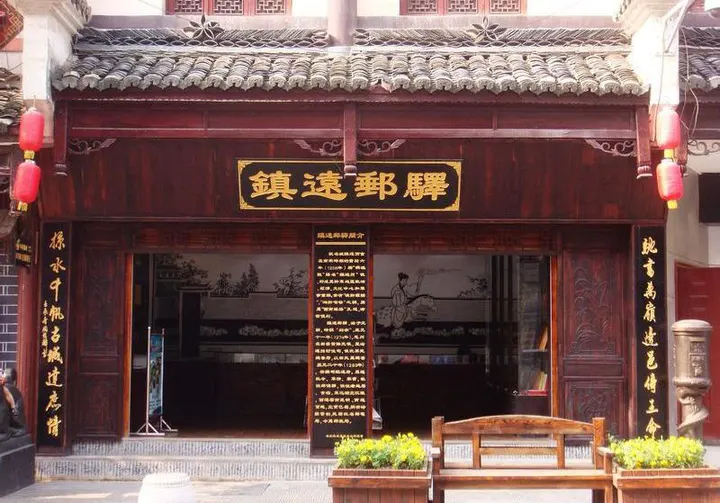
An old post station on Shuncheng Street: gold characters on a black board, a bench outside
Zhenyuan counts six archways and ten lanes; the ones you can still walk are Sifangjing, Fuxing, Renshou, Chongzikou and Shipaifang. They run roughly parallel, climbing from Shuncheng Street by the river up to Xinglong Street and Ximen Street. The easiest route: enter Shuncheng Street at the west end of Zhusheng Bridge, walk 200 m, take Sifangjing Lane on your right at the square well it is named for, climb to the top, cross Xinglong Street, enter Fuxing Lane opposite, and follow it down through Renshou Lane, which exits at the Tianhou Palace on Xinzhong Street. One and a half kilometres, an hour at a wander.
The strangest thing about the lanes has a local name, waimen xiedao — 'crooked doors, slanting lanes'. No front door sits parallel or perpendicular to its lane; each is turned at an angle, and no lane lines up with a main hall. To an outsider it sounds like an insult. It is feng shui: south is the honoured direction, so a door angled slightly southward signals prosperity, and an oblique door also keeps the family's wealth from being visible from the street. Look at the frames, thresholds and door studs and you can tell this was decided when the house was built, not added later.
The lanes are more honest than the streets. Fire walls step up above the rooflines, chillies and beans dry in the skywells, old counters are still made of jointed boards, and now and then a resident sells rice tofu or cold jelly at the door. Light is best before 09:00 and after 16:30, raking into the lanes and picking out the damp patches on the flagstones. Do not photograph into someone's front room; nod first.
The Tianhou Palace
A Mazu temple far inland, set above the river steps on Xinzhong Street: the Fujian guild hall, funded by merchants from that province in the Qing. The main hall seats the sea goddess, and the ridge ornaments put the phoenix above the dragon — an ordering that dates the building to the Tongzhi–Guangxu years, when Cixi held the court. Its reason for existing was practical: the Wuyang ran through to the Yuan and so to Dongting Lake, and Zhenyuan was as far as boats came, so Fujian goods had to change to mule here and the traders needed a place to sacrifice, store and argue. ¥10; listed for national protection in 2019.
Heping Village
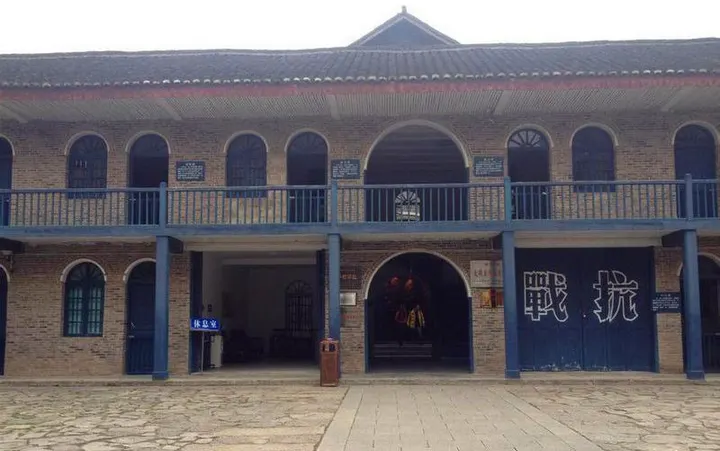
The brick building inside Heping Village: arched windows, blue timber doors, wartime lettering still on them
The courtyard began as the office of the late-Qing Zhenyuan garrison commander, became a model prison in the early Republic, and in the winter of 1938 was taken over as the Second POW Camp of the Nationalist Military Affairs Ministry — commonly called Heping Village after a suggestion by the Japanese anti-war writer Kaji Wataru. Between 1938 and 1944 some 600 Japanese prisoners passed through; 137 of them joined the Japanese People's Anti-War League in China. High earth-and-stone walls enclose it, offices in the front court and prisoners behind, with the assembly hall, infirmary, confinement cells and watchtower all in their original places.
It is now the Zhenyuan Heping Village exhibition hall, free to enter, and the displays are archival: the camp's organisation chart, prisoner rolls, mimeographed anti-war league publications, photographs taken at the time. The courtyard is quiet and few visitors come; most stand in the front court for a few minutes and leave. It was listed for national protection in 2006. Treat it as a memorial rather than an attraction — nobody needs to tell you this once you are inside.
Zhou Dawen's house and the Zhenyuan Museum
Zhou Dawen was born in the garrison city, an early Communist and one of the founders of the Communist Youth League, who later worked in the Soviet Union and was wrongly executed there in 1938 during the purges. His family house on the south side of Heping Street is a courtyard built by his grandfather in the early Guangxu years, ringed by high fire walls with two skywells, and was also the secret Party branch office; it is free, open 08:30–17:30 on weekdays. The Zhenyuan Museum beside the county government on Shuncheng Street covers 2,000 years of local administration, Miao silverwork, Ming and Qing porcelain and the material record of the garrison system — plus a steel ingot stamped 'Number One Under Heaven', rolled at the Qingxi ironworks in 1885, among the earliest products of modern Chinese steel.
The Tiexi valley
A stream valley 4 km northeast of town, ¥50, open 08:00–17:30. You walk in along the water, four kilometres each way to Longtan, about three hours there and back. Longtan is a deep, unnervingly blue-green pool, the colour almost implausible; it gets called the little Jiuzhaigou of the Guizhou plateau, which is overreach, but the water is genuinely that colour. The valley is secondary forest, moss and small cascades, three to five degrees cooler than town in summer. Stones are slippery after rain, so wear grip, and stay out during heavy storms — the stream rises fast.
The lower Wuyang gorge
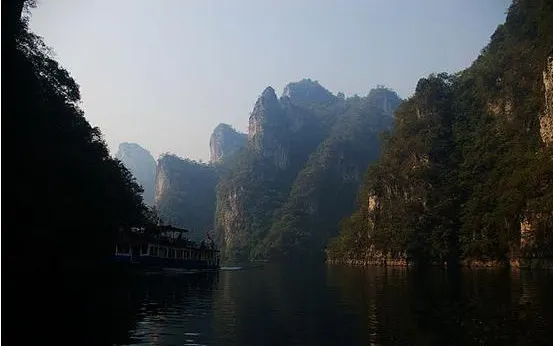
The Wuyang gorge: a tour boat tracking the cliff foot between limestone peaks
Seventeen kilometres west of town, ¥40 admission and ¥100 for the boat. The cruise runs two hours, slowing at formations with names like Peacock Displaying Its Tail and One Line of Sky, then half an hour on the boardwalk ashore — four hours round trip from the old town. The water is a dark green, the banks are sheer limestone, and the shapes are harder than Guilin's, softer than the Three Gorges. It is windy on deck even in midsummer; bring a layer.
Baojing Dong village
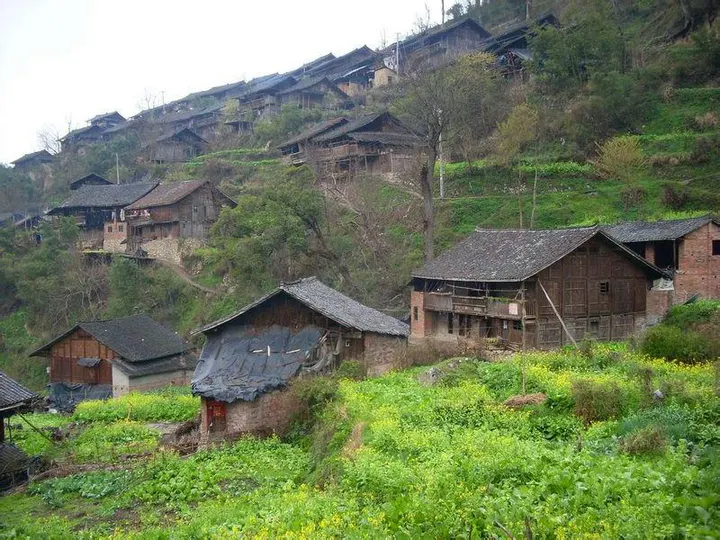
Timber houses on a hillside: grey tiles, board walls, vegetable plots at the door
Thirty-nine kilometres south, nearly 400 households and more than 2,000 Dong residents — the largest Dong village in northern Qiandongnan. Every house is timber, built on stilts, and not one has been faced in tile. The Third of the Third lunar month festival is national intangible heritage, when neighbouring villages arrive for polyphonic singing and long-table meals. On an ordinary day it is very quiet: walk the lanes, watch an old woman at a loom, grain drying in the yard. There are minibuses from the county bus station but not many, so go in the morning or hire a car for the round trip.
06Several ways to use the same river
The evening cruise
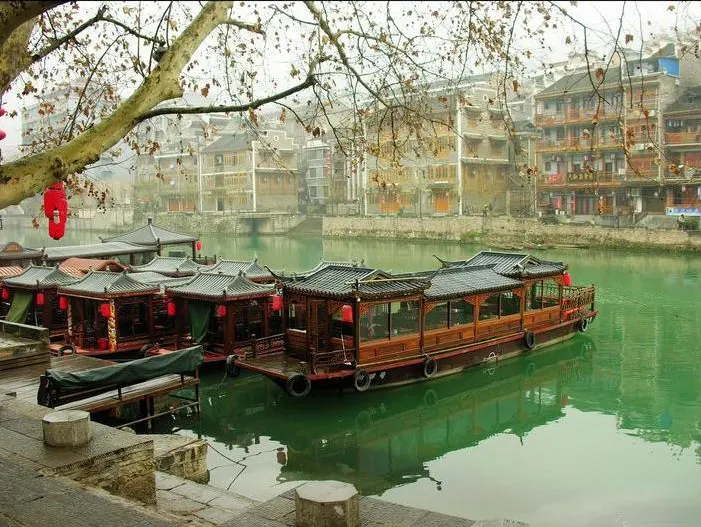
Painted pleasure boats at the stone steps — timber and tiled roofs by day, hung with lights at night
Boats leave from Yumen or Zhenjiange wharf, starting at 19:30, every half hour until 22:00, about 35–40 minutes, shuttling between Zhenjiange and Zhusheng Bridge. ¥80, up to ¥90 on holidays. Sit on the right, near the bow: the Qinglong stretch passes across your whole field of view. There is a commentary, and it is loud; the stern is quieter. Rain and high water cancel sailings, so ask at the wharf on the day.
The ferry
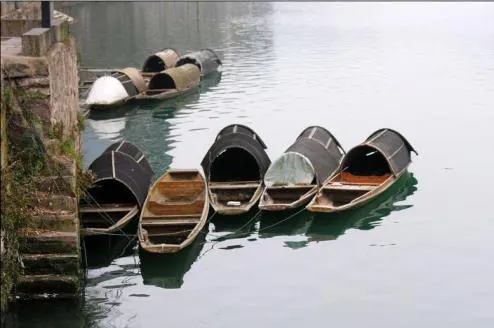
A row of small ferries at the steps, each under a black half-round canopy
Several small wharves still run a crossing for one or two yuan, ninety seconds, no timetable. This is not a show for visitors; it is how people get to the other bank with shopping, scooters and tired legs. Use it three times a day to save walking, or take it after dark, when the lights on both banks come at you head-on.
Dragon boats at the Dragon Boat Festival
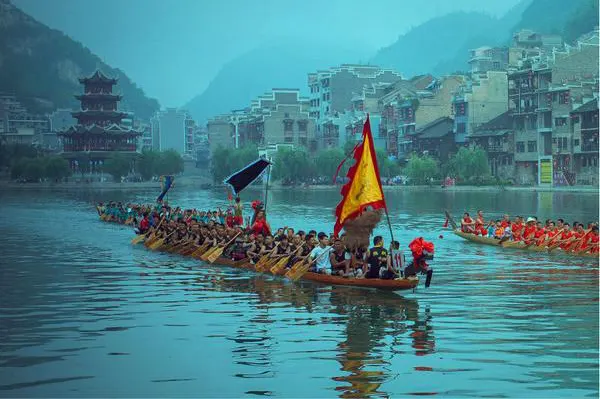
Dragon boats passing the old town, a pagoda on the ridge behind
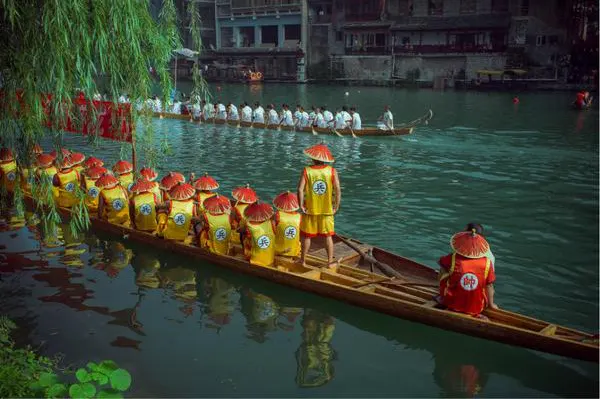
Zhenyuan's dragon-boat racing is national intangible heritage, held on the fifth day of the fifth lunar month — 19 June in 2026 — with river sacrifices, floating lanterns and folk singing in the days around it. Crowds from the neighbouring counties fill both banks. The course used to run past Qinglong Cave and now mostly stretches between the New Bridge and the Jixiang Temple wharf. Rooms double and riverside ones sell out a month ahead, but the atmosphere is the best the town has all year.
A crew in yellow, paddles halfway through the stroke
Four places to stand with a camera
The Shiping Mountain platform, forty minutes before sunset, with the light behind you: the river goes gold-blue and then dull. A 16–24 mm lens takes the whole S in.
The embankment on the Qinglong side, looking south at Zhusheng Bridge: bridge, pavilion, the mountain behind and the hilltop gazebo stack into one frame, reflection included.
The east end of Zhusheng Bridge, looking west at Qinglong Cave: in the twenty minutes after the lamps come on and before the sky goes black, the cliff is warm and the sky is blue — the strongest colour contrast of the day.
The starboard bow of the cruise boat: as it turns past the New Bridge the whole Qinglong cliff opens up. A polariser kills the glare and a slow shutter draws the lights into streaks.
The morning market
Around the East Gate, from 06:30 to 09:00, there is a market: vegetables, tofu, fried rice cakes straight out of the oil, glutinous rice. This is the least staged half-hour in town — live fish in plastic basins, ferns in bamboo baskets, vendors squatting to weigh. Ask before photographing faces; most people smile and nod. By nine the stalls are gone and the street goes back to being the version built for visitors.
07On the river, in a lane, or by the station
Accommodation here comes in three locations, and the price difference mostly buys what is outside the window. A riverside room opens onto the Wuyang and Qinglong Cave; it costs the most and is the noisiest. A courtyard house in a lane is quiet and cheap, but rooms are small and almost none have lifts. The station area is the best value and suits anyone with an early train. Eighty per cent of the guesthouses sit along the two banks, and the balcony river-view rooms are always the first to go on a holiday.
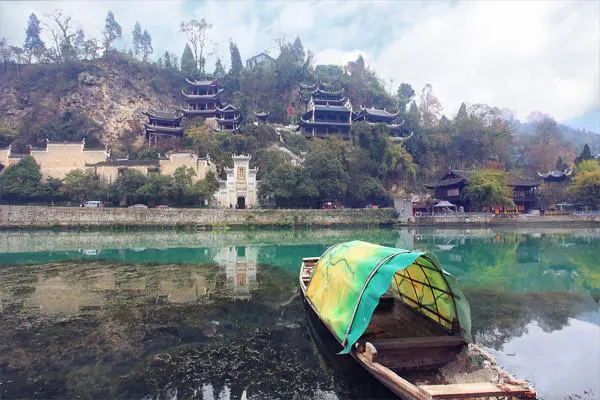
The riverside walk after dark: lanterns along the railing, a lit pavilion across the waterAn empty wooden boat on the river, riverside houses behind
Hostel bunks: ¥40–80, mostly on the south bank, with a common room good for finding shared cars and route advice. Best for solo travellers.
Lane guesthouses: ¥120–250, converted old houses with timber floors, a skywell and no lift; sound carries. The best value tier.
Riverside rooms: ¥300–500, with a balcony or full-height window onto Qinglong Cave and the far bank's lights. The floor below may be a bar or a food stall.
Top end and holidays: from ¥600, with river-view rooms at ¥500–1,200 in peak periods and the top of that range over National Day and the Dragon Boat Festival. Book two weeks out.
Four questions when booking: which floor (ground-floor river views are often blocked by willows), does it face the S-bend directly (a side view is a different room), is there boat-engine and bar noise at night (audible on any low riverside floor), and does the old house have a private bathroom and water heater (some conversions share). If you are driving, confirm parking first: the core is car-free, so the car goes to the visitor centre or the guesthouse's own space, ¥20–30 overnight.
One more question, weather-related: if you take a ground-floor riverside room in the wet season, ask what happens if the river rises. In the June 2024 flood, ground floors along Heba Street took water and hotels moved guests upstairs or out of town. Asking is not rude; it shows you understand where you are.
08Sour, hot, and whatever came out of the river
The cooking is Qiandongnan cooking: sour first, heat second, river fish at the centre. The sourness is fermented, not poured from a vinegar bottle — rice water, wild tomatoes and fermented chilli each produce a different kind. Locals miss it after a single day without, and will spoon sour broth into breakfast noodles. Eating is inexpensive: ¥50–80 a head at riverside restaurants, ¥30–40 in a lane.
Six things to order
Sour-soup fish: red sour is the default, the broth scarlet with a sweet finish, the fish killed to order and tofu and greens cooked in what remains. Sold by weight — confirm the price per jin before ordering.
Grilled fish with tofu curd: the fish grilled until the skin blisters, then covered with soft curd and red broth and kept simmering. The curd soaks up the broth and gets fought over before the fish does.
Daocai: large-leaf mustard pickled in jars, first made by the Taoists at Qinglong Cave, which is where the name comes from. Dark brown, best steamed under pork, and good stir-fried on its own. A better souvenir than any vacuum-packed snack.
Rice tofu: rice slurry cooked with a little alkali, cooled and cut into cubes with a thread, dressed with chilli, spring onion and crisp soybeans. The local water makes it unusually white and smooth. ¥5–8 a bowl.
Beef rice noodles: found all over Guizhou, but here the broth is cleaner and the pickled greens sharper. Slippery noodles, diced beef, a dusting of pepper, chilli oil added by you. ¥10–15.
Ginger candy and sweet-fermented rice cakes: the candy is pulled on a hook in the shopfront, the performance better than the product, and it is best eaten warm. The rice cakes are glutinous dumplings simmered in fermented rice wine with osmanthus — a good start to a wet morning.
Grilled fish under a layer of soft tofu curd, red broth with chilli and spring onion
Where to eat
The riverside stalls under the New Bridge are the busiest patch at night — over two hundred of them, turning out grilled fish, sour-soup fish, crayfish and griddle plates at ¥50–70 a head, with a lot of noise. For quiet, go into the side lanes off Lianhe Street and Xinglong Street, where the local queue usually belongs to a room with five or six tables. The test is simple: prices on the wall and half the tables speaking the local dialect.
A mutton rice-noodle shop at a lane mouth, red lanterns over the door, the owner busy at the cart
Breakfast is its own meal. Locals eat noodles, rice tofu, glutinous rice balls, or oil tea. The stalls by the East Gate market open at 06:30: ¥10 for a bowl of noodles, ¥2 for a fried rice cake. For a drink at night, the local qingjiu is a mild rice spirit that suits sour fish; if you do not drink, order Tianyin tribute tea from Tianyin village in Duping, pale in the cup with a long sweet finish.
09Three things worth carrying, three to walk past
Zhenyuan is not a shopping destination; what travels well is food. Xinglong and Shuncheng streets are dense with souvenir shops, and the same item can differ by thirty per cent three doors apart, so ask before you bargain — haggling is not rude here. What is worth buying is made locally and has a shelf life, not something with the town's name printed on it.
Aged daocai: dark brown, sold in jars, better the longer it keeps. ¥20–40 a bag, good with pork, steamed under belly, or just with rice porridge. Buy vacuum-sealed, not open scoop-your-own.
Qingjiu: the local rice-aroma spirit, marketed on cave ageing, ¥50–150. It is liquid, so it goes in checked luggage, and no more than a couple of bottles each.
Tianyin tribute tea: hand-finished green tea from Tianyin village in Duping, ¥100–300 per jin. Pale liquor, long sweet finish, and a safer gift than spirits.
Three things to walk past
First, 'old silver'. Most of the bangles and headdresses sold as Miao silver are plated alloy, and even genuine pieces are not high-grade — buy them as craft, not as an investment. Second, 'wild' medicinal herbs such as gastrodia and eucommia: this is not their growing area and the pricing is opaque. Third, the gift boxes: the same ginger candy costs half as much in a supermarket outside the old town. The candy itself is fine — buy the batch being pulled on the hook, still warm.
10Zhenyuan Station is on the old line — high-speed means a transfer
Three stations, three different jobs
Zhenyuan Station is a conventional-line stop on the Xiangqian railway, on the edge of the county seat about 2 km from the old town — the only station you can walk in from. High-speed trains on the Shanghai–Kunming line do not stop here; the nearest are Sansui (41 km) and Kaili South (125 km), both requiring a bus or a hired car. Read the station name on your ticket: a ticket to Sansui is not a ticket to Zhenyuan, and there is an hour of road between them.
From Guiyang, Kaili and Hunan
Guiyang to Zhenyuan on a K-train is four to five hours for ¥41.5 in a hard seat, with about five daytime departures — board, sleep, arrive. For speed, take high-speed rail from Guiyang North to Sansui in about 1.5 hours, then the bus from the transport hub outside the station, ¥25 and an hour, to Zhenyuan bus station; or go to Kaili South and take the ¥60 bus, 1.5 hours. Kaili to Zhenyuan by train is 1.5 hours at ¥14.5 with the densest schedule, and it is the route people use coming down from the Xijiang Miao village. From Hunan: Huaihua is three hours at ¥28.5, Yuping one hour at ¥12.5, and Tongren South connects to Yuping station by a ten-minute taxi.
Station to the old town
Out of Zhenyuan Station, head south along Xixiu Street for a kilometre or so into Ximen Street, then another kilometre to the New Bridge: about 2 km, twenty minutes at a brisk pace and half an hour with a suitcase. Otherwise a taxi is ¥10–15 and eight to ten minutes, or bus 1, 3 or 6 costs ¥2 and takes twenty-odd minutes to the New Bridge or the city gate. The core is closed to cars, so you walk from the bridge — which is why you should ask your guesthouse where a car can actually reach.
Flying in
There is no airport. The nearest is Kaili Huangping, 55 km away: a local bus into Huangping bus station and then a coach, a bit over an hour in total. Tongren Fenghuang airport is 170 km, with an airport bus to Tongren coach station and a connection after that, about two hours ten. Guiyang Longdongbao is 250 km, but its coach station runs direct buses to Zhenyuan for ¥80 in two and a half hours, or you can take the airport shuttle to Guiyang station and switch to rail. Of the three, Guiyang has the most departures and the least risk of a missed connection.
In town, and out to the sites
The old town is walked, roughly 15,000 steps a day, on uneven flagstones — grip matters. Ferries cross the river for ¥1–2; taxis inside town are usually ¥5–10, agreed before you get in, and sometimes charged per head. Tiexi is 4 km, fifteen minutes and about ¥20 by taxi with no direct bus. The lower Wuyang gorge is 17 km, ¥150–200 return by hired car, or use the scenic-area shuttle. Baojing is 39 km with infrequent minibuses from the county bus station — go in the morning. Gaoguo is 38 km, about ¥200 return by car. Driving, the Zhenyuan South exit is 6.8 km from the old town and the West exit 8.7 km; park at the visitor centre outside the walls for ¥20–30 overnight.
Emergency numbers: police 110, ambulance 120, fire 119. Tourism enquiries and complaints 0855-572 9999 or 0855-571 9541 (old town scenic area); flood-season rescue 0855-572 3160.
Hospitals: the county people's hospital in Wuyang town is the nearest emergency room; there is no major hospital inside the old town, and a taxi from the river takes about ten minutes. Carry your usual medicines, especially for stomach upsets and motion sickness.
Cash: ATMs are thin inside the old town and bank branches cluster on Ximen and Xinglong streets. WeChat Pay and Alipay are accepted almost everywhere, down to stalls, ferries and guesthouses, so ¥200–300 in cash is enough insurance.
Tickets: buy at the site windows or the official mini-programme, not from anyone at the bridge offering 'inside tickets' or 'discount combos'. Qinglong Cave, Shiping Mountain, Tiexi and the river cruise are separate; the only combination sold is Qinglong Cave plus Shiping Mountain.
Weather: the annual average is 16.5°C with about 1,094 mm of rain, eighty per cent of it from May to October. Summers are humid, winters damp and cold, and interiors are generally unheated. Wet flagstones are genuinely slippery — wear grip.
Drones: the old town is a restricted area, ceiling 120 m, and flights must be reported to the culture and tourism office or the local police station. Do not fly near Qinglong Cave, Heping Village or the station.
The flood season deserves its own paragraph. From May to October, upstream storms can lift the Wuyang within hours, and the authorities close boats, Qinglong Cave, Tiexi and Shiping Mountain at short notice. Check the forecast the day before, and check the Zhenyuan government and scenic-area accounts on the day; tickets are refundable when sailings and sites are shut. The flood of 29 June 2024 was the highest level on record, and the channel and embankments have been reinforced since, but the seasonal pattern has not changed.
12One pair of shoes, one jacket, one dry bag
Shoes: if you pack only one thing properly, make it this. Flagstones, steps and rain mean soft soles with real tread. Heels and thin canvas shoes are instruments of torture here.
Rain kit: a compact umbrella plus a light waterproof shell works better than a poncho, because the lanes are narrow and a long umbrella catches on eaves. Bring covers for your pack and camera bag.
Clothing: a light jacket even in summer, since the river and the boats are windy; a down jacket and scarf in winter, which is damp rather than freezing; and a layer for spring and autumn, when the day swings ten degrees.
Medicine: stomach remedies, motion-sickness tablets, plasters. The mountain roads are winding and the buses to outlying sites will test you; the sour-and-hot diet will test you too.
Documents and money: carry your passport, since free museums log visitors; set up Alipay or WeChat Pay with a foreign card; save your address as a screenshot in Chinese to show a driver.
Booking: two weeks ahead for riverside rooms over May Day, the Dragon Boat Festival, National Day and summer weekends; a month ahead during the dragon-boat regatta. On ordinary days you can arrive and look, though the good river-view rooms still go first.
The last item is expectations. Zhenyuan is small and can be walked in a day, but everything good about it lives in staying a little longer: waiting out a shower, waiting for the lights, waiting for the breakfast stall to pack up. An over-scheduled trip sees less, not more. Leave half a day empty, sit on the stone steps by the river and watch the ferry go back and forth — which is what people here do every day.
13Why the town sits on this particular bend
Geography and climate
Zhenyuan sits in eastern Guizhou on the slope where the plateau drops toward the Hunan hills, a county of karst, running from 354 m at its lowest to 1,132 m. The Wuyang rises in central Guizhou, runs through Huangping and Shibing, bends into its S at the county seat, and then goes east through Yuping into Hunan, joining the Yuan, Dongting Lake and eventually the Yangtze. That is precisely why it worked as a port: boats could reach here, and west of here you switched to mules. The climate is subtropical monsoon, averaging 16.5°C with 315 frost-free days and rain arriving in the warm months.
Built by the army
The name dates from 1226 and means 'garrisoning the far side'. In the early Ming a guard unit was stationed here, at its peak 28,000 soldiers, with the prefectural city and the garrison city facing each other across the water and the wall running up the ridge to the top of Shiping Mountain. The Siguan Hall honours four Warring States generals — Bai Qi, Wang Jian, Lian Po and Li Mu — which tells you what kind of town this was: one held by force. Qing green-standard troops, Republican roads and wartime supply convoys all passed through the same corridor.
Made rich by trade
Through the Ming and Qing, Zhenyuan was the transfer point on the southern Silk Road: timber, tung oil and medicinal herbs came downriver and were unloaded here, while cloth, porcelain and salt from the lower Yangtze came ashore and went west by mule. Merchant groups built guild halls by native place, and at their peak there were eight halls and twelve opera stages — the Jiangxi Wanshou Palace and the Fujian Tianhou Palace both survive. A guild hall was not only a club for people from home; it was warehouse, inn, bank and arbitration room, and the town's commercial order rested on them.
The first furnace of modern Chinese steel
In 1885, during the Self-Strengthening Movement, the Qingxi ironworks opened at Qingxi in Zhenyuan — three years before Hanyang, and the first joint-stock steel enterprise in the country. Its first ingot was stamped 'Number One Under Heaven' and now sits in the Zhenyuan Museum. The works eventually closed on transport costs and mismanagement, but its siting says something: at the end of the nineteenth century Zhenyuan was still eastern Guizhou's logistics hub, or nobody would have built a blast furnace here.
After 1986
In December 1986 the State Council named Zhenyuan a National Historic and Cultural City, and the assessment praised Qinglong Cave as larger and more imposing than the famous Hanging Temple. In 1988 the Wuyang became a national scenic area and Qinglong Cave entered the third batch of nationally protected sites; Heping Village followed in 2006, the city wall in 2013 and the Tianhou Palace in 2019. In January 2020 the old town became a 5A scenic area, and in 2021 it was named among the first national night-culture districts. The titles have multiplied, and the everyday town has become more interesting rather than less — because the people who actually live in it are still there.
14Four ways out of town
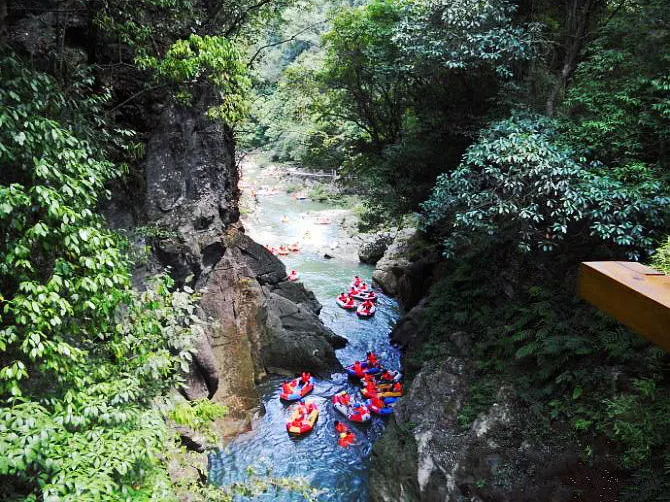
Rafting the Gaoguo River (half a day)
Rafts strung out in the gorge, everyone in orange life jackets
Thirty-eight kilometres north, about an hour by road. The gorge runs 18 km; the rafting section is 4.8 km with 200 m of drop, split into a gentle float and a fast run, taking two and a half to three hours, with a 1.4 m height minimum. Admission is ¥40, rafting ¥150 (up to ¥220 in peak season, with flat promotional prices over holidays) and the shuttle ¥15. It is the best thing to do in high summer — cold water, dense shade, no sun — and the price is that you get soaked, so bring a full change of clothes and a dry bag.
Mount Yuntai at Shibing (a full day)
Sixty kilometres west, ninety minutes by road, part of the South China Karst World Heritage site: dolomite peaks lower than Zhangjiajie's and denser than Guilin's. The main trail runs from the gate to Yindou Pavilion and Five Finger Peak, much of it on steps, four to five hours end to end. ¥80 in peak season, ¥60 off, plus ¥20 for the shuttle. A hired car from Zhenyuan is about ¥300 return, or take a scheduled bus to Shibing and a taxi from there. Cloud and mist after rain make it, but wet steps demand patience.
Xijiang Miao village (one to two days)
The best-known Miao village in Qiandongnan: over a thousand stilt houses across two hillsides, and at night the lights read like a spilled constellation. Getting there means Kaili first (1.5 hours by rail) and then an hour by bus, about three hours in total, or two and a half by hired car. ¥90 admission plus ¥20 for the shuttle. The argument about it is the same one people have about Zhenyuan, only louder: the main street is costume photography and silver shops. For an unsentimental village, go to Baojing; for sheer scale, Xijiang still wins.
Mount Fanjing (two days)
In Tongren prefecture, a World Heritage site rising to 2,570 m, its Red Cloud Golden Summit a stone pillar split down the middle. There is no direct transport from Zhenyuan: usually two and a half hours to Tongren and then the scenic shuttle, or three hours by hired car. Admission, shuttle and return cable car come to ¥298, and you must reserve on the official platform — in peak season it sells out. Weather on the mountain changes fast, and roughly three times in ten the summit is in cloud. If this trip is about Zhenyuan and Qiandongnan, save Fanjing for a calmer visit.
15A little reading before you go
Books
Wu Jingzi's The Scholars runs to fifty-six chapters, three of which are set in Zhenyuan, following a general named Tang and a Miao leader named Bie Zhuangyan, and describing local custom along the way. It is a novel, not a travelogue, but the garrison atmosphere is exact. Yu Qiuyu's travelogue of Qiandongnan is part text, part photographs, covers the whole prefecture and gives Zhenyuan a chapter — good for a train. For something harder, look for the 1986 nomination papers or the county museum's booklet on the historic city.
Television
River of Blood (2007, directed by Wang Jun, written by Hai Yan, thirty episodes) was shot in Zhenyuan and follows one family's fortunes across a decade and more. The river in it is the Wuyang and the lanes are the old lanes, and they look much as they do now — which is one of Zhenyuan's advantages: it has never been comprehensively rebuilt.
Music
A Youduo is a Miao singer from Qiandongnan, and 'Beautiful Zhenyuan' is her song for home — rice wine in the air, sweet water, a Miao girl by the river. The arrangement is gala-pop, but the voice is real. The compilation 'Heavenly Songs' collects field recordings from the prefecture — Dong polyphony, Miao flying songs — and gets closer to what people here actually sing than any staged show.